


19,99 €
Mehr erfahren.
- Herausgeber: John Wiley & Sons
- Kategorie: Fachliteratur
- Sprache: Englisch
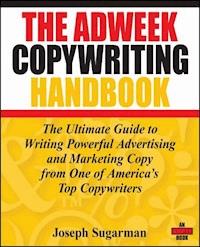
Great copy is the heart and soul of the advertising business. In this practical guide, legendary copywriter Joe Sugarman provides proven guidelines and expert advice on what it takes to write copy that will entice, motivate, and move customers to buy. For anyone who wants to break into the business, this is the ultimate companion resource for unlimited success.
Sie lesen das E-Book in den Legimi-Apps auf:
Seitenzahl: 540
Veröffentlichungsjahr: 2006
Ähnliche



















Contents
Foreword: The Sugarman Legacy
Acknowledgments
Introduction: The Origin of This Book
Section One: Understanding the Process
Preview
Chapter 1: General Knowledge
Experiences Create Ideas
Lateral Thinking for Ideas
The Dictionary as a Tool
Running Your Own Company
Chapter 2: Specific Knowledge
New Technology Required Powerful Presentation
You Must Become an Expert
You Must Know Your Customer, Too
You Must Understand a Product’s Nature
Scare Tactics Don’t Usually Work
The Product Was Not Unusual
Chapter 3: Practice, Practice, Practice
It’s All a Mental Process
Don’t Worry about the First Draft
Chapter 4: The Purpose of All the Graphic Elements of an Ad
Chapter 5: The First Sentence
Magazines Use This Technique
The Purpose of the Next Sentence
Chapter 6: Creating the Perfect Buying Environment
The Honolulu Experience
Painting Looked Incredible
You Control the Environment
Chapter 7: Resonating with the Reader
Wonderful Sales Technique
Harmony Is the Key
Chapter 8: The Slippery Slide
The Force of “Reading Gravity”
Slippery Slide Examples
Save Those Articles
Chapter 9: Assumed Constraints
Elephants Never Forget
You Never Really Know
Chapter 10: Seeds of Curiosity
A Very Unusual Call
An Invitation I Couldn’t Refuse
What Was Her Angle?
I Explained the Problems
A Shock I Never Expected
Chapter 11: Copy as Emotion
You’ve Learned Most of My Concept
Emotion in Advertising
Mercedes Advertising
Logic Often Doesn’t Work
The Emotional Approach
What Comes after the First Draft Is What Counts
Words Have Strong Emotions Attached
Chapter 12: Selling the Concept, Not the Product
Combining Products into Concepts
Soviet Intrigue
Concept Selling Does Well
Price Can Also Affect Concept
Chapter 13: The Incubation Process
Your Mind Is Always Working
Just Allow It to Happen
Left Brain versus Right Brain
Chapter 14: How Much Copy Should You Write?
Intense Interest
Long Enough but Short Enough
The Long-Copy Approach
Short Copy Works, Too
Chapter 15: The Art of Personal Communication
Emotional Process in Communication
Letters Should Be Personal
Use of a Byline
Even Magazines Have Personalities
Chapter 16: The Copy Sequence
Leading the Reader
April Becomes a Real Nuisance
Logical Progression of Flowchart
Flowing in a Logical Sequence
Prepare That Big Idea
Try Patterning Your Ad
Chapter 17: The Editing Process
The Secret to Editing
Copy Has Space Restrictions
Advantages of Fewer Words
Some Principles of Editing
Take as Long as You Need
Read the Periodicals
Computers Are a Great Help
The Use of Commas
Section Two: Understanding What Works
Preview
Chapter 18: Powerful Copy Elements Explained
A Frank Discussion of Service
Fancy Endorsement
Chapter 19: The Psychological Triggers
1. Feeling of Involvement or Ownership
2. Honesty
3. Integrity
4. Credibility
5. Value and Proof of Value
6. Justify the Purchase
7. Greed
8. Establish Authority
9. Satisfaction Conviction
10. Nature of Product
11. Prospect Nature
12. Current Fads
13. Timing
14. Linking
15. Consistency
16. Harmonize
17. Desire to Belong
18. Desire to Collect
19. Curiosity
20. Sense of Urgency
21. Fear
22. Instant Gratification
23. Exclusivity, Rarity or Uniqueness
24. Simplicity
25. Human Relationships
26. Storytelling
27. Mental Engagement
28. Guilt
29. Specificity
30. Familiarity
31. Hope
Chapter 20: Selling a Cure, Not Prevention
Human Nature at Play
Many Products Make Powerful Cures
Make a Preventive a Cure
Chapter 21: Rating Your Writing Level
Reaching a Mass Market
Chapter 22: Seven Steps to Writing Great Copy
You’ve Learned a Great Deal
Section Three: Proving the Points—Ad Examples
Preview
Chapter 23: The Lazy Man’s Way to Riches
Chapter 24: A Fluke of Nature
You Can Imagine the Excitement
Chapter 25: Lingerie for Men
Chapter 26: The More You Learn
Chapter 27: A More Stimulating Way
Chapter 28: Magic Baloney
Real Loser
Ok, Let’s Test it
Simple to Set
Realize Savings
Chapter 29: Pet Plane
Dave is a Farmer
Dave Gets the Word
Advanced Avionics
Chapter 30: Mail Order Mansion
Very Famous Guests
Very Special
Final Refusal
Chapter 31: Hungarian Conspiracy
Massive Conspiracy
Thank You
Auto Parts Dealer
You Can Help
Chapter 32: Vision Breakthrough
Couldn’t Believe Eyes
Sunglass Danger
Dramatic Difference
Chapter 33: Gold Space Chains
Suggestion Rejected
He Doesn’t Give Up
Enter Bob’s Cousin
Chapter 34: Consumers Hero
A Modern Day Robin Hood
The Uncle Henry Problem
Consumers Protected Already
Enter Consumers Hero
Now the Best Part
But There’s More
Easy to Join
Chapter 35: Nautilus Spelling Sale
Too Costly
The Rules
Designed for the Lower Back
A Note: The Power of Your Pen
Section Four: Utilizing Your Copywriting Skills
Preview
Chapter 36: Writing for Different Media
Catalogs
Flyers: Insert Stuffers, Bounce Backs, and Broadsides
Direct Mail
Newspapers
Billboards
Press Releases
Radio
Television
The Infomercial
Back-End Sales
After-Sale Opportunities
Home Shopping
The Internet
Epilogue Some Final Thoughts
Appendix A: Assumed Constraints, Continued
Appendix B: Seeds of Curiosity, Continued
Appendix C: Summary of Axioms and Major Points
Appendix D: Recommended Reading
About the Author
Index
Praise for Joseph Sugarman’s Previous Books
You have a real talent for promotion and writing advertisements.
Albert Gore, Former Vice President United States of America
There are a lot of great copywriters, but Joe Sugarman is the best. He knows how to build a story and close the sale. Anyone who wants to sell better will enjoy Advertising Secrets of the Written Word.
Richard Thalheimer, Founder The Sharper Image
I have been a fan of Joseph Sugarman’s copywriting and marketing ideas for years and have benefited greatly by imitating his long-copy ads. Now he is letting us all in on his secrets in a book that should cost $2,000 because it contains so much detailed information. Thank you, Joe. I really liked the book!
Jack Canfield, Co-Author Chicken Soup for the Soul
Every trade has its role models. And for me, there is no better model for ad copywriters or magazine editors than Joe Sugarman.
Ray Schultz, Editor DIRECT Magazine
Joseph Sugarman is brimming over with creative ideas. That isn’t so unusual; many of us are. But Joe’s ideas rocket into our marketing consciousness like shooting stars with one triumphant difference: His ideas invariably work. They motivate. They sell. So this isn’t a book for theoreticians. It’s aimed like an exquisitely polished arrow into the heart of writing to sell. New to marketing? Read this book. Been in the business for 30 years? Read this book.
Herschell Gordon Lewis, Chairman Communicomp
Copyright © 2007 by Joseph Sugarman. All rights reserved
Published by John Wiley & Sons, Inc., Hoboken, New Jersey
Published simultaneously in Canada
No part of this publication may be reproduced, stored in a retrieval system, or transmitted in any form or by any means, electronic, mechanical, photocopying, recording, scanning, or otherwise, except as permitted under Section 107 or 108 of the 1976 United States Copyright Act, without either the prior written permission of the Publisher, or authorization through payment of the appropriate per-copy fee to the Copyright Clearance Center, Inc., 222 Rosewood Drive, Danvers, MA 01923, (978) 750-8400, fax (978) 646-8600, or on the web at www.copyright.com. Requests to the Publisher for permission should be addressed to the Permissions Department, John Wiley & Sons, Inc., 111 River Street, Hoboken, NJ 07030, (201) 748-6011, fax (201) 748-6008, or online at http://www.wiley.com/go/permissions.
Limit of Liability/Disclaimer of Warranty: While the publisher and author have used their best efforts in preparing this book, they make no representations or warranties with respect to the accuracy or completeness of the contents of this book and specifically disclaim any implied warranties of merchantability or fitness for a particular purpose. No warranty may be created or extended by sales representatives or written sales materials. The advice and strategies contained herein may not be suitable for your situation. You should consult with a professional where appropriate. Neither the publisher nor author shall be liable for any loss of profit or any other commercial damages, including but not limited to special, incidental, consequential, or other damages.
For general information on our other products and services or for technical support, please contact our Customer Care Department within the United States at (800) 762-2974, outside the United States at (317) 572-3993 or fax (317) 572-4002.
Wiley also publishes its books in a variety of electronic formats. Some content that appears in print may not be available in electronic books. For more information about Wiley products, visit our web site at www.wiley.com.
ISBN-13: 978-0-470-05124-5
ISBN-10: 0-470-05124-8
To Mary Stanke, whose support through three-and-a-half decades has been instrumental to my success.
From Seminar Participants Who Learned What You Are About to Learn
I enjoyed the seminar, and I learned a lot. I am more determined than ever to start and succeed at running a mail order business.
Lee R. Herrington III, President Herrington’s Catalog
Your seminar has really opened my eyes to a realization of what makes effective mail order advertising. I am sure that attending the seminar will pay dividends many times over in the years ahead.
J. M. Robinson Atlantic Richfield Company
I told you I’d summarize the 6 or 8 major things, new to me, that I got from the seminar. Going over the notes I find it’s 36 major things I’ll be doing differently.
Gordon T. Beaham III, President Faultless Starch/Bon Ami Company
Not only did you teach me some fundamental new concepts in space advertising, but you planted some seeds that may well change our marketing program and perhaps even our way of doing business.
Frederick J. Simon, President Omaha Steaks International
I would recommend your seminars to novices to gain the degree of confidence necessary to write super ads almost instantaneously. Old-timers will also benefit because what they’ll learn is that you can help them make their ordinary ads super successful. Although I’ve been in mail order for more than 15 years I soon found, as a result of your 5-day seminar, that there was more I didn’t know than I did know.
Ed Axel Energy Group of America, Inc.
You did two things right. First, you charged $2,000. This clever device guaranteed the quality of the participants and assured you of their rapt and undivided attention. Second, you gave them their money’s worth. I did only one thing right. I came.
Joe Karbo Huntington Beach, California
The depth of knowledge and the skill with which you organized and presented it was far above what I anticipated when I signed up for the seminar. But the real payoff was what the course covered that was not in the outline. I feel that the content relating to the philosophy of achieving success in life and the numerous examples you provided to prove this philosophy will have the greatest payoff for us in the long run.
Ed Scofield Garden Way Associates
When you’re a farmer you always worry about the crop. It’s growing too slow—you worry. It’s growing too fast—you really worry. I find it to be about the same when a farmer gets into space advertising. The orders are coming in so good from our space ads, I’m beginning to worry. A high-class worry, I’ll admit.
Frank Schultz Alamo, Texas
I most enjoyed your openness in revealing, in depth, how you run your company. Few businessmen have the confidence to give away their “secrets” as you did!
C. L. Schaldenbrand Word Processing Exchange
At times the seminar combined high drama, “made for TV” movie serialization, and mail order technique in an unbeatable blend of education and excitement. It was the best class I have taken since Harvard Business School.
John E. Groman Epsilon Data Management
On my way back, on Friday night I stayed at the Sheraton Centre Hotel in New York. My two bags with my clothes were stolen in the lobby of the hotel. I don’t care about the clothes, but I can’t tell you how much I regret the loss of the seminar material, which is of inestimable value for me, and which was also in the bags.
Herman Van Hove Brussels, Belgium
It has given me a fresh perspective and the insight I had sought when I first decided to attend your seminar. I now have a much clearer picture of why our successful promotions succeeded and our failures failed.
Richard J. Guilfoyle Limited Editions Collectors Society
Adweek and Brandweek Books are designed to present interesting, insightful books for the general business reader and for professionals in the worlds of media, marketing, and advertising.
These are innovative, creative books that address the challenges and opportunities of these industries, written by leaders in the business. Some of our writers head their own companies, while others have worked their way up to the top of their field in large multinationals. But they all share a knowledge of their craft and a desire to enlighten others.
We hope readers will find these books as helpful and inspiring as Adweek, Brandweek, and Mediaweek magazines.
Published
Disruption: Overturning Conventions and Shaking Up the Marketplace, by Jean-Marie Dru
Under the Radar: Talking to Today’s Cynical Consumer, by Jonathan Bond and Richard Kirshenbaum
Truth, Lies and Advertising: The Art of Account Planning, by Jon Steel
Hey, Whipple, Squeeze This: A Guide to Creating Great Ads, by Luke Sullivan
Eating the Big Fish: How Challenger Brands Can Compete against Brand Leaders, by Adam Morgan
Warp-Speed Branding: The Impact of Technology on Marketing, by Agnieszka Winkler
Creative Company: How St. Luke’s Became “the Ad Agency to End All Ad Agencies,” by Andy Law
Another One Bites the Grass: Making Sense of International Advertising, by Simon Anholt
Attention! How to Interrupt, Yell, Whisper and Touch Consumers, by Ken Sacharin
The Peaceable Kingdom: Building a Company without Factionalism, Fiefdoms, Fear, and Other Staples of Modern Business, by Stan Richards and David Culp
Getting the Bugs Out: The Rise, Fall, and Comeback of Volkswagen in America, by David Kiley
The Do-It-Yourself Lobotomy: Open Your Mind to Greater Creative Thinking, by Tom Monahan
Beyond Disruption: Changing the Rules in the Marketplace, by Jean-Marie Dru
And Now a Few Laughs from Our Sponsor: The Best of Fifty Years of Radio Commercials, by Larry Oakner
Sixty Trends in Sixty Minutes, by Sam Hill
Leap: A Revolution in Creative Business Strategy, by Bob Schmetterer
Buzz: Harness the Power of Influence and Create Demand, by Marian Salzman, Ira Matathia, and Ann O’Reilly
Casting for Big Ideas: A New Manifesto for Agency Managers, by Andrew Jaffe
Life after the 30-Second Spot: Energize Your Brand with a Bold Mix of Alternatives to Traditional Advertising, by Joseph Jaffe
Pick Me: Breaking into Advertising and Staying There, by Nancy Vonk and Janet Kestin
Foreword
The Sugarman Legacy
By Ray Schultz, Editor, DIRECT Magazine
Every trade has its role models. And for me, there is no better model for ad copywriters or magazine editors than Joe Sugarman.
Bandleader Artie Shaw had a standard question for musicians who wanted to join his band: “Who do you listen to?”
A similar question might be asked of writers applying for work: “Who do you read?”
Sugarman is the guy who sells BluBlocker sunglasses on TV. He also happens to be one of the most amusing and prolific writers in the United States, as I discovered when I started reading his JS&A catalog in 1985.
He was totally out of the box. He cracked me up with the sheer exuberance of his copy approach.
He offered readers $10 for every spelling error they found in his copy. (“Please don’t correct my grammar.”)
He offered “loaner” watches to customers as part of a service guarantee.
He offered a $6 million home for sale in the airline magazines, accepting American Express, Visa, MasterCard or any negotiable hard currency.
He sold a $240,000 airplane in a single mail order ad.
And he did it all with a very special tone. It’s like Nelson Algren said about John Cheever—that he was the one writer you could identify “without turning the pages of The New Yorker back to see who wrote it.”
Not that Sugarman is the most colorful rogue ever to write great mail order copy. There were others. Louis Victor Eytinge, a convicted murderer who learned how to write in prison. Or Gene Schwartz, the art collector, who made his living writing stuff like “She Fled the Table When the Doctor Said Cut Her Open.”
But Joe surpassed those guys in a few very important ways—the sheer volume of his writing, the trends that he set and my favorite, the personal catalog, one in which the copy and the product reflect the quirks of the owner. And Joe has a lot of imitators who have personalized their catalogs using Joe’s catalog as their inspiration.
How did Joe learn his trade? He claims he learned it from his failures and not from the mail order greats who preceded him. Greats like David Margoles, who sold 4 million garlic crushers in the 1950s.
Then there was Max Sackheim, co-founder of the Book-of-the-Month Club and another great pitchman who lived by his wits. As Lester Wunderman in 1996 reflected about Sackheim, “When he talked to clients, he promised a breakthrough—not as we have now, minuscule improvement.”
Then there was John Caples, who entered American folklore by writing “They Laughed When I Sat Down at the Piano.” The late Larry Chait asked Caples why he stressed the social benefits instead of just selling the virtues of the course.
“You don’t understand,” Caples answered. “Learning the piano is tough. You can’t sell that. But you can sell the idea of social success and overcoming whatever deficiencies you have in order to become popular.”
Though he may never have met them, Sugarman knows on a gut level what these guys knew. And that’s important, because he’s one of the last of a breed.
Now for the good news. He’s passed the tradition down in this handbook, the best book ever done on the subject of mail order writing.
Besides the advice on selling, it stresses basic truths about writing, in language anyone can understand. I’ve even given the manuscript to my new reporters to read.
I’m sad to report that Sugarman doesn’t write as much copy as he used to—no more catalogs and very few space ads. He’s followed the money into infomercials and home shopping.
Until they reissue old JS&A catalogs (the way they’ve reissued the 1909 edition of Sears, Roebuck), this book will have to stand as Joe’s legacy in print. But it’s a fine legacy.
So here it is. Enjoy. As Walter Winchell said when he introduced Damon Runyon, “The next act is better.”
Ray Schultz is one of the top writers and editors in the direct marketing industry and editor of DIRECT magazine, a Cowles Business Media publication.
Acknowledgments
Many people have contributed to my copywriting skills and to the creation of this book, and to all of them I am very grateful. Mary Stanke, president of JS&A Group, Inc., whose direction, commitment and 35 years of service allowed me the creative freedom to express myself through my writing and who helped me build a substantial business in the process. My ex-wife, Wendy, and our two children, April and Jill, for their understanding and support during the many seminars we held—always behind the scenes, but their presence was very important and always felt. Judy Sugarman, my sister and copyeditor for 25 years—always there to correct my spelling, undangle my modifiers and give me very candid feedback.
I also wish to acknowledge the thousands of customers who gave me a tremendous education and for whom I have an unwavering respect. I wish to acknowledge my many competitors, too. I hated it when they copied me, but in the process of trying to outwit them my copywriting skills grew even stronger. There are hundreds of other people I could mention—too numerous to list here—who have played a vital role in my success and growth.
A special acknowledgment to all my wonderful seminar participants who learned from me and went on to create or build successful businesses—all through the power of their pens. I learned a great deal from them. Finally, I wish to thank, with humility and gratitude, all who have exchanged their hard-earned money for this book. May you, too, learn and prosper.
Introduction
The Origins of This Book
The truly creative mind in any field is no more than . . . a cruelly delicate organism with the overpowering necessity to create, create, create—so that without the creating of music or poetry or books or buildings or something of meaning, his very breath is cut off from him. He must create, must pour out creation. By some strange, unknown, inward urgency he is not really alive unless he is creating.
—Pearl Buck
This is a story about a seminar. It was a copywriting and marketing seminar I presented starting in the 1970s during a time when I was actively involved in both writing copy and marketing a range of products that included everything from electronics to collectibles—from Bone Fones to Picasso tiles.
I was a prolific writer, often writing complete catalogs, print advertisements and direct mailings. And I owned the company, JS&A Group, Inc., that sold these products, so I experienced the direct consequences of my successes and failures.
Failures Outnumbered Successes
My failures far outnumbered my successes. In fact, I have yet to find anybody who has experienced the number of failures I experienced during the early stages of my career. But it was through these failures that I received a very costly education that to this day has guided me through a successful career in advertising and direct marketing.
Lesen Sie weiter in der vollständigen Ausgabe!
Lesen Sie weiter in der vollständigen Ausgabe!
Lesen Sie weiter in der vollständigen Ausgabe!
Lesen Sie weiter in der vollständigen Ausgabe!
Lesen Sie weiter in der vollständigen Ausgabe!
Lesen Sie weiter in der vollständigen Ausgabe!
Lesen Sie weiter in der vollständigen Ausgabe!
Lesen Sie weiter in der vollständigen Ausgabe!
Lesen Sie weiter in der vollständigen Ausgabe!
Lesen Sie weiter in der vollständigen Ausgabe!
Lesen Sie weiter in der vollständigen Ausgabe!
Lesen Sie weiter in der vollständigen Ausgabe!
Lesen Sie weiter in der vollständigen Ausgabe!
Lesen Sie weiter in der vollständigen Ausgabe!
Lesen Sie weiter in der vollständigen Ausgabe!
Lesen Sie weiter in der vollständigen Ausgabe!
Lesen Sie weiter in der vollständigen Ausgabe!
Lesen Sie weiter in der vollständigen Ausgabe!
Lesen Sie weiter in der vollständigen Ausgabe!
Lesen Sie weiter in der vollständigen Ausgabe!
Lesen Sie weiter in der vollständigen Ausgabe!
Lesen Sie weiter in der vollständigen Ausgabe!
Lesen Sie weiter in der vollständigen Ausgabe!
Lesen Sie weiter in der vollständigen Ausgabe!
Lesen Sie weiter in der vollständigen Ausgabe!
Lesen Sie weiter in der vollständigen Ausgabe!
Lesen Sie weiter in der vollständigen Ausgabe!
Lesen Sie weiter in der vollständigen Ausgabe!
Lesen Sie weiter in der vollständigen Ausgabe!
Lesen Sie weiter in der vollständigen Ausgabe!
Lesen Sie weiter in der vollständigen Ausgabe!
Lesen Sie weiter in der vollständigen Ausgabe!
Lesen Sie weiter in der vollständigen Ausgabe!
Lesen Sie weiter in der vollständigen Ausgabe!
Lesen Sie weiter in der vollständigen Ausgabe!
Lesen Sie weiter in der vollständigen Ausgabe!
Lesen Sie weiter in der vollständigen Ausgabe!
Lesen Sie weiter in der vollständigen Ausgabe!
Lesen Sie weiter in der vollständigen Ausgabe!
Lesen Sie weiter in der vollständigen Ausgabe!
Lesen Sie weiter in der vollständigen Ausgabe!
Lesen Sie weiter in der vollständigen Ausgabe!
Lesen Sie weiter in der vollständigen Ausgabe!
Lesen Sie weiter in der vollständigen Ausgabe!
Lesen Sie weiter in der vollständigen Ausgabe!
Lesen Sie weiter in der vollständigen Ausgabe!
Lesen Sie weiter in der vollständigen Ausgabe!
Lesen Sie weiter in der vollständigen Ausgabe!
Lesen Sie weiter in der vollständigen Ausgabe!
Lesen Sie weiter in der vollständigen Ausgabe!
Lesen Sie weiter in der vollständigen Ausgabe!
Lesen Sie weiter in der vollständigen Ausgabe!




