



2,99 €
Mehr erfahren.
- Herausgeber: Ana Ramos
- Kategorie: Lebensstil
- Sprache: Englisch
Over 1,200 curiosities that will make you roar, laugh, and say: "Seriously?!"
Did you know that sharks have been around since before the dinosaurs?
Or that male seahorses are the ones that get pregnant and give birth?
And what if I told you that octopuses have 3 hearts and 9 brains?
Or that snakes smell... with their tongues!
Get ready for a wildly fascinating adventure through the animal kingdom. This book is a celebration of the weird, the incredible, and the absolutely amazing wonders of nature.
- Perfect for curious minds of all ages.
- Great for sharing with the family or breaking the ice in any conversation.
- A read that will make you laugh, think, and say WOW again and again!
Some of these creatures seem like they’re from another planet… and yet, they’re right here, sharing the world with us.
Whether you read it cover to cover or flip to a random page, this book is designed to entertain, amaze, and keep you coming back for more.
So open this book and let your curiosity soar.
Welcome to The Amazing Animal World!
Das E-Book können Sie in Legimi-Apps oder einer beliebigen App lesen, die das folgende Format unterstützen:
Veröffentlichungsjahr: 2025
Ähnliche

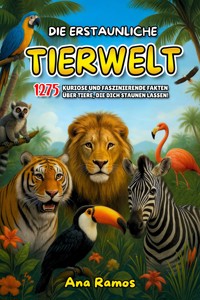




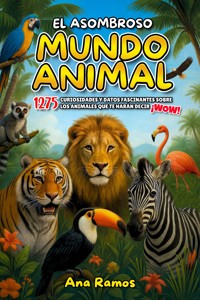











The Amazing Animal World
1275 Curiosities and Fascinating Facts About Animals That Will Make You Say WOW!
Ana Ramos
© 2025 Ana Ramos
All rights reserved.
This book may not be reproduced, stored or transmitted, in whole or in part, in any form or by any means, electronic, mechanical, photocopying, recording or otherwise, without the prior written permission of the copyright holder, except as provided by copyright law.
Index
Introduction
Mammals
Lion
Elephant
Koala
Dolphin
Otter
Wolf
Tiger
Horse
Bear
Kangaroo
Giraffe
Dog
Cat
Zebra
Hippopotamus
Monkey
Sloth
Armadillo
Hedgehog
Cow
Bat
Camel
Lemur
Deer
Whale
Raccoon
Rhinoceros
Beaver
Leopard
Seal
Fox
Porcupine
Birds
Eagle
Toucan
Peacock
Owl
Penguin
Hummingbird
Parrot
Flamingo
Duck
Swan
Chicken
Seagull
Invertebrates
Octopus
Jellyfish
Butterfly
Bee
Spider
Ant
Fly
Snail
Fish
Shark
Clownfish
Piranha
Seahorse
Swordfish
Pufferfish
Reptiles
Crocodile
Snake
Turtle
Chameleon
Komodo Dragon
Amphibians
Frog
Salamander
Axolotl
Conclusion
INTRODUCTION
Did you know that sharks have existed since before the dinosaurs?
Or that a blue whale's tongue is bigger than an elephant, and its heart is larger than a car?
Or that koalas’ fingerprints are so similar to humans' that they could be mistaken at a crime scene?
And what if I told you that octopuses have three hearts and nine brains?
Or that snakes smell… with their tongues?!
The animal kingdom is full of wonders as strange as they are fascinating. Creatures that defy logic, behaviors that seem straight out of a science fiction movie, and adaptations that make us wonder how such things can exist.
If you love interesting facts like these, you're in luck—because this book contains over 1,200 of them!
Every page is a new surprise, with curiosities that will make you say, “Seriously?!”, more than once.
Some facts will make you laugh, others will amaze you, but all of them will make you appreciate the incredible diversity of our planet even more.
So, what are you waiting for?
Let’s dive straight into the amazing animal world!
MAMMALS
LION
They’re the only cats that live in groups, called prides. Unlike other solitary big cats, lions are very social and look out for one another.
A lion’s roar is truly impressive! It can be heard up to 8 kilometers away—about the length of 80 football fields! They use it to mark territory and call their pride.
A lion’s tail is more useful than it seems. It helps with balance and is also used for communication. During a hunt, it signals directions to coordinate the attack.
Lionesses are the pride’s top hunters! They work together as a team to catch prey.
Although they are skilled hunters, they sometimes prefer to steal food rather than hunt. They might take advantage of prey caught by other animals.
They spend a large part of the day sleeping or resting—up to 20 hours a day! That’s why they’re considered the “laziest” of the big cats.
Males have a big mane that gets darker and fuller as they age. But it’s not just for looks—it protects their neck during fights.
A lioness can have between 1 and 6 cubs. The cubs play together and learn to hunt by watching the adults.
A pride’s territory can be enormous—sometimes over 250 km², which is more than 35,000 football fields! Adult males are in charge of guarding and defending it from intruders.
They have big appetites! They need to eat meat almost every day, and a male can devour over 7 kilos in just one day.
In the wild, they usually live up to 14 years, but in zoos or protected parks, with special care, they can live over 20 years.
They’re lightning fast! They can run up to 80 km/h—but only for short distances, since they tire quickly.
They can leap up to 10 meters in a single jump—almost the length of a bus!
There are lions with almost white fur! They're called “white lions” and are very rare. Most live in protected areas in South Africa.
A lion’s tongue is like sandpaper! It’s covered in tiny spines called “papillae” that help them scrape meat off bones and groom their mane.
They’re very protective of their family. If a stranger or predator threatens the pride, both males and females unite to defend it. Strength in numbers!
They are carnivores, which means they eat only meat. Their favorite prey includes zebras, buffaloes, and antelopes.
They can go days without drinking water because they get most of the liquid they need from the meat they eat.
They have incredible night vision, which gives them an advantage when hunting in the dark.
ELEPHANT
Elephants are the largest land animals in the world. Some can weigh more than 6 tons (as much as a truck!) and stand up to 3 meters tall.
They live in various parts of Africa and Asia and can adapt to many habitats, from jungles and savannas to forests and deserts.
Baby elephants can walk on their own just 20 minutes after being born.
An elephant’s trunk is an amazing tool! It’s a combination of nose and upper lip, used for drinking, grabbing food, and smelling their surroundings.
They can store several liters of water in it to drink later or spray on themselves to cool down.
Their tusks are actually incisor teeth that grow throughout their lives. They help dig for water, strip tree bark, and defend against threats.
Their skin can be several centimeters thick, but it’s still very sensitive. That’s why they roll in mud or dust themselves to protect from the sun and insects.
Despite their size, they’re very agile in water and love to swim. They use their trunks like snorkels to breathe underwater.
They mainly eat plants: leaves, grass, tree bark, and fruit. They’re herbivores and spend most of the day eating.
They need to eat hundreds of kilos of food a day and can spend up to 16 hours feeding to get enough energy.
Females usually live in herds with their relatives, led by the most experienced female, called the matriarch.
Males, on the other hand, tend to be solitary or form small groups of males.
They have incredible memory. They can remember places with food and water for years. They never forget their family and recognize loved ones even after long separations.
They have their own secret language! They use infrasound—sounds too low for humans to hear—and also sense ground vibrations to communicate over long distances.
Their large ears help regulate body temperature. They flap them to cool down.
Babies nurse for the first two years but may continue if the mother allows, even up to four years.
They have very large, complex brains. Thanks to this, they show advanced social skills, empathy, and even problem-solving abilities.
They can recognize themselves in a mirror—a rare trait in the animal kingdom and a sign of high intelligence.
Sometimes, if an elephant is sick or dies, companions stay beside them, showing grief and touching them with their trunks.
Despite their strength, their legs prevent them from jumping. They’re among the few land mammals that can’t lift all four feet off the ground at once.
They can live between 60 and 70 years in the wild, making them one of the longest-living mammals.
KOALA
Although they're called “koalas,” people often say “koala bears,” but they’re not actually bears! They’re marsupials, like kangaroos.
When they’re born, baby koalas are about the size of a kidney bean (2 cm) and have no hair or open eyes.
Like kangaroos, mother koalas have a special pouch on their bellies for their babies.
The pouch opens downward so the baby can come and go easily.
Babies spend their first 6 months inside the pouch, drinking milk and growing warm and protected.
After leaving the pouch, they ride on their mother’s back or belly until they’re about one year old.
They’re big sleepers! They can sleep between 18 and 22 hours a day to save energy.
They live in Australia, especially in forested areas where eucalyptus trees grow.
They eat almost exclusively eucalyptus leaves. There are over 600 types of eucalyptus, but they only eat a few select ones. They’re picky eaters!
Those leaves are toxic to most animals, but koalas have a special stomach that neutralizes the toxins.
They rarely drink water, getting almost all their moisture from eucalyptus leaves. “Koala” means “the one who doesn’t drink” in an ancient language.
Watch out, detectives! Their fingerprints are so similar to humans’ that they could be mistaken at a crime scene.
They have two thumbs on each hand, which help them grip branches tightly and climb.
To sleep comfortably in trees, they have curved spines and a spongy “cushion” on their bottoms.
An adult koala can be 60 to 85 centimeters long and weigh up to 15 kilograms.
Their ear and head fur is very soft, giving them that cuddly appearance.
If it gets too hot, koalas sometimes hug tree trunks, which are cooler to the touch.
Their low-energy diet (mostly eucalyptus) explains why they sleep so much and move slowly.
They spend most of their lives in treetops and only come down to change trees or, rarely, drink water.
In the wild, they live around 10–15 years, but in good conditions and with protection, they can live up to 20 years.
DOLPHIN
Dolphins are mammals that live in water, just like whales—but they’re not fish!
Even though they spend their whole lives swimming, they have to come up to the surface to breathe air through a hole on their heads called a blowhole.
They are so intelligent that they can learn tricks, understand signals, and play by mimicking sounds.
They live in groups called pods, where they take care of each other and offer help and protection.
Dolphins communicate through sounds and whistles—each one even has a special whistle, like a unique “name”!
They’re very social and often swim close together, leap, and even do flips out of the water just for fun.
They eat fish, squid, and other sea creatures. They don’t chew their food—they swallow it whole.
Their bodies are long and smooth, perfect for gliding swiftly through the water, reaching speeds over 30 kilometers per hour.
They sleep with one half of their brain awake so they can come up for air and stay alert to predators.
Thanks to echolocation, they send out sounds that bounce off objects or prey, helping them “see” with their ears—even in the dark or murky waters.
They live in many parts of the world—in tropical, temperate, and even some colder seas.
Their skin is very smooth and occasionally sheds to stay free of parasites.
Dolphins form strong bonds within their pod and are known to help injured or sick dolphins—they’re super caring!
Their jumps out of the water can help them communicate, look around, or even shake off parasites.
They’re very curious and sometimes swim near boats or people.
Depending on the species and environmental conditions, they can live between 20 and 40 years.
They don’t drink the salty water they swim in; they get most of the water they need from the food they eat.
Their dorsal fin, the one on their back, helps them keep their balance while swimming.
Dolphins are loved by many people, and more and more people are working to protect them and keep the oceans clean.




