


2,99 €
Mehr erfahren.
- Herausgeber: Ana Ramos
- Kategorie: Fachliteratur
- Sprache: Englisch
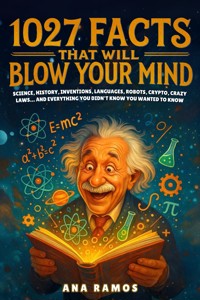
Ready to be blown away?
Welcome to a book full of fun facts, incredible anecdotes, and things so strange they'll make you wonder if they're real (spoiler: they are!).
Here you won’t find boring theory or exams, just a collection of fascinating facts that will make you laugh, marvel, and want to share them with everyone.
Did you know that the human body glows in the dark, even if we can’t see it?
Or that octopuses have 3 hearts and 9 brains?
Or that in some cities it’s actually illegal to die?
And that there are countries where you can be fined for carrying chickens in your pockets?
Yes, you read that right: chickens in your pockets.
This book is like a magic box: no matter where you open it, there’s always a surprise waiting for you.
You can read it in order or at random, alone or with friends, out loud or silently... what matters is enjoying it!
Perfect for curious minds of all ages, this book is your new excuse to say “Did you know that...?” in any conversation.
Because the world is super weird... and we’re here to tell you all about it.
Das E-Book können Sie in Legimi-Apps oder einer beliebigen App lesen, die das folgende Format unterstützen:
Veröffentlichungsjahr: 2025
Ähnliche

















1027 Facts That Will Blow Your Mind
Science, History, Inventions, Languages, Robots, Crypto, Crazy Laws… And Everything You Didn't Know You Wanted to Know
Ana Ramos
© 2025 Ana Ramos
All rights reserved.
This book may not be reproduced, stored, or transmitted, in whole or in part, in any form or by any means—electronic, mechanical, photocopying, recording, or otherwise—without the prior written permission of the copyright holder, except as permitted by intellectual property law.
INDEX
Introduction
The Human Body
History
Countries and Cities
Earth and the Universe
More Science
Sports
Animals
Food and Drink
Crazy Laws
Behind Artificial Intelligence (AI)
Unusual Inventions
Languages
Professions
The Age of Cryptos
Trash is a Serious Matter
Strange Records
Conclusion
INTRODUCTION
Before you start devouring the pages of this book, let me welcome you.
You're about to dive into a journey full of fun facts, surprising anecdotes, and things so weird they'll make you say, “Wait, is that actually true!?”
This isn’t a schoolbook. There’s no studying, no memorizing, no tests. All you need is a dash of curiosity and a big appetite for discovering the strange, the funny, the unexpected… and the things no one usually tells you.
Did you know the human body glows in the dark (even if we can’t see it)?
Or that there are cities where dying is illegal?
Or that octopuses have three hearts?
Or that there are laws against walking around with chickens in your pockets?
All that — and so much more — is waiting for you.
It doesn’t matter if you like to flip through pages at random or read from start to finish. This book is like a box of surprises: wherever you open it, something curious awaits.
So get ready to laugh, be amazed, raise an eyebrow, or say “I have to tell someone about this!”
Because in this world, very strange things happen… and we’re here to tell you all about them.
Enjoy!
THE HUMAN BODY
We produce about one liter of saliva a day — enough to fill over 100 Olympic swimming pools in a lifetime!
We generate enough gas daily to fill a balloon. Your body produces between 0.5 and 2 liters of gas every 24 hours!
We're born with 300 bones, but as adults, we have 206. Many of them fuse as we grow.
Your pinky finger provides 50% of your hand’s strength. Small but mighty!
The ovum is the largest cell in the human body — in fact, it’s visible to the naked eye!
Your eardrums move when you move your eyes.
14% of people don’t have a forearm muscle called the palmaris longus.
Your eyes get oxygen directly from the air. That’s why contact lenses must be gas-permeable.
The smallest bone in the body is the stapes, in the middle ear. It’s only 2.5 mm long but essential for hearing.
If you stretched out all your blood vessels in a line, they’d span about 100,000 km — enough to circle the Earth 4 times!
Women blink almost twice as often as men, but the reason is still a mystery — hormones, eye lubrication, or a biological enigma?
The heart can keep beating outside the body if it has oxygen. It's a tireless muscle with its own electrical system.
You can’t taste without saliva — it dissolves food and activates your taste buds. Without it, your tongue barely detects anything!
Fingernails grow twice as fast as toenails — which is why you need manicures more often than pedicures!
Tooth enamel is as hard as a shark’s.
The human body has about 7 octillion atoms — that's a 1 followed by 48 zeros. Nearly unimaginable!
Teeth are the only part of the body that doesn’t regenerate — so take good care of them!
Kidneys filter about 190 liters of blood daily and produce up to 2 liters of urine. They’re your body’s ultimate purifiers.
The masseter is the strongest muscle relative to its size — it helps you chew your favorite food.
At rest, a woman’s heart beats faster than a man’s.
Onions make us cry due to a chemical called propanethial oxide — a clever defense mechanism against predators.
Sperm cells are the smallest cells in the human body.
The left lung is smaller to make room for the heart.
Stomach acid is so strong it can dissolve metal. But don’t worry — your stomach lining protects you.
Women have up to 50% more olfactory receptors.
Besides the 5 senses, we have proprioception, equilibrioception, and nociception — sensing position, balance, and pain.
The largest muscle is the gluteus maximus — thanks to it, you can stand and walk upright.
People who exercise regularly sweat more and faster — the body becomes more efficient at cooling down.
Over your lifetime, you walk the equivalent of 5 times around the Earth.
The bumps on your tongue are lingual papillae, not taste buds. Real taste buds are microscopic and sit on top of them.
Some people don’t feel physical pain due to a condition called CIP — which can be dangerous because injuries go unnoticed.
Your balance depends on three tiny canals in your inner ear, acting like natural gyroscopes — they help you spin without losing your sense… well, most of the time!
Your brain has about 100 billion neurons — more than the number of stars in the Milky Way!
Your tongue has a unique print, just like fingerprints — no one else has a tongue like yours!
The liver performs over 500 vital functions, like filtering toxins, storing energy, and aiding digestion. It’s your body’s laboratory!
Your lungs have a surface area about the size of a tennis court — perfect for efficient oxygen exchange.
Feeling thirsty is already a sign of dehydration — by the time your body signals it, you're in emergency mode.
You shed between 30,000 and 40,000 skin cells every minute — constant renewal in action!
Your eyes have 3 types of cones that detect red, green, and blue — combined, we perceive millions of colors.
Your skeleton renews itself completely every 10 years.
Your heart pumps about 7,570 liters of blood per day — enough to fill a small pool every week!
We breathe about 20,000 times a day, taking in around 11,000 liters of air.
The skull consists of 22 bones that protect your most important organ — the brain.
The phosphorus in your body could make around 2,200 matches.
The liver can regenerate even after losing 70% of its mass — it's the only organ with this ability.
Your pancreas produces up to 2 liters of digestive juices daily — silently breaking down food and absorbing nutrients.
Our brains are more active at night than during the day — maybe that’s why we dream so much!
We blink around 21,600 times a day — keeping our eyes hydrated and clean.
Nerve impulses travel at about 402 km/h — faster than a Formula 1 car!
There are no muscles in your fingers — they move thanks to muscles in the hand and forearm pulling tendons.
Your belly button can host 67 types of bacteria.
Incompetent people often overestimate their abilities. That’s the Dunning-Kruger effect — less knowledge sometimes means more (wrong) confidence.
Rejection activates the same brain areas as physical pain — that’s why it hurts emotionally.
Dopamine drives us to seek new information constantly — it fuels our curiosity and love of learning.
Your skin fully renews every 27 days.
Tears shed from sadness contain a hormone that acts as a natural painkiller — helping you feel better.
The brain is about 73% water — stay hydrated for it to work properly!
Skin is the body’s largest organ — it protects and regulates your temperature.
If you unraveled all the DNA in your cells, it would stretch over 100 billion kilometers — enough to go to Pluto and back… multiple times.
Your eye muscles are the most active in your body — constantly moving to focus and see.
Veins appear blue due to how light is scattered by the skin — but blood is always red.
The human finger is incredibly sensitive — it can detect ridges as small as 50 nanometers, a thousand times thinner than a hair!
Your brain has more neural connections than there are stars in the Milky Way.
The brain has no pain receptors — that’s why brain surgeries can be done while you're awake.
Some people have extra skull bones called wormian bones — small fragments not everyone has.
The human eye can distinguish about 10 million colors.
Your feet contain 25% of your body’s bones — 52 out of 206. Balance is trickier than it seems!
Your stomach lining regenerates every 3 to 4 days to withstand strong digestive acids.
The small intestine is about 6 meters long — it's the main site for nutrient absorption.
The tongue is the strongest and most flexible muscle — it helps us speak, taste, and swallow.
Babies have more taste buds than adults — which makes them more sensitive to new flavors.
The body releases endorphins — natural painkillers that also bring pleasure and well-being. That’s why exercise feels so good!
Your stomach is acidic enough to dissolve a razor blade.
The brain generates enough electricity to power a small light bulb — about 20 watts.
Nails help us handle small objects and protect our fingertips — more than just decoration!
Even after death, the body can release gases and produce flatulence.
Your body hosts 10 times more bacterial cells than human cells.
Bones are five times stronger than steel, yet incredibly light — true masterpieces of biology!
The liver is the second largest organ after the skin.
The body emits bioluminescent light — but it’s invisible to the human eye. We glow without noticing!
The brain’s storage capacity is virtually limitless — so keep learning!
Humans are the only species that regularly sleeps on their backs.
The heart is so powerful it can squirt blood up to 9 meters — a tireless engine in your chest!
Brain neurons can store more data than any computer.
There's a rare condition called boanthropy, where a person believes they are a cow — acting, eating, and behaving as if they were one.
We have about 2.5 million sweat glands, working nonstop to cool us down.
The brain can survive up to 6 minutes without oxygen.
We sleep about one-third of our lives — during which our body recharges and stores memories.




