


31,19 €
Mehr erfahren.
- Herausgeber: Packt Publishing
- Kategorie: Fachliteratur
- Sprache: Englisch
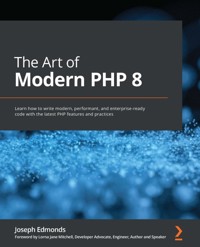
PHP has come a long way since its introduction. While the language has evolved with PHP 8, there are still a lot of websites running on a version of PHP that is no longer supported. If you are a PHP developer working with legacy PHP systems and want to discover the tenants of modern PHP, this is the book for you.
The Art of Modern PHP 8 walks you through the latest PHP features and language concepts. The book helps you upgrade your knowledge of PHP programming and practices. Starting with object-oriented programming (OOP) in PHP and related language features, you'll work through modern programming techniques such as inheritance, understand how it contrasts with composition, and finally look at more advanced language features. You'll learn about the MVC pattern by developing your own MVC system and advance to understanding what a DI container does by building a toy DI container. The book gives you an overview of Composer and how to use it to create reusable PHP packages. You’ll also find techniques for deploying these packages to package libraries for other developers to explore.
By the end of this PHP book, you'll have equipped yourself with modern server-side programming techniques using the latest versions of PHP.
Das E-Book können Sie in Legimi-Apps oder einer beliebigen App lesen, die das folgende Format unterstützen:
Seitenzahl: 384
Veröffentlichungsjahr: 2021
Ähnliche



















The Art of Modern PHP 8
Learn how to write modern, performant, and enterprise-ready code with the latest PHP features and practices
Joseph Edmonds
BIRMINGHAM—MUMBAI
The Art of Modern PHP 8
Copyright © 2021 Packt Publishing
All rights reserved. No part of this book may be reproduced, stored in a retrieval system, or transmitted in any form or by any means, without the prior written permission of the publisher, except in the case of brief quotations embedded in critical articles or reviews.
Every effort has been made in the preparation of this book to ensure the accuracy of the information presented. However, the information contained in this book is sold without warranty, either express or implied. Neither the author, nor Packt Publishing or its dealers and distributors, will be held liable for any damages caused or alleged to have been caused directly or indirectly by this book.
Packt Publishing has endeavored to provide trademark information about all of the companies and products mentioned in this book by the appropriate use of capitals. However, Packt Publishing cannot guarantee the accuracy of this information.
Associate Group Product Manager: Pavan Ramchandani
Publishing Product Manager: Pavan Ramchandani
Senior Editor: Sofi Rogers
Content Development Editor: Feza Shaikh
Technical Editor: Saurabh Kadave
Copy Editor: Safis Editing
Project Coordinator: Manthan Patel
Proofreader: Safis Editing
Indexer: Subalakshmi Govindhan
Production Designer: Sinhayna Bais
First published: September 2021
Production reference: 1240921
Published by Packt Publishing Ltd.
Livery Place
35 Livery Street
Birmingham
B3 2PB, UK.
978-1-80056-615-6
www.packt.com
To my family, who have always supported me.
– Joseph Edmonds
Foreword
I've known Joseph as a member of the local-to-me PHP community here in Yorkshire, England, for what feels like a very long time. Over the years I taught PHP to him and then to the staff he worked hard to train up – and so I was delighted to hear about this book and to be invited to write a few words to introduce it. I know your author as a thoughtful and technical contributor and someone who works to raise his own game and also to share his skills and knowledge with others.
Taking care to learn and keep learning is such an important thing for anyone working in a technical career, or even as a hobby. The only constant is ... that nothing is constant! We always need to be learning, exploring, and developing ourselves. Perhaps you will consume this book quickly, wolfing down the information as fast as you can. Or maybe your style is more to dip in, to make space for a little more knowledge when you are ready to learn and apply something new. Some of you probably won't read the whole book, looking to graze on the parts that interest you or where you are keen to update your knowledge. All of you are investing in yourself, your future, and taking the care to learn.
In this Internet Age, the wealth of information available is incredible. And sometimes? It's too much to swim through it all and somehow fish out just the nugget we need. Reading a well-structured book means taking a prescribed route through complex information and receiving a curated collection of applicable wisdom. If there's something you want to know more about, then you can dive into the uncharted waters of other resources – and you already have a good idea of what you are looking for and how it fits the bigger picture.
Thinking about keeping up to date is one of the big preoccupations of our technical lives. With PHP, there's a disconnect where the language is perceived by others as being old-fashioned, and yet in recent years, it has changed beyond recognition and continues to grow and evolve. I have yet to see data indicating a meaningful decline in PHP's popularity, and rarely hear negativity from anyone with real recent experience of modern versions of PHP. Joseph has been working with PHP throughout these changes and covers the topics you need to understand to make the best use of PHP 8 and beyond.
As a fellow author, who once passed on her knowledge to other PHP people, I am so proud to be part of this thriving tech community still sharing the knowledge and paying it forward. I hope this book will boost your PHP activities, bringing solid theory to things you already know, as well as shining a light onto things you may not have encountered yet. And one day? Who knows, maybe it will be you that writes the next blog post, article, or even book to help inform and inspire the next generation.
Lorna Mitchell
Developer Advocate, Engineer, Author and Speaker
Contributors
About the author
Joseph Edmonds is a business owner, developer, and author. He is a Zend Certified Engineer, among his other credentials.
He's been a part of the e-commerce, tech, and PHP development worlds since the dawn of the millennium. He witnessed the exploding growth of e-commerce from the early days, helping several companies advance and expand their operations. During this time, he has had the pleasure of seeing PHP grow from a fairly amateur language, punching way above its weight, into a modern and highly performant language for serious enterprise projects.
Responding to a growing demand for highly specialized PHP development services, he launched Edmonds Commerce (https://edmondscommerce.co.uk) in 2007. As an independent agency, Edmonds Commerce provides highly specialist PHP development services to businesses that use open source PHP, and predominantly Magento, as the backbone of their online systems, solving even the most complex and unique PHP development challenges.
As a way to offer a high-level, interrelated service to businesses who want to accelerate their growth, he started an exciting new venture in 2020. LTS (Long Term Support Ltd.) provides expert help in recruitment, training, DevOps and infrastructure, consultancy, and development.
You can see his personal website and contact him via:
https://joseph.edmonds.contact
Feel free to get in touch!
Many people have helped me get where I am today and I can't thank everyone. Specifically, I would like to thank Zach Stein, who has been a great help as a technical reviewer and has given me lots of useful feedback. I'd also like to thank the people who stepped up to join my small Slack-based focus group and helped me bounce ideas and get some general feedback. My wife, Nolwenn, deserves special thanks for putting up with my late-night writing sessions and generally putting up with me for many years. Ross Mitchell and Daniel Callaghan, who are the lead developers of Edmonds Commerce, deserve a special thank you for working with me for years and bringing many useful ideas and practices that have no doubt made their way into these pages. And finally, my thanks to Sofi, Pavan, and the rest of the team at Packt who managed to accommodate my unorthodox ways and allowed the book to be created as closely to my vision as possible. I even managed to avoid using MS Word :)
About the reviewer
Zach Stein is a developer who has been using PHP for 18 years and has been a professional developer for 15 years, with a focus on enterprise application development. In that time he has been involved in building numerous types of applications, ranging from e-commerce to healthcare, to social networking using a variety of frameworks, such as Laravel, Symfony, Magento, and Zend. Zach has a passion for design patterns and the sometimes-tedious task of refactoring code. In addition to his passion for software, Zach loves building teams and helping other developers hone their craft.
He holds a master of science degree from La Salle University in computer information science.
In his spare time, you can find Zach on the golf course or in the woodshop making furniture.
I'd like to thank my wife, Jill, and my three cats, Rory, River, and Lilly, for allowing me to spend the time reading and testing the code in this book. I'd also like to thank Joe, without whom this book would not exist, and I hope readers of The Art of Modern PHP 8 find it at least as informative, if not more so, as I did.
Table of Contents
Preface
Section 1 – PHP 8 OOP
Chapter 1: Object-Oriented PHP
What is OOP?
Understanding the phrase
OOP alternatives
Learning object-oriented PHP
PHP OOP basics
Classes
Interfaces
Namespaces
Summary
Chapter 2: Inheritance and Composition, Encapsulation and Visibility, Interfaces and Concretions
Encapsulation and visibility
Private, protected, and public
Inheritance–the classical parent, child, and "is a" style
Constructor promotion
Composition–the modern, flexible "has a" style
Interfaces instead of abstract classes
Summary
Chapter 3: Advanced OOP Features
SPL – the Standard PHP Library
Data structures
Iterators
Exceptions and error handling
Yoda and Pokemon exception handling
Exception and error handling best practices
Meta-programming with reflection and attributes
Reflection
Attributes
Summary
Section 2 – PHP Types
Chapter 4: Scalar, Arrays, and Special Types
Scalar types
Strings
Ints
Floats
Bools
Type juggling
Type and value comparison
Arrays and iterables
Arrays
Iterables
DocBlock types
Nullable, void, and uninitialized
Null and nullable
Void
Uninitialized
Resources
Summary
Chapter 5: Object Types, Interfaces, and Unions
Object type inheritance
Object comparison
Passing objects by reference
Making new objects
Summary
Chapter 6: Parameter, Property, and Return Types
Coercive and strict modes
Covariance and contravariance
Contravariance – that is, allowing less specific parameter types than the parent
Covariance – that is, allowing more specific return types than the parent
Remembering the rules
Summary
Section 3 – Clean PHP 8 Patterns and StyleChapter 7: Design Patterns and Clean Code
Clean Code Acronyms (CCA)
DRY
KICK
Design patterns
Creational patterns
Structural patterns
Behavioral patterns
Architectural patterns
Summary
Chapter 8: Model, View, Controller (MVC) Example
Model, View, Controller – MVC
Controller
Front controller
Model
Entity pattern
Universally unique identifier (UUID)
Persistence and ORM
Singleton anti-pattern
Repository pattern
Collection pattern
View
It lives
Summary
Chapter 9: Dependency Injection Example
Inversion of control container
Dependency injection and the service locator
The service locator anti-pattern
Summary
Section 4 – PHP 8 Composer Package Management (and PHP 8.1)
Chapter 10: Composer For Dependencies
What is Composer?
What are dependencies?
Dependency resolution
But wait, there's more
In a nutshell, it's awesome
Get it installed!
Composer autoloader
Old-fashioned versus autoloaded
A real-world, old-fashioned example
Extra points
Autoloading in PHP
Configuring Composer autoloader
Using Composer to require packages
Finding dependencies
Initialization of composer.json
What is a vendor?
Minimum stability
Package type
License
So far, so good
Installing monolog
Ignore the vendor directory in your VCS
The composer.lock file
Adding extra dependencies
Version constraints
SemVer in a nutshell
Caret (^) Version Range
Tilde (~) Version Range
Exact version
Version range
Multiple acceptable versions
Full documentation
Dev and prod dependencies
Requiring dev dependencies
Installing without dev dependencies
Summary
Chapter 11: Creating Your Own Composer Package
Writing composer.json
Name
Description
Keywords
License
Using source folders and namespaces
Executable Binaries Configured under bin
Extensionless files
Executable permissions
Finding an autoloader
Using versions and tagging
Creating a Git tag
SemVer
Stable and development versions
Private Git repos as Composer dependencies
Publishing on Packagist
Things to check before you publish
Submitting your package to Packagist
Created
If you were just testing, delete it
Summary
Section 5 – Bonus Section - PHP 8.1
Chapter 12: The Awesomeness That Is 8.1
Enumerations
Basic and backed enums
Creating enum instances
Not just classes with cases
Readonly properties
Readonly gotchas
Intersection types
Never return type
Final constants
Summary – end of the book
Other Books You May Enjoy
Preface
I've had the great pleasure of seeing PHP grow; from a somewhat amateur, and often mocked, language that exploded in popularity, punching way above its weight and powering huge swathes of the burgeoning web into a modern and highly performant language that is often used to power large-scale enterprise systems.
With the release of PHP 8, and the upcoming (at the time of writing) release of PHP 8.1, we can really see a bright future for PHP.
You will first read about object-oriented programming (OOP) in PHP, starting with the basics and then going on to more advanced topics. You will work through modern programming techniques, such as inheritance, contrasting this with composition, and finally looking at more advanced language features. You will learn about the MVC pattern by building your own toy MVC system. In addition to this, you'll explore what a dependency injection (DI) container does by building a toy DI container. Later chapters will give you an overview of Composer and will explain how to create reusable PHP packages with it. You'll also find techniques to deploy these packages effectively so that other developers can use them.
By the end of this PHP book, you will have gained a rounded understanding of some of the fundamentals of modern PHP and will have the grounding you need to be able to update your code.
Who this book is for
As PHP has such a long history, it also means that there are many developers out there who are still standing with at least one foot in the past and are missing out on the bright and beautiful future of modern PHP. This book is for you, most of all.
The book is for existing PHP developers and CTO-level professionals who are working with PHP technologies, including legacy PHP, in production. The book assumes a reasonable level of knowledge of PHP programming and may require you to hit the PHP documentation to fill in gaps in your knowledge as they come up.
What this book covers
Chapter 1, Object-Oriented PHP, includes a quick overview of what OOP means and how it contrasts with functional and procedural styles. We review some popular OOP PHP projects that you might want to have a look at and then we go over the basics of classes, objects, interfaces, and namespaces.
Chapter 2, Inheritance and Composition, Encapsulation and Visibility, Interfaces and Concretions, following the theme of looking at OOP, explores inheritance in some detail and then contrasts this with a more modern approach of using composition. You are encouraged to download the code in order to get the most out of this chapter.
Chapter 3, Advanced OOP Features, the third and final chapter in Section 1, continues looking at OOP, and this time we're looking at the SPL (Standard PHP Library), exceptions and error handling, and finally meta-programming with reflection and attributes.
Chapter 4, Scalar, Arrays, and Special Types, explains that since PHP 7, types have become a major feature in modern PHP. This chapter looks at the simpler types, including scalars, arrays, and iterables, and then the "nothing" types of null, void, and uninitialized.
Chapter 5, Object Types, Interfaces, and Unions, continues looking at types, but our focus shifts onto looking at exactly how the type system works when dealing with classes and interfaces.
Chapter 6, Parameter, Property, and Return Types, the final chapter in Section 2, looks at how types can be enforced strictly and examines their usage as parameter, property, and return types. We conclude by looking at covariance and contravariance and confirm how this works in PHP 8.
Chapter 7, Design Patterns and Clean Code, moves on from learning about the language itself and starts to look at ways we write it. We look at some clean coding practices and then have an overview of design patterns that are tried and tested approaches to common requirements.
Chapter 8, Model, View, Controller (MVC) Example, sees us work through the MVC pattern by building a toy MVC system. You are definitely encouraged to download the code for this chapter.
Chapter 9, Dependency Injection Example, as in Chapter 8, Model, View, Controller (MVC) Example, looks to learn by doing, and this time our goal is to understand all about DI. We will create an entire toy DI container to understand how this pattern works.
Chapter 10, Composer for Dependencies, introduces Composer—one of the most important things to happen in the PHP world. We will learn how to use Composer to use third-party packages in our projects.
Chapter 11, Creating Your Own Composer Package, continues with Composer but this time looks at how we can use it to create our own packages, share them with our private projects, and even publish them for the benefit of the PHP community.
Chapter 12, The Awesomeness That Is 8.1, the final chapter of the book, is all about PHP 8.1 and the excellent new features that are included in this new release. It is not an exhaustive list but instead focuses on a selection of features that are most likely to matter to you day to day.
To get the most out of this book
This is a book for PHP developers, and the main thing that you need is a way to write and run PHP code. For editing, modern development practices have very much embraced the IDE as an essential tool. Popular IDEs include PhpStorm and NetBeans. You may choose to use a more lightweight code editor, such as VSCode or Sublime Text, if you prefer.
You will need to be able to run PHP 8 code on the command line, and if you want to run the last chapter, then you will need PHP 8.1 as well. Installing PHP is beyond the scope of this book and is dependent on your specific operating system or virtualization technology.
Practically all code samples in this book (excluding very minor snippets) are included in the public Git repository available on GitHub at https://github.com/PacktPublishing/The-Art-of-Modern-PHP-8. You are strongly encouraged to clone or download all this code so that you can load it in your IDE, run it, and generally play around with it.
If you are using the digital version of this book, we advise you to type the code yourself or access the code from the book's GitHub repository (a link is available in the next section). Doing so will help you avoid any potential errors related to the copying and pasting of code.
Download the example code files
You can clone or download the example code files for this book from GitHub at https://github.com/PacktPublishing/The-Art-of-Modern-PHP-8. If there's an update to the code, it will be updated in the GitHub repository.
We also have other code bundles from our rich catalog of books and videos available at https://github.com/PacktPublishing/. Check them out!
Conventions used
There are a number of text conventions used throughout this book.
Code in text: Indicates code words in text, database table names, folder names, filenames, file extensions, pathnames, dummy URLs, user input, and Twitter handles. Here is an example: "The preceding code has shown us the fact that an instance of ChildClass passes as an instance of all of its parent items all the way up the inheritance tree."
A block of code is set as follows:
{
"php": ">=7.0.0",
"egulias/email-validator": "^2.0|^3.1",
"symfony/polyfill-iconv": "^1.0",
"symfony/polyfill-mbstring": "^1.0",
"symfony/polyfill-intl-idn": "^1.10"
}
When we wish to draw your attention to a particular part of a code block, the relevant lines or items are set in bold:
<?php
declare(strict_types=1);
namespaceBook\Part3\Chapter8\ToyMVC\View\Data;
interfaceTemplateDataInterface
{
}
Any command-line input or output is written as follows:
cd /my/project/root/directory
composer init
Bold: Indicates a new term, an important word, or words that you see onscreen. For instance, words in menus or dialog boxes appear in bold. Here is an example: "It's very easy to remove a package from Packagist. Simply click the red Delete button."
Tips or important notes
Appear like this.
Get in touch
Feedback from our readers is always welcome.
General feedback: If you have questions about any aspect of this book, email us at [email protected] and mention the book title in the subject of your message.
Errata: Although we have taken every care to ensure the accuracy of our content, mistakes do happen. If you have found a mistake in this book, we would be grateful if you would report this to us. Please visit www.packtpub.com/support/errata and fill in the form.
Piracy: If you come across any illegal copies of our works in any form on the internet, we would be grateful if you would provide us with the location address or website name. Please contact us at [email protected] with a link to the material.
If you are interested in becoming an author: If there is a topic that you have expertise in and you are interested in either writing or contributing to a book, please visit authors.packtpub.com.
Share Your Thoughts
Once you’ve read The Art of Modern PHP 8, we’d love to hear your thoughts! Please click here to go straight to the Amazon review pagefor this book and share your feedback.
Your review is important to us and the tech community and will help us make sure we’re delivering excellent quality content.
Section 1 – PHP 8 OOP
Object-Oriented Programming (OOP) is a fundamental feature of modern PHP. In this first section, we are going to go over this in detail, starting with the basics and working our way up to more advanced features.
This section contains the following chapters:
Chapter 1, Object-Oriented PHP Chapter 2, Inheritance and Composition, Encapsulation and Visibility, Interfaces and ConcretionsChapter 3, Advanced OOP Features




