


Erhalten Sie Zugang zu diesem und mehr als 300000 Büchern ab EUR 5,99 monatlich.
- Herausgeber: IVP
- Kategorie: Religion und Spiritualität
- Sprache: Englisch
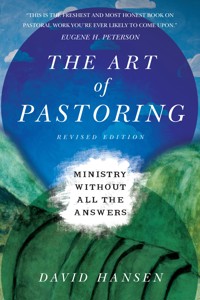
Named one of the Top Ten Books by the Academy of Parish Clergy Hundreds of books, tapes, workshops and seminars promise to answer these impossible questions. Some offer a set of practical guidelines; others suggest a system or pattern to follow. Some stress various ministry functions; others feature case studies as models of success or failure. Some are helpful. Others are not. But in The Art of Pastoring, David Hansen turns pastoral self-help programs on their heads. He tackles the perennial questions from within his own experience. From the Inside Out Hansen's fresh, bold narrative grows from nearly a decade of ministry. He draws you into his life and into the lives of Florence-Victor Parish in the mountains of Montana, including unforgettable encounters with unforgettable people--a stubborn pioneer woman who still chops her own firewood though she's blind and 90 years old, a championship rodeo cowboy who was baptized in his boots, and many more.Hansen's goal is to help you discover "that pastoral ministry is a life, not a technology . . . [that] life as a pastor is far more than the sum of the tasks I carry out. It is a call from God that involves my whole life." From Calling to Living Parable Every pastor has encountered those who struggle to hear God's voice in a hospital room, who reach for Jesus in the sacraments. No systematic answers can meet their deep, eternal needs. What can touch them, Hansen contends, is a life itself, a life lived as a parable of Jesus. "As a parable of Jesus Christ," Hansen writes, "I deliver something to the parishioner that I am not, and in the process I deliver the parishioner into the hands of God." It is this knack for getting to the heart of things that makes The Art of Pastoring valuable for pastors in any setting--rural, suburban or urban. Parachurch workers, missionaries, church leaders and ministry volunteers will also find inspiration here. In this significantly revised new edition, Hansen includes new insights into his view of pastorate as parable and adds a new postlude in which he comes clean on his "constant attempts to leave the ministry."
Sie lesen das E-Book in den Legimi-Apps auf:
Seitenzahl: 338
Veröffentlichungsjahr: 2012
Das E-Book (TTS) können Sie hören im Abo „Legimi Premium” in Legimi-Apps auf:
Ähnliche


















There is a river whose streams make glad the city of God.
PSALM 46:4
The Art of Pastoring
REVISED EDITION
Ministry Without All the Answers
David J. Hansen
“…to equip his people for works of service, so that the body of Christ may be built up.”
ephesians 4:12
God has called us to ministry. But it’s not enough to have a vision for ministry if you don’t have the practical skills for it. Nor is it enough to do the work of ministry if what you do is headed in the wrong direction. We need both vision and expertise for effective ministry. We need praxis.
Praxis puts theory into practice. It brings cutting-edge ministry expertise from visionary practitioners. You’ll find sound biblical and theological foundations for ministry in the real world, with concrete examples for effective action and pastoral ministry. Praxis books are more than the “how to” – they’re also the “why to.” And because being is every bit as important as doing, Praxis attends to the inner life of the leader as well as the outer work of ministry. Feed your soul, and feed your ministry.
InterVarsity Press P.O. Box 1400 Downers Grove, IL 60515-1426 World Wide Web: www.ivpress.com E-mail: [email protected]
© 2012 by David J. Hansen
All rights reserved. No part of this book may be reproduced in any form without written permission from InterVarsity Press.
InterVarsity Press® is the book-publishing division of InterVarsity Christian Fellowship/USA®, a movement of students and faculty active on campus at hundreds of universities, colleges and schools of nursing in the United States of America, and a member movement of the International Fellowship of Evangelical Students. For information about local and regional activities, write Public Relations Dept. InterVarsity Christian Fellowship/USA, 6400 Schroeder Rd., P.O. Box 7895, Madison, WI 53707-7895, or visit the IVCF website at www.intervarsity.org.
Scripture quotations, unless otherwise noted, are from the New Revised Standard Version of the Bible, copyright 1989 by the Division of Christian Education of the National Council of the Churches of Christ in the USA. Used by permission. All rights reserved.
While all stories in this book are true, some names and identifying information in this book have been changed to protect the privacy of the individuals involved.
“Appendix One: Sightings” was first published in Leadership Journal, Winter 2006.
“Appendix Two: Beneath the Surface” is an edited version of “Beneath the Surface,” published in Leadership Journal, Spring 2000 and included in The Best Christian Writing 2001, edited by John Wilson, Harper San Francisco.
Cover design: David Fassett Interior design: Beth Hagenberg Images: painted sky background: © Spiderstock/iStockphoto green terrace painting: © Phillip Jones/iStockphoto
Contents
Foreword to the Revised Edition
Preface to the Revised Edition
An Ebenezer Story: Introduction
1. Beginning
2. Call
3. The Holy Spirit
4. Temptation
5. Eschatology
6. Preaching
7. Prayer
8. Friendship
9. Sacrament
10. Leadership
11. Leaving
12. Reward
Epilogue
Acknowledgments
Appendix 1: Sightings
Appendix 2: Beneath the Surface
Questions for Discussion
Notes
About the Author
Foreword to the Revised Edition
This book literally saved my ministry.
It was 1996, I was thirty-two, and already I was feeling a huge sense of disillusionment. When I came into ministry four years previously, I had this romantic notion that I would be studying Scripture, leading the congregation in worship, visiting the sick, and so on. Instead, thanks to the corrosive effect of church-growth teaching which was all pervasive at that time (and still is), I felt that I was running a franchise. And given that one of my best friends was running a franchise business and earning about three times my wage, I figured that I could be doing a lot better for myself. And then I readThe Art of Pastoring.
Actually, it had been sitting on my desk for a week or so, having been given to me by my spiritual mentor. He said that I would love it. He was right. In fact, I cried my way pretty much through the whole book. Not only was the writing superb (Dave would be a great writer whatever the topic), he was describing what I had imagined being a pastor was all about, but hadn’t had the courage to explore, nor the words to explain.
Dave told me it was all right not to have a vision statement. That was a relief. In fact, he warned me that preaching vision was cheap leadership, and that I could do a lot worse in terms of strategy than simply preach Christ and follow the promptings of the Spirit. After all, if the Spirit is truly at work in the church, then he could be trusted to arrange my work. Indeed, Dave is one of the few pastors I have met who actually believes this, which explains why he used to go fishing so much.
“The pastor has gone fishing,” says one of the parishioners sarcastically. Yes, the pastor has gone fishing, but the pastor is praying. As a matter of fact, what this book taught me was that praying my way through the life of a congregation was just about the best thing I could do for a church that called me to be their pastor. It wasn’t more techniques that I needed, but courage: courage to trust, and courage to love actual people, in actual places, with actual lives.
It is not without significance to me that this book was written in the back of beyond of the Rocky Mountains. It was as if someone needed to leave the world of Christianity—the world of conferences, growth models and Christian celebrities—in order to rediscover the gospel in all its grittiness. This is what Dave did all those years ago when he took up residence in a couple of small rural churches in Montana. And speaking on behalf of many pastors this side of the pond, and speaking as a friend, we give thanks to God that he and Debbie did so.
To say that this book is full of stories is not to say that it lacks theological depth. Not at all. Dave is one of the few people I know who reads Kierkegaard for fun! But like the Bible itself, Dave chooses to distill his theological acumen through narrative. And so you will learn about the fine art of fly-fishing in the Bitterroot valley, experience real-life cowboys in the hills of Montana, and above all, encounter God who comes to us, as Dave insists, not in the beauty of the Rockies, but in the broken and bruised body of the crucified Jesus.
Ian Stackhouse
Guildford Baptist Church
Surrey, UK
Preface to the Revised Edition
Iwas astonished when Cindy Bunch contacted me in October 2011 to tell me that InterVarsity Press wanted me to produce a revised edition of The Art of Pastoring. It came at an auspicious time. The year 2013 marks thirty years since our little family moved to western Montana to begin ministry at the Florence-Victor Parish and twenty years since I submitted my final draft to the Press.
When I first submitted the manuscript, none of us knew what would become of it. The book was, to put it mildly, idiosyncratic. My editor for the book, Rodney Clapp—who shepherded me through the writing process from start to finish—admitted what we all knew: “This book is like a baby bird. When it steps out of the nest, it will either fly away, or drop to the ground.” I still marvel that the wings caught air.
When I told three friends of mine on the faculty at Gordon-Conwell Theological Seminary about my wonderful opportunity, I thought they would be happy for me. Instead they admonished me, “Don’t change a thing.” Forewarned but undaunted I forged ahead. This was my chance. Due to good sense and unrepentant perfectionism, several sections of the book had bothered me for years. I am extremely grateful to readers who brought forth suggestions about how the book might be improved. As it turned out, their critiques and my own matched up pretty well. In addition, the editors requested that I write questions for study groups. I hope they work for you.
Every change—every added sentence, quotation, idea and illustration—reflects what I was thinking and doing during my ministry with the two churches of the Florence-Victor Parish, from January 1983 to April 1992. I have been quite strict about this. For instance, I have only included quotations that I remember knowing from books and articles I’d read up to 1992. This restriction is essential to the integrity of the book.
I still practice ministry without all the answers. It’s my only way. I’m smarter in some areas, and dumber in others. Some skills are sharper, some are rusty. I’ve learned to steer clear of some of the pitfalls of ministry, and in some areas I just keep driving into the same ditch. Things I can’t seem to get right keep me alert. It would bore me stupid to be good at everything I do. I have learned to trust not knowing all the answers as a source of vision and power. I look back in amazement. Many of the accomplishments I am most proud of have occurred in areas where I have little or no talent. In Christ, you have every reason to hope for the same.
I have appended an epilogue and two articles. The epilogue is an answer to the most frequently asked question I receive from my readers: “Why did you move from Montana to Cincinnati?” The articles are ones which I wrote in Cincinnati and published in Leadership Journal. These edited versions describe, in narrative form, the heart and soul of my struggles and joys, and the similarities and the differences of my striving to live as a parable of Jesus Christ, in both settings.
The revised edition is dedicated to my wife, Debbie. Over the past forty years she has never pushed me, but she’s always been there to put me back on my feet.
An Ebenezer Story Introduction
This book is a description of the pastoral ministry. In it I attempt to answer questions such as, when the pastoral ministry happens,
What does it look like?
What does it feel like?
What is it?
My answers come from the inside out. I have not studied the pastoral ministry from a dispassionate, objective standpoint. I have written as an interested party. I have written from the subjective standpoint of being a pastor.
When I began pastoral ministry, I had lots of books prescribing pastoral ministry—the so-called how-to books. I had books on how to preach, how to administrate a church, how to do pastoral counseling and how to lead small groups. They didn’t help me. The authors assumed too much. They assumed that I knew what my goal was. They assumed that I knew what I was and who I was. They assumed that I knew why I was supposed to be doing the things they were teaching me about. But I didn’t know what I was, or who I was, or why I was supposed to be doing the things I was supposed to be doing. And I didn’t know how any of the things I was supposed to be doing fit into a coherent understanding of my call from God to be a pastor.
So I stopped reading how-to books. Instead I read theology, biblical studies and church history. I alternated between the disciplines. These books from the classical disciplines of theology didn’t teach me how to do pastoral ministry, but they helped me immensely in my regular duties. I discovered that spending a day reading thirty pages of Karl Barth’s Dogmatics helped me more in my pastoral work than a hundred of pages of how-to literature.
In my church history reading I ran into a biography of a pastor, The Life of Alexander Whyte; a personal narrative of a pastor, The Letters of Samuel Rutherford; and a fictional account of a pastor, Father Zossima in Feodor Dostoyevsky’s The Brothers Karamazov. Alexander Whyte, who finished his long career in the early part of the twentieth century, pastored a large church in Scotland. Samuel Rutherford, a Scottish pastor from the 1600s, wrote his letters during times of persecution. Father Zossima is a portrayal of a Russian monk of the 1800s.
These books helped me a lot. But I didn’t know why stories about pastors who lived centuries ago could help me so much. I thought I was supposed to be a modern pastor, relevant to the world around me; and these books were from different worlds. But as I read these stories I felt myself caught up in the protagonists’ struggles to follow Jesus Christ in their daily lives.
These narratives pointed me to the fact that pastoral ministry is a life, not a technology. How-to books treat pastoral ministry like a technology. That’s fine on one level—pastoral ministry does require certain skills, and I need all the advice I can get. But my life as a pastor is far more than the sum of the tasks I carry out. It is a call from God that involves my whole life. The stories I read helped me to understand my life comprehensively. My life, too, is a story, and it is the narrative quality of my life that makes my ministry happen. Others see and participate in the story as it is told. I have discovered that when I follow Jesus in my everyday life as a pastor, people meet Jesus through my life.
This is not a new idea. It is a simple observation, perhaps the most basic principle of evangelism, that we lead people to Christ through living simple lives of love.
What is new about this book is that I attempt to describe why it is that people meet Jesus in our lives when we follow Jesus. Even more, I have attempted to describe how and why following Jesus is the central principle of pastoral ministry, the comprehensive principle that integrates every task.
The thesis of this book is that people meet Jesus in our lives because when we follow Jesus, we are parables of Jesus Christ to the people we meet. This book is a description of the pastor as a parable of Jesus Christ.
Since this book is about the pastoral ministry as a narrative, the book itself is a narrative, the story of my life as a pastor. It is, specifically, the story of my life as pastor of the Florence-Victor Parish, a two-church, yoked parish in the Bitterroot Valley of Montana, which I served from January 1983 to April 1992.
This book contains more than the story of my nine-year pastorate. As I attempted to describe and understand my life as a pastor, I was forced again and again to refer to other experiences in my life. For instance, I found that I had no choice but to describe my conversion experience.
This raises the question of why my conversion story, or any story I tell about myself, should have any relevance to you and your ministry. By recounting my conversion experience, I do not want to imply that you must have had a conversion experience like mine in order to be a pastor. What I do want to imply is that your conversion has great implications for your ministry. Just as I have looked carefully into my conversion experience (and many of my stories) to understand my ministry, you must also look carefully at your conversion experience (and many of your stories) to understand your ministry.
That’s the beautiful thing about narrative. As you read my investigation of my experience of ministry, you are not asked to duplicate my experience of ministry. Rather, you are invited to investigate your experience of your ministry. As I tug you through my exploration, I hope that you will be doing exploration too.
This book is a weaving of stories and didactic sections. Pay attention to both equally. But realize that I have given priority to the stories. Do not hurry through them. The didactic sections illustrate the stories, rather than the reverse.
I apologize for the places in the book where you will be slowed down because my writing is poor. I am deeply aware of my shortcomings as a writer, and I wish I could have made it easier for you. On the other hand, I do not apologize for the fact that the pastoral ministry is filled with sticky, complex problems that can only be addressed with sticky, complex writing. I find that I cannot write an easy book about a hard subject. I only hope the book is not harder than the subject matter deserves!
Obviously this book is for pastors. But it is not just for pastors. I sincerely hope that this book can meet the needs of two other groups in the church.
If you are considering entering the pastoral ministry, this book will give you a glimpse of what it is like to be a pastor. I don’t think how-to books can help you see and feel the life of ministry. I doubt that even the best book on how to preach a sermon can help you know what it is like to preach a sermon. This book, I hope, can help you feel what it is like to preach a sermon.
If you are a layperson, active in a church, and you want to know what your pastor is going through, this book may help you to understand. These days there is a gap between laypeople and pastors. Laypeople don’t know what pastors do. Most of us pastors don’t know what we’re doing either. These are difficult times for us.
I’ll admit, too often we pastors just gripe. You may be justifiably tired of listening to our bellyaching. But sometimes your expectations for our ministries are askew. Sometimes you want things from us that we just can’t deliver.
The great missing element in today’s relationships between pastors and laypeople is trust. Trust comes from love and understanding. I warmly invite you to come into this narrative as one of us. Walk in our shoes for a little while.
It needs to be said that your pastor may not believe everything I write here, and you should not judge your pastor by what I say. (Then again, you may be glad that your pastor’s opinions don’t always match mine.)
Finally, this book is an Ebenezer. Scripture says: “Then Samuel took a stone and set it up between Mizpah and Jeshanah, and named it Ebenezer, for he said, ‘Thus far the Lord has helped us’” (1 Sam 7:12). This was not an uncommon practice in early Israel. The patriarchs piled up rocks to mark where the Lord had met them. They made altars where they thanked God for what he had done for them. Afterward, when they walked by the rock piles on their pilgrimages, the rocks served as reminders of God’s faithfulness. This book is a pile of rocks declaring that God has helped me along the way in my wilderness walk as a pastor.
By writing this book I am not claiming to have been a good pastor. All I claim—and this seems bold enough to me—is that I have been a pastor. I have failed many times. Many times I have violated my own best precepts of pastoral ministry. As I look back on my ministry I do not see my faithfulness. What I see is God’s faithfulness. My performance has been mixed. God is the one that has been faithful at every point. My faithfulness, to the extent that I have been faithful, has had its roots in God’s faithfulness to the people he has called me to serve.
It is a great mystery to be a pastor. To the memory of God’s faithful and mysterious work I have stacked these rocks.
1 Beginning
Whoever welcomes you welcomes me, and whoever welcomes me welcomes the one who sent me.
Matthew 10:40
My face sinks into my hands, but the desk is too cold for my elbows. The space heater with the cloth-covered cord has warmed the air: my breath doesn’t show, but the steel desk warms excruciatingly slowly. It’s freezing me. I’m too cold to read a book.
My office is a lean-to attachment to the fellowship hall of a community church in rural Montana. There’s no wall heater, no thermostat, no insulation. The place warms from scratch every morning. It’s six weeks into the New Year, six weeks into my first pastoral charge, 33 degrees outside and sleeting.
It’s sleeting in my soul. I don’t know what I’m supposed to do. I’ve been called, educated, interned and ordained. I have learned lists of tasks to do, but not what I am to be. I’m cold and afraid. There are a hundred things I could do if I could just stop shivering.
In the spring skunks seek secluded dens to make skunk love and raise skunklings. Our fellowship hall, with its crumbling stone foundation, extends a warm invitation to them. Its gaping holes say more than words ever could: “We welcome you to this church.”
We see ourselves as a church family. And we have never met a family’s needs better than we’ve met the Skunks’. Our crawl space is dark and dry, and the trash cans outside the door are perpetually knocked over by wandering dogs. A healthy Montana skunk smells like a burning tire. The acrid odors wafting through my office in springtime make me appreciate the pure 33-degree air I inhale in the winter.
While conjugating a Greek verb, I hear gnawing from the crawl space. I stomp; the noise stops. I return to the Greek and the noise resumes.
Maybe I should have demanded decent working conditions. But after a while I realized something: my office conditions delivered me from the temptation of seeking a job description from the church. I knew what they wanted from me: competent pastoral care and leadership, regular office hours and good preaching. I was hoping to meet these reasonable expectations. But I knew that I could not let the church tell me who I was or how I should go about my work. After all, they couldn’t even see that I needed a heater in my office. I began to question my situation.
Do I deserve a heater in my office?
Yes, I do.
Are these cheap, mean hearted people?
No, they pay me pretty well. I like these people.
Why don’t they do something about my office?
I don’t know.
Do they have the slightest idea what I do?
No, they don’t.
Do I want people who provide me with an office in which I face hypothermia in the winter and asphyxiation in the spring to tell me who I am and what I should be doing?
No, I do not.
After a couple of years the space heater broke (kicked over too many times, I guess), and I did get a wall heater. But the floor never collapsed, so the foundation was never fixed and the skunks stayed. I put up with the situation because it showed me that while I serve the church, I do not work for the church. I never wanted to become their employee, and I never did. What I became was their pastor.
My employer is Jesus Christ. Serving the church is my obedient response to Christ. Jesus is my boss; he orders my day. Shivering while preparing my sermons forced me to take seriously who I was preparing my sermons for. Jesus Christ who also had no place to rest his elbows. The church got better sermons because of it.
Trend-Driven Ministry
My predecessor’s library haunted me. When he left this church, he left the ministry and forsook his library. Every single book remained in the office on the shelves, undisturbed; he took not one. My library was shelved in my other office in the other church, so his books stayed in place, like Little Boy Blue’s toy soldiers obediently waiting for their master.
His library told the story of his ministry. The books were ordered in topical fashion, but instead of “Pastoral Counseling” and “Commentaries” his topics represented most of the trends of Christianity in the 1970s, the decade of his pastoral ministry.
He had some highly conservative commentaries, Bible introductions, a systematic theology, some charts of the end times and “Christian counseling” books.
The church growth movement was well represented. He went to some conferences on the subject and bought books. Church minutes from his tenure reveal that council members attended the conferences with him. They also reveal that he tried the methods but with no results. Closets, desk drawers and file cabinets were filled with dittos of church growth teaching materials, church surveys and proposals.
He journeyed as a charismatic. Books on healing, speaking in tongues and discovering spiritual gifts were present and dog-eared to prove they’d been read.
He had learned from books how to organize growth groups and spiritual retreats.
Evangelical, Mennonite and Catholic books and journals on social awareness and activism took a good part of a shelf. I knew most of them. I’d had a passionate commitment to social awareness and activism for many years. There was a smattering of literature from Reformed theology, psychology, classic liberal theology and biblical studies. He had a small collection of English Puritan authors. I love those dead guys.
A few parishioners told me with deep sadness that by the end of his ministry he had lost much of his Christian faith. His faith crisis did his ministry in. The books couldn’t deliver him.
He was a fine pastor. Everyone said he was a good preacher. He was tireless at calling, superb at organizing small groups. I was amazed at how many parishioners from different age groups and backgrounds gave him this high tribute: “He was a real friend to me.”
He did good work through all the years of trying one movement and then another. He pastored well whether he happened to be a dispensationalist, a charismatic, a small group organizer, a church growth enthusiast or a social activist. The movements he followed actually had little if any effect on his ministry, except in a fatal way: ultimately perhaps he confused following Christian movements with following Christ.
Most of the books and articles were written by genuine Christians. What went wrong?
I didn’t know what went wrong. His library presented a bleak testimony to me, though. He and I were cut from the same piece of cloth. I too believed that following Christian movements amounted to following Christ. I was suckled on trend-driven Christianity. I’d grown up in the thick of consumer religion. It was all I knew. I knew every movement represented in his library. I’d tried them all myself. I didn’t know if I could do pastoral ministry without them. But every time I looked up at his library, I knew that I had to try.
Task-Driven Ministry
Meanwhile, in order to survive, I was performing my tasks as a pastor with as much skill and energy as I could muster. I preached, taught Bible studies, prayed, led worship and administered the sacraments. I worked shoulder to shoulder with church leaders seeking God’s will for the church and planning how to get it done. I looked forward to council meetings, well, most of them. I pastored as best I could. To my surprise, the churches didn’t fire me. They liked my work. I wasn’t following a job description, a Christian movement or a church growth scheme. I just worked away at everyday duties—including long, meandering, prayer walks—sometimes with a fly rod.
Task-driven ministry is something different. Task-driven ministry elevates the method above the Spirit. It subjugates our life with Christ to management technologies. Our day is divided into hours and tasks rather than opportunities to do God’s will. The problem is that when I fine-tune my week, tweaking it like a piano tuner to a perfect A440, I am out of harmony with the kingdom of God. I experience fewer of those serendipitous, perfect opportunities to talk to people about Christ. You know what I mean: the evangelism you never plan, which works better than evangelism you do plan.
The most insidious rationalization for a task-driven ministry is that it provides a pastor with a professional identity. A surgeon is a person trained and authorized to perform surgery. A teacher is a person trained and authorized to teach school. A pastor is a person trained and authorized to carry out pastoral tasks. As a professional, I am a person with expertise. Experts have esoteric knowledge with powers to accomplish tasks. Such knowledge makes us valuable to society. It separates me from those around me. I become “distinguished.”
My ego loves the distance created by esoteric knowledge; it is the power of the witch doctor. But in the end the tragic distance created is within my own soul. When I move from being a lover of the soul to an expert about the soul, I objectify my own soul from myself. In the end my ego is warped; it goes on a rampage, climbing ladders to assert itself.
Better to be a follower of Jesus and no expert at that, just a sinner saved by grace, called to love because I have been bought with a price. I may lose my standing as an expert, but I gain my soul.
The pastoral ministry cannot be employer-driven, trend-driven or task-driven. Pastoral ministry must be following Jesus Christ. Jesus Christ called me to this work, and following him must be integral to realizing his calling.
Pastoral Ministry as Following Jesus Christ
It was one of those clear October afternoons in Montana when the leaves had turned but not fallen. The air was cool but the ground warm—a good day for seeing things. A good day for fishing.
The Bitterroot River riparian zone is a benign chaos of cottonwoods, high grasses, red willows, wild roses and some of the best dry fly fishing in Montana. The randomness reminds me of my life. Birds float in and out like parishioners. Moist bear scat under a freshly stripped wild chokecherry tree reminds me to keep my eye open for dangerous situations. The Bitterroot River—clean, cold, fertile, always moving forward, always cutting new banks, providing constant nourishment for our valley—reminds me of the Holy Spirit. That we can pollute the river, bulldoze it and reroute it reminds me that in my ministry I can quench the Spirit by forcing things to go my way.
I may see a beaver, a mink or a bald eagle, but this is not a nature hike. I’m fishing, and fishing is predation. I’m not watching nature, I’m joining it. My eyes survey the river for rising trout. My mind surveys the Spirit for new ideas.
I come upon a section of river notorious for large trout too wary to be caught. These fish rise eighteen inches from the shore in a pure glass slick; they rise so close to the bank they can see you. As usual, the big ones rise, slowly sipping tiny flies off the surface tension of the water. I hike upstream past the hole and hide behind a tree stump as I loosen my line. The small fly, a number 18 Yellow Humpy, meanders into the slough of feeding trout. A large cutthroat trout takes the fly.
The trout experiences something like death when it fights against the hook and line. The lactic acid builds up in its system inducing a deep ache. Once the fish is in my hands I turn it upside-down, which disorients it, temporarily relaxing its muscles. I ease the hook out of its mouth, gently lowering the beauty into the water facing upstream so its gills will fill with oxygen. It heads to the deep slowly, tired and sore. I know how it feels.
The fish returns to his place in the carefully defined order of troutdom. I look for my place in Christendom. As I walk through the grasses I smell the sweet odor of decomposing plants. As I tramp through theology I smell dead matter too, but it isn’t sweet. The typical response of the theologian is that “Pastoral Ministry” belongs under the rubric “Church.” I see the point, of course: The church calls pastors to do the most important work of the church. Pastors exercise the means of grace entrusted to the church until the Lord’s return. This says what I do, but it does not say what I am.
I serve the church, and I’m willing to do that. I knew when I started pastoral ministry that it meant serving the church to the point of dying. I just want to pick up my cross for the right thing. I do not want to die for the church by going crazy with ten million things to do. Actually, the unreasonable demands do not come from my people. By and large they want me to keep it simple. I can sort through what they say they want me to do. That is basic biblical leadership.[1] I pile expectations and complication upon myself. I need better criteria of what it means for me to work.
The fishing’s not that great. I’ve walked two miles for two fish. I come to the barbed wire fence where I usually turn around and head for home. If I shimmy under it I’ll probably rip my waders, or I may get chased by an angry landowner. But the time has come to explore new water. The waders rip, the fishing gets better, no angry landowner appears. I step over downed cottonwood tree trunks and force my way through tall grass, one eye out to keep me from tripping, the other eye on the river looking for good water. I’m walking along the river bank, a few feet from a steep drop down to deep water. But my eyes are on the trail in front of me. A thought comes to me that makes sense of who I am, what I do and why it works. I have learned previously that Jesus is the parable of God. I cannot take the place of Jesus. I am not a parable of God. On the other hand, as I follow Christ I can be a parable of Jesus. That’s what I am. I am, imperfect as I am, a parable of Jesus. That’s what a pastor is, a parable of Jesus.
Jesus Is the Parable of God
How can I begin to think about the act of following Jesus as also being the act of doing the pastoral ministry? I need to correlate who I am and how I live as a follower of Christ, with who I am and what I do as a pastor. How can my oft-broken life reflect and convey the living, intimate, Lord of the universe, into everyday lives of my oft-broken people? The Word of God tells us, “He heals the brokenhearted and binds up their wounds. He determines the number of the stars and calls them each by name” (Ps 147:3-4 niv). As I bumble my way through healing hearts and binding wounds, the God of stars, mountains and oceans makes something happen that I have learned to call my ministry. However, I have also learned in the shadows of snow-capped peaks that the witness to God in creation can be very misleading.
When our son was nine years old, he and I were walking on a bluff, three hundred yards from our house, two hundred feet above the Bitterroot River, and five miles from the Bitterroot Mountains. He asked me, “Dad, what if God doesn’t exist?” Think fast. All I said was, “I believe in God, and I hope you do too, but as life goes on you will have to make that decision for yourself.” I knew that appealing to creation as proof of the existence of God might later on in life lead him to unbelief. Unbelievers here blow me off all the time saying they worship God in nature. A beautiful sunset does not convict us of sin nor does it offer forgiveness. For that matter, if I am soaking wet and hypothermic in the high country, the raven watching from the tree roots for the hypothermia. In this place I must be a parable of Christ.
Scripture tells us that Jesus is “the image of the invisible God, the first born of all creation.” He is the Servant of God and the Shepherd of the church. I am made in the image of God. I am a servant of God and a shepherd of the church. Here’s where being a pastor makes a huge difference. Since they know me as the pastor of the local church, they associate my action with the Christ. About six months after we’d moved to town my folks drove over from Spokane, Washington, to visit us in Florence. My dad walked into the Bum Steer Saloon to ask if anyone knew where we lived. A guy said, “Oh, ya, the new priest. He lives on Tie Chute Lane in a log house just up the hill.” They knew who I was. To them I represented Christ.
In his work God as the Mystery of the World, the German theologian Eberhard Juengel states that Jesus is the parable of God. Of this insight he says, “This Christological statement is to be regarded as the fundamental proposition of a hermeneutic of the speakability of God.”[2] The speakability of God: this is what I want my life to be, a living organism through which God speaks. Not a hero, but a regular guy working away at imitating Christ in my everyday life. If I blow it sometimes that makes me like the Bible heroes. It’s a chore to find a servant of God in the Scriptures without major flaws. As the old English Puritan said, “God only chose one perfect minister.”
What is a parable? A parable is an extended metaphor. Juengel says, “A parable is to be regarded as an extended metaphor, or, the metaphor can be called an abbreviated parable. The difference consists in the fact that a parable narrates while a metaphor coalesces the narrative in a single word.”[3]
A parable is a story meant to create a comparison between a known thing and an unknown thing, the purpose being to illuminate the unknown thing so as to bring something new, unforeseen and surprising to the hearer. The story of Jesus is a parable of God because Jesus is a man and can be seen whereas God is Spirit and cannot be seen. Jesus’ life is the parable of God par excellence.
The Pastor Is a Parable of Jesus Christ
There are many similarities between Jesus’ life and a pastor’s life. Jesus was called. He was anointed with the Holy Spirit. He was tempted. Jesus taught that the consequence of our lives here extends into eternity. He preached, he prayed, he healed and he befriended sinners. Jesus suffered for the world and for the church. We do all these things. By those criteria, my shepherding is an authentic extended metaphor of the Good Shepherd. And as such, my life conveys the surprising presence of the grace of God.
This is why when I walk into a hospital room, people seem to experience the coming of God. Just to say it sounds egotistical. But sometimes on simple visits in a cafe, it is as if I am not even there. God is there. Sometimes God comes to people when I preach, or pray, or even when I ask how they’re doing when I bump into them in the grocery store. Being a parable of Jesus shows me how it is possibly true when Jesus tells his disciples: “Whoever welcomes you welcomes me, and whoever welcomes me welcomes the one who sent me” (Mt 10:40). This does not need to be complicated; later in the same passage, Jesus goes on to say, “And if anyone gives even a cup of cold water to one of these little ones because he is my disciple, I tell you the truth, he will certainly not lose his reward” (Mt 10:42 niv).
How can receiving me be a form of receiving Christ? On the one hand, the imitation of Christ is the foundation of ministry in the New Testament and the core of my work. On the other hand, my imitation can be pretty shoddy at times. This is where understanding a crucial characteristic of parables and metaphors comes into play. Every metaphor and every parable reaches a place where, by its intrinsic nature, the analogy breaks down. They all play out differently. In the Gospel according to John Jesus tells us, “I am the Light of the world.” In the Sermon of the Mount he tells us, “You are the light of the world.” Though the scope and limitations of the two metaphors can at times be extreme, we really are the light of the world, and we really do exemplify and mediate “The true light, which enlightens every-one.” (Jn 1:9).




