


Erhalten Sie Zugang zu diesem und mehr als 300000 Büchern ab EUR 5,99 monatlich.
- Herausgeber: epubli
- Kategorie: Fachliteratur
- Sprache: Englisch
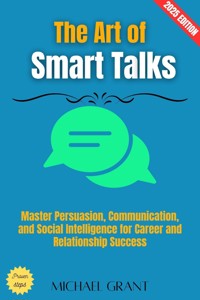
The Art of Smart Talks What if your everyday conversations could become the key to better relationships, deeper trust, and greater influence? The Art of Smart Talks is your guide to mastering the conversations that matter—whether at home, at work, or anywhere in between. In a world where noise often overshadows meaning, this book brings clarity, depth, and intention back to your words. Discover how communication, when done thoughtfully, becomes a tool for connection rather than correction. This book is not about being clever—it's about being clear, confident, and human. Whether you're trying to lead with impact, build stronger bonds, or simply feel heard in a fast-moving world, the tools within these pages will help you speak in a way that resonates—and listen in a way that builds trust. Inside This Book, You'll Discover: Foundations of a Smart Conversation The Power of Listening Before Speaking How to Ask the Right Questions Handling Difficult Conversations with Grace Mastering the Art of Saying No Respectfully Empathy as a Superpower in Communication Practicing Smart Talks in Daily Life Each chapter delivers practical insight paired with timeless principles. You'll learn to disarm conflict without losing your voice, to build rapport that actually lasts, and to replace ego-driven dialogue with meaningful, human-centered exchange. These lessons aren't reserved for public speakers or leaders—they're for anyone ready to make their everyday conversations more intentional, respectful, and powerful. Transform how you speak. Change how you're heard. Scroll Up and Grab Your Copy Today!
Sie lesen das E-Book in den Legimi-Apps auf:
Seitenzahl: 110
Veröffentlichungsjahr: 2025
Das E-Book (TTS) können Sie hören im Abo „Legimi Premium” in Legimi-Apps auf:
Ähnliche

















The Art of Smart Talks
Master Persuasion, Communication, and Social Intelligence for Career and Relationship Success
Michael Grant
Table of Content
The Art of Smart Talks
Foundations of a Smart Conversation
The Power of Listening Before Speaking
How to Ask the Right Questions
Speaking with Clarity and Confidence
Reading the Room: Emotional Intelligence in Dialogue
The Science of Persuasion and Influence
Turning Small Talk into Meaningful Connections
Handling Difficult Conversations with Grace
Mastering the Art of Saying No Respectfully
Timing, Tone, and Tact: Your Communication Trifecta
Smart Talk in Professional Settings
Empathy as a Superpower in Communication
Avoiding the Ego Trap in Conversations
Building Rapport That Lasts
Practicing Smart Talks in Daily Life
Conclusion: Where Smart Talks Take You
© Copyright [2025] [Michael Grant] All rights reserved.
- No part of this book may be reproduced, stored in a retrieval system, or transmitted in any form or by any means, electronic, mechanical, photocopying, recording, or otherwise, without prior written permission of the publisher, except for brief quotations in a review or scholarly article.
- This is an original work of fiction [or non-fiction] by [Michael Grant]. Any resemblance to actual persons, living or dead, or actual events is purely coincidental.
Legal Notice:
The reader is solely responsible for any actions taken based on the information contained in this book. The author and publisher expressly disclaim any responsibility or liability for any damages or losses incurred by the reader as a result of such actions.
Disclaimer:
This book is intended for educational purposes only. The information contained within is not intended as, and should not be construed as medical, legal, or professional advice. The content is provided as general information and is not a substitute for professional advice or treatment.
This declaration is made for the purpose of asserting my legal ownership of the copyright in the Work and to serve as proof of ownership for any legal, publishing, or distribution purposes. I declare under penalty of perjury that the foregoing is true and correct.
We live in an age of constant conversation—texts, calls, comments, meetings, and casual exchanges fill our daily lives. Yet, for all this communication, so much of it falls flat. Misunderstandings multiply. Opinions clash. Voices compete without connection. In the noise, we often forget what truly powerful communication looks and feels like. Smart talk isn’t about sounding intelligent or rehearsing the perfect line—it’s about communicating with purpose, clarity, empathy, and presence.
The Art of Smart Talkswas born out of a simple yet overlooked truth: the way we speak shapes the way we live. Every conversation you have—with your colleagues, your family, your friends, even with strangers—leaves behind an impact. That impact might build bridges or burn them. It might open doors or quietly close them. It might deepen relationships or weaken trust. What determines the difference isn’t how much you say—it’s how you say it. Smart talk is not louder. It’s more intentional. It cuts through confusion. It brings warmth, clarity, and respect to even the hardest conversations.
This book is a guide for anyone who wants to level up their communication—not through tricks or superficial techniques, but through deeper understanding and practice. Each chapter explores a distinct facet of smart conversation, from building foundational habits like listening and asking the right questions, to navigating tough topics with grace and emotional intelligence. You’ll learn how to speak with confidence without arrogance, how to set boundaries without hostility, and how to turn everyday exchanges into meaningful moments.
The goal isn’t perfection. It’s growth. Smart talk is a skill that sharpens with awareness, consistency, and care. You don’t need to be a public speaker or a natural extrovert to communicate powerfully. You simply need to show up with the willingness to speak with intention, to listen with empathy, and to build connection rather than control.
Whether you’re trying to improve your conversations at work, strengthen your personal relationships, or simply feel more understood in your daily life, this book offers practical, grounded insight to guide your journey. The chapters ahead are not quick fixes—they’re invitations. Invitations to reflect, to adjust, to stretch, and to practice. Because the real art of smart talks isn’t found in what you know. It’s found in what you embody, every time you open your mouth—and every time you choose to listen.
Let this be your toolkit. Let it reshape not only how you speak—but how you're heard, how you connect, and how you lead through your words. Welcome to The Art of Smart Talks. Your next conversation can begin right here.
Foundations of a Smart Conversation
A smart conversation doesn’t begin with the mouth—it begins with the mind. Before a single word is spoken, a foundation must be laid in awareness, intention, and understanding. Many people assume that effective communication is about having the right words ready at the right time, but in truth, it’s more about the depth of presence, curiosity, and emotional control that you bring into an exchange. A smart conversation is never just about transferring information—it’s about connection, comprehension, and mutual growth. The smartest talkers are those who prepare themselves not to dominate, but to engage.
At the heart of any smart conversation lies a strong sense of self-awareness. To converse wisely, you need to know your own patterns. How do you react when someone challenges your ideas? Do you interrupt when you get excited? Are you more focused on crafting your response than on truly hearing what’s being said? These questions may seem small, but they are the subtle architects of every interaction. Self-awareness helps you catch yourself before old habits take over. It invites you to pause, to breathe, and to choose words that match your values, not just your emotions.
Equally vital is your intention going into a conversation. Smart talk isn’t about showing off knowledge or winning debates. It’s about creating mutual understanding and reaching outcomes that matter. When your intention is to learn, collaborate, or deepen trust, it affects everything: your tone softens, your questions become more thoughtful, and your ego steps aside. Intention directs attention—what you focus on expands. If you enter a dialogue with the goal of clarity and connection, you will naturally listen more closely and respond more constructively.
Listening is not just an act of hearing words; it’s an act of intellectual and emotional discipline. Most people listen with the intent to reply, not to understand. But in smart conversation, listening becomes an active and generous act. You give someone your full attention without jumping ahead in your mind. You absorb not only their words but the meaning behind them, the emotion underneath, the motivation that may not even be consciously expressed. And when people feel truly heard, they open up. They drop their guard. They invite collaboration rather than resistance.
Another cornerstone of smart conversation is adaptability. No two conversations are exactly alike, and the smartest communicators know how to adjust their style to suit the situation. This doesn’t mean being fake or abandoning your core values. It means being emotionally agile—able to speak calmly with someone who is angry, to simplify ideas for someone unfamiliar with your field, to bring warmth to a cold setting, or to be direct when time is short. Adaptability makes your words land more effectively. It’s not manipulation—it’s respect. Respect for the context, the person, and the shared space between you.
Smart conversations also rely heavily on emotional regulation. If you lose your cool, you lose your credibility. Emotions are natural and powerful, but they should be felt, not flung. A wise communicator knows how to channel their feelings into words that are honest but constructive. This is especially critical in moments of disagreement or tension. When tempers flare, the smartest thing you can do is stay centered. Don’t react to the heat—respond to the heart of the issue. That kind of composure builds trust and earns respect, often more than brilliant words ever could.
Clarity is another essential ingredient. Smart doesn’t mean complicated. In fact, the smartest conversations are often marked by simplicity and precision. When you speak clearly, you show respect for your listener. You take responsibility not just for what you say, but for how it’s understood. That may mean slowing down, defining terms, or giving concrete examples. Smart communicators remove ambiguity not because they want to dumb things down, but because they want to build bridges between minds. Clarity is kindness in disguise.
Humility rounds out the foundation of smart conversation. No one knows everything, and the smartest people are the first to admit it. They don’t fear saying, “I don’t know,” or asking someone to explain something again. This kind of openness invites dialogue rather than defensiveness. When you speak from a place of humility, people are more likely to trust you, more willing to engage, and more ready to be honest themselves. Smart talk isn’t about knowing all the answers—it’s about asking the right questions and being open to learning something new.
Another powerful aspect is the ability to stay present. So many conversations are muddied by distraction—phones buzzing, eyes wandering, thoughts drifting. Smart conversations require presence. Being truly present means you’re not thinking about the past, or planning your response, or multitasking. You’re in the moment, engaging fully. This kind of attention is rare, and people feel it immediately. It makes them feel valued. It makes them feel safe. And in that environment, real dialogue can flourish.
Courage also has a place in foundational conversations. It takes courage to speak up, to be vulnerable, to express a difficult truth with grace. Many people avoid conversations that matter because they fear conflict, judgment, or awkwardness. But smart conversations are not always easy—they’re often brave. They require a willingness to be misunderstood temporarily in pursuit of deeper understanding. When you speak with integrity, even if your voice shakes, you contribute to a culture where honesty isn’t just tolerated—it’s celebrated.
And finally, curiosity is the fuel that keeps every smart conversation alive. When you approach others with genuine interest, they sense it. Your questions go deeper, your responses are more thoughtful, and your relationships become richer. Curiosity dissolves assumptions. It opens doors. It turns transactional moments into transformative ones. A curious mindset says, “I want to know more,” instead of “I already know.” That alone shifts the entire energy of the conversation and sets the stage for connection, creativity, and insight.
All these elements—self-awareness, intention, listening, adaptability, emotional regulation, clarity, humility, presence, courage, and curiosity—come together to form the true foundation of a smart conversation. Without them, even the most eloquent words can fall flat. With them, even a simple sentence can carry great meaning. Smart talk isn’t about impressing people with your vocabulary or facts; it’s about creating moments of genuine understanding. And that kind of connection doesn’t happen by accident—it happens by design.
What’s powerful about these foundations is that they’re not fixed traits—they’re skills. They can be cultivated, practiced, and strengthened over time. You don’t need to be born a great communicator to master smart conversations. You just need to care enough to learn, to reflect, and to grow. The more you build these inner foundations, the more natural your outer communication will become. Your words will align with your values. Your tone will match your intent. Your presence will leave a positive mark on every interaction.
When you approach conversations from this deeper place, something magical begins to happen. People respond differently. They open up. They lean in. They trust more. You’ll start noticing the shift not only in what is said but in how it’s received. And that’s when you’ll realize: smart conversations aren’t just about being understood—they’re about making people feel understood. That’s where the real power lies.
The Power of Listening Before Speaking
In a world overflowing with noise, the rarest and most powerful skill is the ability to truly listen. People are eager to be heard, quick to offer opinions, and often more interested in crafting a response than understanding what’s actually being said. But behind every truly effective communicator is someone who has mastered the art of listening before speaking. It’s not a passive act, nor is it simply waiting for your turn to talk. Listening is an intentional, focused, and often transformative choice that lays the foundation for meaningful, respectful, and impactful conversations.
When you listen deeply, you offer more than your ears—you offer your presence. This alone can change the entire dynamic of a conversation. People are perceptive; they know when they’re being heard and when they’re being tolerated. Real listening signals respect. It tells someone that their thoughts matter, that they are not being rushed or dismissed, and that there is space for their truth to land without interruption. This is a powerful gift to give, and yet, many miss the opportunity because they are too eager to interject, correct, or steer the dialogue toward their own thoughts.




