


17,99 €
Mehr erfahren.
- Herausgeber: John Wiley & Sons
- Kategorie: Geisteswissenschaft
- Sprache: Englisch
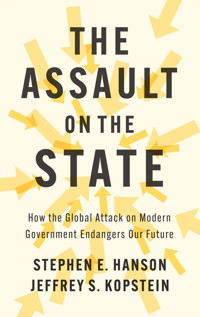
What if the state as we know it didn’t exist? Our air would be poisonous, our votes uncounted, and our markets dysfunctional. Yet across the world, in countries as diverse as Hungary, Israel, the U.K., and the U.S., attacks on the modern state and its workforce are intensifying. They are morphing into power grabs by self-aggrandizing politicians who attempt to seize control of the state for themselves and their cronies. What replaces the modern state once it is fatally undermined is not the free market and the flowering of personal liberty. Instead, the death of government agencies organized under the rule of law inevitably leads to the only realistic alternative: the rule of men.
In The Assault on the State, political scientists Stephen Hanson and Jeffrey Kopstein offer an impassioned plea to defend modern government against those who seek to destroy it. They dissect the attack on the machinery of government from its origins in post-Soviet Russia to the core powers of Western democracy. The dangers of state erosion imperil every aspect of our lives. Hanson and Kopstein outline a strategy that can reverse this destructive trend before humanity is plunged back into the pathological personalistic politics of premodern times.
Also available as an audiobook.
Sie lesen das E-Book in den Legimi-Apps auf:
Seitenzahl: 282
Veröffentlichungsjahr: 2024
Ähnliche




















Table of Contents
Cover
Praise
Title Page
Copyright Page
Acknowledgments
1 At the Precipice
Notes
2 The Deep State Bogeyman
Notes
3 Beyond the Democracy Debate
Notes
4 How Vladimir Putin Resurrected Tsarism
Notes
5 The Wave: From East to West
Notes
6 Reclaiming the Modern State
Notes
Index
End User License Agreement
Guide
Cover
Table of Contents
Begin Reading
Pages
a
b
iii
iv
vi
vii
viii
1
2
3
4
5
6
7
8
9
10
11
12
13
14
15
16
17
18
19
20
21
22
23
24
25
26
27
28
29
30
31
32
33
34
35
36
37
38
39
40
41
42
43
44
45
46
47
48
49
50
51
52
53
54
55
56
57
58
59
60
61
62
63
64
65
66
67
68
69
70
71
72
73
74
75
76
77
78
79
80
81
82
83
84
85
86
87
88
89
90
91
92
93
94
95
96
97
98
99
100
101
102
103
104
105
106
107
108
109
110
111
112
113
114
115
116
117
118
119
120
121
122
123
124
125
126
127
128
129
130
131
132
133
134
135
136
137
138
139
140
141
142
143
144
145
146
147
148
149
150
151
152
153
154
155
156
157
158
159
160
174
175
176
177
178
179
180
181
182
183
184
185
186
187
Praise
Praise for The Assault on the State
“Contemporary authoritarians attack the modern, bureaucratic state as a threat; the ‘deep’ state, they argue, strangles the liberty of citizens and is meant to thwart their ‘real’ representatives. In this book two eminent political scientists show how disingenuous and dangerous such claims are. Attacks on the state, Professors Kopstein and Hanson show, should be seen as a means to an end – a tool modern authoritarians use to colonize the state with their cronies and undermine its ability to check their abuses of power. The Assault on the State is a much-needed addition to our understanding of the ways would-be authoritarians undermine democracy and consolidate their power.”
Sheri Berman, Barnard College, Columbia University
“While scholars and commentators debate the global crisis of democracy, Hanson and Kopstein warn us of an even worse emergency: the return of patrimonialism and the assault on the modern state. From the US to the UK, from Russia to Hungary, from Brazil to Turkey, an unholy alliance of extreme libertarians, religious nationalists, and supporters of strong executive power threatens to undo a host of fundamental achievements that are central to our existence and that are the product of a functioning state. This is an essential book for understanding the current global political conjuncture.”
Giovanni Capoccia, University of Oxford
“In this extraordinarily important book, Stephen Hanson and Jeffrey Kopstein go beyond the contemporary concerns about the state of modern democracy to demonstrate how the increasing attacks on government bureaucracies threaten our health, safety, security, and prosperity. They argue that three decades after outlasting the Soviet Union, the West is falling prey to the spread of corrupt Vladimir Putin-wannabes seeking to emulate Russia’s path to personalistic rule by taking advantage of popular grievances. Hanson and Kopstein close by providing guidance to help us avoid returning to the vagaries of the pre-modern world.”
James Goldgeier, American University
“The state is under attack, with ominous consequences for our safety, our democracy, and our livelihoods. This is an incisive, thoughtful, and spirited analysis of how personalist rule is assaulting and replacing the state: and what we can do about it. A must-read.”
Anna Grzymala-Busse, Stanford University
“A thoughtful and probing discussion of the great challenges facing the democratic state. Powerful and exceptionally well-researched, The Assault on the State has enormous implications for governance in the modern era.”
Don Kettl, The University of Texas at Austin
“In this sobering book, Hanson and Kopstein cogently explain why defending the administrative state from would-be political ‘father figures’ is the key battle of our times. From Putin’s Russia to Orban’s Hungary to Trump’s America and beyond, the rule of law finds itself under attack by the rule of men. Only through clear-eyed recognition of the challenge and concerted, immediate action can we preserve the vital public agencies and services that we all too often take for granted.”
Juliet Johnson, McGill University
“A powerful and important account of attacks on the administrative state by elected officials in the West. A must-read for anyone troubled by the state of democracy in our world.”
Elton Skendaj, Georgetown University
The Assault on the State
How the Global Attack on Modern Government Endangers Our Future
STEPHEN E. HANSON
JEFFREY S. KOPSTEIN
polity
Copyright Page
Copyright © Stephen E. Hanson and Jeffrey S. Kopstein 2024
The right of Stephen E. Hanson and Jeffrey S. Kopstein to be identified as Authors of this Work has been asserted in accordance with the UK Copyright, Designs and Patents Act 1988.
First published in 2024 by Polity Press
Polity Press
65 Bridge Street
Cambridge CB2 1UR, UK
Polity Press
111 River Street
Hoboken, NJ 07030, USA
All rights reserved. Except for the quotation of short passages for the purpose of criticism and review, no part of this publication may be reproduced, stored in a retrieval system or transmitted, in any form or by any means, electronic, mechanical, photocopying, recording or otherwise, without the prior permission of the publisher.
ISBN-13: 978-1-5095-6315-9
A catalogue record for this book is available from the British Library.
Library of Congress Control Number: 2023951143
by Fakenham Prepress Solutions, Fakenham, Norfolk NR21 8NL
The publisher has used its best endeavours to ensure that the URLs for external websites referred to in this book are correct and active at the time of going to press. However, the publisher has no responsibility for the websites and can make no guarantee that a site will remain live or that the content is or will remain appropriate.
Every effort has been made to trace all copyright holders, but if any have been overlooked the publisher will be pleased to include any necessary credits in any subsequent reprint or edition.
For further information on Polity, visit our website: politybooks.com
Acknowledgments
This book grew out of thirty-five years of friendship, conversation, and occasional collaborative writing efforts. Our thinking started during the initial months of the COVID lockdown as bitter social divisions began to emerge about our government’s response to the worst public health crisis in a century. “Why can’t Americans seem to agree on even the most basic government public health guidelines?” we asked ourselves – and that question set us down the road that led to this book. As we considered the issue more deeply, we started to worry. Across the world, the modern state is under attack. In the pages that follow, we try to explain why and what that means for our future.
We received a great deal of help. For their critical comments on the manuscript, we thank Dan Avnon, Sheri Berman, Michael Bernhard, Alon Burstein, Zsuzsa Csergő, Jessica Dawson, Ivan Ermakoff, Sara Goodman, Anna Grzymała-Busse, Juliet Johnson, Serhiy Kudelia, Olga Onuch, Paula Pickering, Peter Rutland, Rachel Shenhav-Goldberg, William Rosenberg, Marty Wattenberg, Dana Weinberg, Daniel Ziblatt, and participants on panels and workshops at the American Political Science Association, the Council of European Studies, the University of California, Irvine, Moldova State University, Stanford University, and the Global Research Institute at William & Mary. We also benefited from the perceptive feedback we received from two anonymous reviewers who read the full final draft of the book. Needless to say, any weaknesses that remain are fully our own responsibility.
Our agent Larry Weissman forced us to make this book much more accessible than it otherwise would have been, and our editor at Polity, Louise Knight, expressed enthusiasm for the book from the get-go. We’re truly grateful.
Our wives, Jennifer Stevenson and Simone Chambers, read every word and provided invaluable feedback on the project. Without their love and encouragement, we might have started to write it or, more likely, we would have thought about and endlessly talked about writing it, but we wouldn’t have finished it. We dedicate this book to them.
1At the Precipice
Americans love to hate the state. It’s difficult now to find anyone in American politics who defends the positive contributions of “state bureaucrats” to our way of life. On the left, democratic socialists see the state as an instrument of wealthy corporate interests, while anarchists continue their quest to smash the state entirely. On the right, Christian nationalists and supporters of enhanced presidential executive power have allied to undermine the power of the secular “administrative state.” Meanwhile, influential billionaires promote the staunchly anti-statist philosophy of libertarianism at think-tanks, universities, and chambers of commerce across the country.
Sometimes, hatred of the state can take fanciful forms. Silicon Valley tech mogul Peter Thiel, for example, has allied with Patri Friedman – grandson of famed libertarian economist Milton Friedman – to promote the concept of “seasteading,” that is, the creation of voluntary cities on the ocean outside of any state’s jurisdiction, made up of individual floating homes that can re-dock elsewhere whenever the local seasteading rules get too oppressive. And extremist groups promoting the “sovereign citizen movement,” which claims that states have no legal authority over individuals whatsoever, have grown significantly since the COVID-19 pandemic. Given all of these diverse movements depicting central government as their mortal enemy, it’s no wonder that belief in the existence of a global “deep state” conspiracy to stamp out human liberty is at an all-time high.1
But as annoying as state bureaucracies and government experts sometimes are, all of us depend on them to live what we now consider normal lives. Like the air we breathe, government agencies are mostly invisible, but without them we would be in grave danger. Without them, our food, water, and air would be poisonous, our money worthless, our children taught by incompetents or worse, our votes uncounted, and our national security violated. What if we no longer had legally constituted states, qualified experts, and well-organized bureaucracies to keep us secure, healthy, and democratic? What if we were to revert in the twenty-first century to premodern forms of personalistic rule? Not so long ago, kings, queens, royal children, grand viziers, and various hangers-on responded to public health crises, natural disasters, and questions of national security with quack remedies, consultation with oracles and soothsayers, or casting blame on “impure” outsiders. This was considered normal, and the results were horrifying: millions of needless deaths in plagues, floods, and genocides. In the modern world, a return to this sort of rule would threaten the very survival of our species. And as unlikely as it sounds, we are far closer to that precipice than most people imagine.
This is not another book about democracy’s demise. It is about something far graver: the assault on the modern state itself, by both elected and unelected leaders. Some of its enemies call for the elimination of the “administrative state,” the dense web of government agencies, staffed by professionals, with a degree of autonomy in deciding how laws are enacted. Others of a more conspiratorial bent see themselves engaged in a pitched battle with a shadowy “deep state.” In essence, both terms have come to refer simply to the modern state as we know it – that is, central government administered according to the rule of law and staffed by employees recruited for their merit and expertise rather than due to their personal connections. This assault is part of a terrifying global trend toward resurrecting older models of state-building based on personalistic authority, one that started in Vladimir Putin’s Russia but has since spread throughout the world. In countries as diverse as Hungary, Israel, the United Kingdom, and the United States, vituperative attacks on “unelected bureaucrats” have morphed into power grabs by self-aggrandizing politicians who attempt to seize control of the state for themselves and their cronies. Unfortunately, what replaces the administrative state, once it is fatally undermined, is not the free market and the flowering of personal liberty; instead, the death of government agencies organized under the rule of law inevitably brings about its only realistic political alternative: the rule of men. The logical endpoint of this trend would be a global return to a bygone era of rule by traditional sovereigns. And the threat of such an outcome is growing.
Certainly, the destruction of the impersonal state bureaucracy in the United States remains an obsession for many in the Republican Party. Former President Donald J. Trump has depicted his entire presidency as one locked in a mortal struggle with the deep state. Florida Governor Ron DeSantis enthusiastically picked up this theme in his own presidential campaign, proclaiming that “too much power has accumulated in D.C., and the result is a detached administrative state that rules over us and imposes its will on us.” He put it even more bluntly to a New Hampshire audience in summer 2023: “On bureaucracy, you know, we’re going to have all these deep state people, you know, we’re going to start slitting throats on day one and be ready to go.” Not to be outdone by Trump or DeSantis, Arkansas Governor Sarah Huckabee Sanders tried to force all applicants to nonpartisan state board and committee jobs to write up to five hundred words on what they “admire” about her accomplishments – before flipflopping and blaming this on a “design error” in her hiring questionnaire. And Representative Marjorie Taylor Greene has gone as far as to propose a “national divorce” involving the separation of “red states and blue states” – essentially, the disintegration of the United States itself – in order to “shrink the federal government.”2
Lest one think that such criticisms are mere flights of overheated rhetoric, it’s important to emphasize that the assault on the modern state has already done a great deal of damage. Consider a revealing incident midway through the Trump presidency, when his Agriculture Secretary, Sonny Perdue, announced the relocation of the USDA’s Economic Research Services and the National Institute of Food and Agriculture from Washington, DC to Kansas City, Missouri. Rather than move, about half the employees of both agencies chose to quit. This result was intentional: to wipe out the department’s capacity to provide accurate information about the impact of climate change, threats to food security, and tax breaks to farmers. As one USDA official noted: “We’ve lost hundreds, if not thousands of staff years of expertise.” Another summed up the aftermath as follows: “The agencies have been decimated. Their ability to perform the functions they were created to perform – it doesn’t exist anymore.” Trump advisor Steve Bannon, who had promised to “deconstruct the administrative state” (a phrase adapted, sometimes with attribution, from Vladimir Lenin), got exactly what he wanted.3
But this is just a small taste of what might await us in the future. Trump made it clear that one of his first acts, were he to be returned to the presidency, would be to revive “Schedule F,” a drastic reduction in civil service protections for federal employees implemented in the last days of his administration. “We need to make it much easier to fire rogue bureaucrats who are deliberately undermining democracy or, at a minimum, just want to keep their jobs,” Trump declared. “Congress should pass historic reforms empowering the president to ensure that any bureaucrat who is corrupt, incompetent or unnecessary for the job can be told – did you ever hear this – ‘You’re fired, get out, you’re fired.’ Have to do it. Deep state. Washington will be an entirely different place.” Following Trump’s lead, Governor DeSantis proposed “parceling out federal agencies to other parts of the country” as a way to “re-constitutionalize government.” And the devastating implications of Representative Greene’s “national divorce” for the ability of the US administrative state to carry out its essential functions can scarcely be imagined.
Much of the analysis of the Trump phenomenon has depicted the ex-president as a would-be dictator – with the implication that his supporters are implicitly antidemocratic as well. Of course, one can read the unfolding of the Trump presidency, from his dalliances with Vladimir Putin to his efforts to undermine the US legal system and hold onto power, as a story of democratic decline. Yet Trumpism is much more than this and will certainly outlast Trump himself. Whether by publicly attacking his own foreign policy and intelligence apparatus, contradicting and upstaging his leading medical specialists, or denigrating the leadership of US law enforcement agencies, Trump promoted his personal power – and that of his cronies – at the direct expense of the experts we used to trust to manage the complex challenges of the modern era. And he’s not alone. When Trump and others like him promise to destroy the deep state, they are really threatening to undermine legally constituted state bureaucracies altogether.
But let’s put Trump aside for a moment to think about the broader question: how, exactly, did we reach this point? To answer this question, we need to look beyond the United States. In fact, the Trump presidency was part of a larger phenomenon: a global wave of rebellion against the modern state. In countries around the world, libertarians, religious nationalists, and supporters of strong executive power have aligned against what they see as the threat to human freedom stemming from overweening state regulation. The specific nature of this coalition varies from place to place – libertarianism tends to be stronger in the more developed countries than in post-communist regions – but in every case these groups are united in their hatred of the professionals and experts who staff government agencies and international organizations. Unfortunately, politics, like nature, abhors a vacuum: the breakdown of modern state institutions brings in its wake not “liberty” or “free markets,” but rather an alternative type of political rule built on personal loyalties and connections to the ruler.
The great German sociologist Max Weber had a word for this type of rule: patrimonialism, based on the arbitrary rule of leaders who view themselves as traditional “fathers” of their nations and who run the state as a family business of sorts. Historically, patrimonial states such as the Netherlands of the sixteenth and seventeenth centuries and the tsarist Russian Empire of the eighteenth century possessed important capabilities. They extracted revenue from their people, violently put down rivals at home, sometimes permitted favored clients to get rich, and frequently invaded their neighbors. But patrimonial states had “strong thumbs” and “no fingers”: they were capable of coercion and intermittent support for merchants and intellectuals, but they were simply awful at providing the predictable enforcement of laws characteristic of modern capitalism.4
In all these respects, patrimonialism is a very old type of government – one that most of us thought had been relegated to history. And for good reason: patrimonial regimes couldn’t compete militarily or economically with states led by expert bureaucracies. Yet a series of global crises in the twenty-first century has unexpectedly made the rule of the supposedly benevolent father and his extended family newly attractive to angry, marginalized publics in countries on every continent. A slew of self-aggrandizing leaders has taken full advantage of this historical moment by seizing state assets for themselves and their loyalists, while labeling anyone who opposes them as part of the deep state. In every case, the result has been a steep decline in the state’s ability to provide essential services such as health care, education, and safety.
This book will diagnose and explain the full-scale global assault on the modern state that now threatens all our futures. It shifts our focus from the decline of democracy to the rise of personalistic rule as an unexpected and dangerously attractive alternative to modern forms of civic governance. Words like autocracy, dictatorship, authoritarianism, and populism don’t fully describe what the modern enemies of the state do when they come to power. We are accustomed to assuming that the advance of modernity would lead to increasingly global compliance with the rule of law. But the practice of the new “rule of men” is to ignore, sideline, or dismantle their expert agencies. These leaders staff the state with family members, friends, and sycophants, regardless of their level of incompetence. The eventual reckoning is inevitable. The bungled response to the COVID-19 pandemic, crumbling infrastructure, financial crises from unregulated banking, the erosion of safety standards for food and water, and an overheated planet all show what lies ahead. More than ever, we need to reclaim the state, defending it against those who would denigrate all government agencies as nests of self-serving bureaucrats or imagined deep state conspiracies. The alternative is unthinkable: a return to the premodern condition of most human societies, in which most people faced lives that were indeed as Thomas Hobbes once described – nasty, brutish, and short.5
In what follows, we focus first on the United States. How did the notion of a “deep state conspiracy,” previously a fringe viewpoint held mostly on the left, become a common belief among leaders and supporters of the US Republican Party? Distrust of the central government is a longstanding American cultural trait, and a healthy skepticism about federal government overreach is of course perfectly understandable. Yet in the twenty-first century, this older form of anti-state sentiment has now morphed into something very different, namely, an explicit attempt to eviscerate the civil service and to dismantle most US central government agencies. Behind this effort, we show, is an unholy alliance of three quite different political movements: extreme libertarians, Christian nationalists, and unabashed supporters of enhanced executive power. These groups disagree about many fundamental issues. Yet they are entirely of one mind on the need to disrupt the normal functioning of the secular administrative state. Indeed, they may ultimately succeed in doing so, with disastrous future consequences for America and the world.
Paradoxically, however, this threat has mostly gone unnoticed. Instead, public debate has been overwhelmingly focused on a related, but quite different issue – namely, the uncertain future of global democracy. We criticize the nearly universal assumption that political regimes can be neatly divided into two types: democracy and authoritarianism. As important as this distinction is, it overlooks an equally important dimension of political organization: whether the state and economy are governed primarily according to laws and procedures applied without regard to personal backgrounds, or instead by personal connections and loyalty to particular leaders. This second dimension does not always coincide with the first. In addition to rule-of-law democracies and personalistic autocracies, there are also many electoral democracies in which power and wealth are primarily distributed through personal networks, such as the Philippines, as well as authoritarian regimes which have historically ruled primarily through the firm application of laws and procedures, like the German Empire in the nineteenth century or Singapore in the twentieth century.
We argue that the “democracy versus authoritarianism” debate has blinded us to an even more important contemporary political threat: the global spread of patrimonial regimes – that is, regimes in which leaders posing as the “father” of the nation demand unquestioned personal loyalty and treat the state like a family business. Around the world, the hard-won professional expertise of state agencies – the very core of modern governance – is being replaced by nepotism, cronyism, and partisan conformity as the basis for political appointments. It is no exaggeration to say that the outcome of this struggle will determine the fate of the modern state itself.
This unexpected global assault on the modern state and the return of a premodern rule of men cries out for explanation. Why now? Where did it come from? While the intellectual antecedents of libertarianism, religious nationalism, and so-called unitary executive theory date back several decades, the global assault on the modern state fully crystallized only after Vladimir Putin succeeded in building a powerful patrimonial regime in post-Soviet Russia. Donald Trump’s consistently obsequious behavior toward Putin has long puzzled political observers. But the exact nature of the link between the two men is difficult to investigate without triggering a chorus of criticisms about resurrecting what Trump liked to call the “Russia hoax.” Clearly, Putin did not call Trump on a regular basis to give him orders. We can, however, document a different sort of bond between them: namely, that they represent different manifestations of the contemporary assault on the modern state. In fact, Putin’s resurrection of tsarist imperialism in Russia after the collapse of the Soviet Union served as the original model for other would-be patrimonial leaders around the world over the past two decades. Social conditions in post-Soviet Russia – characterized by accelerating socioeconomic inequality, inefficient rust-belt industries employing millions of blue-collar workers, and traditional rural communities unprepared for globalization – appear in retrospect to be quite similar to those facing developing countries and advanced capitalist powers alike after the 2008 financial crisis. Putin’s successful mobilization in Russia of mass anger at “corrupt elites” who “betrayed the nation,” his portrayal of Western global institutions as bent on the destruction of Russia’s traditional cultural values, and his promotion of strong personalistic rule as an alternative, unexpectedly turned out to resonate far beyond the post-Soviet context.
The “out of Russia” part of our story, we realize, may be met with skepticism. Is Putin’s establishment of a new tsarist state in Russia really connected to anti-state movements in the developed West? To this objection we can offer two rejoinders, one historical and the other political. Historically, political innovations, both the “good” and “bad,” have emerged in the most unlikely places, on the peripheries of the global order. Who would have ever thought that liberal democracy would emerge in England, an island on the edge of the Roman empire with bad weather, bland food, and a nobility that liked nothing better than hunting with dogs? And yet it happened. Our second rejoinder is related to the first. We wonder whether hesitancy to accept Russia as a source of political innovation – even innovation we may find distasteful – reflects a degree of political parochialism and perhaps even ethnocentrism. It is worth recalling that a different alternative order that changed the world – Leninism – also emerged from Russia just over a century ago. Of course, once the modern version of the rule of the good father established a foothold in other locations, the process of its spread became more complex and multifaceted; it jumped from country to country, back and forth, as would-be patrimonial rulers learned from each other. But the global assault on the modern state started, we maintain, in Russia.6
Putin’s model of patrimonial rule spread throughout the world in part because of the Kremlin’s direct promotion of pro-Russian parties and leaders – little Putins or at least Putin admirers – on a global scale. But an equally important driver of this return to the rule of men has been domestic conditions that made personalistic rule appealing in a broad range of countries. The diffusion of patrimonial rule began in the former Soviet Union, in countries like Kazakhstan, Belarus, and Ukraine before the Euromaidan revolution, where modern state institutions had always been weak. In these cases, Putin’s foreign policy served to reinforce preexisting political realities. But the patrimonial wave later spread to Hungary and Poland, where the European Union had spent fifteen years closely monitoring budding Western-style civil services and judiciaries. From there it moved further afield, to unexpected countries such as Israel, where Prime Minister Benjamin Netanyahu pivoted from a previous strict adherence to the rule of law to attacking his own judiciary and police. Most shockingly, however, the assault on modern government took root in Boris Johnson’s United Kingdom and the United States under Donald Trump, where both leaders went about building their personal rule and attacking their own states’ integrity and capacity. Ultimately, the global patrimonial wave generated strange new geopolitical alliances, not only among leaders like Putin, Orbán, Netanyahu, and Trump, but also between these men and like-minded strongmen in the less-developed countries such as Recep Tayyip Erdoğan in Turkey, Narendra Modi in India, and Jair Bolsonaro in Brazil. The assault on the state appeared in divergent forms from country to country, as leaders drew on different grievances and traditions. But in each case, the result was the same: a stark challenge to modern governance based on the rule of law.
What can be done to reverse the assault on the modern state that now threatens all our futures? We propose a four-part strategy. The first task is to raise awareness of the problem, which has thus far been misunderstood as a struggle to defend democracy against authoritarianism – a framing that blinds us to the ways in which the attack on modern state agencies can unfold in democratic and autocratic countries alike. The politically active public needs to be fully cognizant of the key warning signs that indicate the erosion of modern state governance: the promotion of the ruler’s family and cronies to politically powerful positions, direct attacks on the staff of state agencies and the independence of judiciaries, and the denigration of professional expertise as a criterion for political promotion in favor of loyalty tests. Second, we should fortify and honor the modern state rather than attack it. Although much of our book describes the assault on the state from the right, saving the state will also require resisting siren calls of the left. These include recommendations ranging from the radical democratic inclusion of ordinary citizens into everyday state administration to the rejection of meritocracy as a principle for recruitment into educational, cultural, and bureaucratic institutions. Such well-intentioned cures will be ineffective and quite possibly worse than the disease itself. Third, there needs to be an urgent drive to recruit the next generation of young people to commit themselves to lives of government service, lest the worsening attrition of professional expertise in our state agencies pass the tipping point. Fourth, our foreign policy must also meet the challenge. We need to recognize that the assault on the modern state is being explicitly encouraged by patrimonial rulers who would love nothing more than to dismantle the global liberal order.
In this context, Russia’s war on Ukraine is much more than a land grab. It constitutes an attempt to create a bloc of like-minded patrimonial rulers on the European landmass. Beyond Europe, the growing challenge of a Chinese regime that itself increasingly displays patrimonial features can only be met by an international coalition capable of defending the legal framework that undergirds individual human rights and free markets. The future of humanity depends, more profoundly than ever, on an alliance of law-based states committed to a world governed by shared rules, rather than a view of international politics as relations among big men.
Much ink has been spilled on the threat of democratic erosion, and we share that concern. But defending the modern state is also vital for preserving democracy. From protecting civil rights to simply counting the votes, it’s hard to imagine a stable democratic future without the machinery of modern government. In its absence, elected representatives of the people may pull the formal levers of power – but these levers are increasingly unlikely to be attached to anything. The world has survived past periods of democratic crisis, but in a time of mounting social and environmental threats, it is unlikely to survive a return of the rule of men.
Notes
1
Oliver Wainwright, “Seasteading – a Vanity Project for the Rich or the Future of Humanity?”
Guardian
, June 24, 2020; Max Matza, “What is the Sovereign Citizen Movement?”
BBC News
, August 5, 2020.
2
Salena Zito, “DeSantis: People Don’t Want ‘Agenda being Shoved Down their Throat’,”
New York Post
, February 18, 2023; Doug Thompson, “Design Error Blamed for Essay Requirement on What Accomplishment of Arkansas Governor that Applicants ‘Admire the Most,’”
Arkansas Democrat Gazette
, April 14, 2023.
3
Frank Morris, “USDA Research Agencies ‘Decimated’ by Forced Move. Undoing the Damage Won’t be Easy,”
National Public Radio
, February 2, 2021.
4
Julia Adams,
The Familial State: Ruling Families and Merchant Capitalism in Early Modern Europe
, Cornell University Press, 2005. The metaphor of “thumbs” and “fingers” is taken from Charles Lindblom,
Politics and Markets: The World’s Political-Economic Systems
, Basic Books, 1977.
5
Thomas Hobbes,
Leviathan
, Pearson Longman, 2008 [1651].
6
For the argument that powerful new regime types typically emerge from unexpected and marginalized places, see Ken Jowitt,
New World Order: The Leninist Extinction
, University of California Press, 1992.




