


9,99 €
Mehr erfahren.
- Herausgeber: 50Minutes.com
- Kategorie: Fachliteratur
- Serie: Management & Marketing
- Sprache: Englisch
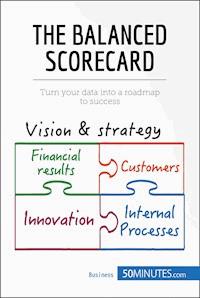
Turn your data into a roadmap to success!
This book is a practical and accessible guide to understanding and implementing the Balanced Scorecard, providing you with the essential information and saving time.
In 50 minutes you will be able to:
• Evaluate company performance and management efficiency
• Focus on all perspectives of the business at once
• Successfully apply the Balanced Scorecard to your business
ABOUT 50MINUTES | Management & Marketing
50MINUTES provides the tools to quickly understand the main theories and concepts that shape the economic world of today. Our publications are easy to use and they will save you time. They provide both elements of theory and case studies, making them excellent guides to understand key concepts in just a few minutes. In fact, they are the starting point to take action and push your business to the next level.
Das E-Book können Sie in Legimi-Apps oder einer beliebigen App lesen, die das folgende Format unterstützen:
Seitenzahl: 21
Veröffentlichungsjahr: 2015
Ähnliche













The Balanced Scorecard
Key information
Name: the Balanced Scorecard (BSC).Uses: the Balanced Scorecard links an organisation’s long term objectives to its daily activities. It is a tool for strategic thinking that can be adapted to suit the organisation’s overall approach.Why is it successful? The Balanced Scorecard gives managers, employees and shareholders a comprehensive view of the company, based on financial and non-financial aspects. The Balanced Scorecard clarifies the short and long term objectives and the strategies of the company. It also ensures consistency between daily activities and the overall vision of the company.Key words:Indicator: qualitative or quantitative information that accounts for the variation of a variable (economic, financial, etc.) for a given time.A means indicator calculates the resources that have been or will be necessary to achieve an objective.A performance indicator measures the performance of the company.Performance: the company’s ability to meet its objectives using appropriate resources at lower costs.Variable: an element that can take on different values according to the group/environment in which it evolves.Introduction
History and context
Before the 1990s, businesses already had access to budgetary and financial frameworks. However, they were often developed by trading societies and industrial companies, often based on old, static information and did not take into account the operational indicators, customers or people. David P. Norton (born in 1941), co-founder of the IT strategy society Nolan, Norton & Company, and Robert S. Kaplan (born in 1940), a professor at Harvard Business School, developed the Balanced Scorecard (BSC) to solve this problem. This tool combines strategy and management and was officially created in 1992 through the article published in the Harvard Business Review by the two American economists, ‘The Balanced Scorecard: Measures That Drive Performance’.
The BSC is a summary of conclusions drawn from a study (which lasted 12 months and was carried out in many different companies) that focuses on the resources available to managers to assess the future performance of their businesses. Norton and Kaplan’s project was created due to the obvious differences between the traditional methods of measuring performance (based only on financial indicators) and the needs of modern businesses.




