


Erhalten Sie Zugang zu diesem und mehr als 300000 Büchern ab EUR 5,99 monatlich.
- Herausgeber: Luath Press
- Kategorie: Geisteswissenschaft
- Sprache: Englisch
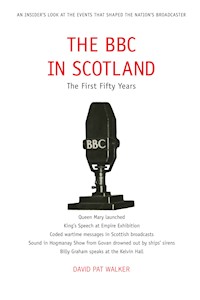
Since its establishment in 1922 the BBC has continually asserted itself as one of the great British institutions at home and abroad. David Pat Walker offers an in-depth analysis of the history of BBC Scotland from its creation in 1923 through to its 50th anniversary in the seventies. Examining how the firm developed over the course of the 20th century, the author portrays how the broadcaster developed its own Scottish identity despite governance from London and how it thrived within the context of the history it reported and created.
Sie lesen das E-Book in den Legimi-Apps auf:
Seitenzahl: 465
Veröffentlichungsjahr: 2020
Das E-Book (TTS) können Sie hören im Abo „Legimi Premium” in Legimi-Apps auf:
Ähnliche




















First published 2011
This edition 2016
ISBN: 978-1-910745-52-6
The paper used in this book is recyclable. It is made from low chlorine pulps produced in a low energy, low emissions manner from renewable forests.
Printed and bound by
Bell & Bain Ltd., Glasgow
Typeset in 11 point Sabon
by 3btype.com
All pictures © BBC unless otherwise indicated.
The author’s right to be identified as author of this book under the Copyright, Designs and Patents Act 1988 has been asserted.
The views expressed in this book are those of the author, and are not necessarily shared by the publishers or the BBC.
© Luath Press Ltd
Contents
Acknowledgements
Chronology
Introduction
CHAPTER ONE
The First Radio Stations
CHAPTER TWO
The Rise of Edinburgh
CHAPTER THREE
Programme Expansion
CHAPTER FOUR
The Renaissance of Glasgow
CHAPTER FIVE
The War Years
CHAPTER SIX
Radio Rules
CHAPTER SEVEN
The Arrival of Television
CHAPTER EIGHT
New Challenges
CHAPTER NINE
A Diversity of Opinion
CHAPTER TEN
‘Tiger at the Gate’
David Pat WalkerAssistant Controller, BBC Scotland.
Acknowledgements
THE FIRST DRAFT OF this book was written shortly after my retirement from the BBC where I had been Assistant Controller, BBC Scotland. At first an idea, it quickly became a reality thanks to the encouragement and generous support of the then Director-General of the BBC, Alasdair Milne.
The BBC’s written archive at Caversham and BBC Scotland’s files were valuable sources, with thanks due to Jacquie Kavanagh and Libby Stanners for their great assistance.
Equally important were the reminiscences willingly given by past and present staff and performers, particularly the few who remained from the earliest days. It was a problem deciding what to leave out.
The book was a personal journey for me. I was fortunate to be able to talk to Edinburgh’s office boy, Tony Cogle, who in 1926 delivered the script of the station’s startlingly effective spoof UK news bulletin to the nearest post office to be telegraphed urgently to London. I became close friends with the Very Rev Ronald Selby Wright who as the Radio Padre incorporated coded messages for MI9 into his weekly wartime broadcast. I also met past members of the Glasgow Orpheus Choir, banned from wartime broadcasting, who could still remember the intervention of Prime Minister Winston Churchill securing their return to the airwaves.
Finally, I must thank Mike Shaw. His unflagging commitment to the completion of the project and additional editorial and photographic research for this account of the nation’s first broadcasters gained willing support from BBC Scotland, and I am grateful that what is quite simply a narrative of perseverance can now be read.
David Pat Walker
Chronology
24 January 1923
BBC secures wavelength (415m) and call sign 5SC from the General Post Office for broadcasting station in Glasgow
1923
Herbert A. Carruthers appointed Glasgow 5SC Station Director
6 March 1923
Opening of Glasgow Station 5SC at Rex House, 202 Bath Street
19 March 1923
First outside broadcast, a live relay from the Coliseum Theatre in Eglinton Street, Glasgow
15 April 1923
First studio broadcast by a minister (Rev John White)
25 April 1923
First outside broadcast with Rev White from the Barony Kirk
31 August 1923
Dramatic excerpts from Walter Scott’s Rob Roy produced by R.E. Jeffrey at 5SC in Glasgow
6 October 1923
Rob Roy repeated as simultaneous broadcast for all BBC stations in the UK network
1923
R.E. Jeffrey appointed Aberdeen 2BD Station Director
10 October 1923
Opening Aberdeen Station 2BD at 17 Belmont Street
2 December 1923
First broadcast in Gaelic by 2BD in Aberdeen
21 December 1923
First Gaelic song recital from 2BD in Aberdeen
23 January 1924
John Reith presides at the inauguration of the BBC’s Glasgow Educational Advisory Committee
February 1924
D. Millar Craig appointed Assistant Controller, BBC in Scotland
February 1924
First ever custom-built schools broadcast to be transmitted by the BBC produced by 5SC in Glasgow and heard by children at Garnetbank School
March 1924
5SC in Glasgow embarks on a series of regular broadcasts of religious services from local churches
7 March 1924
2BD in Aberdeen produces first regular sports broadcasts
March 1924
2BD in Aberdeen broadcasts community singing
April 1924
5SC in Glasgow presents three plays performed by the Scottish National Players
1924
George L. Marshall appointed Edinburgh 2EH Station Director
1 May 1924
Opening of Edinburgh Station 2EH at 79 George Street
9 May 1924
5SC in Glasgow starts regular schools broadcasts
May 1924
2BD in Aberdeen presents own Repertory Players in Macbeth
26 June 1924
Sir Harry Lauder makes his first broadcast from 5SC
July 1924
R.E. Jeffrey leaves 2BD in Aberdeen to become the BBC’s Director of Drama in London and is succeeded by Neil McLean
7 November 1924
Opening of new 5SC premises at 21 Blythswood Square
November 1924
D. Millar Craig made Station Director 5SC in addition to Assistant Controller and Herbert A. Carruthers appointed Head of Music
1924
Eric W. Heddle appointed Dundee 2DE Station Director
12 November 1924
Opening of Dundee Station 2DE at 1 Lochee Road
November 1924
Radio acquires a first place in the crime statistics of Scotland with a police report that ‘during the absence of a family from a house in the West End of Dundee, some person or persons entered and made a clean sweep of a complete wireless set. Nothing else in the house was touched.’
31 December 1924
Glasgow and Aberdeen stations join London at 9.30pm for a fairly muted welcome to the New Year. Dundee closes down at 10.30pm, but Edinburgh abandons London and dances away the night to midnight and Auld Lang Syne
27 July 1925
New long-wave transmitter opens at Daventry
16 January 1926
Father Ronald Knox’s controversial spoof news bulletin Broadcasting the Barricades produced by 2EH in Edinburgh for the whole of the UK
1926
David Cleghorn Thomson replaces D. Millar Craig with title of Northern Area Director (to include Northern Ireland)
1926
George L. Marshall appointed Glasgow 5SC Station Director
1926
J.C.S. Macgregor appointed Edinburgh 2EH Station Director
1 Jan 1927
Staff replace stationery bearing the name British Broadcasting Company with that of the new British Broadcasting Corporation
14 July 1927
Outside Broadcast of the opening of the Scottish National War Memorial on the Castle Rock in Edinburgh by hrh, the Prince of Wales
1927
Gaelic programmes from the Aberdeen station 2BD increased to include a Gaelic Corner ‘for those in the North of Scotland who speak the Gaelic tongue’
1928
Programmes featuring Mod winners and Mod concerts and prize-winners broadcast
24 September 1928
First Scottish News bulletin
30 September 1928
David Cleghorn Thomson’s title changed to Scottish Regional Director
1928–1929
Scottish Regional Plan outlined to curtail local output and achieve full regionalisation of programmes
May 1930
Outside broadcast of the launch of the Clyde-built Empress with estimated world audience of over 100 million
May 1930
Edinburgh staff move into the new Scottish head quarters at 5 Queen Street and later joined by most of the Glasgow staff
29 November 1930
Formal opening of 5 Queen Street, Edinburgh
20 June 1932
Formal opening of new transmitter at Westerglen, near Falkirk, allowing a choice of two programmes on medium wave, one of which became known as the Scottish Regional Wavelength
1933
Moray McLaren replaces David Cleghorn Thomson as Scottish Regional Director on a temporary basis
1933
Melville D. Dinwiddie appointed as Scottish Regional Director
May 1933
First radio play in Gaelic produced by Gordon Gildard who neither spoke nor understood the language
10 January 1934
Series of six fortnightly lessons in Gaelic pronunciation
26 September 1934
Outside broadcast from Clydebank of the launch of Queen Mary by the Queen accompanied by King George V
November 1934
Number of radio licences issued in Scotland rises from 390,000 to more than 500,000
1935
Schools department claims another notable educational first with 762 schools registered as ‘listening’ and 83,000 pamphlets sold for the autumn courses
1 December 1935
The BBC Scottish Orchestra is formally established
28 February 1936
Broadcast of The March of ’45, A Radio Panorama in Verse and Song, written by D.G. Bridson
1 June 1936
Gaelic producer Hugh Macphee moves from Aberdeen to Glasgow
12 October 1936
Burghead chosen as the most northerly transmitting station
3 May 1938
Opening of the Empire Exhibition, including the King’s speech, the largest outside broadcast commitment of its time with over 200 broadcasts in six months
18 November 1938
Opening of new premises at Queen Margaret Drive, Glasgow
9 December 1938
Opening of new premises at Beechgrove, Aberdeen
28 March 1939
First McFlannels broadcast as part of High Tea programme
1 September 1939
Two days before the start of hostilities all regional broadcasting replaced by a single channel, The Home Service
4 December 1939
Lift Up Your Hearts – A Thought For Today starts in Glasgow
4 December 1939
The exercise programme Up In The Morning Early also starts in Glasgow
27 April 1940
BBC Scotland produces first five-minute weekly bulletin of news in Gaelic on the UK Home Service
September 1940
Scottish Half-Hour starts
October 1940
The BBC’s Military Band is based in Glasgow
November 1940
Elizabeth Adair appointed first woman announcer in Scotland
1940
First advertisements inviting engineering applications for ‘Women Operators’ for duty in the Control Room
1940
A special unit for War News established in Scotland
14 March 1941
A large German land mine missed the top of Studio One by less than 50ft and exploded on the other side of the River Kelvin
June 1941
Sir Hugh S. Roberton and the Glasgow Orpheus Choir return to the airwaves at the instigation of Winston Churchill after the conductor had been banned for his pacifist views
1941
Scottish Variety Orchestra formed
1 April 1942
The Radio Padre talks broadcast on the Forces Programme with scripts ‘amended’ by MI9
29 July 1945
The broadcasters return to a peacetime system with the first discernibly Scottish item on the new Scottish Home Service, a religious service in Gaelic
1945
Major programme development to include Scottish Life and Letters, Arts Review, The Guid Scots Tongue, Scottish News, Sports News, Topical News
11 August 1945
Sportsreel takes to the airwaves
27 January 1947
First meeting of the Scottish Advisory Council in Edinburgh
1948
Melville D. Dinwiddie’s title changed from Scottish Regional Director to Controller, Scotland
12 November 1949
Opening of small studio in the Coldside Library, Dundee
1951
McFlannels series on radio ends
1952
Introduction of FM broadcasting on VHF in Scotland
1952
Kirk o’ Shotts developed as the site of the first Scottish television transmitter
15 February 1952
BBC Television service arrives in Scotland
14 March 1952
Formal opening of television service with special programme, Television comes to Scotland
25 November 1952
Last meeting of the Scottish Advisory Council in Glasgow
25 November 1952
Scotland contributes live to the network television programme Other People’s Jobs – The Miner from the Tillicoultry mine
14 January 1953
First meeting of Broadcasting Council for Scotland in Edinburgh
31 December 1953
Scotland produces its first UKHogmanay programme for television from Govan Town Hall with traditional New Year greetings blotted out by ships’ sirens on the nearby river
19 September 1954
Heritage series of 40 radio programmes examining the history, tradition and culture of Scotland
1955
Special Enquiry television programme for UK examining problems of national concern in a local background – housing and Glasgow’s slums
1955
American evangelist Billy Graham’s Good Friday Service from the Kelvin Hall, Glasgow
1957
Andrew Stewart appointed Controller, Scotland
16 August 1957
Scotland-only opt-out On View featuring BBC’s programming in action and transmitted ahead of the launch of Scottish Television’s commercial service
31 December 1957
Scotland broadcasts its own Hogmanay studio party
12 February 1958
The McFlannels broadcast on television
13 March 1958
By-election in Kelvingrove first occasion on which the BBC reports an election campaign in its news bulletins and also presents radio and TV programmes featuring by-election candidates
7 May 1958
First White Heather Club appears as a Scottish opt-out prior to being taken up by the UK network the following year
31 December 1958
Scotland produces Hogmanay for the whole BBC
11 December 1959
Neil Munro’s Vital Spark sets sail for the first time on television
June 1960
Retirement of Kathleen Garscadden from Children’s Hour
1961
Two local radio experiments held in Dundee and Dumfries
November 1963
Panorama produced by London in Scotland angers Glasgow councillors
10 June 1964
Opening of new television studio at Queen Margaret Drive, the first outside London able to make programmes on 405 or 625 lines, attracting BBC 2 interest
1 July 1967
BBC launches regular colour transmissions on BBC 2 network
1965
Scotland hosts television series such as Dr Finlay’s Casebook
1967
The BBC Scottish Symphony Orchestra is established replacing the BBC Scottish Orchestra
1 January 1968
Alasdair Milne appointed Controller, Scotland
1 April 1968
Reporting Scotland launched
April 1968
Where Do We Go From Here? 80-minute edition of Checkpoint examining the mood behind the upsurge of nationalist sentiment
October 1968
Alasdair Milne’s ten-minute speech in Gaelic at Dunoon Mod. The first time a Gaelic speaker on Scottish Board of Management
1969
Scotland gets a colour mobile Control Room and videotape facilities
31 December 1969
Scotland’s first colour programme Ring in the New
1970
Sunset Song starts run of six 45-minute episodes on BBC 2
1970
Scotland hosts Commonwealth Games at Meadowbank Stadium, Edinburgh
4 April 1970
‘Broadcasting in the Seventies’ creates four ‘generic’ radio channels while Scotland retains all the elements of its ‘national’ service as opt-out from the new Radio 4
1973
Robert Coulter appointed Controller, Scotland
6 March 1973
BBC Scotland celebrates its 50th anniversary
John C.W. Reith with BBC Senior Staff(back l/r) G.L. Marshall, first Edinburgh 2EH Station Director; John C.W. Reith, General Manager, British Broadcasting Company; David Cleghorn Thomson, Northern Area Director, title later changed to Scottish Regional Director.(front l/r) E.W. Heddle, first Dundee 2DE Station Director; J.C.S. Macgregor, second Edinburgh 2EH Station Director; D.H. Clark, Appointments; Neil McLean, second Aberdeen 2BD Station Director.(not present, pictured elsewhere) Herbert A. Carruthers, first Glasgow 5SC Station Director; D. Millar Craig, first Assistant Controller for Scotland;R.E. Jeffrey, first Aberdeen 2BD Station Director.
Introduction
ON 6 MARCH 1973, the BBC celebrated 50 years of Scottish broadcasting with a formal lunch held in the Ca’ d’Oro Restaurant in Glasgow. For many it was a meeting of old friends, eager to talk and remember the unbelievable – was it really true that Children’s Hour once dropped the story of the blue and red fairy because an election was pending? This mood of reminiscence continued as the principal guest, Professor Sir Robert Grieve, recalled how he’d first ‘listened in’ with headphones and a simple ‘cat’s whisker’ receiver. Under the gaslight of a tenement house in Glasgow, hearing the London Savoy Orchestra had been an extraordinary experience.
With a fine skill he led his audience forward through the years. Memories of pleasure, and little of violence, an occasional criticism turned to curiosity, and always excitement and enthusiasm.
‘You are the best, but I say it astringently… you’ve had 50 years… you’re so old – you have grown so big. You cannot be dismissed in a few general phrases such as I’ve been using.’
From a corner of the room in which he was speaking the soot-blackened carriage entrance to Glasgow Central Station was clearly visible. It was here that, early in 1923, the General Manager of the British Broadcasting Company, John Reith, had stepped from the London train to meet his Scottish staff for the first time. Had he wished, he could have counted them on the fingers of one hand. Fifty years later, the BBC’s Scottish payroll listed over 1,000 people.
Sir Robert Grieve was right. BBC Scotland, a public service and enjoying considerable status within the community, did merit more than a few general phrases.
David Pat Walker
CHAPTER ONE
The First Radio Stations
THE BRITISH BROADCASTING COMPANY LTD began its first regular broadcasting service from Station 2LO in London on 14 November 1922. The Company (it wouldn’t become a Corporation until the end of 1926) had been formed largely because of government fears that the ‘chaos in the ether’ in America, where over 1,000 stations were fighting for only 89 places on the air, might come to Britain. Determined that UK listening would not suffer a similar fate, the government decided to sidestep future conflict by delivering the whole bag of tricks into the hands of a monopoly.
A series of meetings was arranged – at the first conference no less than 24 manufacturers of wireless apparatus were represented – and after months of argument and negotiation it was finally agreed that there would be a single broadcasting company for the UK. Backed by six of the biggest communication and electrical firms in Britain, the British Broadcasting Company Ltd would have the exclusive right to operate broadcasting stations throughout the country. In return, it would guarantee an adequate service for a maximum number of people. Revenue for the new company, with profits restricted to 7.5 per cent, was to come partly from a share of the government’s broadcasting receiving licence, and partly from royalties from the sale of radio sets and components, all of which had to be made in Britain.
With the ink hardly dry on the finer details (the new Company was not registered until mid-December, and was without a licence until mid-January 1923) the BBC opened its first three stations in London, Birmingham and Manchester. Progress was swift and surprisingly easy thanks to earlier amateur enthusiasts who, now off the air because of the monopoly, frequently found themselves re-employed by the BBC. By Christmas, Newcastle brought the number of new stations to four and next on the list was Cardiff. Then it would be over the border and into Scotland – to Glasgow and then to Aberdeen.
On 24 January 1923, the BBC wrote to the General Post Office in London seeking authority to ‘construct a broadcasting station’ in Glasgow. Broadcasting bureaucracy was still in its infancy and a reply came by return: commence as soon as the station is ready. The wavelength will be 415m and the allotted call sign 5SC. Demonstrating an easy nonchalance the BBC estimated five weeks to completion. Engineers from the Marconi Company moved into the Glasgow Corporation Electricity Supply Station at Port Dundas in the north of the city to install and run a ‘high power’ 1.5kw transmitter, and a search was started for suitable studio and office premises in the city centre.
The British Broadcasting Company’s requestTo the General Post Office to allot a ‘wave length and call letters’ for a station in Glasgow.
The General Post OfficeGives its permission for 5SC to start broadcasting.
Casting around for whatever radio expertise might already exist the BBC soon found two ‘scientific amateurs’ who had been broadcasting on a limited scale in Glasgow for almost a year. Early in 1922 Frank Milligan, a dealer in wireless equipment, along with his friend George Garscadden who owned a household appliance business at Rex House in Bath Street, had taken out a licence to operate station 5MG. From a small room in the city and using a transmitter designed by another enthusiast, J.M.A. Cameron, they had broadcast for a few hours every week. Frequently the main contributor was George Garscadden’s daughter, Kathleen. She was an accomplished pianist and singer and the leading soprano at Park Parish Church, and when the station planned something more complex than songs at the piano the church’s choirmaster and organist, Herbert A. Carruthers, was often asked to help.
5SC premises at Rex House, 202 Bath Street, Glasgow(© Steve Newman Photography)
As a broadcasting package station 5MG contained most of what the BBC needed and without delay the Company set about picking from it for its own station. Herbert A. Carruthers, a man interested in broadcasting and having the kind of organisational and music experience that would enable him to double as conductor of the station’s house orchestra, was offered the post of Scotland’s first Station Director, which he accepted. George Garscadden, the co-founder of 5MG wished to continue with his own business but was offered accommodation on the top floor and attics of his premises at Rex House, 202 Bath Street, and when this was accepted J.M.A. Cameron, now the BBC’s ‘Engineer’, moved in with a great deal of 5MG’s equipment. Kathleen Garscadden was chosen to be an ‘assistant’ and was joined by two others, Alex H. Swinton Paterson and Mungo M. Dewar.
Five staff and some Marconi technicians – not an overabundance of people, but in those days, enough. As the opening date for the new station approached the old hands of 5MG sensed a growing feeling of excitement in and around the city. The Glasgow Herald newspaper had been publishing details of programmes at other BBC stations since January and the staff of 5SC had only one thought in mind – to have their first show over and a verdict, good or bad.
Opening night for the new station was Tuesday 6 March 1923. The transmitter, with its cage-like aerial slung between two of the Port Dundas power station chimneys, was ready and connected to the Control Room in Bath Street by a rented post office telephone line. The evening’s cast of civic dignitaries and performers crammed around the single microphone in the small studio sharing it with the station’s house orchestra while the inevitable pipe band spilled out into the adjoining corridor. Separated from the studio by a thin partition the Control Room Engineer sat watching the minute hand move towards the hour. At 7.00pm precisely he closed a single switch and, following a short burst of music on the pipes, John Reith, the BBC’s General Manager, bent to the microphone and announced 5SC, the Glasgow Station of the British Broadcasting Company, was calling.
The broadcast lasted three and a half hours. All of it was ‘live’ and for those taking part the air seemed to thicken by the minute. The studio, which measured no more than 30ft square, was heavily draped with grey hessian, and had a thick carpeting of felt on the floor. In a corner a small fan did nothing more than suggest ventilation and, despite the invitations to ‘The Opening’ mentioning ‘The Concert Room’, many felt that they were visiting the Black Hole of Calcutta. Notwithstanding these difficulties, however, the next day it was clear that the broadcast had been a complete success. Good reception over a wide area had meant a large number of homes ‘listening in’ and for those without sets, The Glasgow Herald had installed a number of receivers in the city’s Berkeley Hall where the capacity audience had applauded every item loud and long. Describing the evening’s events the next day the newspaper was lyrical in its report:
The aerial slung between two of the Port Dundas Power Station chimneysConnected to Station 5SC’s Control Room in Bath Street by a rented post office telephone line. Port Dundas generated electricity for Glasgow’s trams. The Forth and Clyde Canal can be seen in the foreground.
Front page of the official programmeFor the opening of Station 5SC in Glasgow on Tuesday 6 March 1923.
Running orderFor the opening broadcast of Station 5SC.
Swifter than Mercury from high Olympus the strains of the pipes bore their message to John o’ Groats and Maidenkirk ushering in a new medium of social life and of expanding civilisation.
The Scotsman newspaper, published 50 miles away in Edinburgh, was less enamoured, making no mention at all of the Glasgow opening. Its silence, noted by the BBC, was not unexpected. The earliest government plans for broadcasting had proposed Glasgow or Edinburgh as one of the two Scottish stations, and though the eventual choice of Glasgow had been made on straightforward business grounds, Edinburgh had been less than pleased. Broadcasting, the city had reasoned, was a ‘capital’ matter, inadvertently laying down battle lines that would affect a great deal of the first 50 years of the BBC in Scotland.
5SC’s successful launch, and the flood of congratulations that followed, gave particular satisfaction to John Reith. Twenty-five years later he would write: ‘The General Manager of the British Broadcasting Company Ltd was more than ordinarily interested in the opening of the service in Scotland, for he was a Scot.’ Reith expected much from his fellow countrymen and over the next 15 years he would frequently reach out from London to touch the Scottish operation. For the moment, however, he was content, leaving 5SC in the hands of Herbert A. Carruthers.
During the first few months the station had to generate all its own output. Simultaneous broadcasting – the ability to link stations together to share the same programme – was still some months away and the Glasgow staff found themselves feeding a voracious output. After a normal working day in the office they would gather in the studio for the start of programmes, with Children’s Corner at around 5.30pm. A short interval and then broadcasting continued with a news bulletin at 7.00pm and ran until 10.30pm. For anyone not involved in newsreading, producing, rehearsing or performing, there was a commitment to be out and about in the city talking to the many radio clubs that had sprung up.
Glasgow Station 5SC’s Children’s Corner(l/r) Herbert A. Carruthers, first Station Director and later Head of Music; Alex H. Swinton Paterson (Uncle Alex); Mungo M. Dewar (Uncle Mungo); Kathleen Garscadden (Auntie Cyclone) with Susie the cat on the piano.
As each new station enjoyed a state of virtual programme autonomy, the BBC’s important promise of ‘under central control’ was contrived in various ways. By the selection of ‘suitable’ staff ensuring a unity of purpose and by a nightly news bulletin dictated over the telephone from London to a typist at each station (in Glasgow Mungo M. Dewar admitted to frequently reading a page of the news with an anxious eye on the door waiting for someone to dash in with the next!) and the distribution by post of numerous talks to be re-read at the microphone by local voices. One of the first of these to reach 5SC was a script written by Princess Alice of Athlone on How to Adopt a Child. Finding a female voice proved difficult – people were cautious, fearing that their voices would be distorted – and Kathleen Garscadden chose to read it herself. Unfortunately, the broadcast was heard by her mother who considered it a most unsuitable subject for her young daughter. Later, however, subjects such as The Art of Sweet-Making and Keeping Meals Hot helped to right the balance, as did Kathleen’s boisterous appearances as ‘Auntie Cyclone’ in Children’s Hour.
As the staff of 5SC struggled to keep even two days ahead with their programme plans, music became the mainstay of the output. As well as using the station’s house orchestra – in truth a quartet which could be augmented as and when there was money available – no time was lost in arranging to have music relayed from nearby locations.
Within two weeks of its opening Glasgow transmitted its first Outside Broadcast (OB), a live relay from the Coliseum Theatre in Eglinton Street at 7.30pm on 19 March 1923. Using a single Western Electric microphone buried in the footlights at the front of the stage, no amplifier and a rented telephone line from the theatre to the Control Room at 202 Bath Street, an excerpt from Das Rheingold sung by the British National Opera Company was broadcast to the listeners. A series of broadcasts followed and a new permanent switch was added to the Glasgow Control Room.
Swiftly, broadcasting firsts for Scotland were being notched up. Sunday 15 April marked the first studio broadcast by a minister – the Rev John White – and ten days later there was an OB with him from the Barony Kirk. The clergy were still not well-disposed to what they considered an undue obtrusion on worship and a great deal of perseverance was required. ‘Yes. I will preach into a microphone but I will never pray into it!’, retorted a minister when offered the chance to reach the bedridden and the housebound.
The new station also wanted to try its hand at drama. Plays were known to be popular with London listeners and the Glasgow staff were confident that they could do something similar. Gradually the favourites of the local amateur stage were tempted to the microphone and Glasgow rejoiced on hearing ‘on the wireless’ such people as William Chapman, Jean Taylor Smith, Elliot C. Mason, Cathie Fletcher and R.B. Wharrie. They were the forerunners of the semi-professionals who would take Scottish drama to the forefront of BBC radio over the next 15 years.
The credit for laying the foundations of 5SC’s drama output must go to R.E. Jeffrey, a Glasgow elocutionist and a frequent visitor to the Bath Street studio where he often arranged and took part in music-based programmes. Jeffrey was captivated by broadcasting. He found it exhilarating and exciting and saw tremendous possibilities ahead, particularly in ‘dramatic’ presentations. His ideas were simple, or so it seems now, but at the time were innovative to a degree. He wanted to explore the use of imaginative sound beyond the then staple fare of Shakespearean dialogue and occasional relays from the stage of the local theatre. So far the microphone had been used to present as faithful a reproduction as possible of what was going on around it. Jeffrey’s concept was to make it a part of the production, exploiting its potential for stimulating the imagination. If the eye couldn’t see what was going on, the ear could be persuaded to create a host of plausible images.
Herbert A. Carruthers, the Station Manager, liked the idea and, in any case, was anxious to proceed with some studio-based drama. Jeffery was given the go-ahead and on 31 August 1923 5SC offered the listener dramatic excerpts from Walter Scott’s novel, Rob Roy.
R.E. Jeffrey took the part of Rob Roy and military music was supplied by the band of the 1st Royal Scots Fusiliers who also deftly changed sides and supplied the warring pipe music as well. The choir of The Lyric Club, Glasgow, provided the chorus and even the station’s orchestra was involved. Effects were used frequently – the noises being made by whoever was free at the time – and there was a great deal of clamour at the door to the studio as the warring factions of Scott’s novel arrived and departed on cue.
The next morning the local press hailed it with such phrases as ‘striking new technique’ and ‘brought to life by actors’. They were right. For the first time in broadcasting an attempt had been made to create the sound of events being portrayed – creating actuality. The production had been designed from the start to be broadcast using a mixture of narration and dialogue, a liberal sprinkling of music and effects, and perspectives.
News of the production and its success reached head office in London. By a happy coincidence, two days before the Rob Roy broadcast, experiments using post office circuits to carry programmes over large distances had resulted in the first simultaneous broadcast of a London news bulletin over the 5SC transmitter in Glasgow. It had gone without a hitch and meant that the possibility of passing complete programmes between stations was now a reality. London, casting around for a programme to mark this advance in broadcasting, asked for a repeat performance of the Scottish play and on 6 October 1923, Rob Roy was repeated from the Bath Street Studio in Glasgow, this time as a simultaneous broadcast and was heard by every station in the BBC network.
It was a significant moment for 5SC – the first regional drama production to be broadcast to all stations – but that night the jubilation in the Glasgow studio was tinged with sadness. R.E. Jeffrey’s talent had not gone unnoticed and already the BBC had other plans for him. Their next Scottish station, 2BD in Aberdeen, was due to open on the following Wednesday and he was expected to be there as its first Station Director.
R.E. JeffreyFirst Aberdeen 2BD Station Director who was then appointed Dramatic Director (Head of Drama) in London.
On Wednesday 10 October the BBC arrived in Aberdeen in some force. Accompanying the General Manager was Sir William Noble, a Director of the Company, and Captain Peter Eckersley, the BBC’s Chief Engineer. John Reith was in fine form. A few months before, he had associated himself closely with Glasgow, the city where he had grown up. Now he underlined his northern birth: ‘I am an Aberdonian myself’, he wrote in a preview of the opening day, dismissing the 15 miles or so that separated the city from the town of Stonehaven, where he had been born.
The new station’s importance to the BBC was threefold. It completed the main station ‘spine’ that spread northwards from London, it would be the first of the main stations to include a large element of rural listeners, and if the opening broadcast went as planned – a simultaneous broadcast between Aberdeen and London – the Company could realistically plan for a future when stations would no longer have to supply all their own programme material.
A great deal depended on the success of simultaneous broadcasting. Thankfully it was not seen as a way of enforcing a London monopoly of programmes. In the very week that Aberdeen was to open, Arthur Burrows, the BBC’s first Director of Programmes, had written:
By such a process it could easily be arranged for London alone to provide all the wireless entertainment of Great Britain but such a scheme would meet with early disaster. These islands of ours contain, as every traveller fully knows, various well-defined areas in which the majority of the people have distinct tastes in music and other forms of entertainment. It was in recognition of this fact that certain provincial stations were opened and for the maintenance of programmes catering for local tastes they will continue to be employed. In the future their supporters will have this local fare garnished with the tit-bits from other centres of art and music.
2BD studio at 17 Belmont Street, Aberdeen(l/r) A. Birch; R.E. Jeffrey, Station Director;W.D. Simpson, Engineering; J.M.A. Cameron, Superintendent Engineer (North).
In Aberdeen the morning was going badly for the BBC. Few of the public saw the worried faces among the staff and were unaware that the trunk telephone wires in the north of the country were down because of a severe gale that had swept the country. The opening ceremony for the station, to be carried out by the Marquis of Aberdeen and Temair, was scheduled for 9.00pm that evening. All day engineers worked feverishly to ensure a trouble-free connection out of Aberdeen. The link from the studio at 17 Belmont Street to the 2BD transmitter situated at the premises of the Aberdeen Steam Laundry at 40 Claremont Street posed no problems. In fact that transmitter, housed in the old dye-house, was to give exceedingly good service over the next 15 years. A tribute to the original installation work and the continuing devotion of the commissioning engineers, Messrs Harding, Birch and Burgess, although it has to be admitted that, like the everlasting hatchet, it had had the equivalent of six new handles and three new heads before it was finally replaced.
2BD premises at 17 Belmont Street, Aberdeen(Entrance subsequently established at 15 Belmont Street as part of office development).(© Ritchie Craib)
The worry was the complex of post office lines needed to carry the programme southwards. However, in the event, the broadcast was a success and the simultaneous broadcast arrangements worked perfectly.
The Company’s Chief Engineer, Peter Eckersley, was paying his first visit to Aberdeen. He was so impressed by the occasion that he wrote an account of the day on his return:
The worst is over and from all reports we have ‘simultaneous’ to some effect. Relaxation comes like a ray of warming sunshine after threat of lowering storm. One might almost go and have a sandwich and, if one feels one deserves it, a soda and whisky.
Reception had indeed been good and over the next few days enthusiastic reports poured in. Ironically, one area close by did have problems – Stonehaven, John Reith’s birthplace. Eckersley continued:
… owners of crystal sets were unable to get through but this experience is not necessarily a proof that this class of receiver will not be capable of hearing 2BD as the climate conditions at certain periods were none too favourable.
Returning south the London party had plenty to talk about. The relay to London had been excellent. ‘Not only was the clapping of hands of the audience heard, but even the laughter at the two stories the Marquis of Aberdeen and Temair told,’ reported the London correspondent of The Press and Journal. This was a striking example of the growing efficiency of the broadcasting system.
To begin with, distance had posed problems – anything beyond a few miles causing a considerable drop in quality and reliability. The engineers, along with post office colleagues, had worked hard and long on the problem and now programme transmission over long lines – referred to as ‘land lines’ – was entirely feasible. Now the Aberdeen broadcast was proof that all BBC stations could be drawn together with common programmes of music and speech. No longer was there any fear that broadcasting in Britain might develop along similar lines to that in America where it had mushroomed at great speed, with characteristic energy, and without any method of control whatsoever. In Britain it had been a government decision that the service should be under central control and in the hands of one organisation. Here now was the means of achieving that single standard and one guiding policy.
No time was lost in putting the new system into practice. An obvious first step involved the scripted texts – still being distributed by post from London to be re-read at the local microphones under the description, A Short Talk, as told in London by… Within a week of the Aberdeen opening John Reith wrote in the Radio Times:
In future the following will be broadcast simultaneously: Mr John Strachey’s causerie on books every Monday; Mr Archibald Haddon’s dramatic talk on Wednesdays; the discussion on music by Mr Percy Scholes on Thursdays; and on Fridays the film criticisms by Mr G.A. Atkinson.
These, along with the two general news bulletins broadcast nightly from London, were the first compulsory programmes broadcast by the provincial stations. A few weeks later music was added to the list when Station Directors were told that at least one concert per week was to be taken from London or elsewhere.
These moves to systemise the relaying of London programmes to the provinces did cause some apprehension amongst listeners who enjoyed the local friendliness that was now part of the provincial stations. Sensing this the BBC attempted to allay their fears and in the process defined the reason for, and purpose, of regional broadcasting in a way that was still broadly applicable 50 years later:
We have not the slightest intention of cutting out local programmes. The stations will in no way suffer but will benefit. They are almost in personal touch with their ‘listeners-in’ because people know the artists and officials intimately and it would be as practicable for us successfully to supply and control a provincial broadcasting station from London as it would be to control and supply a local newspaper from London.
By relieving a local station one or two nights during the week we should enable it to achieve a higher local standard. And by relaying the provincial programmes we hope to discover some provincial singers of exceptional talent. They perhaps cannot get to London but they will know that among the many people listening to them will at least be several experts on the lookout for singers and artists of promise.
Confidently on the way to achieving a unified standard of broadcasting, the Company next set about acquiring a larger audience. Many urban areas were still beyond crystal range of the recently established main stations, and cities such as Liverpool, Sheffield, Edinburgh and Dundee kept up a steady clamour of complaint. To satisfy their demands, and at the same time increase the need for more sets and equipment, the BBC proposed setting up 11 new local-power transmitters. These additional stations would make full use of a simultaneous broadcasting system by being linked by land wire to a nearby main station. This would eliminate the need for anything more than a token programme commitment of local material as, for most of the time, the new transmitters would relay the output of their associated station.
G.L. MarshallFirst Edinburgh 2EH Station Director, later Station Director Glasgow, Newcastle and Belfast, then Regional Director and Controller, Northern Ireland.
On the face of it, these relay stations seemed a good idea and one that would be welcomed by the concerned areas. It was a sensible and practicable plan that took into account such engineering nightmares as signal ‘jamming’ and signal ‘shielding’. It would also increase the BBC’s crystal coverage to around three-quarters of the population of Great Britain and it paid due deference to the regional appetite of the provincial audiences. Where it failed was in not anticipating the strong inter-city jealousies that would arise when the main and relay linking was proposed.
There was little love between cities in Britain, and in Scotland, when word came that Edinburgh’s proposed relay station would be fed from Glasgow, there was a distinct chill in the proceedings. Matters were not helped by the Glasgow press. Mindful perhaps of this Edinburgh disdain, when Station 5SC was opened, The Glasgow Herald took the line of most resistance saying, in effect, that if Edinburgh’s application for a wireless station was granted then Dundee would want one – where would it end?
2EH premises at 79 George Street, Edinburgh(Moved to 87 George Street shortly afterwards to secure more accommodation).(© RCAHMS)
In fact the plan to link the 12 new relay stations on a regional basis had ultimately to be abandoned. No-one was more surprised than John Reith who noted: ‘the factor of inter-city civic jealousy had, however, not been reckoned on. It appears that no city counted sufficiently important to have a relay station could listen to the programme of any station other than London without loss of dignity.’
He and the company bowed to the inevitable: the new areas were linked with London where, they said, the best programmes came from.
The Edinburgh relay station, call sign 2EH, was opened on 1 May 1924 with a public relay meeting and concert held in the city’s Usher Hall. The opening ceremony was performed by the Lord Provost of Edinburgh (Sir William Sleigh) and amongst the notables on the platform were John Reith and George L. Marshall, the newly appointed Edinburgh Station Director. Significantly, the programme opened with the sound of the chimes of Big Ben striking 9.00pm. True to their promise the BBC had linked the Edinburgh station to London.
2EH Control Room79 George Street, Edinburgh.
The first local broadcast from the Scottish capital took place the following afternoon at 5.00pm. It was a talk for children and it marked the first use of the BBC studio at 79 George Street. The premises were small and had been rented from Messrs Townsend and Thomson, a city music shop. The Station Director’s office was a throughway to the Control Room and the studio, measuring about 20-feet square and draped with the usual heavy curtaining, was an adaptation of one of Townsend and Thomson’s front rooms.
The transmitter for 2EH was a little more than a mile away in a wooden hut in the quadrangle of the Edinburgh University buildings at Teviot Place. The aerial was suspended from a chimney and, no doubt because of the city’s many hills and high tenements, reception was generally poor. The Station’s Engineer-in-Chief, J.A. Beveridge, took every possible care but the equipment was not up to the task. A replacement was sought and a few months later, after the first Wembley Exhibition, the Wembley transmitter, which had been erected for special broadcasts, was taken to Edinburgh to replace the original installation. The new equipment had more than twice the power of the original and in order to accommodate it the wooden hut had to be extended by building an additional storey. The replacement did help to alleviate some of the reception troubles and none too soon. To the concern of the civic fathers a few of the city’s listeners had already gone to considerable lengths to achieve good reception and in some cases aerials had been stretched from one side of the street to another – just over the live tramway wires!
Edinburgh staff (1924)(l/r) Alec Cameron; Nancy Forres; H.K. Brown; Mamie Irvine; G.L. Marshall, 2EH Station Director; Betty B.C.; Jacky Beveridge; (at front) Tony Coghill, Office Boy.
Within six months of the opening of Edinburgh the final piece of the Scottish jigsaw was set in place. As prophesied by The Glasgow Herald, albeit tongue-in-cheek, the BBC acquired premises in Dundee to house 2DE, the last but one of its relay chain. For a time negotiations had been touch and go. After promising a station as part of the relay development the BBC later withdrew on the grounds that stations were being allotted according to population and that Dundee would not qualify. It took some weighty negotiations by the two MPs for Dundee and pressure from a committee appointed by the Lord Provost before Dundee went back on the list, this time to stay.
First Dundee staff(l/r) L.W. Benson, Asst Maintenance Engineer; Miss B.L. Braid, Secretary; Alex Cameron, Engineer-in-Charge; Miss G.E. Cuthbert, Ladies Organiser (‘Auntie Gwen’); H.W. Dewar, Asst Mt Engineer (front) Eric W. Heddle, 2DE Station Director.Miss GE Cuthbert left the station after barely a year, but would later make her mark as Wendy Wood, one of the early members of the National Party of Scotland (a forerunner party to the SNP).Cuthbert was her name from her first marriage. Her maiden name was Meacham, but she adopted her mother’s maiden name, Wood, ca 1927.(Extract from Dundee Courier © DC Thomson & Co Ltd)
The opening ceremony and programme took place in the Caird Hall on 12 November 1924. Eric W. Heddle was present as the new Station Director while the BBC’s London representative was Vice-Admiral C.D. Carpendale, Assistant General Manager. The formal part of the evening was conducted by the Lord Provost of Dundee, Sir William High. In the various speeches reference was made to the fact that, ‘it was an illustrious citizen of Dundee, the great Dr Bell, who was the real father of the telephone.’ It was a pertinent theme for the occasion as the Dundee station would depend on the telephone system’s network of lines for over 80 per cent of its programmes leaving the small studio at 1 Lochee Road to produce little more than some light music and the ubiquitous children’s broadcasting.
2DE premises at 1 Lochee Road, Dundee(Indicated by arrow as the building was demolished though one to its rear can still be seen).(© University of Dundee Archive Services)
2DE studio premises at 1 Lochee Road, DundeeArtist’s impression shows the BBC’s offices (ex-Gilroy’s) in the centre of the image with a tram approaching from the right. The ornate garden at the back was probably the result of the licence allowed the artist at the period.(© RCAHMS)
Scotland could now boast four BBC stations, quite a feat of expansion in 20 months. All had the ability and will to broadcast programmes either for local consumption or to a wider audience: the determining factor being status – whether a main or a relay station – and financial well-being. These were days of carefree experiment and the broadcasters cast their net wide as they sought ideas for their programmes. The public’s initial fear of broadcasting – every station had its own story of a first-time broadcaster passing out in front of the microphone – was now giving way to native curiosity and boldness. Station waiting rooms – those that hadn’t become extra office accommodation – thronged with hopeful enquirers: ‘Ah wis wantin’ a try on the wireless.’ ‘Yes. Are you a singer or what is your special line?’ ‘Aye. I’m a singer.’ ‘Have you sung in public?’ ‘Oh, aye. I hiv sung at a lot o’ smokers and I aye get an encore.’
2DE Control RoomAlex Cameron, Engineer-in-Charge.(© DC Thomson & Co Ltd)
Mixed in with those seeking musical fame were others wishing to use the BBC’s SOS message facility – usually misguidedly. The SOS




