


Erhalten Sie Zugang zu diesem und mehr als 300000 Büchern ab EUR 5,99 monatlich.
- Herausgeber: The History Press
- Kategorie: Fachliteratur
- Sprache: Englisch
On 24 June 1948 the Soviet Union abruptly closed all land and water access to the Western Sectors of Berlin. Over 2 million civilians, dependent on the surrounding territory and the West for food, fuel, and other basic goods, were suddenly cut off from all necessities of life. The Western Allies had the option of withdrawing their garrisons and allowing the Soviet Union to take control of the entire of city, or of trying to supply the city by air. Never in history had 2 million people been supplied exclusively by air before. None of senior military commanders believed it could be done. But the political leadership in London and Washington insisted that it must be done. So the largest and most ambitious Airlift in history was set in motion. It began without the West really knowing what the Berliners needed in order to survive - much less how much those supplies weighed. It was launched despite an almost complete absence of aircraft and aircrew resources in Germany and despite the serious inadequacies in airfields and air traffic control. It was launched without airlift expertise in theatre or a unified command structure. But once it was took wing, it flew and turned into something that not even its originators and advocators had ever imagined or expected.
Sie lesen das E-Book in den Legimi-Apps auf:
Seitenzahl: 598
Veröffentlichungsjahr: 2011
Das E-Book (TTS) können Sie hören im Abo „Legimi Premium” in Legimi-Apps auf:
Ähnliche



















THE BLOCKADE BREAKERS
THE BLOCKADE BREAKERS
THE BERLIN AIRLIFT
HELENA P. SCHRADER
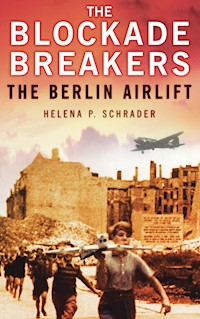
Cover illustrations: Front: Children in Berlin play ‘Airlift’ (Landesarchiv Berlin). Back:‘In the winter of 1948/9, the desperate situation in Berlin forced both air forces to fly in visibility far below the safety minimums established.’ (US National Archives and Records Administration).
First published in 2008
This edition published in 2011
The History Press
The Mill, Brimscombe Port
Stroud, Gloucestershire, GL5 2QG
www.thehistorypress.co.uk
This ebook edition first published in 2011
All rights reserved
© Helena P. Schrader, 2008, 2010, 2011
The right of Helena P. Schrader, to be identified as the Author of this work has been asserted in accordance with the Copyrights, Designs and Patents Act 1988.
This ebook is copyright material and must not be copied, reproduced, transferred, distributed, leased, licensed or publicly performed or used in any way except as specifically permitted in writing by the publishers, as allowed under the terms and conditions under which it was purchased or as strictly permitted by applicable copyright law. Any unauthorised distribution or use of this text may be a direct infringement of the author’s and publisher’s rights, and those responsible may be liable in law accordingly.
EPUB ISBN 978 0 7524 6803 7
MOBI ISBN 978 0 7524 6804 4
Original typesetting by The History Press
To all the men and women who contributed – in whatever way – to the success of this remarkable and unique operation
CONTENTS
List of Maps
Acknowledgements
Preface
1. Crisis in Berlin
2. The Long, Difficult Road to a Dangerous Dead End
3. So What Do We Do Now?
4. Humble Expectations
5. Berliners, East and West
6. The Airlift Begins
7. Dedication without Glory
8. An Army of Worker Ants
9. ‘Is Anyone in Charge Here?’
10. Political Prisoners
11. The Airlift Falters
12. General Winter versus Father Christmas
13. Winning the First Confrontation in the Cold War
14. ‘Hurrah! We’re Still Alive’
15. Conclusion
Appendix I: Timeline
Appendix II: Contributions to the Berlin Airlift
Appendix III: Monthly Flights and Tonnages
Appendix IV: Casualties
Notes and Sources
Bibliography
LIST OF MAPS
MAPS
Map 1: Germany: States within the Zones of Occupation.
Map 2: A diagram of the Berlin Airlift, September 1948.
Map 3: Flight paths of the Berlin Airlift.
ACKNOWLEDGEMENTS
This book could not have been written without the contributions of the many men and women who took the time to write, email or call me with their personal stories. Almost all who contacted me felt their own contribution had been small; most were hesitant about whether their stories were important enough for a book, yet it is precisely the contributions of everyone from cook to flight captain that I would like to honour here. I do not wish to distinguish between them now and I thank them all equally.
I also wish to thank Jonathan Falconer of Sutton Publishing who guided me gently but firmly in the right direction. Without his faith in this book, it would never have been written.
PREFACE
It was cold, wet and windy, as so often in Berlin. The dark clouds hung low over the city. Smoke oozing from the chimneys of the power plants and factories was trapped under the overcast sky, wrapping the city in illsmelling smog.
Nothing in the city had seen paint or fresh plaster for nearly a decade, and so the grime of the smoke-laden air had blackened the faces of the buildings. What buildings there were, that is. Whole sections of the city resembled the ruins of Pompeii and Herculaneum: the pattern of the streets was visible, yet between the streets only heaps of rubble lay helpless and inert in the gloom.
But in Berlin in the winter of 1948 many of these ruins were inhabited. People lived in the cellars and in the decapitated lower stories of halfdestroyed apartment blocks. They housed under the rubble in windowless caverns created by partially intact rooms. They had built shacks out of broken wood and masonry in the hulking wrecks of what had once been gracious courtyards. Plywood, newspaper and tarpaper ‘glazed’ the windows of these dwellings, and chalk messages scribbled on the dirty façades told visitors where the former residents of ruins might now be found.
The once gracious boulevards of the mutilated city led away from the dead heart towards the suburbs. The trees flanking the wide avenues struggled to survive; those trees, that is, that had not been incinerated by the fire-bombs or splintered by artillery and tanks. On the strip between the avenues, remnants of summer vegetable gardens lay fallow awaiting the return of spring. Open trams clanked along ringing their bells to warn the horse-drawn carts and bicycles to move out of the way. Workers in dungarees and young men in made-over uniforms with shabby briefcases clung to the outsides of the trams.
Gradually the buildings rose from the rubble in greater number and height. Their façades were pock-mocked from artillery and small-arms fire; large sheets of naked brick were exposed where the once elegant façades had shattered and fallen off. Here and there signs indicated a shop selling coal or food, and before these, crowds of women wearing head-scarves and shapeless winter coats stood awaiting their turn. And over all droned the continuous, relentless hum of aircraft engines.
A four-engine aircraft broke free of the cloud right over the rooftops of the five-storey buildings crowding the large airfield just south of the city centre. It was already on final approach. Undercarriage and flaps were down as it sank below the rooftops, level with the apartments on the top floor. The approach lights it was following ran through a graveyard and guided the aircraft on to a broad, flat airfield. The Skymaster throttled back, sank the last few feet and settled down hard with a short squeak of rubber on concrete and a puff of rubber smoke.
Ahead, an RAF York was just turning off the runway, and on the parallel runway a Dakota was taking off. Aircraft lined the taxiway like dutiful ducks waiting for the chance to trundle onto the runway and take off. On the hard standings beside the semi-circular terminal buildings which embraced the airfield from the north-west, dozens of Skymasters, Dakotas, Yorks and Hastings stood like docile workhorses, while crates of tinned goods, sacks of flour and bags of coal were offloaded into waiting lorries. Crews of stevedores worked like brigades of frenzied ants to strip the aircraft of their cargoes in the shortest possible time. Their faces, hands and dungarees were black with coal. Soldiers in jeeps dashed between the lorries delivering weather reports and orders to the aircrews.
From the cockpit of an aircraft that had just shut down its engines, the crew emerged, leather flying jackets concealing the rank insignia of the officers. Already the cargo of coal was being moved from the aircraft to the waiting lorry at a hectic pace. The pilot’s trousers were crumpled from the flight, his hands dirty from the grime that had infiltrated every compartment of the aircraft, the coal dust from today, the flour from yesterday. . . .
From under the concrete overhang of the terminal two small civilians emerged. They moved forward hesitantly, intimidated by the bustle, dust and noise of the offloading, the purposeful movements of the heavy lorries and the hectic frenzy of military vehicles. Both civilians were dressed in their best. The taller wore hat and gloves and high-heeled shoes. The shorter wore a puffy skirt, white ankle socks and a ribbon in her hair. The woman had a bouquet of flowers, while the young girl clutched a brown teddy bear with the fuzz worn off its bottom.
The pilot noticed the approach of the two civilians and paused. This was not the first time he had been confronted with such a delegation. Grateful Berliners had increasingly brought tokens of gratitude to the men supplying the besieged city by air. They had brought hand-made gifts and family heirlooms, little plaques and inscribed books – anything they had salvaged from the ruin of their city and could afford to give away. Yet the flowers seemed like a tiny miracle. Where had this woman found fresh flowers in the dead of winter in a besieged city where every square inch of fertile soil was devoted to producing fresh things to eat? But here they were, a tiny burst of colour in the gloom of a wintry dusk, a remembrance of better times and a promise of a better future.
The pilot expressed his thanks to the donor and took the flowers. The ceremony, neither the first nor last of its kind, appeared to be over. But then the little girl offered a gift too. She offered the pilot her teddy bear. The gesture was not easy for her. She was fighting back tears as she handed him her beloved. ‘Please take my teddy bear,’ she pleaded in broken English. ‘Good care take of him for me.’ The pilot was unable to ignore the girl’s tears. He did not need to take the teddy bear to understand the depth of gratitude expressed by the gesture. He assured the child that she could keep her treasured teddy. But the girl insisted. It would, she told him, bring him and his comrades good luck on their flights to Berlin. She knew because this teddy bear had comforted and protected her through the dreadful nights of cowering in the cellar beneath her home. Then, too, the drone of aircraft was unrelenting and merciless. Then, too, the four-engine aircraft filled the air, laden with heavy cargoes intended for Berlin. The fleet of aircraft behind the pilot bore the same markings as those that had filled the air then: the white star of the USAF or the roundels of the RAF. But now the pilot, who for all she knew had been flying then too, had become a friend.1
Chapter 1
CRISIS IN BERLIN
24 JUNE 1948
Just before midnight on the evening of 23 June 1948, the electricity network in the Western Sectors of Berlin collapsed without warning. Shortly afterwards, in the early hours of 24 June, the sole railroad artery into the city from the Western Zone, roughly 100 miles to the west, was closed to rail traffic. Likewise, the only autobahn by which the Western Powers moved personnel, goods and equipment to their garrisons in Berlin, was shut down. At roughly the same time, all barge traffic into the Western Sectors of the city was brought to a complete halt.
As the city awoke to a new day, the Soviet-controlled radio dryly announced to Berliners that: ‘due to technical difficulties’ the Transport Authority of the Soviet Military Administration in Germany (SMAD) had been forced to suspend both passenger and goods traffic on the railroad between Berlin and Helmstedt, the latter being the closest point in the British Zone of Occupation. But Berliners rapidly realised that much more was at stake. The triumphant Soviet Union, which had defeated the once invincible German Wehrmacht, captured Berlin and annexed large parts of Germany, was determined to eliminate an irritation. It wanted to get rid of a patch of territory, deep within its own Occupation Zone, that was not completely under its control: the Western Sectors of Berlin. For whatever reasons, the Soviets had chosen not to use their vastly superior military strength, but to employ an economic weapon instead. Just how powerful the chosen weapon was, however, was recognised at once by those with insight into the situation. The director of the utilities monopoly in the Western Sectors of Berlin, BEWAG, reported the same day that without electricity supplies from the power plants controlled by the Soviets, demand for electricity in the Western Sector could not be met. Furthermore, not only had the Soviets cut off the electricity produced in their own zones of occupation, they had halted the deliveries of coal needed to keep the few small and obsolete power plants located within the Western Sectors of Berlin operating. Therefore, even if electricity consumption was drastically reduced, the Western power plants would only be able to operate for roughly 10 days before their reserves of coal ran out. After that there would be no electricity in the Western Sectors of Berlin at all. No electricity would mean that the city’s water pumps and sewage systems would cease to function. It would mean that the most important components of the public transport system, the trams and the underground railway, would come to a halt, the factories would have to close down and massive unemployment would ensue. In short, the entire economic activity of the city would cease.
This was not all. The Soviets also announced that all deliveries of goods, including food, medicine, coal and liquid fuels to the Western Sectors of Berlin from the Soviet Zone of Germany and Soviet Sector of Berlin were forbidden. Goods from the Soviet Zone, which completely surrounded Berlin, would henceforth only be delivered to and distributed in the Eastern (Soviet) Sector of the city. Control-points were established on the roads leading into the Western Sectors of Berlin from the surrounding Soviet Zone and all along the inner-city border between the Soviet Sector and the Western Sectors of Berlin. These measures, it must be noted, were not aimed solely at ‘capitalist industry’ but rather at every man, woman and child living in the Western Sectors of Berlin. To take just one simple example, the children of West Berlin were dependent upon the surrounding rural areas of the Soviet Zone for deliveries of 50,000l of milk daily. From one day to the next, that vital source of nutrition was cut off.
Throughout the city, stores, factories and private households had reserves of one sort or the other. Shop shelves and warehouses, household cupboards and pantries were not all empty, but the inhabitants recognised how precarious their situation was. Berlin had not been self-sufficient in food, much less energy, for decades. Traditionally, both came from the surrounding regions, near and far. With these abrupt measures, the Soviets had cut off the Western Sectors of Berlin, in which between 2.1 and 2.2 million civilians lived, from all sources of food and energy. Like a medieval city surrounded by a hostile army, the Western Sectors of Berlin were under siege.
The economic situation in the city was already dangerously fragile. At the end of the Second World War, industrial production in Berlin had been reduced by bombing and the final battle for Berlin, to just half of the 1936 levels. During the period of exclusive Soviet occupation, industrial capacity had been reduced even further by the systematic deconstruction of anything that appeared still functional, and the wholesale removal of their components from Germany to Russia in the name of ‘reparations’. Although by 1948 factories were struggling to re-establish themselves, clearly the economy was still frail and vulnerable. Furthermore, that industry was completely dependent upon raw materials and component parts being imported into the city.
In consequence of the war, vast portions of the city’s housing were uninhabitable, and the public transport system was severely lamed by the destruction of the city and the expropriation of rolling stock and rails by the Soviet Union. Telecommunication service had been cut to less than 1 per cent of pre-war levels in the immediate postwar era and was far from recovered. Unemployment was high, over 15 per cent, but wages were almost worthless because of the confused currency situation. As of 24 June 1948 there were two currencies in circulation in Berlin; one of them was illegal in half of the city, while the other was virtually worthless. It was therefore hardly surprising that the black market was flourishing, while honest workers fainted from inadequate nourishment. The daily ration was still only three-quarters of the daily minimum recommended by the Red Cross.
Coupled with this dire economic state was an explosive political situation. Although the vast majority of the elected members of the City Council were members of non-communist parties*, the Communist Party of Germany exercised an effective veto over all political decisions via the Soviet Union, which possessed a veto in the occupation administration of Berlin, the Kommandatura. The Soviets had, among other things, prevented the democratically elected mayor from taking office. To make matters worse, the council members found it increasingly difficult to meet and make decisions, because whenever they tried to attend council meetings they were subjected to harassment and physical abuse from crowds of pro-Soviet agitators. Indeed, the delegates representing the vast majority of the Berlin population found that they were repeatedly prevented from going to their offices and performing their duties because their offices lay in the Soviet Sector and violent protesters blocked their way. They were not accorded police protection from the Soviet-controlled police force.
It was not only the politicians who were subject to terror. Ordinary citizens – journalists, professors, and scientists – ‘disappeared’ with increasing frequency. They were dragged from their beds in the dark of night by men often wearing the uniform of the city police. They were arrested without warrant and sent without counsel or trial to Siberia or the concentration camps in the Soviet Zone that were still operating. Meanwhile, orders had also gone out to the Berlin Fire Department that engines located in the Eastern Sector of the city were not to respond to alarms from the other side of the Sector border.
In short, by the end of June 1948, most city-wide services had ceased to function, from the municipal authorities and police, right down to the fire department and utilities. The city was officially divided into four sectors, but in reality torn in two: East and West; and to make the situation more absurd, one half of the city, the West, was under siege while the other half, the East, was not.
Yet Berlin in June 1948 was still one city. There was no wall surrounding it or dividing it in two. No less than 170,000 workers, who resided in the unaffected Eastern Sector of the city, had jobs located in the besieged sectors, while an estimated 45,000 residents of the besieged sectors worked in the East. In addition, countless residents had family and friends who lived on the opposite side of the political divide. Although they would discover that they were subject to ever more rigorous searches to prevent the movement of foodstuffs and other goods across the zonal border, the movement of people – and so the movement of information, ideas, and opinions – within Berlin was not yet prohibited. The city was thus at one and at the same time both divided and whole.
A second anomaly was almost as curious. Although the Western Sectors were clearly surrounded by an enemy army, they were ‘defended’ by the enemy as well. The army which encircled and besieged them, the ‘Red’ Army of the Soviet Union, was still officially allied to the United States, Great Britain and France, whose armed forces occupied the besieged sectors of the city. The Western Allied Forces of Occupation in Berlin numbered roughly 8,500 men: 5,000 Americans, 2,000 British and 1,500 French. They faced 18,000 Red Army troops inside the Soviet Sector of Berlin and roughly 300,000 Soviet troops in the surrounding Soviet Zone.
It was these foreigners, the wartime allies of the Soviet Union, which were the actual target of the Soviet measures. The method chosen to dislodge them from the Soviet Zone was, however, indirect. The immediate victims of the Soviet siege were the civilians living inside the Western Zones, yet the transparent objective was to make life within the Western Zones so intolerable that the population would force the Western Allies to retreat, leaving the Soviet Union in control of the entire city.
It was up to the Western Allies to find a solution to their predicament. As Clausewitz had written more than a century earlier, it was up to the defenders of the status quo to decide whether they preferred to preserve peace by surrendering to the aggression of the enemy or risk war by resisting. The Western Allies were given a choice between withdrawing from Berlin and thereby sparing the civilian population the hardships imposed by the siege, or of remaining and demanding that the civilian population – their former enemies and defeated subjects – endure hardship and discomfort for the rights of their erstwhile enemies and present occupiers to stay in Berlin.
Chapter 2
THE LONG, DIFFICULT ROAD TO A DANGEROUS DEAD END
RELUCTANT ALLIES
Before examining the Western response to this crisis, it is worth considering how the Western Allies got themselves into such an absurd situation in the first place. The position of the Western Allies in Berlin had its roots in the Second World War, which had been fought jointly by Britain, France, the Soviet Union and the United States in order to crush National Socialist (Nazi) Germany.
The four victorious powers were from the start strange bedfellows, who had been dragged into a war they did not want by the aggression of Nazi Germany. Britain had been the first of the Four Powers to attempt to call a halt to Nazi aggression by declaring war on Germany after its invasion of Poland on 1 September 1939. France reluctantly followed the British lead, but the Soviet Union was at that time an ally of Nazi Germany and very happy to participate in the invasion and partition of Poland. In the following months, while the Soviet Union engaged in aggression of its own against Finland, it tolerated indulgently Hitler’s invasion of Norway, Denmark, Holland, Belgium, France, and eventually Greece. Not until the German Wehrmacht rolled across the Soviet border on 22 June 1941 did the Soviet Union recognise and treat Nazi Germany as an enemy.
The United States was the last of the powers to join the conflict. Strict neutrality at the start of the war had turned into open support for the British after President Franklin Roosevelt’s re-election in the autumn of 1940. Thereafter the United States adopted a policy of increasing support for the UK and, after 22 June 1941, the Soviet Union. This support was primarily financial and economic in the form of loans and supplies, but included military components such as weapons, munitions, and naval escorts for convoys to the mid-Atlantic. Nevertheless, the support stopped short of war. America had declared itself the ‘arsenal of democracy’ but hoped to avoid taking a direct part in the conflict. It was not until the Japanese attack on Pearl Harbor on 7 December 1941 that the US was dragged into the Second World War. Even so, it is doubtful whether the United States would have gone to war against Germany if Hitler had not taken the initiative to declare war on it on 11 December.
By the time the United States entered the war against Germany, France had been out of the conflict for roughly eighteen months. The French Army had surrendered on 22 June 1940 after just six weeks of fighting. A rump puppet-state existed in the South of France, while the northern districts were occupied by the Germans. Remnants of the French Army had escaped to England, and in the French colonies some elements continued to favour the struggle against Germany while others favoured accommodation with the ‘New World Order’ created by Nazi victories. Thus in the critical years, when the tide finally turned against Germany and the bloody victories were being won, France was not a significant partner; the three nations that defeated Germany were the British, the Russians and the Americans.
It is important to remember that while the British and Americans shared a common heritage, language, and system of government that made them friends as well as allies, the Russians shared none of these. Since its inception in the Bolshevik Revolution of 1917, the Soviet Union viewed both Britain and the United States as arch enemies. They were representatives and advocates of the hated capitalist system of oppression – something that, according to communist theology, was doomed. The Soviet Union had engaged in ideological warfare against both Britain and the United States throughout its entire existence. The necessity of accepting British and American aid during the near-fatal struggle against Nazi Germany had not in the least changed the ideological position of the leadership in the Kremlin.
The ideological and political differences between the Anglo-American Allies and the Soviet Union were reflected in their war aims. Even before the US entry into the war, the British and Americans had agreed on their postwar vision: namely, no territorial aggrandisement by the victors and the right of liberated peoples to self-determination.
The Soviet Union never subscribed to these aims. On the contrary, Stalin made his goals explicit in a statement to the Yugoslav communist leader Tito in 1944 when he stated: ‘whoever occupies a country also imposes his own system. Everyone imposes his own system as far as his army has power to do.’1 Thus while the Western Allies prepared to march into Germany, thinking that their job was to eliminate an aggressor and free the way for a restoration of the status quo ante, the Soviet Union saw the Second World War as a continuation of their fundamental struggle against the capitalist system. While the Soviet Union might have been forced into tactical retreat or alliances – whether with Hitler’s Germany or the capitalist powers of Great Britain and the United States – at no time did the Soviet Union give up its long-term goal of world communism.
In the short term, however, the Soviet Union was dependent on American food, supplies and equipment to sustain its fighting capabilities, and was unable to drive the Germans off its territory without incurring unsustainable casualties. It needed Western help to defeat the Nazi threat. Under these circumstances it was forced to compromise with the West, and it was in this period of pre-victory cooperation with the West that a series of decisions were taken concerning the future administration of a soon-to-be-defeated Germany. These decisions were taken incrementally during a succession of wartime meetings between the respective heads of government and in committee at the working level. The result was a consensus based on the fact that Germany would be occupied jointly by the three victorious parties (Britain, the Soviet Union and the United States), and that that joint occupation would take the form of Zones of Occupation, each roughly equal in territory, population and economic potential. Due to the symbolic and psychological importance of Berlin as the capital of Germany, it was also decided that Berlin too had to be occupied jointly. This was interpreted to mean that each occupying power would control a sector of Berlin.
Geography determined that the Soviet Union, whose Red Army was advancing from the East, would be given its Zone of Occupation in the eastern part of Germany, while the Western Allies would occupy the western portions of Germany. Initial plans saw Berlin on the border between East and West. Later, however, the border of the Soviet Zone moved roughly 100 miles further west, leaving Berlin deep inside the Soviet Zone of Occupation. This meant that the Western Sectors of the city were no longer a contiguous and integral part of their own Zones of Occupation, but became small islands of Western authority within the Soviet Zone.
At the time this system of occupation was agreed upon, none of Germany was occupied and everyone involved in the discussions was more concerned about winning the war than about the details of a still somewhat visionary postwar world. The issue of access routes to the Western Sectors of Berlin through the Soviet Zone was not considered important enough for it to be documented in any protocol. At all events, once the Allies’ armies found themselves in occupation of Germany and had taken up their position within the agreed-upon Zones, the Soviets de facto controlled the access routes. At no time did the Western Allies enjoy free movement of goods and persons across the Soviet Zone. It was only with much irritation and many difficulties that the Western Allies were even allowed to take control of their Sectors in Berlin as agreed upon. After the Red Army had won the race to seize Berlin, it remained in sole occupation of the entire city for roughly two months, while the Western Allies had to negotiate the terms and dates on which they would take control of their Sectors. These negotiations proved difficult and tedious and there were those in the West who felt that they should not withdraw their troops back to the agreed-upon zonal borders until Western troops were allowed into Berlin. These voices were overruled, however, by those – notably General Eisenhower himself – who were anxious to cooperate with the Soviet Union in the long run. They felt it was a matter of goodwill to withdraw within the agreed Zones of Occupation and trust the Soviets to let Western troops into Berlin in due course.
Map 1: Germany: States within the Zones of Occupation.
Two things need to be noted about this stage. Firstly, Western demands for ‘free and uninhibited’ access to Berlin were ‘noted’ but not accepted by the Soviets and, secondly, the manner in which the Western Allies were allowed to establish their garrisons in Berlin was a foretaste of things to come. When the first American and British troops set off on their separate ways to garrison their respective Sectors in Berlin, they encountered immediate and arbitrary interference at the zonal border. The Soviets not only prevented the Western Allies from making a triumphal entry into Berlin, but they demonstrated their ability to completely close down access to Berlin any time they wished to do so.
Colonel Howley, the newly appointed deputy commandant of the American Sector in Berlin, had his advance party arbitrarily reduced in size from 500 officers and men in 120 vehicles, to just 37 officers, 175 men and 50 vehicles before being allowed to enter the Soviet Zone. Then, just outside Berlin, this much-reduced force was again stopped by Soviet troops and blocked from entering the city itself. His column was diverted to Babelsberg, just outside Berlin, and prevented from proceeding for roughly one week. Finally, with an exaggerated display of Soviet hospitality, the Americans were allowed to enter Berlin. They were received at their future barracks by Soviet troops who withdrew with waving flags and fixed bayonets in a splendid parade march. They then discovered that their quarters had been stripped not only of furniture but of every oven, stove, light fixture, electrical outlet, window-pane, sink and toilet. The once well-appointed accommodations of the German Wehrmacht had been rendered entirely uninhabitable by the Soviet units that had housed there for two brief months before turning them over to their American ‘Allies’. The American troops had to spend their first days in Berlin camping out in the forest of Grünewald.
The Soviets employed similar tactics against the British. First the advance unit of the Royal Army was told that ‘all’ the bridges across the Elbe in Magdeburg were ‘closed for repair’ and that they would have to wait indefinitely for repairs to be effected. Unfortunately for the Soviets, the British officers commanding this unit were experienced veterans and they very rapidly found a bridge which the Soviets had forgotten to guard. They redeployed and crossed the Elbe after only a few hours’ delay. On reaching Berlin they again encountered bridge problems. In this case, a bridge over the Havel – clearly marked on their maps as intact – had been destroyed by the Soviets ‘by accident’. Again the leading elements fanned out to look for alternatives, which they successfully did. To the sound of fife and drum the British advance unit entered Berlin in parade fashion, but they too had to openly camp on the former Olympic playing fields. Meanwhile, the advance party of the Royal Air Force, that had arrived to assume command of Gatow airfield in the British Sector of Berlin, was herded into a hangar and detained for 24 hours without any explanation, much less an apology from the Soviets.
BERLIN: ZERO HOUR
Berlin, which the Western Allies had now occupied after a long and costly war and after considerable diplomatic squabbling with the Soviets, was anything but the proud capital of a great, albeit defeated, nation. One of the German communists who returned to Berlin with the Soviet Army in May 1945 described it as ‘a picture of Hell’. He found flaking ruins and starving people shambling about in tattered clothing, dazed German soldiers, drunk Red Army troops, long queues with buckets at pumps for water, and felt that everyone he met looked ‘terribly tired, hungry, tense and demoralised’.2
This was not surprising. Fifty thousand Berliners were estimated dead. Many of the bodies had not had a burial and were rotting among the ruins, in streets, cellars, abandoned factories and military installations etc. Shortly before surrendering, fanatical Nazis had ordered the city’s underground system flooded, and thousands who had taken refuge there, before the advancing Soviet tanks, troops and artillery fire, had been drowned. Their bodies only gradually worked their way into the canals and lakes.
Berlin’s water mains had been ruptured in 3,000 places during the fight for the city and only 23 of the city’s 84 sewage pumping stations were functioning.3 The canals were filled not only with corpses and debris but with sewage as well, contributing further to growing health hazards in a city where only 9,300 hospital beds were available compared to a wartime capacity of 38,000. The water was unsafe to drink without boiling it first, but there was no electricity or gas with which to heat stoves and so boil the water. Coal and wood were also in short supply and typhoid and dysentery were spreading, the latter killing an estimated 65 out of every 100 babies born.4 Furthermore, 1.5 million Berliners were homeless out of an estimated population of 3.3 million. In some boroughs of the city, those which had sustained the greatest bomb damage or those areas most fiercely contested in the final land battle for Berlin, the situation was even more acute. In central Schoenberg, for example, 45 per cent of all housing was completely destroyed, 15 per cent was heavily damaged, 35 per cent partially damaged and only 5 per cent still intact.5
Transportation was virtually at a standstill. Of the 150 bridges that had linked the various parts of the city across the rivers Spree and Havel and across the canals, 128 had been destroyed, and there were fewer than 40 buses and 100 street cars still in operable condition. There was absolutely no petrol for either public or private vehicles.6 Three out of four of the city’s fire stations had been destroyed and of the 125,000 street lights that had once lit up the city, only 4,000 were still standing.
This situation at German surrender was the result of war damage both through Anglo-American bombing and Soviet house-to-house fighting, but in the two months that followed, when the Soviets occupied the city alone, these desperate conditions were aggravated by a Soviet policy of private and public theft. While the individual Soviet soldier was given a blank cheque to take whatever he could lay his hands on and carry, the Soviet state set about systematically stealing anything that was not already destroyed. This policy was officially described as ‘reparations’, but the reality was that vast amounts of equipment and industrial plants were dismantled and transported out of Germany, although very little of it was ever reassembled in the Soviet Union. The Soviet policy of dismantling whatever remained of the German transportation and industrial capacity impoverished Germany without enriching the Soviet state or people. Berlin’s telephone system, which before the war had serviced over 600,000 customers, was systematically taken apart until, by the time the Americans arrived, only 4,000 telephone connections remained.7 In consequence of Soviet ‘reparations’, 90 per cent of Berlin’s steel industry, 85 per cent of the optical and electrical industry, and 75 per cent of the printing industry was removed by the USSR.8
One particularly significant casualty of the Soviet demolition policy was the only major power plant located in the Western Sectors of Berlin. By the time the Western Allies arrived in Berlin this vital power plant (but not those plants in the Eastern Sectors of the city) had been dismantled by the Soviets and its component parts had disappeared into the ‘East’, leaving the Western powers dependent upon electricity supplied by the still-functioning power plants located in the Eastern Sectors of the city. Clearly, ‘reparations’ for war damage could have been collected more easily from a power plant located in the East. The dismantling of the only power plant in the Western Sectors of Berlin was a targeted move designed to weaken the position of the Western Powers in Berlin before they even arrived.
Such calculations were not noted at first. The first Western troops to arrive in Hitler’s capital were too stunned by the scale of the destruction to fully grasp the Soviet game. What they saw instead was a shattered city, home not only to the decimated population of the city itself, but also to hoards of refugees displaced by the war. Although the figures for Berlin alone are not recorded, General Lucius Clay, the US Military Governor in Germany, claimed that 4.5 million German ‘expellees’ from the Sudetenland, Hungary, Czechoslovakia and Poland, as well as 2.1 million refugees from other parts of Europe, had swollen the population of the US-occupied territories.9 A portion of these refugees, including former Nazi slave labourers and German refugees who had fled before the advancing Red Army, were stranded in dysfunctional Berlin simply because it had been a magnet and transportation hub until the last days of the war. When the city was surrounded by the Red Army, and the entire transportation network collapsed towards the end of the war, these refugees were trapped in the dying capital. Vast numbers of both ‘expellees’ and ‘refugees’ were now far too weak to continue their trek on foot.
Weakness was widespread because no one was getting enough to eat any more. The German system of provisioning the city had collapsed entirely in the last days of the war and so the Occupation Powers were responsible for supplying a city which had not been self-sustaining for generations. For the West this had been another surprise gift from the Soviets on their arrival in Berlin: the Red Army abruptly announced to the new Western commandants that now they were in Berlin, ‘of course’ they were entirely responsible for feeding the people in their respective Sectors, not from the Soviet Zone surrounding the city but from their own Zones, more than 100 miles away at best. In short, the Soviets dumped the provisioning of over 2 million people in the Western Sectors of Berlin on the Western commandants – without making the slightest concession with regard to the means of transporting those supplies into the city from the West. Initially, however, access was not the issue. The issue was simply finding enough food to prevent a catastrophe.
Even in peacetime, Germany as a whole had imported up to 30 per cent of its food. During most of the war, Germany had drawn upon the agricultural resources of the countries it had conquered from Norway to Italy and from the Aquitaine to the Ukraine. Hunger was a new phenomenon for the Germans, and it was spreading rapidly. The newly liberated populations of Western and Eastern Europe had known hunger under the Nazis and now they claimed their own harvests, while extensive war damage and the slaughter of farm animals had reduced the productive capacity of what was left of Germany. Adding to the problem was the fact that roughly one-third of Germany’s pre-1936 territory (and a larger portion of its agricultural capacity) had just been annexed by the Soviet Union/Poland. Given the fact that the remaining rump state had to support a population swollen with refugees, it was clear that a crisis was in the making. The Occupation Powers were forced to fix rations at between 950 and 1,150 calories per day, or ‘only half the caloric content deemed essential by nutritional experts to support a working population and about one-third of that available to the American people’.10
This was the situation in Germany in the summer of 1945, a point in time which the Germans came to call ‘Zero Hour’. The complete and utter defeat of Nazi Germany, not just the unconditional surrender of Hitler’s armed forces, had been achieved. This was the moment when the victors came together to work out a blueprint for the postwar world.
BLUEPRINT FOR A POSTWAR WORLD
Both Great Britain and the United States came to the first postwar summit conference, held at Potsdam between 17 July and 2 August 1946, with a very strong commitment to continuing the ‘good working relationship’ they had developed with the Soviet Union during the war. By contrast, the Soviet leadership came to the conference fully conscious that the Soviet Union was more powerful than it had been at any point in its history and that its armies were in occupation of vast areas of rich industrial and agricultural territories that were now theirs to exploit. From the Soviet point of view, the time for compromise with the ideological enemy was over. It was time instead to end the distasteful, tactical alliance with the class enemy and resume the strategic struggle against the capitalist powers.
This clear difference in attitude made it easy for the Soviet dictator, Joseph Stalin, to outmanoeuvre his counterparts. Stalin was also advantaged by the fact that both the United States and Great Britain were represented by new heads of state. Harry Truman had assumed the presidency unexpectedly at the death of President Roosevelt in April 1945, and as a result of a surprise victory in the General Election, Clement Attlee replaced Sir Winston Churchill in the very midst of the Potsdam Conference in July 1945. This left Stalin as the only veteran of what would later be called ‘summit diplomacy’ at the conference table in Potsdam.
Stalin won the first round before the conference was even convened. He did so by simply presenting the Western leaders with important fait accompli on vital topics that were supposed to be discussed and agreed at the Conference. Stalin had redrawn the map of Europe, turning over vast portions of Germany to the Poles, and annexing other parts directly into the Soviet Union along with large areas of what had been Poland. As one historian put it: ‘All in all, Stalin had redistributed a quarter of Germany without a word or by-your-leave’ to the West.11 In addition, the Soviet Union had installed a puppet government in Warsaw, ignoring the Polish government in exile, which was still recognised in the West as the legitimate government of Poland. The only concession that the West gained was the belated acceptance of France as a ‘victorious power’, but only on the condition that France’s Zone of Occupation be carved out of the British and American Zones; the Soviets gave up not one inch of territory to accommodate an ‘ally’ that from the Soviet point of view had never participated in the war.
At the conference itself, Stalin masterfully agreed to all the high-sounding principles that his Western Allies favoured, from ‘democracy’ to ‘freedom of the speech, press and religion’, but he carefully inserted the caveat that these rights would be exercised ‘subject to security requirements’ thereby creating an excuse for inhibiting them all. Both the Soviet Union and the West agreed on the need to ‘de-Nazify, demilitarise and de-industrialise Germany’, but the tactics for pursuing these aims were left intentionally vague. While all three Powers agreed on the need to prohibit Germany from the production of war materials, to limit the production of industrial products which could contribute to war production, and to reconstruct ‘peaceful’ and agricultural production, they were not in agreement on the size, nature or source of reparations. In fact, on the issue of reparations, Stalin singularly failed to get his way. By now the Western Allies had seen at first hand just how profound the destruction of German industrial capacity had been and they had had their first taste of reparations ‘Russian-style’. It was rapidly becoming clear to experts and observers that the Soviets had been plundering without accounting ever since they crossed the German border, and that they plundered most thoroughly in those areas which they later turned over to the West.
A more important factor dictating Western firmness on the issue was the fundamental difference in the very concept of reparations. The Western Powers, being good capitalists, wanted Germany to pay reparations out of production and/or earned income. The Soviets wanted to expropriate the means of production. The West correctly foresaw that reparations in the Soviet manner would render Germany incapable of economic recovery, much less sustained growth. It was this, not any miserliness with respect to what the total sum might ultimately be, which made any agreement on reparations impossible.
Potsdam failed to produce any clear guidelines for the reconstruction of Germany or indeed any concrete agreements on key aspects of its recovery. There was no agreement on the reconstruction of transportation and communication networks, the re-establishment of a sound currency and banking system or the introduction of common policies on prices, wages, exports etc. Instead of establishing the framework for pursuing postwar recovery, the ad hoc wartime structure of joint, indeed unanimous, decision-making for anything affecting Germany in its entirety coupled with ‘absolute power’ for the individual Military Governors within their own Zones was retained.
The situation in Berlin was a microcosm of the situation in Germany as a whole. All decisions affecting Berlin ‘as a whole’ had to be made unanimously in the Kommandatura, yet the individual Sector commandants retained the right to rule their Sectors like absolute despots. The first meeting of the Kommandatura was a miniature version of the Potsdam Conference. Here, too, the Soviets presented the West with a series of important fait accompli. The Soviets blandly announced that ‘naturally’ all the orders they had issued while in sole occupation of the city had to be left intact and unquestioned ‘until the Kommandatura saw fit to change them’. While this sounded reasonable enough, the Soviet veto in the Kommandatura meant that every single act of the Soviet Occupation Powers, from the day they took control of the city in May 1945 until the Western Powers arrived in July, was now immutable. As one observer put it:
The Western Allies woke up to find that they had accepted a civil city administration in which the majority of the key posts were held by Communists; a banking system that was Communist controlled; a police force commanded by a Communist convert and staffed by Communists; a trade union system in which three quarters of the executive belonged to the Communist Party; a press set-up in which news and newsprint were freely available only to the Communist newspapers; a radio that broadcast nothing but Russian propaganda, and rationing so arranged that the easiest way to subsist was to be a Communist.12
Far less obvious to the newcomers was the very subtle work which the Soviet cadres had been conducting for months to control the German political scene. Unlike the Western Allies, particularly the Americans, who arrived in Germany with the perception that all Germans were Nazis or their willing followers and that the country was collectively guilty for all the crimes committed in its name, the Soviets arrived in Germany with an ideological framework for differentiating between ‘good’ Germans (i.e. communists) and ‘bad’ Germans (everyone else, who could be labelled either ‘fascist’ or ‘capitalist’ as convenient).
Even before the end of hostilities, German communists, trained in Moscow during the war years, were working systematically to take control of all self-help groups that sprang up in Germany when the existing infrastructure disintegrated. In this manner, they took over almost anything that vaguely hinted at self-government. They were aided in their work by a genuine, domestic movement in favour of communism.
The German Communist Party (KPD) had a very long and heroic history. In the last free election in Germany before the Nazi seizure of power, the KPD polled a full 17 per cent of the vote and was the third largest party in parliament after the Nazis and the Social Democrats (SPD). The first victims of Nazi oppression had been communists (and socialists), even before the Jews. The two institutions, with the highest percentage of members executed by the Nazis for opposition to the Nazi regime, were the German General Staff and the German Communist Party. For many former rank-and-file members of the German Communist Party, the arrival of the Red Army on German soil really was viewed as liberation.
Surviving German communists who thought their time had come at last were frightfully disappointed. The Soviets ensured that within the KPD all power went to those German communists who had been living in the Soviet Union and trained in Moscow. These cadre leaders made it equally clear that they would tolerate neither criticism nor discussion within the party. There was only one right answer to any question, and that was the answer provided by the party leadership in Moscow.
While this policy worked openly in most areas occupied by the Red Army, the returning communist leadership had clearly been briefed on the fact that the Western Allies would be in occupation of roughly two-thirds of Berlin. As a result it was decided that subtler methods were called for, and the leader of the KPD, Walther Ulbricht, openly told his close followers that the objective in Berlin was to ‘appear’ democratic while retaining control of all key organisations. The favoured means of doing so was to appoint a ‘technocrat’ – preferably an academic or intellectual with no party affiliation – to the figurehead top position in any organisation or governing body and ensure that a communist was the ‘deputy’ with the real power. Ulbricht specifically ordered that the mayors of the respective boroughs of the city should be known communists only in the traditional strongholds of the KPD such as Wedding and Friedrichshain. In upper-class suburbs such as Zehlendorf, conservative politicians should be appointed mayor, while in much of the city Social Democrats should be ‘allowed’ to hold office.
Meanwhile, the SMAD worked diligently to ensure that the Communist Party would win the next municipal elections. This was a two-pronged attack. On the one hand the KPD was given almost limitless resources with respect to such things as paper allocations for leaflets and posters, petrol rations for functionaries and agitators to travel around the devastated country, special rations and better housing for loyal party members and – perhaps most enticing of all – jobs for their followers. On the other hand, and simultaneous with this overt political campaign, was the establishment of a covert police network. Wherever the Red Army went it brought the Soviet Secret Police, then known as the NKVD, with it. As with the Gestapo, the NKVD infiltrated into civil society with the purpose of observing, identifying and eliminating elements that looked independent, intelligent and spirited enough to cause ‘trouble’. Troublemakers could be sent either to concentration camps taken over from the Nazis, such as Bautzen in Saxony, or sent to the Gulags in the Soviet Union.
Within a short time of moving into Berlin the Soviets had re-established an efficient Communist Party machine run by Soviet-trained Germans and supported by the Soviet Secret Police. They expected that between the carrot (better rations, housing, jobs) and the stick (fear of disappearing into a concentration camp or Gulag), they would be able to ‘win over’ the German population to communism.
Against this highly planned, well-funded and efficiently executed political programme, the West had literally nothing to offer. The policy of ‘collective guilt’ meant that the Americans particularly were suspicious of all Germans, while British and American democratic traditions were based on a plurality of competing parties. In short, the Western Allies were scrupulously careful not to favour one party over another, a position that was reinforced by the fact that there was a Labour government in the UK which inevitably sympathised with the SPD, while the American authorities were more conservative and almost as suspicious of the SPD as the KPD.
Given the greater resources and unabashed support of the Soviets for the KPD, it is astonishing that the German people did not simply embrace communism. But they did not, largely due to the fact that the political class in Germany had strong memories of the KPD’s pre-war policies and, after their experiences with the Nazis, a healthy hatred of totalitarian parties of any colour. While the Right hated the communists as much as ever, the SPD remembered vividly the tactical swings of the KPD which had periodically treated the ‘social fascist’ SPD as a greater enemy than the Nazis. For the ‘man on the street’ the KPD was simply too obviously ‘the Russian Party’, and the man on the street already had good reason to hate the Russians.
The Germans were not the only people in Europe who failed to recognise the superiority of the Soviet system and embrace it with joy. In November 1945, the Hungarians elected a new parliament in which only 18 per cent of the votes went to the communists. A week later the Austrians went to the polls and the communists reaped less than 5 per cent of the vote.13 At the same time, the NKVD in Germany must have been reporting the fact that despite all the advantages showered upon the KPD and its members, the SPD was gaining strength at the expense of the KPD. Stalin quickly concluded that the German working-class movement could no longer ‘afford’ to be splintered into two parties. It was time to merge the KPD and SPD into a single ‘Socialist Unity Party’ which could represent all ‘progressive’ elements in their struggle against the ‘reactionary’ forces of capitalism and fascism.
A bitter battle for the votes of the registered members of the SPD ensued. A KPD attempt to take over the leadership of the two parties via a coup in the respective executive committees was foiled by the secondary SPD leadership, which rebelled against their own executive. They demanded a referendum among party members and this was set for March 1946. At issue was whether the two parties should merge or not, and the referendum was hotly contested and anxiously monitored by the Occupation Powers. When the day of the referendum rolled around, it was so obvious that the vast majority of SPD members would vote against a merger of the two parties that the Soviet Union felt compelled to intervene on the side of ‘progress’. ‘Due to procedural errors’ no voting was allowed to take place in a number of key boroughs of the Soviet Sector. In those boroughs where voting was initially allowed to proceed, Soviet troops arrived shortly after the opening of the polls, and results already registered were confiscated while those people in line to vote outside were dispersed by force.
Unable to prevent or stop voting in the Western Sectors, however, the Soviets were forced to rely on terror tactics to attempt to discourage participation in the referendum. They spread rumours that the Soviets would punish anyone who did not vote the ‘right’ way and threatened leading SPD figures personally and directly. Altogether these tactics worked well enough to convince almost a third of the registered SPD members that it was too dangerous to vote. Of the 23,000 SPD members who did vote in the referendum, 20,000 voted against a merger with the KPD; but the Socialist Unity Party (Sozialistische Einheitspartei Deutschland – SED) was founded anyway in the Soviet Zone/Sector. In the West there continued to be two leftist parties, the increasingly strong and self-confident SPD and the old KPD, which was now also going under the name of Socialist Unity Party (SED), and was run by Moscow.
This referendum had an impact far beyond the two leftist parties who contended it. The Soviet tactics of denying voting opportunities, confiscating results and harassing voters of the socialist Left was a clear alarm signal to everyone that the Soviet Union would under no circumstances tolerate other classes or parties inside the territories under its control. If the German working class in ‘Red’ Berlin was to be denied their right to have a say in the future of their political parties, then it was obvious to thinking voters with liberal or conservative leanings that they would be disenfranchised in any political system controlled by the Soviets. Any illusions about the tolerance of the Soviet Occupation Power for political diversity died as a result of this referendum.
The Western Powers were experiencing a less spectacular but no less profound disillusionment with Soviet policies of their own. Unlike the SED founding, which represented an open confrontation and final break between the Soviets and the democratic Left, there was no one issue which crystallised the conflict between the Soviets and the Western Powers. Instead, there was a continuous struggle over virtually every aspect of governing Germany and Berlin. Although conflicts were often individually minor, they were cumulatively vital. What the Western Powers discovered in a year of painstaking efforts at cooperation, both at the summit and the working levels, was that it was impossible to come to agreement with the Soviet Union about anything having to do with the reconstruction of Germany. Since everything had to be agreed unanimously, this meant that no progress towards the reconstruction of Germany was being made whatsoever.
At first the Soviets were energetically supported in their obstructionist tactics by the French. The French came to the Allied Control Council and Kommandatura late (only after Potsdam) and with huge chips on their shoulders about having been left out earlier. They were insecure in their place among the ‘victorious powers’ and no doubt acutely aware of the absolute contempt of the Germans, who remembered all too well that the French Army had been defeated soundly in just a few weeks in 1940. The French were determined to punish Germany for this humiliation and distract world attention from the fact that the bulk of the French had happily collaborated with the Germans for the better part of the war. They worked diligently to reduce Germany to a rump, agricultural state incapable of ever again being an industrial, much less military, power. They laid claim not only to Alsace-Lorraine but the Saar and the Rheinland as well. They pursued a reparations policy that was only marginally less rapacious than the Soviet one. Indeed, the French state set about dismantling any industrial capacity that was modern and sophisticated, from watch-making to surgical equipment, not to mention factories for aircraft, automobiles and telecommunications.
Like the Soviets, it was not only the factories that were dismantled and taken away, but skilled workers as well. These were deported to France and put to work rebuilding the stolen factories. In parts of Germany entire forests were felled, destroying 500 years of careful forest management. Meanwhile, in the Control Council the French vetoed American proposals for a central German transport agency. They refused to allow the German labour unions to organise on a national basis. They prevented the establishment of national political parties in Germany. They even stopped the free movement of goods and people between Zones. In this manner they hoped to prevent Germany from ever becoming a unified nation again. What they achieved was the complete breakdown of a Four Power government and an end to the Potsdam system.
FACING UP TO REALITY
The United States was in the enviable position of not suffering from any kind of war damage and of having a powerful domestic economy. As it became increasingly evident that there was no progress being made towards postwar reconstruction, America could have turned its back on Germany and Europe and washed its hands of the whole mess. That it did not do so is to the credit of President Truman, his Secretary of State, General George Marshall, and the American Military Governor in Germany, General Lucius Clay.




