


Erhalten Sie Zugang zu diesem und mehr als 300000 Büchern ab EUR 5,99 monatlich.
- Herausgeber: Ediciones metales pesados
- Kategorie: Geisteswissenschaft
- Sprache: Englisch
The book "The body as a machine" explores the historical process of medicalisation in Chilean society, mainly focusing on the labour force. It highlights the transformation of medicine from a private sphere concerned with individual care to a social phenomenon encompassing various collective dimensions. The book argues that the rise of the liberal oligarchic state, rural-urban migration, and the emergence of a professional medical elite contributed to the socialisation of medicine in Chile. This process involved the standardisation and regulation of the population through medical interventions and establishing a comprehensive healthcare system.
Sie lesen das E-Book in den Legimi-Apps auf:
Seitenzahl: 271
Veröffentlichungsjahr: 2023
Das E-Book (TTS) können Sie hören im Abo „Legimi Premium” in Legimi-Apps auf:
Ähnliche




















Intellectual Property Registration Nº 2023-A-8095
ISBN: 978-956-6203-47-6
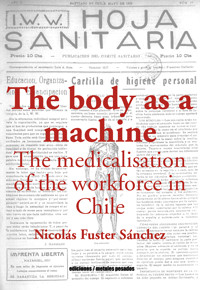
Cover: I.W.W. Hoja Sanitaria, mayo 1926, Chile.
Cover design and digital layout: Paula Lobiano
Translated: Rocío Pozo Peña
First published 2013, El cuerpo como máquina. La medicalización de la fuerza de trabajo en Chile, Ceibo Ediciones, Santiago de Chile.
De esta edición:
© Nicolás Fuster Sánchez
© Ediciones Metales Pesados
E mail: [email protected]
www.metalespesados.cl
Madrid 1998 - Santiago Centro
Teléfono: (56-2) 26328926
Santiago de Chile, julio de 2023
Index
Prologue. Towards a workers’ morality: the medicalisation of the workforce in Chile and its lines of flight Diego Rivera López
Introduction
Chapter I. Medicine and Power: Some intelligibility guidelines. From Foucault to Rosen
18th-century healthcare administration in the European city: from the welfare model to the medical police model
Medicine and the city in the 19th century: from medical statisation to the medicalisation of the workforce
Chapter II. Science at the Fatherland’s Health Service: Medical Device Development in Republican Chile
New physicians, new knowledge, new objectives
State and University: a strategic alliance for the legitimisation of medical science
Scientific medicine and healthcare institutions: the battle to monopolise medical knowledge and practice
Chapter III. Development of Urban Medicine in Chile: the Medicalisation of the Popular Space of Santiago During the 19th and Early 20th Centuries
Santiago’s demographic expansion in the 19th century and the growth of the city panic
Public Hygiene and the social significance of the medical dispositif system
Medicalising Santiago’s Urban Space: Public Hygiene as a Standardisation Technology
The medicalisation of popular housing: public hygiene to modernise the workforce
Chapter IV. Medicine for the Workforce: Medicalisation for the Enlightenment of Chile’s Proletariat
Colonial Welfare and Social Discipline: Political and Economic Precedents
The Popular World’s Proletarianisation Process: Political-Economic Background to an Enlightenment Notion of Labour
Association, medicine and enlightened working-class culture
From mutualist organisation to self-management of healthcare: the medicalisation of the workforce and the objectification of enlightened workerism. 1850-1927
People’s Organisation for mutual aid: Developing a comprehensive medicine for working people and their communities
Enlightened workerism and self-governed healthcare: The Polyclinic and the I.W.W. Sanitary Bulletin 1922-1927
Overview and Synthesis
Prologue Towards a workers’ morality: the medicalisation of the workforce in Chile and its lines of flight
Diego Rivera López
Introduction
Be consistent with your ideas and show solidarity with us in this modest work.
It is not a reproach, comrade; it is a call we make to you.
Juan Gandulfo, Hoja Sanitaria, I. W. W.
Translating this book into English implies updating some discussions to a framework that does not need it. One of the most exciting things about The body as a machine is operating as a document with its articulation. However, after a health crisis embodied during the pandemic, how we conduct our research methods requires some elements which must be shown.
Years after this book, Bruno Latour1 with an ironic gesture stated that now (during COVID-19 emergency), we cannot avoid that non-humans as microbes can be their own actors and are capable of building social relations. Or, in a similar frame, bodies have multiple ontologies enacting in different spaces2, opening research questions and reminding us that the relationship between politics, health, biology, and what we understand as life is now open.
The intention in bringing back a discussion of the medicalisation of the workforce in Chile goes beyond getting a book on a foreign language or recovering a sociohistorical approach. It is possible to think of the situated character3, as more than a synonym of local in the way of composition of phenomena that we call social. The possibility to relate the different strata interacting into shaping, and regulating a problem is still open, especially in times of neoliberal intensification.
The reception in the field
This book has had a special reception in the humanities, social and medical sciences. We divided the lectures of the book into epistemological approaches and problems.
In terms of historical theory, this book has been received as a document of a background of health and medicine in Chile. Fuster’s archive work lets research in several frames. It rebuilds the set of relations that shape national nutrition4, the place of the body in the medical view5, and the ways of institutionalisation of medical knowledge6 meanwhile perform public7 or pharmaceutical discourses8910.
In another way, in the modernisation and formation of the Chilean State, we found special attention to the sort of conflictive relations that shape what we understand for condition and its implications for power exercises11. Fuster’s work is part of the political need to build a national project with a workforce and better ways of capital accumulation using a human engine12. It is one of the approaches that insert him into the Latin American studies of social medicine.
Particular attention has the functional classification dimension, objectivations13 and modular behaviours14, and its effects on the society normalisation, even its contradictions15, which the post-structuralist research approach of Fuster explains it. Therefore, the methodological contribution is highlighted16.
Also, the legitimation of medicine in the intellectual field got attention in terms of an area and its effect as a hygienist device17 of capitalist development18. In that sense, its place as a field of knowledge lets medicine and medicals take place as legitim power.
Opening the discussion to contemporary problems, the adoption of neoliberal nomenclature, especially in individual management of social issues, we found studies highlighting the work's centrality. Although, we must consider that the results that reference Fuster do not adopt this approach from Marxism and hold its critical apparatus. Particularly, relational and critical research19 from the notion of experience, transgressions of personal limits and its practices20, performing its production of subject 21.
Unfortunately, the final statement of the book and the possibility of thinking the power beyond the state had lower attention and just considered strategies of an organisation or nomenclature22. Nevertheless, resistance is viewed in the working-class press23 as part of a repertory of self-psychologisation and medicalisation of its claims.
The body as a machine, ten years after
One of the most exciting things about this research is the impossibility of locating this work in sociology, medical anthropology, philosophy, or history. It is, in a Foucauldian way, porous.
Furthermore, this impossibility has something which made this book particular; its lack of a traditional theoretical “frame” at the beginning. Classic social sciences books often start with a state of discussing a topic, but this book has not. The body as a machine uses a critical apparatus, presenting the reader with an articulation of epistemological approaches which structure the text.
In the beginning, we saw how medicalisation had intervened in body and individual behaviour, its space, and every social relation reminding us of biomedicine’s meddling. This process lets the author precisely explain some of their hypothesis—first, his attention to demographic expansion and its imbrication with modes of accumulation. As a Foucauldian assumption, Fuster’s attention to the effects forces the reader to review how emerged normalisation tools are directly proportional to technological advances and specialisation. For example, the apparition of populational statistics, mortality and birth rates or urban disinfection programmes.
Using these analytical tools, Fuster presents how Chile emerges as a study case. His focus is on how the first social organisations collected their discomfort to build what we know today as collective medicine beyond the State.
In that sense, we could divide the book among its research objectives. Unfortunately, the temptation of this text is paying attention to the object that articulates the theoretical connection: the development of a worker’s morality.
This lecture holds in Fuster’s hypothesis. To study workers’ medicalisation in Chile between 1842 and 1925, specifically during the formation of the modern Chilean State, he presents some ideas which let the reader understand how, when, and why biomedicine colonises spaces that are, apparently, only social. First, we highlight how the Chilean Oligarchic State and its transforming of the productive and political system were accompanied by a hygienist inspiration. It is precisely the process that lets medicine turns to the collective, installing epistemological and institutional bases for its socialisation. Second, its effect on cities development, occupational and productive twist inaugurating a constant medicalisation process in Chilean society. Lastly, an institution directly affected by this process is the workers’ families. State’s intervention with a hygienist approach changes social dynamics and how they understand us—in Fuster’s words, producing an objectivation of a workerism24 in accordance with a civilisational illustrated discourse.
We are employing the book’s main contributions to the academic field. As the text shows, classic approaches to social science and health establish causality from something that we could name “history of totalities”25, which considers a teleological narrative of knowledge and medical practices, avoiding power relations which made medicine a science with the field, object, epistemology, and space of deployment.
Workers’ morality and the IWW: some lines of flight
Consequently, the critical apparatus needs a key concept that articulates the theoretical truss. Fuster uses the concept device in the translation, but we will use dispositif26. Notably, it emerges as a network that interweaves heterogeneous elements, which operate as a game with different discourses, changing positions and making possible some practices. In the case of the text, Chilean modern medical dispositif found in the workforce is based on its development and legitimacy. The foundation of a lack of the lecture is one of the main contributions of The body as a machine. Identifying the medicalisation process as a power space capable of objectifying modern workerism lets the reader understand its political potential. A text as a document to re-think class contradictions, self-organisation, and workers’ mutuals in a neoliberal context with problematic sublimation of the social and the self with health as articulators.
This ambivalent dimension should be noted if we want to bring this discussion to the present. For instance, Clara Han27 considers Chilean contradiction from the precarity concept. The author focuses on the historical condition of the lumpenproletariat, the State’s neglect, and victims of informal work dynamics from a material perspective. Likewise, it proposes it as a common condition of humanity that could acquire substance through attention and singularity. Furthermore, in this perspective that considers anthropologic, political, philosophical, and sociological frames, precarity implies a political condition in which subjects are precarious, like embodied vulnerability. Thus, social structure performs a precarity’s emergence that, in an insecure28 environment, encourages joint problems managed as individual problems.
In that sense, the conditions of economic exploitation and their modes of subjectivation are not static and correspond to a socio-historic construction that lets us cartograph their dynamics. An activity orchestrated by and as a matrix of power reminds us of what philosophy is and its place.
It is possible to think not only about the conditions of accumulation and their effects but also about the centrality of the problem of power in precariousness: the body. Considering that Foucault gave us a body29 to problematise, some points must be identified to keep developing precarity production.
The body is moved by rules, a culture, a time, a set of strains and disputes that finish in its incorporation. The winners of history and its ways of subjection – the medicalisation, for example- the science, objectivity, and its right discourse-the medicine, among others-the procedures or mechanisms configurators of subjectivity- the disease or the health-are part of the body: field of battle, and spoils of war 30.
As Fuster said, the body is a non-orthodox archive, trapped in a series of regimens that model it. Remembering from Foucault that the body is broken by work, rest, and life as an extension; it is forged by resistance. Considering these processes as part of governmentality, we should apply our analysis to technics influencing behaviour and political possibilities. Governmentality is a set of institutions, proceeds, research, and strategies to exercise power. Nevertheless, considering the population as a political-economic tool and a security dispositif. In Foucault, if we apply government techniques with any objective, it is equally essential to disentangle the object of those decisions. Mainly: the constitution of the public is a political problem.
The public, which is a crucial notion in the eighteenth century, is the population seen under the aspect of its opinions, ways of doing things, forms of behaviour, customs, fears, prejudices, and requirements; it is what one gets a hold on through education, campaigns, and convictions. Therefore, the population is everything that extends from biological rootedness through the species up to the surface that gives one a hold provided by the public31.
Considering that, the population mobilises the reorganisation of power mechanisms and articulates disciplinaries means, promoting new ways of subjectivation and subjectivity production. From this approach, we can affirm that governmentality exists to produce and let behaviours on subjects under possibilities established by the power mechanisms. Linking this to the Foucauldian notion of government, we would consider power as a double sense exercise: to himself and the others. It is attractive because it implies that social relations have a normative character. We understand that a behaviour government tries to establish the belief of the free, volunteer, and individually scaled of a set of institutional imposed rules. In that sense, they constitute tools to objectify individuals and characterise them, putting knowledge mechanisms at service, like statistics, of population objectivation.
In that sense, understanding a worker’s morality from its etymological perspective would let us think of it as a dwelling. Precisely, a way to self-production relations with the space and in relations with other institutions such as family or workers’ societies. Indeed, mutual benefit movements, in the case of the book, let us problematise how it became an integral assistance and an opportunity to produce their archives to develop grounded and situated sanitarian strategies. Is it more than that, and therefore the point of view of this research is necessary. If we review the literature, we can see how the Marxist hypothesis focuses323334 the field. A post-structural approach like this one contributes to the discontinuities, becoming subject processes, highlighting the class potential, not in a linear historical version and bringing the reader a toolbox to understand its presence from emergencies, accidents, and the chance of being and staying.
Finally, as the Chilean I.W. W’s pamphlet35 said:
With most explicit intentions, we have received pecuniary [financial] help from the State; but we have not accepted it; we despise our precarious economic situation because we do not want to fall into claudication or inconsistencies with our principle of every State is a useless parasitic organism.
We pretend to keep doing - even if it is embryonic - the practice of postulates of real ethic or moral: mutual benefit, help, justice, and magnanimity (sacrifice spirit), to realise living in a society where words solidarity and liberty are not valid.
References
Becerra, Mauricio. 2019. "“Restaurando la voluntad del enfermo”: Medicalización del uso de drogas en la primera mitad del siglo XX en Chile." Sociedad Hoy (26) 117-153.
Callewaert, Staf. 2017. "Foucault’s concept of dispositif." Grunde: Nordisk tidsskrift for kulturoch samfundsvidenskab (1-2): 29-52.
Calquín, Claudia. 2017. "Maternidad y gobierno de los hombres: el caso de la invención de la "maternidad científica"." Rumbos TS. Un espacio crític para la reflexión en ciencias socailes 16: 11-34.
Devés, Eduardo. 1990. "La cultura obrera ilustrada chilena y algunas ideas en torno al sentido de nuestro quehacer historiográfico." Mapocho. Revista de humanidades y ciencias sociales (30): 127-136.
Fabián, Rodrigo De La, Francisco Pizarro, and Mariano Ruperthuz. 2019. "La metáfora energética del ser humano y su incidencia en el auge de la neurastenia, la neurosis y la depresión." História, Ciências, Saúde – Manguinhos 879-897.
Foucault, Michel. 1988. The Foucault Reader. New York: Pantheon Books.
Foucault, Michel. 2014. Seguridad, territorio y población. Curso en el Collège de France: 1977-1978. Buenos Aires: Siglo XXI.
Fuster, Nicolás, and Pedro Moscoso. 2015. La hoja sanitaria. Archivo del policlínico obrero de la I. W. W Chile 1924-1927. Santiago: Ceibo Editores.
Fuster, Nicolás. 2013. El cuerpo como máquina. La medicalización de la fuerza de trabajo en Chile. Santiago: Ceibo Editores.
Fuster, Nicolás. 2019. "El cuerpo que nos regaló Foucault." In Subversión Foucault. Usos teórico-políticos, by Nicolás Fuster and Andrés Tello, 257-262. Santiago: Metales Pesados.
Grez, Sergio. 1994. "La trayectoria histórica del mutualismo en Chile (1853-1990)." Mapocho. Revista de humanidades y ciencias sociales (35): 277-299.
Guzmán, Emilio. 2020. In Contrapuntos latinoamericanos. Cuadernos CEPIB-UV, by Claudio Berríos and Gonzalo Jara, 141-162. Valparaíso: Ediciones Inubicalistas.
Han, Clara. 2018. "Precarity, precariousness, and vulnerability." Annual Review of Anthropology 47 (1) 331–343 DOI: 10.1146/annurev-anthro-102116-041644.
Haraway, Donna. 1988. "Situated Knowledges: The Science Question in Feminism and the Privilege of Partial Perspective." Feminist Studies 14 (3): 575-599.
Kottow, Andrea. 2022. Enfermedades de la modernidad. Santiago: UAH Ediciones.
Latour, Bruno. 2020. Twitter. Marco 2. Accessed December 15, 2022. https://twitter.com/BrunoLatourAIME/status/1234491625965019136.
Lorey, Isabell. 2016. Estado de inseguridad. Gobernar la precariedad. Buenos Aires: Traficantes de Sueños.
Millones, Mario, and Nicolás Hérnandez. 2020. "Las emociones de la mujer como estrategia publicitaria del campo farmacéutico a comienzos del siglo XX en Chile." Anagramas Vol.18 N°36 77-94.
Millones, Mario. 2015. "Sobre la mirada médica y su relación con el cuerpo y el trabajo en Chile." Sociológica 30 (n°86) 237-258.
Millones, Mario. 2016. "«La Nana» (2009): una sociología de los medicamentos y su relación con el trabajo en ChilE." Revista de medicina y cine 12 (4): 211-216.
Millones, Mario. 2017. "La medicalización de la vida en Chile: un análisis sociológico de la publicidad farmacológica de Tapsin." Revista de información pública Vol. IX n°11 37-66.
Millones, Mario. 2018. "Vidas medicalizadas: desde la mirada médica a una vida analgésica." Revista Latinoamericana de Estudios sobre Cuerpos, Emociones y Sociedad 27 (10): 10-20.
Mol, Annemarie. 2003. The body multiple. Ontology in medical practice. Durham: Duke University Press.
Pincheira, Iván. 2020. "Expulsar, disciplinar y segurizar. El gobierno del Covid-19 en Chile." Hybris: revista de filosofía 11 (1): 39-54.
Ruperthuz, Mariano. 2021. "De la higiene mental, solidaridad y resistencia obrera al uso hegemónico de la psicología en Santaigo de Chile, 1920-1950." Transhumante. Revista americana de Historia Social 18: 190-211.
Saa, Marcela. 2014. "Jóvenes delgadas, bellas y blancas: la producción del cuerpo juvenil en la publicidad. El caso de la revista Margarit a(1930-1940=." Última década 22 n°41 71-87.
Salazar, Gabriel, and Julio Pinto. 1999. Historia Contemporánea de Chile. Tomo I: Estado, legitimidad, ciudadanía. Santiago: Lom Ediciones.
Sir, Hugo, and Nicolás Fuster. 2022. "La (des)gubernamentalización del malestar: racionalidades, lógicas y disputas en la producción de la verdad médica." In El quehacer de la salud pública. Divergencias e inequidades en salud, by Mario Ociel, 113-134. Santiago: Flacso-Chile.
Sir, Hugo. 2018. "¿Hay algún afuera del trabajo? Biomedicina, trabajo y vejez en Chile." Sociológica 33 (9): 203-234.
Ubilla, Lorena. 2021. "Ladrones ocasionales en las clases populares santiaguinas. Prácticas fronterizas entre el mundo del delito y del trabajo, 1900-1928." Revista tiempo histórico 12 (23): 147-165.
Vera, Marlene. 2019. "Tensiones entre el cuidado antivenéreo y el control de las corporalidades en la Reglamentación de Casas de Tolerancia (Santiago de Chile 1896-1925)." Revista Historia y Justicia 1-30.
Yáñez, Juan. 2017. "Alimentación y nutrición en Chile, siglo XX. Una mirada historiográfica." Tiempo histórico: revista de la Escuela de Historia 107-127.
Introduction
In Europe since the 18th century and in Latin America from the 19th, medicine started to transcend the classical limits established by the illness and the assistance to the patient. The practice of medicine gradually became able to establish itself in every existential aspect of the individual, and the collective society. This meant that the Western medicine socialisation process constantly expanded its scope of knowledge and competence. In other words, a medicalisation process.
According to the French philosopher Michel Foucault, nowadays “when we want to turn to a field outside medicine, we find that it has already been medicalised”36. Therefore, medicalisation –as the fact that an individual’s behaviour and body, the space in which they live and, in general, the substance of human life have been the object of medical intervention– would imply an intrusion of medicine into all dimensions of the social sphere. Exceeding even the strictly technical aspect.
Along with the development of French mercantilism and German cameralism in Europe, individuals’ health became one of the essential objectives of political administrations. The 17th century’s beneficiary assistance system stopped being a useful and efficient model, making the new 18th-century medical science assemble itself as an instrument for demographic regulation. The demographic expansion and its mandatory imbrication with the dominant production system forced to design of more extensive and effective standardisation instruments: vaccination and inoculation campaigns; demographic indicators: birth, morbidity, and mortality rates; city transformation and redesign projects; urban disinfection programs or workers’ housing laws. A real “population statistic” was thus generated, in which the body dedicated to working showed all its potential for profitability; biological features of a population that would become relevant components of economic-political management to ensure its subjugation and the constant increase of its usefulness.
On the Latin American side, at the end of the 19th century, in most of its nation, a medicine co-optation was registered by the State produced by the political and economic structures transformations of the former colonies. International market development for raw materials and food, besides the rising of young industrial capitalism, made the states of this region focus on the occupation of a big contingent of productive masses. The first organisations which fought to develop collective medicine in Chile were built far from the state administration. This independent development gave the process of medicalisation its own identity, far away from other countries in Latin America and the European phenomenon. Once the country's independence was achieved, the new republic inherited from the Spanish Colony it used to be, a welfare system based on aristocratic charity which will be (in the first years of this oligarch state) a key element of the State’s administration; later, with the creation of a professional medical elite, the capitalism development as the ruling productive system and the emergence of important urban suburbs due to the migration between the countryside and the city, some sides of the liberal bourgeoisie or middle-class, and some skilled workers managed to develop an integrated health system focus on the “care of physical and moral health of the labour force”. By the end of the 19th century with liberalism’s arrival to power, medicine will become an instrument par excellence to regulate biological aspects of the population, and medicalisation will become an effective technique to lead to discipline and social normalisation.
Since the Republic’s beginning (especially since 1842 because of the Faculty of Medicine of Universidad de Chile’s creation and emergence of academic and institutional space for “the improvement of public and domestic hygiene”), the working masses were targeted constantly by medicalisation techniques, either through family or medical intervention in the space they inhabited. This process would only become an effective legal framework around 1925, with the approval of a series of decree-laws aimed at improving the Ministry of Hygiene, Assistance, Social Welfare and Labour action, and creating the Social Hygiene Division. These regulations (the decrees-laws on Defence of the Race and workers’ housing rent2) represented the outcome of a long struggle - many unsuccessful and quite a few successful - to standardise and regularise, using both medical knowledge and medical practice, the country’s productive mass.
This book’s purpose is to study “the labour force’s medicalisation in Chile between the years of 1842 and 1925”.To carry out this analysis, its structure was articulated in terms as follows:
1. Describe and understand why the process of Chilean medicine socialisation took place.
During the Chilean colonial period, Latin physicians, barber-surgeons, bleeders, and indigenous healers, among others, converged in a common space oriented to the care of the sick body. The medical practice carried out in the family homes and charitable institutions remained focused on the care of the sick, and the private administration of death. To that extent, medicine remained, in general, in the private sphere. It is this book’s hypothesis that given the political and economic development, which historians call the structure of the Liberal Oligarchic State (the productive and political systems transformation, the sustained rural-urban migration, and the emergence of an influential professionalised medical elite close to the hygienist movement), medicine would have turned towards the collective, placing the epistemological. and institutional foundations for its socialisation.
2. To establish the relationship between the medicine socialisation process, and society medicalisation.
As the productive system of farming (hacienda) declined and the precarious labour offered by mining in northern Chile produced a large contingent of itinerant workers seeking to survive in the large Chilean cities. The phenomenon of rural-urban migration persisted throughout the first half of the 19th century, triggering suburban overcrowding and widespread disease on Santiago’s outskirts. Slums’ insalubrity and the continuous plague threat would have jeopardized the practice and scientific 19th-century medicine discourse, and with it, the power and social transcendence of the country’s medical elite. Alongside the liberal dissident bourgeoisie and the medical elite, workers’ groups organised a comprehensive medical model based on the idea of mutual aid, able to manage workers’ and their families’ physical and moral health. Accordingly, as a hypothesis, the turn of medicine towards the collective (both towards the cities’ development and to the labour and productive spheres) was based on a sustained process of society’s medicalisation.
3. Describe and explain the relationship between the labour force medicalisation, and the objectification of enlightened workerism.
As 19th-century medicine was professionalised and an academic institutional administration for its development was created, a productive exchange happened among medical research, chemistry, and physics. Medicine perfected its practice and expertise by creating and developing chemicals and biophysical techniques for the diagnosis and treatment of diseases. These techniques are also used as instruments for the population’s medical intervention. In terms of hypothesis, it is believed that these factors are paramount for society’s medicalisation process. They influenced the subject and triggered transformations in the relationship between disease and society. Consequently, the medicalisation process as part of modern medical practice would have produced -through the hygienic intervention of the working-class family space- a kind of workerism shaped by an illustrated nature civilising discourse.
Currently, some of the difficulties faced by recent studies and research regarding medical research in Chile are the conceptual frameworks that are based on the idea of a “history of totalities”, i.e., a teleological narrative imposed on medical knowledge and practice which has rendered invisible the power dynamics, productivities and tolls that have had to be paid to position medicine symbolically - and materially - as a science.
The modern Chilean medical establishment or dispositif using Foucault’s term, found in the country’s working-class their prime area of action. This means that one of the cornerstones of its development and subsequent legitimisation was the labour force.
Hence the country has systematically ignored this essential relationship to understand how the history of both medicine and the Chilean workers’ movement has evolved37. In this light a critical perspective that stresses the theoretical inputs of total history is of the utmost importance, allowing us, as researchers, to analyse the modern medical phenomenon from the standpoint of spatial development, not only for scientific progress but also for “power”, able to objectify the modern workerism, influencing its own political project. This bet’s political severity is an opportunity to rethink the current social sphere desublimation state being experienced by the country. In other words, it’s a community articulated by a destiny losing the idea of itself. A historical-critical analysis that makes these connections -medicine and productivity- visible is essential for Chile nowadays, since the country is suffering from the naturalisation of the ideas based on the organisational principles behind the social development of liberal capitalism. These changes lead to social class relations becoming depoliticised and the power of the class becoming anonymous.
Nowadays, medicine and its manifestations (strategically articulated around policies on healthy life, healthy diet, healthy schooling, healthy economy, healthy institutionalisation, etc.) have been coercively imposed on society. The power and force relations that revolve around medical knowledge and practice are dissolving the traditional political and legal notion of citizenship. As a result, a drastic separation between biological life (bare life) and political life has been achieved. As Giorgio Agamben explains, “the bare life very separation, as the sovereign could perform upon life forms in certain circumstances, is now massively and daily implemented through body, illness and health pseudo-scientific depictions. Moreover, the 'medicalisation' process involves an increasingly wider life and individual imagination sphere”38. The description of the historical medicalisation process of Chilean society provides the possibility of making visible relationships among medicine, politics, economy, and society to understand to what extent it is possible for us to look at health and bodily issues from alternative spaces.
The first chapter of this book is therefore dedicated to the study of the medicalisation processes in Western societies as linked to the rise of the population as a modern problem. For this purpose, this book explores the works of Michel Foucault and George Rosen intending to delimit the necessary elements for an analytical framework to be configured. By means of these intelligibility keys, we seek to make visible the singularities of the medicalisation process experienced by 19th-century Chilean society, in general, and its labour force, in particular. The second chapter discusses Chilean medicine’s formative process and development during the 19th century, as well as analysing and explaining the elements required for this unfolding. The third chapter describes and analyses several factors behind the medicalisation process in Santiago’s popular space and its inhabitants’ families. Finally, the fourth chapter focuses on labour force medicalisation, with special emphasis on its roots and consequences.
Chapter I Medicine and Power: Some intelligibility guidelines.From Foucault to Rosen
Between the 18th and 19th centuries, the people’s health as individual subjects became one of the essential objectives of public administrations in countries such as France, Germany, and England. The new demographic dynamics with a tendency to dissolve the limits of the old medieval city and the ineluctable advance of a capitalist production system forced the design of more extensive and effective social regulation devices. The permanent migratory bodies’ flow challenged city capitalism’s rationalities and created overcrowding conditions and serious sanitary risks perceived as counter-productive factors for the urban society to work properly.
The “urban panic” or the political-sanitary unrest due to the urban development5 that spread throughout the community, was one of the answers that the city gave to the emerging “population” political problem39. Another way to functionally rationalise the pouring flood of bodies falling on the modern city was “class”.
As Gilles Deleuze points out: “Think about capitalism in the 19th century. It sees flowing a mass which is specifically a flow of workers, a flow of the proletariat. What is that flow? What is that which drips unpleasantly and crawls over our land? Where it goes? The 19th-century thinkers have a very rare reaction, mostly to the French historical school. It is the first one to have thought about the 19th century in terms of classes. They invent the classes theoretical idea as being precisely an essential piece of the capitalist code”40.
With the emergence of “population” as a political-economic problem, a whole range of instruments and techniques (birth, morbidity and mortality rates, vaccination and inoculation programs, demographic assessments, and studies on the relationship between increased wealth and population growth, among others) began to be developed, allowing the formation of a population technology in which the worker’s body made evident its usefulness, profitability and malleability.
This chapter attempts to describe and explain, from the French philosopher Michel Foucault’s standpoint, the leading role played by medical science, through medicalisation through a process designed to ensure the absorption of the social sphere under medical treatment jurisdiction. This process allowed to govern individual and group behaviour through the normalisation and administration of the population flows that were beginning to inhabit the new European industrial cities.
Population, City and Biopower: an introduction to power mutation in the West




