


18,99 €
Mehr erfahren.
- Herausgeber: John Wiley & Sons
- Kategorie: Fachliteratur
- Sprache: Englisch
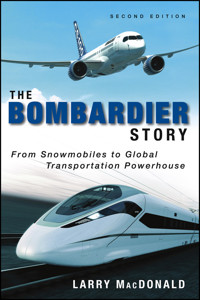
The story of the company that was founded by the inventor of the snowmobile In 1942, Joseph-Armand Bombardier invented the snowmobile and founded his company to manufacture them. From its humble beginnings as an entrepreneurial company in rural Quebec, led by an enterprising inventor, Bombardier Inc. has emerged as a global leader in the transportation industry. This book tells the fascinating tale of this remarkably well managed company that has enjoyed spectacular growth in its chosen markets through strong leadership and management strategy, succession planning, strategic diversification, and turnaround and acquisition artistry. * The fascinating story of the world's largest rail manufacturer for both railway and subway * Reveals why Bombardier Inc. is a multi-faceted global company yet nobody knows their name * Written by Larry MacDonald the author of Nortel Network The Bombardier Story shows how invention and entrepreneurship, management and leadership, smooth succession planning, and turnaround and acquisition built this global powerhouse.
Sie lesen das E-Book in den Legimi-Apps auf:
Seitenzahl: 437
Veröffentlichungsjahr: 2012
Ähnliche



















Contents
Cover
Title Page
Copyright
Acknowledgments
A Brief History of Bombardier Inc.
Preface
Introduction: The Rise of a Corporation
A Meteoric Rise
The Architects of Success
Bombardier Today
Part One
Chapter 1: Joseph-Armand Starts a Company: The 1940s and 1950s
Humble Beginnings
The Bombardier Snowmobile
Inventions and Innovations
Chapter 2: The Ski-Doo Adventure: The Golden Age of the 1960s
The Family Takes Over
A Marketing Renewal
Ski-Doo Fever
Vertical Integration
The First Sea-Doo
Part Two
Chapter 3: Diversify or Die: The 1970s
A Challenging Decade
Taking a New Turn: Rail Transportation
The Montreal Subway
The Acquisition of MLW-Worthington
Chapter 4: The Deal of the Century: The New York City Subway (1982)
A Golden Opportunity
A Contested Victory
The Tools for Success
The Royer Way of Doing Things
The BMS
A Major Breakthrough
Tempest in a Teapot
The Value of Proven Technologies
A Welcome Boost
Chapter 5: New Frontiers: Transportation in the 1980s and 1990s
The North American Market
Full Speed Ahead
A Rocky Start for the LRC
The Vagaries of High-Speed in America
The Disney Monorail
The Acquisition of UTDC
Capturing the European Market
The Chunnel Odyssey
Taking Over by Storm: From Talbot to Adtranz
Part Three
Chapter 6: Aerospace Takes Off
A Bold Move
Early Attempts to Diversify: The Automotive Sector
The Acquisition of Canadair (1986)
Good Things Come in Threes: Shorts, Learjet, and de Havilland
Portrait of a Turnaround Artist
Power in Numbers: Synergizing Operations
Chapter 7: Revolution in the Sky: The Move Toward Regional Jets
The Rise of Airline Hubs
From Challenger to CRJ
A New Captain Steers Aerospace Group
Bombardier Takes Off
Dogfight in the Clouds
Inside the Pro-ex Saga
An Affair of State
Government Support
Chapter 8: Spreading Its Wings
The Global Express Business Jet (1991–1996)
Diversification Delivers
Part Four
Chapter 9: Two Turbulent Decades at Valcourt
The Ski-Doo Loses Speed
Pierre Beaudoin and the Return of the Sea-Doo (1988)
Extreme Snowmobiling and Innovation
Acquisition of Outboard Marine Corporation (2001)
Chapter 10: Lessons in Strategic Governance
The Éminence Grise
Decentralization
Management Tools
An Evolving Structure
Chapter 11: Handing Over the Reins
Robert Brown Takes Charge
The Impact of September 2001
Tellier Joins Bombardier
An Unexpected Comeback
Pierre Takes the Helm and CSeries Aircraft Takes Off
Laurent Beaudoin's Legacy
Endnotes
Color Plates
Index
Copyright © 2013 Larry MacDonald
All photos Copyright © Bombardier Inc. or its subsidiaries.
All rights reserved. No part of this work covered by the copyright herein may be reproduced or used in any form or by any means—graphic, electronic or mechanical—without the prior written permission of the publisher. Any request for photocopying, recording, taping or information storage and retrieval systems of any part of this book shall be directed in writing to the Canadian Copyright Licensing Agency (Access Copyright). For an Access Copyright license, visit www.accesscopyright.ca or call toll free 1-800-893-5777.
Care has been taken to trace ownership of copyright material contained in this book. The publisher will gladly receive any information that will enable them to rectify any reference or credit line in subsequent editions.
Wiley publishes in a variety of print and electronic formats and by print-on-demand. Some material included with standard print versions of this book may not be included in e-books or in print-on-demand. If this book refers to media such as a CD or DVD that is not included in the version you purchased, you may download this material at http://booksupport.wiley.com. For more information about Wiley products, visit www.wiley.com.
Library and Archives Canada Cataloguing in Publication Data
MacDonald, Larry
The Bombardier story : from snowmobiles to global transportation powerhouse / Larry
MacDonald. — 2nd ed.
Includes bibliographical references and index.
Issued also in electronic formats.
ISBN 978-1-118-48294-0
1. Bombardier Inc.—History. I. Title.
HD9709.C34B65 2012a 338.7’629046 C2012-906901-9
Production Credits
Cover design: Adrian So
Typesetting: Thomson Digital
Cover images: Bombardier Inc. or its subsidiaries
Editorial Credits
Executive editor: Don Loney
Managing editor: Alison Maclean
Production editor: Pamela Vokey
John Wiley & Sons Canada, Limited.
6045 Freemont Blvd.
Mississauga, Ontario
L5R 4J3
Brand Names
Bombardier, Challenger, Challenger 601-3R, Challenger 300, Challenger 605, Regional Jet, CRJ, CRJ700, CRJ900, CSeries, CL-415, Global Express, Global 5000, Learjet, Learjet 45, Learjet 45 XR, Learjet 60, Learjet 60 XR, Q400, Dash 8/Series Q, SkyTrain, LRC, Acela, JetTrain, Bilevel, and TRAXX are brand names of Bombardier or its subsidiaries.
Ski-Doo, Sea-Doo, Rotax, Can-Am, Evinrude, Johnson, Elite, Elan, Skandic, Valmont, Blizzard, Summit, Everest, Moto-Ski, Formula, Speedster, E-TEC, and REV are brand names of BRP (Bombardier Recreational Products) or its subsidiaries.
All other brands belong to their respective owners.
Acknowledgments
I would like to thank editor Karen Milner for recommending the topic of this book. As well, editors Ron Edwards and Elizabeth McCurdy deserve special thanks for helping to get the manuscript into shape.
I am grateful to Bombardier Inc. for granting permission to interview staff. The interviews included: Laurent Beaudoin (Chairman), Robert Brown (President and Chief Executive Officer), Yvan Allaire (Executive Vice President and Chairman of Bombardier Capital), Jeremy Lee Jonas (Vice President, Strategic Initiatives), and John Holding (Executive Vice President, Engineering and Product Development). Michel Lord, Vice President, Communications and Public Relations, cordially handled the arrangements.
A number of persons outside of Bombardier agreed to interviews, and I would like to express appreciation for their time and comments. They include: Eric McConachie (Chairman of the Montreal-based aviation consulting firm AvPlan Inc.), John Hethrington (former Bombardier executive), and Ed Lumley (former Liberal Cabinet minister, now Vice Chairman and Director of BMO Nesbitt Burns). There were also interesting communications with other persons, such as former employee Wanda Pokrykus, aerospace MBA graduate René Armando Armas, and McKinsey & Company consultants Luc Sirois and Hugo Sarrazin.
For material on Joseph-Armand Bombardier and the early years of Bombardier, I am indebted to Roger Lacasse's Joseph-Armand Bombardier: An Inventor's Dream Come True (1988) and Carole Precious's J. Armand Bombardier (1984). Historical material was also obtained from portions of Matthew Fraser's Quebec Inc: French-Canadian Entrepreneurs and the New Business Elite (1987) and David Olive's No Guts, No Glory: How Canada's Greatest CEOs Built their Empires (2000).
David and Diana Nicholson of Westmount made me feel at home in Montreal, providing not only accommodations, but also admission into their lively Wednesday Night Salon, a weekly discussion group in which estimable Montreal citizens have exchanged ideas for over two decades. David and Diana also put me in touch with people connected with Bombardier and turned over some Wednesday Night Salons to discussions on Bombardier.
A Brief History of Bombardier Inc.
1937
Joseph-Armand Bombardier awarded patent for the sprocket device that makes the B7 snowmobile possible.1942
Joseph-Armand Bombardier incorporates his firm, L'Auto-Neige Bombardier Limitée, which is based in Valcourt, Quebec.Participates in the manufacture of tracked military vehicles.1945
Begins production of C18 snowmobile (for taking children to school).Ramps up manufacturing of the B12 snowmobile (for public transport, freight transport, mail delivery, and ambulance services).1948
Quebec government passes legislation requiring all highways and local roads to be cleared of snow; L'Auto-Neige Bombardier's sales fall by nearly half in one year.1953
Diversification drive capped by introduction of the Muskeg Tractor, an all-terrain vehicle used in the resource and construction industries to transport heavy loads over swamp and snow.1959
Ski-Doo snowmobile introduced; Bombardier becomes number one producer, and still is.1964
Joseph-Armand Bombardier dies and leaves company in hands of his son, Germain.1966
Following Germain's resignation, Laurent Beaudoin becomes the chief executive, a position he will retain until 2008.1967
L'Auto-Neige Bombardier Limitée renamed Bombardier Ltd.1968
Launch of Sea-Doo watercraft.1969
Listing of Bombardier shares on the Montreal and Toronto Stock Exchanges.1970
Acquisition program highlighted by takeover of Austrian Lohnerwerke GmbH, streetcar manufacturer and maker of the Rotax engines used in Bombardier's snowmobiles (and later in its all-terrain vehicles and watercraft).1971
Acquisition of Moto-Ski.1972
Annual sales of Ski-Doos peak at 210,000 units.Creation of a financing subsidiary to provide inventory financing for Ski-Doo dealers (later extended to other products, railcar leasing, and commercial lending): Crédit Bombardier Ltd. in Canada, and Credit Inc. in the United States.1973
Launch of Can-Am motorbike.1974
Soaring energy prices and economic recession decimate the snowmobile industry, prompting Bombardier to diversify into the mass transit industry starting with a contract to build over 423 cars for the Montreal subway system.1975
Headquarters moved from Valcourt to Montreal.Integration of Bombardier's rail transit operations with MLW-Worthington Ltd., a manufacturer of locomotives and the LRC (Light, Rapid, Comfortable) railcar; company name changed to Bombardier-MLW Ltd., which becomes Bombardier Inc. in 1978.1976
Wins first US transit equipment order (for commuter cars in the Chicago South Suburban Mass Transit District).Delivery of first subway cars in Montreal.1981
Lands an order for 180 subway cars from transit authorities in Mexico City.1982
Wins $1 billion megadeal to make subway cars for New York City, transforming company into the largest North American maker of rail transit equipment.1984
Licenses the monorail design from Disneyland.1986
Commences diversification into aerospace manufacturing with the acquisition of Canadair, maker of the Challenger business jet.Launches expansion into European rail industry with the purchase of a 45 percent interest in BN Constructions Ferroviaires et Métalliques S.A.1987
Acquires the railcar designs of US companies Budd and Pullman.Signs commercial agreement with Alstom (then called GEC-Alsthom) for the marketing of a high-speed train in North America.1988
Launches the second generation of Sea-Doo.1989
Increases critical mass in aerospace with acquisition of Short Brothers.Also buys ANF Industrie (France), the second maker of railway rolling stock in France.Obtains a contract to design and manufacture 252 railcars for transporting automobiles and buses through the English Channel Tunnel.1990
Becomes a provider of a family of business jets with the acquisition of Learjet Corp.1991
Test flight of the 50-seat Canadair Regional Jet, the first commercial jet dedicated to regional transportation.Initiates development of Global Express business jet.1992
Acquires automated subway maker, Urban Transport Development Corp. (UDTC).Gains control of de Havilland, maker of Dash 8 turboprop aircraft.Acquires the assets of Constructora Nacional de Carros de Ferrocarril, a Mexican manufacturer of railway rolling stock.1994
Wins contract to supply metro cars to the city of Kuala Lumpur in Malaysia.1995
Acquires German maker of rail transportation material, Waggonfabrik Talbot GmbH & Co. KG.Introduces Flexjet, a fractional ownership program for business jets.Line of Dash 8 turboprops expanded with launch of 70-passenger version; inaugural flight of the Learjet 45 business aircraft; becomes third-largest manufacturer in the civil aerospace industry after Boeing and the Airbus consortium.Annual sales of the Sea-Doo peak at 110,000 units.1996
Pierre Beaudoin is appointed CEO of the Motorized Consumer Products Group.Amtrak chooses the Bombardier/Alstom consortium to supply train sets for its high-speed service on the Washington/New York/Boston route.Unveiling of the Neighborhood Electric Vehicle.1997
Delivers 200th Canadair Regional Jet, 500th Dash 8 turbo-prop, and 400th Challenger business jet.Bombardier Aerospace launches a new version of the Canadair Regional Jet, the 70-seat Canadair Regional Jet 700.New York City awards Bombardier a $1.3 billion contract to build 680 subway cars.Awarded $2.85 billion multiyear contract for the training of NATO pilots in Canada.1998
Acquires German maker of rail transportation material, in Berlin, Deutsche Waggonbau AG.Creates another operating group, Bombardier International, to pursue growth opportunities in foreign markets outside of North America and Europe.Bombardier wins $2.6 billion order from the British Virgin Rail Group for equipment and maintenance services.Bombardier unveils the Traxter, an all-terrain vehicle.1999
Robert E. Brown is appointed president and chief executive officer of Bombardier; Laurent Beaudoin remains chairman.Bombardier Transportation awarded a contract from the Chinese Ministry of Railways to supply 300 intercity passenger vehicles.The Long Island Railroad requests up to 1,000 commuter cars—contract worth as much as $2.7 billion.2000
Bombardier signs with Delta Connection carriers to provide 94 Canadair Regional Jet aircraft, an order worth nearly $3 billion.Announces development of 90-seat Canadair Regional Jet, CRJ 900.2001
Bombardier completes the purchase of Berlin-based Adtranz, catapulting Bombardier Transportation to the top of the global rail transportation industry.Acquires Johnson and Evinrude engine divisions of Outboard Marine Corp.Bombardier wins a contract from SNCF in France for the delivery of 500 Autorails Grande Capacité (AGC), a quantity increased later to 700 cars, which makes it the biggest series in the modern railway industry.2002
Launch of the Millennium SkyTrain in Vancouver, the longest fully automated metro system in the world.Bombardier Recreational Products revolutionizes the snowmobile industry with the new Ski-Doo REV.Appointment of Paul M. Tellier as president and CEO of Bombardier (December 2002 to December 2004).2003
Sale of the Recreational Products Division to a group comprising members of the Bombardier family, Bain Capital, and the Caisse de dépôt et placement du Québec. The new entity is renamed BRP.2004
In December, Laurent Beaudoin comes back as president and CEO of Bombardier.2006
Bombardier wins an iconic contract from Francilien (NAT), which focuses on 372 commuter trains for the Île-de-France region, including 172 firm orders for 1.3 billion euros.2007
Bombardier wins a contract from the Delhi Metro Rail Corporation Ltd. (DMRC) in India, a historic contract for rail signaling equipment worth $43 million USD.Major penetration of the Chinese market with three successive contracts worth about $760 million USD awarded to Bombardier, for the manufacture of high-speed trains, shuttles, and automated railway signaling equipment.2008
Maiden flight of the CRJ1000 for 100 passengers.Pierre Beaudoin becomes president and CEO of Bombardier Inc.Bombardier gives the green light to the development of the CSeries aircraft, a new generation of commercial aircraft optimized for the 110- and 130-seat market.Preface
While gathering information for this book, I was frequently reminded of the parable of the elephant and the six blind men. One blind man felt the trunk and declared it was like a snake; a second felt the tail and said it was like a piece of rope; a third felt the leg and thought it was like a tree trunk; a fourth felt the side and argued it was like a wall; a fifth felt the ear and proclaimed it was like a fan; a sixth felt the tusk and pronounced it was like a spear.
Bombardier Inc. is certainly of a size to suggest an elephant. Just consider the range of its products. In North America, for example, there are the rail transportation products, which include the Acela high-speed train and thousands of subway cars in Montreal, Toronto, Vancouver, New York City, and several other metropolitan areas around the world. Then there are the aerospace products, which include Canadair Regional Jet, Dash 8 turboprop, and the Global Express business jet. Until 2003, there were the recreational products, which include the Ski-Doo snowmobile, Sea-Doo personal watercraft, and Traxter all-terrain vehicle. Not surprisingly, a variety of reports emanate from the field. Some staff at Bombardier, for example, confirm the existence of Bombardier's legendary family environment—they feel the company will take care of them if they take care of it. But others speak of a sink-or-swim environment arising from the dictates of rapid growth in their areas. Outside the company, there is a diversity of viewpoints as well: constantly in the headlines, Bombardier invariably attracts favorable and unfavorable commentary. Supporters think it is a company for the twenty-first century; detractors think otherwise.
In this book, I have attempted to provide a fair representation of the different viewpoints. And I wanted to do so without creating a compendium of coffee-break tidbits or blood-on-the-boardroom-floor scenes. I believe the story of Bombardier deserves a more elevated treatment because of its accomplishments and spin-off benefits in the socioeconomic realm. Even the critics admit the stellar track record—their contention is with other matters.
This book is both a corporate history and business case study. The corporate history portion provides a sequence of events that lays out the rise of Bombardier from its birth to the present, explaining how the company emerged as a commercial success. The business case study, interwoven into the corporate history, offers lessons and insights into the Bombardier formula.
As such, this book should be of interest to businesspersons, consultants, economists, journalists, policy makers, and commerce students at the undergraduate and graduate levels. It should also be of interest to future, present, and past employees (and their families), staff in companies that deal or compete with Bombardier, users of Bombardier's products, and existing or prospective investors in Bombardier's shares (as well as those investors wishing to obtain a better understanding of the circumstances that can generate long-term growth companies).
John Kay, a British professor who writes a column on management issues for the Financial Times of London, speaks often of the subtleties of corporate histories and business case studies. Because of the elephant and blind men problem, as well as the ingrained biases of any given chronicler, he believes such case studies can offer little more than an interpretation. They can only hope to illuminate aspects of the reality; they are necessarily incomplete in their portrayals.
As an example, Kay cites accounts of the Japanese penetration of the North American motorcycle market in the 1960s.1 One study said Honda and other Japanese manufacturers enjoyed economies of scale in their home market and used this as a springboard for expansion into the United States. Interviews with Honda managers reveal a different story. Hearing there was limited public transportation in California, they brought some of their motorcycles over for their own use. But after discovering the reliability problems of domestic motorbikes and being constantly quizzed on the street about their smaller bikes, they set up a marketing campaign.
Which explanation is right? Kay says neither is true, just as neither is wrong. They are just different ways of looking at the situation, and both can add to our understanding. A story from the inside, for example, is useful for providing detail from the front lines; a story from the outside has the benefit of including a broader list of variables. I tried to keep such subtleties in mind during the writing of this book. Business outcomes are often a mixture of design and accident, of planning and serendipity. They reflect the interaction of internal and external variables—the interplay of the strategies formulated within the company and forces outside the company.
I had completely free reign with this portrayal of Bombardier. Although the topic was suggested by my publisher (the kind of invitation I like to get), they did not specify what the angle should be. And although Bombardier kindly cooperated by allowing senior executives to be interviewed, it was without any strings attached.
In this book, I referred to persons by their last names except for three main characters, Joseph-Armand Bombardier, Laurent Beaudoin, and Pierre Beaudoin. I referred to Joseph-Armand by his first name to avoid possible confusion with the company named after him; I referred to Laurent and Pierre by their first names to avoid possible confusion between father and son.
They say where you stand depends on where you sit. So perhaps I should mention my background as an individual born and raised in Ottawa, who went to work for a dozen years as an economist before turning to business journalism. As such, my rendition of the Bombardier story may have emphasized different aspects than if it were told by a businessperson from Alberta, a social worker in Toronto, or a Quebec employee of the aerospace industry. But I would like to repeat that I have tried to offer a balanced presentation of the perspectives and events. And hopefully, this portrait of the elephant will show more verisimilitude than a beast comprised of snakes, ropes, tree trunks, walls, fans, and spears.
Note: All dollar figures in this book are in Canadian currency unless otherwise noted.
Introduction: The Rise of a Corporation
A Meteoric Rise
Bombardier was under attack again. This time, the flack was coming from the president of Berlin-based Adtranz, the rail equipment subsidiary of DaimlerChrysler AG. In 1999, he traveled to Toronto and made a speech in which he warned that Adtranz was coming to challenge Montreal-based Bombardier on its home turf of North America. His motive was retaliation: he did not like Bombardier's invasion of Adtranz's European markets. So he was going to put the upstart from the hinterlands in its place. “The major player in the United States of the future will be, I believe, Adtranz,” he predicted.1
In the spring of 2001, Bombardier acquired Adtranz: so much for the taunts of rival executives. The parent corporation, wishing to focus on reviving its main business of automobile manufacturing, accepted Bombardier's takeover offer. The purchase more than doubled annual revenues at Bombardier's rail equipment division to $8 billion and created an integrated producer with expertise in both rolling stock and propulsion systems. It also catapulted Bombardier into the number one spot in the railway equipment industry, ahead of the rail divisions of Franco-British conglomerate Alstom and German industrial giant Siemens.
Lesen Sie weiter in der vollständigen Ausgabe!
Lesen Sie weiter in der vollständigen Ausgabe!
Lesen Sie weiter in der vollständigen Ausgabe!
Lesen Sie weiter in der vollständigen Ausgabe!
Lesen Sie weiter in der vollständigen Ausgabe!
Lesen Sie weiter in der vollständigen Ausgabe!
Lesen Sie weiter in der vollständigen Ausgabe!
Lesen Sie weiter in der vollständigen Ausgabe!
Lesen Sie weiter in der vollständigen Ausgabe!
Lesen Sie weiter in der vollständigen Ausgabe!
Lesen Sie weiter in der vollständigen Ausgabe!
Lesen Sie weiter in der vollständigen Ausgabe!
Lesen Sie weiter in der vollständigen Ausgabe!
Lesen Sie weiter in der vollständigen Ausgabe!
Lesen Sie weiter in der vollständigen Ausgabe!
Lesen Sie weiter in der vollständigen Ausgabe!
Lesen Sie weiter in der vollständigen Ausgabe!
Lesen Sie weiter in der vollständigen Ausgabe!




