


15,59 €
Mehr erfahren.
- Herausgeber: Batsford
- Kategorie: Lebensstil
- Sprache: Englisch
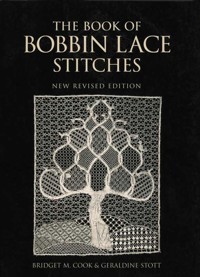
This comprehensive new edition of a standard work contains an exhaustive collection of stitches which have been developed in the traditional art of bobbin lacemaking since the 17th century, and is designed to aid all lacemakers in the recognition and working of each individual feature. The degree of accuracy and detail is the result of many years of research into the methods used in the lacemaking centres of Britain and Europe. Over 260 stitches and variations are described, ranging from the simplest to the most complex. The content has ben arranged so that all the information for each stitch is to be found on one page. The guide is laid out step-by-step and is aimed at both the working lacemaker and the student.
Das E-Book können Sie in Legimi-Apps oder einer beliebigen App lesen, die das folgende Format unterstützen:
Seitenzahl: 91
Veröffentlichungsjahr: 2014
Ähnliche
















THE BOOK OF
BOBBIN LACE
STITCHES
Other books by Bridget Cook and Geraldine Stott:
100 Traditional Bobbin Lace Patterns
Geraldine Stott and Bridget M. Cook
The Bobbin Lace Manual
Geraldine Stott
Building Torchon Lace Patterns
Bridget M. Cook
Introduction to Bobbin Lace Patterns
Bridget M. Cook
Practical Skills in Bobbin Lace
Bridget M. Cook
Russian Lace Making
Bridget M. Cook
Russian Lace Patterns
Bridget M. Cook and Anna Korableva
The Torchon Lace Workbook
Bridget M. Cook
Visual Introduction to Bucks Point Lace
Geraldine Stott
THE BOOK OF
BOBBIN LACE
STITCHES
BRIDGET M. COOK & GERALDINE STOTT
First published 1980. Second edition 1982; reprinted 1984, 1987, 1993 and 1996.
Revised and updated in paperback 2002
Bridget M. Cook & Geraldine Stott 1980 and 2002
eISBN 9781849942027
The moral rights of the author have been asserted.
All rights reserved. No part of this publication may be reproduced, stored in a retrieval system, or transmitted in any form or by any means, electronic, mechanical, photocopying, recording or otherwise, without the prior written permission of the publisher.
First published as eBook in 2014 by
Batsford
1 Gower Street
London WC1E 6HD
An Imprint of Pavilion Books Company Ltd
INTRODUCTION
This book has been designed as a reference text book for the guidance of the growing number of bobbin lace makers across the full ability range.
Each page is devoted to just one of the many complex stitches and illustrates the completed stitch together with an enlargement. Then follows a diagrammatic drawing with the appropriate associated illustration followed by a graph of the pricking and the number of bobbins required.
The stitches are arranged according to their degree of difficulty with the simpler stitches appearing early on, progressing through to the more complex stitches. Towards the end are ‘Spiders’, ‘Buds’, ‘Shells’, ‘Toiles’ and ‘Peas’.
It is to be hoped that the book will assist lace makers in widening their repertoire of stitches and enable them to develop their own free design as well as to use traditional prickings with a greater degree of flexibility.
Most of the stitches date from the late seventeenth or early eighteenth century when bobbin lace techniques were developed to their full potential. At that time the same or very similar stitches could be found in lace from widely separated countries and even districts within these countries. It is not surprising that similar stitches are known by different names dating from that period.
During the second half of the nineteenth century lace makers were relearning the complicated stitches lost during the neoclassical period and new names were applied. Some were purely descriptive, some were based on the antique laces from which the stitches were taken, some were based on institutions where lace making was practised and some were given totally new names, while other stitches were newly created. Lace makers from different areas will have a different vocabulary based in the main on these nineteenth-century names.
Lace makers will therefore appreciate the problems relating to the naming of the stitches in this book and the authors hope that they will be able to identify them satisfactorily. However it is the ability to execute the stitch that is important rather than simply knowing its name.
All samples have deliberately been made in a thick thread (Barbours No. 50 Linen) in order to show the construction of the stitches with greater clarity. In the same way the prickings have all been drawn to match this thickness. It is envisaged that the lace maker will be able to adjust the size quite simply by using a larger or smaller graph paper to suit the thread. For example, if 10 to 1 cm square graph paper is used then D.M.C. No. 60 Retors D’Alsace works quite well, but a sampler must be worked with the thread and graph paper intended for use.
As far as Bucks Point is concerned this again has been drawn to suit the graph paper (approximately 56°). However, it can be made at any angle from 45° to 68° according to the need.
Throughout the book all graphs have been drawn to the same scale. The photograph at the bottom left of each page is actual size, and has been made on the graph shown (10 to 1 inch), while that at the top left is an enlargement.
The numbers at the top of each graph relate to the number of pairs of bobbins needed for that particular stitch.
Scale Below is illustrated, in actual size, a strip of eighteenth-century Flemish lace, while on the next page the photograph is enlarged to the same scale as all the enlargements of all the stitches illustrated in the book. This should enable the reader to appreciate the relationship between the two when working the actual stitches.
The stitches illustrated in this piece of lace are as follows:
1 Half stitch ground
2 Twelve thread armure
3 Haloed spider
4 Toile star
GLOSSARY
braid
A 4 thread plait made by continuous half stitches (fig. 1).
braid x
Number of half stitches per braid, e.g. braid x 3 means 3 half stitches, braid x 3½ means 3 half stitches plus a cross, so braid ends up untwisted.
brick
1 pair weaving back and forth with winkie pins both sides. The worker of a brick always works over the first hole to the opposite hole, then weaves back and forth (fig. 2).
brides
Also called legs – connecting bars, either twisted or braided. Literal translation means ‘bridges’.
bud star
Star motif with centre filled diagonally (fig 3).
cross
Cross left hand thread over right hand thread.
diag.
Diagonal.
fish
With joint top and bottom having horizontal bars weaving through (fig. 4).
h.s.
Half stitch, also called lattice stitch or gauze stitch: 2 over 3; 2 over 1; 4 over 3. Figures on diagram refer to positions only, not to the bobbins, therefore they must be recounted before each move (fig. 5).
honeycomb stitch
Half stitch, twist 1, pin, half stitch, twist 1 (fig. 6).
horiz.
Horizontal.
lazy join
Also called a windmill; made with 4 pairs – each pair used as a single thread, make a wholestitch (fig. 7).
leaf, leaves
Also called petals or wheat ears; usually start and finish with wholestitch to create the distinctive tight top and bottom (fig. 8).
legs
As brides – connecting bars, either twisted or braided.
1t hd
Left hand.
rt hd
Right hand.
no., nos
Number, numbers.
passives
Inactive pairs through which the worker passes.
pea
Cross between fish and spider with a pair worked in and out at centre, to complete the pattern (fig. 9).
picots – single
Make a loop by twisting the thread round a pin over and towards you (fig. 10).
picots – double
Left handed picots: tw. 3 left hand pair, pin pointing to left over left hand thread, bring thread round pin, next take right hand thread round the pin in clockwise motion, gently pull all the twists round pin, tw. 2 (fig. 11).
Right handed picots: as above but reversed and pin under thread (fig. 12).
picots – knotted
(fig. 13).
pinchain
Using 2 pairs: half stitch, twist 1, pin, half stitch, twist 1 continuously along a single line (fig. 14).
pr, prs
Pair, pairs.
plait
Three threaded plait (fig. 15).
raised tallies
Make an extra long leaf, pin, leave to one side, work pattern for underneath; with small stick, raise up leaf and remove pin from start and place between leaf pairs, replace pin in same hole.
ribbon
Usually a collection of untwisted passives making a decorative design.
rt hd
Right hand.
1t hd
Left hand.
sewings
Joining one section to another by using a hook or needlepin to pull a loop through pinhole of worked side then threading the other bobbin of the worker pair through the loop (fig. 16).
sewings – double
Pull 2 loops through pinhole of worked side and thread the other 2 bobbins through loops.
shell star
Star motif with pairs entering and leaving to create a hole in the central area (fig. 17).
six thread cross
Cross centre 2 threads, pass top horizontal thread over and under twice, twist both diagonal pairs, then bottom horizontal thread under and over twice, twist middle 2 threads (fig. 18). This method can also be used in same manner to cross 6 pairs.
spiders
Wholestitch all left hand pairs through right hand pairs, pin, then wholestitch all right hand pairs through left hand pairs (fig. 19).
stars
Divided into groups – toiles, shells, buds, and peas.
st.
Stitch.
tallies
Also called leadworks and cutworks (fig. 20).
toile star
Wholestitch star without pins (fig. 21).
tw.
Twist – right hand thread over left hand thread.
vert.
Vertical.
wholestitch block
1 pair weaving back and forth with winkie pins both sides; the worker always works under first right hand pin and ends on left hand side (fig. 22).
winkie pin
Decorative hole made by twisting worker pair round pin (usually twice) at side of work (fig. 23).
worker
The active pair – also called leaders or weavers.
w.s.
Wholestitch, also called cloth-stitch (fig. 24):
2 over 3; 2 over 1;
4 over 3; 2 over 3
Little dashes on prickings denote number of twists.
Empty circles denote temporary pins to be removed as soon as possible.
BOBBIN LACE STITCHES
HALF STITCH GROUND
This stitch is also called Lattice stitch
2 over 3, 2 over 1, 4 over 3
these figures refer to positions, not to the threads, therefore they must be recounted after each move
If you tw. 1 at edge pins the same thread weaves back and forth
if you tw. 2 at edge pins a new thread weaves each row
GAUZE GROUND
no pins
except to hold horizontals to preserve true alignment
tw. 1, w.s., tw. 1, w.s.
for all horizontals and verticals
HALF GAUZE
no pins
except to hold horizontals to preserve alignment
tw. 1, w.s., tw. 1, w.s.
passives not twisted
TORCHON GAUZE 1
w.s., w.s., tw. 4, w.s., w.s.
no tw. on passives
pin to support only
TORCHON GAUZE 2
tw. 1 on short square
tw. 4 on long lines
w.s., with pin in middle at all joins
all pins removed after 2 rows, so as not to leave pinholes
ITALIAN FILET WITH TOILE DOTS
w.s., tw. 2 workers and passives throughout
except untwisted w.s. squares
pin where necessary to retain shape
ABRUZZIAN POINT AND FLAT
This is so called after a province in Italy just east of Rome.
w.s., tw. 1 workers and passives x 4 for twisted squares
w.s. remainder
pin only where necessary to retain shape




