


87,99 €
Mehr erfahren.
- Herausgeber: John Wiley & Sons
- Kategorie: Fachliteratur
- Sprache: Englisch
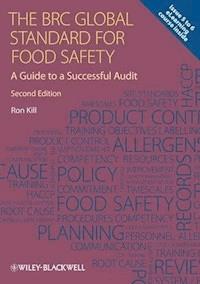
This book will offer companies in the food industry a comprehensive guide to preparing for a British Retail Consortium Standard evaluation (Issue 6). It will enable them to ensure that the correct systems are in place to achieve the Standard, and also that they present themselves in the best possible light during the audit process. It will also recommend the correct steps to take following evaluation and how to correct non-conformities. The book will be of interest not only to suppliers who are seeking certification for the first time but also to those already in the scheme, and are seeking to improve their grades.
Sie lesen das E-Book in den Legimi-Apps auf:
Seitenzahl: 613
Veröffentlichungsjahr: 2012
Ähnliche



















Contents
Cover
Title Page
Copyright
About the Online Training Resources
BRC Update Course Issue 5 to Issue 6
Cast of Characters
Abbreviations
Acknowledgements
Introduction to Second Edition
Introduction to First Edition
Part One: Before the Audit
Chapter 1: The Changes: Issue 5 to Issue 6
Reasons for Change
Two-Part Auditing: Increased Focus on GMP
Vertical Audits
Unannounced Audits
Enrolment Programme
High Care and High Risk
New Report Format
Other Protocol Changes
Changes to Requirements
Chapter 2: Keys to Success
Success
Failure
Embrace the Standard
Preparation
Documented Procedures and Records
Evidence
Track Record
Team Building
Internal Audit
See Yourselves as Others See You
Summary
Chapter 3: Some Background
What is a Certification Body?
Accreditation and Competency
A CB's Contract with the BRC
Consistency
Summary
Chapter 4: Familiarity with the Standard: Part 1 – Structure and Concepts
Why Choose the Global Standard for Food Safety?
Global Food Safety Initiative
Issue 6
The Structure of the Standard
Section I
Section II: The Requirements
Recurring Themes
Section III: The Audit Protocol
Section IV: The Appendices and the Glossary
The BRC Guideline Series and Other Support Information
Summary
Chapter 5: Familiarity with the Standard: Part 2 – The Protocol
Paragraph 1: Introduction
Paragraph 2: Self-Assessment of Compliance with the Standard
Paragraph 3: Selection of an Audit Option
Paragraph 4: Selection of a CB
Paragraph 5: Company/CB Contractual Arrangements
Paragraph 6: Scope of Audit
What About 'Factored Goods'?
Paragraph 7.1: Audit Planning
Paragraph 7.2: Information to be Provided to the CB for Audit Preparation
Paragraph 7.3: Duration of the Audit
Paragraph 8: The On-Site Audit
Paragraph 9: Nonconformities and Corrective Action
Summary
Chapter 6: Familiarity with the Standard: Part 3 – Section IV and the Appendices
Section IV: Management and Governance of the Scheme
The Appendices
Summary
Chapter 7: Final Steps to the Audit
Choosing a Certification Body
The Application Form and Contract
Agreeing the Scope
Registering with the BRC
Fixing a Date
Key Staff
Availability of Records and Other Evidence
Pre-Audits
Facilities for the Auditor
Summary
Chapter 8: The Global Standards Website and Directory
The BRC Global Standards Website
The Directory
Summary
Chapter 9: Training for the Standard
Official BRC Courses
Approved Training Providers
Other Training Requirements
Finding the Right Course for You
Summary
Part Two: The Audit
Chapter 10: How to Survive the Audit
The Format of the Audit
Keeping the Auditor Safe
Preventing Interruptions
Letting the Auditor Lead the Audit
Listening to the Question
Knowing When to be Quiet
Being Positive and Co-operative
Consultants
Remembering the Obvious
Correcting Nonconformities During the Audit
May We Offer the Auditor a Gift?
Summary
Chapter 11: Clause 1: Senior Management Commitment
Clause 1.1: Senior Management Commitment and Continual Improvement (Fundamental)
Clause 1.2: Organisational Structure, Responsibilities and Management Authority
Summary
Chapter 12: Clause 2: Food Safety Plan – HACCP
Clause 2.0: Food Safety Plan – HACCP (Fundamental)
Codex Alimentarius
Other Aspects
Clause 2.1
Clause 2.2
Clause 2.3
Clause 2.4
Clause 2.5
Clause 2.6
Clause 2.7
Clause 2.8
Clause 2.9
Clause 2.10
Clause 2.11
Clause 2.12
Clause 2.13
Clause 2.14
Summary
Chapter 13: Clause 3: Food Safety and Quality Management System
Clause 3.1: Food Safety and Quality Manual
Clause 3.2: Documentation Control
Clause 3.3: Record Completion and Maintenance
Clause 3.4: Internal Audit (Fundamental)
Summary of Internal Audit
Clause 3.5: Supplier and Raw Material Approval and Performance Monitoring
Clause 3.6: Specifications
Clause 3.7: Corrective Action (Fundamental)
Clause 3.8: Control of Nonconforming Product
Clause 3.9: Traceability (Fundamental)
Clause 3.10: Complaint Handling
Clause 3.11: Management of Incidents, Product Withdrawal and Product Recall
Summary
Chapter 14: Clause 4: Site Standards
Production Risk Zones
Clause 4.1: External Standards
Clause 4.2: Security
Clause 4.3: Layout, Product Flow and Segregation (Fundamental)
Clause 4.4: Building Fabric – Raw Material Handling, Preparation, Processing, Packing and Storage Areas
Clause 4.5: Utilities – Water, Ice, Air and Other Gases
Clause 4.6: Equipment
Clause 4.7: Maintenance
Clause 4.8: Staff Facilities
Clause 4.9: Physical and Chemical Product Contamination Control – Raw Material Handling, Preparation, Processing, Packing and Storage Areas
Clause 4.10: Foreign Body Detection and Removal Equipment
Clause 4.11: Housekeeping and Hygiene (Fundamental)
Clause 4.12: Waste/Waste Disposal
Clause 4.13: Pest Control
Clause 4.14: Storage Facilities
Clause 4.15: Dispatch and Transport
Summary
Chapter 15: Clause 5: Product Control
Clause 5.2: Management of Allergens (Fundamental)
Clause 5.1: Product Design/Development
Clause 5.3: Provenance, Assured Status and Claims of Identity Preserved Materials
Clause 5.4: Product Packaging
Clause 5.5: Product Inspection and Laboratory Testing
Clause 5.6: Product Release
Summary
Chapter 16: Clause 6: Process Control
Clause 6.1: Control of Operations (Fundamental)
Clause 6.2: Quantity – Weight, Volume and Number Control
Clause 6.3: Calibration and Control of Measuring and Monitoring Devices
Summary
Chapter 17: Clause 7: Personnel
Clause 7.1: Training – Raw Material Handling, Preparation, Processing, Packing and Storage Areas (Fundamental)
Clause 7.2: Personal Hygiene – Raw Material Handling, Preparation, Processing, Packing and Storage Areas
Clause 7.3: Medical Screening
Clause 7.4: Protective Clothing – Employees or Visitors to Production Areas
Summary
Part Three: After the Audit
Chapter 18: From Audit to Certification
Paragraph 9.2: Procedures for Handling Nonconformities and Corrective Action
Paragraph 10: Grading of the Audit
Paragraph 11: Audit Reporting
Paragraph 12: Certification
Summary
Chapter 19: Correcting Nonconformities
Documentary Evidence
Stating the Corrective Action
Conclusion
The Nature of the Evidence
Corrective Actions: Follow Up
Ways of Sending Evidence
Other Ways of Helping the CB
Returning to Your Site
Root Cause
Enrolment Programme
Summary
Chapter 20: Certification and What Happens Next
Success!
Paragraph 13: BRC Logos and Plaques
Paragraph 14: The BRC Global Standards Directory
Paragraph 15: Surveillance of Certificated Companies
Paragraph 16: Ongoing Audit Frequency and Certification
Paragraph 17: Communication with CBs
Paragraph 18: Appeals
Other Matters
Summary
References
Appendices
Appendix 1: Answers to Quizzes and Exercise
Quiz No. 1 (Chapter 2)
Quiz No. 2 (Chapter 4)
Quiz No. 3 (Chapter 5)
Quiz No. 4 (Chapter 6)
Quiz No. 5 (Chapter 7)
Quiz No. 6 (Chapter 11)
Quiz No. 7 (Chapter 12)
Quiz No. 8 (Chapter 13)
Quiz No. 9 (Chapter 14)
Quiz No. 10 (Chapter 15)
Quiz No. 11 (Chapter 16)
Quiz No. 12 (Chapter 17)
Quiz No. 13 (Chapter 18)
Quiz No. 14 (Chapter 19)
Quiz No. 15 (Chapter 20)
‘Try This’ Exercise (Chapter 5)
Appendix 2: Where Did Issue 5 Go?
Appendix 3: New Clauses for Issue 6
Appendix 4: Changes to Product Categories from Issue 5 to Issue 6
Index
This edition first published 2012 ©2012 by John Wiley & Sons, Ltd. First edition ©2008 by Ron Kill
Wiley-Blackwell is an imprint of John Wiley & Sons, formed by the merger of Wiley's global Scientific, Technical and Medical business with Blackwell Publishing.
Registered office: John Wiley & Sons, Ltd, The Atrium, Southern Gate, Chichester, West Sussex, PO19 8SQ, UK
Editorial offices: 9600 Garsington Road, Oxford, OX4 2DQ, UK The Atrium, Southern Gate, Chichester, West Sussex, PO19 8SQ, UK 2121 State Avenue, Ames, Iowa 50014-8300, USA
For details of our global editorial offices, for customer services and for information about how to apply for permission to reuse the copyright material in this book please see our website at www.wiley.com/wiley-blackwell.
The right of the author to be identified as the author of this work has been asserted in accordance with the UK Copyright, Designs and Patents Act 1988.
All rights reserved. No part of this publication may be reproduced, stored in a retrieval system, or transmitted, in any form or by any means, electronic, mechanical, photocopying, recording or otherwise, except as permitted by the UK Copyright, Designs and Patents Act 1988, without the prior permission of the publisher.
Designations used by companies to distinguish their products are often claimed as trademarks. All brand names and product names used in this book are trade names, service marks, trademarks or registered trademarks of their respective owners. The publisher is not associated with any product or vendor mentioned in this book. This publication is designed to provide accurate and authoritative information in regard to the subject matter covered. It is sold on the understanding that the publisher is not engaged in rendering professional services. If professional advice or other expert assistance is required, the services of a competent professional should be sought.
Library of Congress Cataloging-in-Publication Data
Kill, R. C. The BRC global standard for food safety : a guide to a successful audit / Ron Kill. – 2nd ed. p. cm. Includes bibliographical references and index. ISBN 978-0-470-67065-1 (pbk. : alk. paper) 1. Food industry and trade–Standards–Great Britain. 2. Food industry and trade–Standards. I. Title. TX537.K54 2012 338.1′9–dc23 2012010600
A catalogue record for this book is available from the British Library.
Wiley also publishes its books in a variety of electronic formats. Some content that appears in print may not be available in electronic books.
Cover design by www.hisandhersdesign.co.uk
About the Online Training Resources
BRC Update Course Issue 5 to Issue 6
This course guides the delegate through all the major changes of the BRC Global Standard for Food Safety from Issue 5 to Issue 6 in an easy-to-use e-training course. The course has been developed to complement the book and provides a searchable database of all the changes.
To start using the course, just email [email protected] and request your username and password today, stating ‘BRC Global Standard Course’ in the subject line.
For more details on how to start using the course in conjunction with this book, just go to www.wiley.com/go/kill/brcglobalstandard.
Micron2 in conjunction with totrain are also providing other food-related courses; for more information go to the Micron2 web site at www.micron2.com and click on the e-learning link.
Cast of Characters
Accreditation Body:the body that bestows accreditation on to Certification Bodies to enable them to operate the scheme. They feature from time to time.Approved Training Provider:an individual who is registered with the BRC to carry out their official training courses.Auditor:with a capital ‘A’ this refers to the person carrying out the audit for the Global Standard for Food Safety (as opposed to your internal auditors). They are central characters in this book.Certification Body:the Company that bestows certification on manufacturers and who employs Auditors to carry out the Audits. They also feature frequently.Clause:this term is used to describe the individual requirements of the Standard.Codex Alimentarius:there is only one document referred to specifically in the Standard. It is Codex Alimentarius HACCP Principles (Basic Texts: Hazard Analysis and Critical Control Point (HACCP) System and Guidelines for its Application). It is used as the basis for the Food Safety and HACCP requirements here. I sometimes shorten the name to simply ‘Codex’.Paragraph:this term is used to describe the numbered sections of the Protocol.Stakeholders:these are the people, mostly members of the BRC, who instigated the process of third-party certification and who have a large say in the continuing process and the Standard reviews. They usually require sight of copies of Audit reports of their suppliers. They appear mainly as background characters here.You:In this book, I refer to ‘You’ and ‘Your’ a lot. Note that the book is intended for manufacturers seeking certification. I know some Auditors find it useful too but here ‘You’ refers to all readers who seek certification.Abbreviations
Being a dis-liker of jargon, I resist the use of abbreviations, especially acronyms. However, for the sake of brevity, I have used those as follows.
ABAccreditation BodyATPApproved Training Provider (see above) or adenosine triphosphate depending on the contextBRCBritish Retail Consortium: a member-based body in the UK largely funded by UK retailers.BSDABritish Soft Drinks AssociationCBCertification BodyCIPClean in PlaceEFKElectric Fly KillerFIFOFirst in – First outFSAFood Standards Agency: a public body set up in the UK to give independent information on legislation, nutrition advice, food safety messages and alerts.FSQMSFood Safety and Quality Management SystemGFSIGlobal Food Safety InitiativeGMGenetically ModifiedGMPGood Manufacturing PracticeNPDNew Product DevelopmentSOIStatement of IntentUKASUnited Kingdom Accreditation Service: the AB that functions in the UKWIPWork in ProgressAcknowledgements
My heartfelt thanks to Adrian Davies, who was a great help in researching examples and correcting my grammar for the first edition of this book. Thanks to David Brackston of the BRC for allowing me to use his nonconformity decision tree and for answering all my questions from my Issue 6 courses. Thanks also to the BRC itself for the use of their web pages in this book.
Thanks to my wife Eve for putting up with all this – again!
And as always to the memory of Michael.
Introduction to Second Edition
It seems a long time since I drafted the first edition of this book, which was originally intended to be a companion to Issue 4 of the Standard. In the end, it appeared alongside Issue 5. In terms of this industry, of course, 5 years is a long time and much has changed, not least the structure of the Standard. Issue 6 has some very new ideas, borne partly out of some criticisms of the nature of the Audits, partly out of the need to move on in terms of the value that the Audit offers the company.
The original introduction to the first edition is included again here but please note that the references to Issue 5 matters are largely irrelevant. I kept it in for historical interest and some of the ideas still apply. This book is all about Issue 6.
For this edition, I have retained many of the real-life examples of nonconformities from the first edition as they are still relevant. However, I have changed the clause numbers to match the current issue of the Standard. I have also added a good number (about 200) of new examples. I have changed the structure of the book so that it moves forward in the same way that the Audit process moves. In doing so, I have added a few new chapters, including ones on the BRC Directory and aspects of Training. The structure of this edition partly reflects my time spent on the working group that reviewed the Standard and the training for Auditors that I helped with. I will freely admit that I gained much information and ideas from delegates on courses.
My aims remain the same though – to help the manufacturer through what might feel like a step into the unknown. I also hoped to make it as readable and entertaining as possible. It can be a dry old subject after all.
Sir Steve Redgrave said after winning his fourth Olympic gold medal: ‘I've had it. If anyone sees me near a boat they can shoot me.’ (He subsequently went on to win gold – again – at the Sydney Olympics). I am not exhausted like he was when he said it but at the risk of sounding like Sir Steve and then eating my words, I have said that I will not take part in the next review in 3 years time. Assuming I am still around I will be 62 and I think it is time for some fresher minds to take over. So, I doubt I will be going for gold again, but you never know.
Ron Kill January 2012
Introduction to First Edition
It is Friday afternoon, the phone rings. It is your National Account Manager:
Look, we have just got the contract with (insert name of major retailer). It's brilliant, should double our turnover but now it's over to you ‘cause we have to get the BRC Standard and we need to be up and running in 12 weeks. OK?
Sounds familiar? Apart from ruining your weekend, what goes through your mind? A sinking feeling that you are alone and that you have a mountain to climb? Or a feeling that this is no problem because you have the comfort of a large team around you and the knowledge that your systems are sound. Either way, this book is intended to guide you through the process so that come the days of your Audit you are prepared in the best possible way.
The Global Standard for Food Safety was originally conceived in the mid-1990s when there was an increasing demand for a unified standard to be used by the major retailers in the UK for their suppliers of ‘own label’ food products. I think it is fair to say that up to that time UK retailers were, certainly in Europe, among the leaders in demanding good standards of their food suppliers.
As always with new initiatives, the gestation was quite long, but the first BRC Standard was published in October 1998 with the title: The British Retail Consortium Technical Standard for Companies Supplying Retailer Branded Food Products. (I am reminded of an old Peanuts cartoon in which Snoopy is trying to write his great novel but cannot get past the title because all the good ones: ‘Gone with the Wind’, ‘For Whom the Bell Tolls’, ‘Of Human Bondage’ are used up). In this case, the title did have some real meaning because the idea was to protect those retailers selling ‘own label’ products by ensuring the good standards of their suppliers. What rapidly happened, however, was that it was successful in all areas of the food industry not just in private label retail supply, so that during the life of Issue 3 it was renamed to reflect its ‘Global’ status. In this book, I shall refer to it as the Global Standard or simply the Standard.
Issue 5 of the Global Standard for Food Safety was published in January 2008 and introduced some significant changes to the Certification process, all of which are dealt with here.
The protocol and requirements discussed in this book are based on Issue 5.
Supermarkets in the United Kingdom and around the world have been part of an economic shift over the years in driving down the prices of food. We all now spend a fraction of the proportion of our disposable income on food that our grandparents did but at the same time food is manufactured in volumes and is of a consistency that would not have been possible in those earlier times. Food suppliers have had to become efficient places who can only survive if every penny is watched. Technical staff are sometimes seen as a luxury. My aim in writing this book is to make life easier for the QA and Technical Managers of suppliers who have to prepare for their annual Audits while struggling with all the day to day problems of running the technical and quality side of their business.
In this book, I stress the necessity of having good systems in place (which meet the Standard) all the time. This is important. As a supplier you should be endeavouring to have systems and records in place which meet the Global Standard all year round. Your certificate should not be seen as the objective but the outcome of having good standards that benefit you as well as your customers.
However, it is also important to be able to demonstrate this to the Auditor and for you to be well prepared for the Audit. In our example, a 12-week lead time is not to be recommended, to be honest. As I explain in the book, systems not only have to be in place but you will have to demonstrate that they are working and produce evidence of a good track record.
We would not be human if we did not want to present ourselves in the best possible way when it counts most. So, having good systems in place may count for little if you are poorly prepared for the Audit and are unable to convince the Auditor that you have got it right.
I also aim to make life better for all those intrepid Auditors in the field who may be struggling to explain what it is they need to see or wasting valuable time while they wait for the supplier to present the right document during an Audit. Being an Auditor is sometimes perceived as something of a glamorous life. Yes, there are great moments and for anyone who loves being in factories as I do, it is interesting and instructive. You can meet wonderful people and it can be very satisfying, especially seeing a site improve over time. There is a down side though. It is exacting work, the days are long, travelling is tiring. However, in general, it is manufacturer's lack of preparation for the Audit that makes the Auditor's life most difficult. If suppliers are better prepared for the Audit, then the Auditor's life will be better too.
I have worked for major retailers and have been in both manufacturing and importing businesses to supply them. I now sit in the middle, auditing suppliers in a system that is on behalf of the retailers and other purchasing groups. I know that for the most part both sides of the supply chain are trying to do a good job with the best of intentions. I want to help suppliers to understand the reasoning behind the clauses of the Global Standard for Food Safety, to perform better at their Audits and in doing so give their customers the assurances they need.
Ultimately, I have tried to let you see what might be going on inside the Auditor's head so that you can be better prepared. Where possible, I have illustrated points with examples, usually of where the Auditor has found something wrong. This may seem slightly negative but my intention is that you take something positive from it.
Every ‘Example’ that I use in the book is real. Of course, no names are mentioned. If you think you recognise yourself either (a) you are probably wrong because most of these examples repeat themselves quite regularly at other suppliers or (b) you are right but consider (a) and remember it is in a good cause.
Auditors are human beings (trust me). In this book, the intention is to give you a good idea of what an Auditor is likely to want to see. Of course, everyone has their own ideas, experiences and personality. I cannot tell you exactly what the Auditor will ask for on the day but I hope that I have covered enough ground and given sufficient examples to prepare you for all likely situations.
A note on definitions. For issues 3 and 4 of the Standard, we became used to using the terms ‘Evaluation’ and ‘Evaluator’ to describe the process of auditing against the Standard and the person carrying out the audit. With Issue 5, it has been decided to revert to the more universal terms ‘Audit’ and ‘Auditor’. I now have a slight regret about this because I did find it useful to be able to distinguish between this activity and your own internal auditing by using different wording. For the purposes of this book, therefore, I will use the capital ‘A’ to mean the Certification Body's (CB) activity and lower case to indicate your own.
The factory or production unit receiving an Audit is described throughout mostly as a ‘company’ although I also use the words ‘manufacturer’ and ‘processor’ and similar expressions in my examples. The word ‘supplier’ is reserved for suppliers of raw materials, packaging and services to the company being evaluated.
The Standard has a number of requirements set out into 7 Clauses. In fact, in Issue 5, there are 325 clauses in all including the Statements of Intent. Although the proper term here is ‘requirement’ I often use the word ‘clause’. Again, for the purposes of this book they mean the same thing. Similarly, I also use the term ‘sub-clause’ quite frequently when referring to a requirement that is not an emboldened heading in the Standard and usually bears a string of numbers such as 4.3.2.2.3. They are all individual requirements.
Regarding the structure of the book, I have divided it into three parts. The first part is about the company's general background knowledge and to prepare you in general terms, including the important aspects of the Protocol. In the second part, I look at every clause of the Standard (all 325) and describe what the Auditor is likely to be looking for.
In the third part, I look at what should happen in the days after the Audit leading up to, hopefully, certification and beyond.
Although I discuss every clause in the Standard, for the sake of brevity, I have not reproduced the exact wording of every clause. This book is intended to be read with a copy of the Standard at your side.
Good Luck.
Ron Kill March 2008
Part One
Before the Audit
In this part of the book, I give you all the background information you need on the decisions you must make and the procedures you must follow prior to your first audit.
1
The Changes: Issue 5 to Issue 6
If you are new to the Global Standard, then this chapter may be only of passing interest and you may want to skip to Chapter 2. However, for those who have been involved before or if you are just interested in the history, here is a look at the key headline changes in the Standard from Issue 5 to Issue 6.
Reasons for Change
There were four big issues with the stakeholders for the review this time around:
Other changes were made this time as a result of the wide consultation with CBs and interested parties in industry.
Two-Part Auditing: Increased Focus on GMP
The challenge was how to allow the Auditor to spend more time in the factory. The answer was to have an overall aim of audit time being split 50:50 between production areas and document review in the office and to achieve this by both the review itself and the resulting format of the Standard and by training. In my opinion, this is the most significant change for Issue 6 and will result in a different feel to the audit for all involved.
To help with this, we have now a Standard where the Requirements are divided by colour coding to indicate to the Auditor that which should be audited in each place. In general, GMP aspects will be audited during the site tour (see Chapter 10).
There is also a significant aspect of training in this idea, and the official training courses for Auditors will now include emphasis on spending more time interviewing staff, collecting evidence in the factory, observing product change times and so on (see Chapter 10).
Vertical Audits
To add to this change, we now have more emphasis on what we term as a vertical audit. This will be done in parallel to the traceability challenge carried out by the Auditor. It will be a document review but will take in all the process records related to the traceability exercise being done. Furthermore, it will include all related issues starting with raw material specifications and supplier approval right through to dispatch and finished product release, taking in any relevant training records etc. on the way. In this way, this will be a complete vertical slice through what you do and a valuable way for the Auditor to sample much of your documentation.
Unannounced Audits
We now have two options. The first is mostly as before with some changes, mostly relating to timing and dating. The new Option 2 means that you can opt for an audit that is part unannounced, part announced. The unannounced part will be a GMP audit of your site, mostly spent in the factory. The second part will be announced and take place before the due date as usual. It is hoped that this will encourage more to choose an unannounced option. I am interested in your views, so email me ([email protected]).
Enrolment Programme
Essentially, this idea is to encourage new starters to join the scheme with no fear of ‘failure’. There will be no stigma of failing to achieve a grade but rather a score given that can indicate progress towards certification. As a consequence, this is now the entry point for all companies into the Standard and we will no longer apply the term ‘initial audit’. However, a company may stay in the Enrolment Programme for as long as necessary. One incidental result is that there is now no 90-day grace for resolving a major nonconformity at an initial audit. The thinking being that if you cannot correct a nonconformity in 28 days, you will be un-certificated and remain in the Enrolment Programme or rather the continual development phase (see Chapter 5).
The Protocol itself is also now in two parts, the second of which details the options for the format of audit now available to companies.
High Care and High Risk
New definitions of these terms have been written into the Standard but on the basis of areas or zones in the factory, not the product. The Standard now has an Appendix (2) of five pages covering all levels of risk as applied to the factory areas. There are also some new and rewritten Requirements as a consequence (see Chapter 7).
New Report Format
A new style of report has been developed, with less detail on each clause but a better summarising of each section. There is also more useful detail in the front pages of the report on the company (see Chapter 18). It is hoped that this will be more readable and it will certainly be better for the Auditor to write.
Other Protocol Changes
No more Grade D
The term ‘No Grade’ will be used instead in the appropriate grade box on the report and ‘Not certificated’ in the audit result field as before.
No factored goods
Only products made at the site can be included in your scope.
Root cause
For every nonconformity, you will not only have to submit evidence of your immediate corrective action, but analysis of the root cause of any issue and plans to address it. This includes nonconformities from your standard audit and from any internal issues identified. For more details on root cause analysis, see Chapters 4 and 19.
Head office audits and multiple locations
There is now a system for separate audits of head office functions, where appropriate. There are also new requirements for the auditing of multiple sites and off-site storage areas (see Chapter 16).
Changes to Requirements
There are numerous changes to the Requirements.
Many clauses have been merged, so there appears to be fewer than last time. The total is down from 325 to 284, including SOIs. Do not be fooled; there is plenty of material there. One of the reasons for merging some of the old clauses was to even out the weighting of clauses. A consequence is to make it more appropriate for a minor nonconformity to be given when a certain issue is not complied with.
Some clauses have fallen by the wayside and in one case an entire subject: customer focus has been removed, for example. No one was sorry to see that one go.
Many clauses have been extended to be more prescriptive and easier to understand. Thus, more clauses have lists of specific points to meet.
Other changes include greater emphasis on prerequisite programmes in HACCP and more reference to agency workers in personnel.
Statements of Intent
SOIs have been revised and almost all have been rewritten so that they truly are objectives and not specific requirements in their own right.
Note: Appendix 2 of this book gives details on where all the Requirements of Issue 5 have gone and Appendix 3 gives new clauses for Issue 6.
2
Keys to Success
In this chapter, we look at success and failure and some basic ideas to get you tuned into the right way of thinking about all this so you don’t have to worry about that f-word (failure).
Success
How do we measure success in terms of the Global Standard for Food Safety? Naturally, your first thought will be to get your certificate, as your passport to meeting your customers’ requirements and being able to continue to supply them, and hopefully increase your business by finding new customers.
Lesen Sie weiter in der vollständigen Ausgabe!
Lesen Sie weiter in der vollständigen Ausgabe!
Lesen Sie weiter in der vollständigen Ausgabe!
Lesen Sie weiter in der vollständigen Ausgabe!
Lesen Sie weiter in der vollständigen Ausgabe!
Lesen Sie weiter in der vollständigen Ausgabe!
Lesen Sie weiter in der vollständigen Ausgabe!
Lesen Sie weiter in der vollständigen Ausgabe!
Lesen Sie weiter in der vollständigen Ausgabe!
Lesen Sie weiter in der vollständigen Ausgabe!
Lesen Sie weiter in der vollständigen Ausgabe!
Lesen Sie weiter in der vollständigen Ausgabe!
Lesen Sie weiter in der vollständigen Ausgabe!
Lesen Sie weiter in der vollständigen Ausgabe!
Lesen Sie weiter in der vollständigen Ausgabe!
Lesen Sie weiter in der vollständigen Ausgabe!
Lesen Sie weiter in der vollständigen Ausgabe!
Lesen Sie weiter in der vollständigen Ausgabe!
Lesen Sie weiter in der vollständigen Ausgabe!
Lesen Sie weiter in der vollständigen Ausgabe!
Lesen Sie weiter in der vollständigen Ausgabe!
Lesen Sie weiter in der vollständigen Ausgabe!
Lesen Sie weiter in der vollständigen Ausgabe!
Lesen Sie weiter in der vollständigen Ausgabe!
Lesen Sie weiter in der vollständigen Ausgabe!
Lesen Sie weiter in der vollständigen Ausgabe!
Lesen Sie weiter in der vollständigen Ausgabe!




