


9,59 €
Mehr erfahren.
- Herausgeber: Luath Press
- Kategorie: Geisteswissenschaft
- Serie: Viewpoints
- Sprache: Englisch
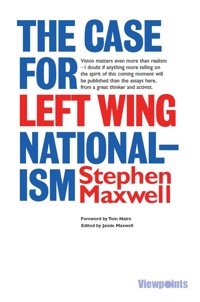
Spanning four politically and socially tumultuous decades, Stephen Maxwell's writings explore the origins and development of the modern Scottish Nationalist movement. As an instrumental member of the SNP and a life-long socialist, Maxwell's work provides an engaging contemporary insight into the debate over Scottish independence, setting out a clear ideological and practical arguments for a socially just Scotland. The Case for Left Wing Nationalism - Maxwell's seminal 1981 pamphlet - considers the historical and cultural roots of Scottish national identity and stresses the importance of a realistic understanding of the past as the basis of a more prosperous, independent future. It concludes with Hugh MacDiarmid's prescription for a Scottish renaissance: Not Traditions - Precedents.
Das E-Book können Sie in Legimi-Apps oder einer beliebigen App lesen, die das folgende Format unterstützen:
Seitenzahl: 399
Veröffentlichungsjahr: 2013
Ähnliche



















STEPHEN MAXWELLwas born in Edinburgh in 1942 to a Scottish medical family. He grew up in Yorkshire and was educated there before winning a scholarship to St John’s College Cambridge, where he read Moral Sciences. This was followed by three years at the London School of Economics studying International Politics. Attracted by stirrings of Scottish Nationalism, he joined the London branch of the SNP in 1967. He worked as a research associate for the International Institute for Strategic Studies in London and a Lecturer in International Affairs at the University of Sussex. In 1970 he returned to Scotland as Chatham House Research Fellow at the University of Edinburgh. He was a frequent contributor to the cultural and political journals fromScottish International ReviewthroughQuestiontoRadical Scotland, which fertilised the Scottish debate from the 1970s to the 1990s. From 1973 to 1978 he was the SNP’s National Press Officer and was director of the SNP’s 1979 campaign in the Scottish Assembly Referendum. He was an SNP councilor on Lothian Regional Council 1975–78 before serving as SNP Vice Chair, successively for Publicity, Policy and Local Government. From the mid-1980s, he worked in the voluntary sector, initially with Scottish Education and Action for Development (SEAD) and then for the Scottish Council for Voluntary Organisations (SCVO). He retired in 2009. He was the founding chair of a Scottish charitable company which today provides support to enable 600 vulnerable people to live in the community. He contributed to numerous collections of essays on Scotland’s future, most recentlyThe ModernSNP: from Protest to Power(ed Hassan, EUP, 2009),Nation in a State(ed Brown, Ten Book Press, 2007) andA Nation Again(ed Henderson Scott, Luath Press, 2011). He died in April 2012.
Luath Press is an independently owned and managed book publishing company based in Scotland, and is not aligned to any political party or grouping.Viewpointsis an occasional series exploring issues of current and future relevance.
Praise forArguing for Independenceby Stephen Maxwell
A lifelong campaigner both for an independent Scotland,and for a socially just and peaceful one.
JOYCE MCMILLAN,Scotsman
An important book which deserves to be widely read by nationalists and unionists alike.
TOM DEVINE,Sunday Herald
A wonderful book… a great legacy for him to have left Scotland at this time.
ELAINE C SMITH,The Herald Books of the Year
A fine contribution by a fine man.
ALEX SALMOND,Scotland on Sunday Books of the Year
A book of astonishing clarity… beautifully written.
MARGO MACDONALD,Sunday Herald Books of the Year
[A]thoroughly integrated vision of this nation’s next step(I hope).
PAT KANE,Sunday Herald Books of the Year
Truly original… his parting shot will make a huge contribution to the end game.
MICHAEL RUSSELL,Scottish Review of Books
The Case for Left Wing Nationalism
Essays and Articles
STEPHEN MAXWELL
LuathPress Limited
EDINBURGH
www.luath.co.uk
First published 2013
ISBN (print): 978-1-908373-87-8
ISBN (eBook): 978-1-909912-57-1
The author’s right to be identified as author of this work under the Copyright, Designs and Patents Act 1988 has been asserted.
© The Estate of Stephen Maxwell 2013
Contents
Acknowledgements
Foreword by Tom Nairn: A Nation’s Blueprint?
Preface by Jamie Maxwell
Can Scotland’s Political Myths Be Broken?
Question Magazine, November 1976
Scottish Radicalism
Question Magazine, May 1976
Scotland’s Foreign Policy
Question Magazine, September 1976
Beyond Social Democracy
The Radical Approach, April 1976
The Double-Edged Referendum
Question Magazine, January 1977
The Trouble with John P. Mackintosh
Question Magazine, March 1977
Review: The Break-Up of Britain
Question Magazine, June 1977
Scotland and the British Crisis
The Bulletin of Scottish Politics, Autumn 1980
The Case for Left Wing Nationalism
The ’79 Group Papers, 1981
Scotland’s Cruel Paradox
Radical Scotland, February / March 1983
Scottish Universities
Radical Scotland, February / March 1984
The Fall and Fall of Toryism in Scotland
Radical Scotland, June / July 1985
The ’79 Group: A Critical Retrospect
Cencrastus, 1985
Review: The Crisis of the Democratic Intellect
Radical Scotland, October / November 1986
Scotland International
Cencrastus, Winter 1989
Scotland’s Claim of Right
A Claim of Right for Scotland, 1989
The Scottish Middle Class and the National Debate
Nationalism in the Nineties, 1991
British Inequality and the Nordic Alternative
SNPAnnual Conference, Donaldson Lecture, October 2007
Social Justice and the SNP
The Modernsnp: From Protest to Power, 2009
Scotland’s Economic Options in the Global Crisis
A Nation Again: why independence will be good for Scotland(and England too),2011
Socialism in Democracy
Scottish Left Review, November / December 2011
Acknowledgements
There are a number of people I’d like to thank. Gavin MacDougall and everyone at Luath Press have been endlessly supportive, as have Luke and Lisa, Katie and Chris, and my mum Sally (together with the extended family in England and New Zealand). Emma Burns, Pete Ramand, Scott Lavery, Callum McCormick, Andrew Smith and Bryan Connolly have all, in different ways and at different times, been a source of great encouragement. Dan Paris provided some useful editorial advice. Harry McGrath and Owen Dudley Edwards were invaluable every step of the way. Above all, though, I’d like to thank my dad for leaving me / us / Scotland with these wonderful essays – and so much else besides. You were a gem.
Editor’s Note
‘Beyond Social Democracy’, from April 1976, is the earliest of the pieces here. But it is perhaps the densest and most challenging. For that reason I have decided to start the collection off with three shorter, punchier articles – ‘Can Scotland’s Political Myths Be Broken?’ (November 1976), ‘Scottish Radicalism’ (May 1976) and ‘Scotland’s Foreign Policy’ (September 1976). From ‘The Double-Edged Referendum’ (January 1977) onwards, the essays follow a strictly chronological order. For the sake of clarity, I have included the original introductory notes to ‘Scottish Radicalism’ and ‘The ’79 Group: A Critical Retrospect’.
Foreword A Nation’s Blueprint?
NOTHING WILL MAKE UP for Stephen Maxwell’s disappearance, it goes without saying. However, there remain some consolations, very important both to those who knew him and to those who will learn more about him from this book. He lived to perceive the political dawn coming, and in his final collection of texts this quiet man summed up much of what that should stand for. With good luck, his nation will come to embody it in due time, as a more distinct identity in the wider political world. I can’t think of any other country – new or renewed – whose formation has benefited so much in this way, or in such a timely fashion.
I also have the strongest personal reasons for welcoming this posthumous contribution. It was Stephen who put me right about both the cases and the likely character of Scottish nationalism, in a period when I remained over-attached to the fossilised remains of ‘Internationalism’. Like many others I had imagined direct transitions from a personal level of faith on to the overarching sky of totality, whether represented by capital-letter Socialism or Communism (philosophically hallowed by Marxism). And in this imagined passage, nationality was somehow bypassed, or treated as a hereditary accident – more likely to impede than assist individual progress towards humanity’s capital-letter plane. In that sense, secular internationalists had simply taken over the deeper framework of so many religions: Hegel’s ‘Absolute’ in 200 or so assorted tongues and disguises. Readers will find the episode referred to below, in typically forgiving style.
Nationality can’t be glossed over or occluded, was the Maxwell message. It has to be incorporated into the contemporary, forward-looking mode of sociality. I think this is the sense of ‘left wing’ in his unceasing struggle to redefine Scotland’s identity and its place in the post-Cold War world. He wasn’t hoping to reanimate Soviet or other phantasies, or to reinvent Socialism. The struggle for Social Democracy in Scotland has been ‘belated’, inevitably. However, such a situation has advantages, too: the belated may be intertwined with the novel, the onset of a different age. The circumstances of ‘globality’ grow daily more distinct from those of 18th to 20th century industrialisation. The latter was a competitive and militarised transformation which had demanded everywhere what one might call ‘high-pressure’ identification. This demanded an over-intense devotion to the peculiar features and needs of each competitor: ‘ethnicity’, as it came to be labelled. Life-or-death turned into part of a deal from which escape was impossible, leading to incessant warfare – of which the ‘Cold War’ was the protracted but (one hopes) concluding episode.
Personally, Stephen would have laughed at the notion of being a ‘prophet’. Nor was this just a matter of temperament. The prophetic period of Scottish nationalism came earlier, between the two World Wars, most famously in the work of C.M. Grieve (‘Hugh MacDiarmid’), whose Drunk Man contemplated a Thistle persisting against all odds, and needing a violent revolution to evolve more freely. The Maxwell equivalent is non-violent, and democratic: a kind of ‘Yes’ to our collective being, and a restoration of the latter’s self-confidence — what Carol Craig has calledThe Scots’ Crisis of Self-Confidence(2003) in one notable survey of the terrain. However, there is surely something more deeply prophetic about the Maxwell oeuvre – expressed in works likeArguing for Independence: Evidence, Risks and the Wicked Issues(Luath Press, 2012). The wicked issue is of course straightforward resumption of national statehood: a ‘Union’ originally opposed by so many, who are now given their chance to affirm a different course.
Such affirmation will be peaceful, and uncontaminated by inherited hatred or resentment. What was wrong wasn’t ‘the English’, but the ‘Great Britain’ which an early 18th-century elite had signed up for, in pursuit of both industrial development and natural resources to be derived from more successful colonisation. The contrary of that union might of course be a differently articulated association, some kind of ‘confederation’ along Swiss lines. But any such reform would itself demand that ‘sovereignty’ be first relocated and diversified, among Scotland, Wales, Northern Ireland and a restored ‘Little England’. This return of statehood would not be an impossible backward plunge into the epoch of extinct ‘-isms’. We can’t help inheriting ideologies from the past; but ‘nationalism’ in that time-bound sense will itself alter and adapt, to confront the novel circumstances of ‘globalisation’. Sovereignty means having the final word; but also, seeking more freely for the new words urgently needed, in such rapidly shifting times.
The prospective alteration has been underway for long enough. As well as Stephen’s ownArguing for Independence, the academic W. Elliot Bulmer has producedA Model Constitution for Scotland: Making Democracy Work(Luath Press, 2011). A little later,Scotland’s Choices: the Referendum and What Happens Afterwards, by Iain McLean, Jim Gallagher and Guy Lodge (Edinburgh University Press) appeared, as didA Nation Again: Why Independence will be good for Scotland(and England too), edited by Paul Henderson Scott (Luath Press). There are already many forerunners of what will be a year’s debate on the resumption of our country’s updated statehood, considering the process in much detail. However, vision matters even more than the realism imposed by an oncoming age. And I doubt if anything more telling on the spirit of this coming moment will be published than the essays here, from the great thinker (and activist) who worked so long and determinedly towards his country’s re-established independence.
The most recent addition to new nationalism’s title list has been Lesley Riddoch’sBlossom: What Scotland Needs to Flourish(Luath Press, 2013). All classical theories of nationalism, like those of Ernest Gellner (Nations and Nationalism, Blackwell’s second edition, 2006) and Liah Greenfeld’sNationalism: Five Roads to Modernity(Harvard, 1993), indicate nation-state formation as always arising from an alliance between popular restlessness and an evolving intelligentsia, inclining towards separate and independent development. ‘Among ordinary Scots… the process has already begun’, observes Riddoch, and ‘the task is to let that flower blossom – to weed out the negativity and self-doubt’ deposited by the half-history of an anachronistic Union. At the end of hisScotland the Brief: Short History of a Nation(Argyll Publishing, 2010) Christopher Harvie noted that ‘a confederal covenant within the islands would be valuable’, and the most obvious next step, if only the negativity could be got rid of. Stephen Maxwell’s positivity is surely the answer, for dismissing ‘the last enchantments of imperialism’, and convincing the English majority of their own need to ‘blossom’ independently.
‘Yes’ is about the conditions required for such advance, which can’t be ‘cultural’ or emerge from civil society alone. Scots invented ‘civil society’ in the 19th century as an alternative to the loss of statehood, but in the 21st century it’s no longer sufficient. The prolonged recession between 2008 and the present has underlined the need for more political diversity, for new ways to tackle a ‘cosmopolitan’ capitalism no longer able to guarantee reasonable development and prosperity. Of course independence ‘by itself’ won’t generate miracles; but the point is, surely, that no society is any longer ‘on its own’, and will only be able to contribute to a broader ‘Common Weal’ with the means to act, experiment, and be different. Independence was never a sufficient condition of societal success; but does it not remain a necessary condition of tolerable change and bearable identity?
Tom Nairn, October 2013
Preface
‘THE CASE FOR LEFT WING NATIONALISM’ was originally published, as a pamphlet, in 1981. My father, who was Chair of the ’79 Group at the time, wanted to challenge the view held by SNP traditionalists that a shared sense of Scottish identity would be sufficient to build a majority for independence. Instead, he argued, nationalists needed to ‘disregard romantic [conceptions] of nationhood’ and make an ‘unsentimental [appeal to] the social and economic interests of the Scottish people’. Specifically, he believed the SNP should develop policies attractive to those most exposed to the effects of British economic decline – Scotland’s industrial working class. He was confident of Scottish workers’ radical constitutional instincts: two years earlier, in the first referendum on devolution, most working class Scots had voted in favour of home rule, while wealthier Scots had voted overwhelmingly against.
How does this (crudely surmised) analysis fare today, 32 years later, in a Scotland less than 12 months away from a vote on independence?
Well, my dad was right about working class attitudes to constitutional change. In 1997, 91 per cent of working class voters supported the creation of the Scottish Parliament compared to 69 per cent of middle class voters. A similar pattern emerges when it comes to independence. Last year, Ipsos MORI published a poll showing that 58 per cent of people living in the most deprived areas of Scotland backed independence compared to 27 per cent of people in the most affluent areas. There is a clear class dynamic to the constitutional debate in Scotland.
My dad was also right about the limits of what Neil McCormick called ‘existentialist nationalism’ – the belief that a nation should be independent simply because it is a nation. Such logic is an intellectual dead-end which, thankfully, few in the SNP subscribe to these days. Its opposite is national sovereignty as the basis of social, economic and cultural change.
This is the thread that binds the essays here, from the first published in the mid-1970s, when my dad was working in various capacities for the SNP, to the last published in late 2011, roughly six months before his death from cancer at the age of 69. Not all the pieces are polemical. They offer a wide-ranging, nuanced analysis of contemporary Scottish history and culture, although usually with a political dimension. Almost all refer in one manner or another to Scotland’s changing economic landscape. My dad’s academic training, at Cambridge and the LSE, was in political theory and that inevitably informed his writing and thinking.
Not long after ‘The Case for Left Wing Nationalism’ was published my dad was expelled from the SNP, alongside Alex Salmond, Kenny McAskill and others, for his membership of the ’79 Group. He was readmitted a few years later but I’m not sure his relationship to the party ever fully recovered. He had, at any rate, always lived at something of an angle to it. For someone with such a gentle personality, he was surprisingly rebellious. His commitment to independent, critical thought – evident on every page of this book – never sat comfortably with the requirements of party discipline.
Jamie Maxwell, October 2013, London
Can Scotland’s PoliticalMyths Be Broken?
Question Magazine, November 1976
PROVINCIAL SCOTLAND, denied the opportunity of defining its sense of national identity through the exercise of self-government, drugged itself with consoling myths. Even today, when Scotland is arduously working provincialism out of its system, there are few sections of the Scottish community which do not require a regular fix of their particular apologetic myth.
Indeed, in the present transitional state of Scottish consciousness, Scotland’s dependence on myth is perhaps greater than ever. As old myths lose their potency, new ones are sought in their place. At a time of nationalist revival it is not only the Nationalists who see in the manipulation of national myths a powerful instrument of propaganda. In Scotland today, no political interest can expect to be allowed a monopoly of myth-making and propagating.
Scotland’s recent cultural history provides extreme examples of the different roles myth-making can play: on the one hand, the mythical Scotland of Harry Lauder and the Alexander Brothers supplying whisky flavoured opium for the bruised Scottish ego; on the other, the ferocious myth-making of Hugh MacDiarmid intended to recreate a complex, dialectically vigorous Scottish culture as a weapon of social and national revolution.
As the focus of Scottish interest has switched from cultural to political revival, Scottish national politics has proved itself as prolific a breeding ground of myth as Scottish cultural politics once was.
The unionist myths are the most banal. They range from the myth of the Scot as the loyal North Briton and warrant officer of Empire through to the concept of the Scot as a hard-nosed, self-interested grafter – the target, presumably, of Sir Alec Douglas-Home’s notorious ‘buttered bread’ appeal in New York – to the demonological myth of the Scot as the natural Bolshevik, the eternal barrack room lawyer or garrulous but inarticulate union agitator.
Defensive
Among unionist interests, it is the Scottish Left, the interest most directly threatened by political nationalism, which has equipped itself with the most impressive array of national myths. Given the Left’s present defensive posture, it is not surprising that most of its myth-making has a conservative purpose. Perhaps the dominant Left-wing myth is of a Scotland that has lived – and continues to live – precariously on the verge of political and social reaction. It finds its historical references in the repressive nature of Scottish Presbyterianism and the religious intolerance of 17th-century Scotland, in the authoritarian and punitive values embodied in the Scottish Poor Law and Scottish education, and in the brutalities of Scottish capitalism. Its symbolic figures could be drawn from a gallery which included Lord Braxfield, Burns on the cutty stool, a tawse-swinging dominie, and Andrew Carnegie with John Pinkerton at his elbow. The myth is all the more potent for the support it draws from that strain of Marxist theorising which sees bourgeois nationalism as necessarily reactionary, in line with recent examples of European nationalism.
Conservative
The historical accuracy of a myth is, in this context, less interesting than the political use to which it is put. The Left’s favourite myth yields an obvious anti-nationalist conclusion. The only force which contains the Scotsman’s Calvinist genius for social reaction is England’s benign and progressive influence and the main obstacle to political reaction in Scotland is the united British labour movement.
As a conservative myth this suffers from the basic flaw that it depends on a continuity of experience which is itself under challenge from the changes the myth is designed to prevent. It ignores for example the possibility, if not the probability, that the influence of traditional religious institutions will be eroded, not strengthened, as rival institutions emerge to challenge their claims. What price the General Assembly’s boast that it is Scotland’s parliament when there is a real Scottish parliament? It ignores the possibility that bourgeois nationalism may attract back into Scotland’s public life those radical middle class elements who have been conspicuously absent over the last several decades and who are likely to be the most hostile to the ethos of provincial Scotland. It ignores the probability that a new political status for Scotland would create a new responsiveness to international influence.
This myth of black, Calvinist Scotland has coexisted on the Left with another superficially antipathetic myth – the myth that the Scottish working class has an instinct for radical if not revolutionary socialism lacking in its Sassenach counterpart. Although this myth can draw on a formidable roll call of heroes – embracing names like Maclean, Gallagher, Maxton and McShane – its political impact is ambiguous. Its chief role seems to be not to act as a spur to radical action by the Scottish Left but to console it for the bleakness of its own vision of Calvinist Scotland. That the myth contains great potency in this role is suggested by the current fashion for political theatre based on this period of Scottish labour history, and by the fatalistic, self-lacerating Connolly cult. As the perspective of change widens for Scotland, the Scottish Left perversely hugs closer to itself its bittersweet images of defeat.
Scottish nationalism is if anything even more fertile in myth than Scottish socialism. Nationalism after all has experienced a far longer gestation period in which the moulding and remoulding of national myth was its only sustenance. For many Nationalists, the constitutional objective of independence has itself acquired an almost mythical quality, dragging in its train all manner of social and political glories.
To many Nationalists, Scotland’s claim to a distinctive history rests on the grand myth of Scottish democracy. Its historical sources are suitably eclectic, embracing Celtic tribal democracy, Wallace’s popular struggle against the English, and the Presbyterianism radicalism of the Reformers, and extending to cover the Reform agitation, the 1820 Rising and the Home Rule days of Scottish socialism before achieving its apotheosis in Scottish nationalism.
Alien Import
The idea that Scottish society is egalitarian is central to the myth of Scottish democracy. In its strong nationalist version, class division is held to be an alien importation from England. In the weaker version it describes the wider opportunity for social mobility in Scotland as illustrated in the ‘lad o’ pairts’ tradition.
Education has played such an important part in the survival of Scotland’s sense of her own identity that it has developed its own distinct mythology. The parochial school, in which the children of the Laird, the doctor, the grieve and the farm labourer unselfconsciously rubbed shoulders; the belief that the Scottish working class was the most literate if not literary working class in Europe; the fancy that every ploughboy has a poet’s pen in his knapsack; the conviction that Scottish education was not only more democratic but also of a higher quality than that available elsewhere – this whole ‘literature and oatmeal’ tradition has played a key part in moulding Scotland’s image of itself as a democratic society.
Another element in the democratic myth popular with Nationalists is the idea that Scotland is politically a more open, less centralised society than England.
Although Scotland could not escape all the centralising consequences of the English form of parliamentary government, Scottish political opinion never embraced the doctrine of parliamentary sovereignty preferring the more radical doctrine of popular sovereignty. Complementing this, the long history of conflict between the claims of religious organisations and the claims of the executive in the form of a remote English authority implanted in the Scottish soul a sense of being permanently ‘agin the government’. Even Scotland’s regional differentiation, and the role of Glasgow, Edinburgh and Aberdeen as distinctive centres, is interpreted as a form of social and cultural federation.
These myths have served a valuable role in mobilising Scottish energies to attack a failed status quo. But as the formative ideas of a party now challenging for political power they contain great dangers. The myths of Scottish democracy have too often served to justify an uncritical acceptance of nationalism’s claim to be a decentralising, anti-bureaucratic force. They have given support to the denunciation of class-based politics and the collective wishing away of class issues which is a well-established SNP ritual. They condone the facile assumption that independence will automatically release a flood of reforming energy to wash away Scotland’s social ills.
It must recognise first of all that Scotland is a class society, not only in the sense that substantial inequalities exist (one in five of Scotland’s population live on the official poverty line and wealth is overall more unevenly distributed than in England) but also in the sense that it is, relatively, both a socially stagnant and a segregated society. What other northern European democracy has so high a proportion of its population living in physically isolated single-class housing estates? In the first three-quarters of the 20th century, Scotland’s political leadership included a large number of working class representatives. In the final quarter it is increasingly middle class. The SNP leadership itself, notwithstanding its official ‘classless’ ideology and its evident ability to win working class votes, fits the classic model of bourgeois nationalism.
Poor Education
Contemporary Scotland’s education system is neither democratic nor of a particularly high quality. Recruitment to the universities is probably more limited socially than it was for a period in the mid-19th century, and opportunities for post-school education outwith the universities are more restricted than in England. Scottish authoritarian attitudes too often combine with the general philistinism and provincialism of Scottish society to undermine both the intellectual and the emotional confidence of young Scots as illustrated (albeit summarily) in the recent ‘Euroscot’ report.
The anti-bureaucratic, decentralising role claimed for nationalism faces a formidable challenge if independence is achieved.
Scotland’s social problems, as well as the economic problems caused by the dominance of foreign capital, will necessitate strong and sustained action by the Scottish state, and the resources will be available in the form of oil revenues to meet the need. Without determined corrective action, an independent Scotland could develop into the most ‘statist’ society outside Eastern Europe.
Threats
Nationalism’s further claim to be the agent through which the value of ‘community’ and ‘fraternity’ will be restored to Scottish life will be threatened by the increase in competitive bargaining between economic interest groups, which is likely if SNP’s promised economic miracle materialises. The economically weak may prove early victims of the ‘revolution of rising expectations’ which the SNP is preparing.
To criticise the cherished nationalist myths of Scottish democracy is not to deny them all significance. They reflect real, though partial, elements in Scottish society which in the past probably has been more democratic than English society and which even today has a more democratic ethos. A political programme for an independent Scotland must, however, be built on a more substantial base than that which the dream of Scottish democracy provides.
Scottish Radicalism
Question Magazine, May 1976
Taking up Christopher Harvie’s article in last month’s ‘Q’ on radicalism, Stephen Maxwell argues that radicalism in Scotland today is specifically Scottish and not just the vanguard of a British movement.
THE MAJORITY OF activists in the Scottish National Party assume that they are participating in a genuine Nationalist movement. They would be surprised to learn that many academic commentators dispute the SNP’s Nationalist credentials. Although electoral developments have forced these commentators to refer to ‘Scottish Nationalism’, they use the words merely as shorthand. In their analyses they seek to provide the SNP with a familiar British habitation and a name.
In this spirit, the SNP has been variously identified by British commentators as the North British manifestation of the protest vote against the two-party system; as a regional variation of a general British reaction against bureaucracy and over-centralisation; and as a protest against relative economic deprivation.
The latest example of this intellectual conservatism is Christopher Harvie’s article –
‘The Road from 1885’ – in last month’sQuestion. ‘Devolution,’ writes Harvie, ‘is not fundamentally about Welsh or Scottish nationalism, but about the political feelings of the people as a whole . . . Our salvation (if such there be) may well lie in returning to the politics of 1885 – replacing the politics of economic manipulation, patronage and welfare with a politics which is about identification, participation and responsibility – with the radical future that Gladstone stole.’
That ‘radical future’ was Joseph Chamberlain’s ‘unauthorised’ radical programme of 1885, embracing manhood suffrage and an end to plural voting, direct working class representation in Parliament, free elementary education, an element of ‘social’ taxation and a programme of decentralisation to strengthened local authorities.
Decentralisation was Chamberlain’s alternative to Gladstone’s cherished policy of Irish Home Rule. By insisting on Home Rule for Ireland, Gladstone forced Chamberlain out of the Liberal Party and into a stormy alliance with the Conservatives. Without Chamberlain’s radicalism the Liberals served merely as a ‘pusillanimous prelude’ to Keir Hardie, the Labour Party and the ‘politics of manipulation, patronage and welfare’. In Harvie’s scenario the significance of the SNP is as a catalyst to the recovery of a lost British radicalism.
Harvie thus appears to strip Scottish politics of both its chief contemporary interest – the emergence of a politically effective nationalism – and one of its proudest traditions: its distinctive radicalism.
Reductionist
The flaws in Harvie’s description of the choices facing Britain at the end of the 19th century reflect flaws in his understanding of contemporary Scotland. Chamberlain’s programme depended on a reductionist analysis of Irish nationalism in the 19th century as Harvie’s own prescription depends on a reductionist analysis of Scottish nationalism in the 20th.
Chamberlain held to the Unionist belief that the Irish problem was basically a ‘knife and fork’ one to be met by social amelioration and reform. But his proposals for a Central Board with legislative powers on education and communication would not have proved acceptable to Irish opinion. As the history of ‘constructive Unionism’ under Balfour demonstrated, the brave ‘radical future’ in Ireland would have likely proved a bloody one.
Chamberlain’s reductionist view of Irish nationalism was somewhat paradoxically combined with a conviction that Home Rule would lead to separation. His fears on this score were reinforced by the equivocal stance adopted by Parnell, whose Parliamentary avowals that Home Rule would satisfy his ambition for Ireland had to be discounted against his famous Dublin statement at the beginning of 1885.
Imperialism
‘No man has a right to set a boundary to the onward march of a nation. No man has the right to say: ‘This far shalt thou go and no further’. Such sentiments presented a direct challenge to Chamberlain’s developing imperialism: to an Irishman the ‘identification’ which Harvie picks out as one of the values asserted in Chamberlain’s programme was to be enforced identification with the metropolitan heart of imperial Britain.
Many of the proposals in Chamberlain’s 1885 programme were, of course, part of the common radical currency of the time. Indeed, Chamberlain’s programme was trumped by the Liberals’ Newcastle programme of 1891 which so affronted Gladstone and Morley. Chamberlain’s advocacy of social reform, however, had sinister overtones absent from the proposals of the Liberal or socialist radicals. Chamberlain saw constitutional and social reform as a way of mobilising Britain’s human and moral resources for imperial purposes. As a recent historian of the period has put it, where the Liberal Party remained a party of liberty and liberties, Chamberlain sought a party that would uphold the claims of the state. The line of development represented by Keir Hardie and the radical Liberals did indeed mature in the mid-20th century into something akin to a corporate state. But there is more than one way to corporatism and Joseph Chamberlain’s way, with its Bismarckian references, would have posed graver dangers to liberal democracy.
Of course, Chamberlain appeared to pose a far more serious threat to the British Establishment in 1885 than Hardie did as the victor of West Ham in 1892. Chamberlain propounded his radical programme from an established position in British politics. Hardie, by contrast, was almost as much of a political eccentricity in 1892 as Winnie Ewing was as the victor of Hamilton in 1967. But ‘Queer Hardie’ of the yellow tweed trousers, the serge jacket and vest and the soft tweed cap had gained a secure position in the demonology of late Victorian middle class Britain, as a socialist agitator and fomenter of class hatred, at a time when Chamberlain was a Cabinet colleague of no less an establishment grandee than Lord Salisbury.
The personal history of Keir Hardie, as of many of his International Labour Party (ILP) colleagues, illustrates the difficulty of dividing the radical men from the reformist boys. Kenneth O. Morgan’s recent biography –Keir Hardie: Radical and Socialist– emphasises Hardie’s deep roots in late Victorian radicalism. With fellow ILP pioneers Bruce Glasier and Ramsay MacDonald, Hardie drew his socialism not from the Methodist or Baptist chapel culture of most of his English and Welsh colleagues but from headier, more eclectic sources – from Scottish democracy and from anti-Calvinism, from the legends of Wallace and the poems of Burns, from Carlyle and Ruskin, Morris, Emersonet al. Hardie was tireless in the work of building bridges to the trades unions but nevertheless found, or made, time to give active support to a wide range of radical causes – pacifism, feminism, anti-colonialism, inter-nationalism – which most of his trade union colleagues understood little.
Hardie’s View on Home Rule
Hardie’s radicalism also embraced a concern for ‘identification, participation and responsibility’. His views on home rule are well known. As the Member for Merthyr Tydfil, he learned to sing the national anthem of his adopted country in Welsh. He had a clear view of the choices facing Welsh nationalism, as other nationalist movements, and warned against the advances of rich Liberals like the industrialist Sir Alfred Mood:
The Nationalist Party I have in mind is this – the people of Wales fighting to recover possession of the land of Wales… that is the kind of nationalism that will be emblazoned on the red flag of socialism.
Hardie’s concern for participation and responsibility was evident, too, in his view of socialist society. Although he was notoriously vague about the details of that society, he knew what he didn’t want – on the one hand, the state socialism of the German Social Democrats, on the other, any version of anarcho-syndicalism.
Unlike many socialists, Hardie took local government seriously, on a theoretical level perhaps as seriously as did Chamberlain. It was one area in which his usually woolly socialism took on a reasonably concrete form. Municipal socialism, in addition to laying the foundations for communal ownership at a national level, would help to restore a sense of civic pride and public involvement. Municipal socialism in Hardie’s vision was not to be restricted to the trams and electricity. The management of a nationalised coal industry, for example, should be undertaken by county councils.
Hardie’s aversion to anarchism and syndicalism sprang from the same civic roots. Like Ramsay MacDonald, he was opposed to a division of political power on the basis of economic or social function. He acknowledged the fact and the political potency of class interest while insisting that it must be subordinated to a wider political and civic community.
The home rule sympathies of Hardie, MacDonald and Glasier followed naturally from their shared Scottish background. It is perhaps less obvious that their wider concern for constitutional action, political community and civic identity owed anything of significance to that background.
Although neither Hardie nor MacDonald were brought up in a conventional Presbyterian environment, they were unavoidably exposed to the political and social ethos of Presbyterianism. The fundamental democracy of Calvinist theology was reflected in the tendency to the formation of schismatic groups (like the Morisonians to which Hardie himself adhered), often with a more thoroughly democratic policy than the established Church. Presbyterian policy itself, however much amended and qualified, never lost contact with the principles of popular election and lay participation, and so provided a practical education in democratic politics as well as a potent constitutional model. The importance attached to an educated laity added a social dimension to the constitutional scheme.
Inheritance
Hardie’s inheritance of political radicalism was absorbed in, and partly nullified by, the centralised welfare state which developed to meet the claims of his social radicalism. He himself would not have been too dismayed at the antimonies which history has thus uncovered in his radical-socialism. As a gradualist he rejected the apocalyptic Marxist view that socialism would spring fully armed from a resolution caused by the progressive ‘immiseration’ of the working class. He welcomed the improvement in living standards enjoyed by the working class in the 19th century, holding to the characteristic radical view that socialism was more likely to be built by an economically confident working class than by a crushed and demoralised proletariat. In the same spirit he would surely have seized on the current reaction against over centralisation and consensus politics as an opportunity of injecting an energising dose of political radicalism into the lethargic body of the welfare state.
As an organised political force the Scottish radicalism of Keir Hardie did not survive the decline of the political party he founded. But its continuing vitality as a moral and intellectual force was attested, in distinctive forms, in the thought and works of three leading and neglected Scots of the mid-20th century – John Grierson, John Reith and A. D. Lindsay.
Indeed, in some ways their response to the claims of political and civic community in a managed industrial society owed more to Presbyterianism than did Keir Hardie’s response 40 years or so earlier to the political and social challenges of his time. Perhaps the political and social legacy of Presbyterianism, made the more mellow and humane by further secularisation, will prove one of the most valuable assets Scottish radicalism will carry into independence.
Scotland’s Foreign Policy
Question Magazine, September 1976
DEBATE ON SCOTLAND’S future as an independent country swings between the banal and the melodramatic. The conventional Nationalist account of a douce nation, making a dignified progress to independence and then calmly, even complacently, ordering its affairs like any self-respecting social democracy, is countered by melodramatic predictions of civil strife on an Ulster scale, of rampant xenophobia, of social reaction cheered on by religious bigotry.
In the field of external affairs, the most distinctive counterpoint to the theme of a Scotland easily accepted into full membership of the international community and calmly deliberating its international options before proceeding to a dispassionate choice between them comes from the left. Scotland will win her independence – if at all – against the opposition of powerful external forces and once independent will find herself permanently besieged by them. The struggle first for existence, then for survival, will leave no room for diplomatic explorations nor for public deliberation leading to the luxury of open, democratic decision-making.
In his contribution toThe Red Paper, John McGrath, in a paper entitled ‘Scotland: Up Against It’, uncovers the ‘grim international reality behind the strategy of [the SNP’s] bid for ‘freedom’’. The State Department, the multi-national corporations, the US military’s arm in Europe – NATO – not to mention the CIA, will not tolerate the prospect of a Western European nation that is not very firmly subordinated to the demands of international capital and its imperialistic logic. And when that combination of forces, plus the entire apparatus of the British state is lined up against you, you take a look at Vietnam, Chile and what remains of Cuba’s hopes and modify your stance. No nation of five million people will alone defeat that imperialist machine, or defy its wishes, without heroic sacrifice and the risk of total destruction.
McGrath’s purple passage deserves a place in Grimm’s anthology of political scare-stories alongside Professor John Erickson’s dark hints that Kalashnikov rifles lie buried beneath the rose bushes in Princes Street Gardens waiting to arm the ‘internal’ enemies of the new Scottish state. But unlike the Professor’s imaginings, John McGrath’s warnings enjoy a degree of intellectual support in the shape of fashionable neo-colonialist theory portraying United States’ imperialist ambitions operating through American economic dominance and various forms of covert intervention backed up by diplomatic bluster, blackmail and blunder in the style of Dr Kissinger.
To bring the danger closer to home, Italy can now be added to the list of victims of US neo-colonialist efforts. The moral is clear: unless Scotland arms herself with the institutions and revolutionary faith of a Socialist Workers’ Republic, independence will be no more than a constitutional facade concealing the continuation, even the intensification, of neo-colonialist exploitation.
Heavy Investment
In this ideological perspective, Scotland does indeed appear a likely target. Even before the wave of American oil investment, Scotland’s economy, with the highest per capita level of US dollar investment outside Canada, was thoroughly penetrated by US capital. Scotland’s oil is a potentially important factor in the political economy of the West, while her location in the North-East Atlantic gives her a key role in Atlantic security, symbolised to Scottish opinion, albeit misleadingly, by the US Polaris base at Holy Loch.
The extent of the United States’ interest in Scotland is, therefore, obvious. What is not so obvious is that the US, with or without the help of her allies, possesses either the will or the appropriate means to enforce that interest.
On this point, the Left is not specific. Rather than attempting to assess the complex factors which will determine the extent and themodus operandiof US influence on Scottish policy-making, it resorts to the well-thumbed checklist of victims of US imperialism, from Cuba to Chile, and leaves imagination to do the rest.
A Manichean theory of history requires a strong devil if it is to carry any conviction. The trouble with the fashionable neo-colonialist theory is that it is by no means obvious that the United States and its multi-national allies possess the required political and economic muscle. The fate of Western oil companies in Libya and other Middle East countries suggests that within the restraints imposed by the present global balance and patterns of economic dependence, US power is severely limited even in respect of small Third World countries. Certainly Dr Kissinger’s recent threats of military action against the more militant oil producers created more embarrassment in Washington than fear in the Arab world.
When the United States has swallowed the nationalisation of US assets in Libya and limited its response to Norway’s tough oil policy to some discreet diplomatic grumbling, it is difficult to see why it should suddenly turn nasty on Scotland. If it did, it would find Scotland a far tougher proposition than most of the other intended victims of post-war US imperialism. Scotland, with her diverse exports, is no ‘one-crop’ economy dangerously dependent on restricted markets. An investment strike by US companies could certainly prove troublesome, but there is evidence that for reasons unconnected with Scottish nationalism, US companies are already losing interest in Scotland as a location for major investment projects.
Anyway, US multi-nationals are by no means tame followers of the State Department, and investment capital will be a commodity in abundant supply in a Scotland controlling her own oil revenues.
Different
Scotland should also prove stony ground for US covert operations. No politically significant section of Scottish society will feel its interests so threatened by independence or by the foreseeable actions of a Scottish government as to seek the serious patronage of external interests. It is hardly necessary to stress that as a country with a long democratic tradition Scotland has a political culture very different from that of the classic victims of US neo-colonialism.
If it is unlikely that Scottish opinion will have been rendered impregnable to US subversion by a militant people’s socialism, a confident and assertive nationalism will provide an adequate (and perhaps less selective) substitute.
Although the United States is usually cast as the neo-colonialist villain, England’s major oil and security interests establish her as a strong claimant to the role in Scotland.
Unlike the United States, England through her control of the physical power of the British state and of the symbols of its political legitimacy might appear to have the means to abort the very emergence of an independent Scotland. In fact, England’s power is less than it seems. The legitimacy of the British state could not survive the persistent denial of the basic right of self-determination to a constituent part whose constitutional identity is formally acknowledged by the state itself and whose historical and cultural identity has never been challenged. In terms ofrealpolitik, the constitutional crisis which would result from such a denial would destroy what remains of the international confidence on which sterling and the United Kingdom economy now so precariously depend. A choice between constitutional crisis and economic collapse on the one hand and a negotiated transition to independence with agreement on English access to the international benefits of Scotland’s oil on the other would leave London with no choice at all. The inevitable settlement will presage a pattern of interdependence between the two countries far more advantageous to Scotland than the bare differences between the size of their populations and economies would suggest.
This is not to argue that the United States and England will not seek to influence Scottish policy, nor that they will forswear all forms of interference and coercion. What is being argued is that their relations with an independent Scotland will be more like their relations with other Northern European democracies than like the political protection racket pictured in left wing melodrama. The banal truth is that Scotland’s foreign policy – like her domestic policy – will be determined more by the natural conservatism of the voter and the received wisdom about the context of decisions, than by specific pressures, overt or covert, exerted by large neighbours or dubious allies.
Diverse Influences
Scotland’s international context is dominated by influences emanating from England and the Common Market, from North America, from the Nordic countries and from the Soviet Union. The fact that Scotland stands at a point where such diverse influences converge immediately distinguishes her position from that of the small Benelux countries whose location and pattern of commercial dependence subject them to the overriding influence of continental developments as mediated through the EEC and the wider Atlantic influence as mediated through NATO. Scotland’s situation is closer to Norway’s, with whom she shares a scope for diplomatic manoeuvre (and the accompanying risks of miscalculation) denied to the Benelux countries.
England’s influence will naturally be the most pervasive. But because it will be mainly economic and Scotland enjoys some important economic advantages, it need not be unduly restrictive. Although England takes a higher proportion of Scotland’s exports than vice versa, Scotland is even now England’s biggest export market. As oil-financed expansion makes Scotland into one of the fastest growing markets in the world, England can expect to increase her already substantial trading surplus with Scotland – at a time when her global balance of payments will have been further weakened by her surrender of oil rights.
This balance of commercial advantage will ensure England’s support for a free trade agreement without Scotland having to deploy the bargaining strength represented by her foreign currency oil earnings. It is worth noting that the exceedingly favourable trading balance England can expect on (non-oil) Anglo-Scottish trade – contrasted with the massive deficit in her trade with her EEC partners – makes Scotland in some ways a more valuable trading partner than the EEC.




