


Erhalten Sie Zugang zu diesem und mehr als 300000 Büchern ab EUR 5,99 monatlich.
- Herausgeber: BC Books
- Kategorie: Geisteswissenschaft
- Serie: The and All That Series
- Sprache: Englisch
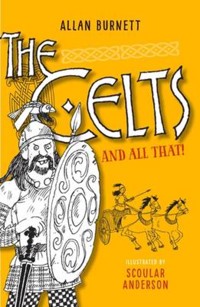
The Celts and All That is a book bursting with blood-curdling battles and dead important details about the ancient Celts. Everything you need to know about human sacrifice and headhunting is all here - plus a recipe for making your own Celtic bog butter! Packed with incredible illustrations of everything from iron-age jewellery to timber fortresses, this is an essential guide to a brilliant bunch of ancient Europeans who shaped our world. The Celts had roads, technology and inventions long before the Romans turned up - but did they also run around naked, as the Romans claimed? You'll find an intriguing answer to that and many other crucial questions inside. Plus you'll learn to tell the difference between Celtic myths and historical facts - but you'll also love the magical legends of Celtic heroes and villains, warrior princesses and monster slaying wizards.
Sie lesen das E-Book in den Legimi-Apps auf:
Seitenzahl: 63
Veröffentlichungsjahr: 2016
Das E-Book (TTS) können Sie hören im Abo „Legimi Premium” in Legimi-Apps auf:
Ähnliche


















For Karl
First published in 2016 by
Birlinn Limited
West Newington House
10 Newington Road
Edinburgh
EH9 1QS
www.bcbooksforkids.co.uk
Text copyright © Allan Burnett 2016
Illustrations copyright © Scoular Anderson 2016
The moral right of Allan Burnett to be identified as the author of this work has been asserted by him in accordance with the Copyright, Designs and Patents Act 1988
All rights reserved.
No part of this publication may be reproduced, stored or transmitted in any form without the express written permission of the publisher.
ISBN: 978 1 78027 392 1eISBN: 978 0 85790 903 9
British Library Cataloguing-in-Publication Data
A catalogue record for this book is available from the British Library
Designed by James Hutcheson
Page make up by Mark Blackadder
Printed and bound by Grafica Veneta SpA
(www.graficaveneta.com)
Prologue
1 Who are the Celts?
2 Back to the beginning
3 Brennus the menace
4 Wild weapons and formidable forts
5 Romans and Gauls
6 The awful art of being Celtic
7 Battles of Britain
8 Deadly druids and scary saints
9 Living legends
Timeline
It was late spring of 685 AD – more than thirteen centuries ago.
A warrior king called Ecgfrith was marching north through the wooded and snow-capped mountains of northern Britain when he and his men came upon a fortress by a lake.
The forty-year-old Ecgfrith held up his hand to call a halt and the jangling of the men’s weapons and packs suddenly stopped. Only the swishing tails of the cavalry horses kept moving.
Ecgfrith looked around the shores of the lake. Hiding in the fortress, or somewhere in the surrounding forest, was his enemy – a tribe of Celts.
‘Come out, come out, you cowardly Celts!’ shouted Ecgfrith, his voice booming across the lake, through the trees and around the mountains.
A pair of swallows screamed overhead, causing some of Ecgfrith’s men and horses to twitch nervously. But of the Celts there was no sign.
The Celts were hiding, but not out of fear. They just wanted Ecgfrith to think they were afraid.
This was all the plan of the Celts’ leader – King Bridei.
Bridei and his cunning Celts had fooled Ecgfrith by pretending to retreat into the hills while Ecgfrith’s army advanced from the south.
Now they had Ecgfrith right where they wanted him. It was a trap, and Ecgfrith had just marched right into it.
With swords and spears at the ready, Bridei and his band of warriors began creeping out of the forest. Others, who had been hiding in the fortress, took aim with their bows and arrows. Ecgfrith and his men were about to be ambushed.
Ecgfrith, with his eyes screwed shut and hands cupped over his mouth, bellowed once more.
‘Come out, come out . . .’ he began, expecting the cowering Celts to appear with their hands up, ready to be taken prisoner.
But one of Ecgfrith’s warriors tapped his shoulder. ‘Errr, I think they’ve come out, sire.’
Ecgfrith looked around. He and his men had been surrounded. This was not part of the plan.
‘Now then,’ Ecgfrith began again with a nervous cough, trying to hide his terror, ‘if you agree to come quietly . . .’
But this time he was cut short. A Celtic arrow whizzed through the air and speared a man on horseback next to him. The wide-eyed warrior groaned as he slumped forwards in his saddle and then fell onto the moor with a thud.
Now the Celts suddenly rushed forward!
More arrows flew through the air, accompanied by spears and rocks. To Ecgfrith’s left and right, his men were skewered like wild boar ready for roasting.
Swords were drawn from Celtic scabbards and thrust into the invaders’ bellies with a squelch. Horses trampled on the wounded and the dying.
Heads were cut off and taken as trophies by some especially bloodthirsty Celts who liked doing things the old-fashioned way.
Ecgfrith’s men fought back, but to no avail.
Amid it all, Ecgfrith was slain. At the end of the battle he lay in a bloody heap on the moor by the lake, next to the bodies of his men.
It was a thumping victory for the Celts, and a great day for King Bridei, whose heroism would be remembered for generations to come.
But it was a dreadful day for Ecgfrith’s tribe, who were known as the Angles.
The Angles had originally come to Britain across the North Sea from Jutland, which is now part of Denmark and northern Germany. They settled in Northumbria, in the country later known as England.
They had been trying to expand their territory northwards, but the Celts were having none of it. The thing is, once upon a time the Celts had lived throughout the length and breadth of Britain – and much of Europe, too. They were fed up of being squeezed by invaders and were determined to fight for their survival.
Perhaps Ecgfrith should have heeded those who warned him not to cross the Celts.
‘I pleaded with him not to go,’ said Ecgfrith’s tearful spiritual adviser, Bishop Cuthbert.
‘We would have told him not to go, too,’ said the long-dead emperors of Rome, who had once built TWO walls to keep the barbarous northern Celts, also known as the Picts, out of Roman Britain.
‘Go where?’ said Bede, a famous medieval English monk and historian who later wrote about the ambush but had no idea where it actually happened.
Even today we are still unsure where exactly the battle took place. But at least we have a name for it. In fact, we have a couple.
To the celebrating Celts, the slaughter of poor old Ecgfrith became known as the Battle of Dun Nechtain. To the Angles it was the Battle of Nechtansmere.
It may have been fought at one of two places in the nation now called Scotland – at either Dunnichen in the Lowlands, or Dunachton in the Highlands. Since Dunachton is in a mountainous area, it might be the more likely location.
Where the battle took place is not the only sketchy detail. There’s a lot about this battle that still has historians and archaeologists – experts who dig up the ground looking for clues – scratching their heads in doubt.
So the account you have just read is only a very rough and colourful idea of how things might have gone down on that day in 685. Other things we could speculate about include:
The answer to is that they might have started off white, but likely turned brown after Ecgfrith was attacked by Bridei’s men. But there are many more questions about this battle that we don’t have an exact answer to.
The same is often true of all things Celtic. That’s because the Celts can seem to be a mysterious, puzzling and shadowy people. Not much evidence about them survives.
Yet there is a lot about the Celts that we do know.
After all, they are one of the most colourful, exciting and talked-about people in history. Their adventures took them across seas and continents, and lasted for thousands of years.
In fact, the Celts helped create the world we live in today.
And that is why you must read on . . .
The Celts have been around for thousands of years. During that time they have been known to eat strange food, wear strange clothes – or no clothes at all, which is even stranger – enjoy some very strange habits, and speak strange languages.




