Table of Contents
Praise
Title Page
Copyright Page
Epigraph
Foreword
Acknowledgements
The Authors
Chapter One - Organizations with Charisma: An Introduction
Beyond Charismatic Leaders
Old Paradigms
What Makes a Charismatic Organization?
Chapter Two - How Social Capital Builds Charisma
City Year’s Social Capital
Defining Social Capital
The Power of Social Capital
Lessons from the Progressive Era
Today’s Nonprofit Environment
Part One - Building a Charismatic Organization A Strong Core
Chapter Three - Mission Motivation
Mission Matters
A Compelling Mission
Infusing the Mission: Honest Tea
Unity Through Purpose: Tufts University
Lessons for Leaders
Chapter Four - Can-Do Culture
What Is Culture?
Why Culture Matters
The Impact of Culture on Performance
Where Culture Comes From: The OPX Story
Communicating Culture: City Year
Lessons for Leaders
Chapter Five - Data-Driven Decision Making
Data Matters
Data-Driven Culture
A Road Map and Other Tools
Evaluation
Lessons for Leaders
Chapter Six - Purposeful Innovation
Innovation
Disruptive and Sustaining Innovation
Why Innovate
Challenges for Nonprofit Innovators
Building the Capacity for Innovation
One Organization’s Innovation Process: Citizen Schools
Systems for Innovation
Lessons for Leaders
Chapter Seven - People-Focused Management
The Power of People
Hiring the Right People
The Wrong People
Keeping the Right People
Volunteers
The Board
Lessons for Leaders
Part Two - Using Charisma Growing a Community of Support
Chapter Eight - Compelling Communications
Why Communication Matters
The Right Tools
Getting the Story Right: Raw Materials
Getting the Word Out: Tools for Communicating
Make the Office Speak
Lessons for Leaders
Chapter Nine - Active Outreach
Reaching Out
Making Connections
Welcoming Visitors: Lessons from Religious and Education Institutions
A Model Visitors Program: City Year
Lessons for Leaders
Chapter Ten - Meaningful Involvement
Involvement with Meaning
Involvement Strategies
Lessons for Leaders
Chapter Eleven - Lessons for Leaders Concluding Thoughts
Last Thoughts
Notes
Index
Praise forThe Charismatic Organization
If you’re nonprofit leader, you have to read this book. The beauty of it lies in a simple, yet counterintuitive, idea: Your entire organization can—and must!—develop charisma if it is to achieve long-lasting social change. Successful nonprofits do it by building vast social networks and creating ways to meaningfully engage supporters, effectively converting “outsiders” to “insiders” and inspiring them to become evangelists for the cause. This requires systematic attention and a relentless, outward-looking focus—traits that are, fortunately, learnable. Sagawa and Jospin show us the way in this fascinating and pragmatic guide.
—Leslie R. Crutchfield, coauthor,Forces for Good: The Six Practices of High-Impact Nonprofits
The Charismatic Organization is an essential guide for people who are trying to create change in the world. Sagawa and Jospin give us a compelling framework, illustrated with wonderful stories, for how leaders and change agents can build powerful and magnetic organizations and communities.
—Michelle Nunn, CEO, Points of Light Institute, cofounder, Hands On Network
Finally, a book that avoids the usual clichés about creating social change and instead breaks new ground by defining the powerful role of social capital in achieving organizational growth. If there is value in original thinking, Sagawa and Jospin have offered up a gold mine of ideas that can be put to practical application by the most traditional leaders and the newest social entrepreneurs alike. Drawing on a diverse set of current examples in education, youth service, and innovate philanthropy among other fields, The Charismatic Organization does not feel like a “how-to” book, but a “how come no one has told us this before?” book. If you are trying to keep up with the breakneck pace of relentless change in the nonprofit sector, and the lessons to be learned, there is no book more instructive, clear, or compelling than The Charismatic Organization.
—Bill Shore, cofounder and executive director, Share Our Strength
Sagawa and Jospin do not suggest that nonprofits operate more like businesses; nor do they create false trade-offs, like the need to be mission-driven or data-driven. Instead, they chart a new path by identifying the ideas and practices that high-impact organizations are using to change the world. Leaders will find much of value in this book.
—Jeff Bradach, managing partner and cofounder, The Bridgespan Group
This book has zing. In The Charismatic Organization, Shirley Sagawa and Deborah Jospin bring to life the technical terms of nonprofit management: mission, organizational culture, human resources, communications, outreach, evaluation, and others. This new volume will be an engaging and useful read for nonprofit managers and board members as well as students in nonprofit management programs.
—Alan Abramson, professor, George Mason University, and senior fellow, the Aspen Institute
A priceless compilation of insights and advice from two well-respected experts in the nonprofit field . . . lessons from The Charismatic Organization will resonate with nonprofit and for-profit leaders alike.
—Jeff Swartz, president and CEO, The Timberland Company
For every organization aspiring to greatness, here is the very best “how-to” book from the most effective “can-do” consulting team I know.
—Marguerite W. Kondracke, president and CEO, America’s Promise Alliance
Shirley Sagawa and Deborah Jospin bring the building of a successful nonprofit into modern times. Today’s nonprofits face unprecedented challenges and require new concepts, such as utilizing “social capital,” to replace old paradigms in order to survive and thrive. Shedding light on how organizations can merge the latest communications tools with time-proven techniques, The Charismatic Organization is a thought-provoking, informative read for anyone in the nonprofit sector.
—Roxanne Spillett, president and CEO, Boys & Girls Clubs of America
Clear, informative, and richly imbued with inspiring examples, this is the essential textbook for anyone starting or running an organization with a cause.
—Stephen Heintz, president, Rockefeller Brothers Fund
The Charismatic Organization channels that rare combination of knowledge, judgment, and common sense that is the hallmark of its authors, Shirley Sagawa and Deborah Jospin. This is an important and insightful book that is a must-read for those of us committed to a robust social sector.
—Ralph Smith, executive vice president, The Annie E. Casey Foundation
Copyright © 2009 by John Wiley & Sons, Inc. All rights reserved.
Published by Jossey-Bass A Wiley Imprint 989 Market Street, San Francisco, CA 94103-1741—www.josseybass.com
No part of this publication may be reproduced, stored in a retrieval system, or transmitted in any form or by any means, electronic, mechanical, photocopying, recording, scanning, or otherwise, except as permitted under Section 107 or 108 of the 1976 United States Copyright Act, without either the prior written permission of the publisher, or authorization through payment of the appropriate per-copy fee to the Copyright Clearance Center, Inc., 222 Rosewood Drive, Danvers, MA 01923, 978-750-8400, fax 978-646-8600, or on the Web at www.copyright.com. Requests to the publisher for permission should be addressed to the Permissions Department, John Wiley & Sons, Inc., 111 River Street, Hoboken, NJ 07030, 201-748-6011, fax 201-748-6008, or online at www.wiley.com/go/permissions.
Readers should be aware that Internet Web sites offered as citations and/or sources for further information may have changed or disappeared between the time this was written and when it is read.
Limit of Liability/Disclaimer of Warranty: While the publisher and author have used their best efforts in preparing this book, they make no representations or warranties with respect to the accuracy or completeness of the contents of this book and specifically disclaim any implied warranties of merchantability or fitness for a particular purpose. No warranty may be created or extended by sales representatives or written sales materials. The advice and strategies contained herein may not be suitable for your situation. You should consult with a professional where appropriate. Neither the publisher nor author shall be liable for any loss of profit or any other commercial damages, including but not limited to special, incidental, consequential, or other damages.
Jossey-Bass books and products are available through most bookstores. To contact Jossey-Bass directly call our Customer Care Department within the U.S. at 800-956-7739, outside the U.S. at 317-572-3986, or fax 317-572-4002.
Jossey-Bass also publishes its books in a variety of electronic formats. Some content that appears in print may not be available in electronic books.
Library of Congress Cataloging-in-Publication DataThe charismatic organization: eight ways to grow a nonprofit that builds buzz, delights donors, and energizes employees/Shirley Sagawa, Deborah Jospin; foreword by Jonathan M. Tisch. p. cm. Includes bibliographical references and index.
eISBN : 978-0-470-44934-9
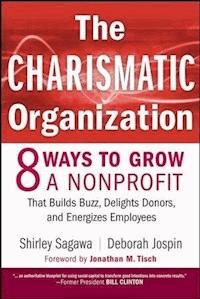
“In today’s interdependent world, nonprofitorganizations have more opportunity thanever before to make a difference in people’slives. Drawing upon their extensive experience inpublic service, Shirley Sagawa and Deborah Jospinidentify the traits that give successful nonprofitsthe competitive edge they need to maximize theireffectiveness and sustainability. The CharismaticOrganization: Eight Ways to Grow a Nonprofit That BuildsBuzz, Delights Donors, and Energizes Employees drawsan authoritative blueprint for using social capital totransform good intentions into concrete results.”
- Former President Bill Clinton
Foreword
In the hotel industry, building customer loyalty is the core of our strategy. We want our guests to stay with us not just once but every time they travel. And of course loyalty cannot be created at the CEO level; a customer’s loyalty comes from relationships with people at every level of our organization and from appreciation for the work of countless employees the customer will never meet.
This situation is not unique to the hospitality industry, or even to business in general. In today’s world, organizations of every kind—nonprofit groups, government agencies, cultural institutions, even sports teams—must work hard to attract and keep supporters and clients.
In fact, in most of these fields, competition is intensifying, investors are becoming more demanding, and old ways of creating customer loyalty have lost much of their impact. And with the communications media becoming ever more interactive and fragmented, it is becoming harder and harder for organizations to convey a strong and convincing message to the general public.
In this environment, offering a good product, effective program, or useful service is no longer enough. Today’s consumers are looking for something more—a relationship with an organization in which they feel invested. As a result, organizations are discovering that the most effective way to establish strong and lasting connections with their clients or customers is by providing them with experiences that breed true commitment.
As the chairman and CEO of Loews Hotels, I think about this issue all the time. What differentiates a Loews Hotel from other hotels? How can we delight our guests? How do we produce value for investors and at the same time support the communities in which we live?
As Shirley Sagawa and Deborah Jospin would describe it, we do it by striving to be a “charismatic organization.” All of us who work at Loews Hotels are driven by our mission of providing guests with a supremely comfortable, vibrant, and uniquely local experience in our hotels. We do this by listening to what our customers have to say (something that may sound easy but few organizations do well) and by investing in innovative business intelligence systems that help us track what our customers like and want. For example, when Ms. Jones visits our Miami property, we know that she has also stayed with us in New York and Lake Las Vegas, that she prefers the New York Times to USA Today, and that she likes foam pillows more than feather ones. We do our best to make her feel valued.
At Loews Hotels, we nurture a vibrant, positive corporate culture. We invest heavily in our employees, known as team members, who are the heart of our enterprise. We embrace diversity at our core and offer the opportunity for all team members to reach their potential as professionals. While visiting one of our properties recently, I talked with a manager who had worked for two other hotel companies before coming to work at Loews. He told me that Loews is the hotel of choice as far as employees were concerned. Another manager, who had been lured away by a competitor who offered him significantly more money, returned to our company after spending less than a month at his new job and sent me this e-mail: “I can not express to you how thankful, excited, and proud I am to be back at Loews Hotels. . . . Certainly these few weeks away opened up my eyes and just made me realize how amazing our hotel and our Loews Family is and how I needed to quickly return home.” What better way to describe a charismatic organization!
We fervently believe in the power of buzz at Loews Hotels. Creating word-of-mouth marketing is a critical part of our strategy. We don’t have the advertising budgets of our larger competitors so we have to find ways to spread our message through free media: coverage in newspapers, magazines, the broadcast media, and the Internet. Nearly every marketing success we have had at Loews is a result of this strategy: craft a public-relations-friendly message that will resonate with the media and the public and thereby produce positive buzz for our hotels. And by tapping into current happenings on the cultural scene, we stay at the cutting edge of what our guests are interested in and keep the buzz about Loews Hotels lively.
We also believe in the power of social capital. Loews Hotels is as profit driven as any other business, but we also do things a little differently. Our reputation as a caring corporate citizen means that political leaders and community activists welcome Loews Hotels into their neighborhoods, that local organizations and businesses like to choose Loews Hotels for their gatherings because they think of us as “their” hotel, and that the best employees—the most caring, committed, and creative people in our industry—rank Loews high on the list of companies they want to work for. The ultimate impact on our bottom line is hugely favorable.
Shirley and Deb have written a powerful and timely book. They are experienced nonprofit leaders who understand the organizational traps inherent in the old paradigm ways of doing business. In The Charismatic Organization, they have provided a clear road map out of those traps. By highlighting the power of social capital and challenging us to think specifically about the charismatic organization rather than the charismatic leader, they have started an exciting conversation. I began reading this book thinking it would prove helpful in how we interact with nonprofits; I finished it believing that it offers important lessons for our business.
Let’s be honest: we all want to be the best in our fields, whether we are hoteliers, college presidents, beverage makers, nonprofit leaders, or neighborhood coffee shop owners. We want to be the organization that is doing such great things that everyone is talking about us. We want to be the partner of choice for interesting projects, the employer of choice for people in our fields, the place to go for the services we offer, and the investment of choice for donors and owners. Thanks to Shirley and Deb, we now know how to get there.
Jonathan M. TischChairman and CEO, Loews Hotels
Acknowledgments
This book was inspired by the many charismatic organizations we have been privileged to know over the years, some of which are featured in this book and many that aren’t. Some were our clients; others, our grantees. We have volunteered for some and served on the boards of a few, and have admired even more from afar. This book was also inspired by our growing frustration that so many nonprofits with great ideas and great potential seemed to be treading water at best. We embarked on a quest to find the answers to a simple question: How do some organizations make it seem so easy? What are their secrets?
We are grateful to the leaders of the charismatic organizations cited in this book for the time they spent teaching us their secrets: Eric Schwarz, Citizen Schools; Bonnie Fogelman and Sally Romansky, Imagination Stage; Nora Partlow, St. Elmo’s Coffee Pub; Seth Goldman, Honest Tea; Larry Bacow, Tufts University; Gerald Chertavian, Year Up; Barbara Mullenex and Steve Polo, OPX, LLC; Alan Khazei, Michael Brown, and AnnMaura Connolly, City Year; Dan Cardinali, Communities in Schools; Dorothy Stoneman and the entire senior management team, YouthBuild USA; Vanessa Kirsch and Kim Syman, New Profit, Inc.; Charles Best, DonorsChoose; Jill Vialet, Sports4Kids; David Eisner and our former colleagues at the Corporation for National and Community Service; Marcia Greenberger and Nancy Duff Campbell, National Women’s Law Center; Kathy Connolly, Save the Children; and Bruce Adams, Big Train Baseball.
Many people provided us with helpful insights into the issues that make this field so interesting, including Jennifer Sagawa, Rodney Ferguson, Chris Wolz, Leslie Crutchfield, Tracy Gray, and Cinthia Schuman Ottinger. We also value all that we have learned from our clients over the past eight years and will always appreciate the chance they gave us to contribute to their important work.
We are extremely grateful to our editor, Jesse Wiley, and the team at Jossey-Bass. Jesse was our champion from the beginning, kept us on task, and trusted our instincts. We also appreciate the work of Mickey Butts, a freelance editor who helped us frame our ideas and present them in what we hope is a compelling way, and Beverly Miller, who helped us polish the manuscript.
Many people reviewed drafts of chapters and weighed in on the book’s title. We thank them for their counsel and their enthusiasm for this project. In particular, our smart and sweet husbands, Greg Baer and Chris Gallagher, read countless drafts, offered helpful criticisms, and gave us unwavering support. The book is better because of them.
We must also give a special thanks to our five boys—Jackson, Matthew, and Thomas Baer and Jonathan and Matthew Dutko—for their patience as we slogged through many versions of this book. They provided many moments of levity and perspective, as well as a few good stories, and we love them for it.
Finally, we thank our late friend, Eli Segal, who always believed in the partnership that became sagawa/jospin. We hope we haven’t disappointed you.
Shirley Sagawa and Deborah Jospin
The Authors
Shirley Sagawa, a national expert on children and youth policy, has been called a “founding mother of the modern service movement.” She was named a “Woman to Watch in the 21st Century” by Newsweek magazine and one of the “Most Influential Working Mothers in America” by Working Mother magazine. She is a partner in sagawa/jospin, which provides strategic consulting services to nonprofit organizations. She is currently a visiting fellow at the Center for American Progress, a Washington-based think tank.
Sagawa served as a presidential appointee in both the Clinton and George H. W. Bush administrations. As special assistant to President Clinton for domestic policy, Sagawa was instrumental to the drafting and passage of legislation creating the Corporation for National and Community Service. After Senate confirmation as the corporation’s first managing director, she oversaw all the programs of the corporation, including AmeriCorps, and directed strategic planning for this new government corporation. She returned to the White House in the last two years of the Clinton administration as deputy assistant to the president and deputy chief of staff to the First Lady.
Sagawa was the founding executive director of the Learning First Alliance, a partnership of national education associations. She has served as the chief counsel for youth policy for the Senate Labor Committee, where she was responsible for child care, early childhood, and national service policy. She has also served as senior counsel to the National Women’s Law Center as an expert on children and youth, education, and military family issues.
Sagawa’s award-winning book, Common Interest, Common Good: Creating Value Through Business and Social Sector Partnerships (with coauthor Eli Segal), describes how business and social sector organizations can collaborate for mutual gain.
Sagawa graduated magna cum laude from Smith College. She holds an M.Sc. in public policy from the London School of Economics and is a cum laude graduate of Harvard Law School, where she was notes editor of the Harvard Law Review.
Deborah Jospin, cofounder of the sagawa/jospin consulting firm, formerly served as the director of AmeriCorps. In this position, she oversaw the management and direction of the AmeriCorps Grants program, AmeriCorps*VISTA, AmeriCorps*National Civilian Community Corps, and the AmeriCorps Recruitment, Selection and Placement unit. During this period, AmeriCorps grew from an annual budget of $150 million, with eighteen thousand members serving in 350 programs, to an annual budget of $234 million, with sixty thousand members serving in 925 programs. Prior to serving as the AmeriCorps director, Jospin served as the associate general counsel for the Corporation for National and Community Service and as chief of staff to the CEO, Harris Wofford. She continues to actively support AmeriCorps members by serving as cochair of Friends of AmeriCorps Alums.
Jospin is president of the Daniel A. Dutko Memorial Foundation, established in memory of her late husband, Dan Dutko. In 2001, the foundation established the Dutko Fellowship program at Tufts University, enabling Tufts graduates who are interested in public policy management to spend ten months in Washington, D.C., working in politics or for a nonprofit organization.
Jospin is a 1980 graduate of Tufts University. She earned an M.Sc. in public policy from the London School of Economics in 1983 and a law degree from the Georgetown University Law Center in 1989. She served for several years as an associate at a lobbying and public affairs firm and an associate in private law practice.
When Tufts University created the University College of Citizenship and Public Service in 1999, Jospin became a founding member of its board, and in 2007 she became chair of that board. Now called the Jonathan M. Tisch College of Citizenship and Public Service, its mission is to provide a comprehensive education, both inside and outside the classroom, that prepares Tufts graduates to be committed public citizens and leaders who take an active role in building stronger communities and societies. Jospin is also a trustee of Tufts and serves on the Washington, D.C., Local Advisory Council for Sports4Kids.
Chapter One
Organizations with Charisma: An Introduction
In 1995, Eric Schwarz and Ned Rimer had an idea. They saw that children in their Boston community were failing and felt the frustration of local businesspeople who wanted to help but were unable to find an entry point into the schools. They also observed that while there seemed to be too little time in the school day to deal with much more than the basic subjects, the after-school hours for most children were unproductive, even risky. And they sensed a particular challenge for middle school students, especially low-income youth who were making the difficult transition into adolescence without the kinds of supports that their better-off counterparts took for granted. Out of these observations, Citizen Schools was born.1
The concept was simple: Citizen Schools would organize educational after-school programs in middle schools serving low-income youth. But they would not simply extend the school day with more of the same. They would engage the students with interesting learning activities that got them out into the community and, more important, brought the community into them with local businesspeople and others leading the students in “apprenticeships”: multiweek projects that would teach the youth real-world skills and expose them to different career fields.
Lesen Sie weiter in der vollständigen Ausgabe!
Lesen Sie weiter in der vollständigen Ausgabe!
Lesen Sie weiter in der vollständigen Ausgabe!
Lesen Sie weiter in der vollständigen Ausgabe!
Lesen Sie weiter in der vollständigen Ausgabe!
Lesen Sie weiter in der vollständigen Ausgabe!
Lesen Sie weiter in der vollständigen Ausgabe!
Lesen Sie weiter in der vollständigen Ausgabe!
Lesen Sie weiter in der vollständigen Ausgabe!
Lesen Sie weiter in der vollständigen Ausgabe!
Lesen Sie weiter in der vollständigen Ausgabe!
Lesen Sie weiter in der vollständigen Ausgabe!
Lesen Sie weiter in der vollständigen Ausgabe!
Lesen Sie weiter in der vollständigen Ausgabe!