


25,99 €
Mehr erfahren.
- Herausgeber: John Wiley & Sons
- Kategorie: Fachliteratur
- Sprache: Englisch
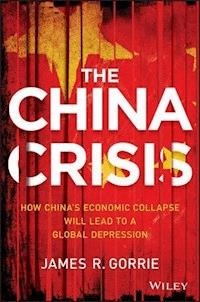
A controversial look at the impending Chinese economic collapse--the history behind it, its contemporary causes, and its dire implications for the global economy All the experts agree: the 21st century belongs to China. Given America's looming insolvency and the possibility of the collapse of the U.S. dollar, who can doubt that China is poised to take over the role of economic superpower? Written by political economist and leading financial journalist James Gorrie, this book offers a highly controversial, contrarian view of contemporary China. Drawing upon a wealth of historical and up-to-the-minute data, Gorrie makes a strong case that China, itself, is on the verge of an economic crisis of epic proportions. He explains how, caught in a recurrent boom/bust cycle that has played itself out several times over the past sixty years, China is again approaching total economic and social collapse. But with one important difference this time: they may very well take the entire global economy down with them. * Explores the Chinese communist party's unfortunate history of making costly and very bloody mistakes on an enormous scale * One-by-one Gorrie analyzes those critical mistakes and explains how they may lead to economic collapse in China and global depression * Describes Chinese "cannibal capitalism," and where its massive abuse of the country's environment, people, and arable lands is leading that country and the world economy * Chronicles China's history of recurring economic crisis and explains why all the evidence suggests that history is about to repeat itself
Sie lesen das E-Book in den Legimi-Apps auf:
Seitenzahl: 520
Veröffentlichungsjahr: 2013
Ähnliche



















Contents
Acknowledgments
Introduction
Chapter 1: A World on Edge
What Is the Proper Context in Which to Assess China Today?
China’s Self-Inflicted Crises
Great Leap Forward or Famine?
Cultural Revolution or Social Cannibalism?
How Has Economic Integration with the Global Economy Changed China?
Is China Becoming the Next Superpower?
Trading Partner to the World
The World’s Manufacturer
An Appetite for Commodities
Why Does China Have “Gold Fever”?
What Does the Rise of Other Nations, but Especially of China, Mean for the Current Financial System?
Marketing the China Brand
Does China Have a Bright and Powerful Future?
What’s Really behind the Great Wall?
Notes
Chapter 2: Stability and Legitimacy: A Chinese Crisis from Within
What Kinds of Risks and Problems Are Typical of Unstable Nations?
Stability and Instability: What Are They?
The Source of China’s “Stability”
What Are the Characteristics and Effects of Instability?
Does Stability also Mean “Legitimacy” in China?
Is Legitimacy of the Government Necessary for Stability?
Does Communist China Have a History of Stability?
Does China’s Beijing Model Lead to Stability and Legitimacy?
Notes
Chapter 3: The Rising Tide of Instability
Has China Been Influenced by Western Ideas?
Sources of Rising Instability in China
Notes
Chapter 4: Is China’s Economy Sustainable?
The Beijing Model: The Path Forward or Cannibal Capitalism?
What Is the Beijing Model?
Is the Beijing Model Self-Sustaining?
Notes
Chapter 5: China’s Quiet Crisis: Financial and Economic Meltdown
A Perception of Strength
China’s Quality of GDP
A Public and Private Stimulus Time Bomb
Development versus Economic Growth
How Much Was the Money Supply Expanded in China?
Bursting Bubbles
How Underperforming Are the Assets and the Loans Underlying Them?
China’s Banks Looking for the Real Thing
Currency Manipulation and the Domestic Economy
Will the Yuan Devaluation Be Enough to Keep the Economy Going?
Inflation and Deflation Dangers
Food for Riots
Financial Endgame
Notes
Chapter 6: China’s Extreme Environmental Degradation
Raging Environmental Crises
A History of Huge Mistakes
Hiding the Truth
Command Economies, Dehumanized Society, and Pollution
Pollution, Development, and Democracy
China’s Lose-Lose-Lose Proposition
China’s Air Pollution—Gasping For a Breath of Fresh Air
Bitter Water: China’s Lakes, Rivers, and Streams of Poison
How Bad Is the Water Pollution Situation in China?
Cancer Villages and Insanity
Why Has China’s Water Pollution Gotten So Bad?
Lifeless Oceans
A Plague Upon the Land
China’s Dead Zones
The Land of Arsenic
Why Is Such Pollution Tolerated?
CCP Land Policies Promote Abuse
Losing the Breadbasket
The Deforestation and Desertification of China
What Is the Real Cause of Desertification?
Ghosts of Famines Past
Notes
Chapter 7: Political Transition and the Breaking Point
Will Xi Jinping Unify the CCP?
Liberalization versus Stability
Passing the Torch: China’s New Nationalism
Domestic Crises for the New Leadership
How Will the New Chinese Leadership Navigate the Rough Waters Ahead?
Hell and High Water
Notes
Chapter 8: Empire Decline and Complexity Theory
China as an Empire
Hong Kong
Taiwan
China’s Uighur Problem in Xinjiang
The Sandals and Saffron Threat of Tibet
Fear and Greed in the New Leadership
Complexity Theory
Notes
Chapter 9: The Fall of the Red Dragon
China’s War with China
The Breakup
Conclusion
Notes
About the Author
Index
Cover image: © Duncan Walker/iStockphoto
Cover design: Michael J. Freeland
Copyright © 2013 by James R. Gorrie. All rights reserved.
Published by John Wiley & Sons, Inc., Hoboken, New Jersey.
Published simultaneously in Canada.
No part of this publication may be reproduced, stored in a retrieval system, or transmitted in any form or by any means, electronic, mechanical, photocopying, recording, scanning, or otherwise, except as permitted under Section 107 or 108 of the 1976 United States Copyright Act, without either the prior written permission of the Publisher, or authorization through payment of the appropriate per-copy fee to the Copyright Clearance Center, Inc., 222 Rosewood Drive, Danvers, MA 01923, (978) 750-8400, fax (978) 646-8600, or on the Web at www.copyright.com. Requests to the Publisher for permission should be addressed to the Permissions Department, John Wiley & Sons, Inc., 111 River Street, Hoboken, NJ 07030, (201) 748-6011, fax (201) 748-6008, or online at http://www.wiley.com/go/permissions.
Limit of Liability/Disclaimer of Warranty: While the publisher and author have used their best efforts in preparing this book, they make no representations or warranties with respect to the accuracy or completeness of the contents of this book and specifically disclaim any implied warranties of merchantability or fitness for a particular purpose. No warranty may be created or extended by sales representatives or written sales materials. The advice and strategies contained herein may not be suitable for your situation. You should consult with a professional where appropriate. Neither the publisher nor author shall be liable for any loss of profit or any other commercial damages, including but not limited to special, incidental, consequential, or other damages.
For general information on our other products and services or for technical support, please contact our Customer Care Department within the United States at (800) 762-2974, outside the United States at (317) 572-3993, or fax (317) 572-4002.
Wiley publishes in a variety of print and electronic formats and by print-on-demand. Some material included with standard print versions of this book may not be included in e-books or in print-on-demand. If this book refers to media such as a CD or DVD that is not included in the version you purchased, you may download this material at http://booksupport.wiley.com. For more information about Wiley products, visit www.wiley.com.
Library of Congress Cataloging-in-Publication Data:
Gorrie, James R.
The China crisis : how China’s economic collapse will lead to a global depression / James R. Gorrie.
pages cm
Includes bibliographical references and index.
ISBN 978-1-118-47077-0 (cloth); ISBN 978-1-118-47080-0 (ePDF);
ISBN 978-1-118-47079-4 (Mobi); ISBN 978-1-118-47078-7 (ePub)
1. China—Economic conditions—2000- 2. China—Economic policy—2000-
3. Global Financial Crisis, 2008-2009. I. Title.
HC427.95.G67 2013
330.951—dc23
2012049233
I dedicate this book to my beautiful wife Lulu, who supported and encouraged me throughout the long writing process with a timely smile, loads of patience, and the occasional yet indispensable glass of wine. Her heartfelt faith in me is much appreciated.
I would also like to dedicate this book to my three boys, Brandon, Oliver, and Alexander, whose playful interruptions and numerous video game sessions gave me much-needed breaks along the way.
Finally, I would like to dedicate this book to my parents, Dr. Douglas and Marjorie Gorrie, for their love and encouragement throughout my life.
James R. Gorrie
Austin, Texas
November 30, 2012
“Men in the game are blind to what men looking on see clearly.”
—Chinese proverb
Acknowledgments
When I decided to write The China Crisis, it was sort of an intellectual homecoming for me. As an “economically challenged” doctoral student at the University of California at Santa Barbara more than a few years ago, I had just passed my comprehensive exams and gathered my dissertation committee together when I lost my funding amidst budget cutbacks. My choice was either to go into debt another hundred grand while I wrote my dissertation on the political economy of China (and probably live out of my 1969 VW camper van, which was all I had at the time) or forage for a job in the “real world” outside the protective walls of academia. I chose the latter. It has been quite a winding path, to say the least.
Fast-forward 20 years, and I have finally written the book that I had wanted to write. Though now far removed from graduate school, I have never lost interest in the world at large, nor of watching China as it grew and transformed itself, year after year, into a formidable, fascinating and greatly distorted economic power. Needless to say, completing this book is a dream come true for me and a very personal accomplishment. In getting my thoughts out of my head and into print, there are a few people who truly made it happen for me and they deserve my sincere thanks and acknowledgment.
My heartfelt thanks and gratitude belong to my wife Louise, who always found a way to make much of the long road a bit smoother than otherwise would have been, and remained with me through the very rough spots. I could not have a better companion with whom to travel life’s winding, adventurous path.
I want to also thank MaryEllen Tribby, who not only is a fan of my writing, but was at one time also a colleague. Of course, I also want to thank the people at John Wiley & Sons: in particular, Deborah Englander, for her faith in me, for agreeing to go along with my idea for The China Crisis, and for giving me the opportunity to write for such an esteemed publisher. I could not have asked for a better home for my first nonfiction book. I would also like to express my personal appreciation to my editor, Judy Howarth, for all her help with the book, her flexibility, and her wise suggestions along the way.
Finally, I would like to thank my good friend, Al Hyam, for his insight and perspective, (though sometimes challenging my own, highly valued nonetheless) and for more than 20 years of great conversation and friendship through good times and some not-so-good times.
JRG
Introduction
When I discussed writing this book with my publishers, I mentioned that I wanted to make it as informative yet easy to read and digest as possible. I wanted the book to appeal to the business individual as well as academics and those with a causal interest in what’s evolving in China. As a former academic, I am used to academic writing, but the vast majority of the public—including business people and those with a general interest in what’s happening in the world—are not. That is not a dig against academia; it’s just a fact. Most people get their information from Internet sites and so I have attempted to keep the writing as informative and engagingly conversational as possible. Also, I will use statistics as reasonably and effectively as possible without turning the book into a chore to get through.
My main purpose in writing this book is to inform the reader just what is going on with China’s economy, and to provide a more balanced and accurate picture of some of the enormous challenges that China faces, which seem to get overlooked in popular news reports. As noted above, I use statistics where needed or helpful, but at the same time, I am mindful of avoiding presenting a dry, quantitative recitation.
Rather, my objective in writing The China Crisis is to view China from a macro perspective, to look at the broad forces that are at work within China’s economy, its demographics, its environment, and the Chinese Communist Party. I want to connect the dots as I see them in a plausible fashion that is interpretive in style, scope, and intent. Like any predictive effort, there is the promise of being ahead of the curve in some areas, and the danger of misreading the meanings of events or facts, and, of course, of being just plain wrong. Whatever the case may be, I can bear the risk of being publicly wrong on certain points; after all, no one is right all of the time, and when someone thinks they are they tend to be a bit of a boor anyway. That said, I think the risk is worth the effort. The worst-case scenario for The China Crisis is that it will provide a context for many provocative conversations about the subject going forward.
Like so many other observers, when I first began thinking about China and its fantastic rise in the world, I was greatly impressed by how far that country has come in such a relatively brief period of time. It was not too long ago that China was the bicycle capital of the world. From the opening of China in the late 1970s up through the early 1990s, almost any newscast from Beijing—with the possible exception of the Tiananmen Square Massacre in 1989—would include the obligatory camera shot of thousands upon thousands of Chinese riding their bikes on Beijing roads. “The Bicycle Kingdom” was a kind of standing joke about the industrially backward and communist Chinese.
Suffice it so say, those days are long gone. Today, people speak of China’s “economic miracle,” which has lifted hundreds of millions of Chinese out of poverty and strengthened the prospect of China’s growing role on the world stage. Such speculation is not altogether unfounded. In fact, on the face of it, there would seem to be nothing standing in the way of China in becoming the greatest power on Earth.
This is only a slight exaggeration, but there is always an awe factor when a nation of 1.3 billion people—one-fifth of the world’s population—challenges the United States, the world’s most powerful nation, in such a brazen and rapid fashion as China most certainly is doing. There is certainly no question that China already has surpassed the United States in several economic measures, and will continue to claim more firsts as their wealth and economy expand. Having said that, I explore reasons why China’s economy is more likely to contract rather than expand, and what this means in the larger context of China’s expected rise to global dominance.
Lesen Sie weiter in der vollständigen Ausgabe!
Lesen Sie weiter in der vollständigen Ausgabe!
Lesen Sie weiter in der vollständigen Ausgabe!
Lesen Sie weiter in der vollständigen Ausgabe!
Lesen Sie weiter in der vollständigen Ausgabe!
Lesen Sie weiter in der vollständigen Ausgabe!
Lesen Sie weiter in der vollständigen Ausgabe!
Lesen Sie weiter in der vollständigen Ausgabe!
Lesen Sie weiter in der vollständigen Ausgabe!
Lesen Sie weiter in der vollständigen Ausgabe!
Lesen Sie weiter in der vollständigen Ausgabe!




