


72,99 €
Mehr erfahren.
- Herausgeber: John Wiley & Sons
- Kategorie: Fachliteratur
- Serie: Wiley Finance Editions
- Sprache: Englisch
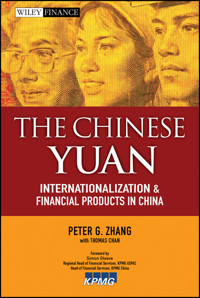
Few topics have attracted as much attention worldwide in recent years as the RMB. These debates have gained added urgency in light of the financial crisis and the topic of RMB revaluation is now being actively debated in countries all over the world from Tunisia to the United States. This book explores the ever-changing role of the RMB and the related derivative products. However, it does so from a view that is heavily influenced by the fallout from the financial crisis as well as the in the context of the increasing maturity of the Chinese capital markets. The author has drawn on his experience as a regulator to provide invaluable views, insights and information on RMB derivative products and the development of this market going forward. Key topics include: * Overview of current China economy and its capital market * In-depth analysis on the China's banking system and foreign exchange system * Extensive analysis of on-shore and off-shore financial products in China * Explanation of the needs and reasons for RMB products innovation * Insights into the internationalization of the RMB Not only will this book leave its readers with a much clearer idea of the structure of China's capital markets but it also gives insights on the market going forward leveraged through Peter Zhang's many years of experience as both a senior banker and through his integral role in the key regulatory authority of the banking sector, the CBRC.
Sie lesen das E-Book in den Legimi-Apps auf:
Seitenzahl: 437
Veröffentlichungsjahr: 2010
Ähnliche



















Contents
Cover
Title Page
Copyright
Foreword
Preface
Acknowledgments
Part One: The Chinese Economy and Financial Markets
Chapter 1: The Chinese Economy
Population and Human Resources
Foreign Direct Investment
International Trade
Foreign Exchange Reserves and Foreign Debt
GDP and GDP per Capita
Enormous Consumption Potential
Problems in China's Economic Development
Development Forecasts
Conclusion
Chapter 2: China's Banking System
Regulatory bodies
Financial institutions in China
Commercial banks
Interest rate system
Inter-bank market
Conclusion
Chapter 3: China's Capital Market
Stock Market
Price/Earnings Ratio, Turnover Rate, and Securitization
China's Exchange-Traded Fund
Securities Companies
Hong Kong Stock Exchange
The Structure of China's Bond Market
PBC Bills Market
Treasury Bond Market
Financial, Corporate, and Other Bonds
Bonds Issued by Overseas Organizations in the PRC and Issued by PRC Organizations Overseas
Relationship Between Direct and Indirect Financing
Fund Management
China's Insurance Industry
Qualified Foreign Institutional Investors
China's WTO Commitments
Conclusion
Chapter 4: China's Foreign Exchange System and International Investment Positions
Reforming the Foreign Exchange System
CNY/US$ Exchange Rates
Foreign Exchange Trading Value
International Investment Position
IIPs Compared
Conclusion
Part Two: Major Onshore CNY Products and Their Markets
Chapter 5: CNY Foreign Exchange Forwards
A brief history of the CNY forward market
An illustrative CNY forward transaction
Currency composition of CNY forward transactions
Foreign exchange settlement and sale before and after Foreign exchange reform
Status of CNY forward transactions in CFETS
Merchant foreign exchange forward trading
Problems in the CNY forward market
The potential for the CNY forward market
Conclusion
Chapter 6: The Foreign Exchange Swap Market
Introduction
Launch of CNY Foreign Exchange swaps
Functions of Foreign Exhange swaps
Development of CNY foreign exchange swap market
Transaction volume, maturity profile, product mix, and currencies for foreign exchange swaps
Market participants
International comparisons
Major issues for the swap market
Conclusion
Chapter 7: CNY Bond Forwards
Introduction
The significance of bond forwards
The current position
Underlying bond types
Terms of bond forwards
Institutional players
Conclusion
Chapter 8: CNY Interest Rate Swaps
Importance in the global OTC market
Key concepts
Types of CNY swaps
History and development
Contract highlights
Use and significance of CNY swaps
Turnover and future development
International comparisons
Conclusion
Chapter 9: Forward Rate Agreements
Introduction
Regulations
Implications of marketing CNY FRA transactions
Maturity structure
Conclusion
Chapter 10: Wealth Management Products in China
Development of wealth management products
Development of foreign currency products in China
Risks attending wealth management products in China
Regulation and future developments
Conclusion
Chapter 11: Other CNY Products
Development of the Global Warrants Markets
Development of the Warrants Market in China
Convertible Bonds
Development of China's Market
Significance of the development of China's convertible bond market
Conclusion
Part Three: Offshore CNY Derivatives Products
Chapter 12: CNY Non-deliverable Forwards
Development History
Revaluation/Devaluation Pressure on the CNY and the NDF Market
Major Terms of CNY Non-Deliverable Forwards
Factors Affecting the CNY NDF Market
Market Issues
Conclusion
Chapter 13: CNY Non-deliverable Options
Foreign Exchange Options: Basic Concepts
Fundamentals of the CNY NDO
CNY NDO Contracts
Historical Volatility of CNY Foreign Exchange Rates
Implied Volatility of CNY/US$
Factors Influencing Implied Volatilities
Necessity of Onshore CNY Foreign Exchange Options
Conclusion
Chapter 14: CNY Non-deliverable Swaps
Cross-Currency Swaps
Non-Deliverable Swaps
CNY NDSs
Application
Foreign Exchange Forward Swaps
Conclusion
Chapter 15: Non-deliverable CNY Interest Rate Swaps
Introduction
Domestic and Offshore Swaps
Conclusion
Chapter 16: Stock Index Futures and Options
Concept of stock index futures and options
H-shares and the H-share Index
Futures products with H-shares as their underlying asset
Options with H-shares Index as the underlying index
Applications of H-share Index futures and options
Relationship between the H-share Index, its related derivatives, and CNY appreciation
A-share stock index futures
Conclusion
Part Four: The Internationalization of the CNY and Development of CNY Markets
Chapter 17: Major International Currencies and Their Foreign Exchange Market Liquidities
The IMF's special drawing rights
Composition of major international reserve currencies
Status of major international currencies in the international Foreign Exchange market
Major currencies in the international Foreign Exchange derivatives market
Degrees of internationalization in the foreign exchange market
The currencies of major developing countries
YUAN and RUPEE compared
Conclusion
Chapter 18: Lessons from the Internationalization of the Yen
The yen as an international reserve currency
The yen's role in trade settlements
Gradual relaxation of exchange controls
Japan's capital account liberalization
Overview of Japan's promotion of yen internationalization
Fundamental work on reforming the financial system
OTC products in Japan
Derivatives trading
Tokyo as an international financial center
Conclusion
Chapter 19: The Current Status of the CNY Internationalization Process
General situation
Use of CNY in trade
Current CNY applications in Hong Kong
Deposits
CNY bonds in Hong Kong SAR
CNY futures on the CME
CNY-settled cross-border trades
Potential for use in Foreign Exchange reserves
Conclusion
Chapter 20: Market and Product Trends Under the Internationalization of the CNY
CNY internationalization and development needs for the Foreign Exchange market in 2020
Development requirements for the capital market
Unique role of Hong Kong
CNY and yen: Internationalization processes compared
Financial innovation for diverse investment
Risk management instruments and trading places
Creating innovative CNY products: A matter of urgency
Financial innovation for promoting Shanghai as an international financial center
Strengthening supervision of cross-border capital flows
Conclusion
Bibliography
Index
Copyright © 2011 John Wiley & Sons (Asia) Pte. Ltd.
Published in 2011 by John Wiley & Sons (Asia) Pte. Ltd.
2 Clementi Loop, #02–01, Singapore 129809
All rights reserved.
No part of this publication may be reproduced, stored in a retrieval system, or transmitted in any form or by any means, electronic, mechanical, photocopying, recording, scanning, or otherwise, except as expressly permitted by law, without either the prior written permission of the Publisher, or authorization through payment of the appropriate photocopy fee to the Copyright Clearance Center. Requests for permission should be addressed to the Publisher, John Wiley & Sons (Asia) Pte. Ltd., 2 Clementi Loop, #02–01, Singapore 129809, tel: 65–6463–2400, fax: 65–6463–4605, e-mail: [email protected].
This publication is designed to provide accurate and authoritative information in regard to the subject matter covered. It is sold with the understanding that the publisher is not engaged in rendering professional services. If professional advice or other expert assistance is required, the services of a competent professional person should be sought.
Neither the authors nor the publisher are liable for any actions prompted or caused by the information presented in this book. Any views expressed herein are those of the authors and do not represent the views of the organizations they work for.
Other Wiley Editorial Offices
John Wiley & Sons, 111 River Street, Hoboken, NJ 07030, USA
John Wiley & Sons, The Atrium, Southern Gate, Chichester, West Sussex, P019 8SQ, United Kingdom
John Wiley & Sons (Canada) Ltd., 5353 Dundas Street West, Suite 400, Toronto, Ontario, M9B 6HB, Canada
John Wiley & Sons Australia Ltd., 42 McDougall Street, Milton, Queensland 4064, Australia
Wiley-VCH, Boschstrasse 12, D-69469 Weinheim, Germany
Library of Congress Cataloging-in-Publication Data
ISBN 978-0-470-82737-6 (Hardback)
ISBN 978-0-470-82739-0 (ePDF)
ISBN 978-0-470-82738-3 (Mobi)
ISBN 978-0-470-82740-6 (ePub)
Foreword
The emergence of China as a leading exporter and “factory to the world” was arguably the most significant development of the late 20th and early 21st century. By opening the country to outside investment, and unleashing the potential of China's own entrepreneurs and state-owned enterprises, China's government has been able to achieve in thirty years what many developed countries have achieved over centuries.
China's impressive economic achievements derived from the reforms of the 1980s and 1990s, were accompanied by government's management of the Chinese yuan (CNY) exchange rate and the country's capital account. As a consequence, the rapid growth of the export driven economy, has been accompanied by the United States trade deficit with China increasing from just US$6 million in 1985 to US$173 billion for the first six months of 2010.1 Over this period, the exchange rate to the US dollar has gradually been adjusted from CNY1.50 in 1980 to CNY8.62 by 1994, favoring China's exporters, although more recently it has appreciated to CNY6.66. While in 2005 the peg to the US dollar was replaced by a market floating exchange rate referenced to a basket of foreign currencies, the peg was reintroduced in 2008 in response to the worsening global financial crisis. In June 2010, the CNY was allowed once again to float within a basket of foreign currencies but the boundaries remain tight, with its value significantly below the expectation of western countries.
Despite these measures, the CNY has undoubtedly started down the path of internationalization. Recent steps include the setting up of a number of bilateral currency swap agreements which allow certain countries and areas, including Argentina, Belarus, Indonesia, Malaysia, South Korea and Hong Kong to exchange substantial amounts of their own currency into CNY at times when they are under strong selling pressure in the international markets. Another step towards internationalization are the pilot schemes for cross border trade financing which allow manufacturers and importers based in southern China to settle their cross border transactions in CNY. This step is important because it allows the manufacturers to transfer their foreign exchange risk to their overseas customers. Meanwhile, Hong Kong has been established as a test center for capital markets activities in CNY through the issue of CNY denominated securities by certain banks in Hong Kong, and China's agreement with the IMF in 2009 that China may use CNY to purchase special drawing rights. All the above arrangements have strengthened the influence of CNY internationally.
While the above steps represent significant progress, there remains a significant length of road to be traveled before the yuan can be called a truly international currency. There are a number of reasons why China's government has not allowed the CNY to float freely and appreciate rapidly. One of the most important is the impact which any significant appreciation in the yuan would have on the already fragile export market which is still suffering from a combination of increasing labor and production costs, and weakened consumer sentiment in the developed west. Over the past few months, the calls for China to make further currency reforms have become even louder. There are also voices from within China who see appreciation of the CNY as being necessary to take some of the pressure off the asset bubbles which are becoming apparent in many areas of the economy, and in particular the property market.
The arguments and counter-arguments concerning the respective merits of relaxing China's currency and capital account controls will be familiar to anyone who has opened a newspaper or watched a financial news program in the past 10 years. However, in analyzing the current role and performance of CNY dominated products in financial markets in China and overseas, the authors of this book have focused on the lesser-discussed aspects of this debate. Namely that while the years of government's management over the CNY have undoubtedly played an important role in China's recent economic successes, they have also contributed to the relatively underdeveloped state of China's financial markets. If China is to further liberalize its foreign currency markets, and allow the CNY to become an international currency, then it must as a matter of urgency improve the liquidity of CNY denominated financial instruments, and promote further innovation in CNY denominated financial products. With a broader range of CNY denominated financial products, Chinese companies and overseas investors will be able to more effectively control the increased risks which would arise from a relaxation of the controls over China's capital account and the exchange rate. Such innovation will also further support the government's stated strategy of establishing Shanghai as an international financial centre. Financial institutions in Shanghai will also be able to compete more effectively with their counterparts in New York or London.
By providing readers with such an informative overview of the developments in China's financial markets to date, this book highlights the work which still needs to be done, and in doing so provides an effective roadmap for the future direction which further development of CNY-denominated financial products is likely to take.
Simon Gleave
Regional Head of Financial Services, KPMG ASPAC
Head of Financial Services, KPMG China
Endnote
1. US Census Bureau Foreign Trade Statistics.
Preface
The Seventeenth Central Committee of the Communist Party of China (CPC), held in October 2007, called for the whole party and people of all ethnic groups to vigorously enhance the spirit of reform and innovation, thoroughly pursue rational development, improve the capability of independent innovation, and build an innovative country. The report of the Seventeenth CPC Central Committee pointed out that China should stick to the road of independent innovation with Chinese characteristics, and carry out independent innovation in various aspects of modernization. The report clearly requires the financial sector to sharpen the competitiveness of the banking, securities, and insurance industries.
Sharpening the competitiveness of the financial sector is, in effect, increasing its innovative capabilities. China's economy has recorded remarkable achievements in 30 years of reform and opening-up, with its innovative capability being further enhanced each year. Though the pace of economic and financial globalization has been affected to varying degrees by the international financial crisis, the wheel will continue to move forward. Given the increasingly international status of its economy, China should look to identify gaps and areas for improvement in its current performance, comparing this both with its own historical achievements and with the performance of developed and developing countries.
With the steady growth of China's economy and its higher global ranking, Chinese companies will gradually accelerate their expansion overseas and foreign enterprises will increase their investments in China. This will result in foreign currency business accounting for a higher proportion of China's financial sector. However, as the vast majority of the assets of Chinese financial institutions will still be denominated in Chinese yuan (CNY), the key to financial innovation in Chinese institutions in the foreseeable future will lie in innovating CNY products. With gradual progress in the internationalization of the CNY, demand for innovative CNY products from both Chinese and foreign investors will continue to increase. Financial innovation is all about innovative ideas, mechanisms, and risk management. Nevertheless, the performance and profitability of financial institutions depends on products and services; so financial innovation is, in effect, product innovation. Therefore, creating innovative CNY products is the key to China's financial innovation.
China made tremendous progress in its economic development in the 30 years from 1978, when the reform and opening-up program began, recording an average annual real GDP growth rate of almost 10 percent. Even in 2009, when the world economy was in the grip of the global financial crisis, it achieved 8.7 percent growth, reflecting the effectiveness and timeliness of the various measures it had taken to combat the worst effects of the crisis.
Besides the great achievements in economic development, China has also made good progress in developing its financial market in the past decade or so, particularly in the inter-bank marketplace, with more and more new products. The first new business in the banking industry was the foreign exchange forward settlement, launched in April 1997, after the People's Bank of China issued “The Tentative Administrative Methods for Renminbi (CNY) Forward Settlement” in January that year. CNY bond forwards, foreign exchange forward trading, foreign exchange swaps, interest rate swaps, and forward rate agreements were introduced in the inter-bank marketplace consecutively from 2005. These new products have developed reasonably well in the past few years, providing market participants with instruments to hedge foreign exchange and interest rate risk.
Despite good progress in product innovation and market development in the financial market, financial futures are still absent from the organized exchanges, and options are absent from both exchanges and the inter-bank marketplace in mainland China. Although the above-mentioned over-the-counter (OTC) products have come into play in the past few years, market liquidity has been rather low, with international weights much lower than the corresponding GDP global weight for each of these products. Risk management cannot be practiced satisfactorily without there being sufficient liquidity for these instruments.
Further, the financial market cannot serve the underlying economy well enough without sufficient development. For example, promotion of the CNY to settle international trade is highly necessary, and the experimental implementation of settlement in 2009 was very timely. Yet, the fact that settlement volume has not been significantly high implies that market foundations, such as CNY foreign exchange risk management, have to be strengthened. Thus, CNY foreign exchange forward and swaps markets need sufficient liquidity for market participants to hedge the related foreign exchange risk.
The financial crisis has taught us many lessons since September 2008. Financial derivative products have been widely blamed for having “caused” the crisis, or at least made it worse. However, we have not seen any serious problems with any derivatives trading in any organized exchanges or most OTC derivatives (other than credit default swaps) worldwide, despite moderate declines in trading values of futures and options trading worldwide from the second half of 2008 and 2009. Futures and options trading in exchanges and most OTC derivative products have well-defined functions in the financial system and the whole economy, so that the underlying economy cannot do well without the necessary financial products and sufficient market liquidity for these products. China has achieved tremendous economic development in the last three decades and has developed its financial markets significantly. Yet many necessary financial products are still absent from the market and the liquidity of most existing segments of the financial market is relatively low. It is highly necessary for China to accelerate the development of its financial market in order to serve its economy better.
While there have been many studies on different aspects of the Chinese economy, there are comparatively few on the current conditions of the financial market, particularly on the specific status of major components of the inter-bank market. The purpose of this book is to provide readers with a detailed description and analysis of the current status of Chinese financial markets, products, liquidities, and potential problems.
The book is divided into four parts. Part OneI provides an introduction to the Chinese economy and financial markets, covering such aspects as the macroeconomy; the banking industry, and corresponding regulatory bodies; the capital market and corresponding regulatory bodies; and the foreign exchange system and China's international investment positions. Part TwoII introduces the major components of China's inter-bank market; the foreign exchange forward, and swaps markets; the CNY bond forward and interest rate swaps markets; forward rate agreements; and wealth management and other OTC products.
Part ThreeIII covers offshore CNY products, principally those being traded in the Hong Kong Special Administrative Region. These include CNY non-deliverable foreign exchange forwards, CNY non-deliverable options, non-deliverable foreign exchange swaps, and non-deliverable CNY interest rate swaps. It also introduces H-share stock index futures and CNY bonds in Hong Kong.
In Part FourIV, we explore CNY product innovation and market development in line with the increasing internationalization of the CNY in the coming decades. We analyze major international currencies and their major markets, and examine the current status of the internationalization process and the need for risk management. In the final chapter, we round things off by looking at the potential development trends for major CNY derivatives markets that will accompany the gradual internationalization of the CNY over the coming decade.
In April 2009, the Chinese State Council released an important set of guidelines to accelerate its stated intention to build Shanghai into an international financial center by 2020 in line with China's economic status. International participation and the internationalization of the CNY are necessary conditions if this aim is to be achieved. We strongly believe that the Chinese financial market, particularly the inter-bank market, will grow steadily so that its major components will occupy similar weights in the global inter-bank marketplace to the weight that the Chinese economy will occupy in the world economy in the coming decades.
We hope that this book can help readers understand the current status of the major Chinese inter-bank market and its future development. We wish to emphasize, however, that the views expressed are those of the authors alone, and not those of the institutions for whom they work.
Peter G. Zhang with Thomas Chan November 2010
Acknowledgments
We would like to thank those who have contributed much research work for the completion of this book, in particular, Luo Pengyu of Bank of China, Zhang Zhiqiang of Zendai Investment Management Company, Ms. Ge Chongyang of China Life Asset Management Co. Ltd., Ms. Song Xiaoling of Goldman Sachs International Bank, as well as Du Han, Huang Xindong, Liu Huai-yuan, Sun Yinho, and Xiao Lijuan of the Graduate School of the People's Bank of China. We would also like to thank partners and staff of KPMG China. KPMG Partners Nelson Fung and Terence Fong provided invaluable advice and comments, while Wayne Tsang, Tom Jenkins, Michael Hurle, Fiona Yan, Maggie Ji, Ian Xu, Ryan Ren, Allen Cui, Christina Yu, Teresa Shang, Coco Yang, Andrew Chen, Ada He, Ivor Cheung, Isabel Wu, and Chris Guo all assisted with the editing and translation of the book.
We hereby express our sincere gratitude for their contribution and professional work. At the same time, it is necessary to stress that all the views in this book are expressed in an academic context and do not represent the views of the units or corporations to which the above people belong.
Part One
The Chinese Economy and Financial Markets
As the wheel of history has turned, Chinese culture has expanded from the Yellow River valley to the seven seas. At every phase of history, China has had to face other people and their cultures. Numerous contacts and exchanges, whether positive or negative, have brought about changes in the cultures of China and its neighbors. [D]uring this process the “us” and “them” have merged into a new “us.”
From A Long River of History by Cho-Yun Hsu
One of the important lessons to emerge from the recent financial crisis is that the entire purpose of the financial industry is to serve its underlying economy. The dangers of allowing the financial industry to stray too far from the needs of its underlying economy have been all too evident over the past few years. With this as our starting point, we begin by introducing the underlying Chinese economy and its major financial markets before examining the major products in the Chinese inter-bank markets.
Chapter 1
The Chinese Economy
Since a country's economy involves many areas, a systematic and in-depth description and analysis of China's economy is beyond the scope of this book. In this chapter, we will focus on describing and analyzing the key aspects of the economy, including its tremendous achievements in the past 30 years and its current problems.
Population and Human Resources
Human resources are the most important components of economic development as people are the carriers of culture and genes, the subject of social production, practices and consumption, and the subject of succession, learning and innovation in thinking, science and technology. As long as there are people capable of embracing and learning from outstanding cultures created by peoples around the world, and with the courage to explore new territories, anything is possible.
Lesen Sie weiter in der vollständigen Ausgabe!
Lesen Sie weiter in der vollständigen Ausgabe!
Lesen Sie weiter in der vollständigen Ausgabe!
Lesen Sie weiter in der vollständigen Ausgabe!
Lesen Sie weiter in der vollständigen Ausgabe!
Lesen Sie weiter in der vollständigen Ausgabe!
Lesen Sie weiter in der vollständigen Ausgabe!
Lesen Sie weiter in der vollständigen Ausgabe!
Lesen Sie weiter in der vollständigen Ausgabe!
Lesen Sie weiter in der vollständigen Ausgabe!
Lesen Sie weiter in der vollständigen Ausgabe!
Lesen Sie weiter in der vollständigen Ausgabe!
Lesen Sie weiter in der vollständigen Ausgabe!
Lesen Sie weiter in der vollständigen Ausgabe!
Lesen Sie weiter in der vollständigen Ausgabe!
Lesen Sie weiter in der vollständigen Ausgabe!
Lesen Sie weiter in der vollständigen Ausgabe!
Lesen Sie weiter in der vollständigen Ausgabe!
Lesen Sie weiter in der vollständigen Ausgabe!
Lesen Sie weiter in der vollständigen Ausgabe!
Lesen Sie weiter in der vollständigen Ausgabe!
Lesen Sie weiter in der vollständigen Ausgabe!
Lesen Sie weiter in der vollständigen Ausgabe!
Lesen Sie weiter in der vollständigen Ausgabe!




