


33,99 €
Mehr erfahren.
- Herausgeber: John Wiley & Sons
- Kategorie: Fachliteratur
- Serie: Wiley CIO
- Sprache: Englisch
As our economy shifts from recession to recovery, our current economic climate is ripe for transformation. CIOs are in a unique position to leverage technology in order to drive innovation and boost business growth.
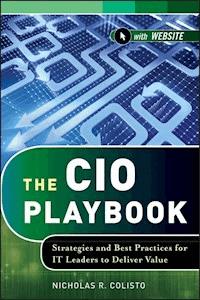
The CIO Playbook is the handy desk reference for CIOs, CEOs, CFOs, and up and coming leaders, revealing a dynamic seven-step framework (Partner – Organize – Innovate – Deliver – Support – Protect – Grow) that will guide you in making essential changes to your organization.
The proven strategies, tools, and techniques in The CIO Playbook make it the ultimate "how-to" resource for creating a high-performance IT organization that delivers value-added products and services to employees, customers, and shareholders. Author Nicholas Colisto provides solutions to the issues that concern business leaders and IT practitioners, including:
- How to truly partner with business peers
- Delivering high-quality products and services that are embraced by your user community
- How to ensure your team is focused on the right innovations
- Measuring performance and running your department like a business
- Ways to attract, motivate, and retain a talented team working toward a common vision
- Managing risks to operate effectively and protect corporate reputation
Featuring online templates for each of the seven steps described in the book, The CIO Playbook can help you transform your IT department from a mere order taker to a high-performance organization that delivers extraordinary business outcomes, despite this era of turbulent economic challenges.
Das E-Book können Sie in Legimi-Apps oder einer beliebigen App lesen, die das folgende Format unterstützen:
Seitenzahl: 341
Veröffentlichungsjahr: 2012
Ähnliche



















Table of Contents
Title Page
Copyright
Dedication
Preface
Acknowledgments
Chapter 1: Step 1: Partner
Partnership versus Alignment
Build Business Partnerships
Develop an IT Strategic Plan
Different Approaches to Strategic Planning
Cloud Computing Is Changing the Role of IT
Notes
Chapter 2: Step 2: Organize
Brand Your Department
Define an IT Organizational Model
Define a Project Methodology
Manage the Software Selection Process
Maintain a Portfolio of Products and Services
PPM Software
Understand Your Capacity
Create IT Policies
Manage the Technology Partners
Benchmark IT
Notes
Chapter 3: Step 3: Innovate
Turn Ideas into Action
Create a Governance Framework
Demonstrate the Possibilities
Think Big
Develop Business Cases
Package Innovation
Go Green
Notes
Chapter 4: Step 4: Deliver
Why System Implementations Fail
Develop a High-Performance Team
Develop a Team-Building Program
Discover Organizational Readiness
Develop and Implement
Get Insanely Motivated
Just Say No
Manage Transitions
Measure Benefits
Communicate IT Value
Create a Communication Program
Go Global with Infrastructure
Choose the Right Number of Instances
Notes
Chapter 5: Step 5: Support
Create Service Level Agreements
Determine an Approach to IT Charge-Backs
Manage Operational Performance
Develop a Super User Program
Encourage Feedback
Standardize Communications
Build a Shared Service Center
Notes
Chapter 6: Step 6: Protect
Define Risk Management Goals
Be Transparent with Risk Management
Safeguard Cloud Computing
Safeguard Mobility
Safeguard Social Media
Notes
Chapter 7: Step 7: Grow
Standardize Job Descriptions
Develop a Role-Based Training Program
Rotate Your Staff
Retain Critical Skills
Cultivate High Potential
Recruit the Best
Foster Teamwork through Community Service
Recognize and Reward Employees
Build Your Personal Brand
Prepare Yourself for the New Workforce
Notes
Conclusion
Touchdown Passes
Use Governance to Avoid Chaos
Show People How They Fit In
Just Say No
Don't Be Afraid to Take Risks
Manage Operational Performance
Use Meetings to Drive Deliverables
Build Awesome Teams
Bibliography
About the Author
About the Website
Index
Copyright © 2012 by Nicholas R. Colisto. All rights reserved.
Published by John Wiley & Sons, Inc., Hoboken, New Jersey.
Published simultaneously in Canada.
No part of this publication may be reproduced, stored in a retrieval system, or transmitted in any form or by any means, electronic, mechanical, photocopying, recording, scanning, or otherwise, except as permitted under Section 107 or 108 of the 1976 United States Copyright Act, without either the prior written permission of the Publisher, or authorization through payment of the appropriate per-copy fee to the Copyright Clearance Center, Inc., 222 Rosewood Drive, Danvers, MA 01923, (978) 750-8400, fax (978) 646-8600, or on the Web at www.copyright.com. Requests to the Publisher for permission should be addressed to the Permissions Department, John Wiley & Sons, Inc., 111 River Street, Hoboken, NJ 07030, (201) 748-6011, fax (201) 748-6008, or online at http://www.wiley.com/go/permissions.
Limit of Liability/Disclaimer of Warranty: While the publisher and author have used their best efforts in preparing this book, they make no representations or warranties with respect to the accuracy or completeness of the contents of this book and specifically disclaim any implied warranties of merchantability or fitness for a particular purpose. No warranty may be created or extended by sales representatives or written sales materials. The advice and strategies contained herein may not be suitable for your situation. You should consult with a professional where appropriate. Neither the publisher nor author shall be liable for any loss of profit or any other commercial damages, including but not limited to special, incidental, consequential, or other damages.
For general information on our other products and services or for technical support, please contact our Customer Care Department within the United States at (800) 762-2974, outside the United States at (317) 572-3993 or fax (317) 572-4002.
Wiley also publishes its books in a variety of electronic formats. Some content that appears in print may not be available in electronic books. For more information about Wiley products, visit our web site at www.wiley.com.
Library of Congress Cataloging-in-Publication Data:
Colisto, Nicholas R.,
The CIO playbook : strategies and best practices for IT leaders to deliver value / Nicholas R. Colisto.
p. cm.
ISBN 978-1-118-34759-1 (cloth); ISBN 978-1-118-38518-0 (ebk.); ISBN 978-1-118-41118-6 (ebk.); ISBN 978-1-118-41119-3 (ebk.)
1. Chief information officers. 2. Information technology–Management. 3. Information resources management. I. Title.
HD30.2.C6245 2012
658.4'038–dc23
2012012392
Preface
The only thing to do with good advice is to pass it on. It is never of any use to oneself.
—Oscar Wilde
These are times for transformation. The economy is shifting from recession to recovery. Companies are transitioning from cost containment to value creation. Chief information officers (CIOs) are uniquely positioned to help their organizations create a critical turning point by leveraging technology to drive innovation and business growth.
Whether you are an information technology (IT) leader or a business professional who leverages technology to help drive results, you will find that this book offers insightful and practical advice and strategies to help you maximize the effect of IT on your business. While the technologies constantly change at a dramatic pace, the practices I describe in this book are timeless and can help you transform your IT department from a mere order taker to a high-performance organization that delivers extraordinary business outcomes, despite this era of turbulent economic challenges.
To begin this journey, I examine the pressing questions that IT practitioners ask themselves and often struggle with answering: How do I truly partner with my business peers? How do I ensure that my team is focused on the right innovations? How do I deliver high-quality products and services that are embraced by my user community? What strategies should I employ to run my department like a business and measure performance? How can I manage and minimize risks so that my company can continue to operate effectively and protect its reputation—particularly in this era of social networking, mobilization, and cloud computing ? How can I attract, motivate, and retain a talented team that is focused on the same vision?
In this book, I share a framework that I have developed over my career that includes practical strategies and tactics to address these questions and help IT leaders truly transform their organizations. The framework involves seven steps:
Each step involves a set of practices designed to help you achieve success. The steps are interrelated and complement one another as part of an overall effort to establish a high-performance IT organization.
I have dedicated a chapter to each of these steps and described the best practices. I realize that every organization is unique and my strategies and tactics may not always fit the circumstances due to cultural, political, and organizational constraints. That being said, I have had the pleasure of working for eight companies, spanning seven industries, and have yet to come across a situation where most, if not all, of these steps could not be applied. I have also enlisted the help of IT leaders and other executives from a diverse set of industries and practices to share their strategies and stories in this book.
I promise you, this book is not filled with theoretical concepts or prosaic monologues; rather, it provides a comprehensive set of proven strategies, tools, and techniques. It's tiring to read all of those books, blogs, and articles that lecture IT leaders on getting a seat at the executive table but never explain how to actually do it. It is also frustrating to read a book or attend a conference and not walk away with salient points of advice that you can readily apply. For that reason, I conclude each chapter with a list of tips that I refer to as my Top Plays.
Everyone learns differently: some like theory, others enjoy reading interviews with executives, and still others prefer to stumble along and learn from experience. Will Rogers once wrote, “There are three kinds of men, ones that learn by reading, a few who learn by observation, and the rest of them have to pee on the electric fence and find out for themselves.”
In my experience, IT professionals generally appreciate structure and pragmatic advice. They have a predilection for methodology, process, policies, and templates. They want to face a chaotic world equipped with an orderly approach so they can enable their businesses to grow and prosper. I suppose that is why they entered the profession in the first place—it's part of their DNA. And with a field as dynamic and complex as IT, theory and entertaining anecdotes alone are not enough.
So for that reason, I decided to write this book: to create order from chaos and provide a comprehensive set of specific steps that IT leaders can take to deliver extraordinary results despite tumultuous times. Think of this book as the first how-to guide for creating a high-performance IT organization that delivers value-added products and services to employees, customers, and shareholders.
Leading an IT organization in an age when there is an unprecedented demand on technology to drive business growth requires CIOs to learn and apply these seven transformative steps. I want to arm leaders with the tools to get them started right away. For that reason, I have developed templates for each of the seven steps described in this book. The templates are straightforward and easily customizable by you or your staff to create similar documents for your own organization. They can be found on the companion website for this book (see the About the Website page for more information).
Acknowledgments
This book is a compilation of my work experience as well as the result of research that I conducted. I would like to acknowledge the many people who have helped me along the way.
First, I offer my sincere gratitude to the executives who participated in the interviews: Gary Boyd, Jeff Boyd, Rich Brennen, David Colville, Michael Del Priore, Greg Fell, Jim Gery, Jon Harding, Ken Harris, John Hinkle, David Kaufman, Richard Lattmann, Brian R. Lurie, Diane Montalto, Ken Murdoch, Kevin Nash, and Phil Schneidermeyer. I hope that this book captures your excellent insights.
Next, I would like to thank the many managers and mentors I have had during my career: Daren Bien, Michael Clifford, Jeff Hoffman, Ara K. Hovnanian, Holger Huels, Tom Lesica, Joan Pertak, Joanne Raimondo, Ron Rose, and J. Larry Sorsby. I am grateful for your good advice, counsel, and support.
I would also like to acknowledge my IT staff at Hovnanian Enterprises Inc. and the many members of my staff whom I have had the pleasure to work with throughout my career. I thank you for your passion, commitment, and drive to be the best at what you do. Without you, this book would not have been possible.
Many thanks to Sanjog Aul, Cecilia Biegel, Jon Hernandez, Mike Keizur, Hunter Muller, Kate Rood, Bethany Simpson, and Avery Wright for inviting me to lecture at industry events and forums and encouraging me to write. You helped me find my voice for this book, and for that I am deeply grateful.
I would also like to thank Sheck Cho, Kimberly Monroe-Hill, and Stacey Rivera, my editors at John Wiley & Sons, who believed in me and gave me such wonderful guidance and advice.
A sincere thank-you to the people that have inspired me to be socially responsible by inviting me to participate on academic and health-care boards: Serena DiMaso, Esq.; Dr. David Finegold; David L. Flood; Elizabeth Milewski; Thomas Setaro; Dr. Deborah Silver; Wendell Smith, Esq.; and Aleta You. The only thing you take with you when you leave this earth is what you leave behind, and I am grateful for the opportunity to serve my community.
I want to acknowledge the support and love of my parents. You have always been so supportive and have encouraged me to chase my dreams. I love you so much.
And thanks to my sister, Linda, for her love and support that mean so much to me. She typed my first report in high school. I should have asked her to type this book for me. She types much faster than I do.
I have also been fortunate to have a father-in-law and a mother-in-law who have supported me and shared invaluable lessons in life and business that have always guided me and still do today. And thanks to all of my sisters-in-law and brothers-in-law and their families, who keep me grounded–as only a large Italian family can do–and are a constant reminder of what's most important.
Most of all, I thank my wife, Joanne, for her unconditional love and unwavering support as I hunkered down in my home office to write this book on many evenings and weekends. And I thank my children, Alexandra and Evan, for being so understanding, loving, and supportive.
Chapter 1
Step 1: Partner
If we are together nothing is impossible. If we are divided all will fail.
—Winston Churchill
Your success greatly depends on your relationships with others. Whether you are trying to drive results within your team, with stakeholders across your company, or with suppliers, your ability to create positive business outcomes will rest on the strength of your business relationships. Partnerships begin with having a clear understanding of a company's vision, goals, and strategies. This chapter describes the stages of a business partnership and how to build an IT strategic plan, in cooperation with your team and business partners, so that everyone has a clear picture of the value IT will contribute to the company.
Partnership versus Alignment
Year after year, IT survey results inevitably state that one of the top priorities for the coming year will be to align IT with the business. The topic certainly gets a lot of attention and is often the source of many articles, postings, books, and presentations. Out of curiosity, I performed a search on Google, and it returned an astonishing 3.3 million results on the topic.
Lesen Sie weiter in der vollständigen Ausgabe!
Lesen Sie weiter in der vollständigen Ausgabe!
Lesen Sie weiter in der vollständigen Ausgabe!
Lesen Sie weiter in der vollständigen Ausgabe!
Lesen Sie weiter in der vollständigen Ausgabe!
Lesen Sie weiter in der vollständigen Ausgabe!
Lesen Sie weiter in der vollständigen Ausgabe!
Lesen Sie weiter in der vollständigen Ausgabe!
Lesen Sie weiter in der vollständigen Ausgabe!
Lesen Sie weiter in der vollständigen Ausgabe!
Lesen Sie weiter in der vollständigen Ausgabe!




