


Erhalten Sie Zugang zu diesem und mehr als 300000 Büchern ab EUR 5,99 monatlich.
- Herausgeber: Mercier Press
- Kategorie: Geisteswissenschaft
- Sprache: Englisch
On the morning of 15th May, 1922, over 1,000 recruits of the newly established Civic Guard suddenly broke ranks during Commissioner Michael Staines' TD address at Morning Parade in the training depot at Kildare Barracks. The recruits immediately set about raiding the armoury while Staines and his senior officers withdrew under armed protection and evacuated the barracks much to the annoyance of Michael Collins, the Chairman of the fledgling Provisional Government. For almost seven weeks, Collins and the mutineers struggled to reconcile their differences in the midst of the Irish Civil War. Both sides were unaware that their efforts to resolve the dispute were thwarted by a group of anti-Treaty Civic Guards intent on destroying the new force. This book investigates the reasons why the earliest recruits of the Civic Guard took up arms against their own masters and brought about a significant security risk that had direct implications for both the civil war and the future structure of the its successor, An Garda Síochána.
Sie lesen das E-Book in den Legimi-Apps auf:
Seitenzahl: 307
Veröffentlichungsjahr: 2012
Das E-Book (TTS) können Sie hören im Abo „Legimi Premium” in Legimi-Apps auf:
Ähnliche




















He was appointed deputy commissioner of the Civic Guard in 1922.
Courtesy of the Garda Museum and Archives.
MERCIER PRESS
3B Oak House, Bessboro Rd
Blackrock, Cork, Ireland.
www.mercierpress.ie
http://twitter.com/IrishPublisher
http://www.facebook.com/mercier.press
© Brian McCarthy, 2012
ISBN: 978 1 78117 045 8
Epub ISBN: 978 1 78117 151 6
Mobi ISBN: 978 1 78117 152 3
This eBook is copyright material and must not be copied, reproduced, transferred, distributed, leased, licensed or publicly performed or used in any way except as specifically permitted in writing by the publishers, as allowed under the terms and conditions under which it was purchased or as strictly permitted by applicable copyright law. Any unauthorised distribution or use of this text may be a direct infringement of the author’s and publisher’s rights and those responsible may be liable in law accordingly.
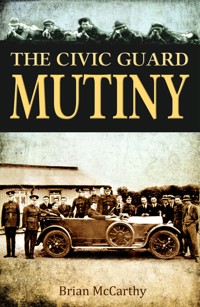
Front cover (bottom) image: Assistant Commissioner Patrick Brennan TD, in the driver’s seat of a Wolseley Stellite motor car, which he received in September 1922 as a token of gratitude from the recruits of Kildare Barracks. Courtesy of the Garda Museum and Archives.
Back cover image: A group of the earliest Civic Guard recruits in the RDS, Ballsbridge. Courtesy of the Garda Museum and Archives.
Contents
Acknowledgements
Prologue
Introduction
1. Policing in Ireland before 1922
2. The Replacement of the RIC
3. The Outbreak of Mutiny
4. The Commission of Enquiry
5. Recommendations of the Commission of Enquiry
6. The Aftermath of the Mutiny
Conclusion
Notes
Bibliography
In memory of my uncle,
William F. (Liam) McCarthy (1934–2010)
Acknowledgements
The publication of this book is largely due to the encouragement and support of Dr Deirdre Raftery, under whose guidance and direction I previously completed a PhD on the history of the education and training of recruits in the Garda Síochána at University College Dublin. I also wish to acknowledge the assistance of Professor Mary Daly under whose supervision I completed an MA in 20th Century Irish Studies at University College Dublin in 1996. I am grateful to the staffs of the UCD School of Education, National Archives of Ireland and National Library of Ireland. Since 1994 I have been a regular visitor to the Garda Museum and Archives, and have had the pleasure of meeting a staff who always facilitate the researcher in a hospitable and professional manner. In particular, I wish to acknowledge the assistance of retired Inspector John Duffy, whose passion for police history has been a source of inspiration to my research. I wish to express my appreciation to the author Pádraig Óg Ó Ruairc for his generosity in sharing sources and responding to my many historical queries relating to County Clare. Thanks is also due to Joe Humphreys for his advice and encouragement, and to my colleague Seán Ruane, who provided suggestions and perspectives that proved invaluable.
I wish to sincerely thank Mary Feehan and the staff at Mercier Press for all their efforts in assisting me in the completion of this book.
On a personal note, I owe my wife Karen enormous and inexpressible thanks for yet again displaying endless patience, tolerance and support. I must especially thank my parents, Brian and Nancy, and my wider family and friends, for all their assistance and encouragement throughout the completion of this book.
Prologue
On the morning of 15 May 1922, more than 1,200 recruits of the newly established Civic Guard suddenly broke ranks during the commissioner’s address at morning parade in the training depot at Kildare Barracks. The dissident recruits immediately set about raiding the armoury, while the commissioner and his senior officers withdrew under armed protection and evacuated the barracks, much to the annoyance of Michael Collins, the chairman of the fledgling Provisional Government. For almost seven weeks, Collins and the mutineers struggled to reconcile their differences in the midst of the Irish Civil War. This book investigates the reasons why these early recruits of the Civic Guard took up arms against their own masters, bringing about a significant security risk that had direct implications for both the Civil War and the future structure of the Civic Guard’s successor, An Garda Síochána.
Introduction
To date, the events surrounding the Civic Guard Mutiny of 1922 have remained one of Ireland’s best-kept historical secrets. Despite the presence of relevant files in the National Archives of Ireland, the mutiny has largely been overlooked or hastily summarised in publications devoted to the history of Irish policing, regardless of the direct involvement of many senior Irish political figures. Indeed, the events of the mutiny have been neglected by historical commentators to such an extent that in the 1960s one veteran of the dispute wrote a series of short articles about the mutiny entitled ‘Smothered History’.1
To appreciate the complexities of the mutiny, an understanding of the historical background of Irish policing is necessary. My primary focus here concerns the decision of the Provisional Government to establish a new police force modelled on the disbanded and world-renowned Royal Irish Constabulary (RIC), which had been the target of republican attacks in the War of Independence between 1919 and 1921. The transition of police power from the RIC to the Civic Guard is identified as the moment that the Provisional Government failed to take decisive action to avert an imminent mutiny. This book examines the actual events of the mutiny, but a significant part of it is also concerned with the repercussions for the force. The assessment of the aftermath of the mutiny is helped by the reports from the official enquiry into the dispute, which provided a series of recommendations for the future of Irish policing that have been preserved and embraced by An Garda Síochána. I would like to thank the National Archives of Ireland and the Director of the National Archives of Ireland for permission to reproduce parts of the commission of enquiry into the mutiny, as well as other relevant texts in their collection.
Michael Staines, Quartermaster-General, Irish Volunteers (c. 1916).
He was appointed commissioner of the Civic Guard in 1922.
Courtesy of the Garda Museum and Archives.
1 Policing in Ireland before 1922
In 1169, on the orders of King Henry II, the successful Anglo-Norman invasion of Ireland took place. In 1204, King John of England commissioned the construction of a stone castle in Dublin to become the headquarters of the new administration in Ireland and the result, Dublin Castle, would remain the headquarters of British administrative and political control in the country until the establishment of the Irish Free State in 1922. It was at Dublin Castle that Michael Staines, the commissioner of Ireland’s first national police force, the Civic Guard, was granted the symbolic privilege of leading a batch of the force’s new recruits to relieve the remaining British personnel of their duties, an event which took place on 17 August 1922.1 When approaching the history of policing in Ireland that led to this significant moment for the new Irish Free State, it is necessary to travel as far back as 1199.
In that year John, the youngest son of Henry II, acceded to the throne and ordered the gradual division of Ireland into counties. It was decreed that robbers ‘be driven out of our land in Ireland, and that they and those who receive them be dealt with according to the law of England’ (9 John, ad 1207).2 The implementation of John’s policies facilitated the systematic replacement of the native Irish system of Brehon Law with English laws and administration.
No overall authority had existed to administer or enforce Brehon Law, although trained judges mediated in disputes of a criminal or civil nature. The social standing of the offender determined the amount of compensation to be paid and it was normal for both parties to hire an advocate to present cases before a judge.3 This absence of a law enforcement agency in Gaelic Ireland contrasted with the situation in England and was something John’s successors would seek to remedy. In 1285 the terms of the Statute of Winchester obliged each county of Ireland to abandon Brehon Law and accept the authority of English justices of the peace to hear criminal and civil cases (1 Edward II, ad 1308).4 The statute regulated a nightwatch system in towns and cities, supervised by two high constables. All resident males, including native Irishmen, between fifteen and sixty years of age were to take their turn as nightwatchmen at each town gate, although the Irish were prohibited from holding the positions of mayor, bailiff or any office of the king.
The provisions of the Statute of Winchester were amended continuously, and between the thirteenth and eighteenth centuries provided the basis for a policing system. For centuries, the successful transition to English Law within Ireland largely occurred in the towns and cities, while the Gaelic lords preserved their traditional customs and laws in the rest of the country. However, Henry VIII’s policy of ‘surrender and regrant’, instituted in the 1540s, threatened Gaelic lords with confiscation of their lands unless they surrendered their titles and assumed alternative English titles, customs and laws. As a result, most Gaelic and Anglo-Irish subjects accepted the kingship of the English monarch and the attendant customs and laws, although they tended to repudiate the subsequent espousal of the Protestant faith, much to the annoyance of the English monarchy.
On her ascent to the throne, Elizabeth I continued her father’s policy of extending crown control over Ireland. A rebellion led by the prominent lords of Munster in 1579 was crushed by the forces of the crown. Elizabeth confiscated their lands and transferred ownership to loyal Protestant colonists. Following the settlement of loyal English colonists in large areas of Munster, it was anticipated that the final displacement of native Irish Brehon laws and customs would be achieved effectively. Yet the celebrated poet and English planter in Munster, Edmund Spenser, contested the policy of forcing English Law on the native Irish population. In his capacity as secretary to Sir Arthur Grey, lord deputy of Ireland, Spenser argued that it was naïve to expect the English legal system to function in Ireland merely on the basis that it was already operating successfully in England:
… for laws ought to be fashioned unto the manners and conditions of the people to whom they are meant, and not to be imposed upon them according to the simple rule of right, for then … instead of good they may work ill and pervert justice to extreme unjustice.5
In Ulster, the Gaelic lords feared a similar fate to that of their dispossessed counterparts in Munster and began to secure military support from Spain. The defeat of the Gaelic lords and Spaniards at the Battle of Kinsale in 1601 effectively ensured the end of the native Irish ruling class. The subsequent plantation of Ulster with Scottish and English Protestant immigrants followed the hasty departure of the Gaelic lords to the safety of the Continent.
In the wake of the Battle of Kinsale, the English authorities sought to weaken the numerical supremacy of the native Irish in Ireland and expedited the influx of loyal subjects who would abide by English Common Law. By 1641 there were 22,000 planters in Munster and 15,000 in the province of Ulster.6 This policy was based on the premise that loyalty to the crown could be imported from England and Scotland: ‘If the Irish would not become Protestant, then Protestants must be brought to Ireland.’7
On three occasions during the seventeenth century, Irish Catholic forces fought unsuccessfully against Protestant armies for supremacy in Ireland. The victory of William of Orange at the Battle of the Boyne in 1690 finally ensured the permanency of the planters and terminated decisively any lingering aspirations the native Irish had of securing ownership of lost lands. The last remaining and besieged Catholic force accepted the terms of the Treaty of Limerick in October 1691, and the supremacy of Protestants in Ireland was assured and safeguarded by their own Irish parliament. The enactment of a comprehensive series of anti-Catholic measures, the ‘Penal Laws’, ensured that the Protestant ruling class would be in a position of ascendancy over the native Irish population. Catholics were excluded from the legal profession, parliament and government office, and banned from holding commissions in the army or navy. Such legislation effectively restricted the advancement of the native Irish in society. Furthermore, ‘An Act to refrain papists from being high or petty constables and for the better regulating of the parish watches’ (2 Geo. I, c. 10) was introduced in 1715.8 From that point onwards, constables were required to take the following oath:
I do solemnly and sincerely, in the presence of God, profess, testify and declare, that I do believe, that in the sacrament of the lord’s supper there is not any transubstantiation of the elements of bread and wine into the body and blood of Christ, at or after the consecration thereof by any person whatsoever: and that the invocation, or adoration of the virgin Mary, or any other saint, and the sacrifice of the mass, as they are now used in the church of Rome, are superstitious and idolatrous.9
The enactment of further anti-Catholic legislation in 1704 and 1709 prohibited Catholics from buying land, inheriting land from Protestants and taking leases for more than thirty-one years. By 1778 Catholic ownership of land in the country had been reduced to five per cent from eighteen per cent in 1704, and the greater part of the Irish countryside gradually entered a system of domination by Protestant landlords, who were largely supported by Catholic tenant subsistence farming.10 The maintenance of law and order in such a divided social setting was of paramount importance to the English authorities.
Police Reform in the Eighteenth Century
The Irish political framework provided a parliament composed almost exclusively of Protestant members and drawn from a narrow franchise. However, supreme authority rested with the representative of the English crown in Ireland, the lord lieutenant, otherwise referred to as the ‘viceroy’. The chief secretary assisted the lord lieutenant in the formulation of national policy and together they effectively ruled the country.11 In 1715 grand juries were established in each of the 300 baronies in Ireland. All baronies were required to appoint a high constable to supervise the watch system, which by this time could employ only Protestants. The appointed watchmen were authorised to stop and search people, and on finding any who could not give a satisfactory account of their activities, were empowered to bring them before the local justice.12By the 1760s, the ineffectiveness of the baronial constables was illustrated by the degree of agrarian violence carried out by native Irish peasants, who formed a secret society of ‘Whiteboys’. The organisation frustrated the constables by engaging in harmful acts against agents, animals and properties of landlords in County Tipperary and surrounding counties.13
The collective and localised violence of the Whiteboys was soon escalated by a new secret society, the Rightboys. In 1785 the Rightboys launched a campaign of violence against the payment of tithes to the Anglican church. The movement appealed to a wider social base than the Whiteboys, as the Rightboys also protested forcibly against levels of rents and taxes.
Unrest in Ireland attracted the attention of the British authorities, who had recently failed in their endeavour to introduce the London and Westminster Police Bill of 1785, which sought to establish a government-controlled, full-time professional police force for London.14 Opponents of the bill claimed that the extensive powers of the proposed force were too radical and extreme.15 Under mounting pressure from the press and public opinion, the British prime minister, William Pitt, withdrew the offending bill and promised to submit an alternative policing legislative measure in due course. The British government looked towards Ireland as the appropriate experimental venue for its proposed police force. The uncertain prevailing circumstances of agrarian violence, coupled with civil unrest in towns and cities as various classes demanded concessions from the British government in the wake of revolutions in America and France, prompted the Irish authorities reluctantly to accept the directives from the English government to enact two substantial police bills.
The Dublin Police Act of 1786 (26 Geo. III, c. 24) was the first decree of British legislation to include the French word ‘police’, used in terms of ‘keeping order’.16 This act also established the first modern police force in the United Kingdom, and allowed for experimentation in policing before similar strategies were embarked on in England, Scotland and Wales. Commentators have continued to cite the Dublin Police Act of 1786 as the forerunner to the establishment of modern police forces throughout Britain: ‘[A] full history of the new police would probably lay its first scene in Ireland and begin with the Dublin Police Act passed by the Irish Parliament in 1786.’17 This was the first occasion that Ireland was used as a ‘social laboratory’ for experiments the English government was not prepared to contemplate in England.18Subsequent use of Ireland as a convenient venue for experimentation occurred between 1786 and 1838, in areas such as welfare, planning and education.19
The Dublin Evening Post of March 1786 openly condemned the bill and accused Pitt’s administration of succumbing to English public opinion over the contentious issue of police reform and smuggling the spurned bill into an undiscerning Ireland.20 Thomas Orde, the Irish chief secretary at the time, was given responsibility for the replacement of the traditional nightwatch model of law enforcement with the first centralised force of policemen in the United Kingdom. For policing purposes, Dublin, with a population of 150,000, was divided into four districts and placed under the authority of Dublin Castle. The commissioners were obliged to recruit men who were young and in good health. Though the population of Dublin was approximately seventy-five per cent Catholic in composition, only Protestants were entitled to seek employment in a force consisting of 400 men.21 Successful applicants were to be dressed in the prescribed blue uniforms and bear arms consisting of bayonets and muskets.22
In 1787 the English government, satisfied with the initial progress of the police innovation in Dublin, introduced similar legislation to the rest of the country through ‘The Irish County Act’, the immediate implementation of which sought to suppress the campaign of the Rightboys in their stronghold counties of Tipperary, Kerry, Kilkenny and Cork. Under the terms of the act, each of the 300 baronies in Ireland was to be provided with a chief constable and sixteen sub-constables. A provision excluding Catholics from employment within the force was included in the act.
Despite Grattan subsequently introducing legislation to modify policing arrangements in Dublin, the United Irishmen Rebellion of 1798 immediately transformed the Irish political scene and had a major impact on security arrangements for the country. The Catholic and Protestant insurgents of the United Irishmen had obtained French assistance in their quest for Irish independence from England, but nevertheless were routed. Despite their failure, with a death toll of 30,000 the rebellion reawakened fears that the Irish parliament was not capable of containing political agitation without strong reliance on support from England. In the aftermath of the rebellion, the Irish parliament approved a more centralised form of policing, as contained in the Dublin Police Act of 1799, and agreed to terminate its own existence by approving the Act of Union in 1800, which reintroduced direct rule from the English parliament at Westminster and ‘sought to bind Ireland more closely to Britain through a policy of cultural assimilation’.23 In actuality, the responsibility for day-to-day Irish affairs was still entrusted to the authorities in Dublin Castle, under the direction of the lord lieutenant and the chief secretary, and it was at this juncture that the more fervent nationalists started to identify the police as the ‘eyes and ears’ of Dublin Castle.24
The ‘Peelers’
In September 1812 Robert Peel, at the age of twenty-four, was appointed chief secretary of Ireland. Peel soon identified agrarian protest movements and the possibility of another rebellion as the most threatening issues confronting the authorities at Dublin Castle. In June 1814 Peel established a mobile force of uniformed and armed policemen controlled by Dublin Castle and officially referred to as the Peace Preservation Force (PPF). Significantly, the PPF (or ‘Peelers’ as they were popularly known) became the first police force in the United Kingdom to recruit Catholics, who accounted for 16 per cent of the 2,326 men enlisted until the force was allowed to dissolve on a gradual basis between 1822 and 1828.25
In 1822 Peel was appointed home secretary and continued his reform of policing in Ireland with the establishment of the County Constabulary, which was to be a permanent armed police force under the control of Dublin Castle. The 313 chief constables were to conduct monthly inspections and ensure that the 5,000 constables adhered to the regulations. The vast majority of the constables were the sons of farmers, while the higher-ranking members were drawn from the ascendancy classes.26 The County Constabulary was the first Irish police force to require its members to undergo three months of training conducted by military instructors at four provincial training centres. The code of the force expressed the need for constables ‘never to use more force, or violence than is absolutely necessary’ and, as public servants to the crown, a degree of impartiality towards the public was to be observed.27
The exacting standards demanded by police barrack regulations were in contrast to the abject poverty and living conditions associated with the lower classes of Irish society. Members of the County Constabulary were to provide an example of morality to the impoverished masses.28 Though the force was largely Protestant in composition, its deployment in the countryside was aided by its policy of recruiting a greater number of Catholics than had been the case under the PPF. It is significant that during this period the leader of the Catholic Association, Daniel O’Connell, recommended that Catholics should seize the opportunity of a career in the County Constabulary as it would provide much-needed employment, end discrimination and thereby support the campaign for Catholic emancipation.
While policing in Ireland was slowly becoming more representative, it simultaneously assumed a distinctly military appearance through the provision of barracks throughout the country. Each policeman was heavily armed with a sabre, pistol, short carbine with attached bayonet, and sixty rounds of ball cartridge.29 By the 1820s the strength of the County Constabulary was edging towards 6,000, and the chief secretary, Henry Goulburn, advised Peel that a smaller military presence in Ireland was expected as a result of the pressures of foreign military campaigns, so it was necessary for the County Constabulary uniquely to combine the duties of a police and military force to maintain law and order in Ireland. Though the loyalty and efficiency of the County Constabulary was not tested by the mass campaign for Catholic emancipation, which was resolved peacefully in April 1829, the divisive issues of tithes and of O’Connell’s crusade to repeal the Act of Union placed the police in a precarious position. Between 1830 and 1832, an escalation of rioting occurred among tenants. The prevalence of agrarian unrest necessitated the reintroduction of the PPF to assist the County Constabulary in the collection of tithes. Forty-four tenants and twenty-three County Constables died in disturbances during the Tithe War (1830–6).30Despite the Catholic composition of the County Constabulary, the force was increasingly perceived as the enforcer of English and Protestant rule in Ireland. The County Constabulary responded to tenant hostility by withdrawing from its thatched barracks and moving into better-fortified accommodation.
Drummond’s Two Police Forces
In the 1830s Dublin Castle confronted the threat of ongoing agrarian unrest through the centralisation of Irish policing. Two separate police forces were established: the Irish Constabulary and the Dublin Metropolitan Police (DMP). The Irish under-secretary, Thomas Drummond, drafted the legislation for the creation of both forces – the Police Reform Act of 1836.
The Irish Constabulary was a semi-military police force with responsibility for policing most of the country. Drummond intensified his efforts to seek greater public acceptance for the new force by recruiting a higher proportion of Catholics. Though the senior ranks of the force were reserved for former British army officers, Catholics accounted for two-thirds of the lower ranks of the new force.31 Furthermore, Drummond modified the traditional policy of recruiting the sons of farmers to include the labouring class, especially from the north-westerly counties of Roscommon, Leitrim, Sligo, Cavan and Fermanagh.32 The radical overhaul of the Irish national school system in 1831 by the chief secretary, Edward G. Stanley, ensured that the Irish Constabulary would be provided with a steady supply of suitably qualified men eager for recruitment to the lower ranks of the force. The basic entrance requirements to the force demanded that candidates be aged between nineteen and twenty-seven years, at least 5ft 8in (1.7 metres) in height and ‘capable of reading, without hesitation, any printed or written document and able to write legible hand’.33 The considerable expansion of the national school system effectively provided a basic education for all children in Ireland, regardless of creed. By 1860 there were seven times more national schools in the country than there had been in 1833.34
Year Number of schools Number of pupils35
1833 789 107,042
1840 1,978 232,560
1850 4,547 511,239
1860 5,632 804,000
In addition, each candidate was required to be single and display honesty, sobriety and fidelity. A three-month training programme was undertaken at the purpose-built training depot in Phoenix Park, Dublin, which was opened in 1842.
By 1843 the Irish Constabulary had established more than 1,400 barracks throughout the country. The strategic positioning of these ensured that during occasions of public disorder or rebellion in any area of the country there was a barracks that could be called upon.36 In his book, Ireland, the German travel writer, Johann Georg Kohl, describes his impression of the force in the first few months of its existence:
The police station, which lay on our road, and at which we stopped, was a new, neat, spacious building. At a short distance it appeared like a little strong castle. The house contained eight men of the constabulary force, as it is called, and which is a military-armed police, now extended over the whole of Ireland, for the prevention of crime, the discovery and apprehension of criminals, the protection of property, and the preservation of the peace. It consists of 8,000 men, classified and disciplined in the same manner as soldiers … They are armed with carbines and swords, and also use their bayonets as daggers. They differ from the soldiers in their uniform alone, which is somewhat less ornamented and a dark green colour. This police force is, therefore, properly a military garrison, though under another name. Since the strongest men, and those only of the most unblemished characters, are admitted into this force, and then distributed into every corner of the land, they possess an extremely intimate knowledge of it and of its inhabitants, and in the event of a war or a rebellion would probably be more valuable than an army of 30,000 men.37
In the early years of the force, its inspector-general, James Shaw-Kennedy, issued a comprehensive code of regulations for the Irish Constabulary, much of which was drawn upon by subsequent Irish police forces up to the mid-twentieth century.38 The code specifically outlined the duties and regulations for the maintenance of a disciplined force to the extent that the Irish Constabulary maintained the ‘toughest and most uncompromising code of regulations of any police force in the world’.39 The appointment of ex-military personnel to high-ranking positions within the force ensured a heavy emphasis on efficiency and discipline. In terms of their relationship with the local upper classes, the constabulary’s performance of the duties of gamekeeping and private protection ceased. However, members of the lower and middle ranks were required to be respected by the people and ‘obtain the good opinion of the gentry’.40 In addition to the local priest, members of the Irish Constabulary were often the only source of literacy in the locality. The Irish Constabulary drew on such public reliance for the gathering of intelligence and obliged its members to fortify their position through additional duties to the extent that ‘everything in Ireland, from the muzzling of a dog to the suppression of a rebellion is done by the Irish Constabulary’.41 To this end, the police evolved into an agency of local government and assumed responsibility for road regulations, census taking, weights and measures inspections, and the collection of agricultural statistics.42
In contrast to the military appearance of the Irish Constabulary, the DMP consisted of 900 unarmed men. By the 1840s the members of that force were involved in the detection of crime and vice in Dublin city, where the population had increased to more than 200,000.43 Despite sharing similar training regimes, entrance criteria and composition of personnel, the fortunes of the DMP and the Irish Constabulary would contrast sharply in succeeding decades because of political upheaval. In contrast to the armed members of the Irish Constabulary, the constables of the DMP enjoyed wider public acceptance, and they were not the target of agrarian and political unrest.
Policing Political Upheaval
Within a decade of the establishment of the Irish Constabulary and the DMP, the country was in the grip of the Great Famine, following successive outbreaks of potato blight in the mid-1840s. High rates of mortality and emigration reduced the Irish population of eight million by one-fifth between 1845 and 1851.44 Fearing bankruptcy, many landlords further compounded the misery of impecunious tenants by evicting those who were in rent arrears.45 In 1849 the Irish Constabulary recorded 90,000 evictions; a year later the number was in excess of 100,000.46 The involvement of the Irish Constabulary in the processes of eviction reinforced the claim by its critics that the police were mere agents of the landlords and British rule.
Following the death of Daniel O’Connell in 1847, a void was left in Irish politics, which extreme nationalism sought to fill by organising itself into an oath-bound secret society, the Irish Republican Brotherhood (IRB), in 1858. The estimated 60,000 members of the IRB were referred to as Fenians and, under the leadership of James Stephens, a rebellion was planned. The Irish Constabulary succeeded in monitoring the movements of the society and thwarted their attempts to obtain and distribute arms among their members. On 5 March 1867, the Fenians rebelled and attacked many Irish Constabulary barracks, almost exclusively in the southern half of Ireland. The effective military training of the well-armed Irish Constabulary ensured limited and only momentary success for the insurgents at three barracks. Following the arrest of 169 men, both the House of Commons and the House of Lords in London applauded the Irish Constabulary, and nine members of the force were decorated for valour.47In recognition of their successful suppression of the Rising, Queen Victoria bestowed the title ‘Royal Irish Constabulary’ (RIC) on the force on 6 September 1867. Nationalist critics regarded the conferment of the title ‘Royal’ on the force as a reward for the Irish Constabulary’s unwavering loyalty to the British crown and its determination to preserve the political and social status quo. In the aftermath of the Fenian Rising, Lord Derby addressed the House of Lords and proclaimed his surprise that a police force which was largely composed of ordinary Irishmen could demonstrate such commitment in suppressing unrest among their own people:
This body of police are sprung from that class of the people, amongst whom, if amongst any, there are likely to be found the seeds of discontent; and yet, in no case was there the slightest disloyalty amongst them; and their determined and successful efforts to suppress this insurrection have been nothing short of actual heroism.48
In 1877 Michael Davitt was released from Dartmoor prison after serving seven years for his part in the trafficking of arms for the IRB in London. On witnessing the high levels of poverty and eviction in his native area of County Mayo in 1879, Davitt organised a public meeting of 15,000 people in Irishtown, which led to the establishment of the Irish National Land League in October of that year. Davitt claimed that the RIC were the upholders of an Irish landlord system that was based on the exploitation of tenant farmers and labourers. He asserted that an Irishman can ‘have no feeling of respect towards the RIC, because he knows that it is an Imperial political force, having none of the qualities of a police body, and that its extra-political raison d’être is to form a bodyguard for the system of Irish landlordism’.49
Among the primary objectives of the league were the prevention of unjust evictions and the attainment of land ownership by tenant farmers. The presidency of the league was bestowed on Charles Stewart Parnell, MP, leader of the largest political organisation in Ireland, the Irish Parliamentary Party, at the inaugural meeting on 21 October. During his leadership, from 1879 to 1882, a period of intense agrarian unrest referred to as the ‘Land War’ unfolded. The league provided support and shelter to evicted families, and people deemed to have violated the code of the Land League were socially ostracised or ‘boycotted’.50 Despite the non-violent methods of the Land League, the more extreme supporters were responsible for an explosion of serious agrarian crime. In 1879, 863 cases of agrarian crime had been reported, but by 1881 the annual number of cases had increased five-fold.51 The decision by the British government to increase the supply of ammunition to the force and to require that RIC members assist bailiffs and landlords in evicting tenants, only served to reinforce the notion that the police were upholding the landlord system.
The hardship endured by the RIC in dealing with the more violent events of the ‘Land War’ was relieved temporarily in March 1882, following successful negotiations between Prime Minister William Gladstone and Parnell, who had been arrested for sedition and was being held in Kilmainham Jail. The introduction of state-aided land-purchase schemes effectively curtailed the power of Irish landlords, as large numbers of Irish tenant farmers were helped by the British government to purchase their own land. Parnell’s success in agrarian matters allowed him to concentrate on the attainment of Irish Home Rule. However, the public revelation in 1889 of his adultery with Mrs Katherine O’Shea divided the Irish Parliamentary Party and rendered it an ineffective force in Irish politics for the following decade.
The Demise of the RIC
The public perception of the RIC became more agreeable in the wake of Parnell’s death, as the force was no longer confronted with an organised nationalist political movement. However, as the nineteenth century drew to a close, the emergence of non-political movements began to overshadow the effectiveness of the divided Irish Parliamentary Party, and gradually a wave of resentment towards the RIC began to resurface. In 1884 the Gaelic Athletic Association (GAA) was established, and the provision of codified rules for the playing of native Irish games provided the basis for the rapid expansion of the movement. The organisation was outspokenly nationalist and attracted many IRB members. Significantly, the GAA enacted rules that forbade its members from playing or even watching ‘imported games’, and excluded RIC and DMP personnel from registering as members. This exclusion of Irish police members was based primarily on the suspicion that they were ‘the principal source of information on the strength and disposition of all nationalist activity’.52
Meanwhile, the Anglo-Irish literary revival, led by William Butler Yeats, romanticised ancient Irish legendary heroes and portrayed Ireland as an old woman who could be restored as queen only through the heroic actions of her countrymen. In addition to the sporting and literary revivals, the Gaelic League, established by Douglas Hyde and Eoin MacNeill in 1893, sought to restore the Irish language as the spoken tongue of the country. However, Hyde earnestly attempted to prevent the Gaelic League from being permeated by IRB members and resigned in protest when the leadership of the organisation finally succumbed to the influence of nationalist extremists.
Ironically, as the silent outbreak of cultural nationalism spread throughout Ireland in the early twentieth century, the RIC enjoyed a period of relative calm. In 1900 the three-week royal visit by Queen Victoria and her family to Ireland was widely welcomed by the Irish people and the security arrangements of the RIC and DMP earned each member a medal to commemorate the historic event. The successful royal visit emphasised the notion that policing in Ireland was enjoying a period of civil tranquillity. From 1900, with the widespread availability of the bicycle, sections of the police code were relaxed. Consequently, off-duty RIC members were no longer required to remain in the barracks, and only those who were finishing duty were detailed to attend the nightly roll call at 11 p.m.53 Indeed, the RIC received favourable editorial comments even in the nationalist pamphlet, United Irishman, where Arthur Griffith, co-founder of the Sinn Féin political party, wrote:




