


17,99 €
Mehr erfahren.
- Herausgeber: John Wiley & Sons
- Kategorie: Fachliteratur
- Sprache: Englisch
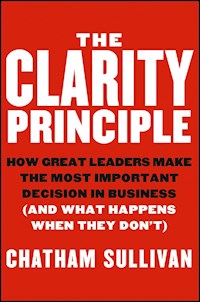
Turf wars, low morale, bad politics, and misguided strategies: these are issues that claim much of a leader's time. But this parade of dysfunctions and messy "people" problems actually points to an organization confused about its core business, torn between competing ideas about what it is and wants to be--an organization facing an identity crisis. Strategy and leadership expert Chatham Sullivan argues that when the purpose of a business becomes confused, it is the leaders' responsibility to restore clarity, especially in the face of tough strategic choices that have political, personal, and cultural consequences for the organization. Sullivan shows leaders how to take the decisive stand that clarifies their organization's core purpose. Featuring compelling stories of leaders who have succumbed to and successfully resolved their organizations' identity crises, The Clarity Principle bridges the gap between leadership and strategy and demonstrates the tremendous gains to be achieved by leaders willing to make tough choices.
Sie lesen das E-Book in den Legimi-Apps auf:
Seitenzahl: 280
Veröffentlichungsjahr: 2013
Ähnliche



















Table of Contents
Title page
Copyright page
Dedication
Introduction
Identity Crisis
The Failure to Choose
From Crisis to Clarity
1: Proxy Wars
Donna and Apple
Better to Be a Pirate
The Distribution “Problem”
Breakdown
The Confrontation
Proxy War
Déjà Vu
The Fate of Donna Dubinsky
2: The Murky Middle
CNN Faces a Crisis
It’s Harder Than You Think
Market Moves
A Hard Choice
3: Neither Fish Nor Fowl
A House Divided Cannot Stand
Laws of Attraction and Aversion
Cognitive Fluency
The Categorical Imperative
Making the Leap
4: The Shadow Side of Strategy
The Common App
The Shadow Side of Strategy
The Anatomy of Choice
The Clash of Two Models
Marrying Hard and Soft
5: Taking a Stand
Conservatory Roots, Contemporary Reality
Facing the Facts
The Gordian Knot
Longy and the “Musician of the 21st Century”
Debunking Old Myths
Gaining by Giving Up
The Risks of Equivocating
What’s the Right Thing to Do?
A Fortuitous Meeting
The Freedom of Choosing
6: The Hunger for Purpose
Creating Meaning at PayPal
Why Corporate Life So Often Disappoints
Connecting with the Why of Business
Meaning That Makes Sense
Why Meaning Motivates
Cause and Community
Fighting for Clarity
Epilogue: From Insight to Action
The Courage to Confront Uncomfortable Facts
Acknowledgments
About the Author
Index
Copyright © 2013 by John Wiley & Sons, Inc. All rights reserved.
Published by Jossey-Bass
A Wiley Brand
One Montgomery Street, Suite 1200, San Francisco, CA 94104-4594—www.josseybass.com
No part of this publication may be reproduced, stored in a retrieval system, or transmitted in any form or by any means, electronic, mechanical, photocopying, recording, scanning, or otherwise, except as permitted under Section 107 or 108 of the 1976 United States Copyright Act, without either the prior written permission of the publisher, or authorization through payment of the appropriate per-copy fee to the Copyright Clearance Center, Inc., 222 Rosewood Drive, Danvers, MA 01923, 978-750-8400, fax 978-646-8600, or on the Web at www.copyright.com. Requests to the publisher for permission should be addressed to the Permissions Department, John Wiley & Sons, Inc., 111 River Street, Hoboken, NJ 07030, 201-748-6011, fax 201-748-6008, or online at www.wiley.com/go/permissions.
Limit of Liability/Disclaimer of Warranty: While the publisher and author have used their best efforts in preparing this book, they make no representations or warranties with respect to the accuracy or completeness of the contents of this book and specifically disclaim any implied warranties of merchantability or fitness for a particular purpose. No warranty may be created or extended by sales representatives or written sales materials. The advice and strategies contained herein may not be suitable for your situation. You should consult with a professional where appropriate. Neither the publisher nor author shall be liable for any loss of profit or any other commercial damages, including but not limited to special, incidental, consequential, or other damages. Readers should be aware that Internet Web sites offered as citations and/or sources for further information may have changed or disappeared between the time this was written and when it is read.
Jossey-Bass books and products are available through most bookstores. To contact Jossey-Bass directly call our Customer Care Department within the U.S. at 800-956-7739, outside the U.S. at 317-572-3986, or fax 317-572-4002.
Wiley publishes in a variety of print and electronic formats and by print-on-demand. Some material included with standard print versions of this book may not be included in e-books or in print-on-demand. If this book refers to media such as a CD or DVD that is not included in the version you purchased, you may download this material at http://booksupport.wiley.com. For more information about Wiley products, visit www.wiley.com.
Library of Congress Cataloging-in-Publication Data
Sullivan, Chatham, 1976–
The clarity principle : how great leaders make the most important decision in business (and what happens when they don’t) / Chatham Sullivan.—First edition.
pages cm
Includes bibliographical references and index.
ISBN 978-1-118-43466-6 (cloth); ISBN 978-1-118-62727-3 (ebk); ISBN 978-1-118-63068-6 (ebk); ISBN 978-1-118-63071-6 (ebk)
1. Leadership. 2. Decision making. I. Title.
HD57.7.S85 2013
658.4'092—dc23
2012049785
To my family
Elizabeth, Sophia, Abraham, and Lyra
Introduction
Three hundred senior managers of a Fortune 500 consumer goods company sat patiently in a ballroom of a posh San Francisco hotel. Like me, they were there to hear important news. Leadership changes, restructuring, and questions about the company’s strategy had spread confusion throughout the organization. The assembled group hoped for some clarity.
As a consultant, my job was to help the group discuss the implications of the new strategy later that day. The company’s senior executives had worked right up to the eleventh hour, and I knew only the bare outlines of what they were going to reveal. I was curious myself to see what would happen.
It started well enough. The morning had been finely choreographed. Professional videographers patrolled the perimeter of the room while a succession of senior executives delivered warm-up speeches for the new strategy. Introduced by tasteful selections of contemporary rock hits, the executives passed by the company’s supersized logo which adorned a backlit wall above center stage. Like presenters at the Oscars, the executives traded playful banter at the podium. Some offered heartfelt pep talks about the future. Others shared stories. It was scripted, but good-humored. They seemed to know the right words to say. One executive declared, “We have to make big choices.”
Good, I thought from my perch in the back of the room. This sounds pretty serious. They might get something started today.
Two hours later my optimism had faded. The trailer had been better than the movie. Beyond the 2 × 2 that summarized the strategy, the bullet points, and the management speak, the new strategy didn’t say much. If anything, it confused rather than clarified. It was vague, equivocal, and short on substance for people in the room. It certainly didn’t satisfy the bigger questions that I knew were on everybody’s minds.
Sitting at the back of the ballroom, I looked around to observe the audience reaction. I craned my neck to see the expressions of managers in the row of tables directly in front of me. It wasn’t good. I saw hints of exasperation and cynicism. People stirred and shifted in their seats, or shot quick glances at one another. The bolder ones expressed their feelings in harsh whispers (“What’s really different?”); the majority held their tongues, nodded, or else sighed in resignation. Then, as the wagon train of speakers rolled on, I imagined that the assembled managers were already beginning to work out in their heads what they would say to their people back home—people who were waiting for answers.
As for me, I sank down in my chair and stared into the vast space above the ballroom. My job didn’t hang in the balance. I was just a consultant. Still, I felt a mixture of disappointment and frustration. Not because my task for the afternoon had become more difficult, but because I had seen this movie too many times before. It was one more example of a company that couldn’t get clear about what it was.
Identity Crisis
Every company, including yours, exists for a reason. Every business has a purpose. Even if your organization’s objective is to make money, the way it endures is by solving a particular kind of problem in the world. Whether you are a pharmaceutical carving out a unique way to treat patients, a nonprofit serving a worthy constituency, or a global retailer satisfying a particular consumer desire, your market, your customers, and the people in your organization all need to know clearly what the business is about. Just like individuals, companies need to know “who” they are, what they’re up to, and why it matters.
As the following chapters will show, businesses that clearly understand and express their purpose outperform those that don’t. Clarity of purpose, I’ll argue, is a competitive imperative. It’s also an existential one. Purpose, and the identity it conveys, is the lifeblood of the organization. It’s what gives a business its driving motive and cohering storyline.
But purpose doesn’t happen by default. It’s chosen. The viability of the strategy wasn’t the real problem in San Francisco that day. It wasn’t a matter of formulating the right market position or finding the right words or communicating the right messages. The problem was that when it came time to make the big choice, the company and its leaders blinked. They were unwilling to take a stand on the company’s core purpose and make a decision.
Having worked closely with executives in Fortune 100s, owner-led businesses, assorted nonprofits, and cultural institutions, I have found that the majority of these organizations—whether great or small—become confused at times about who and what they are. Like the company in the opening vignette, their leaders feign clarity but cannot articulate what they’re truly up to. Through their leaders’ decisions and actions, these companies unwittingly, but systemically, avoid answering fundamental questions about the business. Some duck the responsibility. Others pretend they have the answer when they do not. But by whatever means, the problem of purpose remains unaddressed. These organizations persistently project an incoherent image to the world. This is an increasingly common condition in business that I think can appropriately be referred to as an “identity crisis.”
For those of you who’ve heard the term, I use identity crisis in much the same way it was originally used, by the psychologist Erik Erikson, to describe an individual whose personality has not matured coherently enough to know who they are or to determine the course of their own life. Although it may seem unusual to transpose a psychological concept onto business, we’ll see that the analogy is powerfully applicable. Your business, just like a person, must lay claim to an identity in the world. Your company has to take a stand on what—or who—it is. When it can’t—when the business’s identity and purpose become vague to its market, customers, and employees—a crisis ensues.
The Clarity Principle expounds a simple idea. Clarity is derived from purpose, and purpose from a pivotal act of choice that leaders make about the business. The goal of this book is to illuminate how difficult it is to define your business, the costs you incur when you fail to clarify your purpose, and the tremendous gains to be won by succeeding in that effort. I will argue that the act of choosing a purpose is the most fundamental activity in business. As we’ll see, the task has all the drama, conflict, and potential for transformation that you would expect from something so important.
The Failure to Choose
Back in 1960, Ted Levitt, a beloved lecturer at the Harvard Business School, posed what endures as the quintessential question in management: “What business are you in?” Levitt’s work introduced leaders to a new kind of organizational self-consciousness.1 He insisted that companies think through who they are and why they exist. Using now-iconic examples, he showed how organizations misconstrue their purposes. “Railroad companies think they are in the business of making trains,” Levitt declared, “when really they are in the transportation business.” Levitt argued that companies that define their business incorrectly face irrelevancy. Railroads, for example, missed the impact of the automobile because they focused all their energy on making bigger and faster trains rather than on solving the principal job of moving people across the country. Levitt was unequivocal about where to place the blame for defining the business incorrectly. “The failure,” he wrote, “is at the top.”
But even Levitt might sympathize with today’s leaders, including my consumer-goods client in San Francisco. Although his message is still relevant, it must be applied in radically different conditions.
My colleagues and I often hear from our clients that the scale of change that will occur over the next ten years is likely to surpass that of the last fifty. This may prove to be true, but a more vital fact is that the kind of change is changing. To borrow the useful terminology of Clay Christensen (a Harvard Business School professor, Christensen developed the concept of disruptive innovation and is the world’s foremost authority on the topic), we can be said to live in a disruptive era. Technological and business model innovation has uprooted the foundations of many industries. Music, publishing, and media were only the beginning. Early signs of the sea changes to come can already be seen in sectors as diverse as healthcare, retail, financial services, energy, and consumer goods. It’s very possible that the shadow of future disruption has already been cast on your industry—or that you’re right in the middle of it.
As an illustration, consider the rate of churn in the Standard & Poor’s 500. In the 1960s, the average tenure of a company on the S&P list was sixty years. As of this writing, if your company is listed on the S&P 500 you can expect to remain there a mere fifteen years. In five years that tenure is expected to shrink even more. At this pace only 25 percent of the current S&P will remain on the list by 2027.2 Think about companies in the news lately. Research in Motion (RIM), the company that brought us the BlackBerry, was once blessed with a huge installed base in corporate America. Their market share eroded almost overnight, plummeting from a high watermark of 55 percent market share to 15 percent in less than two years. As companies quickly fall, others rise. Facebook, a company that didn’t even exist eight years ago, was worth $100 billion at the point of its IPO.
Could that have happened twenty years ago? I think not. Companies and their purposes come and go, and they do so quickly and under conditions of greater uncertainty. Although in the past, your business might have had to reinvent itself every ten to fifteen years, you may now need to reevaluate your role and position in the market on much shorter cycles. Many businesses have abandoned traditional strategic planning altogether for a more fluid process of constant adaptation. Like chameleons increasing their odds of survival, they change colors as the environment dictates. If the world is so uncertain, why commit at all?
In a disruptive and highly uncertain world, the problem isn’t that companies define themselves incorrectly—that is, that they, like the railroads, make a choice distorted by their history or their assumptions about the market. No, the problem today is that companies don’t choose at all. Choosing, as we’ll see, is a risky prospect, fraught with personal, political, and cultural risks for the organization and its leaders. In some cases the failure to choose is a willful irresolution. Leaders intentionally dodge the big questions about the business. In others, the failure is an implicit looking away or an artful compromise across competing strategic ideas about what the business should be. But beneath it all leaders duck their responsibility for choosing because they cannot accept the tradeoffs, risk, and loss that accompany an act of commitment to one definition of the business over another. In a word, leaders are conflicted about what the company should be. This avoidance of choice and its pernicious impact on the vitality of a business, as well as its galvanizing solution, is the focus of this book.
What then is an identity crisis in the business realm? Put simply, it is parade of symptoms that occur in the absence of purpose. It occurs when your organization becomes confused about what it is, torn among competing alternatives of what to be. Do we serve this client or that one? Do we fulfill this mission or another? Do we occupy this position in the market or that one? Do we compete on this capability or that? Are we one firm or several? In the context of shifting markets, quickly aging business models, complex company politics, and conflicting pressures on the business, an increasing number of companies—nonprofits included—struggle to make a clear choice about what business they’re in. When this happens, their identity becomes incoherent, and a crisis—which may last for years—settles in.
To illustrate the confusion born of a crisis, here are a few examples taken from press reports:
These snippets capture the outward signs of an identity crisis. According to the analysts, Dell, Starbucks, and Gap are trapped between positions in the market in a way that points to a muddled identity. Is Dell a personal computer manufacturer or a business-to-business provider of integrated technology solutions? Can Starbucks be an intimate coffee house when there’s one on every corner? Is Gap a purveyor of cheap chic or quality classics?
Ultimately, as we’ll see, identity is about purpose. Purpose is your organization’s reason for being in the world, what we might call your company’s “problem-to-solve.” Purpose isn’t about a specific product or service, but about the calling your company answers in the market. Apple, for example, is an answer to a problem. In a market full of clunky, undifferentiated mass-market products, Apple offers creative, simple, elegant, and highly integrated consumer electronics and software. I would argue that whether you articulate it or not, your company exists in the context of a problem-to-solve. Helping you understand and solve that problem is the crux of this book.
Choosing is an ongoing activity. All companies—including Apple, including yours—are dynamic, existing always in a process of becoming rather than a stable state of being. They gain, lose, and reinvent their purpose all the time. But this impermanence doesn’t mean that your company—even if it’s successful—can afford to stop defining itself. In the contemporary business world, the battle against ambiguity is never ending. Defining the business is essential.
Even a stalwart like Walmart can lose touch with its problem-to-solve. From the beginning, the big box retailer’s position was “Always Low Prices.” It didn’t matter if the unit was a bottle of detergent or a pair of shorts; Walmart’s purpose and identity were all about providing rock-bottom prices to people who didn’t want (or couldn’t afford) to spend more money.
But then Walmart tweaked its purpose. Seduced by the prospect of adding a few points to their margin, they invited customers to “look beyond the basics”—shop for cheap products but also entertain more upscale merchandise, such as 500-thread-count sheets.6 Walmart thought it could entice customers to make a few higher-cost purchases that would boost store sales. The strategy backfired, and after a period of self-examination, the company reclaimed its purpose, cut prices, and announced a new tagline: “Saving people money so they live better lives.” In addition to recalibrating their brand image, the clarification of purpose was operationalized through the company’s pricing strategy, supply chain, and merchandising. Walmart’s actions show that purpose is not an empty slogan—it touches every corner of the business—and that redefining and sometimes reclaiming that purpose is a critical leadership task.
Still, choice is an act burdened with risk, drama, and angst for a business and its leaders. You can often feel this dynamic in critical conversation at the top. In the middle of a conversation with the CEO and the top thirty leaders of a global marketing firm, I witnessed a vice president of strategy give voice to the inertia and anxiety that can afflict a leader of a business in the throes of an identity crisis. “We are collectively afraid,” he said to his colleagues, “of making the wrong strategic decision about the business we are in.” And further, “Until we take a stand, we will continue to struggle to unite our teams, drive our business, and achieve great results.”
When I asked the group, “What is your particular role in the market? What are you guys really doing?” the executive team came up with vague, unconvincing answers. They couldn’t articulate an overarching logic to the business. Moreover, they were distraught over being unable to answer the question clearly. The identity crisis was like the proverbial elephant in the room—something everyone understood viscerally but couldn’t confront directly. Yet the heat in the vice president’s words and his colleagues’ response revealed an emerging awareness that something crucial was missing.
Externally, purpose creates coherence and renders your business intelligible to customers in the market. As we’ll see, clarity in the marketplace is critical. But the function of purpose within the organization is even more vital. Competing ideas and inconsistencies about identity can permeate the very fabric of your business. Over time, these clashing threads become woven into patterns of enterprise behavior through incentive systems, reporting structures, the dynamics of the culture, and the relationships among individual employees and groups. Like a pattern that repeats itself at larger and smaller scales, an identity crisis shows up everywhere in the business.
For example, contradictions in the identity of the business are often reflected in its most painful patterns of behavior. Turf wars, dysfunctional teams, conflicts between departments, and instances of poor execution are all signs of a deeper conflict about the purpose of the organization. Indeed, I argue—and will show through examples—that even interpersonal conflicts that we view as isolated “people issues” are often actually instantiations of bigger questions about the business. They are events with a common cause, the widespread symptoms of an identity crisis.
This book will show you that it doesn’t have to be this way. Leaders and managers can learn to identify and resolve the crisis, and those suffering from its symptoms can learn to alleviate them. Indeed, the conflict underlying the crisis, once identified and transformed into choices to be made by leaders, can transform an organization. Tensions once avoided become fertile ground for innovation and reinvention—a wellspring of energy, creativity, meaning, and community for the business.
This kind of alchemy won’t be easy. As we’ll see, the transition from crisis to clarity places a tremendous burden on leadership. There are myriad, compelling reasons leaders often avoid, rather than confront, the underlying anxieties that afflict their organizations and why they evade the momentous decisions that define the business and its future. A clear purpose—that most precious of assets—doesn’t come cheap, as the stories in this book will attest. But I will show you that the work of choosing a purpose is worth it. This pivotal act isn’t just the crucial antidote to the identity crisis, it is the definitive act that provides the North Star that guides and animates the business.
From Crisis to Clarity
Unfortunately, there’s no recipe for finding purpose, and so this book isn’t like a cookbook. Instead, it is designed to show, through stories, evidence, and insight, what happens in a company when an identity crisis occurs, why it occurs, and what the solution looks like.
We begin our journey by getting a feel for the crisis itself in Chapter One, “Proxy Wars.” There are signs and symptoms of a crisis that allow us to diagnose its outbreak. These symptoms tell us an extraordinary amount about how businesses really work. We’ll see, in the rather dramatic tale of Donna Dubinsky, how complex, often painful dysfunctions in organizations are enactments of bigger strategic questions. We’ll begin to understand how tensions felt throughout the organization often originate in the executive suite—in this case, between Steve Jobs and Apple CEO John Sculley—only to spill over to do collateral damage elsewhere in the enterprise.
In Chapter Two, “The Murky Middle,” we’ll discover that the heart of the crisis is an insoluble dilemma. Confusion emerges when a company tries to be two things at once, but neither successfully. Through a number of stories, anchored by the ten-years-in-the-making saga at CNN, we will come to understand how shifts in the market demand fate-making choices about the identity of a company, and how a crisis arises when leaders fail to choose between competing notions of the business. Chapter Two ends with a glimpse of the considerable burden leaders face as they confront the most important decisions about the business.
In Chapter Three, “Neither Fish Nor Fowl,” we’ll turn our attention outward. The market has no sympathy for companies that don’t know what they are. This chapter illustrates the stiff penalty that companies pay in the market for lacking both purpose and a clear identity. We’ll examine an array of evidence from the worlds of branding, strategy, and economics, making a case for why companies with strong, clear, and meaningfully differentiated identities tend to outperform their rivals.
This brings us to Chapter Four, “The Shadow Side of Strategy.” Most of us view business as a rational enterprise. The foundations of business, we believe, can be properly understood through the analysis of revenues, costs, market share, and other metrics of performance. Executives, according to this worldview, are mostly objective decision-makers. However, we’ll see in this chapter that that’s not always the case. Looking more closely at the causes of an identity crisis, we see that emotional, political, and often very personal dynamics compel leaders to avoid choosing; moreover, those forces are often far beyond their conscious awareness. In fact, the tangled web of breakdowns, failures to execute, and the inability of the business to make meaningful progress often has its roots not in poor decision making per se, but in the unacknowledged failure to define the business. We’ll learn that, rather than being a straightforward problem that can be surfaced and resolved, an identity crisis often cannot even be discussed. It is a problem that everyone feels but no one dares to confront.
The concluding chapters focus on solutions. In Chapter Five, “Taking a Stand,” I will show how a variety of organizations—both renowned and unsung—have resolved their identity crises. I’ll offer behind-the-scenes insights on leaders who brought clarity to their businesses through acts of choice and courage. In the context of an identity crisis, choosing goes beyond the rational calculus of looking at the numbers and evaluating sets of strategic options. In many cases, the choice is existential in nature: in order to resolve the crisis and bring purpose to the organization, leaders must take a stand regarding the business. They must make a defining commitment. Many of the stories in this chapter are drawn from my firsthand experience of what these leaders sacrificed, what they gained, and how they generated meaning that brought clarity to the enterprise—to the benefit of both its people and its position in the marketplace.
Chapter Six, “The Hunger for Purpose,” illustrates what an organization gains through purpose. We’ll look at the power of shared identity through the organizational lens, demonstrating how purpose gives your organization its motive and life force. Purpose provides an organizing principle and logic that gives order, shape, and reason to your organization’s activities. As such, purpose helps managers navigate the complexity of the business and make sound, rational decisions. We’ll see how purpose establishes a sense of community and meaning for a company.
Finally, the Epilogue will describe how everyone—executive, manager, and even frontline employee—can begin to address a crisis.
• • •
This book is for everyone. For the strategist: I hope you will find a deeper understanding of the political, communal, and often emotional dimensions of strategic choice. For the employee: you may well see reflected in these stories some of your own complicated experiences in the workplace and learn how to understand them not just as personal events but also as expressions of larger struggles in the business. Leaders, especially executives, are a special audience for this book. The following chapters will demonstrate that you have a profound responsibility for taking a stand on what you believe the business is (and is not), and for making the defining choice about its purpose.
To readers of all types, I would make one request before we begin. Because the issues described in this book are as much viscerally felt as intellectually understood, and you may have been in any number of situations like those I describe—and may have felt their impact—I invite you to read this book actively, to the extent that it is helpful to do so. Search out those ideas and stories that hit closest to home, those situations and characters that resonate, and reflect on how they might give you new insights about your own organization. Most important, consider how you might take action based on those insights. If this book does nothing more than give you a cause for action, it will have accomplished its primary objective.
Notes
1. Theodore Levitt, “Marketing Myopia,” Harvard Business Review, 38 (July–August 1960): 24–47.
2. Richard Foster, Creative Destruction Whips Through Corporate America, Innosight White Paper, 2012.
3. Y. Q. Mui, “Fading Out of Fashion,” Washington Post, January 2007, http://www.washingtonpost.com/wp-dyn/content/article/2007/01/09/AR2007010901643.html.
4. K. Benner, “Michael Dell’s Dilemma,” June 2011. http://tech.fortune.cnn.com/2011/06/13/michael-dells-dilemma/.
5. T. Mullaney, “Drip by Drip, Starbucks Lost What Made It Shine,” Chicago Tribune, 2013. http://www.chicagotribune.com/chi-starbucks-experience-perspective,0,1699819.story.
6. M. Barbaro, “Wal-Mart’s New Strategy Goes Back to Basics: Saving Money.” http://www.nytimes.com/2007/03/01/business/worldbusiness/01iht-walmart.4768503.html. March 2007.
1
Proxy Wars
In 1985, Apple Computer was riding the early wave of the microcomputer revolution. Cofounder and CEO Steve Jobs was among the leading rebels. But the main character in the story I want to tell is Donna Dubinsky, a talented operations manager who came to serve as a kind of canary in the coal mine of Apple’s first leadership crisis. (Though I draw from a variety of Apple and industry sources, I rely extensively on the very well documented 1995 Harvard Business School case, “Donna Dubinsky and Apple Computer, Inc.,” written by research associate Mary Gentile under the supervision of Prof. Todd D. Jick.1 My depiction of Donna Dubinsky’s crisis largely retells the story as it was vividly related by Prof. Jick and Ms. Gentile. Unless otherwise indicated, quotes from Dubinsky and others are taken from the HBS case.)
Donna and Apple
Donna Dubinsky’s star rose quickly at Apple. Forgoing lucrative positions on Wall Street, the Harvard Business School graduate wanted to be close to customers. For her first gig out of school, Dubinsky landed a job in Apple’s customer-support team. It was 1981.
It didn’t take her long to make an imprint on the company. Under the tutelage of mentor Roy Weaver, Dubinsky grew into an accomplished manager. She ran a tight ship, cultivated a sense of loyalty among her team, and could hold her own with other leaders when needed. “She says what she thinks,” noted one senior manager at the time. “If she’s right and she loses her issue, she goes down fighting.”
By the beginning of 1985, Dubinsky had already been promoted enough times that she was managing all of sales administration, inventory control, customer relations, and the six field warehouses that provided Apple dealers with Mac and Apple II computers. Distribution was her baby, and at Apple in the mid-1980s, distribution mattered. At that time, retailers couldn’t afford to carry their own inventory and depended on the efficiency of Apple’s distribution system. Dubinsky’s organization fulfilled this role admirably. The group had never caused a delay in product delivery, even with record shipment sizes.
Apple, too, was riding high. A year earlier, in January 1984, the Macintosh (the Mac) had made a grand entrance into the personal computer market with its iconic—and iconoclastic—$1.5 million Super Bowl commercial. Two days after that, at the Apple annual shareholder meeting, Apple cofounder Steve Jobs had put on the first of his now famous product revelations. The story he told was about David versus Goliath, Apple versus IBM, creativity and spirit versus Big Brother. Apple was out to take on the world. Here is how former Apple executive Andy Hertzfeld recalls the dramatics of the Jobs keynote speech:
The crowd is in a frenzy now, as the already famous 1984 commercial, which was shown for the first and only time during the Super Bowl two days ago, fills the screen, featuring a beautiful young woman athlete storming into a meeting of futuristic skinheads, throwing a sledge-hammer at Big Brother, imploding the screen in a burst of apocalyptic light. By the time the commercial is finished, everyone in the auditorium is standing and cheering. All this time, a lone Macintosh has been sitting in its canvas carrying case near the center of the stage. Steve walks over to the bag and opens it up, unveiling the Mac to the world for the very first time. The Macintosh becomes the first computer to introduce itself, speaking in a tremulous voice:
“Hello, I am Macintosh. It sure is great to get out of that bag!”
Pandemonium reigns as the demo completes. Steve has the biggest smile I’ve ever seen on his face, obviously holding back tears as he is overwhelmed by the moment. The ovation continues for at least five minutes before he quiets the crowd down.2
Dubinsky and Apple were on a run. But by the spring of 1985, just a little over a year after Jobs’s speech, the good times came to a dramatic end. Apple reached what many, looking back later, believe was the lowest point in the company’s grand history. By June, InfoWorld




