


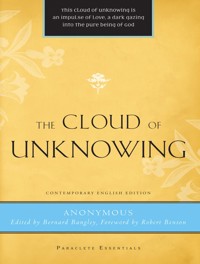
Erhalten Sie Zugang zu diesem und mehr als 300000 Büchern ab EUR 5,99 monatlich.
- Herausgeber: Paraclete Press
- Kategorie: Religion und Spiritualität
- Sprache: Englisch
A mystical classic now easier to understand Very few spiritual classics from centuries past offer real guidance for entering into the darkness and light of Christian mysticism. Notoriously difficult to understand, this contemporary English translation of one of the most popular texts from the late Middle Ages is different: It offers an accessible invitation to the reader to enter into an engagement with God, through this "cloud of unknowing." Mystical concepts are explained in everyday language. Written by an anonymous fourteenth-century author, The Cloud of Unknowing was originally prepared for cloistered monks. Yet it has found centuries of readers from all walks of life. Each brief chapter offers the spiritual seeker a way to enter into the life of prayer and appeals to the reader's common sense in beginning steps on the path to knowing a God beyond all knowing. A foreword by bestselling author, Robert Benson, special to this edition, helps to put this classic text within reach of everyday Christians.
Sie lesen das E-Book in den Legimi-Apps auf:
Seitenzahl: 138
Veröffentlichungsjahr: 2009
Das E-Book (TTS) können Sie hören im Abo „Legimi Premium” in Legimi-Apps auf:
Ähnliche




















The Cloud of Unknowing
2006 First Printing2009 First Printing This Edition
Copyright © 2006 by Bernard Bangley
ISBN 978-1-55725-669-0
Library of Congress Cataloging-in-Publication Data
Bangley, Bernard, 1935- The cloud of unknowing / edited and modernized by Bernard Bangley. p. cm. — (Paraclete Essentials edition) Originally published: Brewster, Mass. : Paraclete Press, c2006. With new foreword. ISBN 978-1-55725-669-01. Mysticism. I. Title. BV5082.3.B36 2009 248.2′2—dc22
2009021178
10 9 8 7 6 5 4 3 2 1
All rights reserved. No portion of this book may be reproduced, stored in an electronic retrieval system, or transmitted in any form or by any means—electronic, mechanical, photocopy, recording, or any other—except for brief quotations in printed reviews, without the prior permission of the publisher.
Published by Paraclete PressBrewster, Massachusettswww.paracletepress.comPrinted in the United States of America.
CONTENTS
FOREWORD by Robert Benson
INTRODUCTION
PRAYER
PREFACE
1 Four degrees of Christian living
2 Spiritual preparation
3 A superior discipline
4 Knowledge and imagination
5 The cloud of forgetting
6 A brief dialogue
7 Intellectual curiosity
8 Regarding uncertainties
9 Contemplative prayer
10 Discernment
11 Evaluating thoughts
12 Results of contemplation
13 Perfect and imperfect humility
14 Begin with imperfect humility
15 Understanding humility
16 Contemplative humility
17 A critical world
18 Ignorance
19 Complaining
20 God responds
21 The text
22 Love and contemplation
23 God’s spiritual provision
24 Contemplative love
25 Details
26 When difficult prayer becomes possible
27 Who should attempt contemplation?
28 Begin by seeking forgiveness
29 Endurance
30 Critics
31 Beginners and temptation
32 Spiritual devices
33 Perfect rest
34 God’s gift
35 Reading, reflection, and prayer
36 Meditation
37 Special prayers
38 Why short prayers pierce heaven
39 The nature of prayer
40 Forgetting virtue and vice
41 Contemplation and indiscretion
42 Indiscretion produces discretion
43 Forgetting the self
44 Suppressing the self
45 Spiritual illusions
46 Spiritual enthusiasm
47 Approaching God
48 Physical aspects of prayer
49 Essence of perfection
50 Pure love
51 Misinterpretation
52 Beginners’ mistakes
53 Outward behavior
54 Controlling the body
55 Condemning others
56 Common sense and common doctrine
57 Presumptuous beginners
58 Forcing imagination
59 Time, place, and prayer
60 Desire
61 Spirit and flesh
62 Understanding spiritual activity
63 Mind
64 Reason and will
65 Imagination
66 Sensuality
67 The spiritual way
68 Nowhere is everywhere
69 Nothingness and love
70 Comprehending God
71 Variety of experience
72 Differences
73 Contributions
74 Recognition
75 Certainty
APPENDIX: Essay on The Cloud of Unknowing by Evelyn Underhill
FOREWORD
As the anonymous writer of the letter to the Hebrews reminds us, we are indeed surrounded by a great cloud of witnesses. One of them is another unknown writer, the one who wrote this little book that you hold in your hands.
The writer was a part of that great river of christian prayer that has been offered down through the centuries, prayed by thousands upon thousands of saints, both known and unknown, sustaining the life of the church itself. It is a great river of prayer that we are called to join when we hear the call to pray without ceasing. It is a great river of prayer that is made up of different streams of prayer, different ways to pray.
We moderns tend to make our prayers verbally for the most part. These days more and more of us practice the tradition of the daily office, the saying of collects in our worship services, and the praying of the psalms in the same settings. Extemporaneous conversational prayer, both public and private—“our ongoing dialogue with Christ,” as Brother Roger of Taizé called it—has long been a part of prayer practice for most of us.
The Cloud of Unknowing offers us a glimpse into another way of prayer, contemplative prayer. It is prayer that is centered around listening rather than speaking, being rather than doing, searching for God’s presence rather than searching for answers or blessings or mercies. It is a way of prayer that has deep roots in the Christian tradition and yet has not been commonly practiced by us moderns.
The anonymous author offers straightforward talk about the joys and the obstacles, the consolations and the doubts, the practicalities and the possibilities that are a part of this way of prayer. He also offers us way of infusing our actions in the world with light that comes from contemplative prayer.
“When there is a crisis in the Church,” writes Carlo Carretto, “it is always here: a crisis of contemplation.”
In the noise and the rush of the modern world in which we live, our need for contemplative prayer is increased, not decreased. Our unknowing of this way of prayer does not diminish its importance.
The unknown writer, one of the unknown saints, part of that great cloud of witnesses, invites you to join in this way of prayer.
And so do I.
—Robert Benson
INTRODUCTION
If you are serious about your prayer life, this book is for you. The writer offers helpful spiritual instruction for those who are learning to pray, guiding them logically and clearly toward ideal prayer—what he calls “perfect” prayer. This anonymous fourteenth-century author of The Cloud of Unknowing originally prepared this book for cloistered English monks. A keen observer of human behavior, he laughed down the violations of good common sense that he saw religious communities employing.
Though scholars have struggled for centuries to discover the writer’s identity and to place him in a particular religious order, the humble guide stubbornly remains unknown.
He is not interested in telling us how profound his own prayer life is, though we can clearly see that it is substantial. Instead, his intent is to extend a helping hand to the rest of us. He communicates, as Jesus did in the Gospels, with ordinary, everyday language. No doubt he would have been astonished to discover how many would find his little book a key spiritual guide down through the centuries.
In his time, England and much of Europe were immersed in mystical religions. Practitioners of necromancy and sorcery experimented widely. The whole culture was intensely religious. Into this context Christian mystics, addressing the devout life, introduced a healthier spiritual tone and wrote what were to become timeless works. Meister Eckhart, Henry Suso, John Tauler, Walter Hilton, Julian of Norwich, Richard Rolle, Catherine of Siena, Thomas Kempis, and others wrote during this period.
The fourteenth century was also a time of social, artistic, and political revolution. The unknown writer of The Cloud gives that century and following centuries something genuine, something worth our aspiration. He does so with a smile on his face and a twinkle in his eye. He is attractive to readers in the way that Jesus Christ is attractive: He is serious without being stuffy. He talks about important religious issues, but he does so without becoming haughty.
The anonymous author is intelligent, but he avoids and criticizes convoluted academic style. A master of hyperbole, he employs colorful language to emphasize the spiritual hazards of formal education. He does not come across as anti-intellectual, but simply observes that theological erudition offers little service to one’s prayer life. What we find in these pages is a healthy mysticism simply based in growing toward God. It is not a book of spiritual tricks that lead to a quick jolt of spiritual fireworks, but offer little for the remaining journey.
The Cloud of Unknowing contains seventy-five chapters (chapitres). For such a slim book, that equals about one chapter per page. While they may seem more like section breaks than new chapters, they are markers along the way of sustained and developing thought. Although he briefly digresses a time or two, he otherwise sticks tenaciously to his subject, and at the end of the book he returns the reader to the place he began.
The author sometimes struggles to express himself clearly, fearing that his readers will only take his words at face value. He knows that, if readers do not keep in mind the overall direction of the book, they may wind up in seemingly contradictory theological dead ends. For example, when the writer mentions that the idea of God, being spirit, is more compatible with a purely spiritual desire (one not based on emotional human desires), some may read that and come to an erroneous conclusion. Rather than leading the reader into a trap, he points out that the purer our spirituality, the more it is in harmony with God’s spirit.
Some modern readers may have difficulty with the concept of the devil, or Satan, who is often mentioned in The Cloud of Unknowing. The author attributes many religious mistakes to the devil’s work. I have included these passages as the author originally expressed them. As you read these sections, remind yourself that religious thought in this period of our history includes the active influence of a personal devil. In Wartburg Castle, where Martin Luther worked on his translation of the Bible, tourists are shown a spot on the wall where Luther threw an inkbottle at the devil in 1521. His hymn, “A Mighty Fortress Is Our God,” assures us that devils, who threaten to undo us, fill our world:
For still our ancient foeDoth seek to work us woe;His craft and power are great;And, armed with cruel hate,On earth is not his equal.
Thomas Aquinas, in Summa Theologiae, writing in the thirteenth century, points out that Holy Scripture describes the properties of intelligible things with natural images. Following Aquinas, the anonymous author contends that angels and demons can take on the bodily appearance congruent with the content of their business among us.
As you read The Cloud, you may detect the influences of other writers. Thomas Aquinas and Anselm were certainly on his bookshelf, but many other authors also influenced him. In chapter 35, the author recommends an unnamed book, likely Ladder by Guigo II, as it contains the same four devotional steps he discusses in The Cloud: reading, reflecting, praying, and contemplation. The writer mentions other unnamed books, but likely refers to Hilton’s Scale of Perfection and Denis’s Mystical Theology, from which the closing chapters gain their tone.
When I read two modern versions of The Cloud of Unknowing back in 1983, I kept my red “reading pencil” busy, underlining and commenting to myself in the margins. As a matter of interest, I pulled these books from my shelf to see what I had done. Curiously, the red marks diminish sharply at chapter 62 and do not pick up again until chapter 68. The book’s character changes dramatically in this passage. Where the author has been spiritually arcane, he now becomes philosophically abstract, following the writings of St. Augustine regarding the dynamics of human consciousness. In De Trinitate, Augustine distinguishes between ratio superior and ratio inferior. Our unknown author incorporates these valuable ideas into his work, and I have attempted to retain the distinctly different style and tone of these sections.
Repetition of ideas is characteristic of the classical writing style of the period. While this may help to drive a point into memory, it seems like wheel-spinning to modern readers. Our anonymous author avoids this hazard. The Cloud of Unknowing, already a brief book, does not cry out for condensation, as do other spiritual classics. I omitted only a few repetitious sentences and paragraphs in this modernized version.
I am not attempting to present the definitive edition of The Cloud of Unknowing. Our generation already has several good ones. Instead, my desire has been to prepare a clean, smooth, easily read modernization that avoids antique syntax while remaining faithful to the teaching of the original. I do not attempt to explain ideas with my own amended comments. What is esoteric in the original remains esoteric in this version.
A comparison of texts demonstrates the uniqueness of this book.
ORIGINAL TEXT
Goostly freende in God, thou schalt wel understonde that I fynde, in my boistous beholdyng, foure degrees and fourmes of Cristen mens levyng; and ben theese: Comoun, Special, Singuler, and Parfite. Thre of theese mow be bigonnen and eendid in this liif; and the ferthe may bi grace be bigonnen here, bot it schal ever laste with outen eende in the blis of heven.
MODERN ENGLISH EDITION BY JOHN WATKINS
Ghostly friend in God, thou shalt well understand that I find, in my boisterous beholding, four degrees and forms of Christian men’s living: and they be these, Common, Special, Singular, and Perfect. Three of these may be begun and ended in this life; and the fourth may by grace be begun here, but it shall ever last without end in the bliss of Heaven.
THIS VERSION
My spiritual friend in God, this book is an attempt to pass along to you some important lessons learned from experience.
There are four degrees of Christian living: ordinary, extraordinary, unique, and ideal. We can experience the first three in this life, but the fourth is heavenly. Yet by the grace of God, we may begin the ideal here and see it continue for all eternity.
HERE BYGYNNITHA BOOK OF CONTEMPLACYON,THE WHICHE IS CLEPYDTHE CLOWDE OF UNKNOWYNG,IN WHICHE A SOULE IS ONYD WITH GOD.
Here begins a book of contemplation,which is called The Cloud of Unknowing,in which a soul is united with God.
PRAYER
O God, all hearts are open to you.You perceive my desire.Nothing is hidden from you.Purify the thoughts of my heartwith the gift of your Spirit, that I may love you with aperfect love and give you the praise you deserve.Amen.
PREFACE
In the name of the Father, the Son, and the Holy Spirit.
Here is a message for the unidentified person who is holding this book. Whether you own it or have borrowed it, whether you are taking it to someone else or intend to read it yourself, please respect the special nature of its contents. This book is for devout followers of Christ. Those who have not already learned to pray and who desire a life in service to Christ should read it. If such a person does read this book, or hear it read aloud, it may not make any sense. Therefore, when you read it, be sure to read the entire book. As the text develops, you will find that a question you had on an earlier page will find an answer on a later page. To read only a section means that you will be taking a passage out of context, and this could be misleading.
I do not intend this book for everyone. I do not want clever clerics and self-appointed critics discussing it. I would prefer they never see it. I did not write this book for them and do not want them involved with it. I prepared this book for souls inclined to contemplative prayer. Perhaps, by God’s grace, this book may be a helpful source of guidance.
My book contains seventy-five sections arranged in progressive order. By the time you read and ponder all of them, the final section will help you determine if you are being directed toward contemplative prayer.
CHAPTER 1Four degrees of Christian living
My spiritual friend in God, this book is an attempt to pass along to you some important lessons learned from experience.
There are four degrees of Christian living: ordinary, extraordinary, unique, and ideal. We can experience the first three in this life, but the fourth is heavenly. Yet by the grace of God, we may begin the ideal here and see it continue for all eternity. I list these four degrees as stages in ascending order. If you make progress through these stages, the merciful Lord has called you and is leading you to himself by these same degrees.
Early in your life, you lived in an ordinary manner with your worldly friends. The everlasting love of God created and redeemed you. God also inspired your desire for him. It was as though God attached to you a leash of longing and led you to himself. God brought you to the place where you can be a servant among his special servants. You have an opportunity now to discover a deeper spirituality. New possibilities await you.




