


4,49 €
Mehr erfahren.
- Herausgeber: The Normandy Press
- Kategorie: Geisteswissenschaft
- Sprache: Englisch
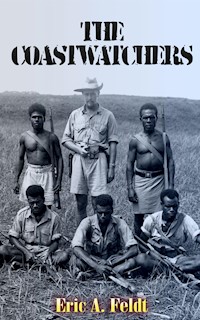
The Coastwatchers is the story of the unsung heroic civilian spotters of World War 2 who roamed the coastlines of their home islands and reported back enemy sightings to Allied Intelligence. Author Eric Feldt led Operation Ferdinand, part of the build-up to the Normandy landings, in which the Coastwatchers, by this time on the US Navy's payroll, played a critical role. His intimate knowledge of Ferdinand, and his familiarity with the Coastwatchers of the Pacific islands, provides a unique perspective on this little known but important chapter of military history.
Das E-Book können Sie in Legimi-Apps oder einer beliebigen App lesen, die das folgende Format unterstützen:
Veröffentlichungsjahr: 2019
Ähnliche




















ISBN: 978-0-359-91550-7.
The Coastwatchers
Eric A. Feldt
Published by The Normandy Press, 2019.
Table of Contents
Title Page
Title Page
1
2
3
4
5
6
7
8
9
10
11
12
13
14
15
16
17
18
19
20
21
22
Further Reading: Blood on the Rising Sun: The Japanese Invasion of the Philippines
1
This is the story of the men of Ferdinand, and of FERDINAND itself. It is the story of a secret and highly unorthodox military unit which, out of the foresight of the Australian Navy and the determination of a handful of enemy-surrounded planters, missionaries, government officers, and miners, grew into the organization that supplied information from the heart of Japanese-occupied tropical islands in the Southwest Pacific, to the two Allied Headquarters of the Pacific Theater.
It is a story of damp, dimly lit jungle camps, of hidden treetop lookouts; of silent submarines landing a few intrepid men on hostile beaches, in the dead of night; of American airmen mysteriously rescued from enemy-held islands surrounded by enemy-dominated seas. It is the story of how Allied coastwatchers managed, in strange and devious ways, not only to exist under the noses of the Japanese, but also to radio out vital military information. It is the story, too, of the bravery, the loyalty, and the ingenuity of many tropical natives, and of the perfidy or weakness of others.
FERDINAND was a small organization. All told, it numbered only a few hundred officers and men, both in the field and at its bases handling administrative work, supply, and communication. Yet it wove an intelligence network over more than half a million square miles of island and ocean. So secret was this organization of coastwatchers behind enemy lines that not even its existence was admitted during the war. Few knew that when the first landing waves of United States Marines hit the bitterly contested beaches of the Solomons, back in the jungles were Allies who were still ‘older inhabitants’ of Guadalcanal or New Georgia or Bougainville, coastwatchers who were eyes and ears for the invasion forces.
The coastwatchers’ codename, FERDINAND, was chosen from the child’s storybook, Ferdinand the Bull, but with no frivolous purpose. Besides serving as one of its cloaks of secrecy, this name was an order to the coastwatchers; a definition of their job. It was a reminder to them that it was not their duty to fight, and thus draw attention to themselves; like Disney’s bull, who just sat under a tree and smelled the flowers, it was their duty to sit, circumspectly and unobtrusively, and gather information. Of course, like Ferdinand, they could fight if they were stung.
Harried by the Japanese, sometimes betrayed as well as helped by natives, the lonely coastwatchers often did have to fight, with fleetness and improvisation taking the place of force.
But even when they were unobtrusive and circumspect, their effectiveness was tremendous. For example, when the Japanese attempted their first air attack on our landing forces at Guadalcanal, 23 of the 24 enemy torpedo bombers engaged in the raid were brought down and no damage was done to our invasion force. The defeat of this particular air force and of many that followed was made possible by the warnings by radio of a coastwatcher, hidden 300 miles away, between the great Japanese air and naval base of Rabaul and the battleground of Guadalcanal. At Guadalcanal and at many other battles of the New Guinea-Solomons area, the work of the coastwatchers gave the Allies a considerable, even a decisive, advantage.
Neither FERDINAND nor the Australian coastwatching system out of which it grew sprang up full-blown with the emergency of war. The story of its origin goes back to 1919 and to the problem of protecting Australia’s long, undefended coastline.
The island continent, its population of seven million largely concentrated in its southeast corner, presents large areas where, in wartime, an enemy might operate without hindrance and, in fact, without anyone’s being aware of it. Pondering this problem after the last war, the Navy hit on a scheme of appointing selected civilians in the coastal areas as coastwatchers, their duty being to report any enemy activity, suspicious event, or subversive behavior in time of war. On the greater part of the Australian coast, the watchers appointed by the Navy were generally postmasters, harbormasters, schoolteachers, police, or railway officials; people who had at hand the means of passing information by telegraph. The General Post Office agreed to send their reports over the telegraph lines of the Commonwealth to the Navy Office at Melbourne. The watchers themselves were supplied with printed instructions on what to report and how to report it.
The north and northwest coasts of Australia, the least inhabited parts, presented a more difficult problem. Before the 1930’s, the few scattered missionaries and managers of cattle stations in these areas had no means of swift communication. Then the invention of the pedal radio gave them a link with the outside world, and Naval Intelligence was quick to enroll all missionaries and cattlemen owning these instruments.
Frugality was the governing factor in the design of the system, for the Navy had little money in peacetime. The coastwatchers were unpaid, and it was not possible for the Navy to supply them with radio equipment. It was a case of making the most of the personnel and the material available.
The most important addition to the scheme was made when government administrative officers at coastal stations in Papua, New Guinea, and the Solomon Islands were enrolled as watchers. Unfortunately, the geographical positions of the stations were determined by civil government needs and not by strategical requirements. The Navy partly remedied this defect, as time went on, by appointing selected planters to the organization. Some of the patrol and district officers in the islands had radio communication and could use the code of the islands’ administrations. Others had neither. Six government officers in the area had both radio communications and high-grade codes.
The arrangements for organizing this pre-war network, simple as it was, were necessarily protracted. State governments, boards of missions, territory governments, all had to be consulted and their co-operation sought in lengthy and voluminous correspondence.
But by September 1939, the coastwatchers were eight hundred strong, the great majority of them, of course, on the Australian mainland. In Australia’s island screen, where FERDINAND was eventually to operate, the system was still very thin and spotty, but at least a nucleus existed, and funds were available. Upon the outbreak of war with Germany, the Navy directed the organization, such as it was, to commence functioning.
It was at this point that my connection with the organization began. I had been a naval officer before I became an islander. After joining one of the first terms of cadets to enter the Royal Australian Naval College, I had gone to the Grand Fleet in 1917 as a midshipman. In 1922, I had retired with the rank of Lieutenant, and the following year had gone to New Guinea, in the government service. When war broke, I was warden of Wau Goldfield in New Guinea. I was on the emergency list of Royal Australian Naval officers, with the rank of lieutenant commander. So, in September 1939, I rejoined the Navy.
I was directed to report to Commander R. B. M. Long, Director of Naval Intelligence. Long had been a term mate of mine at the Royal Australian Naval College and we knew each other well. On him had fallen much of the burden of building up the Naval Intelligence Division, and it had been a thankless task, calling for patience and equanimity. Lack of funds had prevented him from carrying out his ideas in full, and now he had to work against time to fill in the blanks.
He was a leader rather than a driver, and, if anything, over-indulgent of the faults of his juniors. Years of secretive work had developed in him an indirect, oblique approach to problems, a habit which he sometimes carried to extremes. Experience had given him a wide knowledge, and he combined a capacity for working long hours with an unfailing good humor. Above all his other virtues was his ability to let anything alone if it functioned properly. Under Long, I was appointed Staff Officer (Intelligence) at Port Moresby, in charge of the intelligence organization in Papua, New Guinea, and the Solomon Islands. Long and his civil assistant, W. H. Brooksbank, who had also borne the long struggle to build up the coastwatching organization, provided me with all the information—a considerable amount—which would be of use to me.
It was to be my duty, first, to ensure the proper functioning of the organization in the islands, as it then stood; and second, to expand it so that it would cover all our needs. Long knew what he wanted, but because of his lack of knowledge of island conditions, did not know quite how to get it.
So he left that part to me, together with the problem of dealing with those difficult people, the islanders. None of us then knew, of course, that the organization we were building would eventually operate in hostile territory, its posts surrounded by the enemy.
––––––––
Recruitment Poster for the Australian Imperial Force
2
To Americans, the islands where FERDINAND operated are known as the Southwest Pacific. To Australians, from the perspective of their still more southwesterly position, they are the Northeast Area, a chain screening the island continent. In the Navy, we thought of them somewhat as a fence, but a fence with several gates; the straits between the islands. In the period between the declaration of war on Germany and the invasion of the Japanese, my job was to make the fence as effective as possible.
On 21 September 1939, with the war sixteen days old, I set out with a sheaf of printed coastwatcher instructions to visit every man in the islands who had a teleradio. My travels took me by ship, motorboat, canoe, bicycle, airplane, and boot throughout the Solomons, the New Hebrides, Papua, New Guinea, New Britain, New Ireland, and their satellite specks of land. I saw nearly everybody and nearly everybody saw me. I already knew more than half of those I met, and all were helpful.
By December 1939, I had enrolled all existing teleradio operators, taught them how to code, what to report, and that speed in reporting was the prime essential. With an eye to the future, I also instructed about a hundred others in reporting, although most of these had no means by which a message could be passed to us except by runner to the nearest teleradio; often a matter of days.
When I returned to Port Moresby, I proposed to Long that we depart from the Australian scheme of using only coastwatchers with communications equipment already at hand, and lend additional teleradios to selected persons at strategic points.
At this time, the war with Germany was of course receiving first priority, and a proposal such as this, meaning diversion of effort to the Pacific, represented one more strain on inadequate resources. But Long, imbued with the belief that Japan would one day enter the war, pressed hard and carried the plan. Its prompt approval made all the future possible. The governments of the islands and the Royal Australian Air Force eagerly assisted us in distributing the teleradios to their strategic positions. But even under the pressure at which everyone worked, it was August 1940 before the instruments were all placed in the far-flung ports and lonely plantations.
Still one more move was needed to close the gates in the fence. The principal gap in the chain is that between New Ireland and Buka, with the tiny Anir (Feni) and Nissan Islands from which the sea lanes can be watched. A plantation manager manned a Navy-supplied teleradio on Nissan, but as navigators usually prefer the route near Anir, it was vital that Anir, too, have a watcher.
For this desolate point, we selected Chief Yeoman of Signals S. Lamont, an old sailor, as Irish as Paddy’s pig. He was a complete stranger to conditions of life on an isolated island, but a resourceful and dependable man. While the news was coming through of the debacle in France and the capitulation of Belgium, he was landed and placed in a temporary camp, and then was left to shift for himself. His first few months on Anir must have been acute misery but, as we expected, he adjusted himself and carried on his watch ably.
While we were choosing watchers and placing teleradios, we were also working out a method for integrating men and instruments into a unique communications system. Taking the materials at hand as our basis, we fitted each teleradio in the area, whether naval or privately owned, with a crystal cut to give a special frequency, known as ‘X.’ Loudspeakers kept constantly switched on at key stations in Rabaul, Tulagi Harbour, Port Moresby, and Thursday Island, could receive any signal sent on X frequency at any hour. Previously the small stations in the area had communicated with key points at fixed times; ‘skeds,’ as they were called.
We had no trouble in enlisting co-operation for our plan, for in the Solomons, radio was managed by the Government, and in Papua and New Guinea it was in the hands of Amalgamated Wireless of Australia, a company in which the Commonwealth Government held 51 percent of the shares. Until the Japanese attacked, Amalgamated Wireless was in charge of maintaining our teleradios, while the Navy paid it for this service and for the watch kept on X frequency.
The teleradios themselves had been developed by Amalgamated Wireless. They were grand instruments, standing up to heat, wet, and amateur handling, with a range up to 400 miles on voice and 600 miles if keys were used to transmit Morse. The model we used, the ‘3B,’ produced in 1939, consisted of a transmitter, receiver, and loudspeaker, with four alternative transmission frequencies which could be tuned to complete accuracy. All parts were enclosed in three metal boxes, each about a foot deep, a foot wide, and two feet long. Power was supplied by batteries like those a car uses, which were charged by a small gasoline engine weighing about 70 pounds, the heaviest part of the set.
The instrument had one serious disadvantage. It was difficult to carry, requiring twelve to sixteen porters. Foreseeing that the time might come when this would be a serious handicap, Naval Intelligence drew up requirements for a portable teleradio and placed orders. An error crept into the manufacturing and after many months we were supplied not with the type we wanted, but with a radio similar to the 3B, only not quite as good. The Air Forces developed what we wanted independently, and eventually we were able to obtain it and even to supply it by parachute to coastwatchers. In the meantime, however, the 3B was our mainstay.
In this grim game of watching and reporting, part of the value of the signal would be lost if the enemy knew he had been reported and could take countermeasures, so a code was an absolute necessity.
‘Playfair,’ a simple cipher known to most schoolboys, had been chosen in peacetime when the coastwatchers were first appointed by the Navy. It has the virtue that it needs no documents other than a list of agreed-on keywords, but it has the disadvantage of being low grade. I devised a variation known as ‘Playfair Feldt Method’—one by which the bigrams were broken—which was a little more secure than the original. Eventually, after the watchers had amply proved themselves, the Navy supplied us with really good codes.
Long before the war, the Navy had pondered the problem of reliability of coastwatchers and had devised a scale to take into account both its faith in the individual informant and the likelihood of the occurrence he reported. This grading system was carefully used from 1939 until Japan entered the war. But when coastwatchers came fully into the picture, with war on their doorsteps, they established such a gilt-edged reputation that their reports were automatically accepted, qualified only by any doubts which the watcher himself expressed.
In December 1940, the coastwatchers had a first tangle with the enemy when two German raiders chose the small island of Emirau, north of Kavieng, to land prisoners from ships they had sunk. This gave the watchers some real practice. A boat from the island reached Kavieng where the District Officer, who was the coastwatcher there, signaled its arrival and the position of the prisoners.
Arrangements were promptly made to pick up the marooned passengers and crews. Soon the officers dispatched, more than busy collecting information concerning the appearance of the raiders, their armament, their methods, and for the reconstruction of the routes they had followed. With the arrival of the refugees in an Australian port, the coastwatchers settled down to waiting again, now with a feeling that they had a real role to play.
The presence of the raiders, however, added indirectly to one of our minor but annoying troubles; the patriotic fervor of loud-mouthed flag-wavers. These nuisances had nothing much to do, so they engaged in a heresy hunt. They were not so much security-mad. In New Guinea some of the Germans, even some Lutheran missionaries, were Nazis, and after their internment suspicion of all Germans, including anyone with a German-sounding name, burned to incandescence.
The surveillance of subversive activity was the duty of Military Intelligence, so I took little part in it, but at times found my way beset with difficulties. For instance, when I proposed making an Australian Lutheran missionary a coastwatcher, a high civil official said, horror in every syllable, ‘But he spells his name F-r-e-u-n-d!’
I could only reply, weakly, by spelling my own.
Another who was held in deep suspicion by the ultra-patriotic was Ken Frank, manager of the Amalgamated Wireless station at Port Moresby. Frank’s advice and expert assistance to us were beyond price but he was a cynic who derided the Empire; consequently, while he worked day and night to save the country, he was amusingly enough dubbed a Fifth Columnist. Later, when disaster was near, Frank sat at a receiver with the bombs falling around him, still wisecracking about Old School Ties and Strategic Retreats, his accusers long since having sugared off to safety.
During our period of waiting, the lesson from Europe had been the need for co-operation among the Armed Services. So, in Melbourne the Chiefs of Staff of Australian Army, Navy, and Air Force pooled their authority and exercised command as the ‘Combined War Room’ overall forces.
Our coastwatcher reports, which obviously concerned the three services, were available instantly to all. Coastwatchers were under general supervision of the civil government in the islands, but experience had shown us that in times of even minor stress civil officials were so busy at their own affairs they had no time to attend to ours. To remedy this, the Navy appointed intelligence officers to Port Moresby, Thursday Island, Rabaul, Tulagi, and Vila, each to control coastwatchers in his own area and to transmit intelligence to Melbourne and to Area Combined Headquarters in Townsville.
Through this arrangement, I lost my assistant Hugh Mackenzie, who was appointed to Rabaul. Mackenzie had been in the same term as I at Naval College. He had spent most of the years between the two wars in New Guinea and Papua, first as a rolling stone and later as a planter. He was conscientious and thorough in an unsystematic way, occasionally doing something quite illogical. The coastwatching service was lucky the day it got Mackenzie, for this man, who completely lacked the qualities of salesmanship and showmanship, was to fill brilliantly one of the most dramatic and responsible assignments of the battle for Guadalcanal.
Mackenzie and each of the other four Naval Intelligence Officers assigned to coastwatcher control kept a plot of ships in his area. Should Lamont on Anir sight a ship, for instance, he would immediately code a signal and call Rabaul on X frequency. Amalgamated Wireless at Rabaul would telephone the signal over a direct wire to Mackenzie, who would decode it. If no ship on his plot corresponded to that reported, his office would pass Lamont’s signal to the Air Force and would then code a signal in high-grade cypher for Melbourne and Townsville. The Air Force’s Rabaul Advanced Operational Base would send out an aircraft to intercept and examine the ship.
If the sighting were of aircraft instead of a ship, the signal from the coastwatcher had to be sent in plain language. Experience had shown us that by the time the signal was decoded, aircraft information was cold.
As far as could be done, the intelligence position was sewn up. As far as could be done...
There was one grave weakness in our position. We had insufficient force to back up and hold our intelligence screen. Australia’s sea forces, somewhere to the south, were not adequate in any case to deal with more than a squadron of light cruisers. The Air Force had some Catalinas, a few Hudson bombers, and half a dozen Wirraways. The Army had little more than a battalion in Port Moresby, about the same force at Rabaul, and still smaller forces at five other points in the vast territory. In terms of war, we had merely token forces.
It was obvious that if the enemy came on anything more serious than a raid, any of our key coastwatcher points might be occupied and our chain broken.
So we were increasingly haunted by the specter of enemy occupation, and by the anomalous position of the coastwatchers. Under international law, coastwatchers, as civilians, had no real right to transmit intelligence once their area was effectively occupied. Should they continue reporting they would be absolutely unprotected, their position that of spies.
No policy was laid down on this disturbing possibility until late in 1941, when Long made the decision that civilian coastwatchers were to cease reporting in the event of enemy occupation. Bound as he was by international law and by the limitation that civilians could not be ordered to remain in invaded territory, he could take no other stand. Unofficially, however, we all hoped that in case of invasion some civilians would remain and report enemy movements.
So, in practice, we left things pretty much in the air. Watchers were informed that they were not ordered to remain. However, we took care not to give a definite order that they cease reporting and we did give them careful instructions on how to contact another radio station should their own control station fail to reply.
Thus, when Japan struck, the decision was really in the hands of the watchers themselves. A civilian coastwatcher could remain, at his own risk and in the hope he would get recognition and support. But there was no promise, even an implied promise, that he would get either. All he had was the promise of certain peril.
3
When, a month after Pearl Harbor, the hurricane of war struck at the Northeast Area, it worked havoc with our island intelligence chain. Here and there, parts of the chain were left freakishly intact; in other places it was destroyed, or its links dislocated.
There was, for instance, C.C. Jervis, planter and retired Navy telegraphist on Nissan Island, who watched an enemy ship move toward the lagoon entrance of his low, undefended atoll; he calmly coded and sent a report of its presence, and was never heard of again.
There was J. Daymond, assistant district officer at Gasmata, a noisome, marshy native prison island off the south coast of New Britain, who warned Port Moresby of its first air raid, giving the town ample time to prepare, and then was betrayed, unwittingly, by his countrymen: the news was broadcast in Australia that enemy aircraft had been sighted over Gasmata, direct information to the Japanese that we had a reporting station at that point. Promptly the enemy bombed and gunned Gasmata station. For the nonce, Daymond and his staff were saved, having wisely moved with their teleradio across to the mainland.
Unsatisfied, the Japanese landed a force at Gasmata two weeks after the fall of Rabaul. According to the story that percolated through, they asked the first native they saw where the kiap was, and were led, in innocent simplicity, to Daymond and his assistant, who had returned to the island. A third member of the staff radioed the bare facts of their capture, and that was the last heard from him, too. We did not even receive an acknowledgment of our reply to his desperate message.
There was, on the other hand, L.G. Vial, a young assistant district officer evacuated by the Air Force from Rabaul, who was swiftly commissioned an Air Force Pilot Officer, supplied within a week with teleradio, codes, food, and instruction, and flown to Salamaua on the New Guinea coast a few days before the Japanese moved in. Hidden in the hills above Salamaua airfield, for six months, in his quiet unhurried voice, he reported aircraft on the way, their types, numbers, course, and height. His was the voice most listened for at Port Moresby, and at last a correspondent dubbed him ‘The Golden Voice,’ a title which embarrassed him considerably. At the end of his watch, he was awarded the American Distinguished Service Cross.
There was D.G.N. Chambers on Emirau Island, north of Kavieng, who made a remarkable escape by launch, passing enemy held Rabaul at night. Next morning, driven ashore by an enemy destroyer, his launch wrecked, he managed to find a party of other refugees and to make his escape with them. His experience was typical of a number of the watchers who were forced to flee their posts but who survived to serve FERDINAND another day.
There were W.L. Tupling on Ningo and J.H. McColl on Wuvulu, small coral islands in the Admiralty Group, 250 miles northwest of Rabaul. When the radio station at Rabaul was silenced, they tried desperately to raise Port Moresby on their teleradios, but distance and the intervening mountain ranges were too much. So, uninstructed, they remained at their lonely posts to warn a small detachment of Commandos in the islands of approaching ships, to help in destroying everything of use to the Japanese, and finally to aid in evacuating the soldiers. At last one of their signals was picked up, they were instructed to evacuate, and in a plantation launch they made their way, like Chambers, to safety and to future service.
And there was Cornelius Lyons Page, watcher on Tabar Island, east of New Ireland, the outer perimeter of our coastwatcher defense. In many ways, Page’s story epitomizes the frustration, the improvisation and, in the light of what was happening, the almost unreasonable faith which were the themes of coastwatcher existence in the six months after January 1942. It exemplifies, also, both the magnificent and the maddening aspects of the island backgrounds of our watchers.
Although Page was only thirty years old when Japan entered the war, he was already a confirmed and seasoned islander. Brought up in a Sydney suburb, he had come to the islands with his parents at the age of nineteen. In Rabaul, ‘metropolis’ of the Northeast Area, he was given a job behind a counter in a store. But his eyes ranged far away beyond the hills that fringed the harbor. He met men who lived untrammeled lives (or so it seemed to him); recruiters, miners, planters. The glamor of far places in the islands called him insistently, whispering of white beaches and palms in moonlight and of hot, still jungle, but not of loneliness and melancholy.
So, Page left his job in Rabaul and settled on Mussau Island, northwest of Kavieng. He took up land and commenced to plant it with coconuts, trading with the natives to pay his way. Personal freedom, complete freedom was his. His dream was realized. Now he had only to five it, unspurred by further ambition.
Days, unmarked, drifted to months, and months to years. Having no European neighbors, Page talked to natives, growing from a stranger to a familiar with them. Their thoughts impinged upon his, slowly at first, but shaping his ideas as time went by, as two stones rubbing together shape themselves to each other. He came, imperceptibly, to regard Massau, Kavieng, and the nearby islands as his country, indeed as his world, to feel that other places were nebulous and far away.
Big and virile, he enjoyed his life. And yet, under the overlay of his contentment, his heritage of energy, will, and pride, unchanneled toward a goal, was at odds with his environment. Aimlessly goaded to further adventure, at length he sold his plantation on Massau and went to Tabar, where traces of gold had been found. He tried prospecting, then took jobs here and there in the New Ireland area, never staying long in any.
Familiarity had bred an acceptance of the natives in a higher status, a place closer to himself, than the European generally concedes, and on Tabar, Page took a young native girl, Ansin Bulu, to live with him. This was more than an outlet for excess sexual vitality. Through companionship the relation between the two developed into something much deeper than is usual in such liaisons.
When war broke out with Germany, Page felt the urge to fight, but it all seemed far away and not of his world and, undecided and restless, he let the days drift by. Then, when copra became all but unsaleable, a planter who decided to go after ready money gave him a job as manager of his plantation, Pigibut, on Simberi, one of three small islands in the Tabar group. Earlier a teleradio had been lent to this planter by the Navy, and so with his plantation duties Page also undertook the coastwatching duties of his predecessor.
The island group was a small world of its own, its only connection with the outside world an unreliable twenty-mile canoe journey to the nearest point on the New Ireland shore, and the occasional visits of copra ships. It was a backwater, a little group of land specks of no importance whatever.
On Simberi, in addition to the plantation which Page managed, there was one other plantation, managed by ‘Sailor’ Herterich. On Tatau Island, three miles to the south, a plantation was owned and managed by Jack Talmage. Talmage was an elderly veteran of World War I, a quiet man, respected by his neighbors. A sailor, Herterich was not. He had settled in New Guinea when it was a German colony, but when the war was lost to Germany, he became not so much German as the husband of a native woman; and so escaped deportation. In the years since, he had managed plantations, a lazy, unreliable man, who drifted along with the tide of life.
The other four plantations in the island group were owned by a firm and run by a succession of managers, transients who came, stayed awhile, and left. The only other inhabitants were the natives, who had the reputation of being idle, quarrelsome, and lacking in character.
With the outbreak of war with Japan, the Tabar group was immediately jolted from its inconsequential position in the outer nebula of New Guinea. Those who navigate aircraft differ little in their methods from the navigators of ships. After a long trip over open ocean, the navigator likes to make a landfall to fix his position. For Japanese pilots, flying from Truk to bomb Rabaul, the usual landfall was Tabar.
In the month that preceded the fall of Rabaul, Page kept watch for these planes, reporting them day and night. It is interesting to speculate on the possible difference this might have made in the course of the war, had there been a squadron of modern fighter aircraft at Rabaul instead of the antiquated Wirraways. Page’s warnings would have given them time to reach altitude, intercept the unescorted bombers, and shoot them down like ducks. The enemy losses would have disorganized the Japanese capacity for long-range attack and reconnaissance.
Perhaps Japan would have paused, given us time to move our forces to the area, and smash the enemy convoy when at last it moved, so that there would have been no campaign in the Southwest and South Pacific. All a might have been, but if it had happened so, what fame would have been Page’s!
While Page watched and signaled, Sailor Herterich considered his position. The Japanese would come, and then what would happen to Sailor? He had best be a German again, an ally of Japan. Busily he spread word among the natives that the Japanese would come and were to be treated as friends.
Page heard the whispers being passed around, and countered them. The Japanese would not come, he said, and if they did would soon be driven off. He, Page, was staying. The natives, hearing both opinions, uneasily reserved their decision.
Page’s radio signals had not escaped the notice of the Japanese, and with the fall of Rabaul and Kavieng he became a hunted man. Once they were established in the area, the Japanese promptly sent a warship to raid the plantation. Page had already moved his teleradio to a hut in the jungle, however, and he was not discovered. When the ship had gone, he signaled over his teleradio, reporting its departure.
At our headquarters in Townsville, Page’s position appeared untenable. I signaled, ‘You have done magnificent work. Your position is now dangerous if you continue reporting and under present circumstances your reports are of little value. You are to bury your teleradio and may join either party on New Ireland or take other measures for safety. Good luck.’
Page took no notice of the signal. He was on Simberi, a master who had told the natives he would stay. This was his world, his only frame of reference. He was fighting the war, but it was the Tabar War, his own war.
He continued to send signals concerning the extent of the Japanese occupation at Kavieng, the names of Europeans in the area who had been captured, enemy guns and defense positions.
In Townsville, we knew nothing of his local problems or his state of mind, but it was obvious that he had no intention of leaving. This being the case, the best course was to try to keep him quiet until a time came when his information would be of greatest use. A sudden complete silence might lead the Japanese to think he had gone. So we sent another signal, ‘Your reports appreciated, but it is more important to keep yourself free. Do not transmit except in extreme emergency. You will be ordered to make reports when they will be of greatest value.’
Finally, as he still came on the air, we ordered him to cease transmission altogether, until ordered to recommence. Even this did little good. Such disobedience, inconceivable in any other wartime operation, was not too surprising in an islander. We had to accept it, interwoven as it was with other traits so valuable to us.
Meantime, extremely worried over the civilian status of men in Page’s position, we were making recommendations that Page and others be given naval rank. Possibly rank would be no protection against a brutal enemy but, even so, every aid was needed. Aside from its dubious advantages of personal safety, rank would permit us to pay the watchers and to provide for their dependents.
At long last, in March 1942, the red tape was cut, and Page, unseen by authorities or doctors and without signing any forms, was commissioned a sub-lieutenant, Royal Australian Naval Volunteer Reserve, probably a happening without precedent.
On Tabar, as the natives watched events, they slowly began to lean toward Herterich and the Japanese, although Talmage supported Page to his utmost. Ironically, Page, the man who had been so close to native life and native thinking, was losing his influence and with it his control. In March, renegade natives from Kavieng, possibly encouraged by Herterich, looted the plantation and threatened to report Page’s whereabouts to the Japanese.
Shortly after this event, Hans Pettersen, a half-caste, fat, sly swine of a man who had been in disrepute since boyhood, came to live with Herterich. He too preached acceptance of the Japanese and gradually the natives’ attitude toward Page drifted from uncertainty to positive opposition.
In view of these developments, it was problematical that Page’s whereabouts could be kept secret even should we be able to impress upon him the need for discretion. So we advised him to make for Buka, northernmost island of the Solomons, which was still clear of the enemy. Beset by an obstinacy which was aggravated by his dislike of Herterich and Pettersen, Page rejected the suggestion. His reply was to send a further list of captured Europeans and to warn that Namatani airfield on New Ireland was mined, information he had obtained by careful questioning of runaway natives.
Other radios were also on the air, and coastwatchers were listening to each other to glean any news they could. Page and a watcher on Bougainville were accustomed to chatter to each other in Kavieng dialect which both knew, and which was as safe as any code.
Once teleradio eavesdroppers heard two missionaries in Papua talking to each other when Page wanted to send an urgent signal. The missionaries were depressed as they discussed their prospects, and Page listened with growing impatience while one said, ‘I will pray for you, Brother.’
The other replied, ‘And I will pray for you, Brother.’
At this point, Page was heard to break in, ‘Get off the ruddy air and I will pray for both of you.’
For his signals to headquarters, Page obtained new code keywords during communication with his mother in Australia, through names of persons and places woven into the conversation.
By the end of March, Page was a dot in a Japanese-held ocean. Every surrounding key point had been occupied and even thought of escape was futile, unless it could be managed by outside aid. Supply, too, was becoming impossible for him locally, with fewer and fewer natives supporting him. His plantation supplies were nearly consumed, and he had no arms whatever to defend himself. He moved into caves, and at one time only Ansin Bulu, his native wife, stood by him.
To drop supplies from an aircraft was the only solution, but our few aircraft were overworked, and each trip threatened a loss that could ill be spared, while parachutes were rare as diamonds.
So, it was late in May before a drop could be made ready. Cap and badges of rank, food, a rifle, and ammunition were included in the supply packets. The pack containing the rifle jammed in the bomb-bay doors, during the drop, and had to be returned to Port Moresby in that position; just one of those things that happened. The other supplies, fortunately, were successfully dropped and found by Page.
Shortly afterward his radio developed a fault in the voice transmission, and he had to send his signals laboriously by Morse, touching two wires together in place of a key. The signals were hardly readable. Ken Frank, the cynical Amalgamated Wireless man at Port Moresby who had appeared so sinister to the super-patriotic, guessed the fault as a broken lead-in, and the whole part was dropped to Page by parachute, rectifying the fault; a fine feat of remote diagnosis.
The supplies, indicating outside support for Page, restored his prestige a little with the natives. But when he signaled that the Japanese were enrolling native police, we knew that he could evade the enemy for very little longer. We decided to attempt to evacuate him.
Several United States submarines had recently arrived in Australia, and, with the help of the U.S. Naval Liaison Officer, a rescue trip and a rendezvous were arranged. Page at last agreed to take our advice and to make his escape on the vessel.
For three nights, Page kept the rendezvous, flashing the agreed signals from a torch in a small boat. Every flash must have seemed an invitation to unseen enemies. Every ripple of the water must have made his heart leap with hope of friend or fear of foe. Those three nights must have been a fairly complete catalog of hope, desperation, and triumph over panic.
But no submarine came. Later, we learned the vessel had developed a serious mechanical defect and had been hard put to limp back to port. These were old submarines, which had already taken a beating in the Philippines and were not to be compared with the models of efficiency which later operated in the South and Southwestern Pacific.
We made distracted attempts to get another submarine to undertake the mission, but there were other tasks of urgent strategical value and the Navy regretfully decided it could do no more.




