


19,99 €
Mehr erfahren.
- Herausgeber: John Wiley & Sons
- Kategorie: Fachliteratur
- Sprache: Englisch
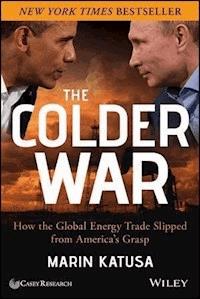
How the massive power shift in Russia threatens the political dominance of the United States There is a new cold war underway, driven by a massive geopolitical power shift to Russia that went almost unnoticed across the globe. In The Colder War: How the Global Energy Trade Slipped from America's Grasp, energy expert Marin Katusa takes a look at the ways the western world is losing control of the energy market, and what can be done about it. Russia is in the midst of a rapid economic and geopolitical renaissance under the rule of Vladimir Putin, a tenacious KGB officer turned modern-day tsar. Understanding his rise to power provides the keys to understanding the shift in the energy trade from Saudi Arabia to Russia. This powerful new position threatens to unravel the political dominance of the United States once and for all. * Discover how political coups, hostile takeovers, and assassinations have brought Russia to the center of the world's energy market * Follow Putin's rise to power and how it has led to an upsetting of the global balance of trade * Learn how Russia toppled a generation of robber barons and positioned itself as the most powerful force in the energy market * Study Putin's long-range plans and their potential impact on the United States and the U.S. dollar If Putin's plans are successful, not only will Russia be able to starve other countries of power, but the BRIC countries (Brazil, Russia, India, and China) will replace the G7 in wealth and clout. The Colder War takes a hard look at what is to come in a new global energy market that is certain to cause unprecedented impact on the U.S. dollar and the American way of life.
Sie lesen das E-Book in den Legimi-Apps auf:
Seitenzahl: 398
Veröffentlichungsjahr: 2014
Ähnliche



















THE COLDER WAR
How the Global Energy Trade Slipped from America’s Grasp
Marin Katusa
Cover design: Jan Linke Cover Images: Obama/Putin: © Evan Vucci/Associated Press; clouds/oil field © Mick Roessler/Corbis
Copyright © 2015 by Marin Katusa. All rights reserved.
Published by John Wiley & Sons, Inc., Hoboken, New Jersey, and Casey Research, LLC, Stowe, Vermont. Published simultaneously in Canada.
No part of this publication may be reproduced, stored in a retrieval system, or transmitted in any form or by any means, electronic, mechanical, photocopying, recording, scanning, or otherwise, except as permitted under Section 107 or 108 of the 1976 United States Copyright Act, without either the prior written permission of the Publisher, or authorization through payment of the appropriate per-copy fee to the Copyright Clearance Center, Inc., 222 Rosewood Drive, Danvers, MA 01923, (978) 750-8400, fax (978) 646-8600, or on the Web at www.copyright.com. Requests to the Publisher for permission should be addressed to the Permissions Department, John Wiley & Sons, Inc., 111 River Street, Hoboken, NJ 07030, (201) 748-6011, fax (201) 748-6008, or online at http://www.wiley.com/go/permissions.
Limit of Liability/Disclaimer of Warranty: While the publisher and author have used their best efforts in preparing this book, they make no representations or warranties with respect to the accuracy or completeness of the contents of this book and specifically disclaim any implied warranties of merchantability or fitness for a particular purpose. No warranty may be created or extended by sales representatives or written sales materials. The advice and strategies contained herein may not be suitable for your situation. You should consult with a professional where appropriate. Neither the publisher nor author shall be liable for any loss of profit or any other commercial damages, including but not limited to special, incidental, consequential, or other damages.
For general information on our other products and services or for technical support, please contact our Customer Care Department within the United States at (800) 762-2974, outside the United States at (317) 572-3993 or fax (317) 572-4002.
Wiley publishes in a variety of print and electronic formats and by print-on-demand. Some material included with standard print versions of this book may not be included in e-books or in print-on-demand. If this book refers to media such as a CD or DVD that is not included in the version you purchased, you may download this material at http://booksupport.wiley.com. For more information about Wiley products, visit www.wiley.com.
ISBN 9781118799949 (Hardcover) ISBN 9781118800058 (ePDF) ISBN 9781118800072 (ePub)
To my wife, Marina. Your support and undying love carry me in all I do.
Contents
Foreword
Energy
… and the Man
Acknowledgments
Chapter 1 The End of the Lost Decade
The Lost Decade
Move to Moscow
The Bombings
Second Chechen War
Putin Installed
Notes
Chapter 2 Humbling the Oligarchs
Land of Opportunity
Nailing Khodorkovsky
Vouchers
The Yukos Way
Putin's Best Offer
Dropping the Hammer
A Trail of Bodies
Daring to Notice
Survive and Thrive
Vision and Principle
Chapter 3 The Great Game and the End of the Cold War
The First Drop
The Pioneer
Go Big
Oil, War, and Peace
The First Nickel
Everyone's Dollar
Thank You, Mr. Nixon
Notes
Chapter 4 The Slavic Warrior
Little Boy Putin
Big Boy Putin
Putin at Work
Hands off Georgia
Hands on Georgia
Chapter 5 Ukraine
What Putin Wants in Ukraine
After the USSR
Don't Forget to Vote
Maidan Up Close
Crimea Comes Home
Notes
Chapter 6 Putin the Statesman
Beyond the Common Economic Space
Here We Go Again
Chapter 7 The Putinization of Oil
Arctic Oil
European Market
Rosneft
Winking at OPEC
Oil Pipelines
Notes
Chapter 8 The Putinization of Gas
Better Pipes
Liquefied Natural Gas
European Burners
Gazprom
Beyond Europe and Back
Notes
Chapter 9 The Putinization of Uranium
Long-Term Shortage
Science Lesson
Short-Term Fixes
Putin's Uranium Superstore
The Ultimate Source
Going to School in Mongolia
Toward the Endgame
The Transient Surplus
Chapter 10 The Middle East: Oil, Wars, and the Great Game
Iran: Sanctions, Coups, and Revolutions
Iraq: The Quagmire
Iraq's Oil History
Kurdistan—The Would-Be Country
Afghanistan: The Bear Trap
Syria: Why Do We Care?
Bahrain's Importance
Israel
Rattling around the Shaky House of Saud
Notes
Chapter 11 Twilight of the Petrodollar
Darts at the Dollar
The Dollar Shoots Itself
The Tide of Commerce
Back to Riyadh
Notes
Chapter 12 Post-Petrodollar America
Softening Up
The Process
On the Fast Tracks
Last Exit
What You Can Do
Bringing Modern Technology to Old Fields
Afterword
References
About the Author
Index
Advert
End User License Agreement
List of Illustrations
Chapter 1
Figure 1.1
Commonwealth of Independent States (CIS)
Figure 1.2
Russian Gross Domestic Product (Producer Price Parity) since the Fall of the Soviet Union
Chapter 3
Figure 3.1
Nominal versus Real Price of Oil
Chapter 5
Figure 5.1
Percentage of Ukrainians Who Speak Russian Natively
Chapter 6
Figure 6.1
How Much Europe Depends on Russian Energy
Chapter 7
Figure 7.1
Worldwide Oil Production
Figure 7.2
Russia's Crude Oil and Condensate Main Export Destinations, 2012
Chapter 8
Figure 8.1
Largest Proven Holders of Natural Gas Reserves
Figure 8.2
Reliance on Gazprom as a Percentage of Consumption
Figure 8.3
China's Energy Consumption
Chapter 9
Figure 9.1
Spot Uranium Price
Figure 9.2
Nuclear Reactors Worldwide
Figure 9.3
EU-27 Sources of Uranium, 2010
Figure 9.4
Current Uranium Enrichment Capacity
Figure 9.5
Uranium Conversion Capacity
Chapter 10
Figure 10.1
Predominant Religious Sects of Inhabitants Near Oil Fields
Figure 10.2
Israel's Natural Gas Reserves
Chapter 11
Figure 11.1
Saudi Crude Oil Exports by Destination, 2012
Guide
Cover
Table of Contents
Chapter
Pages
ix
x
xi
xii
xiii
xv
xvi
1
2
3
5
6
7
8
9
10
11
12
13
14
15
17
18
19
20
22
23
24
25
26
27
28
29
30
31
32
33
34
35
36
37
38
39
40
41
42
43
44
45
46
47
48
49
50
51
52
54
55
56
57
58
59
60
61
62
63
64
65
66
68
69
71
72
73
74
75
76
77
78
79
80
81
82
83
84
85
86
87
88
89
90
91
92
93
94
96
97
98
99
100
101
102
103
104
105
107
108
109
111
112
113
114
115
116
117
118
119
120
121
123
124
126
127
128
129
130
131
132
133
134
135
136
137
138
139
141
143
144
145
146
147
148
149
150
151
152
153
154
155
156
157
158
159
160
161
162
163
164
165
166
167
168
169
170
171
172
173
174
175
176
177
178
179
180
181
182
183
184
185
186
187
188
189
190
191
192
193
194
195
196
197
198
199
200
201
202
203
204
205
206
207
208
209
210
211
212
213
214
215
216
217
218
219
220
223
224
225
226
227
228
229
230
231
232
233
234
235
236
237
238
239
240
241
242
243
244
245
246
247
248
Foreword
Let me be candid. I really like this book because it's original, it's well reasoned, and its conclusions are correct. It's important that you read it.
Let me take a couple of pages to explain why the subject of energy is even more important than most people imagine, and why Marin is not only the right man to explain it but a winning player in the rough-and-tumble energy arena.
Marin wasn't planning to write a book until I twisted his arm. Although he's a competent writer, as you'll see, he's first and foremost a deal maker. But what has brought him so much success in that career is being a preternaturally shrewd analyst and an independent big-picture thinker. His take on many things—not least the Putinization of energy and the incipient Colder War—is likely to give you a new view on what is going on in the world. He won't be echoing the conventional wisdom you're likely to hear on network TV or read in the New York Times.
Energy
It's a commonplace that “the world runs on energy,” but few appreciate the mercilessness of that truth for an industrialized world. Putting it quite simply, energy is the sine qua non of civilization itself. Without large quantities of it, most of us would literally starve and would do so while freezing in the dark.
Your food requires large quantities of fossil fuel to be grown, packaged, transported, refrigerated, and later cooked. That dependence may not be ideal, but it's reality for at least another generation of mankind. For your car to run, for planes to fly, and for trucks and trains to deliver goods, it's going to take a lot of fossil fuel for many years to come. Fossil fuels are the raw material for many of the things we use, from plastics to clothing. Without a river of energy, you can forget about communications, TV, computers, and the Internet. Without oil, natural gas, coal, and nuclear power, modern civilization would wither in a matter of days.
But that's only a description of how things are now. Despite greenism and the widespread enthusiasm for the idea of conservation, energy isn't going to become less important; it's going to become vastly more important. The Second Law of Thermodynamics states, in essence, that without continual inputs of energy, all systems wind down. Entropy, like gravity, conquers all. Only inputs of energy can hold the process at bay.
The world's population will likely grow to 10 billion people by the end of the century, and their energy requirements will grow much, much faster. Today two-thirds of all people are still poor and consume little energy. As they approach a Western standard of living, they're going to want more—say, about 10 times more—than they have now of the things you and I take for granted. And all those things are made with energy inputs and run on more energy inputs.
Now, it's true that technology is making rapid improvements in the efficiency of renewable or sustainable energy, mainly solar and wind. They will likely become economical, at some point, for many applications. But in the foreseeable future, there is no remotely practical substitute for the high-density energy of fossil fuels.
There eventually will be such a substitute, I'm sure, if only because there are more scientists and engineers alive today than have lived in all of previous history. Vastly improved, much smaller, much cheaper, much safer uranium-fueled power plants are on the way. So are thorium reactors. Fusion may eventually obviate all energy problems. And in the meantime, we're always improving the efficiency of using fossil fuels. The Boeing 787, for instance, is more than three times more fuel efficient than a Boeing 707; a 2014 Corvette can cruise at 30 miles per gallon, whereas its 1960 predecessor would be pressed to make 12.
Solutions will be found and innovations will appear. In the meantime, the use of fossil fuels will continue to rise, albeit at higher costs per unit of energy. The commercialization of fracking, horizontal drilling, coal bed methane recovery, deep-sea drilling, and tar sands recovery are just a few new sources of oil and gas.
Mankind's sources of energy will continue to evolve. But for the next few decades, fossil fuel will be critical just for maintaining civilization as it is today, and the expected escape from poverty by billions of people will require even more of it. The Second Law is always there, grinding away. And over the coming generation, the companies and countries that control fossil fuels are going to have more influence on the rest of the world than they ever had before. It's going to be, at the nicest, the Colder War that Marin posits.
… and the Man
Marin is that rare person who is both academically smart and street smart. He was a university math professor and has a bent for science. And it didn't take him long to put theory into practice, analyzing the fundamentals of mining companies and oil companies—geology, mineralogy, engineering, permitting, management, and a score of other disciplines.
There are thousands of such companies, and they're represented by the most volatile class of stocks you can find. Over the course of a commodity cycle, many of the small ones are capable of moving 100 to 1 in price, or more. Most of them turn out to be just black holes for capital, however. Speculators in this area seldom appreciate how great the potential can be and the severity of the risk. Paradoxically, however, companies with the lowest risk can have the highest potential—if the speculator knows what to look for.
And this is an area where Marin really shines. He not only has a strong academic background in oil, gas, unconventional energy, uranium, and mining, he also has a proven hands-on, boots-on-the-ground record of building and running successful companies. In particular, he's largely responsible for putting Canada's third-largest copper mine into production—all the way from property acquisition to financing, construction, and profitable operation. That's a rare accomplishment and extraordinary for a 30-year-old (his age at the time).
He was one of the largest investors in the company early on. He's even now one of the most successful financiers in the resource exploration business and runs four hedge funds, where he and I are the largest investors. (He puts his money where his mouth is.) The funds have outperformed the TSX-V index by 600 percent over the past five years, despite holding large cash balances. In both relative and absolute terms, it's one of the most exceptional performances I've ever seen.
But it's not just knowledge and technical expertise that put Marin at the top. It's also his people skills. The son of Croatian immigrants, Marin had (what turned out to be) the good fortune to be born on the wrong side of the tracks. So he's not just book smart, but street smart. Whether it's with the president of a company or the president of a country, he knows how to relate to them over a bottle of something potent. Watching him ask questions and get answers as few people can, I'm forced to remark that he could have been the type of police detective they do TV shows about. And he's a world-class poker player.
With that background, he's now concentrating on finance. I've been in the resource finance business for about 40 years and have gotten to know most of the movers and shakers. Many of them—like Robert Friedland, Lukas Lundin, Frank Giustra, and Ross Beaty—are multibillionaires. Marin will join their ranks, quite possibly in this cycle—since, as I write, resource stocks are at a historic bottom. I saw him cut the deal that founded the largest shale gas company in Europe. And we were recently in Albania together to assess what may become Europe's largest onshore oil producer.
I've been to more than 135 countries, but Marin is starting to close in on me. We've traveled through the Balkans, across Iraq, through Asia and South America, as well as all over North America together. Travel becomes an aggravation once you've done enough of it, but it's essential in this business. One reason is that you want to meet a company's management in their element and see how things are going with your own eyes. Another is to understand the local political situation, a theme that's central to this book. In today's world—much more so than in even the recent past—the world's 200+ governments are the biggest factor in resources. Their leaders and bureaucracies determine whether a resource can even be exploited, what workers are paid, and how much will be left over after the government extracts its royalties and taxes.
Hence, a good part of this book explains how international politics relate to energy and how the worldwide energy picture is likely to evolve over the next decade—especially with regard to Russia, and more particularly with regard to Vladimir Putin, who, at age 62 as I write, is likely to be on the scene for years to come. He's both a lot smarter and a lot tougher than any of his counterparts in the West, and he will be a big part of what will make the next decade among the most “interesting” (to use that word as the Chinese do) in world history.
You're going to be glad you read this book.
Doug Casey Author of The International Man, Strategic Investing,Crisis Investing, Totally Incorrect, and Right on the Money,Chairman, Casey Research
Acknowledgments
As I sit at my office desk, in midsummer 2014, going through the last chapter of the manuscript and responding to all of Terry Coxon's comments and edits, I wonder how many wrong turns I might have left uncorrected but for the attention Terry and other members of the Casey Research team have given the project.
When Doug Casey, the founder of Casey Research, broached the idea of writing about my theories of the Colder War, I was reluctant. I'm much more of an investment analyst than a writer, and I've never felt a yearning to see my work sitting on a bookshelf. But Doug persisted, and when I took up his idea of writing the book, he responded with advice that helped make it what its first reviewer termed “such a good read.”
The support and guidance I received from Doug's partner, Olivier Garret, the CEO of Casey Research, were critical to making The Colder War happen, and to making it happen well. Olivier believed in the concepts and ideas I've been sharing with Casey Research subscribers for most of the past 10 years, and he saw the value in assembling the core of those ideas into a book for a wider audience. Without Olivier, the group of funds I manage would never have happened, and together we have been able to deliver to our shareholders some of the best returns in the sector over the past five years, beating our comparable index by over 600 percent.
Doug Hornig and Terry Coxon both were prime movers in the evolution of The Colder War, and they deserve much credit for any success it enjoys. Doug Hornig worked tirelessly to organize my early jumble of notes and jottings, to identify and hunt down needed details, and, most important, to impose some literary discipline on the technical topics—material that for me is music, but for most readers just isn't. Terry Coxon, as you may notice as you read the book, is an exceptional editor; he did much to streamline the story and ease its flow from the first page to the last.
I've been fortunate to find a career I love and that has invited me to travel the world many times over—and doubly fortunate for the friends and colleagues who've greeted me along the way. Jim O'Rourke, a member of the Canadian Mining Hall of Fame, and Rick Rule of Sprott Global have been generous mentors who for many years have shared their knowledge and experience. David Galland, of Casey Research, gave me a platform to excel at what I most enjoy, which is finding the best resource investments around the world.
My parents came to Canada with nothing but a dream of a better life for their kids than they had experienced growing up under the communist regime of Yugoslavia. I can never thank you enough. My appetite for work came from watching the two of you work to live out that dream. And to my brothers, Jad and Karlo, who nurtured my competitive, never-give-up attitude in the uncompromising way only big brothers can, thank you.
It is my brilliant and beautiful wife, Marina, whom I must thank the most. Her support and undying love carry me in all I do.
Marin Katusa Vancouver, British Columbia, 2014
Lesen Sie weiter in der vollständigen Ausgabe!
Lesen Sie weiter in der vollständigen Ausgabe!
Lesen Sie weiter in der vollständigen Ausgabe!
Lesen Sie weiter in der vollständigen Ausgabe!
Lesen Sie weiter in der vollständigen Ausgabe!
Lesen Sie weiter in der vollständigen Ausgabe!
Lesen Sie weiter in der vollständigen Ausgabe!
Lesen Sie weiter in der vollständigen Ausgabe!
Lesen Sie weiter in der vollständigen Ausgabe!
Lesen Sie weiter in der vollständigen Ausgabe!
Lesen Sie weiter in der vollständigen Ausgabe!
Lesen Sie weiter in der vollständigen Ausgabe!
Lesen Sie weiter in der vollständigen Ausgabe!
Lesen Sie weiter in der vollständigen Ausgabe!
Lesen Sie weiter in der vollständigen Ausgabe!
Lesen Sie weiter in der vollständigen Ausgabe!
Lesen Sie weiter in der vollständigen Ausgabe!
Lesen Sie weiter in der vollständigen Ausgabe!




