


12,99 €
Mehr erfahren.
- Herausgeber: John Wiley & Sons
- Kategorie: Fachliteratur
- Sprache: Englisch
Provides a proven series of skills and techniques that anyone can use to make their relationships thrive
Healthy communication is essential in any professional or personal relationship. When the lines of communication are frayed or broken, the resulting drama, unnecessary conflict, and inefficiency often lead to 'dropping the ball'. Better communication yields better results. It's a no-brainer—honest conversations build deeper, more productive relationships. It may seem simple in theory, but healthy communication is one of the most challenging things to master in practice.
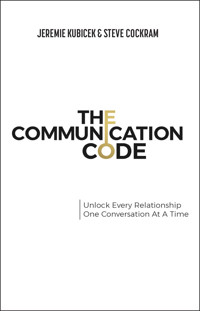
The Communication Code helps you set up conversations and communication in a way that creates a win-win scenario for everyone involved. In this real-world guide, bestselling authors and international speakers Jeremie Kubicek and Steve Cockram share their simple but powerful strategies for boosting your emotional intelligence and elevating your interpersonal communication skills. Step by step, you will learn to integrate Care, Celebration, Collaboration, Critique, and Clarification into your communication toolbox. Using one of these 5 Cs, you can verbally ask someone to respond in the way that you most want, and as a result, facilitate a successful interaction.
Written by the team that brought you The 100X Leader, The 5 Voices, and The 5 Gears, this must-have book will help you:
- Connect and communicate effectively with your team, your family, and your friends
- Define the parameters of a conversation from the outset to avoid any misunderstandings
- Understand the power dynamics of an interaction to eliminate the fear of honest conversation
- Offer constructive criticism without offending or disappointing the person on the other side
- Maximize your situational awareness and collaborate like a pro
- Prevent communication attacks and restore healthy communication flow
The Communication Code: Unlock Every Relationship, One Conversation at a Time offers a practical, easy-to-implement solution for decreasing or eliminating miscommunication. It is essential reading for anyone wanting to improve the health of their relationships through clear and authentic communication.
Sie lesen das E-Book in den Legimi-Apps auf:
Seitenzahl: 228
Veröffentlichungsjahr: 2023
Ähnliche














Table of Contents
Cover
Table of Contents
Praise for
The Communication Code
Title Page
Copyright
Dedication
Acknowledgments
Introduction
Solving Relationships
1 The Secret of Relational Codes
Complexity Is Complex
Understanding Communication
Missed Communication
Why People Create Codes
The Most Complex Codes
How to Break Codes
Understanding a Spouse's Code
Making Progress
Note
2 The Power of the Past
1. Relational Trust
2. Managing Expectations
3. Power Dynamics
3 The Communication Code
Different Relationships. Different Codes.
A New Communication System
The Communication Code
Personality Tendencies
The Communication Code at Work
The Communication Code at Home
Note
4 Why Celebrating Works
Why Is Celebration So Hard?
Exaggerating Celebration
When Celebration Has Never Been Valued
Some View Celebration as Weakness
How Different Personalities Celebrate
Start Meetings with Celebration
When You Don't Celebrate
Why Celebration Wins
Try This If You Don't Know What to Do
What Happens When You Don't Take Time to Celebrate
Celebrating Work without Affecting Work
Monthly, Quarterly, Annually
Little Big Things
Celebrating at Home
Celebration Dinners
Learn to Celebrate for Everyone's Benefit
Notes
5 Why You Should Care
Care Is Shelter
What People Need
When Did You Stop Being Cared For?
Is It the Reason You Don't Care?
Fighting Can Be Caring
How to Care Well
Note
6 The Superpower of Clarity
What Clarity Actually Is
Clarity Matters
Clarifying Benefits Everyone
Whom Are You Talking To
How to Clarify Well
Active Listening Audit
Why You Want Others to Clarify
Clarifying Is Your Responsibility
7 Collaborating to Win
What Does It Mean to Collaborate?
The Making of Great Teams
Blitz
Collaborative Strength
Examples of Poor Collaboration
Collaboration Assessment
Note
8 How to Critique Without Being Critical
The Difference between Critique versus Criticism
How to Deliver Critique Well
How to Receive Critique Well
Making Critique Work for You, Not against You
Learning to Love Critique
9 People Whispering
Deciding to Change
Use the Code Word
What Do They Want?
What Do You Want?
Know Your Default Pattern
Reading Others Well
People Whispering Assessment
Advanced Learning
Team Whispering
Don't Be That Person
10 Is It Worth It?
The Relational Prize Test
Evaluating Relationships
Resistant or Responsive
Need to or Want to (or Both)
Relationships Are Worth It until They Aren't
What Is the Cost of Not Working on It?
Choosing to Lean Out
Choosing to Lean In
11 Re‐Establishing Communication
Overcoming Relational Blockage
Real‐Life Scenarios
Cold Heart Syndrome
10 Ideas for Re‐Establishing Communication
12 Your Communication Plan
Prevention
About the Authors
Index
End User License Agreement
List of Illustrations
Chapter 2
Figure 2.1 The Support Challenge Matrix.
Figure 2.2 Expectations Scale.
Chapter 3
Figure 3.1 The Communication Code.
Chapter 12
Figure 12.1 The Communication Code.
Guide
Cover Page
Praise for The Communication Code
Title Page
Copyright
Dedication
Acknowledgments
Introduction
Table of Contents
Begin Reading
About the Authors
Index
Wiley End User License Agreement
Pages
i
ii
v
vi
vii
xi
xii
xiii
xiv
xv
xvi
xvii
xviii
1
3
4
5
6
7
8
9
10
11
12
13
15
17
18
19
20
21
22
23
24
25
26
27
28
29
30
31
32
33
34
35
37
38
39
40
41
42
43
44
45
46
47
48
49
51
53
54
55
56
57
58
59
60
61
62
63
64
65
66
67
68
69
70
71
72
73
75
77
78
79
80
81
82
83
84
85
86
87
88
89
90
91
92
93
95
96
97
98
99
100
101
102
103
104
105
107
108
109
110
111
112
113
114
115
117
119
120
121
122
123
124
125
126
127
128
129
130
131
132
133
135
136
137
138
139
140
141
142
143
144
145
146
147
148
149
151
153
154
155
156
157
158
159
160
161
162
163
164
165
167
169
170
171
172
173
174
175
176
177
178
179
180
181
182
183
185
186
187
188
189
190
191
192
193
194
195
196
197
198
199
200
201
202
Praise for The Communication Code
“In all of my years of leading organizations, positive relationships were the key tenants. If people can trust each other, then they can communicate effectively. The world needs better leaders, and The Communication Code gives you a set of tools to build better relationships to work together to enable cultures to serve the greater good with an integrated life, which is our love made visible.”
—Alan Mulally, Former President and CEO of Boeing Commercial Airplanes and the Ford Motor Company
“I write songs to unlock people and get them to relax. Jeremie and Steve write books to do the same. This one is changing the way I deal with people. Don't miss it.”
—Breland, Platinum Selling Recording Artist
“Who doesn't want to “unlock” every relationship in their life? This book is timely in this era of disconnection. Read it and win!”
—Molly Fletcher, author of The Energy Clock and host of the Game Changers with Molly Fletcher podcast
“Relationships are stories—some good, some bad. Jeremie and Steve have created a formula to reset what everyone wants—better relationships. Enjoy!”
—Nancy Duarte, CEO of Duarte and best‐selling author
“Every single week I help people work on their relationships, and The Communication Code is one of my go‐to tools that I use to help unlock people. I use it personally as well as in so many of my own relationships and can honestly say that if you use The Communication Code, you will drastically improve your life, almost immediately.”
—Dr. Ed Newton, Sr. Pastor, CBC San Antonio
“I've been working with GiANT for years and can honestly say these tools work. The Communication Code is a mirror that challenges you to improve every relationship if you choose to accept it. You simply need to adopt it.”
—Robert Kellogg, CEO, WatersEdge
“People need people, and when relationships don't work, nothing does. Really soak in this wisdom here as you attempt to reset the relationships that are most dear to you!”
—Bob Goff, author of Love Does
JEREMIE KUBICEK & STEVE COCKRAM
THE COMMUNICATION CODE
Unlock Every Relationship, One Conversation At A Time
Copyright © 2024 by Jeremie Kubicek and Steve Cockram. All rights reserved.
Published by John Wiley & Sons, Inc., Hoboken, New Jersey.
Published simultaneously in Canada.
No part of this publication may be reproduced, stored in a retrieval system, or transmitted in any form or by any means, electronic, mechanical, photocopying, recording, scanning, or otherwise, except as permitted under Section 107 or 108 of the 1976 United States Copyright Act, without either the prior written permission of the Publisher, or authorization through payment of the appropriate per‐copy fee to the Copyright Clearance Center, Inc., 222 Rosewood Drive, Danvers, MA 01923, (978) 750‐8400, fax (978) 750‐4470, or on the web at www.copyright.com. Requests to the Publisher for permission should be addressed to the Permissions Department, John Wiley & Sons, Inc., 111 River Street, Hoboken, NJ 07030, (201) 748‐6011, fax (201) 748‐6008, or online at http://www.wiley.com/go/permission.
Trademarks: Wiley and the Wiley logo are trademarks or registered trademarks of John Wiley & Sons, Inc. and/or its affiliates in the United States and other countries and may not be used without written permission. All other trademarks are the property of their respective owners. John Wiley & Sons, Inc. is not associated with any product or vendor mentioned in this book.
Limit of Liability/Disclaimer of Warranty: While the publisher and author have used their best efforts in preparing this book, they make no representations or warranties with respect to the accuracy or completeness of the contents of this book and specifically disclaim any implied warranties of merchantability or fitness for a particular purpose. No warranty may be created or extended by sales representatives or written sales materials. The advice and strategies contained herein may not be suitable for your situation. You should consult with a professional where appropriate. Further, readers should be aware that websites listed in this work may have changed or disappeared between when this work was written and when it is read. Neither the publisher nor authors shall be liable for any loss of profit or any other commercial damages, including but not limited to special, incidental, consequential, or other damages.
For general information on our other products and services or for technical support, please contact our Customer Care Department within the United States at (800) 762‐2974, outside the United States at (317) 572‐3993 or fax (317) 572‐4002.
Wiley also publishes its books in a variety of electronic formats. Some content that appears in print may not be available in electronic formats. For more information about Wiley products, visit our web site at www.wiley.com.
Library of Congress Cataloging‐in‐Publication Data:
Names: Kubicek, Jeremie, author. | Cockram, Steve, author.
Title: The communication code : unlock every relationship, one conversation at a time / Jeremie Kubicek and Steve Cockram.
Description: Hoboken, New Jersey : Wiley, [2024] | Includes index.
Identifiers: LCCN 2023035111 (print) | LCCN 2023035112 (ebook) | ISBN 9781394150533 (cloth) | ISBN 9781394150557 (adobe pdf) | ISBN 9781394150540 (epub)
Subjects: LCSH: Interpersonal communication. | Communication in management.
Classification: LCC BF637.C45 K83 2024 (print) | LCC BF637.C45 (ebook) | DDC 153.6—dc23/eng/20230823
LC record available at https://lccn.loc.gov/2023035111
LC ebook record available at https://lccn.loc.gov/2023035112
Cover Design and Illustration: Courtesy of Jeremie Kubicek
Jeremie and Steve dedicate this book to those longing for a breakthrough in communicating with others. We hope you are inspired by this content and use it to transform your relationships for everyone's benefit.
Acknowledgments
We want to thank the incredible GiANT HQ team for the work it continues to do to serve leaders around the globe. Each of you bring so much to the table. Special thanks to Bronson Taylor and the leadership team for your consistency.
To the over one thousand Partners, Guides, and Catalysts, we are grateful for your partnership to raise up liberators and unlock the potential of people around the globe. What a privilege to link arms with you to do something bigger than we could do separately.
From Jeremie:
Kelly, thank you for believing in me every single day. I couldn't do it without you. I love you.
Addison, Will, and Kate, you are rock stars! I am so excited to see your influence and the companies you will lead. I am super proud of who you are and what you are doing to help so many.
Steve, we made it to 10 years. Let's go for another 10! Thanks for being there for me and pushing me to be the best version of myself.
Thanks also to Bryan Evans for allowing me a retreat location to write. It is always easier to write inspired. I am also grateful for my YPO forum—you are all amazing.
Special thanks to these partners for allowing me to be me on the projects we are working together on—Bronson Taylor, Kevin DeShazo, Will Kubicek, Tracy Rader, Clare Smith, and Mike Oppedahl. I respect you all!
Thanks for managing my world, Andrea Ediger and Anne O'Hea. You are so helpful.
Last, thanks to you, Mike and Kianna Kubicek, for being consistently supportive. I know you are for us. Words are not enough.
From Steve:
Helen, thank you for communicating with me so graciously every day for over 30 years—I have learned so much from you and my wonderful parents and in‐laws, Ian and Sue Cockram, and Chris and Myra Adams.
Thank you to my three amazing daughters, Izzy, Megan, and Charlie, who keep me grounded and grateful.
Jeremie—what an adventure! It's not easy partnering with a pioneer. Sorry for all the critique I intended as collaboration, and thanks for teaching us to celebrate well.
To my local GiANT family, thank you for doing life with us and making it fun—Becky and Tim Barsellotti, Stu and Susie Wright, Jaz, Ed Ampaw‐Farr, and Dan and Heather Joy. I should thank Maliks of Gerrards Cross for keeping us fed so well.
Finally, thanks to many lifelong friends who have deepened my understanding of how we communicate (and endured me talking about this during vacations)—Tracy and John Cotterell, Robert and Elspeth Hughes‐Penney, Jonathan and Jenny Perry, Jon and Katherine Shaw, Terry and Jean O'Regan, John and Ash Marsh, and Rachel and Graham Hawley.
Introduction
Effective communication is the lifeblood of every healthy relationship.
So why does it have to be so complicated?
Healthy communication is one of the most challenging things to master. How often has someone shared information with you, and when they're finished, you respond with something that either offends them, disappoints them, or makes them mad?
Healthy communication is an exception, not the norm.
Having worked with leaders worldwide in every aspect of their lives, we've concluded that effective communication is the exception, not the norm. That's why so few relationships stay healthy over the long term.
It's as if someone you are in relationship with (at home or at work) had come to you expecting a specific response but didn't tell you what they really wanted. You then respond in your most natural way (according to your personality or your experiences) to what you thought they were asking. Instead of giving them the response they were hoping for, you miss it entirely by either trying to solve their problem, critiquing their approach, or even blowing it off, not realizing how important it was to them.
Intent is not enough—good people who care deeply about each other, who are trying to listen, still blow it.
The Communication Code helps solve that. It's a tool that can unlock relationships one conversation at a time by allowing you to set up communication to create a win‐win for both parties. As a result, there is a successful connection. Using five simple cipher code words, you can verbally reach people with what they are expecting from you. The five code words are: care, celebration, clarification, collaboration, and critique.
By asking them what they want, they are giving you a clue to crack their code and help them. If you do this well, both people walk away feeling satisfied.
You are about to explore the depths of relationships and how to unlock your communication and build relational trust. This level of transformation in relationships is a gift. We want to help you obtain the tools and the process to rebuild past relationships and create healthy relationships from the start.
Everything you are about to read has been experienced directly between us. This entire concept and Communication Code tool were created out of our frustration with each other.
Over the past decade, this tool has been used inside teams in the world's largest organizations and everyday families. It is a concept, process, and system that unlocks people and helps them come alive in ways they never thought possible.
As for the two of us, we have become adept at mining out our areas of weakness, and communication is at the top. Our science is creating visual tools that make a common language that creates objectivity, not subjectivity, to help heal or solve some of the biggest problems in your life. Our design philosophy with all of our tools is that they are like mirrors that allow people to see themselves clearly and make the changes needed to grow.
Solving Relationships
This book is ultimately about relationships and how to establish or re‐establish relational trust between two people.
Relationships (and people development) are often called soft skills. The truth is that they are the hardest skills to learn because there are so many dynamics affecting two people. Examples between two people include:
The levels of security or immaturity
Maturity or immaturity
Personality dynamics
Present orientation or future orientation
Current levels of stress
Levels of responsibility
Past relational dynamics
Other people are infringing on the relationship, and so on.
Our goal is that, by reading this book, you could take a problematic relationship and make it better, whether at home, at work, or both.
We want to help you take your relationships to the next level.
Becoming a People Whisperer
Have you ever met someone who just got you? They were easy to be with. You couldn't wait to reconnect because they seemed to care when you needed it, celebrate well, or clarify before critiquing your thoughts.
Effective communication comes more naturally to some; for most, it's a challenge and a skill set that must be learned. We have found a way to codify the principles of effective communication and then train others on how to use them, which is precisely why this book was written!
Suppose you have followed any of our past writings, specifically The 5 Voices and The 5 Gears. In that case, you will know that we create tools that are simple enough for a 13‐year‐old to learn the concepts, and tools to scale throughout families, teams, and organizations. The same is true with The Communication Code—it is designed for you to learn it and immediately apply it, and even better, teach it to others.
The goal is that you might not only solve a relationship issue, but also begin to master communication and learn how to be a people whisperer as you grow.
The Platinum Rule
Most people unknowingly misuse the Golden Rule of “Do unto others as you would have them do unto you.”
The problem is that a large majority misapplies this rule by saying things like, “I don't need a hug, why should you?” or “I don't need to celebrate, why should you?” and so on.
The Platinum Rule, written by Dr. Tony Alessandra, encourages us to “Do unto others as they would want to be done to them.” It is a subtle shift but pulls out the Golden Rule's best.
To improve your relationship, you must shift what you want and become more adept at understanding the other person's needs.
Unlocking Every Relationship
“Unlocking a relationship” refers to making significant and transformative changes to the dynamics, structure, or nature of a relationship—whether at home or at work. It involves implementing innovative and groundbreaking approaches to reshape the way individuals interact, communicate, and relate to each other within the relationship and within each conversation.
To unlock a relationship means to move beyond traditional patterns and expectations and to explore new possibilities for growth, connection, and fulfillment. It often entails challenging existing assumptions, dismantling unhealthy or unproductive behaviors, and embracing novel ways of thinking and relating.
This intentional focus requires a willingness to step out of comfort zones, challenge old patterns, and embrace change. It involves a shared commitment from both individuals to embark on a transformative journey together, seeking to create a relationship that is more fulfilling, authentic, and aligned with their evolving needs and values.
Increase Hope. Lighten the Load.
Transforming relationships is heavy lifting. It requires you to develop a conscious competence to restore trust and communicate to the next level. The tools we provide are designed to lighten your load and make building relationships more sustainable.
We are going to provide you with a visualization process you can practice in real time with every relationship in your life. As you enhance your relationships, you will build confidence, which will appear in other areas of your life.
By the end of this book, we want you to have a game plan to improve every meaningful relationship in your life and train you on how to improve every conversation you have on a daily basis. Feel free to mark up the book, highlight specific areas, or listen via audiobook and take notes as you go.
We can't wait to hear the stories of true relational transformation as you improve your communication and solve the issues that have been keeping you from true freedom.
We are pulling for you on this journey.
—Jeremie and Steve
1The Secret of Relational Codes
People are enigmas. They are mysterious, puzzling, and sometimes challenging to understand. Knowing their thoughts or motives for doing certain things is typically quite tricky.
Everyone has a complex Communication Code that needs to be unlocked if trust is to be established in a relationship and if communication is to flow freely. Most people are blissfully unaware of this fact; consequently, they don't know how to help you connect with them.
The enigma is found in the complexity of how to fully know someone—to be allowed in at the deepest levels of their life.
“People are an enigma, wrapped in a mystery, shrouded in riddles, and coated in layers of complexity.”
—Anand Nav
You are just as puzzling as anyone else. Just as you don't understand them, people in your life may not fully understand you either, nor how you operate, which makes the game of relationships tiring, frustrating, and thrilling at the same time.
In this chapter you will learn what communication is, how people engage in relationship‐centric communication, and how to establish the trust needed to unlock others.
Complexity Is Complex
The complexity of our communication exists due to the nature of our personality, our nurtured upbringing, and the expectations of others. Add that the choices we have made affecting our outcomes mean that every human being, like a snowflake, is truly unique.
Our life experiences (nurture) lead us to make particular choices. When life hurts or disappoints us, we add another layer of complexity to our code, making it harder for people to connect with us because they don't know how to read us.
Over time, the Communication Code inside relationships can become impenetrable, and communication can become impossible, which might cause someone to pull away and think, “It isn't worth getting that close to them.”
When people pull away, the result can create an unease in relationships and loneliness can set in. Loneliness is the despair of our age. We have never been more connected digitally yet more isolated relationally.
We have a way to change that!
Understanding Communication
Transmission of information is not communication. You can send a message repeatedly, but if the recipient doesn't understand the transmission, decode it properly, and confirm they have received it, then your message is only a one‐way transmission.
Effective communication happens when the person receiving our transmission is aware of our expectations and intent, and can respond appropriately.
Communication, then, is the transmission of expectation or intent during this exchange. It involves a Sender + a Message + a Recipient, just like one satellite sends a message and another receives it.
Communication between two parties aims to ensure that we are on the same page, relationally and transactionally. The better the relationship, the more transparent the communication. Conversely, the lower the relational trust, the less effective the communication. Repeated frustrations in trying to communicate eventually lead us to stop trying.
Communication is the transmission and receiving of expectation or intent.
If you want better communication, you must understand how to unlock others and communicate your intent and expectations.
Missed Communication
Two co‐workers, Ian and Jane, worked in the same department of a large corporation. Ian was responsible for collecting and analyzing data, while Jane created reports based on that data.
Ian was a very intelligent person, but he was not very good at communicating with others. He often sent Jane his reports without context or explanation, assuming she would understand everything independently.
Jane was different. She was an amiable and outgoing person who loved collaborating. However, she found it challenging to work with Ian because of his lack of communication. She would often have to spend hours trying to decipher his reports and would sometimes make incorrect assumptions, which would lead to errors in her work.
Despite Jane's attempts to share her frustrations with Ian, he never seemed to understand the problem. He continued to transmit his thoughts through long emails without any context or explanation, and their working relationship continued to suffer.
Over time, the tension between Ian and Jane grew, and they began to avoid each other whenever possible. This affected their work and the team's morale, and other colleagues noticed the strain between them.
Their manager noticed the problem and tried intervening, but Ian resisted. He felt that his reports were clear and concise, and he did not see the need to provide any additional explanation.
As time passed, Jane became increasingly frustrated with the situation. She started to dread receiving reports from Ian, knowing she would have to spend hours deciphering them. She tried to find ways to work around Ian, but it wasn't easy because their work was interconnected.
Unfortunately, their relationship never improved. Despite attempts by their manager to mediate, Ian remained stubborn and unwilling to change. Jane eventually left the company, unable to work in an environment where effective communication was not valued.
Two smart people needed help understanding the fundamental reality that the transmission of information is not communication. It takes two people to receive the intent and confirm their understanding.
Why People Create Codes
People create codes to protect themselves because relationships can be emotionally intense, and individuals may feel vulnerable or exposed inside these relationships.
Our relational codes can change over time as we experience life. When we are hurt, we add a new level of complexity to the code to avoid experiencing that pain again. This avoidance explains why people growing up in safe and healthy families have more straightforward relational codes




