


16,99 €
Mehr erfahren.
- Herausgeber: John Wiley & Sons
- Kategorie: Fachliteratur
- Sprache: Englisch
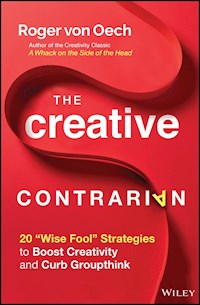
Tackle your thorniest problems using the Wise Fool's savvy Strategies! The Wise Fool is the archetypal contrarian known for his creativity, irreverence, and humor. He looks at life in unorthodox ways and pushes back against the status quo. Throughout history, powerful decision-makers (Egyptian pharaohs, Chinese emperors, Persian sultans, and European kings) consulted Wise Fools to question the assumptions that kept them mired in stale and obsolete solutions. In The Creative Contrarian, best-selling author (A Whack on the Side of the Head), speaker, and toy designer (Ball of Whacks) Dr. Roger von Oech provides readers with a fully-illustrated "Wise Fool Guide" to challenge established procedures and engage in creative thinking. Roger shows how to gain the confidence to speak up in "groupthink" situations -- and boldly present a different perspective. From laughing at your most beloved ideas to test their validity to adding constraints to problems to reveal new solutions, he offers a framework for creativity that works in business, design, education, and anywhere new ideas are required -- and appreciated! Employing a wealth of stories and examples, The Creative Contrarian presents 20 Wise Fool Strategies: * Some offer ideas to enhance your creativity ("Reverse Your Perspective," "Look for Ambiguity," and "Kiss a Favorite Idea Goodbye") * Some provide tips on how to break away from the herd ("Buck the Crowd," "Flex Your Risk Muscle," and "Seek Other Right Answers") * And still others convey prudent warnings in an unpredictable world ("Exercise Humility," "Imagine Unintended Outcomes," and "Develop a Thick Skin") Together, these jewels of insight will help you see things from the Wise Fool's perspective! As the Wise Fool puts it: "Nothing is more dangerous than an idea when it's the only one you have"; and "Every 'right' idea eventually becomes the 'wrong' one." The Creative Contrarian: 20 "Wise Fool" Strategies to Boost Creativity and Curb Group think is an indispensable resource for anyone seeking fresh solutions to common problems at the office, in the classroom, or at home.
Sie lesen das E-Book in den Legimi-Apps auf:
Seitenzahl: 219
Veröffentlichungsjahr: 2021
Ähnliche



















Table of Contents
Cover
Title Page
Copyright
Dedication
Introduction
Notes
Part I: Meet the Wise Fool
1. What Does the Wise Fool Do?
2. Put on Your Wise Fool's Cap
3. The Wise Fool Strategies
4. Reap the Wise Fool's Bounty
Note
Part II: The Wise Fool Strategies
Wise Fool Strategy # 1: Buck the Crowd
Wise Fool Strategy # 2: Flex Your Risk Muscle
Wise Fool Strategy # 3: Laugh at It
Note
Wise Fool Strategy # 4: Seek Other Right Answers
Note
Wise Fool Strategy # 5: Keep Playing with It
Note
Wise Fool Strategy # 6: Reverse Your Perspective
Notes
Wise Fool Strategy # 7: Fool Around with the Constraints
Wise Fool Strategy # 8: Build on an Odd Idea
Wise Fool Strategy # 9: Look for Ambiguity
Wise Fool Strategy # 10: See the Obvious
Notes
Wise Fool Strategy # 11: Use Your Forgettery
Note
Wise Fool Strategy # 12: Drop What's Obsolete
Note
Wise Fool Strategy # 13: Kiss a Favorite Idea Goodbye
Wise Fool Strategy # 14: Revisit a Discarded Idea
Wise Fool Strategy # 15: Find What's out of Whack
Note
Wise Fool Strategy # 16: Stop Fooling Yourself
Note
Wise Fool Strategy # 17: Exercise Humility
Note
Wise Fool Strategy # 18: Imagine the Unintended
Notes
Wise Fool Strategy # 19: Develop a Thick Skin
Wise Fool Strategy # 20: Shed an Illusion
Part III: Use Your Wise Fool Know-How
1. Ask the Wise Fool Oracle
2. The Strategies as Daily Mantras
3. Have Fun!
4. Final Thoughts
Note
Selected Bibliography
Index of Proper Names
Acknowledgments
About the Author
End User License Agreement
Guide
Cover
Title Page
Copyright
Dedication
Table of Contents
Introduction
Begin Reading
Selected Bibliography
Index of Proper Names
Acknowledgments
About the Author
End User License Agreement
Pages
ii
iii
iv
v
1
2
3
4
5
6
7
8
9
10
11
12
13
14
15
16
17
18
19
20
21
22
23
25
26
27
28
29
30
31
32
33
34
35
36
37
38
39
40
41
42
43
44
45
46
47
48
49
50
51
52
53
54
55
56
57
58
59
60
61
62
63
64
65
66
67
68
69
70
71
72
73
74
75
76
77
78
79
80
81
82
83
84
85
86
87
88
89
90
91
92
93
94
95
96
97
98
99
100
101
102
103
104
105
106
107
108
109
110
111
112
113
114
115
116
117
118
119
120
121
122
123
124
125
126
127
128
129
130
131
132
133
134
135
136
137
138
139
140
141
142
143
144
145
146
147
148
149
150
151
152
153
154
155
156
157
158
159
160
161
162
163
164
165
166
167
168
169
170
171
172
173
174
175
176
177
178
179
180
181
182
183
184
185
186
187
188
189
190
191
193
194
195
196
197
198
199
200
201
By Roger von Oech
A Whack on the Side of the Head
A Kick in the Seat of the Pants
Expect the Unexpected
(or You Won't Find It)
The Creative Contrarian
Creative Whack Pack
Innovative Whack Pack
Ball of Whacks
X-Ball
Y-Ball
Star-Ball
Rhombi
The Creative Contrarian
20 “Wise Fool” Strategies to Boost Creativity and Curb Groupthink
Roger von Oech
Illustrations by Bingo Barnes
Copyright © 2022 by Roger von Oech. All rights reserved.
Wise Fool® and Creative Contrarian® are registered trademarks of Roger von Oech.
Published by John Wiley & Sons, Inc., Hoboken, New Jersey.
Published simultaneously in Canada.
Book design by Roger von Oech. Illustrated by Bingo Barnes.Drawings on pages 103, 173, 177, and 191 by George Willett.Drawings on pages 79–80 by Roger von Oech.
No part of this publication may be reproduced, stored in a retrieval system, or transmitted in any form or by any means, electronic, mechanical, photocopying, recording, scanning, or otherwise, except as permitted under Section 107 or 108 of the 1976 United States Copyright Act, without either the prior written permission of the Publisher, or authorization through payment of the appropriate per-copy fee to the Copyright Clearance Center, Inc., 222 Rosewood Drive, Danvers, MA 01923, (978) 750-8400, fax (978) 646-8600, or on the Web at www.copyright.com. Requests to the Publisher for permission should be addressed to the Permissions Department, John Wiley & Sons, Inc., 111 River Street, Hoboken, NJ 07030, (201) 748-6011, fax (201) 748-6008, or online at http://www.wiley.com/go/permissions.
Limit of Liability/Disclaimer of Warranty: While the publisher and author have used their best efforts in preparing this book, they make no representations or warranties with respect to the accuracy or completeness of the contents of this book and specifically disclaim any implied warranties of merchantability or fitness for a particular purpose. No warranty may be created or extended by sales representatives or written sales materials. The advice and strategies contained herein may not be suitable for your situation. You should consult with a professional where appropriate. Neither the publisher nor author shall be liable for any loss of profit or any other commercial damages, including but not limited to special, incidental, consequential, or other damages.
For general information on our other products and services or for technical support, please contact our Customer Care Department within the United States at (800) 762-2974, outside the United States at (317) 572-3993 or fax (317) 572-4002.
Wiley publishes in a variety of print and electronic formats and by print-on-demand. Some material included with standard print versions of this book may not be included in e-books or in print-on-demand. If this book refers to media such as a CD or DVD that is not included in the version you purchased, you may download this material at http://booksupport.wiley.com. For more information about Wiley products, visit www.wiley.com.
Library of Congress Cataloging-in-Publication Data:
Names: Von Oech, Roger, author.
Title: The creative contrarian : 20 “wise fool” strategies to boost your creativity and curb groupthink / Roger von Oech.
Description: First edition. | Hoboken, New Jersey : Wiley, 2021. | Includes bibliographical references and index.
Identifiers: LCCN 2021036604 (print) | LCCN 2021036605 (ebook) | ISBN 9781119843269 (hardback) | ISBN 9781119844716 (adobe pdf) | ISBN 9781119844709 (epub)
Subjects: LCSH: Creative ability.
Classification: LCC BF408 .V577 2021 (print) | LCC BF408 (ebook) | DDC 153.3/5--dc23
LC record available at https://lccn.loc.gov/2021036604
LC ebook record available at https://lccn.loc.gov/2021036605
Cover design: Paul McCarthy.
Cover image: © Getty Images | Miragec.
For:
Max, Axel, Vivian, and Lucy
May your Wise Fools shine now
and well into the future!
Introduction
“If anyone among you thinks he is wise in this age, let him become a fool that he may become wise.”
— St. Paul, I Corinthians 3:18
Discovery consists in looking at the same thing as everyone else and thinking something different.
— Albert Szent-Györgyi, Hungarian Biochemist
I've been a lifelong student of the creative process. From my college days on through to my professional career as an author, business consultant, speaker, conference producer, product developer, and more recently as a toy designer, I've been interested in how and when the mind does its best work.
When does my mind feel most alive? Truth be told, it's when I allow myself to take on the role of the Wise Fool. Indeed, I've had an enduring fascination with this character: his free-spirited energy, his unexpected observations, and most importantly, his ability to shake people out of their habitual responses to problems so that they might conjure up more imaginative solutions.
The Wise Fool is an archetypal figure — such as the Sage, the Magician, and the Healer — who resides deep within the human psyche and fulfills a purposeful role in society. The Wise Fool is the one who looks at life in different and often non-traditional ways and pushes back against the status quo. We might recognize this character today as the creative contrarian.
Historically, Wise Fools were hired by the powerful (kings, emperors, pharaohs) to be a kind of “thought pattern disrupter.” Their job was to take a whack at the assumptions that kept their clients mired in conventional thinking. They did this so the rulers might see the issues before them in a fresh light.
When I don my Wise Fool's cap, I feel like I am in “my best thinking self.” This means that I am a little less dogmatic and a lot more playful; less afraid to be the guy who asks the stupid questions and more skeptical of “received” truths; less convinced that I've got the right answer and more likely to see the humor in ambiguous situations. I'm also more amused at the unexpected and unintended things that come my way.
Decades ago, right after I completed my doctoral studies, I interviewed for a job with IBM (still the world's greatest company back then). To prepare myself, I read a history of IBM, and one particular passage jumped out at me. At a board meeting in the early 1960s, IBM chairman Tom Watson Jr. was discussing the company's culture, and he lamented that far too many IBMers thought alike, dressed alike, and behaved alike. “What we need here,” he said, “are a few wild ducks.” At my interview, I quoted this story (which delighted my interviewers), and told them that I wanted to be one of those “wild ducks” Watson desired. I got the job, but I soon realized that:
It's okay to be a wild duck just as long as you fly in formation.
From this, I learned that thinking in a different, contrary fashion wasn't always welcome. Fortunately, I listened to my inner Wise Fool, and decided to pivot. This experience showed me that there was a need for people to use their creative abilities and consider alternatives. Not all of the time obviously, but even just 5% of the day would be a real boon both to themselves and to their organizations. I filled this need by starting a company to help people develop their own creative thinking skills (which I brought to many organizations around the world).
During my many years of conducting creativity seminars in business, I discovered that those exercises I did that involved Wise Fool thinking were usually my clients' favorites. That's because they yielded a lot of provocative ideas pertaining to their respective companies. (The participants found that being a creative contrarian can be fun!)
Quick quiz: The term “Wise Fool thinking” may be foreign to some, but its underlying specifics are recognizable (and practiced) by many. For example, have you ever:
Felt like you were in a room full of “crazy people” all thinking the exact same thing — and then mustered up the courage to offer a contrary viewpoint?
Laughed at one of your most beloved ideas to test its validity?
Felt dissatisfied with the first right answer you found, and then looked for some ambiguity in the problem to give yourself to room to think?
Behaved counterintuitively to accomplish an objective, say, gone to the city to be alone?
If so, you're familiar with Wise Fool thinking.*
As I reflect on my life, I would say that having a measure of Wise Fool “savvy” has been an asset in my mental portfolio of skills, abilities, and beliefs. I'm not alone. Over the years, I have talked with successful people in various walks of life, and many of them have expressed a similar gratitude for having a bit of the Wise Fool in their outlook — especially when it was necessary to think differently, and then act contrary to the crowd to produce innovative ideas.
I believe that most people could benefit from having some Wise Fool know-how in their approach to the world. Unfortunately, there hasn't been a simple guidebook laying out the elements of Wise Fool thinking (sort of like what Machiavelli did for the ruthless management of power in The Prince, or what Aristotle did for the essentials of dramatic theory in his Poetics).
That is, until now. I present to you: The Creative Contrarian: 20 “Wise Fool” Strategies to Boost Creativity and Curb Groupthink. This work provides you with the basics in how Wise Fools approach life, problem solving, decision making, and, of course, letting their voice be heard. In it, we will examine the 20 essential ideas that give Wise Fools their wisdom. These powerful Strategies will allow you to incorporate their cognitive orientation into your mental processes so that you too can do your own “best work.”
Why did I write it? A quick story. A few years after starting my own company, I found myself in the office of Steve Jobs, then Apple's chairman — he was in his mid-20s, this was during his first stint at the company. We were talking about the ideas he would be presenting at an upcoming conference I was producing dealing with high-tech innovation. During our conservation, I asked him: “Why did you start Apple?” His answer has stayed with me ever since: “We make what we want for ourselves. I always wanted a personal computer, but there wasn't one available, so I had to put myself in a position to create one.”
Similarly, I've long been infatuated with Wise Fools, and I wanted to create a guidebook that boiled their wisdom and strategies for being a creative contrarian into an easily accessible form. I also wanted to include some of my favorite stories in it — both from long ago and recent ones as well.
This is the sort of resource I wish had been available to me at various times in my own life, say, when I needed to think things over, and “unlearn” an idea or two — especially when I was making major life decisions. This also would have been a boost when I was planning projects, and certainly when I was in school (to counteract some of the dogmas that were being dished out).
This work is a modest “tip o' the cap” to the ancient Greek philosopher Socrates, history's most extraordinary Wise Fool. Socrates had, as you may recall, his own personal daemon — a kind of internal oracular spirit — to whom he could turn when he needed some guidance and inspiration. I contend that each of us has something similar nestled within our lobes: an inner creative contrarian with whom we can consult when we need to think differently or buck the crowd. Sometimes Wise Fools may say, “Kiss a favorite idea goodbye,” or “Seek other right answers.” At others, they may advocate, “Flex your risk muscle,” or “Exercise humility.” Whatever their counsel, it's prudent to give it consideration. Simply put, you may think of this book as:
A stimulant to help you gain a different perspective, and an antidote to conformity and groupthink.
You can read it all in one sitting if you wish. In putting it together, however, my primary design criterion has been to create a resource that you can dip into anywhere on a regular basis whenever you need a bit of inspiration from the Wise Fool to “think differently.”
Some of you may be familiar with my products, perhaps one of my books, for example, A Whack on the Side of the Head(whose “Don't Be Foolish” chapter provided the seeds for this current work), or my creativity tools such as the Creative Whack Pack card deck (and app) and the Ball of Whacks line of design toys. If so, you are already aware of my fondness for the Wise Fool's contrarian behavior. You may also recognize a few of the anecdotes I've used to bring the Wise Fool to life. I trust these perennial ideas will continue to light up your mind and inspire your own Wise Fool! *
I hope you'll find The Creative Contrarian to be of value both when you need another point of view, and also when you're in groupthink situations and need to push back. I trust you will enjoy working and playing with the concepts in this book.
Stay curious and be imaginative!
Roger von OechWoodside, California
Notes
*
Important distinction
: There are two types of fools: the
Young Fool
and the
Wise Fool
(the subject of this work). The former often does stupid stuff, messes things up, and has neither the skills nor the understanding to know any better. The Wise Fool, on the other hand, does things by design — his objective is to challenge and provoke people's thinking into unfamiliar territory.
*
You might be interested to know that I have been collecting Wise Fools of various sorts for over four decades: sculptures (in wood, steel, bronze, ceramic), drawings, etchings, posters, needlepoint, cups, jewelry, and masks. If you were to visit my studio, you would see Wise Fools just about everywhere!
Part IMeet the Wise Fool
“Jesters do oft prove prophets.”
— William Shakespeare, English Playwright
1. What Does the Wise Fool Do?
Let's suppose that you're dealing with a challenging issue and it resists your best efforts. You feel like you are doing everything “right” but things just aren't flowing. Perhaps your imagination is off or your powers of discernment aren't focused. You've tried various techniques to jump-start your creative process, but you still feel stuck. You think to yourself:
Who can give me a different perspective?
One answer is to do what problem solvers and decision makers since the dawn of civilization have done to stimulate their imaginations and improve their judgment:
Ask a Wise Fool what he thinks.
Wise Fools were consulted by Egyptian pharaohs and Babylonian kings. Their ideas were sought by Greek tyrants and Roman emperors. They advised Persian sultans, and also chiefs in the Pueblo, Hopi, and Sioux nations. They played an important role at the courts of the Chinese emperors, and were prominently employed by European royalty in the Middle Ages and Renaissance.*
What did these Wise Fools do? Put very simply, it was their job to “whack” the king's thinking out of his habitual thought patterns. The king's advisers were often “yes-men” and sycophants who told him exactly what he wanted to hear. The king realized that this wasn't a good environment in which to make decisions or conjure up promising alternatives. Therefore, he gave his Wise Fool a license to parody and ridicule any proposal under discussion so as to shatter the conventional viewpoint — in other words, to be a creative contrarian.
The Wise Fool's candid jokes and observations put the issue in a fresh light and forced the king to reexamine his assumptions. By listening to the Wise Fool, the king improved his judgment, enhanced his creativity, and protected himself from his groupthink milieu.
How do Wise Fools look at things? Well, they operate in a world that runs counter to conventional patterns. Everyday ways of perceiving, understanding, and acting have little meaning for them. They'll extol the trivial, trifle the exalted, and parody the common perception of a situation. Here are some examples of the Wise Fool's contrarian approach to life:
Wise Fools are eager to challenge our usual perceptions. One might say, “If a man is sitting on a horse facing the rear, why do we assume that it is the man who is backwards and not the horse?”
They turn the rules on their head. They look at policies and think of reasons why the reverse objectives could also make sense. Many organizations espouse the value: “We Are Committed to Excellence.” They say: “Let's shoot for mediocrity. Imagine the benefits: less product development time, lower training costs, less quality control, and less production time. If we had mediocre products, we'd have to learn how to sell more aggressively. I'm sure we would be successful because: Nothing succeeds like mediocrity because everyone understands it so well.”
Wise Fools are irreverent. One might pose a brainteaser such as: “What is it that the rich man puts in his pocket that the poor man throws away?” When she answers, “Snot,” she forces us to reconsider the wisdom of some of our most basic hygenic practices.
They can be absurd. Having lost his donkey, a Wise Fool knelt down and began exuberantly praising God. A passerby saw him and asked, “Your donkey is missing; why are you expressing your gratitude to the Almighty?” He replied, “I'm thanking Him for seeing to it that I wasn't aboard him at the time. Otherwise, I would be missing as well.”
They ask odd questions. “If you put a dozen roses in your refrigerator and the next day they start smelling like Roquefort cheese, does the cheese smell like roses?”
They are paradoxical. “When I came home, I expected a surprise but there was no surprise for me, so, of course, I was surprised” (Wittgenstein); “All of the true things I'm about to tell you are shameless lies” (Vonnegut); “Only the ephemeral is of lasting value” (Ionesco).
Wise Fools observe the things most people overlook. “Why do people who pour cream into their coffee do so after the coffee is already in the cup, rather than pouring it in first and saving themselves the trouble of stirring?”
They can be cryptic. One might say that the best way to see something is with your ears. This may seem odd, but after you've thought about it, you might agree that listening to a well-written story or poem can stimulate your imagination more than watching TV or a video.
Many Wise Fools see life as a series of metaphors. If a one took an intelligence test with this question on it: “Which is true? A) Birds eat seeds, or B) Seeds eat birds,” she would answer both “A” and “B” because she's seen dead birds decomposing on the ground “feeding” freshly fallen seeds.
Wise Fools can provoke us into thinking, perceiving, and acting differently:
Their offbeat comments can force us to focus on information that we had previously thought was irrrevelant.
Their playful barbs might inspire us to conjure up an offbeat hypothesis, or perhaps jettison an obsolete assumption.
Their candid statements of the obvious might force us to toss aside some of our arrogance.
Their sobering directness might help us honestly assess the obstacles we could expect to encounter while implementing a new idea.
In other words, the Wise Fool is the character who jars us into an awareness that there are other ways to look at what we're doing, and that we should be seeking better answers than the ones we currently have. The great Danish physicist Niels Bohr felt that being a creative contrarian was a good way to come up with breakthrough ideas. During a tense brainstorming session, he told a colleague:
We all know your idea is crazy. The question is, whether it is crazy enough.
Some people, however, regard the Wise Fool as a simpleton, a dunce “whose elevator doesn't go all the way to the top,” the imbecile “whose belt doesn't go through all the loops,” the idiot “whose bell has no clapper,” or the moron “who's a few French fries short of a Happy Meal.”
Nothing could be further from the truth! It takes intelligence, imagination, cleverness, and insight to play the role of the Wise Fool. A good Wise Fool needs to be part actor and part poet, part philosopher and part psychologist. Because of their ability to open up people's thinking, Wise Fools in some cultures have been held in as much esteem as the priest, the medicine man, and the shaman.
The great benefit of the Wise Fool's antics and observations is that they stimulate our thinking. They jolt us in the same way that a splash of cold water awakens us when we're drowsy. We may not like their ideas. Some of them may irritate us and strike us as silly or useless. But they force us to entertain — perhaps only momentarily — alternative ways of looking at our situation.
2. Put on Your Wise Fool's Cap
So far, we have established that it's good to have a Wise Fool to consult with from time to time when we need a creative spark. But what do you do if there isn't one handy to help you put things into perspective? The answer is simple:
Be your own Wise Fool.




