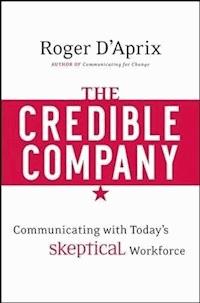
Table of Contents
Praise
Title Page
Copyright Page
Dedication
Preface
Who Should Read This Book—and How
Prologue
Change, Change, and More Change
Shifting Priorities and Constituencies
An Obvious Question
How Things Got This Way
Chapter 1 - A MORALITY TALE
A Tale Worth Considering
Who Does It Right?
Combining Principles into a Coherent Whole
Chapter 2 - INFORMATION
The New Assembly Line
Information Requirements and a New Opportunity
Information and Business Performance: From Outputs to Outcomes
The Challenge
Technology and Its Information Consequences
Technology, Information, and Role Definition
Technology, Social Media, and Information Democracy
Corporate Democracy and Social Media
Preparing the Way for Gen Y
Summing Up: Information and the Communication Professional
Chapter 3 - NEEDS ON THE JOB
A Landmark Set of Findings
Gallup and Employee Engagement
More Evidence
Commonality
Determining Needs in Your Organization
Employee Engagement
The Art of the Possible
Implications for Communication Professionals
Chapter 4 - FACE-TO-FACE
Frontline Communication
Making It All Work
High Tech and High Touch
Face-to-Face and the Professional Communicator
Chapter 5 - OPENNESS
What Employees Need to Know
Change Communication and Openness
Examples of Openness
A Case of Inevitability
Chapter 6 - RESEARCH
Data Gathering
The Executive Interviews
Typical Interview Questions
Focus Groups
Best Practices
Other Company Research
Presenting Your Findings
Developing the Plan
Quantitative Versus Qualitative Research
Communication Measurement
Chapter 7 - MARKETPLACE
From Vertical to Horizontal Line of Sight
Context and Line of Sight
Stickiness
The Marketplace as Rationale for the Story
Chapter 8 - STRATEGY
The Strategic Solution
Epilogue
Notes
Acknowledgements
The Author
Index
More praise forThe Credible Company
“This is a book about people communicating with people, not communicating at them. It is about the message, not the medium. And it is about communication, analysis, reflection, and clear-thinking, not about speed of delivery, sound bites, and instant judgments. The Credible Company is the perfect sequel to D’Aprix’s best-selling Communicating for Change.”
—Wilma Mathews, Arizona State University
“Most business management books center on one simple concept; one chapter is often the whole premise. Roger’s book is full of practical ideas and approaches to improving business today through effective communication. You’ll want to read this whole book.”
—Karen Horn, SVP, Corporate Communication, Washington Mutual
“The wisdom of a lifetime of experience, from the world’s greatest internal communication guru, in one very easy-to-read volume. Compulsory and compulsive reading for everyone interested in improving organizational performance.”
—Rodney Gray, Employee Communication & Surveys, Sydney
“Roger D’Aprix has once again put his finger on the pulse of business communication and developed a practical book to make companies credible with a skeptical workforce. His INFORMS model is elegant and is based on theory, research, and his extensive experience as a communication executive and consultant. This work will become an important part of both the scholarly literature and every business communicator’s bookshelf. If you’ve ever felt that the concept of trust was too slippery to grab a hold of, grab a hold of this book.”
—Diane M. Gayeski, PhD, associate dean and professor of strategic communication, Roy H. Park School of Communications at Ithaca College
Copyright © 2009 by Roger D’Aprix. All rights reserved.
Published by Jossey-Bass A Wiley Imprint 989 Market Street, San Francisco, CA 94103-1741—www.josseybass.com
No part of this publication may be reproduced, stored in a retrieval system, or transmitted in any form or by any means, electronic, mechanical, photocopying, recording, scanning, or otherwise, except as permitted under Section 107 or 108 of the 1976 United States Copyright Act, without either the prior written permission of the publisher, or authorization through payment of the appropriate per-copy fee to the Copyright Clearance Center, Inc., 222 Rosewood Drive, Danvers, MA 01923, 978-750-8400, fax 978-646-8600, or on the Web at www.copyright.com. Requests to the publisher for permission should be addressed to the Permissions Department, John Wiley & Sons, Inc., 111 River Street, Hoboken, NJ 07030, 201-748-6011, fax 201-748- 6008, or online at www.wiley.com/go/permissions.
Readers should be aware that Internet Web sites offered as citations and/or sources for further information may have changed or disappeared between the time this was written and when it is read.
Limit of Liability/Disclaimer of Warranty: While the publisher and author have used their best efforts in preparing this book, they make no representations or warranties with respect to the accuracy or completeness of the contents of this book and specifically disclaim any implied warranties of merchantability or fitness for a particular purpose. No warranty may be created or extended by sales representatives or written sales materials. The advice and strategies contained herein may not be suitable for your situation. You should consult with a professional where appropriate. Neither the publisher nor author shall be liable for any loss of profit or any other commercial damages, including but not limited to special, incidental, consequential, or other damages.
Jossey-Bass books and products are available through most bookstores. To contact Jossey-Bass directly call our Customer Care Department within the U.S. at 800-956-7739, outside the U.S. at 317-572-3986, or fax 317-572-4002.
Jossey-Bass also publishes its books in a variety of electronic formats. Some content that appears in print may not be available in electronic books.
Library of Congress Cataloging-in-Publication Data
D’Aprix, Roger M. The credible company : communicating with today’s skeptical workforce / Roger D’Aprix. p. cm. Includes bibliographical references and index.
eISBN : 978-0-470-44734-5
For Theresa, my lifelong partner,who has endured, indulged, and supported my worksince the first day we met . . . and for our seven grandchildren—Matthew, Luke, Sarah, Joseph, Charley,and the twins, Kate and Abigail
Preface
Why This Book Is Important
The first question any busy person should ask in browsing through a book like this one is: Is this important enough for me to spend my valuable time on, or should I search for a good novel instead? Let me try to answer that question and tell you the essential message of this book in four brief bullet points:
• Today’s organizations are undergoing revolutionary change that has turned their relationship with their employees upside down.
• Those employees are increasingly skeptical, if not cynical, about the communication they receive at work.
• Because employees are now the means of doing business as opposed to their former status as the cost of doing business, the credible company is the one that takes note of the changed relationship and treats them like the precious asset they were always told they were—even when company actions often belied that claim.
• Company leaders and the communication professionals who are supposed to advise them had better understand the changed relationship and concoct communication strategies that are suited to these changed circumstances that, taken together, constitute a workplace revolution in an increasingly complex global economy.
With information the lifeblood of today’s intellectual capital assembly line, the internal communication task has taken on unprecedented importance in the contemporary organization. Today’s leadership is increasingly aware of the importance of educating its workforce to the realities of strategy, competition, and the needs of customers and shareholders. Without that education the workforce is left to guess about the organization’s issues and its strategy to confront and resolve those issues. Because the worker is now a vital partner in that process, it is essential to ensure that he or she is fully informed.
The objective of this book is to analyze the critical elements of a communication strategy to reach a skeptical workforce. The reasons for that skepticism are many, including conducting massive downsizings over many years, taking for granted the contributions of talented employees, neglecting employee development and training, treating people as largely interchangeable, for the most part ignoring the all-important task of frontline leadership, and keeping people in the dark about future company intentions.
Whether you are a corporate leader, a communication professional charged with helping your leadership get through to a skeptical audience, or just someone interested in the dynamics of communication leadership, this book is worth your time and attention. If, on the other hand, you believe that communication is a simple matter of putting out a few facts, cranking up the company intranet, and letting the process take care of itself, you probably will be better off with that novel I alluded to earlier.
Who Should Read This Book—and How
Having said that, the question remains: who will benefit the most from this book? The potential audience is a broad one—anyone who cares about the process of helping people find greater meaning in their work and in making the workplace more productive and more honest. That should certainly include those colleagues of mine who make their living by producing credible communications for their coworkers. Or those aspirants who for one reason or another respond to that noble purpose of making our work the fulfilling venture we all desire but too rarely experience. Work has become our religion in the twenty-first century, for good or for ill. We are absorbed in it. We sacrifice our needs for it—and sometimes the needs of the people we care most about. And we long for the dignity and self-worth that it provides for us.
The leaders who carry the responsibility to make their organizations competitive and credible to the people they employ are also a natural audience for this book. In the end it is their responsibility to provide the kind of workplace culture in which people can flourish in the pursuit of worthwhile goals. In my view that is a vital—and maybe even a sacred—trust that cannot be delegated to anyone else.
If you disagree with that view and regard companies and other institutional organizations only as profit-making engines regardless of how they accomplish that goal, this book is also not for you. If, on the other hand, you see those institutional organizations as living products of our human need to unite our talents in pursuit of worthwhile goals, read on.
This book is organized so that the chapter titles create an acronym: INFORMS. That is an apt framework for a book that purports to be a prescription for effective communication. The prologue and the eight chapters that follow show the movement from employee entitlement to capital asset; an epilogue defines the challenges facing the communication profession in a global economy. Chapters Two through Eight contain the meat of the book: a prescription for those with the insight and motivation to work for greater credibility within companies and other institutional organizations.
Chapter Two talks about the changing nature and importance of information as a raw material for today’s knowledge assembly line. Chapter Three focuses on the human needs that everyone brings daily to the workplace. Chapter Four highlights the critical role played by face-to-face communication, even—or more to the point, particularly—in a highly wired society. Chapter Five makes the case for greater openness and less secrecy in the workplace.
Chapter Six chiefly addresses the communication professionals who must conduct appropriate research as a foundation for their various strategies. Chapter Seven emphasizes the importance of turning all eyes outward to the marketplace as the source of and rationale for today’s explosive change. And Chapter Eight shows how the INFORMS communication prescription finally comes together as a coherent strategy for greater company credibility.
The Credible Company is the product of a lifetime spent in appreciating and working with the dynamics of human organizations. It is a collection of my observations, opinions, and conclusions based on that lifetime of experience in determining how to communicate with a skeptical employee audience. As such it represents only my own views, which may or may not be shared by my talented colleagues at ROI Communication. If there are any errors, omissions, or lapses in logic, they are strictly my own responsibility.
I hope that The Credible Company will inspire its readers to see the nobility of this vital task of effective workplace communication as I see it. Welcome to the new and exciting world of internal communication in large organizations.
Roger D’AprixRochester, New YorkFall 2008
Prologue
From Entitlement to Capital Asset
The employee audience in any large organization today is skeptical at best and cynical and turned off at worst. And they clearly have their reasons.
Lesen Sie weiter in der vollständigen Ausgabe!
Lesen Sie weiter in der vollständigen Ausgabe!
Lesen Sie weiter in der vollständigen Ausgabe!
Lesen Sie weiter in der vollständigen Ausgabe!
Lesen Sie weiter in der vollständigen Ausgabe!
Lesen Sie weiter in der vollständigen Ausgabe!
Lesen Sie weiter in der vollständigen Ausgabe!
Lesen Sie weiter in der vollständigen Ausgabe!
Lesen Sie weiter in der vollständigen Ausgabe!
Lesen Sie weiter in der vollständigen Ausgabe!
Lesen Sie weiter in der vollständigen Ausgabe!
Lesen Sie weiter in der vollständigen Ausgabe!
Lesen Sie weiter in der vollständigen Ausgabe!
Lesen Sie weiter in der vollständigen Ausgabe!