


9,99 €
Mehr erfahren.
- Herausgeber: 50Minutes.com
- Kategorie: Religion und Spiritualität
- Serie: History
- Sprache: Englisch
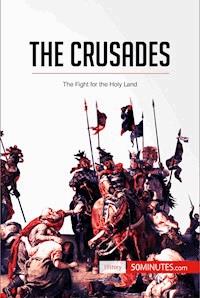
Keen to learn but short on time? Get to grips with the history of the Crusades in next to no time with this concise guide.
50Minutes.com provides a clear and engaging analysis of the Crusades. In the 11th century, tensions peaked between the Christian West and the Muslim East over control of the Holy Land. At the pope’s call to Crusade, a series of conflicts broke out that would endure for nearly two centuries. The cultural and political shockwaves sent by the Crusades continue to affect the world today.
In just 50 minutes you will:
• Gain deeper understanding of the political and religious context surrounding the Crusades
• Discover the key figures of the Crusades, including Richard the Lionheart and Saint Louis
• Analyse the impact of the Crusades on both Western and Eastern cultures, and how the cultural exchange led to the Renaissance
ABOUT 50MINUTES.COM | History & Culture
50MINUTES.COM will enable you to quickly understand the main events, people, conflicts and discoveries from world history that have shaped the world we live in today. Our publications present the key information on a wide variety of topics in a quick and accessible way that is guaranteed to save you time on your journey of discovery.
Das E-Book können Sie in Legimi-Apps oder einer beliebigen App lesen, die das folgende Format unterstützen:
Seitenzahl: 37
Veröffentlichungsjahr: 2017
Ähnliche

















The Crusades
Key information
When: 1095-1291.Where: the Middle East, Constantinople, Egypt and Tunisia.Context:The expansion of Seljuk Turkish Muslims in the Middle East and Asia Minor, who entered into conflict with the Byzantine Christian Empire and the local Arab populations.Pope Urban II’s plan to liberate the Holy Sepulchre, the location of Christ’s tomb, which had been occupied by Muslims for several centuries.Key protagonists:Pope Urban II (1042-1099)Godfrey of Bouillon, first Advocate of the Holy Sepulchre (1061-1100)Saladin, leader of the Muslim troops (1138-1193)Richard the Lionheart, king of England (1157-1199)Frederick II of Hohenstaufen, the Holy Roman Emperor (1194-1250)Louis IX, king of France (1214/5-1270).Impact:In the East: end of the golden age of Arab civilisation and definitive implementation of Turkish power in the Middle East.In the West: development of Europe and economic and cultural enrichment.Introduction
Even today, the eight Crusades led in the Holy Land occupy a particular space in the collective imagination and symbolise the violence of the clash between the Christian West and the Muslim East. These armed pilgrimages, incited by the preaching of Popes and monarchs for almost two centuries, led hundreds of thousands of crusaders to set off, making their mark on history forever.
Far from being limited to a merely religious battle, the Crusades were a political and military conflict between the three great powers of the era: Catholic Europe, the Muslim world and the Orthodox Byzantine Empire. The crusaders managed to seize the Holy Land during the First Crusade and created the Crusader states, small Christian states in Muslim lands whose defence was ensured by the Knights Templar. The expeditions that followed would be vain attempts at reconquering these lands, which, one after the other, were taken back under Islamic rule.
Many well-known figures took part in the Crusades and gained fame through them, including the famous Godfrey of Bouillon, the great Richard the Lionheart and the pious Louis IX. The stories of these great knights are thus intertwined with those of the great battles of Hattin (1187), Damietta (1249) and Al Mansurah (1250). The meeting of these worlds finally allowed the West to catch up in many domains that had been dominated by Arabs until that point, such as algebra, science and philosophy. The major economic and cultural renewal brought by the Crusades would open the doors of the Renaissance to Europe.
Context
The birth and progression of Islam
The Muslim world held an important position among the various cultures and religions that were in conflict in the Middle East during the Crusades. Islam, preached by the prophet Muhammad (around 570-632) in Arabia during the 7th century, is therefore a relatively recent monotheist religion, but had already conquered a large part of the known world. Indeed, whether through trading caravans or by force, Muslim doctrine was quickly spreading towards the East – in the direction of Persia and Mesopotamia, up to the Indus River – and towards the West, to the formerly Christian nations of the Ancient Roman Empire.
In just a few years, Syria, Palestine and North Africa were under Muslim influence, thus taking away part of the Byzantine Empire and all of the Neo-Persian Empire (an ancient Iranian dynasty). Constantinople was weakened, but still kept control of Asia Minor – the territory now known as Turkey – and briefly put an end to Muslim ambitions in this region. But nothing seemed to halt the progression of Muslim troops, who took the Atlantic coast and crossed the Strait of Gibraltar to reach Europe at the beginning of the 8th century. After invading Spain in 712 under the command of Tariq ibn Ziyad (died in around 720), they reached the region of Poitiers in France, where they were eventually defeated by Charles Martel (Prince of the Franks, around 688-741).
Bataille de Poitiers, painting by Charles de Steuben, 1837.




