


27,99 €
Mehr erfahren.
- Herausgeber: John Wiley & Sons
- Kategorie: Geisteswissenschaft
- Sprache: Englisch
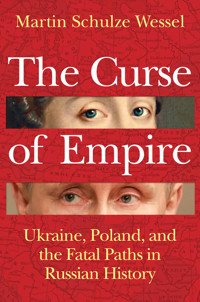
Russia's attack on Ukraine marks an epochal break in European and global history. Undoubtedly, the decision to go to war is closely linked to one person, Vladimir Putin, but Russia's war is not driven solely by one man's power calculations. We can only make sense of Russia's actions in Ukraine, argues the distinguished historian Martin Schulze Wessel, by putting them in the broader context of the history of Russian imperialism and the influence it continues to exert today.
Schulze Wessel argues that Russian imperialism was shaped by Russia's relationship to Poland and Ukraine. These states were absorbed or partitioned by Russia in the eighteenth century, but Russia's rule over them was contested both by the Poles and by the Ukrainians. The entangled history of these three states produced path dependencies whose impact is still felt toda. Poland and Ukraine share a common history characterized by Russian domination and Polish and Ukrainian resistance to it; just as the Polish question challenged the Russian Empire in previous centuries, so too does the Ukrainian question today. Schulze Wessel argues that, as a result of Russia's confrontation with the Polish and Ukrainian questions, Russia's national identity merged with imperial claims in ways that were pernicious and consequential – the curse of empire.
By placing the war in Ukraine in the context of an era of Russian imperialism that spans three centuries, this book sheds new light on one of the bloodiest and most destructive conflicts of our time.
Sie lesen das E-Book in den Legimi-Apps auf:
Seitenzahl: 605
Veröffentlichungsjahr: 2025
Ähnliche















Table of Contents
Cover
Title Page
Copyright Page
Introduction
Notes
1. Russia’s Empire, the Hetmanate, and the Republic of Poland (1700–1795)
Moscow’s road to Europe
The Ukrainian Hetmanate between Poland and Russia
Poltava
Europe’s first East–West conflict
Russia and Ukraine after the Northern War
Catherine II: Completing the work of Peter I
Notes
2. Imperial Order and the National Challenge (1796–1856)
Russia’s empire in the age of Napoleon
The Holy Alliance
The November Uprising in Poland as a European event
Russia’s response to Europe
Polish and Ukrainian ideas of liberation
The identity politics of the Tsarist Empire
Geopolitics in exile
The European revolution and the war over Crimea
Poland’s uprising and Russia’s fear of the Ukrainian question
Notes
3. The Idea of Russian Exceptionalism and the End of the Tsarist Empire (1856–1917)
The imperial set of ideas following the Crimean War and the Polish uprising
Ukrainian alternatives
Tsarist symbolic politics and the search for a foreign policy doctrine
National and social dynamics in Ukraine
The First World War
The founding of the nation-state in Kyiv
Revolution and civil war
Notes
4. The Soviet Experiment and the Imperial Tradition (1917–1991)
Old borders, new borders
Nationalization of culture, centralization of the economy
Poland and Prometheism
Holodomor (Ukrainian famine)
The return of the Great Russian people
From Rapallo to the Hitler–Stalin Pact
War against Poland
The Great Patriotic War
Russian and Ukrainian myths
Yalta and the Cold War
Ukraine as the second nation of the Soviet Union
Post-Stalinism
The new policy toward the East (
Ostpolitik
)
Poland and Ukraine in the final years of the Soviet Empire
Notes
5. Post-Soviet Ukraine and Russia’s Neo-imperialism (1992–2022)
The belated revolution in Ukraine
Russia’s road to dictatorship
Empire fatigue and Soviet nostalgia
Imperial infrastructures
Imperial fantasies: Dugin and Putin
Notes
Conclusion
Notes
Acknowledgments
Figures
Maps
References
Index of Names
End User License Agreement
List of Illustrations
Chapter 1
Figure 1: A consciously casual atmosphere: Vladimir Putin addresses young entrepreneurs in...
Figure 2: The beginnings of Ukrainian statehood: Ivan Mazepa’s seal from the 17th c...
Figure 3: The “Polish pie”: a caricature of the First Partition of Poland in...
Figure 4: Early East–West conflict: Catherine II as a bear, Prince Potemkin as a ho...
Figure 5: “An Imperial Stride”: French caricature of Catherine II’s f...
Figure 6: “I have won back what was lost”: a medal minted by Catherine II in...
Chapter 2
Figure 7: United in faith: contemporary depiction of the “Holy Alliance,” wi...
Figure 8: Ukrainian icon: Portrait of Taras Shevchenko by the Russian artist Ivan Kramskoy...
Figure 9: Peter cult: the equestrian statue on the Neva with the inscription by Catherine ...
Figure 10: Caricature from the British publication
Punch
from 29 September 1855.
Figure 11: Ineffective notes of protest: French caricature of the Western attitude during t...
Chapter 3
Figure 12: Putin’s role model: the Russian president at the unveiling of a monument ...
Figure 13: Mistrust of one’s own people: execution of a civilian by Austro-Hungarian...
Figure 14: The German Reich as the hegemonic power in Ukraine: the new hetman Pavlo Skoropa...
Figure 15: Dependent and independent at the same time: German troops on the streets of Kyiv...
Chapter 4
Figure 16: “Corrupt Petliura sold Ukraine to his Polish masters!”: a propagan...
Figure 17: Left to certain starvation: a Soviet search party confiscates grain in a farmhou...
Figure 18: “Daily free amputations”: caricature of the consequences of the Hi...
Figure 19: The small nations in a mousetrap: caricature of Churchill’s realpolitik t...
Figure 20: Escalation averted: Władysław Gomułka speaks to an estimate...
Figure 21: Signing in the Kremlin: the signing of the Moscow Treaty on 12 August 1970.
Figure 22: Recognition of German guilt: Brandt drops to his knees in Warsaw on 7 December 1...
Guide
Cover
Table of Contents
Begin Reading
Pages
iii
iv
1
2
3
4
5
6
7
8
9
10
11
12
13
14
15
16
17
18
19
20
21
22
23
24
25
26
27
28
29
30
31
32
33
34
35
36
37
38
39
40
41
42
43
44
45
46
47
48
49
50
51
52
53
54
55
56
57
58
59
60
61
62
63
64
65
66
67
68
69
70
71
72
73
74
75
76
77
78
79
80
81
82
83
84
85
86
87
88
89
90
91
92
93
94
95
96
97
98
99
100
101
102
103
104
105
106
107
108
109
110
111
112
113
114
115
116
117
118
119
120
121
122
123
124
125
126
127
128
129
130
131
132
133
134
135
136
137
138
139
140
141
142
143
144
145
146
147
148
149
150
151
152
153
154
155
156
157
158
159
160
161
162
163
164
165
166
167
168
169
170
171
172
173
174
175
176
177
178
179
180
181
182
183
184
185
186
187
188
189
190
191
192
193
194
195
196
197
198
199
200
201
202
203
204
205
206
207
208
209
210
211
212
213
214
215
216
217
218
219
220
221
222
223
224
225
226
227
228
229
230
231
232
233
234
235
236
237
238
239
240
241
242
243
244
245
246
247
248
249
250
251
252
253
254
255
256
257
258
259
260
261
262
263
264
265
266
267
268
269
270
271
272
273
274
275
276
277
278
279
280
281
282
283
304
305
306
307
308
309
310
311
312
313
314
315
316
317
318
319
320
321
322
323
324
325
326
327
328
329
330
331
332
333
334
335
336
337
THE CURSE OF EMPIRE
Ukraine, Poland, and the Fatal Paths in Russian History
Martin Schulze Wessel
Translated by Neil Solomon
polity
Copyright Page
Originally published in German as Der Fluch des Imperiums. Die Ukraine, Polen und der Irrweg in der russischen Geschichte © Verlag C.H.Beck oHG, München 2023
This English translation © Polity Press, 2026
The translation of this book was supported by a grant from the Goethe-Institut.
Polity Press
65 Bridge Street
Cambridge CB2 1UR, UK
Polity Press
111 River Street
Hoboken, NJ 07030, USA
All rights reserved. Except for the quotation of short passages for the purpose of criticism and review, no part of this publication may be reproduced, stored in a retrieval system or transmitted, in any form or by any means, electronic, mechanical, photocopying, recording or otherwise, without the prior permission of the publisher.
ISBN-13: 978-1-5095-6399-9 – hardback
A catalogue record for this book is available from the British Library.
Library of Congress Control Number: 2025936426
by Fakenham Prepress Solutions, Fakenham, Norfolk NR21 8NL
The publisher has used its best endeavors to ensure that the URLs for external websites referred to in this book are correct and active at the time of going to press. However, the publisher has no responsibility for the websites and can make no guarantee that a site will remain live or that the content is or will remain appropriate.
Every effort has been made to trace all copyright holders, but if any have been overlooked the publisher will be pleased to include any necessary credits in any subsequent reprint or edition.
For further information on Polity, visit our website: politybooks.com
Introduction
Ever since 24 February 2022, Russia’s war against Ukraine has been a source of horror. After failing to quickly seize power in Kyiv, Russia’s invasion has been aimed at the physical destruction and symbolic annihilation of the neighboring country. Kremlin propaganda denies Ukraine its national identity, describes its political and cultural elites as “fascists,” and attempts to systematically dehumanize the political leadership around President Zelensky. Meanwhile, Russian troops are shelling civilians and civilian infrastructure. Entire cities lie in ruins. Far from the front line, the Russian army is bombing hospitals, kindergartens, and shopping centers. The violence sends a message: life is not safe in Ukraine, anywhere. A few months after the start of the invasion, a third of the Ukrainian population was on the run. This included 7 million within Ukraine and another 7 million – mainly women and children – who left the country. In the first months of the war, 1 million Ukrainians were funneled out of the occupied territories through so-called filtration camps. They were sent eastward and distributed across the Russian Federation, no doubt in the expectation that they would be assimilated into Russia. At the same time, but prior to mobilization, the Russian army sent above all members of non-Russian ethnic groups from far-flung regions to fight in a battle that involved heavy losses. This war of extermination therefore also involves an element of ethnic cleansing.
In Germany, it has taken a long time to open people’s eyes to the full extent of the atrocity and what this entails. One reason for this lies in the way German history is dealt with. The incomparably greater horror of the Holocaust and the German war of extermination in Eastern Europe had an inhibiting effect when it came to identifying Russian violence for what it is. It took some effort to realize that German history gave rise to a special responsibility for helping Ukraine.
History also plays a special role in the war itself. The legitimization that Russian President Vladimir Putin cites for the attack on Ukraine is historical in nature. Long before the invasion, he used historical narratives to justify Russia’s historical mission and deny Ukraine’s right to exist. This contrasts strikingly with Russia’s other military engagements. For the wars in Chechnya, Georgia, or Syria, the Kremlin did not invoke historical justifications, but sought to use international law to legitimate its claims. Justifying a war of aggression primarily through historical myths is also new in Putin’s Russia. Moscow’s claim to Crimea represents the best example of this. In fact, there is nothing “primordially Russian” about the peninsula: it is, in fact, a conquest that the Tsarist Empire made relatively late in its war against the Ottoman Empire. It only became part of the Russian Empire in 1783, which has not prevented Putin from claiming it as a legitimate possession. On the other hand, the fact that Crimea was transferred to Ukraine in Soviet times is, in Putin’s view, “unhistorical” – an error in the course of history that needs correcting.
Putin manipulates and instrumentalizes history. This statement is correct, but also quite banal. The Russian president is an amateur historian of the worst kind who thinks he understands history and can change it. As the British historian and security expert Mark Galeotti writes, Putin has “started a fight with history,” forgetting that history is a river that never flows backward.1 Ukraine is no longer the country that was part of the Tsarist Empire in the nineteenth century, no longer the Soviet republic of the 1960s and 1970s, no longer even the Ukraine of 2014.
The “special operation” that Putin has launched is Russia’s war. It is a war that cannot be understood solely in terms of the present, for it is not just about the rationally tangible interests of the clique that calls the shots in Russia. This is the flawed assumption at the heart of Western and especially German policy prior to 24 February 2022. In fact, the Russian decision to invade is based on myths and obsessions. The war rhetoric broadcast into the country day after day by state television caters to base instincts, implicitly or explicitly invoking history time and again. It is almost impossible to correct the flood of lies and half-truths. However, it is necessary to show that the set pieces of Russian propaganda themselves have a history. This consists of discourses with a long-term effect, which are conditioned by certain traditions of Russia’s imperial policy. Russia’s long-term structural problems thus emerge in the war against Ukraine.
However, the history of these problems does not encompass the entire Russian past. Since the start of the Russian invasion in February 2022, long-forgotten interpretations have resurfaced in the West that speak of a consistently violent tradition in Russian history and locate the roots of the current outbreak of violence as deeply as possible in that history. Comparisons are drawn between Putin and Ivan the Terrible, and the cruelty of the Russian Middle Ages is made responsible for Russia’s warfare today. In this way, Russian history is essentialized. But demonization and romanticization are just two sides of the same coin.
The Russian aggression against Ukraine cannot be explained simply through a present-day lens, using notions that the public in the West views as rational behavior. At the same time, however, this aggression is also not rooted in the infinite depth of Russian history. There is a medium-range historical depth to the explanatory framework that this book chooses: it involves the history of the modern Russian Empire, which began with the reign of Peter I. A structural problem arose at the beginning of the eighteenth century, the effects of which we are still dealing with today.
Russia, of course, was not the only country that exercised imperial rule. London, Paris, Madrid, Vienna, Berlin, Brussels, and other European metropolises were also imperial centers, if one understands an empire according to John M. MacKenzie’s well-founded definition. In his words, an empire is an “expansionist polity that seeks to establish various forms of sovereignty over people or peoples whose ethnicity is different from (or in some cases the same as) its own.” An empire thus becomes “a politically composite entity with, generally, a ruling center and a dominated periphery.” This can result in different forms of hegemony.2 Russia fits well into this general definition. The structural postimperial problems that emerge in Russia’s restoration attempt vis-à-vis Ukraine have, however, a different character than the West European decolonization processes, which were not without complications of their own. The Russian Empire also expanded into Europe by first incorporating the Ukrainian Hetmanate in the eighteenth century and then annexing the Baltic states and parts of Poland. In becoming a great power, Russia exposed itself to intense international competition in Europe and to a transfer of ideas that brought modern concepts, including the concept of nation, from the imperially dominated peripheries to the center of the empire. National issues arose on the western border of the Russian Empire – first the Polish question and then the Ukrainian question, as well as Baltic and Finnish aspirations for autonomy and independence. Each had geopolitical implications in the system of European states and acted as a model for other national movements in the Tsarist Empire and the Soviet Union. This is historically specific to the history of the Russian Empire, and, as early as the nineteenth century, it gave rise to an East–West clash of ideas in which Russia took on the role of an autocratic pole. Among the many empires of Europe, Russia did not stand out for the cruelty of its rule. What distinguished Russia from the other empires was the fact that a large land empire grew into Europe, so to speak, by annexing territories in Northeastern, East Central, and Southeastern Europe or by creating spheres of influence there.
France and Germany also established hegemonic orders in Europe during the Napoleonic era and under National Socialist rule, respectively, but these were comparatively short-lived. Russia, on the other hand, has exercised hegemony or a dominant influence in its western borderlands for more than 300 years. Western states have repeatedly attempted to contain Russia, and this has given rise in Europe to a liberal discourse critical of Russia since the nineteenth century. The clash with the West was thus inscribed in the traditional self-image of the Russian Empire over a long period of time. The contradiction between the dominant role Russia played in the eastern half of the continent in terms of power politics and the defensive position it found itself in against progressive thinking in Europe promoted exceptionalist ideas of Russia’s historical mission. Slavophile thinkers demanded that Russia should no longer allow itself to be measured by European standards. Even today, we are still burdened by this complex of imperial and nationalist ideas that were shaped in the nineteenth century. They are having a devastating effect on Ukraine in the current war. Moreover, they are preventing Russia from taking a place in a multilateral European and global order that is conducive to its own economic and social development.
We are also acquainted with such a development from Prussian-German history. Here, too, there was an imperial and colonial expansion into East Central Europe and thinking in terms of spheres of influence. Here, too, an imperial and nationalist ideology emerged that gained its self-image from its opposition to the West. In this respect, Germany and Russia have parallel histories that are intertwined. But there are differences: In Germany, the combination of power politics and antiliberal ideas gave rise to a radical racist policy that did not and does not exist in this form in Russia or the Soviet Union. The unconditional surrender of Nazi Germany to the Allies and the decades of liberalization and Westernization processes enabled a reevaluation, a reevaluation that affected not only the period of National Socialism, but also certain traditions of Prussian-German imperial history. In Russia, such a fundamental revision has yet to take place.
The road to such a revision will probably be long and difficult. This is due in part to the fact that the imperial crimes of the two countries in the twentieth century differed. The openly inhuman approach of German National Socialism was comparatively easy to delegitimize after the total defeat of the Reich. In contrast, the Soviet project, with its universalist aspirations, attracted idealists at home and abroad, who were able to delude themselves about its criminal character for a surprisingly long time. The Soviet Union’s decisive role in the Allied victory over Nazi Germany and the liberation of Auschwitz by the Red Army created a nimbus that is still exploited heavily by historically “informed” Russian politics today. For this reason, the devaluation of the complex of nationalist and imperial ideas in Russia will hardly be possible without a profound sea change in politics. A new beginning will have to prevail against numerous obstacles and will require a great deal of time.
This book attempts to answer the question of what the underlying factors were that led to the Russian war against Ukraine. It distances itself from a widespread explanatory scheme that claims to explain Russia’s history with the help of the contrast between (good) Western influences and (bad) autochthonous traditions. The scheme’s symbols are suggestive: the religious and patriarchal Moscow is contrasted with the new European-style capital of St. Petersburg, which Peter I created as a “window to Europe.” However, such constructions do not provide us with any deeper insight, and they are not even suitable as a starting point for analysis. One example of the binary approach is the influential account of Putin’s thinking presented by the French philosopher Michel Eltchaninoff. He asks: “[W]hy did Putin’s portrait of the pro-European Peter the Great, hung in his St. Petersburg mayoral office in the early 1990s, come off his office walls in the Kremlin ten years later?”3 One may ponder this, but an answer to Eltchaninoff’s question will hardly help to explain the present. The sight of the portrait of Peter would certainly not have deterred the Russian president from his war of aggression against Ukraine. On the contrary, Russia’s imperial tradition is particularly closely associated with rulers such as Peter I and Catherine II, whom we perceive as European. Notorious Westerners and admirers of Peter such as Vissarion Belinsky and Peter Struve stood out in the nineteenth century as eager supporters of imperialist-based conceptions of the Russian nation. The division of Russian history into European and non-European strands is misleading. The specific path that Russia has taken since the beginning of the eighteenth century is inconceivable without the interweaving of traditions that were thought to be autochthonous with ideas imported from the West.
According to MacKenzie’s definition of empire, Russia exercised various forms of hegemony or rule. After the successive elimination of the Hetmanate’s autonomy, Ukraine became part first of the Tsarist Empire and later – after the brief creation of a Ukrainian nation-state in 1918/19 – of the state of the Soviet Union. It formed a part of the internal empire. Poland’s relationship with the Russian Empire was more complicated in terms of state law. As a result of the Partitions of Poland (1772–95), Russia annexed a number of Polish territories. As a result of the Congress of Vienna in 1815, the Tsarist Empire annexed further Polish territories without incorporating them into its empire. It created a dependent Polish state, which at times – between 1815 and 1831 – enjoyed a certain degree of autonomy. This sphere of indirect rule can be referred to as an external empire. The affiliation to the empire was therefore gradual and fluid, which also applied to some non-European peripheries of the Tsarist Empire.
Dominance over spheres of influence (outer empire) required cooperation with other European powers. Cooperation with Prussian Germany and the Habsburg monarchy was necessary for the entire East Central European region bordering the Tsarist Empire. During the Soviet period, Russian–German relations sometimes had a similar role to play. Russia’s imperial expansion westward brought it into close contact with the European system of states. Within just one generation at the beginning of the eighteenth century, Russia achieved hegemony in Eastern Europe. This fascinated some observers in Western Europe, but it also elicited voices of warning. They marked the beginning of an intense Russian–European conflict in which power politics and national or imperial ideologization were inseparable. The French Enlightenment philosopher Jean-Jacques Rousseau was an early admonisher of the Tsarist Empire’s expansion. In 1772, he recommended to the Poles that, if the division of their country could not be prevented, they should develop a national spirit that would make it impossible for Russia to “digest” or assimilate Poland. Voltaire had previously expressed similar sentiments about Ukraine and the annexation of its Hetmanate to Russia. The history of Russia’s imperial expansion westward can be seen as the history of failed processes of assimilation. The annexations gave rise, with a time lag, to the “Polish question” and the “Ukrainian question.” These were agendas of certain Polish and Ukrainian actors that were framed as “questions” in the manner typical of the nineteenth century and placed on the agenda of the international public, where they were combined with aspirations from other regions and areas of life.4
The Russian discourse felt challenged by the “questions” in the west of the empire. What actually constituted Russian identity, whether it should be understood as distinct from the empire or as an imperial nation, was – and still is – undefined. Clarification was needed regarding where the sphere of ethnic Russians ended and where the empire began. Did the pioneers of a modern Russian identity themselves understand the incongruence of imperial and national mental maps? Russia’s identity, which oscillates between empire and nation, emerged not least as a result of the confrontation with Polish and Ukrainian concepts of nation. In this respect, Russia’s imperial history must be understood as a product of interdependencies, just as the history of the Polish and Ukrainian nations can only be understood by looking at these dependent interlinkages.
Interdependent histories are usually written on a bilateral basis. Good examples of this are Klaus Zernack’s history of Poland and Russia as “two paths in European history” and Andreas Kappeler’s history of Russia and Ukraine as “unequal brothers.”5 Both books are designed as double biographies of two states or nations. This book takes a different approach: it broadens the view to the three-way relationship between Russia, Ukraine, and Poland in the modern era, whereby additional attention should always be paid to Germany and the German territorial states. It focuses on history since the eighteenth century and only considers medieval beginnings when they become a topic of the modern politics of history.
Poland and Ukraine experienced a similar fate in the early modern period, however different the initial conditions of the Polish Rzeczpospolita and the Ukrainian Hetmanate were: both lost their statehood as a result of Russian expansion. Both developed a similar type of liberation nationalism that preserved an awareness of the democratic structures of the lost statehood and at the same time developed universalist, messianic projections for the future. As the Ukrainian historian Yaroslav Hrytsak writes, “in Ukraine the West was clad in Polish dress.”6 The development of the modern Polish national idea was triggered by the Polish November Uprising of 1830. Around the same time, the ideological framework of the Ukrainian nation emerged with adaptations of ideas and practices from Polish nationalism. The Ukrainian aspirations for autonomy were perceived in the imperial center of Russia through the prism of the country’s previous experiences with Poland.
In view of the enormous burdens that Russia had placed on itself by assuming rule over Poland, it was essential for St. Petersburg to prevent separatism from spreading from the outer empire (Poland) to the inner empire (Ukraine). Polish geopolitical thinkers and politicians, on the other hand, had been developing strategies since the mid-nineteenth century based on the insight that national independence from the Tsarist Empire or the Soviet Union could best be achieved and secured in conjunction with Ukraine. The connections between Ukraine and Poland extend into the Soviet era. Stalin’s decision to deliberately intensify the Holodomor (Ukrainian famine) in the early 1930s while waging a campaign against Ukrainian national culture was also intended to prevent Poland from exerting influence on Ukraine. The history of Russian–Polish and Russian–Ukrainian relations has always been and still is played out in the context of an East–West conflict, in which, from the Russian point of view, Poland and Ukraine appear as spearheads of the West. This is particularly evident in the current war. Larry Wolff, in his seminal book Inventing Eastern Europe (Stanford 1994), traces the emergence of the distinction between East and West to a construction of the French and German Enlightenment. In this view, the “invention of Eastern Europe” by West European intellectuals in the eighteenth century thus created the epistemologies that later shaped the opposition between East and West in power politics: first during the Napoleonic era and then during the Cold War, materializing in the form of walls and barbed wire. This book turns this process on its head, putting the inventing of Eastern Europe back on its feet: in the beginning there was a polarization in power politics between East and West, which was connected to Russia’s rise to hegemony in Eastern Europe. This antagonism in the sphere of power politics, which emerged at the beginning of the eighteenth century, found its ideological form in the nineteenth century. It was not power politics that followed ideological constructs, but rather the discourses that followed a cartography already shaped by power politics. In this process, the Partitions of Poland between 1772 and 1795 and the associated demarcation of imperial spheres of influence in Eastern Europe played a decisive role. It was these events that – between 1815 and the 1860s – produced an East–West antagonism in international politics. Political discourse then took up, ideologized, and essentialized this conflict in the course of the nineteenth century, long before the bloc-based antagonism of the twentieth century.
This encounter with Western Europe, which took place both on the level of power politics and ideas, had far-reaching consequences for Russia. In the last third of the nineteenth century, cognitive dissonance arose in the Russian Empire between, on the one hand, its own imperial claim to hegemony and, on the other, repeated setbacks in international politics and experiences of marginalization in relation to a progressive European discourse. This led to a complex of Russian exceptionalism and anti-European ideas that became of fundamental relevance for the history of Poland and Ukraine.
The notion of a special Russian mission arose in the context of the conflict with Poland and Ukraine and had a particularly significant impact on relations with these countries. The ideologues of the Russian Empire saw Poland’s striving for independence as an extension of the West. At the same time, they suspected Ukrainian autonomy efforts of being motivated by Polish intrigue, and thus, indirectly, as a further instance of Western influence. The imperial-nationalist and anti-European ideas influenced not only relations between the center of the empire and its peripheries, but also had repercussions at the level of international politics. Thus, ideas about Russia’s strategic foreign policy goals were directly related to the concepts of empire and nation. Anti-European discourse and ideas of Russian exceptionalism had a direct impact on Russia’s policy of alliances. They determined the style and often the content of Russia’s international behavior. The dialectic between structures of political power and ideas deeply marked by empire has had repercussions up to the present. Russia’s war of aggression against Ukraine can only be understood against the background of a set of ideas that emerged in the late nineteenth century and in which certain experiences of power politics since the eighteenth century are inscribed. This connection between foreign policy and the construction of collective identity has only sporadically been the subject of attention in Russian historiography.7 In political science, it plays a more important role.8 The issue here is one of mutual influence. On the one hand, as Ilya Prizel emphasizes, national identity is constantly being redefined by foreign policy. On the other hand, as Ursula Stark Urrestarazu points out, every foreign policy action is identity-driven.9 With regard to Russia, this means that power politics generated imperial ideology, which in turn produced power politics.
None of this was inevitable. The challenge in writing this book was how to grasp the links between the past of the eighteenth, nineteenth, and twentieth centuries and the present. There are outstanding historical studies that introduce us to an entirely unique past world with logics of its own distinct from those of the present. The appeal of such books lies in the fact that they dissolve the self-evidence of the “here and now” through an encounter with a past that is as foreign as a distant land. If you delve deeper into the history of the web of relationships among Russia, Poland, Ukraine, and the German territories since the beginning of the eighteenth century, a completely different impression emerges: the past and the present are interrelated in many ways, and time and again you encounter the present in the past.
Relationships between temporal strata may arise in different ways: historical actors themselves may cite history (1), analogies may impose themselves on the viewer (2), and/or it may be possible to identify path dependencies in certain areas (3).
First, contemporary actors cite the past and use it to legitimate themselves. The historical essays that Putin has written in recent years offer numerous examples of this. Putin explicitly claims to be continuing the work of Peter the Great and presents the policies of Alexander III in such a way that they appear to be a blueprint for his own policies. Above all, Putin is creating a violent cartography (Michael Shapiro), a moral and geographical space of imagination based on the binary opposites of order and chaos, self and other, which claims to identify legitimate goals of violence. This cartography is based on historical clichés – the sacred shared past of Russians and Ukrainians in medieval Rus’, the demonization of the Ukrainian leadership as Banderites and a fifth column of an aggressive West. It is an ideological construct made up of historical references, something that has been a tradition in Russia since the last third of the nineteenth century.
Second, in the history of Russia, Ukraine, Poland, and the German territories, one repeatedly encounters analogies between the past of the eighteenth, nineteenth, and twentieth centuries and the present. Doesn’t the German enthusiasm for Poland after the 1830/31 uprising resemble the solidarity of German civil society with the Ukrainians defending their country’s independence and shared democratic values? A “turning point in history” (Zeitenwende) was already proclaimed in Berlin in the nineteenth century, albeit with different terms, when Prussian diplomacy briefly tried to break out of the tradition of ties with Russia in March 1848. At first glance, these analogies may appear to be no more than perplexing. In the epochal framework defined by Russia’s hegemonic policy, however, they demonstrate the continuity of real-world relationships.
And, third, we have path dependency. The basic idea here is that the course of processes can be influenced by events that occurred a long time ago. Various factors come into play here: the influence of earlier formative events (initial conditions) or the self-reinforcing effects of paths once they have been taken (self-reinforcement, reactive sequence).
The power politics of the eighteenth century are characterized by path dependency, which arose from Russia’s interest in dominating its East Central European periphery. To this end, the Tsarist Empire allied itself with Prussia and the Habsburg monarchy, which, despite all the sudden and unexpected twists and turns of diplomacy, created a stable structure in the European system of powers.10 Based on the common interest of the three East European powers in controlling their neighbor Poland – one of the great territorial states of early modern Europe – a stable system developed that proved resilient in the face of temporary disruptions resulting from other, conflicting interests. The Seven Years’ War, which pitted Russia against Prussia, represented a disruption of this kind. It was ended by the separate peace that St. Petersburg and Berlin concluded in 1762. The Partitions of Poland between 1772 and 1795 put the system on a new footing. They had the character of initial conditions that would shape the long term. From that time onward, the East European empires shared a long-term interest in retaining the acquired territories, and they provided mutual support when these territories developed into revolutionary trouble spots in the nineteenth century. The Polish uprisings of the nineteenth century challenged the stability of the system, but were actually self-reinforcing. They resulted in the East European empires taking action together to quash these uprisings, after previously only having guaranteed each other’s territorial gains in treaties. They also deepened the ideological antagonism between the East European powers, which insisted on their right to annexation, and the West European public, with its ideals of freedom and the nation-state. The course of events that led from the beginning of the eighteenth century to the 1870s was not planned by any of the actors involved. The interest that these political powers shared in controlling Poland resulted in their collective act of partitioning it. And this in turn led to the formation of blocs in a Europe divided between East and West in terms of political ideas. Each new stage along this path was unforeseeable for those involved. The uprisings of 1830/31 and 1863 had a particularly strong transformative effect within Russia, giving rise to an anti-European self-image and the aforementioned violent cartography. This was the context in which the Ukrainian question, which arose in the 1860s, was viewed. From that time on, the imperial center in St. Petersburg associated those fears and strategies with Ukraine that it had developed in relation to Poland. Putin’s historical obsessions and Russia’s wars of aggression can be seen in this context.
The Russian Empire had many structural problems that became apparent over the long term: for example, its economic backwardness compared to Western Europe, which it was never able to overcome; the relationship between state reform and traditional society; and the insurmountable participation deficits in such a geographically extensive empire. There is good literature on these issues.11 This book focuses on something else: the connection between imperial politics, foreign policy, and identity constructs, in which the tradition of empire was coupled with Russian nationalism. This is where the “curse of empire” lies.
Studying path dependencies requires a heightened sense for the contingency of history, because the impact of continuities only becomes visible where existing structures are challenged by change, unexpected events, and the intention of actors to break with the past and start anew.12 Such caesuras can be seen, for example, in Alexander I’s programmatic attempt to try out a new approach in his policy toward Poland, or in the declared intention of the Bolsheviks to leave behind the imperial legacy of Great Russian chauvinism. Only by assuming a fundamental openness to development can the factors be determined that have kept Russian history on certain paths since the eighteenth century. As a result of this tradition, historically accumulated political and cultural paradigms are available today for Russian policy that can be used to legitimize, to the Russian public, the attack on a sovereign neighboring country. These traditions are only the condition of possibility for the criminal war we are witnessing. It was Putin’s choice to seize this opportunity, and he is to blame for it. A curse can be broken. Russia must stop acting in terms of spheres of influence determined by power politics and overcome the great power chauvinism of the nineteenth century. This is important for Ukraine, whose state integrity must be restored so that it can achieve an economically prosperous and politically influential position as a member of the European Union. But only by withdrawing from Ukraine will Russia itself be able to make a fresh start.
* * *
History since the eighteenth century has also changed the names of states, regions, and cities. This is especially true for Ukraine. Its cities are consistently referred to by their new Ukrainian names – Kyiv instead of Kiev, Odesa instead of Odessa – even if this may seem anachronistic in relation to the eighteenth and nineteenth centuries.
Notes
1
https://www.t-online.de/nachrichten/ausland/krisen/id_100060160/ukraine-krieg-historiker-damit-ruiniert-sich-wladimir-putin-selbst-.html
.
2
MacKenzie (2016) “Empires in World History,” lxxxiii.
3
Eltchaninoff (2018)
Inside the Mind of Vladimir Putin
, 29.
4
Case (2018)
The Age of Questions
.
5
Zernack (1994)
Polen und Russland
; Kappeler (2023)
Ungleiche Brüder
.
6
Hrytsak (2022) “Putin Made a Profound Miscalculation on Ukraine.”
7
Utz (2008)
Russlands unbrauchbare Vergangenheit
; Maiorova (2010)
From the Shadow of Empire
.
8
Tsygankov (2022)
Russia’s Foreign Policy
.
9
Prizel (2009)
National Identity and Foreign Policy
; Urrestarazu (2015) “Identity in International Relations and Foreign Policy Theory,” 136. Urrestarazu puts it as follows: “There is no such thing as ‘non-identity-driven’ foreign policy practice.”
10
Zernack (1974) “Negative Polenpolitik.”
11
See, most recently, Hildermeier (2022)
Die rückständige Großmacht
.
12
Diner (2022) “Roads not taken.”
1Russia’s Empire, the Hetmanate, and the Republic of Poland (1700–1795)
Moscow’s road to Europe
About 100 days after the start of the Russian invasion of Ukraine, on 9 June 2022, Vladimir Putin invited young entrepreneurs, engineers, and scientists to take part in a conversation intended to give the impression of modern political communication (see Figure 1). In an intentionally casual atmosphere, the president outlined the main features of his policy and promised to pass on suggestions from the conversation to his prime minister. He was sitting across from representatives of an elite whose professional futures had taken a turn for the worse after the invasion-related sanctions were imposed. Many qualified young Russians, both men and women, turned their backs on their country and settled in Turkey, Armenia, or Georgia. It was not a coincidence that Putin chose to hold his conversation at the site of the Exhibition of Achievements of National Economy (VDNKh) in Moscow, which had been established by Nikita Khrushchev to demonstrate Soviet superiority over Western technology. The famous exhibition of the Sputnik satellite took place at the VDNKh. The exhibition area thus conveys the nostalgic memory of a race that the Soviet Union had once won against the West, when it had advanced into space with the first satellite and with Yuri Gagarin as its first cosmonaut. In this way, Putin was alluding to the future-oriented fitness that the Soviet Union had previously possessed and was seeking to derive from it vague promises for Russia’s future development.
Figure 1: A consciously casual atmosphere: Vladimir Putin addresses young entrepreneurs in St. Petersburg on 9 June 2022.
There was another, much more important past for him, however: the history of Peter I, whose 350th birthday was being celebrated at the time in the exhibition at the VDNKh and who went down in history as Peter the Great. What Putin said on 9 June about the contemporary significance of the tsarist era was the archaic counterpoint to his vague discourse on the future. He said that today it is again about the “conquering and fortifying” of territories. Putin revealed that he had turned away from more sophisticated means of exercising power. After his prewar attempt to force Ukraine back into the Russian orbit through economic pressure had failed, and the invasion of Ukraine had not led to the installation of a Russian puppet regime in Kyiv, the Russian president now professed allegiance to a premodern pattern of politics, a tsarist-like use of harsh military power.
For Putin, Peter I represents a usable past, a past with which he justifies his war of aggression against Ukraine. Peter I also recovered “Russian land” in the Northern War. With this, Putin was referring to the region in which Peter founded the new Russian capital, St. Petersburg. In fact, prior to Peter, this coastal region had only been ruled by the Tsardom of Muscovy for a short period of time. By harking back to Peter I, Putin was passing off the “conquering and fortifying” of territories as the essence of Russian history across the epochs. Here one must understand Putin as saying that no matter how important scientific and technological innovation is, this is the hard currency of Russian politics. This was the message Putin wanted to convey to the young elite.
That Putin justified his policy with a historical reference to Peter I and cast himself in the role of the great tsar’s successor is not uncommon in the politics of history. At most, what is special about it is the aggressiveness of the message and the presumptuousness with which a living politician personally, in his own words, places himself in the succession of a great ruler. But the connections between Peter and Putin go deeper than this instrumentalization of history reveals. During the reign of Peter I, an imperial policy and a political identity of Russia emerged, the effects of which extend to the present. Constellations in international politics were formed that are, in a fundamental sense, still in effect today. The claim to direct rule over Ukraine, combined with a policy of hegemony over East Central Europe, the Baltic states, and the Balkans; special Russian–German relations that also have a raw materials component; and the East–West divide: all are hallmarks of Russian politics that first emerged under Peter I. But Putin is not continuing the legacy of Peter the Great, he is destroying it. What began with Peter will presumably end with the “turning point in history” (Zeitenwende) that Putin has brought about.
It is in keeping with the conventional historical view to associate Peter I (1672–1725) above all with the Europeanization of the Tsarist Empire. Peter paved Russia’s road to Europe, or so the popular view goes. As a modernizer, he is said to have opened “the window to Europe.” Indeed, the tsar himself undertook a trip to Europe under a pseudonym, brought innovations in military technology and shipbuilding back to Russia, and reformed Russian institutions and customs according to European models. Beards were shorn and European clothing adopted. All of this had a serious downside, but when viewed from the outside, openness and development seemed to be the hallmarks of the era. Foreigners, especially Germans, enjoyed fabulous careers at the court of the tsar. Heinrich Ostermann (1687–1747), the son of a pastor from Bochum, represents one such example: he rose to become foreign minister and vice-chancellor under Peter. The tsar reformed the nobility according to meritocratic principles. This resulted in a Russian elite with greater fluctuations in rank, both upward and downward, than in the more tradition-bound European aristocratic cultures. Russia was on the move and open to outside influences.
In this narrative of Russia’s Europeanization under Peter, power politics plays only a marginal role. However, “Moscow’s road to Europe” has a twofold meaning. The formulation refers not only to the internal transformation of the Russian Empire along European lines, but also to Russia’s advance into Europe as a new great power. During the eighteenth century, Russia revolutionized the balance of power in three European regions through war and diplomacy: on the Baltic Sea, in Poland, and on the Black Sea. By significantly expanding its influence in these regions under Peter I and Catherine II, Russia fundamentally challenged the European system of states. Before Peter I, a system of alliances steered by France had dominated in Eastern Europe. For Paris, this system served the purpose of keeping the power of archrival Habsburg in check. To this end, in the sixteenth and seventeenth centuries, Paris entered into treaties with Sweden, Poland, and the Ottoman Empire, which together formed a “barrière de l’Est” on the far side of the Habsburg monarchy. Tsarist Russia did not yet play a role in this system of alliances. In the eighteenth century, however, the cards were reshuffled, and it was Russia, with its move into Europe, that triggered the revolution in the system of states. In the course of the eighteenth century, a new European system of powers emerged from this, the pentarchy of England, France, Habsburg, Prussia, and Russia. The Russian Empire, around 1700 still a marginal state on the eastern periphery of the continent, dominated the Baltic and Black Seas a hundred years later and, together with Prussia and Austria, had partitioned Poland. As early as the first quarter of the eighteenth century, during the reign of Peter I, Russia had begun, as Leopold von Ranke wrote, “to lay down the law in the North”1 and by the time of Catherine II, Russia was all-powerful in the eastern part of the continent.
Rule over Ukraine was in part the precondition and in part the goal of “Moscow’s road to Europe.” This road began with the partition of Ukraine, which occurred about a hundred years before the Partitions of Poland. Ukraine, however, did not form a unified territory or dominion, and its inhabitants did not profess allegiance to a Ukrainian nation. The following areas were settled by ethnic Ukrainians: Sloboda Ukraine, with Kharkiv as its center, which came under Muscovite rule as early as the seventeenth century; the Cossack territories east of the Dnipro; the Polish-influenced regions of Podolia and Volhynia; and Ruthenia and Carpathian Ukraine, which at the end of the seventeenth century belonged to the Crown of Hungary. During the eighteenth century, Ukrainian settlers and others colonized the Black Sea coast and the Donets Basin. Thus, in the sixteenth and seventeenth centuries, Ukrainians lived between several centers of power. Aside from the Ottoman Empire in the south, these consisted primarily of the Kingdom of Poland–Lithuania and the Tsardom of Muscovy. These states represented different forms of rule, and they competed not only for power, but also represented an early modern conflict of systems.
Poland–Lithuania, the dominant power in Central and Eastern Europe in the sixteenth century, was initially a loose union of the Kingdom of Poland and the Grand Duchy of Lithuania. The two countries were only connected by the fact that they shared the same ruler from the Jagiellonian dynasty. In the Polish part of the dual state, the estates of the nobility and high clergy enjoyed extensive rights. At imperial and provincial diets, they decided on the budget, on war and peace, and elected the king. In the fifteenth and sixteenth centuries, Poland and Lithuania were gradually transformed from a personal union into a real union. The Polish estate-based system of government (corporate statism), with its extensive participatory rights for the social elites, was gradually transferred to Lithuania. This structural assimilation of the Grand Duchy of Lithuania by the Kingdom of Poland was finalized in the Union of Lublin (1569), which made Poland–Lithuania a unified state in which the magnates and the high clergy were in charge. At that time, the Polish–Lithuanian Commonwealth, known as the Rzeczpospolita, was at the height of its power. Almost all Ukrainian territories belonged to it.
The Muscovite state developed in a completely different way in the early modern period. In the Grand Duchy of Muscovy, there had also been powerful nobles, the boyars, alongside the ruler, who had held the title of tsar since 1547. In contrast to Poland, however, Muscovy did not develop into a corporate state with chartered noble rights. Instead, the tsar managed to curb the power of the boyars and, in so doing, created an autocratically administered state. Its principles were summarized in the Tsarskiy Sudebnik, the tsar’s legal code of 1549, and two years later at the Hundred Chapter Synod in Moscow. In terms of foreign policy, the Muscovy state was characterized by its expansionist reach. It saw itself as the legitimate successor to Kyivan Rus’ and subordinated other Russian principalities that had been organized under its rule in the Middle Ages. Its conquests went beyond the Russian sphere when Muscovy conquered Kazan in 1552 and Astrakhan in 1556, extending its rule in this way over non-Slavic and non-Orthodox ethnic groups on a large scale for the first time. Muscovy had become an empire.2
Muscovy’s attack on Livonia, a medieval confederation located in present-day Estonia and Latvia, also took place during this period. Almost a century and a half before Peter I, Muscovy’s trade interests in gaining access to the Baltic Sea formed the backdrop here, as it moved to shorten the existing European–Russian sea route via the North Cape and the White Sea. At issue was the trade with the English Muscovy Company, the delivery of weapons and cloth in exchange for Russian raw materials such as hemp and soon wood as well. After the series of military successes that Muscovy had achieved in the south, the war against the still largely medieval, estate-based rule of Livonia probably did not present itself as a difficult task. Tsar Ivan IV probably regarded the attack as a limited military operation. In fact, Muscovy’s bid for the Baltic coast in 1558 triggered a long war. Poland–Lithuania and Sweden intervened against Muscovy. Among the unintended consequences of Russia’s war of aggression was the internal consolidation of Poland–Lithuania, because the noble elites of both countries considered the constitutional-political union of Poland and Lithuania to be the order of the day in view of the Russian challenge. They intensified integration and concluded the Union of Lublin of 1569. The external threat forced internal consolidation. After twenty-five years, the war ended. Warsaw and Stockholm had triumphed, while Russia was plunged into a deep crisis.3
The Ukrainian Hetmanate between Poland and Russia
For the Ukrainians, the strengthening of the Polish–Lithuanian republic of nobles had ambivalent repercussions. The Union of Lublin intensified a trend of cultural assimilation of the non-Polish ethnic population of Poland, especially of the Ukrainians. This tendency culminated in the Union of Brest (1596), which established the Greek Catholic Church; it retained the Orthodox rite but recognized the Pope as its head and is therefore also referred to as the Uniate Church. From the point of view of many Orthodox, the founding of the new church was a Catholic offensive intended to deprive the Ukrainians of their faith and culture.4 It was opposed not only by Orthodox brotherhoods in Ukrainian cities, but also by the Cossacks. The latter lived nomadically along the lower Dnipro and lower Don, where they maintained fortified camps and represented a significant factor of regional power. They formed “a kind of ‘military democracy.’”5 More specifically, the Cossack army was led by a hetman, who was elected by an assembly of all Cossacks, the kolo (ring). The hetman exercised absolute authority, limited only by the principle of election. Military obedience and proto-democratic elements came together in the political organization of the Cossacks. Cossack rule was particularly attractive to peasant serfs who wanted to escape the yoke and coercion of Polish and Muscovite law by fleeing to Cossack territory. The Ukrainian Zaporozhian Sich represented a center of power between the Kingdom of Poland and the Tsardom of Muscovy, but its location between Warsaw and Moscow did not allow it to act independently. Politically, the Cossacks were under the loose overlordship of the Polish state, which maintained special Cossack units, known as the Registered Cossacks, to protect its southeastern border. On the other hand, the Cossacks were connected to the Russian Empire through their shared Orthodox faith. The Union of Brest, with the founding of the Uniate Church, politicized the Cossacks. Their hetman Petro Konashevych-Sahaidachny (1570–1622) openly defended Orthodoxy, which brought the Cossacks into conflict with the Polish state. There was repeated protest against Polish overlordship, which was also fed by social issues, such as the withdrawal of privileges or the nonpayment of wages. The largest Cossack revolt took place in 1648 and was organized by Bohdan Khmelnytsky (1595–1657), who had long led the typical life of a Ukrainian minor nobleman integrated into Polish structures. This included his Jesuit education and his service in the army of the Registered Cossacks. Only two years before the uprising, he had experienced firsthand his lack of rights in a dispute with a Polish nobleman. He subsequently left his estate and his family to fight for the recognition of the traditional privileges of the Cossacks, including tax exemption and the preservation of paramilitary structures. In 1648, he was elected hetman by the Zaporozhian Cossacks and led the Cossacks in a revolt against Poland. According to Marc Raeff, this resembled the “feudal revolts and rebellions in the name of regional particularism and traditional privileges in Western Europe,” for the Cossacks were resisting the pressure of “rational modernization and the institutionalization of political authority. They regarded their relationship to the ruler as a special and personal one based on their voluntary service obligations; in return they expected the czar’s protection of their religion, traditional social organization, and administrative autonomy.”6
From the Cossacks’ point of view, Polish rule had lost its legitimacy. Khmelnytsky’s advance was accompanied by massacres of Jews, Poles, Jesuits, and Roman Catholic clergy at the hands of the Cossacks. Thousands of Jews fell victim to this. Khmelnytsky allied with the Khan of Crimea, whose Tatar cavalry reinforced the Cossack troops. Their initial advance was successful, but the Cossacks then suffered defeats at the hands of the Royal Polish army. In this situation, the hetman sought the support of Muscovy. At the Cossack Rada of Pereiaslav in January 1654, the majority of the Cossack elite swore an oath of allegiance to Tsar Alexei. This included members of the Cossack Council and Cossack regiments. In return, they were granted the right to freely elect their hetmans and were assured of the protection of their landholdings. The Treaty of Pereiaslav obliged the tsar to protect the Hetmanate and to declare war on Poland–Lithuania. It was these specific and pragmatic provisions that distinguished the treaty, not the idea that a “reunification” of Russia and Ukraine had been achieved. The political traditions, cultures, and lifestyles of Russians and Cossacks were fundamentally different. The “unloved alliance” (Hans-Joachim Torke) followed a logic of power politics reflecting a mutual anti-Polish interest. It was not part of a historicizing tradition of the restoration of Kyivan Rus’ or of the Muscovite mission of the “gathering of the lands of Rus’.”7 Paradoxically, it was Ukrainian Orthodox clergy who formulated such ideological positions after the conclusion of the treaty. They had become influential in the Russian Empire and tried to protect themselves against the resentment of their fellow Russian clergy by pointing out the common roots of Russia and Ukraine.8 To this day, the treaty is understood in Ukraine as an agreement between two independent states, whereas Russian historiography insists that it was an irrevocable submission of the Cossack state to the Russian Empire.
The Cossacks were now involved in international politics for the first time. As a result of Khmelnytsky’s change of allegiance and the founding of the Cossack state, the Hetmanate became the object of the political rivalry between Warsaw and Moscow and thus also fell victim to the logic of power politics. On the basis of the new relationship of allegiance between the tsar and the Cossacks, the Muscovite ruler declared war on Poland, which ended after thirteen years with the Truce of Andrusovo (1667).9 As a result, the Hetmanate was divided between Russia and Poland. The territories east of the Dnieper – known as “left-bank” Ukraine in reference to the direction of the river – fell to the Russian Empire, while the western territories, known as “right-bank” Ukraine, fell to Poland. The Truce of Andrusovo concluded centuries of Polish–Lithuanian dominance in Eastern Europe in favor of Russia.
The Hetmanate remained influenced by Western ideas of autonomy, even when it allied itself with Muscovy for reasons of power politics. This becomes evident in the history of Baturyn, today a small town with 2,500 inhabitants in the northern Ukrainian oblast of Chernihiv. In the seventeenth century, the Cossacks chose Baturyn as their provisional capital, which they had wrested from Polish rule in 1648. Six years later, in the year of the Pereiaslav Treaty, Baturyn received Magdeburg (city) rights and thus enjoyed the self-government that had spread from Poland far into East Central Europe.10 Baturyn found itself becoming Westernized even as it maintained political ties with the Tsardom of Muscovy.




