


15,99 €
Mehr erfahren.
- Herausgeber: John Wiley & Sons
- Kategorie: Fachliteratur
- Sprache: Englisch
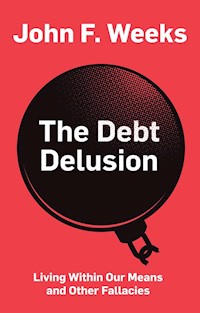
'Governments should spend no more than their tax income.' Most people in Europe and North America accept this statement as simple common sense. It resonates with the deeply engrained economic metaphors that dominate public discourse, from 'living within your means' to 'balancing the budget' - all necessary, or so conventional wisdom holds, to avoid the dangers of debt, taxation and financial ruin. This book shows how these homely metaphors constitute the 'debt delusion': a set of plausible-sounding yet false ideas that have been used to justify damaging austerity policies. John Weeks debunks these myths, explaining the true story behind public spending, taxation, and debt, and their real function in the management of our economies. He demonstrates that disputes about public finances are not primarily technical matters best left to specialists and experts, as many politicians would have us believe, but rather fundamentally questions about our true political priorities. Requiring no prior economic knowledge, this is an ideal primer for anyone wishing to cut through the rhetoric and misinformation that dominate political debates on economics and become an informed citizen.
Sie lesen das E-Book in den Legimi-Apps auf:
Seitenzahl: 268
Veröffentlichungsjahr: 2020
Ähnliche



















CONTENTS
Cover
Front Matter
Introduction: Debt, Deficits and Austerity
A Citizen’s Guide
Austerity Politics
Austerity in Practice
Austerity Politics and Reality
1 We Must Live Within Our Means
The Myth Itself
What Are Our Means?
How Governments Borrow
Public Sector Auto-Finance
From Myth to Reality
2 Governments Must Balance Their Books
The Myth Itself
Budget Uncertainty
Why Do Governments Tax?
From Myth to Reality
3 We Must Tighten Our Belts
The Myth Itself
The Affordability Fallacy
Social Protection and Equity
From Myth to Reality
4 Never Go into Debt
The Myth Itself
Why Debt Accumulates
Debt and the Economic Cycle
Myth and Reality
5 Taxes Are a Burden
The Myth Itself
The Eponymous Taxpayer
Taxes in the Concrete
From Myth to Reality
6 Austerity: There is No Alternative
The Myth Itself
Public Debt Disasters
Euro Debt Crisis and the TINA Principle
Fear of Deficits and Inflation
From Myth to Reality
7 Always an Alternative
Decommissioning Exchange Rates
Decommissioning Monetary Policy
Decommissioning Fiscal Policy
There is an Alternative: Democracy
Index
End User License Agreement
List of Tables
Chapter 5
Table 5.1
Distribution of central government expenditures, Germany, United Kingdom and Uni…
List of Illustrations
Introduction
Figure 0.1
Public revenue minus spending for the United States, 1950–2018, percentage of gr…
Figure 0.2
Public revenue minus spending for the United Kingdom, 1950–2017, percentage of g…
Figure 0.3
Index of total public expenditure, United Kingdom and United States, 2000–2017
Figure 0.4
Index of total public expenditure, four major eurozone countries, 2000–2017
Figure 0.5
Index of total public expenditure, three austerity-implementing eurozone countri…
Chapter 2
Figure 2.1
Balancing a simple economy that has one part
Figure 2.2
Balancing a more complete economy that has two parts
Figure 2.3
Balancing a complete three-part economy
Figure 2.4
Automatic stabilization of the UK economy, public and private lending/borrowing,…
Figure 2.5
Managing the economy into the Goldilocks Zone
Chapter 3
Figure 3.1
Public pension payments in six high-income countries, 1991–2013
Figure 3.2
Ratio of disposable income to original income, United Kingdom and United States,…
Figure 3.3
Ratio of disposable income and final income to original income, United Kingdom, …
Chapter 4
Figure 4.1
Household income, expenditure and debt
Figure 4.2
“Delinquent” loans of US commercial banks by type, 1998–2017
Figure 4.3
United States: federal, non-financial corporate, and household debt as share of …
Figure 4.4
United Kingdom: federal, nonfinancial corporate, and household debt as share of …
Figure 4.5
Germany: all government, nonfinancial corporate, and household debt as a share o…
Figure 4.6
Governments grow out of debt: debt to GDP ratio for the United Kingdom and the U…
Chapter 5
Figure 5.1
Per capita income and per capita tax for twenty countries, all levels of governm…
Figure 5.2
Government taxes on US, UK and German households by income quintile, mid-2010s
Figure 5.3
Percentage distribution of tax revenue by type, EU, Germany, UK and US, 2015
Figure 5.4
Distribution of the US federal government debt, 2017
Figure 5.5
Distribution of the UK government gross debt, 2017
Chapter 6
Figure 6.1
Value of debt defaults, 1980–2016
Figure 6.2
Interest rates on long-term public bonds, seven eurozone countries and the UK, 2…
Figure 6.3
Two components of the US consumer price index, 2000–2017
Figure 6.4
Two components of the UK consumer price index, 2000–2017
Guide
Cover
Table of Contents
Begin Reading
Pages
a
b
ii
iii
iv
1
2
3
4
5
6
7
8
9
10
11
12
13
14
15
16
17
18
19
20
21
22
23
24
25
26
27
28
29
30
31
32
33
34
35
36
37
38
39
40
41
42
43
44
45
46
47
48
49
50
51
52
53
54
55
56
57
58
59
60
61
62
63
64
65
66
67
68
69
70
71
72
73
74
75
76
77
78
79
80
81
82
83
84
85
86
87
88
89
90
91
92
93
94
95
96
97
98
99
100
101
102
103
104
105
106
107
108
109
110
111
112
113
114
115
116
117
118
119
120
121
122
123
124
125
126
127
128
129
130
131
132
133
134
135
136
137
138
139
140
141
142
143
144
145
146
147
148
149
150
151
152
153
154
155
156
157
158
159
160
161
162
163
164
165
166
167
168
169
170
171
172
173
174
175
176
177
178
179
180
181
182
183
184
185
186
187
188
189
190
191
192
193
194
195
196
197
198
199
200
201
202
203
204
205
206
207
208
209
210
“Analytically brilliant; crystal clear writing; forensic in its investigation; entertaining and erudite. If you want to know what the alternative to austerity is, there is no better guide.”
Danny Dorling, University of Oxford
“John Weeks is one of the most incisive critics of austerity policy. In this book he shows, in clear, non-technical language, how the mythology of ‘balancing the books’ has subverted public understanding of the social and economic purpose of state budgets, allowing governments to inflict serious, unnecessary and possibly lasting damage on ordinary citizens.”
Lord Robert Skidelsky, Warwick University and the British Academy
“John Weeks is a distinguished and worldly economist who, long before it became fashionable, rigorously, and to devastating effect, contested the intellectual foundations of neoliberal economics. His generosity in sharing his deep knowledge of economic theory, policies and systems has inspired and motivated many thousands of students, policy makers and activists. His work in discrediting the policies of austerity laid the foundations on which Labour’s Corbyn movement was built and popularized.”
Ann Pettifor, Director, Prime Economics
“Austerity is one of the greatest deceptions foisted on the British public in modern history. It was based on ideological economics designed to accelerate the dismantling of the social state and the privatization of the commons. John Weeks has been a consistent principled critic since the austerity era was launched. His scorn should be welcomed.”
Guy Standing, SOAS, University of London
“John Weeks has been one of the most powerful critics of mainstream neoclassical economics and of neoliberal economic policies in the last few decades. His analyses are razor-sharp and his criticisms unsparing, but he uses them to propose ways to build a solidaristic economy and a compassionate society.”
Ha-Joon Chang, University of Cambridge
“John Weeks has been a vigorous campaigner against the fallacies of neoliberal economics. He is a model to us all in his energy and resilience in making the case for a more progressive economics and promoting an alternative approach to economic policy making that is sorely needed. He draws on his long and valuable experience in teaching, research and advising governments around the world. It is a tribute to his influence and his clarity of exposition that his students are now taking his ideas forward both at home and abroad.”
Susan Himmelweit, Open University
Dedication
For my son Matthew Dore-Weeks
The Debt Delusion
Living Within Our Means and Other Fallacies
John F. Weeks
polity
Copyright © John F. Weeks 2020
The right of John F. Weeks to be identified as Author of this Work has been asserted in accordance with the UK Copyright, Designs and Patents Act 1988.
First published in 2020 by Polity Press
Polity Press65 Bridge StreetCambridge CB2 1UR, UK
Polity Press101 Station LandingSuite 300Medford, MA 02155, USA
All rights reserved. Except for the quotation of short passages for the purpose of criticism and review, no part of this publication may be reproduced, stored in a retrieval system or transmitted, in any form or by any means, electronic, mechanical, photocopying, recording or otherwise, without the prior permission of the publisher.
ISBN-13: 978-1-5095-3296-4
A catalogue record for this book is available from the British Library.
Library of Congress Cataloging-in-Publication Data
Names: Weeks, John, 1941- author.Title: The debt delusion : living within our means and other fallacies / John Weeks.Description: Cambridge, UK ; Medford, MA : Polity Press, 2019. | Includes bibliographical references and index.Identifiers: LCCN 2019016223 (print) | LCCN 2019018253 (ebook) | ISBN 9781509532964 (Epub) | ISBN 9781509532933 (hardback) | ISBN 9781509532940 (pbk.)Subjects: LCSH: Debts, Public. | Finance, Public. | Government spending policy. | Fiscal policy.Classification: LCC HJ8015 (ebook) | LCC HJ8015 .W44 2019 (print) | DDC 336.3/4--dc23LC record available at https://lccn.loc.gov/2019016223
The publisher has used its best endeavours to ensure that the URLs for external websites referred to in this book are correct and active at the time of going to press. However, the publisher has no responsibility for the websites and can make no guarantee that a site will remain live or that the content is or will remain appropriate.
Every effort has been made to trace all copyright holders, but if any have been overlooked the publisher will be pleased to include any necessary credits in any subsequent reprint or edition.
For further information on Polity, visit our website: politybooks.com




