


17,99 €
Mehr erfahren.
- Herausgeber: John Wiley & Sons
- Kategorie: Fachliteratur
- Sprache: Englisch
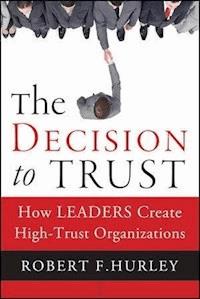
A proven model to create high-performing, high-trust organizations
Globally, there has been a decline in trust over the past few decades, and only a third of Americans believe they can trust the government, big business, and large institutions. In The Decision to Trust, Robert Hurley explains how this new culture of cynicism and distrust creates many problems, and why it is almost impossible to manage an organization well if its people do not trust one another. High-performing, world-class companies are almost always high-trust environments. Without this elusive, important ingredient, companies cannot attract or retain top talent.
In this book, Hurley reveals a new model to measure and repair trust with colleagues managers and employees.
- Outlines a proven Decision to Trust Model (DTM) of ten factors that establish whether or not one party will trust the other
- Filled with original examples from Daimler, PriceWaterhouse Coopers, Goldman Sachs, Microsoft, QuikTrip, General Electric, Procter and Gamble, AzKoNobel, Johnson and Johnson, Whole Foods, and Zappos
- Reveals how leaders in Asia, Europe, and North America have used the DTM to build high-trust organizations
Covering trust building in teams, across functions, within organizations and across national cultures, The Decision to Trust shows how any organization can improve trust and the bottom line.
Sie lesen das E-Book in den Legimi-Apps auf:
Seitenzahl: 344
Veröffentlichungsjahr: 2011
Ähnliche



















Table of Contents
Praise for The Decision to Trust
Title Page
Copyright
Dedication
Introduction
Chapter One: The Decision to Trust
A Deeper Look into the Decision to Trust
The State of Trust over Time
Making Sense of the Decline in Trust
The Implications of the Decline in Trust
Chapter Two: The Decision to Trust Model
Ten Essential Elements of Trust
Testing the DTM
Trust and Ethics
Chapter Three: How We Differ in Trusting
Risk Tolerance and Trust
Psychological Adjustment and Trust
Power and Trust
Influencing the Disposition to Trust
Chapter Four: Situational Factors in the Building of Trust
Security and Trust
Similarities and Trust
Alignment of Interests and Trust
Benevolent Concern and Trust
Capability and Trust
Predictability, Integrity, and Trust
Communication and Trust
Chapter Five: Tools for Diagnosing, Building, and Repairing Trust
Trust Building
Repairing Trust
Mind-Set and Skills for Trust Building
Larger-Scale Betrayal and Repair
Chapter Six: Trust in Leadership and Management
Build Risk Tolerance in the Face of Growing Risk
Inspire Self-Confidence, Especially in Low-Adjustment People
Balance Out Inequities Where You Have All the Power
Add Security to Insecure Circumstances
Cultivate Similarities and Shared Values in a Diverse Workplace
Keep Interests Aligned amid Competing and Conflicting Loyalties
Demonstrate Benevolence in a Bottom-Line World
Prove and Improve Your Capability in an Age of Complexity
Practice Predictability and Integrity in a Sea of Uncertainty
Communicate, Communicate, Communicate
Chapter Seven: Trust in Organizations
Building Organizational Trust
Embedding Elements of the DTM into the Organization
Chapter Eight: Building Trust Within Teams
Types of Teams and Forms of Trust
The DTM Factors Most Critical to Trust Within Teams
Chapter Nine: Building Trust Across Groups and National Cultures
Collaboration, Trust, and Performance
DTM Factors Most Critical to Trust Across Groups
Trust Across National Cultures
The DTM Factors Most Critical to Trust Across National Cultures
Chapter Ten: Hope for the Future of Trust
Improving Trustors
Improving Trustees
Engineering Trust into Organizational Systems
The Future
Appendix A: Research on the Antecedents to Trust
References
Appendix B: Trust Diagnosis Worksheet
Appendix C: Trust Interventions
Appendix D: Systemic Trust Interventions
Notes
Introduction
Chapter 1
Chapter 2
Chapter 3
Chapter 4
Chapter 5
Chapter 6
Chapter 7
Chapter 8
Chapter 9
Chapter 10
Acknowledgments
About the Author
Index
Praise for The Decision to Trust
“This book provides an invaluable perspective on what organizational trust really is all about and how it can be influenced by individuals, teams, and leadership systems. Dr. Hurley's research is both comprehensive and compelling. More important, it offers the reader practical guidelines and tools.”
—Jon R. Katzenbach, coauthor, Leading Outside the Lines, and senior vice president, Booz & Company
“For executives and managers who aspire to create high-trust organizations, Robert Hurley's The Decision to Trust is the book to read. The framework he proposes is eminently sensible and powerful. The Decision to Trust will help leaders reap the myriad benefits of trust within their own organizations.”
—Roderick M. Kramer, William R. Kimball Professor of Organizational Behavior, Graduate School of Business, Stanford University
“Nothing much happens within an organization unless there is a foundation of trust between its members. Robert Hurley makes building that fundamental trust very actionable. For a leader who is attempting to build a team, this model is invaluable. We've seen a lot of books on trust, but none come close to examining the issue of trust in working relationships with the rigor that Dr. Hurley has provided.”
—Doug Lennick and Fred Kiel, coauthors, Moral Intelligence
“This well-researched book provides valuable information for individuals, as well as for leaders of organizations, on how they can increase the trust that others have of them.”
—Morton Deutsch, E. L. Thorndike Professor Emeritus of Psychology and Director Emeritus of the International Center for Cooperation and Conflict Resolution, Teachers College, Columbia University
“Dr. Hurley's deep experience in research and in the trenches of organizational practice allows him to offer some powerful ideas on how to manage trust. The Decision to Trust is full of useful insights and should be required reading for leaders and anyone seeking to earn and keep others' trust.”
—Chester Cadieux, chairman and CEO retired, Quiktrip Corporation
“In these times, when working with organizational executives, the issue that constantly tops the list is trust—that is, the lack thereof. Mistrust is pervasive, cutting across all kinds of organizations, and is highly stable, whereas trust is delicate and can be destroyed in a nanosecond. Trust, therefore, can never be taken for granted, as Hurley makes abundantly clear in this excellent book. His invaluable contribution has been to provide a model for (a) how to understand the nature of trust and (b) what the key criteria are in deciding whether to trust in the first place. Hurley has addressed one of the most important issues in human relationships today.”
—W. Warner Burke, Edward Lee Thorndike Professor of Psychology and Education, Teachers College, Columbia University
Copyright © 2012 by Robert F. Hurley. All rights reserved.
Published by Jossey-Bass
A Wiley Imprint
989 Market Street, San Francisco, CA 94103-1741—www.josseybass.com
No part of this publication may be reproduced, stored in a retrieval system, or transmitted in any form or by any means, electronic, mechanical, photocopying, recording, scanning, or otherwise, except as permitted under Section 107 or 108 of the 1976 United States Copyright Act, without either the prior written permission of the publisher, or authorization through payment of the appropriate per-copy fee to the Copyright Clearance Center, Inc., 222 Rosewood Drive, Danvers, MA 01923, 978-750-8400, fax 978-646-8600, or on the Web at www.copyright.com. Requests to the publisher for permission should be addressed to the Permissions Department, John Wiley & Sons, Inc., 111 River Street, Hoboken, NJ 07030, 201-748-6011, fax 201-748-6008, or online at www.wiley.com/go/permissions.
Limit of Liability/Disclaimer of Warranty: While the publisher and author have used their best efforts in preparing this book, they make no representations or warranties with respect to the accuracy or completeness of the contents of this book and specifically disclaim any implied warranties of merchantability or fitness for a particular purpose. No warranty may be created or extended by sales representatives or written sales materials. The advice and strategies contained herein may not be suitable for your situation. You should consult with a professional where appropriate. Neither the publisher nor author shall be liable for any loss of profit or any other commercial damages, including but not limited to special, incidental, consequential, or other damages. Readers should be aware that Internet Web sites offered as citations and/or sources for further information may have changed or disappeared between the time this was written and when it is read.
Jossey-Bass books and products are available through most bookstores. To contact Jossey-Bass directly call our Customer Care Department within the U.S. at 800-956-7739, outside the U.S. at 317-572-3986, or fax 317-572-4002.
Wiley also publishes its books in a variety of electronic formats and by print-on-demand. Not all content that is available in standard print versions of this book may appear or be packaged in all book formats. If you have purchased a version of this book that did not include media that is referenced by or accompanies a standard print version, you may request this media by visiting http://booksupport.wiley.com. For more information about Wiley products, visit us at www.wiley.com.
Library of Congress Cataloging-in-Publication Data
Hurley, Robert F.
The decision to trust : how leaders create high-trust organizations / Robert F.
Hurley.—1st ed.
p. cm.
Includes bibliographical references and index.
ISBN 978-1-118-07264-6 (cloth); ISBN 978-1-118-13186-2 (ebk); ISBN 978-1-118-13187-9 (ebk); ISBN 978-1-118-13188-6 (ebk)
1. Trust-Psychology. 2. Leadership. 3. Trust-Case studies. I. Title.
BF575.T7H87 2012
658.4′092-dc23
2011030029
This book is dedicated to the two people who have affected my life in the most profound ways.
To my wife, Kathleen Conway Hurley, whom I have been blessed to call my wife and trusted partner for over thirty years. No one lives the ideas concerning trustworthiness found in these pages better than you.
Introduction
Having helped business leaders solve problems for more than thirty years, I have seen as both a researcher and a practitioner that organizational life has changed in fundamental ways. One of the most profound changes has been the loss of loyalty and trust, both of which have declined globally in nearly all industrialized democracies over the past three decades. If we define loyalty as a sense of duty and support among parties in a relationship, we are safe in saying that in most organizations today, loyalty is largely contingent on favorable economics and that this foundation is increasingly unstable and uncertain. The decline of loyalty in organizations may be the irreversible consequence of globalization, the growth of market-based economies, and the dynamics of creative destruction and innovation.1 In fact, many would argue that organizations that must be agile to respond to rapidly changing markets can operate more effectively with less loyalty. But what happens when trust is lost? To what degree can an organization continue to be agile and effective when feelings of trust among employees, customers, investors, or other stakeholders have been replaced by distrust or suspicion?
Trust is the degree of confidence you have that another party can be relied on to fulfill commitments, be fair, be transparent, and not take advantage of your vulnerability. A simple thought experiment shows the consequences when trust is lost. Ask yourself, in the absence of force or coercion, how sustainable and vigilant would your commitment be to a partner who you thought would take advantage of you if given the opportunity? What about your commitment to a company where you believed that the CEO was exclusively concerned with his own income? Would you be willing to give up some resource (money, energy, water) to another party (person, organization, nation) if you felt that others would take advantage, squander your donation, and never reciprocate? Of course, the answer is that distrust reduces your willingness to cooperate, and therein lies the danger of a loss of trust. When we lose trust, we lose cooperation. Without trust, organizations and societies begin to break down. The loss of trust is much more dangerous than the loss of loyalty because it is an essential element to all effective relationships.
This book is the result of decades of working to apply research on trust with individuals, teams, and organizations. It is the product of a commitment to understand what trust really is and how it can be influenced in the variety of environments that we vulnerable humans must navigate. Most important, this book explains why some people, groups, organizations, and institutions have been able to defy the overall trend of declining trust—how they have created trust even in environments where change, uncertainty, and risk exist.
The essence of this book is the Decision to Trust Model (DTM), which can be used to make better trust decisions and to help diagnose and build trust. The development of the DTM involved going back and forth from research to practice to create a model that was grounded in the science of trust but also useable with leaders, teams, and organizations. I examined much of the vast theoretical and empirical research on trust, then tested the model in practice with many individuals, teams, and organizations over a twenty-year period. Beginning in 1990, I used the model in sessions on trust in an ongoing Columbia Business School executive program called High Impact Leadership and in Executive MBA classes at the Fordham Graduate School of Business. In these sessions, executives were asked to talk about how they made decisions to trust or distrust, and we covered trust at multiple levels: trust in a person, group, and organization. Each time, we used the latest iteration of the trust model to help them diagnose a trust relationship. Each year, I refined the model, balancing the goals of making it both thorough and practicable.
In 2006, a version of the model was published in the Harvard Business Review.2 Many people and companies found the model useful; this led to more experience applying the model with executives, teams, and in some cases entire organizations, helping train leaders about what trust is and how it can be managed. The DTM has been used by over a thousand executives in Asia, Europe, and North America to understand, diagnose, and build trust relations. These experiences led to further refinement of the model and to the development of a variety of tools and techniques to diagnose and build trust. All of these tools and techniques for diagnosing and building trust are presented in this book.
The model uses ten specific factors that have a bearing on whether people will be comfortable trusting. The ten factors are risk tolerance, adjustment, power, situational security, similarities, interests, benevolent concern, capability, predictability and integrity, and communication. Each of these factors will be reviewed in detail in this book, but for now what is important to know is that this list of ten items is both comprehensive and useful for addressing a variety of trust issues at the individual, group, and organizational levels. The DTM enables a clear diagnosis of why trust is high or low and, perhaps more important, aids in pinpointing areas for interventions and designing concrete actions to improve trust.
Using the DTM to make trust more understandable and manageable enables us to
Make better decisions concerning whom to trust, so as to avoid harm and to increase pressure on untrustworthy agents to reform themselvesAllocate our trust-building energy better by appreciating how different people approach the trust decisionIdentify the root cause of trust issuesOffer concrete interventions and reforms that can enhance trustDistinguish situations in which building and repairing trust can work from those where it may not workEnhance trust at different levels: with a person, within teams, across teams, across national cultures, within organizations, and in leadershipThis book is organized as follows. Chapter One, The Decision to Trust, explores trust as a decision-making process, reviews the trends of declining trust, and offers some explanation for the loss of trust. Chapter Two, The Decision to Trust Model, reviews the inputs to the trust decision and outlines the DTM, which can be used to understand and diagnose situations requiring a decision to trust. Through real examples and common trust scenarios, the model shows how to determine which of the ten factors are most trust deficient and what steps can be taken to improve the prospects for a successful trusting exchange.
Chapter Three, How We Differ in Trusting, focuses on the three DTM factors that measure one's personal proclivity to trust: risk tolerance, adjustment, and power. We will witness the toll that compulsive mistrust—commonly called micromanagement—can take on a company's or division's bottom line.
Chapter Four, Situational Factors in the Building of Trust, examines situational and relationship issues between parties that build or destroy trust. Special attention is paid to the seven DTM factors that affect relationships, such as the alignment of interests, predictability, integrity, and benevolence. Chapter Five, Tools for Diagnosing, Building, and Repairing Trust, explains how to use DTM analysis to remedy and repair areas of trust where needed, drawing on the trust workshops I have held across Asia, Europe, and North America in recent years.
Chapter Six, Trust in Leadership and Management, offers some concrete ideas on how to lead with trust, and discusses how leaders at any level can take active steps toward making their companies high-trust organizations. Chapter Seven, Trust in Organizations, examines the process of embedding a high-trust culture; it profiles examples of companies that have defied the trend of declining trust. Chapter Eight, Building Trust Within Teams, covers how trust can be developed within groups and teams. How to create a unifying identity and common goals is a key focus. Chapter Nine, Building Trust Across Groups and National Cultures, addresses how trust and trust building operate across functional, geographic, company, and national cultural partitions. The book concludes with Chapter Ten, Hope for the Future of Trust, which offers three major paradigm shifts that will be necessary to restore trust in our more cynical age.
My hope is that after reading this book, you will never think about trust and trustworthiness the same way. You will know why you trust or distrust, you will be better able to repair trust, and, most important, you will understand how to build trustworthiness in yourself, your teams, and your organization. In doing so, you will ensure more sustainable progress and eliminate a great deal of angst in your life and in the lives of those around you.
Chapter One
The Decision to Trust
Trust is central to human existence. Like all social animals, human beings have an instinctive need to cooperate and rely on each other in order to satisfy their most basic emotional, psychological, and material needs. Without trust, we are not only less happy as individuals but also less productive in groups. Research has linked the virtues and benefits of trust to economic prosperity, societal stability, and even human survival.1 The powerful effect of trust is that it enables cooperative behavior without costly and cumbersome monitoring and contracting. In short, trust is a form of social capital that enhances performance between individuals, within and among groups, and in larger collectives (for example, organizations, institutions, and nations).
Yet even though the decision to trust is so important, most of us can provide only rudimentary explanations of why we choose to trust certain people, groups, and institutions and not others. Trust, like love and happiness, is difficult for people to explain in clear, rational terms. This often makes us very bad trustors (a person deciding to trust or distrust). It also can create problems for us in life. We extend trust with only a vague sense of our reasons for trusting, and we unknowingly create an incentive and a market for untrustworthy opportunists who rely on a steady supply of naïve trustors. In not understanding trust, we may also fail to grasp why someone might be wary of giving us his or her trust. Worst of all, we may sometimes act unintentionally in ways that erode others' trust in us.
Lesen Sie weiter in der vollständigen Ausgabe!
Lesen Sie weiter in der vollständigen Ausgabe!
Lesen Sie weiter in der vollständigen Ausgabe!
Lesen Sie weiter in der vollständigen Ausgabe!
Lesen Sie weiter in der vollständigen Ausgabe!
Lesen Sie weiter in der vollständigen Ausgabe!
Lesen Sie weiter in der vollständigen Ausgabe!
Lesen Sie weiter in der vollständigen Ausgabe!
Lesen Sie weiter in der vollständigen Ausgabe!
Lesen Sie weiter in der vollständigen Ausgabe!
Lesen Sie weiter in der vollständigen Ausgabe!
Lesen Sie weiter in der vollständigen Ausgabe!
Lesen Sie weiter in der vollständigen Ausgabe!
Lesen Sie weiter in der vollständigen Ausgabe!
Lesen Sie weiter in der vollständigen Ausgabe!
Lesen Sie weiter in der vollständigen Ausgabe!
Lesen Sie weiter in der vollständigen Ausgabe!




