


4,49 €
Mehr erfahren.
- Herausgeber: neobooks
- Kategorie: Erotik
- Serie: Natascha K – Dark Romance Romane
- Sprache: Deutsch
She says nothing. He does not either. Yet everything between them is decided. In the small northern town of Torgelow, where economic pressure, routine, and silence shape everyday life, Jana and Maik build a relationship that refuses simple definition. There are no dramatic declarations, no guarantees, no safe formulas. Only presence, tension, attraction, and the constant negotiation between closeness and independence. Their connection moves through uncertainty, emotional vulnerability, quiet power dynamics, and moments of unexpected tenderness. External pressures, past relationships, shifting stability, and personal autonomy test what they are willing to risk for each other. This dark romance explores intimacy without illusion, love without formal security, and the fragile strength of choosing someone again and again without certainty. Atmospheric, emotionally intense, and grounded in realistic social context, this novel examines how modern relationships form under economic strain, personal freedom, and the need for emotional honesty. Attention: The author uses artificial intelligence for creating most of his texts (and is required to disclose this use).
Das E-Book können Sie in Legimi-Apps oder einer beliebigen App lesen, die das folgende Format unterstützen:
Seitenzahl: 156
Veröffentlichungsjahr: 2026
Ähnliche









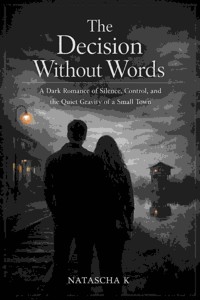
The Decision Without Words
Subtitle:
A Dark Romance of Silence, Control, and the Quiet Gravity of a Small Town
Trigger Warning
This novel contains dark romantic themes, emotional tension, psychological conflict, power imbalance, and depictions of toxic relational dynamics.
The story focuses on atmosphere, emotional perspective, and interpersonal intensity rather than explicit violence or sensationalism.
Reader discretion is advised.
Foreword
Some decisions are not spoken.
They settle between two people the way fog settles over a river. Quiet. Persistent. Impossible to fully grasp.
This story unfolds in a small northern German town where streets remember footsteps and silence often carries more weight than words. The people here move carefully. Sometimes out of habit. Sometimes because they know exactly who might be watching.
At its core, this novel explores closeness that never feels entirely safe. Attraction that does not ask permission. The subtle negotiation between distance and surrender. It is not a story about perfect love. It is about presence, absence, and the space in between.
Nothing here demands judgment. Nothing insists on explanation. What matters is what remains unsaid, what lingers after a glance, what grows quietly when neither side chooses to step away.
Some choices happen long before anyone admits them.
Disclaimer
This is a work of fiction. Names, characters, locations, businesses, streets, and incidents are used fictionally, even where real geographic settings are referenced. Any resemblance to actual persons, living or dead, is coincidental.
This novel was created with the assistance of artificial intelligence as a creative writing tool. Human guidance, editing, and narrative direction shaped the material, but portions of the text were generated through AI-supported processes.
The book aims to explore emotional complexity, psychological tension, and relational ambiguity. It does not promote harmful behavior, violence, or toxic relationships. Readers are encouraged to interpret the material critically and personally.
The purpose of this work is literary exploration, not instruction, endorsement, or factual representation.
Imprint:
V. i. S. d. P.: Marcus Petersen-Clausen, Ginsterweg 7, 30900 Mellendorf/Wedemark (DE) - Tel.: 491796162178
Dieses Dokument ist lizenziert unter dem Urheberrecht!
(c) 2026 Marcus Petersen-Clausen
(c) 2026 Köche-Nord.de
Table of Contents:
Chapter One: Where Silence Begins
Chapter Two: The Shape of Staying
Chapter Three: Where Streets Remember
Chapter Four: Distances That Narrow Quietly
Chapter Five: Lines That Quietly Close
Chapter Six: The Weight of What Is Not Said
Chapter Seven: Echoes Beneath Familiar Streets
Chapter Eight: What Stays Beneath the Surface
Chapter Nine: What People Do Not Finish Saying
Chapter Ten: Where Familiar Paths Begin to Shift
Chapter Eleven: What Surfaces Slowly
Chapter Twelve: Where Stories Begin to Show Edges
Chapter Thirteen: Between Familiar Ground and Unf
Chapter Fourteen: What Slips Away and Quietly Returns
Chapter Fifteen: When Familiar Ground Changes Shape
Chapter Sixteen: Where Distance Finally Breaks
Chapter Seventeen: Where Presence Begins to Matter More Than Distance
Chapter Eighteen: Where Closeness Becomes Something That Cannot Be Ignored
Chapter Nineteen: Where Gravity Turns Into Pressure
Chapter Twenty: Where Silence Stops Protecting
Chapter Twenty-One: Where Light Falls Too Clearly
Chapter Twenty-Two: Where Composure Finally Breaks
Chapter Twenty-Three: Where Aftermath Creates Quiet Resolve
Chapter Twenty-Four: Where Light Softens the Edges Again
Chapter Twenty-Five: Where Familiar Streets Begin to Hold Different Meanings
Chapter Twenty-Six: Where Something Quietly Surfaces
Chapter Twenty-Seven: Where Stillness Hides a Sudden Fracture
Chapter Twenty-Eight: Where What Was Stable Begins to Shift Again
Chapter Twenty-Nine: Where Altered Perception Changes the Quiet Balance
Chapter Thirty: Where Familiar Streets Reflect Unfamiliar Thoughts
Chapter Thirty-One: Where Softness Returns Without Warning
Chapter Thirty-Two: Where a Question Changes the Shape of Silence
Chapter Thirty-Three: Where Time Becomes a Deliberate Space
Chapter Thirty-Four: Where Saying No Does Not End What Exists
Chapter Thirty-Five: Where Calm Reveals What Still Moves Beneath
Chapter Thirty-Six: Where Stability Learns to Bend
Chapter Thirty-Seven: Where Quiet Decisions Begin Before Words Exist
Chapter Thirty-Eight: Where Love Stays Without Promises
Epilogue: Where What Remains Becomes the Story
Addiction Support Websites in Germany and Europe
Chapter One: Where Silence Begins
Malchin always seemed quieter after rain. Not cleaner. Not calmer. Just muted, as if every sound had to push through a layer of damp air before reaching anyone. Jana noticed it the moment she stepped off the bus near BahnhofstraĂźe. The pavement still held thin reflective streaks, streetlights trembling inside them.
She pulled her jacket closer but did not hurry. There was no one waiting. No one expecting her.
Across the street, the bakery window glowed faintly. Someone inside laughed. Short, restrained. It faded quickly, like most things here.
Malchin had that effect. It never forced people out, but it rarely held them tightly either.
Except sometimes.
She sensed him before she saw him. That slight shift in attention, the instinctive awareness that another gaze had settled somewhere near her shoulder. Not intrusive. Not accidental.
Maik stood beside the ticket machine, hands in pockets, posture relaxed in a way that did not look entirely natural. Early nineties haircut still stubbornly present, dark blond, slightly uneven. He had not changed much since school. Maybe quieter. Maybe sharper around the eyes.
Neither spoke at first.
Rainwater dripped rhythmically from the station roof. Somewhere, a car passed slowly.
“Long day?” he finally asked.
She shrugged. Not dismissive. Not inviting.
“Same as always.”
A pause followed. Not uncomfortable exactly. More like unfinished.
They began walking without deciding it. Toward the parking area first, then beyond it, where the street curved toward the old town center. Their steps found a shared rhythm quickly, though neither acknowledged it.
“You still go to Torgelow often?” he asked.
“Sometimes. Work mostly.”
He nodded. Looked ahead. “Ferdinandstraße still feels the same?”
“Mostly. Empty shops more than before.”
That corner where a clothing store used to be now carried a handwritten lease sign fading from sun and weather. She had stared at it last week longer than necessary.
Maik exhaled quietly. “People leave. Or they stay and count every euro.”
She glanced sideways. His expression remained neutral, but his jaw moved slightly, as if something unspoken pressed there.
“My sister moved west,” she said. “Says planning anything long term here feels… unrealistic.”
“Low wages,” he said. “Low buying power. Hard to build anything.”
They reached the small bridge crossing the Peene. Water moved slowly beneath, almost hesitant.
“It’s not just money,” Jana said. “It’s what it does to people. Always calculating. Always adjusting.”
He looked at her then. Directly. Longer than casual.
“And yet you’re still here.”
“So are you.”
A faint smile appeared on his face. Not warmth exactly. Recognition perhaps.
“Habit,” he said.
“Or attachment.”
Neither clarified.
The air cooled further. Evening settling in layers. Lights appearing in windows one by one.
Later that week, she found herself in Torgelow again. UeckermĂĽnder StraĂźe carried its usual restrained traffic, nothing rushed, nothing loud. She finished work early and walked instead of taking the bus immediately.
The Markt area looked almost staged in its quietness. A few people crossing, heads slightly lowered. Conversations brief.
Maik’s message had been simple earlier:
Coffee later? Bahnhof or market. Your choice.
She had not answered. Yet here she was.
The café near Bahnhofstraße was half empty. She chose a table facing the window. Control through observation. Always easier that way.
He arrived without visible hurry. Sat opposite her. Ordered nothing yet.
“You didn’t reply,” he said.
“But I came.”
“Yes.”
Another pause. He seemed comfortable inside it. That unsettled her more than direct questions would have.
“You ever think about leaving?” he asked after a while.
“Often.”
“But?”
“My parents. The apartment. And… you know how it is.”
He did. Of course he did.
“Hard to save. Hard to plan retirement. Hard to feel secure,” he said quietly. “Mecklenburg-Vorpommern isn’t exactly known for economic optimism.”
“That sounds like a brochure nobody printed.”
He almost laughed. Almost.
Outside, a train passed slowly. Reflected light slid across the café wall, then vanished.
“Still,” he continued, voice lower now, “there’s something about staying.”
“Fear?”
“Maybe. Or familiarity.”
She held his gaze this time. Deliberately. Testing how long he would maintain it.
He did.
Not aggressive. Not soft either. Just steady. Patient.
That steadiness made distance complicated.
Later they walked toward the edge of town. The direction of Ukranenland, though neither said it aloud. The reconstructed Slavic settlement lay quiet this time of year, wooden structures dark against the fading sky.
Tourist place in summer. Almost abandoned in winter.
“Strange place for reflection,” she murmured.
“History helps people pretend stability exists,” he replied.
“And does it?”
“No.”
The wind shifted. She stepped slightly closer without deciding to. He noticed. Said nothing. Adjusted his pace subtly so their shoulders nearly touched.
Not touching. Almost.
Control sometimes looked exactly like that. Not forcing. Just shaping space.
“Back in school,” he said after a while, “you rarely spoke.”
“You spoke enough for both.”
“That wasn’t confidence.”
“No?”
“More like… avoidance.”
She stopped walking. He stopped too.
Silence settled again. Thicker now.
“What are we doing, Maik?” she asked quietly.
“Walking.”
“You know what I mean.”
“Yes.”
He did not elaborate.
That non-answer stayed between them like an object neither wanted to move. She could have insisted. Could have demanded clarity.
Instead she resumed walking.
Because clarity sometimes closed doors.
At Bahnhof Torgelow, the platform lights flickered on. The next train to Malchin would arrive soon. Announcements echoed faintly.
He stood beside her but slightly behind. Positioning that felt intentional. Protective perhaps. Or observational.
“You don’t have to stay,” he said suddenly.
“I know.”
“But you do.”
“So do you.”
A longer pause. Then:
“Maybe some decisions happen without words.”
She did not respond.
The train arrived. Doors opened with a soft mechanical sigh. She stepped inside, found a seat by the window.
Maik remained on the platform.
Not waving. Not signaling.
Just watching.
As the train pulled away, she noticed he had not moved at all.
And she did not look away until the curve of the track made it impossible.
Something had settled. No declaration. No agreement.
But something decided nonetheless.
Chapter Two: The Shape of Staying
The next time Jana saw Torgelow, the sky hung low enough to make the rooftops look compressed. Clouds pressed downward like a lid. She stepped off the train at Bahnhof Torgelow and stood still for a moment longer than necessary, letting the metallic smell of wet rails settle in her throat.
She told herself it was habit. Nothing more.
BahnhofstraĂźe stretched ahead with its restrained afternoon movement. A cyclist passed, tires whispering over damp asphalt. Somewhere a delivery truck idled, diesel vibrations steady, almost comforting in their predictability.
Maik had not written today.
Still she walked.
The bakery on the corner released a warm yeasty scent into the cold air. For a second she nearly went inside. Then she noticed her reflection in the glass. Slightly tense shoulders. Lips pressed together without awareness.
She continued toward the Markt instead.
The square carried its usual quiet. A few pensioners near the benches, conversations low. The fountain basin empty this season, leaves collecting where water would normally ripple. Buildings around the square showed the familiar mix of careful renovation and slow decline.
Economic reality made visible without anyone needing to name it.
Footsteps behind her. Not hurried. Not hesitant.
She did not turn immediately.
“You walk like you expect someone to follow,” Maik said.
His voice close enough that she felt the warmth of it near her ear before she faced him. He stood half a step behind, hands again in his jacket pockets, gaze steady but unreadable.
“I don’t,” she replied.
“Good.”
That single word carried something she could not categorize. Approval maybe. Or simple observation.
They began moving along the edge of the Markt, neither deciding who led. Their pace aligned quickly. Again.
“You didn’t message,” she said.
“You came anyway.”
“That isn’t an answer.”
“No.”
Silence folded back between them. Comfortable for him. Less so for her, though she would not show it.
They turned into Ferdinandstraße. Several storefronts stood empty now. Paper signs faded to pale rectangles. One window displayed a handwritten “Zu vermieten” curling slightly at the edges.
Maik slowed. Not enough to stop. Enough that she noticed.
“My cousin had a shop here,” he said. “Closed last year. Costs higher than income. Typical story.”
Jana nodded. She knew similar stories in Malchin. Everywhere in the region, really. Low wages, careful spending, plans postponed indefinitely.
“Hard to build anything stable,” she said.
He glanced sideways. “Stability is overrated.”
“Easy to say if you don’t need it.”
“And do you?”
She hesitated. Just a fraction too long.
His mouth curved slightly. Not quite a smile.
They reached the intersection with UeckermĂĽnder StraĂźe. Traffic louder here, though still far from city intensity. A bus passed, windows reflecting dull sky. The air smelled faintly of exhaust and wet concrete.
“Coffee?” he asked.
There was a café halfway down the street. She knew it. Small, slightly too warm inside, the kind of place where conversations linger longer than intended.
She agreed with a brief nod.
Inside, condensation fogged the windows. The hum of a refrigerator unit mixed with low music. They chose a table near the back. Not hidden. Not exposed.
Maik sat opposite but leaned back, one arm draped casually along the chair beside him. Space claimed without obvious effort.
Jana noticed. The detail stayed with her.
“You still working near here?” he asked.
“Yes. Temporary contract again.”
“Another one.”
“Yes.”
His gaze lingered on her hands resting around the coffee cup. She became aware of her fingers tightening slightly. She loosened them deliberately.
“Temporary keeps options open,” he said.
“Or prevents roots.”
“Roots can trap.”
She met his eyes. Held them.
“Depends who planted them.”
For a moment neither looked away. Something in his expression shifted, subtle but undeniable. Interest sharpened. Or caution.
Then he exhaled softly, tension dispersing almost invisibly.
Outside, light faded further. Streetlamps flickered on along UeckermĂĽnder StraĂźe, reflections trembling across the wet pavement.
“Ever think about leaving for good?” he asked again.
“Sometimes.”
“But you don’t.”
“You don’t either.”
“No.”
That admission sat heavier than expected.
When they left the café, the air had cooled noticeably. Evening traffic softened. They walked toward the direction of Ukranenland, wooden structures barely visible in the distance beyond darker tree lines.
Tourist attraction in summer. Quiet terrain now.
“Strange place,” Jana said.
“History reconstruction,” he replied. “People like the illusion of continuity.”
“And you?”
“I prefer control to illusion.”
The sentence landed softly yet carried weight. She felt it physically, somewhere between sternum and throat.
Wind lifted a strand of her hair. Before she could move it aside, his fingers brushed it back. Brief contact. Precise. Not lingering.
Still, her breathing changed slightly.
He noticed. Of course he did.
“Too close?” he asked.
“Not necessarily.”
That answer seemed to satisfy him.
They stopped near the edge of the wooded area leading toward Ukranenland. No one else nearby. Just distant road noise and occasional bird calls settling for night.
“You choose silence often,” he said.
“So do you.”
“Yes. But for different reasons.”
She waited. He did not explain.
A pattern forming.
“You like control,” she said quietly.
“And you don’t?”
She considered that. The question hung between them, unhurried.
“I like knowing where I stand.”
“That can change quickly.”
Another statement without explanation. Another faint tightening in her chest.
The streetlight behind him cast his face partly into shadow. Eyes harder to read now. Voice lower.
“People think danger announces itself,” he continued. “Usually it doesn’t. It just… stays near.”
The phrasing unsettled her. Not threatening exactly. Not reassuring either.
“Are you warning me?” she asked.
“No.”
“Informing me?”
“Maybe.”
Wind again. Colder now.
She realized he had stepped slightly closer during the conversation. Gradual enough she had not marked the exact moment. Distance reduced to something intentional.
Not invasive.
But unmistakable.
“I should go,” she said finally.
“Yes.”
He did not move aside immediately. Not blocking. Just holding position. A second longer than necessary.
Then he stepped back.
Control, again. Subtle. Consistent.
At Bahnhof Torgelow the platform lights buzzed faintly. Train approaching in six minutes according to the display board. She stood near the edge, hands in pockets.
Maik beside her. Quiet.
“You could stay tonight,” he said eventually. Tone neutral.
Not insistence. Not suggestion exactly.
Just possibility placed carefully.
She did not answer.
Train headlights appeared in the distance, two pale circles growing larger. Metal vibration reached them seconds later.
“You always leave before things clarify,” he added.
“And you never clarify them.”
“Fair.”
The train stopped. Doors opened.
She stepped inside without looking back immediately. Found a seat. Only then allowed herself to glance through the window.
He stood exactly where she had left him. Posture relaxed. Expression unreadable. Watching, but not waving.
Again.
As the train moved, Jana noticed something unfamiliar beneath the quiet tension. Not fear. Not comfort.
Something closer to gravity.
Pull without visible source.
And she had not yet decided whether resisting it mattered.
Chapter Three: Where Streets Remember
Jana arrived in Torgelow earlier than necessary. Morning light had that pale northern quality, not weak, not strong, simply diffused. It softened edges without making anything warmer. The train doors closed behind her with a hydraulic sigh, leaving a faint echo along the Bahnhof platform.
She did not head straight toward work.
Instead she turned left along BahnhofstraĂźe. The asphalt still carried night moisture, shoes producing that soft adhesive sound with each step. Familiar now. Predictable.
Predictability helped.
Across the street the small kiosk owner arranged newspapers, movements methodical. Headlines about rising prices again. Nothing surprising. Still unsettling in their repetition.
She continued until UeckermĂĽnder StraĂźe opened ahead. Traffic thicker this morning. Commuters. Delivery vans. People carrying routines on their shoulders. The smell of coffee drifted from a bakery entrance. Fresh rolls, yeast, warmth. For a second she imagined staying inside that scent all day.
She kept walking.
Maik’s message had come late last night:
Walk later. Not market. Somewhere quieter.
No explanation. No time specified.
She noticed she had not asked for either.
Work passed in fragments. Conversations about rent increases, temporary contracts, overtime requests that never turned into permanent positions. The usual regional arithmetic. Earn little. Spend carefully. Hope circumstances shift.
They rarely did.
By afternoon she left through the rear exit and followed FerdinandstraĂźe again. The closed clothing store window reflected her silhouette back, slightly distorted by uneven glass. For a moment she studied that reflection. Shoulders straighter than she felt. Expression composed.
Performance without audience.
She crossed toward Pasewalker StraĂźe. Traffic thinned there. Older residential buildings, some renovated, some hesitating between maintenance and slow decay. Curtains moving slightly behind windows. Observers without names.
Maik stood near the intersection with Blumenthaler StraĂźe. Exactly where shadow from a tall maple tree cut across the sidewalk. Positioning again. Always slightly removed from direct exposure.
“You chose quiet,” she said.
“You came.”
His eyes scanned her briefly. Not intrusive. Assessing.
“Long day?”
“Predictable.”
“That sounds exhausting.”
She almost smiled.




