


19,99 €
Mehr erfahren.
- Herausgeber: John Wiley & Sons
- Kategorie: Fachliteratur
- Sprache: Englisch
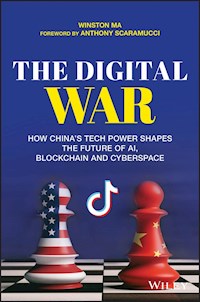
What new directions in China's digital economy mean for us all China is the largest homogenous digital market on Earth: unified by language, culture, and mobile payments. Not only a consumer market of unrivaled size, it's also a vast and hyperactive innovation ecosystem for new technologies. And as China's digital economy moves from a consumer-focused phase to an enterprise-oriented one, Chinese companies are rushing to capitalize on ways the newer wave of tech--the Internet of Things, AI, blockchain, cloud computing, and data analytics (iABCD)--can unlock value for their businesses from non-traditional angles. In The Digital War, Winston Ma--investment professional, capital markets attorney, adjunct professor of digital economy, and bestselling author--details the profound global implications of this new direction, including how Chinese apps for services such as food delivery expand so quickly they surpass their U.S. models within a couple of years, and how the sheer scale and pace of Chinese innovation might lead to an AI arms race in which China and the U.S. vie aggressively for leadership. * How China's younger netizens participate in their evolving digital economy as consumers, creators, and entrepreneurs * Why Online/Office (OMO, Online-merge-with-Offline) integration is viewed as the natural next step on from the O2O (Online-to-Offline) model used in the rest of the world * The ways in which traditional Chinese industries such as retail, banking, and insurance are innovating to stay in the game * What emerging markets can learn from China as they leapfrog past the personal computer age altogether, diving straight into the mobile-first economy Anyone interested in what's next for Chinese digital powerhouses--investors, governments, entrepreneurs, international business players--will find this an essential guide to what lies ahead as China's flexes new digital muscles to create new forms of value and challenge established tech giants across the world.
Sie lesen das E-Book in den Legimi-Apps auf:
Seitenzahl: 592
Veröffentlichungsjahr: 2020
Ähnliche
















Table of Contents
Cover
Praise for The Digital War
Praise for China's Mobile Economy
Title Page
Copyright
Dedication
Foreword
Author's Notes and Acknowledgments
About the Author
Preface
Part One: From “Mobile Economy” to “Digital Economy”
Part Two: China's Digital Transformation and Innovation
Part Three: Shared Digital Future
PART I: From “Mobile Economy” to “Digital Economy”
CHAPTER 1: China's Leap into 5G iABCD
Blockchain with Chinese Characteristics
AlphaGo, the Historical Match
AI First—“Second Half Game” of Mobile Internet
5G iABCD New Infrastructure
Digital Transformation in the Cloud
BaaS Startup Innovation Ecosystem
Splinternet and the Digital Silk Road
CHAPTER 2: The World’s Largest Mobile Economy
Ten Years of Xiaomi Smartphones and AIoT
“Mobile First” and “Mobile Only”
Shoppertainment: The Digital Middle Class
Singles' Day: Hard Tech Drives the e-Shopping Festival
BAT, TMD, and the New ATM
PART II: China's Digital Transformation and Innovation
CHAPTER 3: Big Data on the Digital Middle Class
The 4Cs Model: Know Your Customer
Freshippo OMO: E-commerce Will Die
C2M: Pinduoduo and Social E-commerce
Bullet Screens: Hollywood Losing the “Big Data” Movie Battle
Post-pandemic Consumers Come of Age
CHAPTER 4: The AI-powered Internet Celebrities and Fans Economy
Bilibili: Bullet Chats, Membership Questionnaires, and Gen Z Uploaders
Tencent's China Literature: The Gods of the Internet Novels
Beyond Twitter—The (Brief) Revival of Weibo's UGC Platform
TikTok: Goofy Videos Dominating Social Media
Kuaishou, iQIYI, and More: Into the Multiple Screen Competition
CHAPTER 5: The Heartland of Blockchain and Fintech
The Heart of Bitcoin and Blockchain Network
Red Envelopes and Mobile Payments
Crowd-funding and P2P Lending
Micro Loans, Big Data Solutions
AI and Alt-data for Wealth Management
Blockchain and SCF: Alliance of Alibaba and ICBC
CHAPTER 6: O2O and the Shared Economy
Sperm Donation, O2O, and the Sharing Economy
Didi Taking over Uber in China
Mobike and Ofo: Bike Sharing of Yesterday
Umbrellas, Sex Dolls, and Everything to Share
Meituan, Didi, and Ele.me: All-in-one On-demand Services Platform
From MaaS to OaaS—a Smart Pie
CHAPTER 7: From C2C to 2CC: “Innovated in China”
Say It with Starbucks
Premier's Cappuccino Kick-started Entrepreneurship
Hot on the Heels of Silicon Valley
2CC—Panda Kitchen Copied to the United States
From “Innovative Models” to “Innovative Technologies”
Peak Unicorn? The Critical Link with the United States
CHAPTER 8: Land of Big Data and Its Legal Framework
Facebook and China Awaken to Privacy
World's Largest Data Worker Pool in the Land of Big Data
From Human Flesh Search to Big Data Killing
The AI Age: Privacy, Security, and Value
New Rules for a New Game
Ride-hailing Sex Incidents: More Questions than Answers
Civil Code 2020 and More to Come
PART III: Shared Digital Future
CHAPTER 9: The Tech Cold War
ZTE's Shot Blocked
TID – Not All National Security Is the Same
Critical Technology and Semiconductor Chips
From Hard Tech to Invisible Data
China and the United States—Mutually Self-sufficient?
Europe, Japan, and More—the Divided Tech World
No Winner in Balkanization of Cyberspace
CHAPTER 10: The Silk Road in Cyberspace
Global Connectivity, Digital Divide
DSR Greens the Belt and Road
Farmer Retailers, Taobao Villages, and the Alibaba University
AI Anxiety and DSR Co-development
Israel and Everyone: Caught in the Middle
Innovative, Invigorated, Interconnected, and Inclusive
Bibliography
Chapter 1
Chapter 2
Chapter 3
Chapter 4
Chapter 5
Chapter 6
Chapter 7
Chapter 8
Chapter 9
Chapter 10
China's Digital Innovation Challenges US Tech Supremacy
Index
End User License Agreement
List of Tables
Chapter 1
Table 1.1 The speedy ascent (and retirement) of AlphaGo
Table 1.2 Major Chinese national and local government strategy an...
Chapter 2
Table 2.1 2019 Global top 5 smartphone companies
Table 2.2 Top 10 most used mobile apps in China
Chapter 3
Table 3.1 Alibaba's Taobao and Tmall marketplaces
Table 3.2 Main differences between Alibaba and JD
Table 3.3 Social e-commerce versus traditional e-commerce
Chapter 4
Table 4.1 Bilibili top 10 bullet chats in 2019
Table 4.1 The five ranks of web writers in China
Table 4.2 Weibo's critical adjustment to its positioning and offering
Chapter 5
Table 5.1 Online lending firms' dtocks dropping 90% from their highs
Table 5.2 Chinese banks/internet firms launch blockchain-based “...
Chapter 7
Table 7.1 New ideas from China to the United States
Chapter 8
Table 8.1 Selective improvements in 2020 Civil Code
Table 8.2 China's data law framework
Chapter 9
Table 9.1 [Seven] Six transactions blocked by US Presidential action
Chapter 10
Table 10.1 Countries signing DSR-specific MOUs with China
List of Illustrations
Chapter 1
Figure 1.1 How is DCEP designed?
Figure 1.2 Blockchain from 1.0 to 3.0
Figure 1.3 China's internet population jump with mobile internet
Figure 1.4 From “information consumption” to “digital economy”...
Figure 1.5 New infrastructure – 5G iABCD
Figure 1.6 Alibaba's IT infrastructure goes internal
Figure 1.7 Alibaba Cloud leads the Chinese market
Figure 1.8 From “Internet +” to data-driven digital economy...
Figure 1.9 China's innovation ecosystem
Figure 1.10 Global blockchain patent application 2019 ranking
Figure 1.11 The 3C transpacific synergy (of yesterday)
Figure 1.12 The Pacific Light Cable Network
Chapter 2
Figure 2.1 Xiaomi's dual engine
Figure 2.2 Tibet and remote provinces lead mobile payments
Figure 2.3 Riders for hire
Figure 2.4 China's “Male Beauty Era”
Figure 2.5 Weed – The three psychological stages of a consumer
Figure 2.6 Percentage (%) of mobile GMV on Singles' Days
Figure 2.7 Top 5 publicly listed Chinese internet companies
Figure 2.8 The bigger-than-you-thought Tencent empire
Chapter 3
Figure 3.1 Top 10 shampoo brands in China
Figure 3.2 The 4Cs in the smart economy
Figure 3.3 E-commerce giants acquiring offline stores
Figure 3.4 OMO seamlessly integrating online and offline
Figure 3.5 Rapid expansion of Freshippo stores
Figure 3.6 High percentage of supermarkets adding online persona
Figure 3.7 Together, more savings, more fun
Figure 3.8 Different platform users' profiles and DATs
Figure 3.9 Data through the life cycle of a movie
Figure 3.10 The declining China market share of Hollywood movies
Chapter 4
Figure 4.1 Young netizens dominating China's internet Demography
Figure 4.2 The three key components of a fan economy
Figure 4.3 Online novel business representing the 4Cs model
Figure 4.4 The Internet novel as the “upstream” IP
Figure 4.5 Ecosystem—Prolongs the life cycle of an online novel
Figure 4.6 Weibo's stock price run (2016–2019)
Figure 4.7 Rapid growth of DAUs and MAUs of Weibo (millions, 2015–2018)...
Figure 4.8 The TikTok family
Figure 4.9 The ecosystem of the fan economy
Figure 4.10 The coming age of multi-screen, multi-revenue model...
Chapter 5
Figure 5.1 China dominates Bitcoin mining's hash power
Figure 5.2 The fintech empire of Ant
Figure 5.3 The parties in a red envelope—fun and value
Figure 5.4 Mobile payment market share breakdown in China
Figure 5.5 “Fragmented time” and O2O activities
Figure 5.6 Crowd-funding: Public offering versus private placement
Figure 5.7 The abrupt expansion of P2P and its quick collapse (2012–2019)...
Figure 5.8 Two-way data Flow between Sesame Credit and digital businesses...
Figure 5.9 The rise (and recent fall) of Yu'e Bao (billion RMB, 2013–2018)...
Figure 5.10 The high volatility of China's stock market
Figure 5.11 ML augments quantitative investments
Figure 5.12 Blockchain from 1.0 to 3.0
Figure 5.13 Supply chain financing the leading blockchain application
Chapter 6
Figure 6.1 Location/map searches are the key to an O2O business model
Figure 6.2 Does owning a car improve one's social status?
Figure 6.3 The competitive landscape before Didi, Kuaidi, and Uber China's m...
Figure 6.4 Have you used the mobility solution that you are familiar with?...
Figure 6.5 China's bike sharing going global in 2017
Figure 6.6 Sector distribution of 59 sharing economy startups
Figure 6.7 The competitive landscape after the 2015 Meituan–Dianping merger...
Figure 6.8 The new competitive landscape of shared bikes
Figure 6.9 All-in-one on-demand services platform—three contenders...
Figure 6.10 Almost half of Chinese unicorns are in the sharing economy
Figure 6.11 MaaS in Chinese “smart” cities
Chapter 7
Figure 7.1 The digital path of Starbucks China
Figure 7.2 China's innovation ecosystem
Figure 7.3 Regional distribution of tech unicorns in China chart
Figure 7.4 From “C2C” to “2CC”
Figure 7.5 The sector distribution of internet and digital tech unicorns
Figure 7.6 Luckin Coffee's dark brew revenue booking
Figure 7.7 The United States is the No.1 listing choice of Chinese unicorns...
Chapter 8
Figure 8.1 AI fed on labeled data
Figure 8.2 Data: The new addition to “production factors”
Figure 8.3 Personal data—key resource for AI
Figure 8.4 Serious issues around personal data
Chapter 9
Figure 9.1 The TID focus of CFIUS
Figure 9.2 CFIUS member agencies
Figure 9.3 Japan and China's bids for Fairchild
Figure 9.4 The chain of ownership and control of Canyon Bridge
Figure 9.5 PII transactions undone by National Security Review
Figure 9.6 ByteDance ring-fenced data for CFIUS
Figure 9.7 5G-powered iABCD
Figure 9.8 New sovereign funds of the United States for 5G
Chapter 10
Figure 10.1 Internet users in rural areas as % of total Internet Population ...
Figure 10.2 The three prongs of the BRI
Figure 10.3 Virtuous circle of rural e-commerce
Figure 10.4 ASEAN marketplace empowered by Alibaba
Figure 10.5 DSR evolves from “hard” to “soft” connectivity...
Figure 10.6 Taobao “influencers” to discover "small but beautiful" brands...
Figure 10.7 China's leap forward in four decades
Figure 10.8 Number of high-impact AI experts (2015–2017)
Figure 10.9 The open blockchain-based service network, BSN
Figure 10.10 Five major parts of the BSN framework
Figure 10.11 Israel balancing United States–China relationships
Guide
Cover Page
Table of Contents
Begin Reading
Pages
i
ii
iii
iv
vii
viii
ix
xiii
xiv
xv
xvi
xvii
xviii
xix
xx
xxi
xxii
xxiii
xxiv
xxv
xxvi
xxvii
xxviii
xxix
xxx
xxxi
1
3
4
5
6
7
8
9
10
11
12
13
14
15
16
17
18
19
20
21
22
23
24
25
26
27
28
29
30
31
32
33
34
35
36
37
38
39
40
41
42
43
44
45
46
47
48
49
50
51
52
53
54
55
56
57
58
59
60
61
62
63
64
65
66
67
68
69
70
71
73
74
75
76
77
78
79
80
81
82
83
84
85
86
87
88
89
90
91
92
93
94
95
96
97
98
99
100
101
102
103
104
105
106
107
108
109
110
111
112
113
114
115
116
117
118
119
120
121
122
123
124
125
126
127
128
129
130
131
132
133
134
135
136
137
138
139
140
141
142
143
144
145
146
147
148
149
150
151
152
153
154
155
156
157
158
159
160
161
162
163
164
165
166
167
168
169
170
171
172
173
174
175
176
177
178
179
180
181
182
183
184
185
186
187
188
189
190
191
192
193
194
195
196
197
198
199
200
201
202
203
204
205
206
207
208
209
210
211
212
213
214
215
216
217
218
219
220
221
222
223
224
225
226
227
228
229
230
231
232
233
234
235
236
237
238
239
240
241
242
243
244
245
246
247
248
249
250
251
252
253
254
255
256
257
258
259
260
261
262
263
264
265
266
267
268
269
271
273
274
275
276
277
278
279
280
281
282
283
284
285
286
287
288
289
290
291
292
293
294
295
296
297
298
299
300
301
302
303
304
305
306
307
308
309
310
311
312
313
314
315
316
317
318
319
320
321
322
323
324
325
326
327
328
329
330
331
332
333
334
335
336
337
338
339
340
341
342
343
344
345
346
347
348
349
350
351
352
353
355
356
357
358
359
360
361
362
363
364
365
366
367
368
369
370
371
372
373
374
375
376
377
378
379
Praise for The Digital War
“The Fourth Industrial Revolution may impose significant challenges for many of the smaller countries, especially those that are lack of technology resources and have large labor forces that might be replaced by AI. But it may also be a leapfrogging opportunity for them, if those countries embrace the new technology revolution just as keenly and the Digital Silk Road from China provides necessary support. Winston Ma's latest book on digital economy is a cutting-edge text that spotlights the digital transformation in China and its global impact through the Silk Road in the cyberspace.”
– Professor Klaus Schwab, Founder and Executive Chairman of the World Economic Forum
“As the United States and China head down the ill-conceived path of digital and technology decoupling, The Digital War must be read before these policies become irreversible. Winston's Ma's insider's view of China's digital development takes the reader down a path too rarely tread by those trying to understand China.”
– Stephen A. Orlins, President, National Committee on U.S.–China Relations
“If you're not paying attention to China's digital transformation, you're missing the emergence of the world's new technology superpower, one whose innovations will drive rapid economic advances and alter the balance of global economic power. Thankfully, Winston Ma has delivered exactly the kind of comprehensive, timely and thought-provoking account you need to get up to date. Don't miss the vitally important read.”
– Michael J. Casey, co-author, The Truth Machine: The Blockchain and the Future of Everything
“China is determined to make innovation an engine for the next stage of the country's development, and no sector has been more creative or dynamic than the mobile economy, which in some areas has surpassed even the United States. Winston Ma's deep dive into this fiercely competitive, constantly evolving industry dissects the companies, personalities and forces that are transforming China and that inevitably will influence commerce far beyond its shores.”
– John L. Thornton, Co-Chairman, Brookings Institution
“Having worked at both the Wall Street and China Investment Corporation, Winston Ma seems eminently qualified to give both Western and Chinese readers a unique perspective on the development of China's digital economy. This is the go-to-guide for companies and investors seeking to understand China's grand tech ambitions, what the Chinese players' strategy is, and where the huge opportunities are.”
– Dr. Chen Datong, Founding Partner, West Summit Capital
“The book is appropriately titled, The Digital War, but my great hope is that we can use technology to build a greater understanding between East and West.”
– Anthony Scaramucci, Founder & Managing Partner of SkyBridge
Praise for CHINA'S MOBILE ECONOMY
(the beginning of Winston Ma's pentalogy on China's Digital Revolution and Tech Power)
“One of the best 2016 business books for CIOs”.
– i-CIO.com
“Every company – and every country – must succeed at digitization to compete successfully in the twenty-first century. Winston Ma delivers the rare book that is both an outstanding survey of a fast-changing and vitally important economic landscape and a delightful ‘field guide’ that will enrich your understanding of what's really happening on the ground”.
– Dominic Barton, Global Managing Partner, McKinsey & Company
“Winston has written a first of its kind – timely, insightful, and eminently readable analyses of the world's fastest growing mobile economy. A must read for anyone interested in China, the mobile economy, or technology more broadly. Eye opening and thoroughly enjoyable”.
– Reuben Jeffery III, President and CEO, Rockefeller & Co., Inc
“As the world moves to mobile technologies, and with China now the world's largest market of Internet users, all stakeholders have to think about China's economy, market, and society from a completely new perspective. This is an indispensable book for understanding the emerging shape and scale of opportunities in the Middle Kingdom and beyond”.
– Rod Beckstrom, Co-author, The Starfish and the Spider: The Unstoppable Power of Leaderless Organizations and former President and CEO of ICANN
“Chinese society is experiencing a rapid transformation, becoming increasingly industrialized and digital-based. The Chinese internet population has officially entered into the age of mobile internet. This extraordinary book explains how the internet has been the engine that catapults commercial activities from offline to online and towards ubiquity”.
– Dr. Xiaodong Lee, President and CEO, China Internet Network Information Center (CNNIC)
WINSTON MA
FOREWORD BY ANTHONY SCARAMUCCI
THE DIGITAL WAR
HOW CHINA’S TECH POWER SHAPES THE FUTURE OF AI, BLOCKCHAIN AND CYBERSPACE
This edition first published 2021.
© 2021 Winston Ma. All rights reserved.
All rights reserved. No part of this publication may be reproduced, stored in a retrieval system, or transmitted, in any form or by any means, electronic, mechanical, photocopying, recording or otherwise, except as permitted by law. Advice on how to obtain permission to reuse material from this title is available at http://www.wiley.com/go/permissions.
The right of Winston Ma to be identified as the author of the editorial material in this work has been asserted in accordance with law.
Registered Office(s)
John Wiley & Sons, Ltd., The Atrium, Southern Gate, Chichester, West Sussex, PO19 8SQ, United Kingdom
For details of our global editorial offices, customer services, and more information about Wiley products visit us at www.wiley.com.
Wiley also publishes its books in a variety of electronic formats and by print-on-demand. Some content that appears in standard print versions of this book may not be available in other formats.
Limit of Liability/Disclaimer of Warranty
While the publisher and authors have used their best efforts in preparing this work, they make no representations or warranties with respect to the accuracy or completeness of the contents of this work and specifically disclaim all warranties, including without limitation any implied warranties of merchantability or fitness for a particular purpose. No warranty may be created or extended by sales representatives, written sales materials or promotional statements for this work. The fact that an organization, website, or product is referred to in this work as a citation and/or potential source of further information does not mean that the publisher and authors endorse the information or services the organization, website, or product may provide or recommendations it may make. This work is sold with the understanding that the publisher is not engaged in rendering professional services. The advice and strategies contained herein may not be suitable for your situation. You should consult with a specialist where appropriate. Further, readers should be aware that websites listed in this work may have changed or disappeared between when this work was written and when it is read. Neither the publisher nor authors shall be liable for any loss of profit or any other commercial damages, including but not limited to special, incidental, consequential, or other damages.
Library of Congress Cataloging-in-Publication Data
9781119748915 (paperback); 9781119748892 (ePDF); 9781119748984 (epub); 9781119749073 (obook)
Cover Design: WileyCover Image: © US America and China flagson chess pawns © rawf8/Shutterstock,Tik Tok icon © Icon Lab/Shutterstock
To Angela – I love you dearly
Foreword
The Digital War to End War
The explosion of China's mobile economy has paved the way for an even more transformational technology revolution in the country. So, naturally, Winston Ma is back with a tour-de-force on the latter subject, having enlightened us on the former only four short years ago. Ma, with his impressive business and academic background combined with a unique multicultural life experience, is the perfect messenger to explain the current and future state of the world's “digital war”.
“If data is the new oil, then China is the new OPEC”. While now cliché, the catchphrase provides a useful framework for understanding the progression of digital power. With a population of 1.4 billion people, a society of mobile-first internet users, and dominant super-apps in WeChat, Alibaba, and Meituan, China has a massive set of data from which to train AI systems – the more promising avenue for AI development (as opposed to rules-based AI) for the foreseeable future.
However, the availability of data is only one-half of the equation when it comes to technological advancement. The other half is the ability to collect and process that data dynamically. In addition to having the world's greatest reservoir of data, China has become the leader in developing tools to harness it. For example, it is the leader in developing 5G infrastructure. President Xi Jinping has publicly placed an emphasis on building platforms and providing incentives to incubate blockchain startups. Perhaps, most importantly, China has committed to supporting and nurturing the world's greatest tech minds, especially in fields like deep learning, at a time when America (at least temporarily) is attempting to wall itself off.
Ma begins the book with a discussion of the “Sputnik moment” for China when it comes to developing advanced technologies. When AlphaGo, an artificially intelligent system developed by Google's DeepMind lab, handily defeated world champion Ke Jie in a three-game series of the popular game “Go” in May 2017, it spurred an all-out commitment by the government and business leadership in the country to dominate the future of AI.
As a result of a laser focus on digital transformation, the portrayal of China as a copycat of intellectual property is now outdated. While China's tech community used to operate like a rules-based AI, mimicking American technology companies, it now operates more like a neural network, originating ideas and learning through data analysis. The most obvious example of this phenomenon is Chinese technology giant Meituan, which was originally launched based on the Groupon model in the United States. While Groupon ultimately failed, Meituan has flourished into one of China's most influential tech giants.
The success of China's campaign to become the dominant global player in data-driven technologies also leads the reader to a philosophical question about the role of government in society. Government intervention has been an accelerator, not a deterrent, to the development in China of the “iABCD” technologies—the Internet of Things, AI, blockchain, cloud computing, and data analytics. While US politics are today characterized by reactive short-termism and divisiveness, China is effectively executing on 20-, 50-, and 100-year plans. Just as I believe Chinese leaders could learn from elements of the American system, the United States must learn from the rapid progress made by China.
While Ma's earlier book, China's Mobile Economy, is a great prequel to The Digital War, he does a brilliant job of providing stand-alone context within his latest work. An American audience may only have learned about WeChat due to President Donald Trump's efforts to block the app in the United States. However, understanding the scope of WeChat, one of the most powerful apps in the world, is key to understanding the rise of China's digital prowess. The goofy short-video platform of TikTok, on the other hand, is a more recent phenomenon, and it has amassed huge number of US users since the COVID-19 pandemic. In fact, Bytedance, the parent company of TikTok, is the only technology firm, bar Apple, with more than 100 million users both in China and in the Western markets.
Ma has produced a terrific and highly accessible field guide to understanding how the digital economy is accelerating in China, and what that rapid growth means for China's place in the world. (Both WeChat and TikTok, e.g., are the subjects of US President Donald Trump's executive order to restrict their operations in the United States.) It is an honest and balanced account of the opportunities being seized on by the Chinese and the significant challenges that remain. While the innovation that gave rise to China's mobile economy was impressive, the possibilities created by its progress in the data economy are virtually limitless.
This book is appropriately titled The Digital War, but my great hope is that we can use technology to build a greater understanding between East and West. At a time when the United States is pulling away from the rest of the world under President Trump, China is filling the void. The Belt and Road and Digital Silk Road initiatives are strengthening infrastructure, trade, and investment links between China and emerging market economies. However, the internet is also bifurcating in unproductive ways. Every country in the world is now being forced to choose between China and the United States. In my opinion, the immense potential of Sino-American collaboration is too great an opportunity to miss.
While certain elements of our cultures will likely always remain incompatible, the United States and China have the ability to address myriad intractable global problems together, especially relating to health, climate, and security. The answer is not pulling out of the World Health Organization (WHO) or the Paris Climate Accord. The answer is using data and technology to produce better, fairer, supranational systems and more effective, innovative solutions. Smart, open-minded young experts like Ma – and those who heed the analysis contained in his book – are the ones who will make that possible.
Anthony ScaramucciFounder and Managing Partner of SkyBridge
Author's Notes and Acknowledgments
Winston Ma
In the middle of 1990s, the early days of China's tech and Internet boom, I majored in electronic materials and semiconductor physics at Fudan University in Shanghai. Aiming for graduate studies in the United States, I diligently studied English for the TOEFL and GRE exams, and I also took a national exam for a professional certificate that is no longer relevant two decades later—“software programmer”.
Back then, China had so few software programmers that the central government organized national qualification exams to encourage the young generation to study computer science. Sensing the tremendous potential of China's tech revolution, I sat in a one-day exam to solve coding problems in C, Fortune, and Pascal languages before I became a “nationally certified software programmer”. Today, however, those programming languages are “old” for coding, and there is no need for such a national exam because every year hundreds of thousands of Chinese college students graduate from computer science majors—even highly specialized major like artificial intelligence (AI).
No doubt, over the past two decades, China has evolved to be a worldwide tech leader. Thus, in 2016, I shifted my focus to China's digital innovation for my book series on China with China's Mobile Economy: Opportunities in the Largest and Fastest Information Consumption Boom (also with Wiley publishing).
Compared to my previous book, Investing in China: New Opportunities in a Transforming Stock Market, published in 2006, the book on China's internet-based “mobile economy” was a much more challenging project. For one thing, China's economic model was transformed from decades-long double-digit rapid growth into a more sustainable growth model based on innovation and consumption. For another, the explosive growth of smartphone users, e-commerce, and online content consumption and creation led to a digital revolution in almost all industries and business sectors.
What I never expected then was that China's digital transformation would become so dynamic and powerful that I would have to write one book each year to cover its leap forward. After China's Mobile Economy (English, 2016), I published my book serial in different languages—Digital Economy 2.0 (Chinese, 2017), The Digital Silk Road (German, 2018), and China's AI Big Bang (Japanese, 2019)—before I returned to work with Wiley again to publish this book, in English, with the China–US tech war in the background.
***
A book on such a complex and fast-moving topic would not have been possible if I had not been blessed to work with and learn from an amazing group of mentors in business, law, and tech investments.
My deepest thanks go to Dr. Rita and Gus Hauser at the New York University (NYU) School of Law, and John Sexton, the legendary Dean of NYU Law School when I was pursuing my LL.M degree in Comparative Law. My PE/VC investing, investment banking, and practicing attorney experiences all started with the generous Hauser scholarship in 1997.
During his decade-long tenure as the President of NYU, John kindly engaged me at his inaugural President's Global Council as he developed the world's first and only GNU (global network university). My NYU experience was the foundation for my future career as a global professional working in the cross-border business world. Great thanks to John Sexton, the legendary Dean of NYU Law School when I was pursuing my LL.M degree in Comparative Law.
My sincere appreciation to both Mr. Lou Jiwei and Dr. Gao Xi-qing, the inaugural Chairman and President of China Investment Corporation (CIC), for recruiting me at its inception. One of the most gratifying aspects of being part of CIC is the opportunity to be exposed to a wide range of global financial markets' new developments. The unique platform has brought me to the movers and shakers everywhere in the world, including Silicon Valley projects that linked global tech innovation with the Chinese market.
The same thanks go to Chairman Ding Xue-dong and President Li Ke-ping, whom I reported to at CIC in recent years. Similarly, thanks to Linda Simpson, senior partner at the New York headquarters of Davis Polk & Wardwell, and Santosh Nabar, Managing Director at the New York headquarters of J. P. Morgan. Those two former bosses on Wall Street gave me a foundation to develop a career in the global capital markets.
Many thanks to Mr. Jing Liqun, President of Asian Infrastructure Investment Bank (AIIB) and formerly the Supervisory Chairman of CIC, for educating me about Shakespeare's works besides guiding me professionally. The readings on Hamlet, Macbeth, and King Lear improved my English writing skills, and hopefully, the writing style of the book serial is more interesting and engaging than my previous finance textbook Investing in China.
For such a dynamic book topic, I benefited from the best market intelligence from a distinctive group of institutional investors, tech entrepreneurs, and business leaders at the World Economic Forum (WEF), especially my peers at the Young Global Leaders (YGL) community and Council for Digital Economy and Society. Professor Klaus Schwab, Founder and Executive Chairman of the World Economic Forum, has a tremendous vision of a sustainable, shared digital future for the world, which is an important theme of this book.
My gratitude goes to many other outstanding friends, colleagues, practitioners, and academics who provided expert opinions, feedback, insights, and suggestions for improvement. For anecdotes, pointers, and constant reality checks, I turned to them because they were at the front line of industry and business practices. I would particularly like to thank the friends at the West Summit Fund, which I set up at CIC in 2009 for cross-border investments between Silicon Valley and China. Over the last 10 years, we’ve had great fun together.
On its journey from a collection of ideas and themes to a coherent book, the manuscript went through multiple iterations and a meticulous editorial and review process by the John Wiley team, led by the book commissioning editor Gemma Valler. Our long-term collaboration started with my 2016 book, and in 2020, just months before this book, we worked together and released another new work, The Hunt for Unicorns: How Sovereign Funds Are Reshaping Investment in the Digital Economy (October 2020). The managing editor Purvi Patel and copyeditor Barbara Long contributed substantially to the final shape of the book. Special thanks to Gladys Ganaden for her design of the book cover and figures.
And last in the lineup but first in my heart, I thank my wife, Angela Ju-hsin Pan, who gave me love and support. You are a true partner in helping me frame and create this work. Thank you for the patience you had while I wrecked our weekends and evenings working on this book.
About the Author
Winston Wenyan Ma, CFA & Esq.
Winston Ma is an investor, attorney, author, and adjunct professor in the global digital economy. He is one of a small number of native Chinese who have worked as investment professionals and practiced as capital markets attorneys in both the United States and China. Most recently, for 10 years, he was Managing Director and Head of North America Office for China Investment Corporation (CIC), China's sovereign wealth fund.
At CIC's inception in 2007, he was among the first group of overseas hires by CIC, where he was a founding member of both CIC's Private Equity Department and later the Special Investment Department for direct investing (Head of CIC North America office 2014–2015). He had leadership roles in global investments involving financial services, technology (TMT), energy, and natural resources sectors, including the setup of West Summit (Huashan) Capital, a cross-border growth capital fund in Silicon Valley, which was CIC's first overseas tech investment.
Prior to that, Ma served as the deputy head of equity capital markets at Barclays Capital, a vice president at J.P. Morgan investment banking, and a corporate lawyer at Davis Polk & Wardwell LLP. A nationally certified software programmer as early as 1994, Ma is the book author of Investing in China: New Opportunities in a Transforming Stock Market (Risk Books, 2006), China's Mobile Economy: Opportunities in the Largest and Fastest Information Consumption Boom (Wiley, 2016; among “best 2016 business books for CIOs”), Digital Economy 2.0 (2017, Chinese), The Digital Silk Road (2018, German), and China's AI Big Bang (2019, Japanese).
He is also an adjunct professor at NYU School of Law. Relating to his course “Sovereign Investments & Regulations”, he published The Hunt for Unicorns: How Sovereign Funds Are Reshaping Investment in the Digital Economy (2020) with Wiley.
Ma has served on the boards of multinational listed and private companies. He was selected a 2013 Young Global Leader at the World Economic Forum (WEF) and has been a member of the Council for Long-Term Investing and Council for Digital Economy and Society. He is a member of New York University (NYU) President's Global Council since its inception, and in 2014, he received the NYU Distinguished Alumni Award.
The author can be reached on LinkedIn for comments and feedback on The Digital War: How China's Tech Power Shapes the Future of AI, Blockchain and Cyberspace.
Preface
In May 2017, China hosted the historical match of the weiqi game (the “Go” game) between Ke Jie, the world's No.1 ranked player and world champion, and the AI (artificial intelligence)-enabled computer Go program named AlphaGo, designed by the DeepMind Lab of the US internet giant Google. The Wuzhen showdown was ripe with suspense and symbolism—human versus machine, intuition versus algorithm, tradition versus modern, and with the AI machine's straight 3–0 win over the world’s best human player, the unequivocal rise of the “digital economy”.
Almost overnight, the internet business community in China started discussing “the second half” of the mobile economy era, which in 2013–2016 drove a boom in e-commerce and mobile entertainment. In particular, the image of a top human player crying at his loss to AI has triggered a great sense of determination and urgency among Chinese businesses and companies: either adapt to the fast-evolving technology of AI, big data analysis, and computer chips to upgrade – or be destroyed. Since 2017, the new key words have been data and intelligence.
As covered by my 2016 book China's Mobile Economy (published by Wiley and called one of “the best 2016 business books for Chief Information Officers” by i-CIO.com), China has built the world's largest mobile internet economy, powered by the world's largest group of internet users, smart devices, mobile applications, and social networks. China's digitally connected new middle class has led to a seismic change in the Chinese consumer market. Even for multinational corporations that have done business in China for many decades, a comprehensive rethink of their strategies in China may be necessary.
Today, China's consumer-focused Internet is transforming into a more enterprise-oriented Internet, characterized by faster 5G mobile networks and more advanced digital technologies, including the Internet of Things, artificial intelligence (AI), blockchain, cloud computing, and data analytics (iABCD). Across just about every industry sector, Chinese companies have rushed to learn how 5G iABCD digital technologies can be integrated into their businesses to unlock value from nontraditional angles (see figure above). In short, China is leaping forward from “mobile first” to “intelligence first”.
For example, Tencent, one of the highest-valued Chinese internet companies, with its roots in gaming and online services, has made dramatic changes in response to the new trend. In 2018, for the first time in six years, Tencent announced a major restructuring to move from a consumer-only business toward one that caters to industries as well. The restructuring includes the creation of a new Cloud and Smart Industries Group, focusing on artificial intelligence, cloud service, Big Data and security; furthermore, Tencent has formed a new technology committee to better coordinate fundamental technology research across the company.
As a result, the next phase of development is referred to as the “second half game” of the mobile internet economy. The market expects far more profound and broader transformation of China's economy to come from “intelligent +” (data economy) than from earlier years of “internet +” (mobile economy). The years 2017 to 2018 were an even more important inflection point for China's digital transformation than the 2014–2015 inflection point (see the following figure). We are at the cusp of another major digital revolution in China.
This shift has profound implications for emerging markets that are looking at China as a reference case when they work on their own digital transformation. That means they need to look beyond mobile phone and digital wallet; instead, they must start positioning themselves for the next phase of AI and the digital economy – now. The billion-user messaging service of the WeChat app (Tencent), the US$30 billion and more total GMV (Gross Merchandise Value) in 24 hours on the Single's Day, and the “smile-to-pay” functions creating a cashless society are already snapshots from the past.
For example, yes, the November 11 (Singles' Day) festival remains the world's largest online shopping day, beating Black Friday and Cyber Monday combined. However, the highlight of late is no longer the GMV number but the advanced data technologies involved. Because the logistics issue of Singles' Day—the inventory, distribution and delivery of numerous orders close to US$40 billion in a short span of time—is such a challenge, Alibaba's logistics affiliate, Cainiao, has used AI techniques and GIS (Geographic Information System) to determine the fastest and most cost-effective delivery routes in a variety of complex road networks, including both rural villages and crowded urban areas.
As such, China's leaping forward may also give the rest of the world (emerging markets) a sense of urgency. But it may also be a leapfrogging opportunity for them, if those countries embrace the new technology revolution just as keenly. From “mobile” to “digital”, what's truly extraordinary is the decisive commitment from the Chinese government. It plans to become possibly the world’s first AI superpower through its ambitious move to embrace the AI and Fourth Industrial Revolutions.
Furthermore, in late 2019 President Xi urged that China should accelerate the development of blockchain to “seize the opportunity”, in remarks that marked the first major world leader to issue such a strong endorsement of the widely hyped—but still unproven—technology. During the 2020 coronavirus pandemic, China launched the “New Infrastructure” initiative in May, which acts as a stimulus to help stabilize the economy against COVID-19 disruptions, as well as a foundation for China to stay competitive and succeed in the age of Industry 4.0.
Meanwhile, the rise of China's tech power has also disrupted the global competition landscape, challenging the long-held dominance of America’s Silicon Valley. In fact, the years of 2019–2020 may be remembered as an important inflection point for the global digital economy, from collaborative co-existence to head-on tension. It is critical for the United States and China to reach a new equilibrium to collectively lead innovation in the age of AI because at the core of the digital economy is the free flow of trade, capital, intellectual, and data. Global dialogue and cooperation are ever more important for a shared digital future of the world.
The book is organized in three parts, as follows.
Part One: From “Mobile Economy” to “Digital Economy”
The two chapters in Part One lay the foundation for the rest of book. China is the largest homogenous digital market in the world, unified by the same language, culture, and mobile payment system. They provide an overview of China's mobile internet revolution during the last few years and how the mobile economy set up the foundation for the forthcoming industrial revolution.
Chapter 1: China's Leap into 5G iABCD
The opening chapter is an overview of China's digital transformation. Chinese internet companies have turned themselves into tech companies, and they subsequently help companies from all sectors of the economy to digitally transform. Blockchain is the latest addition to the innovation mix, and the Blockchain BaaS services from tech giants are enabling entrepreneurs to focus on building new applications, leading to a wave of blockchain startups in China.
Chapter 2: The World's Largest Mobile Economy
Chapter 2 explains the evolution of mobile internet businesses in China during the past years. In addition to the unrivalled internet user population size, what also makes the China market unique is the fact that China is the largest “mobile first” and “mobile only” market in the world. One extraordinary example is Singles' Day (a Chinese holiday on November 11, now the world's largest shopping day), which in 2019 had more than US$38 billion GMV in 24 hours, connecting buyers and sellers from more than 200 countries across the world—with more than 90% transacted from mobile terminals.
Still, China's mobile internet market shows no sign of slowing down in innovation, and the competition between the leading giants and the hungry upcomers is ever fierce. The mobile infrastructure, corresponding data accumulation, and industries digitalizing their businesses along the way, collectively provide a powerful foundation for China's AI innovation and digital transformation today.
Part Two: China's Digital Transformation and Innovation
The chapters in Part Two cover in detail Chinese companies' digital transformation, which is reshaping retail, financial, entertainment, transportation, lifestyle services, education, smart hardware, and many traditional industries. China is one of the most interesting innovation centers in the world and where the new generation startups are pioneering 5G iABCD innovation.
Chapter 3: Big Data on the Digital Middle Class
There is no longer a single, one-size-fits-all definition of the Chinese consumer. The key to all industry sectors is to personalize products and services to serve the varying needs and demands of millions of Chinese consumers. In this chapter, the case studies of Hema “new retail”, Pinduoduo C2M social e-commerce, and “Big Data” movies are all successful examples of consumer data-driven OMO (online-merge-offline) models. E-commerce giants such as Alibaba and JD.com had acquired “bricks-and-mortar” stores way before Amazon had acquired Whole Foods. Now they set up fully “digitalized” stores to integrate online and offline operations and data.
Chapter 4: The AI-powered Internet Celebrities and Fans Economy
This chapter covers the digital entertainment revolution in China, where average users, or fans, are at the center of the fans economy. New social media platforms are pivoting from “elite”-centered community toward the untapped grassroots crowds derived from smaller cities, younger age, lower social status, and less glamorous-looking groups. Numerous examples of the new fans economy are examined: the bullet screen of Bilibili, the boom of online novels, the revival of Weibo (China's Twitter), the struggles of video streaming sites like Youku and iQiyi, and the rise of short-form video platforms like Tik Tok and Kuaishou.
Chapter 5: The Heartland of Blockchain and Fintech
This chapter discusses many successful examples of China's internet finance and fintech innovation, including mobile payments, crowdfunding, consumer credit system, asset management, and corporate finance. China is far ahead of the rest of the world in terms of how widely internet finance is used. China's fintech success is not just from unprecedented technological innovation, but also from integrating tech tools with real-economy needs, which is best illustrated by its distinctive approach to Bitcoin and blockchain technology (supply chain finance is the best example of the latter).
Chapter 6: O2O and the Shared Economy
The shared bikes and then “everything share” (essentially “mobile renting”) is a unique Chinese phenomenon. The common denominator of all the “sharing” ventures, from cars and bikes to basketballs and refrigerators to clothes and massage chairs to luxury handbags and phone chargers, is the mobile payment mechanism for which China is by far the global leader. Unlike the United States, mobile renting of everything is a bigger story—for China and emerging markets—than putting existing under-utilized cars (Uber) and spaces (Airbnb) to more frequent use.
The bigger “shared economy” is on the major O2O platforms like Meituan, Alibaba, and Didi. They create affordable infrastructure for startups by allowing them to share the on-demand transportation system and a massive fleet of delivery staff, as well as additional operational systems like smart payment and location-based targeted consumer marketing, rather than own them. When everyone was ordering take-outs during the coronavirus outbreak, Meituan and Ele.me cultivated a clan of “virtual restaurants” that operate only out of a kitchen.
Chapter 7: From C2C to 2CC: “Innovated in China”
Compared to their US counterparts, Chinese mobile apps are more advanced for content, social and commerce, and they are more transaction-based. The examples in this chapter show that the new trend is “to China Copy” (2CC), that is, Western companies copying new business models that are coming out of China. The new generation Chinese companies are shifting their focus, from “innovative models” to “innovative technology (iABCD)”, from “online platform building” into “digital technology research”. From copiers to originators, Chinese tech companies are showing the way forward with leading-edge advances that rival the West.
Chapter 8: Land of Big Data and Its Legal Framework
If data is the new oil, then China is the new OPEC. The country's massive population—nearing 1.4 billion people—offers researchers and start-ups valuable human data for AI training. Meanwhile, Chinese users are demanding more data privacy. After years of Chinese internet companies building business models around Chinese people's lack of awareness about privacy, users are becoming more knowledgeable, and they are getting angry about companies abusing their personal information. China is putting together a comprehensive legal framework to protect individual data rights from large internet platforms, and China's legal development as part of the global digital governance system simply cannot be ignored.
Part Three: Shared Digital Future
China in Asia and the United States in the West are forming two leading innovation centers of different strengths. China's digital economy is expanding overseas, both forming development partnerships with emerging markets and challenging America's tech supremacy.
Chapter 9: The Tech Cold War
China's ambitions and progress have led to talk of an artificial intelligence arms race with the United States. Cross-border tech investments are increasingly viewed through national security lenses by the two countries. In recent years, more and more deals have been blocked, corporations sanctioned, and AI exchanges restricted. Hence, the digital economy is in a vital conflict and crisis: the global tech world, together with at least part of the world economy, has now fractured into two – and potentially more, considering Europe, Japan, and other regions – spheres of influence. Nations and companies around the world are being forced to choose sides in a conflict that is fracturing global supply chains and tech innovation.
Chapter 10: The Silk Road in Cyberspace
“Digital Silk Road (DSR)” is the digital prong of China's Belt and Road Initiative (BRI), which seeks to strengthen infrastructure, trade, and investment links between China and the rest of the world. While many Western observers emphasize the data security risk of the DSR, the DSR initiative does help the unmet needs of digital connectivity in emerging markets, from online education in Africa, smart health in the Middle East, to local entrepreneurs in ASEAN countries. The DSR – at least the global connectivity concept behind it – is an important initiative for an increasingly fractured tech world. All global stakeholders must cooperate to ensure that digital innovation continues to serve as the growth engine for the world.
PART IFrom “Mobile Economy” to “Digital Economy”
China is the largest homogenous digital market in the world, unified by the same language, culture, and mobile payment system. The first two chapters provide an overview of China's mobile internet revolution during the last few years and how the mobile economy set up the foundation for the subsequent industrial revolution.
CHAPTER 1China's Leap into 5G iABCD
Blockchain with Chinese Characteristics
AlphaGo, the Historical Match
AI First—“Second Half Game” of Mobile Internet
5G iABCD New Infrastructure
Digital Transformation in the Cloud
BaaS Startup Innovation Ecosystem
Splinternet and the Digital Silk Road
Blockchain with Chinese Characteristics
Since the coronavirus became a pandemic and people dived into remote working in March 2020, video-conferencing services have become vital components of this new way of life. Zoom, an until then little-known online platform, has emerged as the go-to service for not only virtual meetings and classroom lessons, but also church services, costume parties, romantic dates, and even wedding ceremonies. Zoom has quickly become the No. 1 video-conferencing platform in the United States, more popular than similar offerings from Google, Microsoft, and Facebook. Between December 2019 and April 2000, Zoom's daily meeting participants jumped 30-fold to 300 million in a mere five months.
Whereas Zoom is headquartered in the United States and listed on the Nasdaq exchange, the actual Zoom app appears to have been developed by companies in China. In its Securities and Exchange Commission (SEC) filings, Zoom has at least 700 employees who work in research and development out of its affiliated companies in China. The company founder is a native Chinese who had working experience at the US telecom giant Cisco. When Western corporations flocked to Zoom it could well have been their first time to use Chinese enterprise-solution software in their businesses. In the past, the US and European markets mostly learned about China's booming digital economy from the billion users of WeChat (the WhatsApp of China), mind-boggling e-commerce volume of Alibaba, or the goofy videos of TikTok.
Most of them, however, probably have missed a much bigger technology breakthrough in China in the same month, which further illustrates China's digital economy prowess—in the form of “hard tech” innovation—way more than pure mobile applications connecting online users. After more than six years of preparation, in April 2020 People's Bank of China (PBOC, the central bank) unveiled to the public its new digital currency, the world's first central bank digital currency (CBDC), known as the Digital Currency/Electronic Payment (DCEP), which could replace cash with a blockchain (like)-based solution.
Most likely, DCEP makes China the first major economy to adopt a native digital currency. DCEP is designed to function as the digitalization of physical cash (i.e. paper cash, coins, and banknotes) or just as the substitution of the base money supply (M0)—at least for now. Progress on the DCEP was broadly viewed as a reaction to Facebook's announcement in 2019 that it intended to launch Lybra, Facebook's planned blockchain-based digital currency, which is still trying to win approval from regulators. Unlike Bitcoin and other cryptocurrencies, built on the excitement regarding “decentralization”, DCEP is run from a centralized database; nevertheless, DCEP is built with blockchain and cryptography, and it has incorporated blockchain's key concepts, such as peer-to-peer payment, traceability, and tamper-proof-ness (see Figure 1.1).
Figure 1.1How is DCEP designed?
Data Source: Media Reports, April 2020.
Since its April launch, the new digital currency has been piloted in four major cities, Shenzhen, Suzhou, Chengdu, and Xiong'an New Area, the city to replace Beijing as the country's capital. (Leveraging the blockchain technology's strength in data management, the whole city of Xiong'an has a blockchain DNA. See the “Vice Capital Built on Blockchain” box.)
In the pilot zones, DCEP has been formally adopted into the cities' monetary systems, with some government employees having started to receive their salaries in the digital currency in May 2020. People can create a DCEP wallet in their commercial bank's mobile app and use the national digital currency for expenses like transportation, education, healthcare, and other consumer goods and services. Starbucks, McDonald's, and Subway chains in China, for example, were named on the central bank list of firms to test DCEP. In July, Chinese ride-hailing giant Didi Chuxing entered a strategic partnership with the PBOC to test DCEP on its transport platform of over 500 million users. In August, China expanded DCEP trials to Beijing and several major cities—getting even closer to its official launch.
Vice Capital Built on Blockchain
Billed as “a strategy crucial for the millennium to come,” the Xiong'an New Area is a new area of “national significance” launched by China on April 1, 2017, following the Shenzhen Special Economic Zone in the 1980s and Shanghai Pudong New Area in the 1990s. Designed for taking over “non-capital functions” from the hyper-crowding of Beijing, Xiong'an (meaning “brave and peace”), located about 100 km southwest of Beijing, will be a new home—a “vice capital”—for Beijing's colleges, hospitals, financial institutions, and state-owned enterprises' headquarters.
As China's “city of the future”, Xiong'an has been designed to become a smart city zone for innovation. In this context, the integration and application of the Internet of Things (IoT) technologies, artificial intelligence, Big Data, and cloud computing has been strongly encouraged in the city planning. In particular, the new city is set to become the blockchain hub in China and has taken a lead in rolling out blockchain-based services.
The blockchain DNA of the megacity had started even before its construction. To build the vice capital over swampland, the government purchased land from local farmers. Those transactions are made via blockchain to keep them transparent and organized. The so-called Blockchain Land Compensation Distribution Platform distributes financial subsidies for relocated residents in the area. Since April 2020, DCEP, the blockchain-based digital currency, has been tested at hotels and convenience stores in the New Area.
In order to create a “beautiful forest to last a thousand years”, every tree in Xiong'an will have its unique identification after being planted. The Xiong'an project team has built a system powered by blockchain, Big Data, and cloud computing technology to track the whole process for quality control, including seedling selection, excavation, packaging unloading, planting, and irrigation. Based on this system, each tree has a digital ID. After being encoded, all of its information, including its species, place of origin, planting location, and growth status, can be found in the database.
In parallel, as a model of “transparent Xiong'an”, a blockchain-powered funding management platform is used to monitor the flow of cash and ensure the funds will be used exclusively for the digital forest project. The blockchain platform also tracks each worker's activities and directly pays salaries to their bank accounts. By the end of 2019, Xiongan had planted 14 million trees—on the blockchain.
China's DCEP has set off a global debate for its future potential to challenge the US dollar for primacy. To some, DCEP—the world's first central bank digital currency (CBDC) for a major country—may provide a functional alternative to the dollar settlement system that reigns supreme in the global economy for decades. For example, China could use DCEP to manage funding and transactions for its Belt and Road Initiative (BRI) of overseas infrastructure investments, extending its monetary sphere of influence.
This national digital currency push does not come as a surprise. In an October 2019 speech, Chinese President Xi Jinping declared blockchain “an important breakthrough,” that would play “an important role in the next round of technological innovation and industrial transformation.” President Xi urged that China should accelerate the development of blockchain to “seize the opportunity”, in remarks that marked the first major world leader to issue such a strong endorsement of the widely hyped—but still unproven—distributed ledger technology (DLT). (By contrast, most governments in the West have been far more cautious.)
Calling for blockchain to become a focus of national innovation, President Xi's speech detailed the ways the Chinese government would support blockchain research, development, and standardization. To global policymakers, China's blockchain push seems to serve two of its strategic goals: ending the hegemony of the dollar and reducing dependence on the United States for foundational technologies. The central government's support for blockchain projects in China puts any initiatives or standards that emerge on the front foot, potentially hastening the mainstream application and use of the technology.
To be clear, President Xi's speech and DCEP is entirely about blockchain, far from a vote of confidence in Bitcoin or other cryptocurrencies. Blockchain is a form of distributed ledger that creates an online database where every participant can share and synchronize information. The data,




