


95,99 €
Mehr erfahren.
- Herausgeber: John Wiley & Sons
- Kategorie: Fachliteratur
- Sprache: Englisch
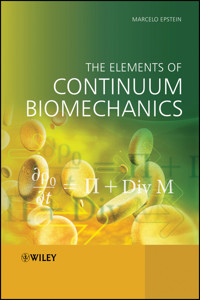
An appealing and engaging introduction to Continuum Mechanics in Biosciences
This book presents the elements of Continuum Mechanics to people interested in applications to biological systems. It is divided into two parts, the first of which introduces the basic concepts within a strictly one-dimensional spatial context. This policy has been adopted so as to allow the newcomer to Continuum Mechanics to appreciate how the theory can be applied to important issues in Biomechanics from the very beginning. These include mechanical and thermodynamical balance, materials with fading memory and chemically reacting mixtures.
In the second part of the book, the fully fledged three-dimensional theory is presented and applied to hyperelasticity of soft tissue, and to theories of remodeling, aging and growth. The book closes with a chapter devoted to Finite Element analysis. These and other topics are illustrated with case studies motivated by biomedical applications, such as vibration of air in the air canal, hyperthermia treatment of tumours, striated muscle memory, biphasic model of cartilage and adaptive elasticity of bone. The book offers a challenging and appealing introduction to Continuum Mechanics for students and researchers of biomechanics, and other engineering and scientific disciplines.
Key features:
- Explains continuum mechanics using examples from biomechanics for a uniquely accessible introduction to the topic
- Moves from foundation topics, such as kinematics and balance laws, to more advanced areas such as theories of growth and the finite element method..
- Transition from a one-dimensional approach to the general theory gives the book broad coverage, providing a clear introduction for beginners new to the topic, as well as an excellent foundation for those considering moving to more advanced application
Sie lesen das E-Book in den Legimi-Apps auf:
Seitenzahl: 697
Veröffentlichungsjahr: 2012
Ähnliche

















Table of Contents
Title Page
Copyright
Dedication
Preface
Part I: A One-dimensional Context
Chapter 1: Material Bodies and Kinematics
1.1 Introduction
1.2 Continuous versus Discrete
1.3 Configurations and Deformations
1.4 The Deformation Gradient
1.5 Change of Reference Configuration
1.6 Strain
1.7 Displacement
1.8 Motion
1.9 The Lagrangian and Eulerian Representations of Fields
1.10 The Material Derivative
1.11 The Rate of Deformation
1.12 The Cross Section
Chapter 2: Balance Laws
2.1 Introduction
2.2 The Generic Lagrangian Balance Equation
2.3 The Generic Eulerian Balance Equation
2.4 Case Study: Blood Flow as a Traffic Problem
2.5 Case Study: Diffusion of a Pollutant
2.6 The Thermomechanical Balance Laws
2.7 Case Study: Vibration of Air in the Ear Canal
2.8 Kinetic Energy
2.9 The Thermodynamical Balance Laws
2.10 Summary of Balance Equations
2.11 Case Study: Bioheat Transfer and Malignant Hyperthermia
References
Chapter 3: Constitutive Equations
3.1 Introduction
3.2 The Principle of Determinism
3.3 The Principle of Equipresence
3.4 The Principle of Material Frame Indifference
3.5 The Principle of Dissipation
3.6 Case Study: Memory Aspects of Striated Muscle
3.7 Case Study: The Thermo(visco)elastic Effect in Skeletal Muscle
3.8 The Theory of Materials with Fading Memory
References
Chapter 4: Mixture Theory
4.1 Introduction
4.2 The Basic Tenets of Mixture Theory
4.3 Mass Balance
4.4 Balance of Linear Momentum
4.5 Case Study: Confined Compression of Articular Cartilage
4.6 Energy Balance
4.7 The Entropy Inequality
4.8 Chemical Aspects
4.9 Ideal Mixtures
4.10 Case Study: Bone as a Chemically Reacting Mixture
References
Part II: Towards Three Spatial Dimensions
Chapter 5: Geometry and Kinematics
5.1 Introduction
5.2 Vectors and Tensors
5.3 Geometry of Classical Space-time
5.4 Eigenvalues and Eigenvectors
5.5 Kinematics
Chapter 6: Balance Laws and Constitutive Equations
6.1 Preliminary Notions
6.2 Balance Equations
6.3 Constitutive Theory
6.4 Material Symmetries
6.5 Case Study: The Elasticity of Soft Tissue
6.6 Remarks on Initial and Boundary Value Problems
References
Chapter 7: Remodelling, Ageing and Growth
7.1 Introduction
7.2 Discrete and Semi-discrete Models
7.3 The Continuum Approach
7.4 Case Study: Tumour Growth
7.5 Case Study: Adaptive Elasticity of Bone
7.6 Anelasticity
7.7 Case Study: Exercise and Growth
7.8 Case Study: Bone Remodelling and Wolff's Law
References
Chapter 8: Principles of the Finite-Element Method
8.1 Introductory Remarks
8.2 Discretization Procedures
8.3 The Calculus of Variations
8.4 Rayleigh, Ritz and Galerkin
8.5 The Finite-Element Idea
8.6 The FEM in Solid Mechanics
8.7 Finite-Element Implementation
References
Index
This edition first published 2012
© 2012 John Wiley & Sons Ltd
Registered office
John Wiley & Sons Ltd, The Atrium, Southern Gate, Chichester, West Sussex, PO19 8SQ, United Kingdom
For details of our global editorial offices, for customer services and for information about how to apply for permission to reuse the copyright material in this book please see our website at www.wiley.com.
The right of the author to be identified as the author of this work has been asserted in accordance with the Copyright, Designs and Patents Act 1988.
All rights reserved. No part of this publication may be reproduced, stored in a retrieval system, or transmitted, in any form or by any means, electronic, mechanical, photocopying, recording or otherwise, except as permitted by the UK Copyright, Designs and Patents Act 1988, without the prior permission of the publisher.
Wiley also publishes its books in a variety of electronic formats. Some content that appears in print may not be available in electronic books.
Designations used by companies to distinguish their products are often claimed as trademarks. All brand names and product names used in this book are trade names, service marks, trademarks or registered trademarks of their respective owners. The publisher is not associated with any product or vendor mentioned in this book. This publication is designed to provide accurate and authoritative information in regard to the subject matter covered. It is sold on the understanding that the publisher is not engaged in rendering professional services. If professional advice or other expert assistance is required, the services of a competent professional should be sought.
Mathematica® is a registered trademark of Wolfram Research, Inc. and is used with permission. Wolfram Research, Inc. does not warrant the accuracy of the text or exercises in this book. The book's use or discussion of Mathematica® or related products does not constitute endorsement or sponsorship byWolfram Research, Inc. nor is Wolfram Research, Inc. directly involved in this book's development or creation.
Library of Congress Cataloging-in-Publication Data
Epstein, M. (Marcelo)
The elements of continuum biomechanics / Marcelo Epstein.
p. cm.
Includes bibliographical references and index.
ISBN 978-1-119-99923-2 (cloth)
1. Biomechanics. 2. Biomechanics--Case studies. I. Title.
QH513.E77 2012
573.7'9343–dc23
2012007486
A catalogue record for this book is available from the British Library.
To my mother
Catalina Ana Blejer de Epstein
Preface
Euclides a Ptolemaeo interrogatus an non esset methodus discendae Geometriae methodo sua facilior: Non est regia, inquit Euclides, ad Geometriam via.
(PROCLUS, Commentary on Euclid's Book I, Latin translation of the Greek original.)
There is no via regia, no royal road, to continuum mechanics. All one can hope for is a more comfortable ride. Many of us, trained in the good old days of pure thought, driven by intellectual curiosity, did actually enjoy the hardships of the journey and our lives were ennobled by it, as a pilgrimage to a sacred Source. This highly personal transformative phenomenon continues to take place, to be sure, as I have had the chance to observe in the lives of more than a few of my former and present students. Today, on the other hand, we face a more formidable and exciting challenge, since, as it turns out, some of the most interesting applications of continuum mechanics have arisen from the field of biology. Materials of interest are no longer inert or passive systems upon which one can apply the classical paradigms of thought: mass is conserved, the history of the deformation and the temperature suffice to determine the material response, and so on. Instead, biological systems are alive, open to mass exchanges, controlled by external agents, subject to chemical reactions with outside sources, highly structured at various phenomenological levels. Moreover, those most interested in using the rigorous and elegant cutting tools of continuum mechanics in biological applications are not only the applied mechanicians and mathematicians of yore. They are, in rapidly increasing numbers, members of the younger generation working in human performance laboratories, kinesiology departments, faculties of medicine and engineering schools the world over.
One of the objectives of this book is to allow the newcomer to the field to get involved in important issues from the very beginning. To achieve this aim, the policy in the first part of the book is to present everything that can be presented in a one-dimensional spatial context. The polar decomposition of the deformation gradient and the divergence theorem become trivial in one dimension. Nevertheless, important topics such as fading memory and mixture theory retain most of the features of the general formalism. It is thus possible to deal with these important topics rather early in the book. To emphasize the potential of these material models, the landscape is dotted with case studies motivated by biomedical applications. Some examples of these case studies are: vibration of air in the ear canal, hyperthermia treatment of tumours, striated-muscle memory and cartilage mechanics.
Upon completion of the first four chapters, the reader should have acquired a fairly good idea of the scope and method of continuum mechanics. In the second part of the book, the three-dimensional context is introduced and developed over two chapters. A further chapter is devoted to the modern theories of growth and remodelling. Finally, a chapter on the finite-element method, although not strictly part of continuum mechanics, is also included, and the opportunity is not wasted to talk about the calculus of variations and the notion of weak formulation of balance equations.
As in so many other realms, when considering the material to be included in a technical book, choices have to be made. Every educator has a hidden agenda. Mine has been to open the eyes of the student to the enchanted forest of truly original ideas which, long after having been learned and seemingly forgotten, continue to colour our view of the world.
Part I
A One-Dimensional Context
Chapter 1
Material Bodies and Kinematics
1.1 Introduction
Many important biological structures can be considered as continuous, and many of these can be regarded as one-dimensional and straight. Moreover, it is not uncommon to observe that, whenever these structures deform, grow, sustain heat and undergo chemical reactions, they remain straight. Let us look at some examples.
Tendons. One of the main functions of tendons is to provide a connection between muscles (made of relatively soft tissue) and bone (hard tissue). Moreover, the deformability of tendinous tissue and its ability to store and release elastic energy are important for the healthy performance of human and animal activities, such as walking, running, chewing and eye movement. Tendons are generally slender and straight. Figure 1.1 shows a human foot densely populated by a network of tendons and ligaments. The Achilles tendon connects the calcaneus bone with the gastrocnemius and soleus muscles located in the lower leg.
Figure 1.1 Tendons and ligaments in the human foot
Muscle components. Most muscles are structurally too complex to be considered as one-dimensional entities. On the other hand, at some level of analysis, muscle fibres and their components down to the myofibril and sarcomere level can be considered as straight one-dimensional structural elements, as illustrated schematically in Figure 1.2.
Figure 1.2 A skeletal muscle and its components
Hair. Figure 1.3 shows a skin block with follicles and hair. When subjected to tensile loads, hair can be analysed as a one-dimensional straight structure.
Figure 1.3 Skin cube with follicles and hair
One of the questions that continuum mechanics addresses for these and more complex structures is the following: what is the mechanism of transmission of load? The general answer to this question is: deformation. It took millennia of empirical familiarity with natural and human-made structures before this simple answer could be arrived at. Indeed, the majestic Egyptian pyramids, the beautiful Greek temples, the imposing Roman arches, the overwhelming Gothic cathedrals and many other such structures were conceived, built and utilized without any awareness of the fact that their deformation, small as it might be, plays a crucial role in the process of transmission of load from one part of the structure to another. In an intuitive picture, one may say that the deformation of a continuous structure is the reflection of the change in atomic distances at a deeper level, a change that results in the development of internal forces in response to the applied external loads. Although this naïve model should not be pushed too far, it certainly contains enough physical motivation to elicit the general picture and to be useful in many applications.
Once the role of the deformation has been recognized, continuum mechanics tends to organize itself in a tripartite fashion around the following questions:
This subdivision of the discipline is not only paedagogically useful, but also epistemologically meaningful. The answers to the three questions just formulated are encompassed, respectively, under the following three headings:
From the mathematical standpoint, continuum kinematics is a direct application of the branch of mathematics known as differential geometry. In the one-dimensional context implied by our examples so far, all that needs to be said about differential geometry can be summarily absorbed within the realm of elementary calculus and algebra. For this to be the case, it is important to bear in mind not only that the structures considered are essentially one-dimensional, but also that they remain straight throughout the process of deformation.
The physical balance laws that apply to all continuous media, regardless of their material constitution, are mechanical (balance of mass, linear momentum, angular momentum) and thermodynamical (balance of energy, entropy production). In some applications, electromagnetical, chemical and other laws may be required. The fact that all these laws are formulated over a continuous entity, rather than over a discrete collection of particles, is an essential feature of continuum mechanics.
Finally, by not directly incorporating the more fundamental levels of physical discourse (cellular, molecular, atomic, subatomic), continuum mechanics must introduce phenomenological descriptors of material behaviour. Thus, tendon responds to the application of forces differently from muscle or skin. In other words, geometrically identical pieces of different materials will undergo vastly different deformations under the application of the same loads. One may think that the only considerations to be borne in mind in this respect are purely experimental. Nevertheless, there are some principles that can be established a priori on theoretical grounds, thus justifying the name of constitutive theory for this fundamental third pillar of the discipline. In particular, the introduction of ideal material models, such as elasticity, viscoelasticity and plasticity, has proven historically useful in terms of proposing material responses that can be characterized by means of a relatively small number of parameters to be determined experimentally.
1.2 Continuous versus Discrete
A pendulum, an elastic spring, a shock absorber: are they to be considered as continuous entities? The answer to this question depends ultimately on the level of description adopted. Leaving aside the deeper fact that bodies are made of a very large, though finite, number of particles, it is clear that, at a more mundane phenomenological level, the three entities just mentioned could be considered as fully-fledged three-dimensional continuous bodies. Moreover, if a spring is slender and straight, it might be appropriate to analyse it as a one-dimensional structure of the kind discussed in the previous section. A tendon, in fact, can be regarded as an example of a spring-like biological structure.
On the other hand, as we know from many encounters with an elastic spring attached to a mass in physics textbooks, there is a different sense in which words such as ‘spring’ or ‘damper’ can be used. To highlight the main difference between a ‘real’ spring and the physics textbook spring (which may be called a ‘spring element’), we observe that in the former the mass and the elastic quality are smoothly distributed over the length of the spring. In other words, these properties are specified as some along the length of the spring. Concomitantly, the deformation is expressed in terms of some over the same domain. Physically, this implies that phenomena such as the propagation of sound waves become describable in this context. In contrast, the physics textbook spring element is characterized by just three numbers: its total mass (concentrated at one end), its relaxed length and its stiffness. The deformation is given by a single number, namely, the total instantaneous length. In a model of this kind, therefore, the description of any phenomenon distributed throughout the structure has been irrevocably sacrificed.
Lesen Sie weiter in der vollständigen Ausgabe!
Lesen Sie weiter in der vollständigen Ausgabe!
Lesen Sie weiter in der vollständigen Ausgabe!
Lesen Sie weiter in der vollständigen Ausgabe!
Lesen Sie weiter in der vollständigen Ausgabe!
Lesen Sie weiter in der vollständigen Ausgabe!
Lesen Sie weiter in der vollständigen Ausgabe!
Lesen Sie weiter in der vollständigen Ausgabe!
Lesen Sie weiter in der vollständigen Ausgabe!




