


9,59 €
Mehr erfahren.
- Herausgeber: Pushkin Press
- Kategorie: Geisteswissenschaft
- Sprache: Englisch
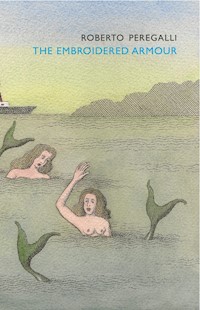
Roberto Peregalli's The Embroidered Armour examines the Greek Mysteries, mythology and legends that heralded a revolution in thinking between the time of Homer and Plato which gave birth to the Western cultural tradition. In investigating ancient Greek concepts concerning the relationship between seeing and knowing, Roberto Peregalli presents an eloquent demonstration of the modernity of Ancient Greek wisdom. Roberto Peregalli was born in Milan in 1961 and studied Philosophy. He worked extensively with Renzo Mongiardino before opening his own architectural firm in partnership with Laura Sartori Rimini. In addition to designing sets for opera, he also frequently contributes articles on cinema to Conde Nast publications. The Embroidered Armour is his first book. Roberto Peregalli lives between Milan and Tangiers.
Das E-Book können Sie in Legimi-Apps oder einer beliebigen App lesen, die das folgende Format unterstützen:
Veröffentlichungsjahr: 2013
Ähnliche




















ROBERTO PEREGALLI
THE EMBROIDERED ARMOUR
THE GREEKS AND THE INVISIBLE
DRAWINGS BY PIERRE LE TAN
CONTENTS
THE EMBROIDERED ARMOUR
THE GREEKS AND THE INVISIBLE
To the night-ramblers, magicians, Bacchants, Maenads, Mystics … Heraclitus Fragments B14
INTRODUCTION
THE LIFE OF HOMER1 relates that the poet, standing by Achilles’ tomb, wanted to see the hero in the armour made by Hephaestus, “brighter than blazing fire.” (Il. XVIII 609) He was blinded by its brilliance. In return he was given wisdom.
The most skilful blacksmith had forged perfect armour, too beautiful to be seen by the eyes of men. The shield, the breastplate, the helmet, the greaves. A whole universe was sculpted within them. He decorated it with “earth, sky and sea, the tireless sun, the full moon, and all the constellations with which the skies are crowned.” (Il. XVIII 483–485) And then the doings of men, places, wars.
Homer wanted to see. Hence he wished to know what was revealed. The disclosure, to the eyes, of that which is hidden concerns truth.2
Seeing for the Greeks is knowing. For that reason they are known as “the people of the eye”.3 That which is hidden is taken from the darkness of the invisible and brought into the light. The distance that separates that space and keeps it together generates the very possibility of knowledge. And, as such, it is precisely because of its ‘tragic’ essence, in that it presupposes that two incommensurable worlds, that of the visible and that of the invisible, enter into communication with one another.
Homer wishes to see Achilles’ gleaming armour because the truth is inscribed within it. The splendour of that which is revealed to the light dims the vision. The dappled cloak of the shield constitutes the membrane which connects and divides the visible and the invisible. It is as dazzling as the thoughts of the gods. 4
The concept of the tragic is produced and arranged within this space. The relationship of mortals to the world is based on what may be seen. But the truth of this is hidden, or only fitfully apparent. So for a people that connects knowledge with sight,5 the relationship with truth becomes a tragic one. Privileging the visible as a place in which the fates of the world are played out, that which is invisible becomes deception,6 fracture, mask. The invisible is an obstacle to knowledge. So it must be revealed. Truth is the revelation of that which is hidden.
Hence the way towards truth is the attempt to overcome that which is by its essence invisible. The Greeks want to see everything, to embrace the whole of the horizon with their eyes. In this ‘seeing everything’, the link between sight and knowledge becomes clear. That which is seen, insofar as it comes to light, is true. But the movement of appearing, condensed in the gaze, is possible only as emergence from hiding.
The words ‘true’ (a-lethes) and ‘invisible’ (a-delon) are at the same time mirror images and opposites. But their connection is evident: the negation of hiddenness certifies its existence. If that which is visible is true, it is true also that truth has its origin in that which cannot be seen. In the Greek world it is thus the ambiguous essence of truth which from the outset connects the visible and the invisible.
The ‘invisible’ is the shadow of the ‘visible’, its hidden bottom. The interesting thing about this word, a-delon, lies precisely in the difficulty of its appearance. The Greeks were sparing in their mentions of it until Plato. In Homer it occurs on one occasion only, and few others in the authors that followed him, seldom with profound significance. This kind of Greek repression of the invisible is evident and inevitable. Sight is immediate knowledge and life. “The invisible,” Aristotle will say, is “privation of potency”.7 Blindness, then, is an absence of completeness.
‘Invisible’ (a-delon) is a word rich in resonances.8 It means uncertain, unknown, hidden, unclear, not manifest.9 However, this negativity, parallel with that of ‘truth’ (a-letheia) with its privative ‘a’, seems to constitute its reverse, that of darkness. The invisible is part of all that cannot be mastered with the gaze, and thus, for a pre-Platonic Greek, with the mind. Being unmasterable, it constitutes a point of darkness. And it is upon this darkness, at the boundary between darkness and light, that Greek wisdom is structured.
The visible hides vast depths. But for the Greeks what matters is to remain on the surface. 10 From this derives the antinomy that forms the tragic element within their thought. Grasping the invisible means losing the lightness, the plasticity linked with sight, which represents for them an irrefutable presupposition.
Hence, capturing the invisible means leaving the structure of one world in order to enter another. The Greeks perceive this as a transgression, and, as such, a sin. Crossing the confines reserved for the possibilities of men means, for them, wanting to confront death, seeking in vain to overcome it.
At the same time Achilles’ gleaming armour is what is most noteworthy, that which it is worth letting the gaze linger over. In a single moment, in its sudden gleam, the very possibility of knowledge unfolds. And furthermore, only insofar as it becomes visible does it produce wisdom.
This profound antinomy runs through Greek wisdom from its earliest beginnings.11 Starting from the negative, from what for the Greeks was inexpressible, trying to discover its traces behind the curtain of the visible is perhaps one way of confronting it.12 The path starts in Homer and concludes with Plato. It is a path towards darkness and death. The position with regard to the gaze is inverted. The importance of that which is not seen becomes the ontological constitution of an unattainable truth.
The subtle distinction between ‘truth’ (a-letheia) and ‘invisible’ (a-delon) vanishes. The invisible becomes that which is true. Homer’s world which “knows no background”13, the trust in the gaze, the truth of the visible, which can be a source of wisdom only in that it shows itself, are no longer enough. The gaze, resting on all that is visible, apparent, is fallacious. To capture the truth we must close our eyes to visible things. That is the gesture performed before Hades, the lord of the dead. The tragic origin of knowledge is apparent in all its force. Once the veil of the gaze has been removed, the flashing splendour of Olympus is inverted to become a vision of Hades.
The connection between truth and the invisible creates the arduous journey from that which is seen to that which is hidden. It is there that the mysteries, the word, Memory show themselves. With Plato this transformation is taken to its conclusion. In his dialogues, playing with words as an “accomplished Sophist”,14 he structures a new vision of the world.
The “race of men most capable of seducing us into life”15 creates the soul, that hidden and nocturnal fragment that lies within man. The gleaming fascination of the images sculpted on Achilles’ shield is translated ‘in interiorem hominem’. The sight of the body is dimmed to make way for that of the soul. While blindness, supported by double vision, will no longer communicate with the gods.
The path that connects that which is seen to the invisible bottom of things, and its tortuous journey through the subtle space in which the Greeks placed knowledge and death, are the ‘fabric’ of this essay.
Notes
1. Introduction J Burckhardt, Storia della civiltà greca, (Florence, Sansoni, 1955, original ed. 1898–1902), p 706.
2. Cf M Heidegger, Plato’s Doctrine of Truth, trans Thomas Sheehan, Stanford University Press.
3. G Kittel, Theological Dictionary of the New Testament, trans and ed Geoffrey W Bromiley, Michigan 1964, s v: orao.
4. Burckhardt, Storia della civiltà greca, p 507.
5. E Auerbach, Mimesis. The Representation of Reality in Western Literature, Trans Willard R Trask, Princeton, 1953, pp 3–9.
6.This word, in its ‘tragic’ sense, will be one of this book’s fundamental motifs.
7. Aristotle, Metaphysics, V, 15, 1021a.
8. The word ‘invisible’ is represented in the Greek language (until Plato) by three different words: adelon, aphanes, aoraton. A fourth word, aides, added to Plato’s lexicon, will be considered in chapter 8. This multiplicity, rather than stressing translatability of a different kind, constitutes the most dazzling proof of the varied structure of its meaning. The verbs deloó, phaino, orao are linked to the bright horizon of the gaze, in terms of its movement as it enters light.
9. P Chantraine, Dictionnaire étymologique de la langue grecque: histoire des mots, Paris, Klincksieck, 1968–1977, s v: a-delon
10. E Rohde, Psyche, Trans. W B Hillis, London 2000 (original edition 1925), p 242: “From such gloomy severity, from the rigid and overpowering dogmatism that a people without imagination had constructed for itself out of religious speculations and visions won by much labour and thought, the Greeks were fortunately preserved by their own genius. Their fancy is a winged god whose nature it is to pass lightly over things – not to fall to earth and there remain ponderously prostrate.”
11. In a note of 1953, Pierre Maxime Schuhl wrote that “cette notion des àdela, des choses cachées, opposées à celles qui sont patentes, fanerà, mérite qu’on s’y arrête, car elle permet de préciser les attitudes d’un certain nombre de philosophes et de savants grecs à l’égard de la connaissance métaphysique, de la science et même de la théologie.” [This concept of adela, of hidden things, opposed to those which are manifest, phanera, is worth lingering over, because it allows us to identify the attitude of a certain number of Greek philosophers and sages concerning metaphysical knowledge and knowledge of science and even of theology.] And he added: “Nous ne donnerons ici qu’une première esquisse de cette recherche qui mériterait, croyons-nous, de plus longs développements.” [Here we will only give an initial outline of this research, which would deserve, we maintain, a more lengthy examination.] P M Schuhl, Adèla, in: Homo. Etudes philosophiques, Annales publiées par la Faculté des Lettres de Toulouse, 1953, I, pp 86–94.
12. One precedent here that cannot be ignored is Nietzsche’s The Birth of Tragedy, with its dazzling intuitions about the polarity of the Apolline and the Dionysiac, as well as the subsequent research by Giorgio Colli, a titanic attempt to apply Nietzschean categories to the classical philosophers.
13. Auerbach, Mimesis, p 5.
14. Plato, Cratylus, 403e.
15. Friedrich Nietzsche, The Birth of Tragedy, trans Shaun Whiteside, Harmondsworth 1993, p 3. See also the critique of Nietzsche by Ulrich von Wilamowitz-Moellendorff in: Future Philology! (trans. Postl, Babich, Schmid, Fordham University 2000, original edition 1872) “Had he known Homer properly, how could he attribute to the Homeric world – a world of youthful freshness, cheerful exuberance in the sweet pleasures of life, refreshingly unspoilt hearts of youthful naturalness, to this springtime of a people who truly dreamt the dream of life in the most beautiful fashion – pessimistic sentimentality, elderly people’s yearning for non-existence, and conscious self-deception?”




