


Erhalten Sie Zugang zu diesem und mehr als 300000 Büchern ab EUR 5,99 monatlich.
- Herausgeber: The History Press
- Kategorie: Fachliteratur
- Sprache: Englisch
In 1977, the iconic Swindon Works was building locomotives. By 1986, it was shut down. In The End of the Line, Ron Bateman recounts the fight to save Swindon Works, its 3,500 jobs and the livelihood of the entire community it represented. Initially joining through the Works Training School in 1977, Ron witnessed this tragic struggle and the crushing blow dealt to the industry that had defined Swindon for generations. Combining personal recollections with information and interviews from many other insiders and railmen, this book provides the only comprehensive chronicle on the final decade of 147 years of railway engineering and a fateful milestone in the history of Swindon.
Sie lesen das E-Book in den Legimi-Apps auf:
Seitenzahl: 355
Veröffentlichungsjahr: 2020
Das E-Book (TTS) können Sie hören im Abo „Legimi Premium” in Legimi-Apps auf:
Ähnliche


















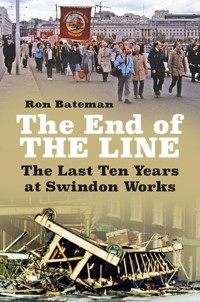
Front Cover Illustrations: Redundant railway workers march across Waterloo Bridge, August 1983 (Tony Rima); the dismantling and scrapping of the A-Shop, 1987 (Brian Robert Marshall).
Back Cover Illustration: Rail workers listen to John Prescott at Farrindon Road Park, 4 August 1984 (Andy Binks, The Swindon Society).
First published 2020
The History Press
97 St George’s Place, Cheltenham,
Gloucestershire, GL50 3QB
www.thehistorypress.co.uk
© Ron Bateman, 2020
The right of Ron Bateman to be identified as the Author of this work has been asserted in accordance with the Copyright, Designs and Patents Act 1988.
All rights reserved. No part of this book may be reprinted or reproduced or utilised in any form or by any electronic, mechanical or other means, now known or hereafter invented, including photocopying and recording, or in any information storage or retrieval system, without the permission in writing from the Publishers.
British Library Cataloguing in Publication Data.
A catalogue record for this book is available from the British Library.
ISBN 978 0 7509 9528 3
Typesetting and origination by The History Press
Printed and bound in Great Britain by TJ International Ltd.
eBook converted by Geethik Technologies
CONTENTS
Foreword
Introduction
A Note on the Text
1 1977 – A New Beginning
2 The Works Training School
3 Going Inside – First Impressions
4 Becoming a Painter
5 The Swindon Railwaymen
6 The Beginning of the End
7 A Fight to the Death
8 The Axe Falls
9 The Last Days and Black Wednesday
10 Brave New World
Endnotes
Acknowledgements
This publication of this book commemorates the sixtieth anniversary of the completion of 92220 Evening Star in March 1960. Built in Swindon Works, she was the final steam locomotive for British Railways.
Evening Star and the men who built her. Also see the images in the colour section. (Andy Binks, The Swindon Society)
FOREWORD
BR Standard Class 9F 92220 is more than just a steam locomotive. Swindon Works was more than just a railway factory. Both are much bigger than the sum of their parts. Both have a rich heritage and presence that still lives on today. The sixtieth anniversary of the Evening Star is an appropriate time to revisit that heritage and explore the nuts and bolts of the calibre of the men who built her, as well as their fight to keep Swindon ‘railway’.
No. 92220 Evening Star has many credentials that make it special: it was named by a competition, it was the last steam locomotive built by BR and at Swindon Works, and it was built for preservation. It is a living reminder of a bygone age.
The rich railway heritage that was Swindon is still visible today, if you know where to look for it. Hidden under the layers of ‘other’ uses, incomers, as Swindonians called those who had not been born and bred in Swindon, would be hard pressed to know its original purpose. In the decades between Swindon Works’ closure on ‘Black Wednesday’, 26 March 1986 to now, Swindon has changed from a town filled with railwaymen and women and their families, almost totally reliant on the railways, whether Great Western Railway or British Rail, ‘to a thriving economic centre of commerce and multinational expansion’ and the railway factory with its myriad of old workshops now serves its community in different ways, so that only those ‘who were there’ know the reality of what it really was and what made it so great that its reputation was worldwide and is still talked of today.
Whilst most of the old buildings stand proud and strong, many of those ‘insider’ witnesses have passed on. Indeed, a great many of those older railwaymen who I interviewed to record their stories and experiences are, sadly, no longer here. Now they need the younger generation that followed them from the era of steam to the time of diesel and electrical trains to record those stories and those times. Happily, those of the BR era are still here with memories and recollections that are as fresh and vital as on the first day they stepped inside the works.
In this fascinating exploration of the works’ demise from the late 1970s, Ron Bateman explores his own experiences and recollections alongside those of his railway workmates and ‘railway family’. Starting with his time in the Works Training School (WTS), then as ‘the boy’ apprentice painter before working as a skilled coach painter mainly in the huge A Shop working on the electrical multiple units for the Kent Coast routes, until eventually joining the last few men on ‘the funeral cortege’ of the final day in 1986, he tells of the ups but mostly downs as the works and its men fought for their existence.
Those interested in either railway, social, economic, or trade union history will find this an intriguing step back ‘inside’ those famous Swindon Works walls, and although it was ‘the End of the Line’ it is the beginning of a great read.
Dr Rosa Matheson
INTRODUCTION
The closure of Swindon’s former Great Western Railway Works was arguably the most significant milestone in the history of the town. The Great Western Railway (GWR) has long been regarded by railway enthusiasts as ‘the stuff of legends’, and during its heyday the Swindon Works built some of the most powerful steam locomotives in the world. At its peak in the mid-1920s it was staffed by more than 14,000 employees, and in 1919, following a much-needed programme of expansion, the mighty A Shop became Europe’s largest building under one roof. Former Works Manager Harry Roberts summed up Swindon’s role in the GWR beautifully when he proclaimed that Swindon locomotives had been designed and built to become ‘trend-setters and world-leaders – hence the adaptation of GWR into God’s Wonderful Railway’.1
Had it not been for its former dependence on the GWR company, the town of Swindon would probably not have evolved into the large-scale urban development of around 250,000 inhabitants that exists today. From the day the works opened in 1843, a marked demographic increase kept pace with the gradual expansion of the works. Over the next twenty years the population increased from 2,500 to more than 7,000, and by 1911 to around 51,000, with nearly a quarter of this figure employed inside the town’s railway workshops.2 Swindon Works also played an active role in respect of the education, welfare and recreational opportunities of its employees. In comparison with the surrounding area, because of this almost exclusive dependence on railway employment, Swindon came to be regarded as being differentiated – economically, socially and culturally.
A CULTURE OF BELONGING
Across almost a century and a half of continuous operation, no fewer than six generations of workers drawn from Swindon and the surrounding area went inside to earn their living. A large number of those men could boast a generation-upon-generation connection to the works through their fathers, their grandfathers and even their great-grandfathers. They spoke with unbridled passion about the glory days of steam, and typically viewed the Swindon Works as the centre of their universe; especially those who remembered the dominant role that the works used to play at the very heart of the town’s active life. Even throughout those final ten years that are the subject of this book, those of us who went inside at that eleventh hour still initially developed a sense of pride that we were carrying on the tradition of half a dozen previous generations of ‘Swindonians’ who had proudly served their time in the railway works. It is also apparent from the many comments that I have either read or listened to in the course of this exercise that numerous former employees look back on their service in the workshops with great fondness – describing it as ‘the best place I ever worked’ in so many cases. The camaraderie inside the works was the chief aspect that the men particularly liked to reflect upon. It is something that still carries on more than three decades after the works closed, particularly at regular coffee mornings in the Railway Village Community Centre. ‘The spirit and camaraderie inside the works was phenomenal! Everyone still has it. Everyone still looks out for each other.’3
When I began my apprenticeship in the autumn of 1977, I had at first been overwhelmed by the history and traditions of the Swindon Works, as well as being touched by the sentimentality of the men who had served in the works back in the days of the Great Western Railway. I quickly came to realise that the aura of romance that embellished the days of the GWR had never fully faded. The men who had previously worked for the company, and then later for British Rail (BR) were very proud men, many of whom were happy to admit that they ‘lived’ to serve in the works. I was also particularly impressed by the dedication and professionalism of many of the staff employed at the Works Training School – particularly those instructors who came across from the works to teach us health and safety and first-aid procedures. They lived and breathed Swindon Works, and they gradually indoctrinated us into a culture that they obviously adored. It was as clear to me then as it is now that they had all internalised a proud sense of ‘belonging’ that seemed to permeate every aspect of their lives. This was true across many generations of ‘Swindonians’ whose service in the railway works was proudly woven into their family histories, just as the importance of the works is now deeply embedded in the history of the town.
Every generation of school-leavers who went inside quickly became absorbed into this exclusive micro-culture, a shared perspective that included a medium of slang unique to Swindon Works that stretched back across many generations. When asked to define that culture well over three decades later, I find it difficult to provide an explanation that can be condensed into a single sentence. It was a culture that went beyond that shared vocabulary; it was more like being part of a brotherhood or an extended family. It had as much to do with shared ideas and values, a sense of community and comradeship, and of doing an honest day’s work and having pride in the work that was done. It also had something to do with shared involvement in sporting and social functions or other after-hours activities, and of serving the establishment in ways that were in addition to the job itself. At its most base level, the rail works culture went beyond being an instinctive adherence to a certain way of life. Being a ‘true railwayman’ incorporated a deep sense of belonging to the works, just as an animal belongs to its habitat. Having since taken this opportunity to work through the chronology of events leading up to the decline and closure of the works, it seems amazing to me just how resilient that ‘rail works culture’ turned out to be. Despite nationalisation, despite the end of the steam era and despite the headcount reductions of the 1960s that saw the size of the workforce shrink alarmingly, the culture of the rail works continued to survive – undiluted by the effects of deliberate disinvestment.
I vividly remember my first real insight into that ‘culture of belonging’ on the day I was taken on my first guided tour of Swindon Works in the early spring of 1978. Aside from my amazement at discovering what lay beyond those tall, red brick walls, the other thing that struck me was that many of the workshops incorporated communal areas for the various ‘gangs’ that often had a home-from-home appearance. I remember on those first wanderings through the great archipelago of workshops that one could not help but notice the occasional fish tank, the odd cat hanging around here and there, and the well-stocked larder hidden behind a ‘Rail Blue’ cupboard door. I also noticed the chinaware and cutlery, the electric heaters, the shaving facilities, the mirrors, the kettles, the glazed, earthenware teapots, the neat tables, the magazine racks, the house plants, the ornamental clocks and barometers and the radios. These kinds of things were a long way from the kind of factory life that I had expected or imagined. Nor did I ever expect to see sparrows flying freely around the workshops, and piles of crumbs laid out on factory-issue blue paper for the purpose of feeding the uninvited guests. More importantly, I was never under any illusion that such home comforts distracted the men from the most important thing – that being the job in hand. These men were happy to spend their entire working life inside, and these added comforts and amusements were just another extension of the deep sense of belonging that existed within Swindon Works.
BLACK FRIDAYS AND THE END OF THE GWR
Those of us who went inside during that final decade of the works still possess very vivid memories of watching close to a century and a half of railway engineering history dying before our eyes. Even though we were at ‘the sharp end’ of it, the critical events that brought about the demise and death of the works can be viewed as having occurred over a long period of time in three distinct phases. It is worth looking back briefly, if only to appreciate just how we got to where we were at the beginning of that final ten-year period.
After eighty-odd years of almost unbroken success, the Great Western Railway Company had first run into severe difficulties during the interwar period, mainly due to the collapse of the Welsh coal trade in the years following the General Strike of 1926. Additionally, the ever-expanding road transport network would bring about an end to an era of guaranteed dominance and prosperity for the company. The GWR would be compelled to economise wherever possible – even to the extent that a storeman would not issue a new broom until he was satisfied that the bristles on the old one were sufficiently worn!4 Eventually there were major job losses at the works in the 1930s when profits began to fall alarmingly. In his book about Swindon Works in the 1930s, Hugh Freebury writes of the dreaded ‘Black Fridays’ when foremen emerged from their offices with lists of workers to be released.5 Anxiety-fuelled rumours that the workload had dropped off would begin to circulate weeks in advance, and soon everyone would be convinced that a large number of workers would have to be let go. The consequences of such a thing would have been far more devastating in the 1930s as Swindon was much more of a one-industry town and being laid off would all but condemn a man to the breadline. There just wasn’t the same level of governmental support back then, and neither would the men have received any assistance from the company, except a promise that, ‘You can come back when things are looking up again.’ Men whose fathers had been inside had grown up with the recurring threat of redundancy hanging over the household, and soon they themselves would be suffering a similar fate. Freebury writes of the ‘partiality and favouritism’ employed by the foremen in the early days, a system that allowed them to retain or get rid of whoever they wanted. The emerging might of the unions had recently put paid to such practices, and their insistence of ‘last in, first out’ had at the very least put some minds at rest. To the men who worked inside throughout the final years of the works, this all sounds very familiar, except in our case at least we would have a fighting chance of getting another job locally, or would at least be offered opportunities for retraining, along with a fixed allowance and state aid if we passed the means test. For those men in the 1930s, the best they could hope for was a job in another town or city involving a long commute, or else scraping by on a means-tested benefit that barely allowed for basic subsistence.
The GWR company struggled on thereafter and was given a much-needed boost when figures spiked again immediately after the war when petrol shortages and rationing worked in its favour.6 This improvement in its fortunes allowed the GWR to partially recover from the ravages of war, before finally succumbing to nationalisation in 1948; thereafter it became the Western Region of British Rail. The iconic designs and livery of the GWR continued to be used for a number of years afterwards, despite the company having being officially wound up in December 1949.
EVENING STAR: THE HARBINGER OF DOOM?
A second feature that can be said to have exacerbated the decline of Swindon Works was a brutal programme of cuts to the railway network in the 1960s. It was a process that not only sought to accelerate the phasing out of the steam locomotive but would also result in the end of locomotive manufacturing in Swindon – the very thing on which the proud reputation of the works had been built. This procedure had already begun to occur in the decade following nationalisation when the Modernisation Plan of 1955 called for the complete phasing out of steam traction. Even though British Rail overly pessimistically forecasted that this could not be fully achieved before 1972, it was still a hammer blow for the works. The psychological effect that the end of steam locomotive manufacture created – the realisation that those magnificent engines that gave us our ‘glow of pride’ were now gone forever – never really receded. It is for this reason that this memoir has been released to coincide with the sixtieth anniversary of the final steam locomotive to be built at Swindon Works – or anywhere by British Rail – the 9F freight locomotive No. 92220 Evening Star.
I remember as a boy being fascinated by the Evening Star – I had never seen a locomotive with five pairs of coupled driving wheels beneath such a huge boiler. I also remember as an apprentice utilising one of my free railway passes to travel up to York one day just to stand and admire it in the National Railway Museum. Despite the fact that Swindon’s railmen had staged a one-day strike in 1958 after British Rail had said an order for ten 9Fs could not be built in the works, the Evening Star was not held in the same reverence by many of the former GWR men that I came into contact with. They would speak with passion and pride about the magnificence of the GWR Castles and Kings, but the Evening Star – despite its name – did not shine so brightly. I remember one embittered craftsman from the age of steam insisting that this giant locomotive was a ‘white elephant’ and scoffed that its cost had far outweighed its usefulness. All the indications at the time seemed to suggest that Evening Star was being built solely for the purpose of future preservation. Its production had been delayed by three years due to the accelerated introduction of the ill-fated Warship Class 42 diesel-hydraulic locomotives – a development that merely added to the cynicism. Diesel manufacture had long been in progress, and yet here they were, building another steam locomotive, while men in the same works were employed outside in the yard in breaking them up for scrap!
It also seemed to be a strange thing to be doing, bearing in mind the financial position of British Rail at that time, as this did not make impressive reading. The passenger side posted a loss of £87.7 million in 1960, while the freight side lost £46 million. When adjusted to take into account a slight profit in the parcels division, BR posted total losses of £128.3 million – hardly the time to be spending a huge sum on building a soon-to-be obsolete locomotive!7 Figures from 1960 onwards also reflected a constrained demand for rail transport, while at the same time a massively expanding motorway network over the next decade and a half ultimately gave rise to a new age of road transport.
It is now an accepted fact that Evening Star had indeed been built by British Rail with a view to preservation status, and was never intended to serve out its useful life. Workers were given food for thinking as such when a competition was organised to find a name for the locomotive – the only 9F that was officially named. Three entrants had all chosen the name that BR thought appropriate, owing to the fact that one of the first locomotives to operate on the GWR had been named Morning Star. To enhance its appearance for preservation Evening Star was also given a specially commissioned livery and copper-capped chimney – all the other 250 9F locomotives were painted black.
A special naming ceremony for Evening Star was to be held in the AE Shop at Swindon Works on 18 March 1960. The foreword in the programme for the ceremony stated that:
The Building at the Swindon Works of British Rail last steam locomotive marks the end of an era begun by Watt, Trevithick and Stephenson, and the onrush of modernisation by which diesel and electric traction become the impelling force on the country’s railways. This ceremony is held fittingly to praise steam as a medium by which untold millions of miles have been run in the service of humanity, and through which British Rail developed a network of railways second to none in the world.
The historical and emotional significance of the final steam locomotive was alluded to by R.F. Hanks of the British Transport Commission, who chose his words carefully for the occasion:
I trust I shall not be considered parochial when I say that it is a proud day for Great Western men everywhere who will find much satisfaction, since there had to be a ‘last one’ that it should fall to the lot of Swindon to see the job through.
We must not be gloomy today, but thankful that steam has served the railways so long and so faithfully.
R.F. Hanks of the British Transport Commission chose his words carefully at the naming ceremony for 92220 Evening Star. (Swindon Advertiser)
The former General Manager of the Western Region, K.W.C Grand, then presented the three winners of the naming competition with their share of the ten-Guinea prize.8 Meanwhile, David Gilles was an engineering apprentice in A Shop back in 1960, and witnessed the ceremony from the farthest track of the 100-ton crane:
I took a photo just after the curtains had been opened by KWC Grand to officially reveal the name of 92220, which of course, was no surprise to us. I believe the locomotive was in light steam and made not a sound during the entire ceremony. Afterwards I recall a 204hp diesel shunter dragging it out of the AE Shop because its boiler pressure had dropped too low.9
One veteran of the works who declined to be named remembered making the ash pans for the Evening Star, and also remembered the naming ceremony:
It was all very sad really. The works made a big effort to turn it into a celebration, rather than the sad occasion that it was. They brought in some of the famous locos from Swindon’s glorious past – some great names that had gone before. The North Star was there, another locomotive we built for the Caledonian Railways and also the City of Truro – they were all displayed in the workshop for the occasion.
One railwayman with forty-six years inside looked on with sadness and made his feelings known to the Evening Advertiser, which gave the ceremony front-page exposure:
The new day had to come, but so much is lost too. There was romance in the sight and smell of steam. The scent of the old steam engine had memories for all of us, but they will soon be something long gone.
Evening Advertiser, 18 March 1960
Fred Simpson had started out at Swindon Works as an office boy in 1935, before getting a job on the footplate two years later. He spent fifteen years as a fireman and twenty-two years a driver, and tested out Evening Star while it was still painted black, before getting a final coat of the famous Brunswick Green. It was around this time that Fred had to switch over to testing diesel locomotives:
The switch over to diesel locomotives was not popular. We accepted the change – we thought it was great and clean and warm. But driving was strange being on your own. It eventually became a bore – you no longer had the adrenaline when going at 70 or 80mph.
Swindon Advertiser, 1 April 2006
A few days after the naming ceremony, on 21 March, a peal referred to as Evening Star Delight Minor was rung at St Marks Church for more than two and a half hours to mark the completion of the final steam locomotive.10
Stephenson’s Rocket and Evening Star, special naming ceremony programme, 18 March 1960.
If the completion of the Evening Star was deemed to be an event worthy of celebration, there would be very little else to celebrate at Swindon Works for the next seventeen years. Following the Main Workshops for the Future Plan of 1962 that called for closure of fifteen of the thirty-one railway workshops in the country, the old carriage and wagon works in Swindon was earmarked for closure by 1967. This initiative was given further impetus by Beeching’s plans for reduction and restructuring Britain’s railways outlined in two reports in 1963 and 1965. The Beeching Axe, as it became known, would decimate Britain’s railway network through the elimination of many uneconomical services in an effort to make it profitable. Beeching’s determined assault raised the tempo of major cutbacks, which had a significant impact on the headcount at Swindon Works. The workforce effectively halved, coming down from more than 8,000 in 1963 to 4,203 in 1965 and then to 3,886 by 1969.11 Nationally, the number of workshops was cut by twelve between 1962 and 1966, coupled with significant reductions in the remaining nationwide workforce. From 1 January 1963, control of all of the regions’ main workshops would thereafter be transferred to one central authority called the British Railways Workshop Division, a move that was widely considered to have been a bad thing for Swindon Works. Throughout the regions as stations were closed and railway lines were torn from their sleepers in accordance with the plan, Beeching also asserted that the British Transport Commission had been overly pessimistic in its forecast that all steam locomotives could not be fully phased out until 1972, and proposed a significant acceleration of the process. All steam locos would be withdrawn from both the East and Western Regions by 1965; and from all other regions by 1967. As things turned out there would be no more steam after August 1968.12
Suspicion about Evening Star’s limited lifespan was realised when the locomotive was officially withdrawn from service just five years after the naming ceremony. The locomotive was thereafter kept in operational service until well into the 1980s, having been claimed for the national collection in 1975.13 With regular maintenance, steam engines typically lasted for thirty years, although the Class Fs such as Evening Star had been designed to last for twenty. In the same year that the locomotive was withdrawn prematurely, the remaining 5,000 or so workers in Swindon were dealt yet another hammer blow when the announcement came that Swindon Works would no longer build railway locomotives. The decision by the Western Region management to take the path of experimenting with diesel-hydraulic transmission had turned out to be a grave error when Beeching discarded the system in favour of diesel-electric locomotion. It was felt that a degree of favouritism had come into play here, for the costs of converting from steam to this type of diesel, whereby the wheels were powered by engine rotation, had not weighed too heavily on the works’ budget, although large bonuses recently negotiated in favour of Swindon workers had not helped their cause.14 British Rail began the withdrawal of the Class 14 diesel-hydraulic locomotives in 1968, and by 1970 none remained. The Warship Class 42 locomotives were all withdrawn between 1968 and 1972.
The now redundant former locomotive works would be reconditioned and modified to allow for carriage and wagon repair. The loss of locomotive manufacture came as a terrible blow to the workforce as there were many employees at the time who believed that ‘dieselisation’ would be the beginning of a bright new future for the works. Going forward, they could only seek reassurance from the fact that Swindon still had its carriage and wagon works. A number of veterans I spoke to from this era still felt bitter about this, and felt this was a much bigger blow than the phasing out of steam traction. One former foreman in the AE Shop thought the Warships were superb locomotives, ‘It was the Maybach engines that were the problem.’ As simple as this may sound, neither the Warships, nor the Western Class locomotives, were all fitted with Maybach engines. There are differing perspectives on which manufacturers’ engines were to blame.15
Obsolete diesel-hydraulic locomotives scattered around the yard at Swindon Works in 1975 prior to being broken up for scrap. (Ron Bateman Snr)
Commemorative plaque attached to the boiler casing of Evening Star. (Ron Bateman)
Evening Star returned to its place of birth in April of 1990 as a part of the ‘National Railway Museum on Tour’ exhibition staged in the old 19 Shop in Swindon Works. It returned again in September 2008, and remained on display for two years at the Swindon Steam Museum of the GWR to celebrate the fiftieth anniversary of its completion. By this time, the dark significance of the 999th BR Standard locomotive had long been forgiven by the railway enthusiasts, many of whom turned up in their thousands to marvel at the beauty and size of such an impressive feat of railway engineering.
FROM HOPE TO DESPAIR – THE FINAL DECADE
The third and final phase in the demise brings us to The End of the Line: The Last Ten Years of Swindon Works. Armed with so many memories and so much information, I have written this account as an attempt to both chronicle and to share my experience of that final ten years inside. The early chapters reflect a period that began on a note of real optimism when the works unexpectedly won a contract to build complete locomotives for the first time in twelve years. In the intervening years, which had seen the withdrawal of the diesel-hydraulic fleet in the early 1970s, the shop floor headcount had fallen perilously low to just 1,800 manual workers, with only around 2,200 on the payroll in total. By that time, the old British Transport Commission and been disbanded, to be replaced by the British Railways Board. Then, on 1 January 1970, British Rail Engineering Ltd (BREL) was formed as a subsidiary company of British Rail, and it was then that a new Work’s Manager, Yorkshireman Harry Roberts arrived on the scene, cast in the role of ‘the axeman’ by his impatient employers.
Harry Roberts presents the apprentice of the year shield in 1973. Roberts had arrived at Swindon in 1972 with a remit to close the works. (Roy Hazell Collection)
My own arrival at the works in July 1972 was not exactly heralded with a fanfare of trumpets, as it was an open secret that my remit was to close the works down completely – the quicker the better as far as the BR board were concerned!
Harry Roberts, 1985
Roberts quickly absorbed what he described as, ‘The true potential obscured under the disorientated, disordered atmosphere that pervaded the whole works,’ and, against the demands of his employer, endeavoured to keep the Swindon Works operational for as long as possible. By 1977, under his guidance, the works started winning new orders for outside work that brought a fresh wave of optimism as the headcount began to increase once more. Roberts achieved this by actively promoting the efficiency of the works, and was thereafter rewarded with a string of orders that would stave off the dreaded axe for the foreseeable future. During that ensuing period of calm when the ship held steady for a number of years we were able to laugh and joke together, and to make plans – even going as far as to buy houses, marry our girlfriends and start families! Had Roberts seen things differently at that time, my life would have taken a completely different direction, and I would not have had a final ten years inside Swindon Works to write about.
Sadly, the upsurge in confidence in the late 1970s was not to last, and for all his genuine effort on our behalf, Harry Roberts had only been able to buy us some time. By the early 1980s, anyone but the politically naïve would have become increasingly aware that the favoured ‘New Right’ ideology of the Thatcher government would finally spell the end for the railway workshops. Thatcherism encompassed a commitment to a new economic liberalism, resulting in policies that included privatisation of nationalised industries. The Serpell Review of 1982–83 – a commission of enquiry set up to examine ways of improving railway finances – agreed that privatisation would be an option worthy of consideration as far as BREL was concerned. Although the review had been widely rejected by the government, it was soon being accused of implementing the recommendations by stealth. Government policy thereafter would incorporate an insistence that replacement and refurbishment of BR’s ageing rolling stock be procured wherever possible by means of competitive tendering, a clear indication that the main rationale was to prepare railway engineering for privatisation.16 For Swindon Works, primarily a repair and refurbishment facility, this would indeed mean that the end of the line was more than a distinct possibility.
When I had completed my apprenticeship (or ‘came out of my time’ as it was known), I was immediately re-employed as a tradesman painter, and within a year the renewed optimism that had permeated the atmosphere when I first began my apprenticeship in the late 1970s had long since faded. The later chapters of this book describe what evolved into a long downward spiral for the works, a period largely characterised by consecutive headcount reductions. The forward planning of BREL had reflected a desire for new build and modernisation over repair and refurbish, a strategy that undoubtedly paid heed to the government’s privatisation ambition. For the worker, it was about the constant vacillation between hope to despair, and about trying to get on with one’s life, albeit on the edge of a deep ravine that was constantly being referred to as ‘outside in the real world’. This was an existence I had endured for much of the first ten years of my working life, for the first six years of my then married life and for my first three years as a father.
From April 1982 onwards the road to that infamous Black Wednesday became a long, demoralising journey, largely endured in an atmosphere of rancour and cynicism as the ongoing fight to save Swindon Works became ever more bitter. There were no more significant orders in the pipeline, men were succumbing to early retirement and voluntary redundancy on an almost daily basis and the workshops were looking increasingly bare.
Just as the overall decline of Swindon works can be separated out into three distinct phases, so the process of running down and eventually closing the works also encompassed three key stages of headcount reduction. Some of the figures quoted in the local press and by employees’ representatives are at first confusing, as they seldom kept in step with the numbers and pace of the ongoing headcount reductions originally planned. As virtually all the surplus employees pertaining to the first two headcount reductions took either early retirement or volunteered for redundancy, it is difficult to know exactly how many employees had effectively been let go prior to the next phase of job losses being announced. Additionally, some of the figures quoted often related only to shop floor men, and did not take into account the office staff and other employees indirectly connected to the works. The only certainty was that my turn would soon come, and along with many hundreds of my rail works colleagues I had to accept that my not too distant fate would be to find myself jobless at a time of mass unemployment both locally and nationally.
When the decision to close the works finally came, it still felt like a crushing blow, even though it had long been expected. It was not just the personal ramifications of the decision that hit home either, it was also the realisation that 143 years of railway engineering in the town was going to end in a matter of months. I still remember the bitterness felt by my colleagues when all was lost, and the ghostly atmosphere inside the deserted workshops on the night shift during those final weeks. People who had been employed at the works, in some cases for their entire working life, were simply discarded, owing to what British Rail described as ‘over-riding business problems’.17 Black Wednesday was a day that will live in infamy for those who were there, when the silence was so deafening that one could barely gather ones thoughts. Barely a quarter of a century after Evening Star had entered service, Swindon’s railway works was effectively consigned to the history books.
Formerly a hive of activity, the now deserted AM shop prior to demolition. (Jason McCormick/Neil Lover, Swindon’s Other Railway)
A PERSONAL MEMOIR OF LIFE ON THE INSIDE
Most of my own personal memories in this account were rough drafted around twenty-eight years ago, just a few years after the works had officially closed down. The idea to put into print everything that I could remember from my time inside had originally come to me when I first read Hugh Freebury’s excellent Great Western Apprentice: Swindon in the Thirties, a classic, active participant account of what day-to-day life in the works was really like.18 Freebury writes of his experiences with such emotional openness that one internalises his thoughts and his feelings, his hopes and his regrets and his highs and his lows. His motivation for writing the book had been to tell the other side of the story, that being from the shop-floor perspective. Large-scale reductions in headcount had occurred in the Swindon Works during the 1930s, and he felt as though the worry and the hardship endured by large numbers of embittered men had been understated in an account that had recently been published by a member of the management team.19 I took inspiration from his references to many of the familiar phrases and rituals with which I was familiar, and began setting down my own memories of my time as a British Rail apprentice and tradesman in what were similarly difficult times.
Well over a quarter of a century has now passed since I wrote those memoirs, a period that included two divorces and various house moves; little wonder I had long since thought the manuscript to be lost. It was only during my preparations to relocate overseas in early 2016 that I rediscovered much of the original typescript that I had drafted all those years ago. Upon re-reading, it immediately became apparent to me that, even in its slightly juvenile form, it really did capture something of the atmosphere inside the Swindon Works throughout those final ten years. The memoir also contained a detailed account of my time at the Works Training School, an exercise that at that time had never been published before. I had no serious ambition to be a writer back in 1991, so I presumably wrote everything down under the assumption that in years to come my memories of my apprenticeship and of working inside would fade, destined to become distorted by the fallibility of long-term memory. At the time I simply wanted to preserve my own memories of the works by telling my own story to myself – exactly how I remembered it. I have since edited that original document as an attempt to describe, evaluate and chronicle the experiences and observations of which I originally wrote. I have also readily taken on board the experiences of others, sometimes as a means of providing a measure of verification to my own recollections.
Having now described that ‘journey’, the end result represents a unique angle on the experience of being inside the Swindon Works throughout that final decade of its existence. It is evident that in my quest to provide the most truthful interpretation of that original script there was very little danger of too much sentimentality breeding the opposite of fact in the final account. These had been long, stressful years of uncertainty; a period that deeply affected everybody, young and old, and in different ways, especially as the final closure approached. Whatever impression I may create at the conclusion of this memoir, it does not alter the fact that I have always been extremely proud of Swindon’s railway heritage. With that in mind, it has never been my intention to rob either the men of the Great Western Railway of their hard-earned glory or those latterly employed by British Rail Engineering Ltd of their remarkable achievements in the face of adversity.
A NOTE ON THE TEXT
The original manuscript I typed back in the early 1990s contained the names of many men who I had long-since forgotten, but to whom I could instantly put a face. A lot of men that I mentioned have sadly long-since passed away and I have no wish to tarnish their memory in any way. Also, there are other men who have since moved on in their lives and would probably not wish to be identified. For these reasons I have applied false names to persons referred to in the course of this book, except for those men who I felt were worthy of high praise, and others who played a key managerial role in the history of the Swindon Works.
Regarding the quotes, all contributors were very happy for me to publish their recollections, although some expressed a preference to remain anonymous.
It was not a job,
it was a way of life.
Harry Roberts (1985)




