


17,99 €
Mehr erfahren.
- Herausgeber: John Wiley & Sons
- Kategorie: Fachliteratur
- Sprache: Englisch
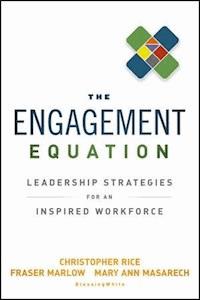
Create a culture of engagement and build high-performance culture The Engagement Equation explains the drivers of employee engagement, and how you can use improved engagement to execute strategy, reduce costs, and meet your organizational goals. This book describes a unique engagement model that focuses on individuals' contribution to a company's success and personal satisfaction in their roles. Aligning employees' values, goals, and aspirations with those of the organization is the best method for achieving the sustainable employee engagement. The Engagement Equation is designed to provide a framework that will help you move the needle on engagement. * Explains how to plan and execute a sustainable organization-wide engagement initiative * Shows how to avoid the engagement survey analysis-paralysis trap * Shares ways to align employee contribution with strategy * Encourages leaders to pay attention to and better understand your organizational culture, and much more Ultimately, it's the daily dynamics at play in your team, your division, and your organization that matter most.
Sie lesen das E-Book in den Legimi-Apps auf:
Seitenzahl: 357
Veröffentlichungsjahr: 2012
Ähnliche



















Contents
Preface: Standing on the Shoulders of Giants—The Legacy of Buck Blessing and Tod White
Acknowledgments
Introduction
Chapter 1: What is Engagement Anyway?
Critical but Elusive
Engagement is Not. . .
The Playing Field: The Job
Engagement Happens at the Apex
Short-Term versus Long-Term Engagement
Factors that Influence the Engagement Equation
Satisfaction
Contribution
Other
Chapter 2: The Five Levels of Engagement
It is Rarely all or Nothing
The Engaged
The Disengaged
The Honeymooners & Hamsters
The Crash & Burners
The Almost Engaged
The Five Levels of Engagement in the Real World
Chapter 3: Global Insights and Macro Trends
Starting at the Top
Some Departments Fare Better than Others
The Generational Debate: Those Pesky Gen Yers
Regional Factors
The Four-Year Itch
Some Industries See Higher Engagement. But Who Cares?
Gender
Unions Get a Bad Rap
Chapter 4: Shared Accountability and Daily Priority
Why Most Engagement Initiatives Fall Short
Do Not Separate Engagement from the Work to Be Done
Everyone Owns a Piece of the Engagement Equation
Individuals Need to ACT
Managers Need to CARE about Engagement
Executives Need to Build a CASE for Engagement
Chapter 5: A Dead Battery Can’t Jump-Start Another
Challenges at the Top
A Propensity for Engagement
When Executives Spin Out of Control. . .
Managing Your Own Engagement Equation
Chapter 6: Culture
Beyond Petri Dishes
Six Steps
Chapter 7: Seems Kind of Obvious: Align Your Employees!
Foundations for Alignment
Why the Cats Won’t Herd
Best Practices
Case Study: Mission is Not Enough
Case Study: Alignment at the Local Level
Making Alignment Happen
Chapter 8: Dialogue and Empowerment Trump Action Planning
The Virtuous Cycle: Dialogue, Relationships, and Trust
X Marks the Spot
The Performance Appraisal
The Career Coaching Conversation
The Onboarding Discussion
The Engagement Review
Moving the Responsibility from Managers to Employees
Chapter 9: Career Development
Why Worry about Career Development?
What are Employees Looking For?
But What are Organizations Doing about Career?
The Razorfish Story
Redefining Career
Recommendations
Chapter 10: Measuring ROI
Engagement at Sea and on Shore
Quid Pro Quo
Employee Retention
Not Employee Retention
Employee Engagement and the Balanced Scorecard
The Importance (and Lack) of HR Metrics
Quantitative, Qualitative, and Mixed Measurement
Chapter 11: The Good, the Bad, and the Ugly of Engagement Surveys
Surveys: A Love/Hate Affair
Characteristics of a Good Survey
Actionable Items
Survey Best Practices Summary
What You Can Learn from Response Rates
Survey Pitfalls to Consider
Good Follow-Up Actions versus Bad Follow-Up Actions
Chapter 12: Final Considerations
If You are Starting Out
Improving Existing Engagement Initiatives
A Few More Cautions for Both New and Established Initiatives
Maintaining Momentum
Appendix
Interviews and Contributors
Endnotes
Index
Cover image and design: Paul McCarthy
Copyright © 2012 by BlessingWhite. All rights reserved.
Published by John Wiley & Sons, Inc., Hoboken, New Jersey.
Published simultaneously in Canada.
No part of this publication may be reproduced, stored in a retrieval system, or transmitted in any form or by any means, electronic, mechanical, photocopying, recording, scanning, or otherwise, except as permitted under Section 107 or 108 of the 1976 United States Copyright Act, without either the prior written permission of the Publisher, or authorization through payment of the appropriate per-copy fee to the Copyright Clearance Center, Inc., 222 Rosewood Drive, Danvers, MA 01923, (978) 750-8400, fax (978) 646-8600, or on the web at www.copyright.com. Requests to the Publisher for permission should be addressed to the Permissions Department, John Wiley & Sons, Inc., 111 River Street, Hoboken, NJ 07030, (201) 748-6011, fax (201) 748-6008, or online at http://www.wiley.com/go/permissions.
Limit of Liability/Disclaimer of Warranty: While the publisher and author have used their best efforts in preparing this book, they make no representations or warranties with respect to the accuracy or completeness of the contents of this book and specifically disclaim any implied warranties of merchantability or fitness for a particular purpose. No warranty may be created or extended by sales representatives or written sales materials. The advice and strategies contained herein may not be suitable for your situation. You should consult with a professional where appropriate. Neither the publisher nor author shall be liable for any loss of profit or any other commercial damages, including but not limited to special, incidental, consequential, or other damages.
For general information on our other products and services or for technical support, please contact our Customer Care Department within the United States at (800) 762-2974, outside the United States at (317) 572-3993 or fax (317) 572-4002.
Wiley publishes in a variety of print and electronic formats and by print-on-demand. Some material included with standard print versions of this book may not be included in e-books or in print-on-demand. If this book refers to media such as a CD or DVD that is not included in the version you purchased, you may download this material at http://booksupport.wiley.com. For more information about Wiley products, visit www.wiley.com.
ISBN 978-1-118-30835-6 (cloth); ISBN 978-1-118-33199-6 (ebk);
ISBN 978-1-118-33419-5 (ebk); ISBN 978-1-118-33532-1 (ebk)
Preface: Standing on the Shoulders of Giants—The Legacy of Buck Blessing and Tod White
We often hear people describing employee engagement as a new field in corporate leadership. We beg to differ. Employee engagement—like innovation or effective management—has always been around. But it is an idea that leaders are turning to with more pressing attention as they explore all options for developing a competitive advantage. Increasing engagement is one of the few ways to boost productivity without additional headcount or new technology. While competitors can access capital, resources, and markets in the same way that you can, organizational culture and the engagement of a workforce are things that cannot be acquired or outsourced.
Two men who understood this were Buck Blessing and Tod White. In 1973 they founded their fledgling partnership above a barber shop in Princeton, New Jersey. Together, they devised a model of employee engagement and spent the next five years perfecting it by training thousands of professionals. To date, millions of people worldwide have benefited from programs that use this approach.
Sociology, psychology, and neuroscience are among the many disciplines that have taken a stab at the topic of employee engagement, and all have contributed to the body of research. We have found that many of these suggested approaches are great in theory but fall apart when faced with the realities of implementing them in the workplace.
Our approach remains firmly as practitioners: we help organizations move the needle on employee engagement every day. The pragmatic lessons we have learned from advising senior teams and working hands-on in developing professionals around the world are distilled into this book.
Today BlessingWhite is a thriving consultancy and organizational development firm focused exclusively on employee engagement and leadership development. Companies such as General Electric, Toyota, Rolls-Royce, Unilever, Deutsche Bank, and Johnson & Johnson have turned to BlessingWhite to help craft their culture, develop their leaders, and engage their teams. In this book, we share the best practices and insights from these companies and many other organizations from around the world.
This journey began with Buck and Tod. We thank them for the initial spark and for starting us down the road. We dedicate this book to them.
Acknowledgments
This book was the work of many BlessingWhite colleagues around the world, past and present.
We want to specially acknowledge the contributions of David Koeppel, whose articles for the New York Times impressed us and made us realize we needed his guidance.
We are indebted to several of our partners in Asia Pacific—Ken Simper, Reg Polson, Rebecca Jones, Roy Gao, Ashish Arora, and Paul Mitchell—who arranged interviews with executives at companies in China, India, and Australia.
Our partners at Abu Dhabi University provided insight and arranged for us to talk to executives in the Middle East. We want to express our appreciation to Ahmad Badr, Gene Crozier, and Rabei Wazzeh.
We thank Paul Turner, Professor of Management Practice at Birmingham City University and longtime thought partner, for providing insightful guidance that kept us on track.
BlessingWhite employees in the United States and Europe contributed insight, challenged us, found interesting people for us to interview, did research and analysis, and made the book far better. Our thanks to Amanda Veinott, Matt Varava, Joan Dasher, Scott Mason, Chris Brunone, Eileen Garger, Charmian Hall, Tom Barry, Bill Lingrel, Mike Shoenfelt, and Sue Kang, who got thrown in the deep end.
And finally, we wish to thank our editor at John Wiley & Sons, Adrianna Johnson, who guided us through the process.
—Christopher Rice,
Fraser Marlow, and
Mary Ann Masarech
Introduction
“We Accept the Premise”
There is an organization in your industry that enjoys the benefits of high employee engagement. You can read it in its performance metrics and feel it when you walk the corridors. You see it in the loyalty displayed by its customers, in its ongoing innovation, and in the piles of applications received for each job opening. This organization has achieved high levels of employee commitment and is buzzing with activity and a sense of purpose.
Is this your organization?
Maybe you are a leader in an organization suffering from chronic disengagement and are observing your more engaged competitors with envy. “How can we replicate what they have? How come they seem to have ‘it’ and we don’t?”
High levels of employee engagement drive high organizational performance. As a leader you get this.
As you peel back the layers and examine the functions of that more engaged enterprise, it is difficult initially to put your finger on what exactly is different. Similar staff, similar expertise, similar products, and a similar customer base. But either the soul is there . . . or it isn’t. How do you emulate or replicate those intangibles? And how do you protect and nourish it once you have it?
And so the conversation starts: if we want to tackle engagement, we first need to measure it. This requires time and money, and as in any rational organization the question becomes, “What is the payback?”
There are many studies on the benefits of having an engaged workforce. They proclaim direct lines between increased engagement and key business metrics. Promised benefits include
Higher productivity
More discretionary effort
Faster time-to-market
More rapid innovation
Higher customer satisfaction
Lower turnover
Reduced absenteeism
Fewer accidents
More resilience to change
Which all add up to . . . higher profitability!
Such studies, while academically stimulating, are totally useless to you unless you happen to have been part of that specific piece of research. Your enterprise has its own goals and strategy, its own strengths and weaknesses, and its own dynamics.
Meanwhile, consulting firms muddy the waters with dubious calculations on lost productivity and subjective definitions that are hard to act upon. Armies of bloggers and talking heads tout all kinds of quick-fix solutions, from free yoga sessions to recognition awards to engaging your employees with annual birthday gifts.
Despite the confusion surrounding the topic, most leaders agree—as Pat Hasbrook, a senior VP at global financial information services company Experian, once told us—“We no longer worry about calculating ROI for this. We simply accept the premise that an engaged workforce is essential for the success of the company.”1
Spinning Plates
Picture if you will each employee as a spinning plate. You can see your organization as a large space with 100, 1,000, or even 50,000 plates spinning. Left too long without attention, they run out of energy, start spinning out of control, and may come crashing to the floor. Personal development, coaching, performance management, addressing team dynamics, and reinforcing objectives are all forms of plate spinning. Masters of this circus manipulation art can barely keep 100 plates spinning at a time.2 How many plates can any harried player-manager handle? Typically, less than a dozen.
Low engagement is like having less energy flowing into these plates. The result is that more attention is needed to keep everything spinning. Leaders in organizations with low engagement describe it as driving with the brakes on. Things could be so much easier and get done so much faster if it were not for the drag caused by disengagement.
Managing in a low engagement environment is exhausting—and so is spinning plates. How often and how much time do you spend sweeping up smashed crockery?
An Individualized Equation
Here’s another hitch: as a leader you can’t actually make employees engaged.
Engagement is fundamentally an individualized equation. What might make one employee engaged might turn off the person in the next cubicle. There are many variables that can impact any one person’s engagement. You can’t just become a better plate spinner. You have to find ways to keep the plates spinning on their own.
To truly be engaged, people need to be satisfied with their immediate work and their career opportunities. Work and career are two intangible catchall terms used to describe something much more profound to employees: work is a very large part of an employee’s identity. It is an opportunity to satisfy values, to maximize unique talents, and to learn, develop, and fulfill personal goals.
But your business’s purpose is not to make employees satisfied. They also need to be contributing. Luckily for many of us, these are closely equated. Employees become satisfied because they accomplish results and know their contribution is recognized and adding value.
As we shall see, this is how we define full engagement: maximum satisfaction and maximum contribution. If you look at engagement through this prism, it becomes a win-win relationship. The individual is getting what he or she wants from the job, and the organization is getting what it needs from its employees.
A Long Road Ahead
The process of creating a more engaged workforce is not easy. According to industry analyst firm Bersin & Associates, 71 percent of organizations in North America measure employee engagement, yet only 35 percent of HR practitioners believe that their engagement efforts led to positive business outcomes.3
You can weave engagement into the fabric of your organization, but it will not happen next quarter and should not happen solely to improve the results of your upcoming employee survey. Increased engagement is the long-term trajectory you will want to put your organization on.
The road is uncertain, but the returns can be great. The aim of this book is to wrap our arms around a concept that can sometimes be amorphous and bring practical solutions to the workplace. Not all workplaces are populated with highly engaged employees, but every organization can build—and sustain—a culture of high engagement. We will not sugarcoat it for you: it is a long road and demands sustained commitment from the executive team. But once established it will be the strongest competitive advantage you have.
If this is a commitment you are willing to make, we can show you the way. We share a practical framework to define engagement and the language to discuss it in practical terms. We articulate the roles that everyone in a workforce needs to play. We highlight the most productive strategies. We explain the pitfalls and lessons learned from those mistakes. And we challenge you along the way to ask yourself, “How engaged am I?”
Specifically, we will address how to
Use a common definition and pragmatic framework for talking about employee engagement (Chapters 1 and 2).
Lose your fascination with benchmarks and global trends and pay attention to the individualized engagement equations that are happening (or not) in every corner of
your
workplace (Chapter 3).
Turn employee engagement into a shared responsibility and daily priority so everyone in your organization plays a role in solving the equation (Chapter 4).
Take control of your own engagement. Dead batteries cannot jump-start others. If you are not fully engaged, your chances of creating a more engaged workforce are slim (Chapter 5).
Build a culture to fuel engagement, and then protect it fiercely (Chapter 6).
Create a crystal-clear organizational direction and work tirelessly to align all employees to that vision. If that is done correctly, they can take initiative and carry on (keep spinning) without endless intervention (Chapter 7).
Open communication channels between managers and employees to ensure the constant dialogue required for employees to accomplish meaningful work (however they define it) while simultaneously driving your strategies forward (Chapter 8).
Define what a future in your organization looks like by redefining notions of
career
. Then equip all employees to manage successful journeys (Chapter 9).
Develop a realistic approach to assessing return-on-investment for engagement initiatives (Chapter 10).
Avoid the many pitfalls of engagement surveys; your survey scores are not the prize (Chapter 11).
Map out your entire initiative. Get started with best practices—whatever your size or checkered history with engagement initiatives (Chapter 12).
Notes
1. Despite Experian’s initial “leap of faith,” they continue to refine their approach and monitor the relationship between engagement and business metrics, as detailed on page 223.
2. The unbroken world record for spinning multiple plates, verified as a Guinness World Record, is held by David Spathaky, assisted by Debbie Woolley, who spun 108 plates simultaneously in Bangkok, Thailand, on television in 1996. He had previously held and broken his own record four times since 1986.
3. Bersin & Associates, “Employee Engagement: A Changing Marketplace,” 2012.
Chapter 1
What Is Engagement Anyway?
When the engagement you want isn’t there, you don’t need a survey to tell you that. You can feel it when you walk into the room.
—Keith Rodwell, group executive, BOQ Finance (a 137-year-old Australian financial institution)
Critical but Elusive
Most people have experienced periods of full engagement at work. Yet as we have interviewed hundreds of executives and worked on engagement initiatives around the world, the lack of a common definition is striking. Ask one executive how she defines employee engagement, and you will get a vague statement about discretionary effort and motivation. Another might say it’s about being in the zone or being married to the company. It is one of those experiences that is more easily described by engaged employees than defined by observers.
Ask those observers what engagement is, and you will still get disparate definitions. A problem with solving the mystery of employee engagement is that it’s both critical to business success and elusive in its definition. But if we’re going to move forward to discuss engagement, we need to set up a common framework. First, let’s consider some of the most popular definitions that don’t quite work for our purposes.
Lesen Sie weiter in der vollständigen Ausgabe!
Lesen Sie weiter in der vollständigen Ausgabe!
Lesen Sie weiter in der vollständigen Ausgabe!
Lesen Sie weiter in der vollständigen Ausgabe!
Lesen Sie weiter in der vollständigen Ausgabe!
Lesen Sie weiter in der vollständigen Ausgabe!
Lesen Sie weiter in der vollständigen Ausgabe!
Lesen Sie weiter in der vollständigen Ausgabe!
Lesen Sie weiter in der vollständigen Ausgabe!
Lesen Sie weiter in der vollständigen Ausgabe!
Lesen Sie weiter in der vollständigen Ausgabe!
Lesen Sie weiter in der vollständigen Ausgabe!
Lesen Sie weiter in der vollständigen Ausgabe!
Lesen Sie weiter in der vollständigen Ausgabe!
Lesen Sie weiter in der vollständigen Ausgabe!




