


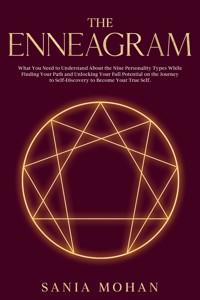
2,99 €
Mehr erfahren.
- Herausgeber: Sania Mohan
- Kategorie: Ratgeber
- Sprache: Englisch
UNLOCK THE SECRETS OF YOUR PERSONALITY AND EMBARK ON A TRANSFORMATIVE JOURNEY OF SELF-DISCOVERY WITH THIS GAME-CHANGING BOOK!
Are you tired of feeling overwhelmed by your own reactions?
Do you want to understand why you and others respond disproportionately to various situations?
Are you seeking a way to identify your reactive behaviors in times of stress and gain control over your emotional responses?
"
The Enneagram
" is just the guide you’ll need to
understand the 9 personality types, use them to find your path, unlock your full potential, and become your true self
. Discover the power of the Enneagram, a dynamic personality system that unveils the intricacies of human behavior.
If you’re looking to kickstart your personal growth journey, become more self-aware, and navigate life's challenges with grace and authenticity, this guide is for you!
Here's what you’ll learn:
- Self-Discovery: Uncover your true self as you explore each of the nine personality types, their strengths, and their potential pitfalls. Gain a deep understanding of your own motivations, fears, and longings, allowing you to make conscious choices that align with your values and aspirations.
- Emotional Mastery: Identify your reactive behaviors and patterns, particularly in stressful situations. Learn effective strategies to regulate your emotions, develop healthier coping mechanisms, and transform your responses into ones that promote harmony and growth.
- Relationship Insights: Understand how different personality types interact and influence one another. Discover the dynamics that can lead to conflicts and learn practical tools to navigate personal and professional relationships with empathy, compassion, and effective communication.
With " The Enneagram", you can embark on a transformative journey towards self-mastery and create a life of authenticity, purpose, and fulfillment.
Begin the journey of self-discovery and start living a life that aligns with your true self by grabbing your copy today!
Das E-Book können Sie in Legimi-Apps oder einer beliebigen App lesen, die das folgende Format unterstützen:
Veröffentlichungsjahr: 2023
Ähnliche

















The Enneagram
What You Need to Understand About the Nine Personality Types While Finding Your Path and Unlocking Your Full Potential on the Journey to Self-Discovery to Become Your True Self.
Sania Mohan
Copyright ©️ 2023 by Sania Mohan
All rights reserved.
It is not legal to reproduce, duplicate, or transmit any part of this document in either electronic means or in printed format. Recording of this publication is strictly prohibited and any storage of this document is not allowed unless with written permission from the publisher except for the use of brief quotations in a book review.
Contents
Introduction
We are all unique. Categorizing us into personality types seems reductive and generalizing, even pointless. But personality systems don't need to tell us everything about ourselves. They need to give us a framework through which we can analyze our inclinations, understand our strengths and weaknesses, and chart a course toward self-discovery and realizing our potential.
Most human interactions are cordial, so it's rare to see certain sides of ourselves and others. We all have a major blind spot that can only be illuminated if we understand personality types. The ability to decipher personalities gives us a near-supernatural vision into the souls of those around us, but more importantly, into our own darkest, most hidden propensities.
Understanding personalities helps us see past the lies, defense mechanisms, and veils that we all wear, giving us the ability to truly connect with empathy and boldness.
Personality systems reveal human nature. We can use them to understand others and ourselves if we approach everything with curiosity as opposed to judgment.
There are dozens, perhaps more, personality systems that developed over the centuries (some date back millennia). The Enneagram of Personality is just one of them, but it's exceptional for reasons we will get into.
The word "Enneagram" is from the Greek "ennea" (nine) and "gramma" (meaning something that's either written or drawn). It is represented by a nine-point figure which serves as a visual diagram of this personality system.
The Enneagram of personality is rooted in antiquity, although scholars have been unable to pinpoint its precise origins. Evidence of its use has been found in ancient philosophical as well as spiritual writings of Buddhism, Sufism, and the Kabbalah.
Our modern understanding of the Enneagram was pioneered by the Bolivian spiritualist and philosopher Oscar Ichazo in the 1960s and 70s. It has since spread, and it's widely used today in self-improvement, coaching, corporate training, spirituality, and even in non-academic psychological analysis.
Ichazo strongly believed that spiritual development was only possible through understanding one's own motivations. The core idea that our motivations can be deciphered from our patterns of behavior is what distinguishes the Enneagram from other more academically inclined personality systems.
The Enneagram of personality may not be as cerebral or as scientifically based as other well-known systems like Myers-Briggs, The Big Five, or the HEXACO Model, but its simplicity makes it profoundly beneficial to regular people. When you understand it, you'll know why you behave as you do. You'll have better relationships because you'll see loved ones for who they truly are and keep your own rough edges in check. You'll put a face to your core fears and crippling weaknesses, and you'll conquer your limitations.
So, welcome to this journey of self-discovery – Let's learn everything about the Enneagram of Personality.
How the Enneagram Personality System Works
As humans, we are hardwired to survive and thrive. We, therefore, form personalities in response to the environment to which we are introduced as children.
Personalities are amalgamations of defensive, reflexive, coping, and other innate behavior or proclivities that we exhibit with the goal of survival. Our attempts at a young age to gain attention and to fit in often blossom into complex adaptive strategies that we employ later in life on autopilot.
Personality systems (in this case, the Enneagram) are meant to map out these proclivities in adherence to a meticulously constructed organizing principle.
Structure of the Enneagram
The Enneagram of personality is organized as follows: there are 9 basic personality types, grouped into 3 sets of 3, called triads. It's depicted as a circle with the numbers 1 to 9 listed equidistantly along its circumference. The number 9 is at the apex, and it's believed to represent the most common personality type.
Within the circle are straight arrows pointing from various numbers to other specific numbers.
The 9 Basic Personality Types
The nine personality types are represented by the numbers 1 to 9. They are as follows:
Type 1: The Perfectionist, or the reformer. Idealistic, rational, dedicated, and reliable. Driven to do the right thing and make the world better, but also to evade fault to a fault.
Type 2: The Helper, or the giver. Warm, encouraging, caring, and demonstrative, but also possessive. They want to feel needed and loved, even at the expense of their own needs.
Type 3: The performer, the achiever, or the motivator. Productive, ambitious, and pragmatic, but also image-conscious. They deeply want success and fear failure.
Type 4: The Romantic, the individualist, or the artist. Sensitive and creative, but also self-absorbed and moody. Driven by a desire to be understood and to feel extraordinary.
Type 5: The Investigator, or the thinker. Very analytical and perceptive, but also detached and can be provocative. Driven by a thirst for knowledge and self-reliance.
Type 6: The Loyalist, the guardian, or the skeptic. Very practical and dutiful, but also suspicious of others. Driven by fear and a primal need to feel secure.
Type 7: The Enthusiast, or the optimist. Spontaneous, fun, and adventurous, but it can be excessive. Their motivation is happiness and excitement, and avoiding pain.
Type 8: The Leader, or the challenger. Commanding, assertive, and confident, but are also confrontational and intense. They desire to be strong and avoid vulnerability.
Type 9: The Peacemaker, or the reformer. Pleasant and laid back, but also too accommodating or complacent. They desire to maintain peace and avoid conflict.
Give these brief descriptions, and your personality may jump at you. But don't worry if it's not immediately apparent. In fact, it never is for most people. The best way to figure out where you fit in is to keep reading. Many people think they lean a certain way, only to realize later that different traits come out stronger in them. Also, don't obsess over the personality you wish you had. Just try to figure out who you are – for better or worse.
The Triads
Each triad contains personality types that share a "center of intelligence." The centers correlate to body parts: The heart, the head, or the gut.
The heart feels. The head thinks and fears. The gut is associated with instinct and particularly with the emotion of anger. Personalities in each triad have strengths or weaknesses in how they express the core emotion associated with the corresponding triad.
The Heart Triad (Feeling Personalities)
It includes personality types 2, 3, and 4, which are driven by feeling.
The 2s (helpers) overexpress their feelings, meaning they present positive emotions outwardly, but repress negative feelings.




