


1,99 €
Mehr erfahren.
- Herausgeber: Quickie Classics
- Kategorie: Gesellschafts- und Liebesromane
- Sprache: Englisch
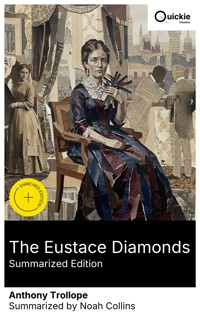
The Eustace Diamonds, third of Trollope's Palliser novels (1873), centers on Lizzie Eustace, a beguiling widow who clings to a contested family necklace she insists was a gift, though lawyers deem it an heirloom. Around this object Trollope stages legal skirmishes, social maneuvering, and a theft, blending omniscient irony with the pacing of sensation fiction à la Wilkie Collins. Contrasted with the principled Lucy Morris and vacillating suitors—Frank Greystock, Lord Fawn—Lizzie's romanticism exposes Victorian anxieties about property, marriage, and truthfulness. Trollope's career in the Post Office honed observational discipline; his Palliser series draws on Westminster politics. Composed during debates around the Married Women's Property Act of 1870, the novel channels contemporary legal ambiguities into plot. Trollope both satirizes and studies the culture of acquisitiveness, refining techniques of free indirect discourse and the serial installment to examine how law, journalism, and gossip adjudicate female reputation. Readers of Victorian fiction, legal drama, and psychological satire will find The Eustace Diamonds absorbing and incisive, a work that also stands alone within the Palliser cycle. Its supple narration, morally intricate characters, and unresolved mysteries invite both pleasure and analysis, making it an ideal text for studies of gender, property, and the novel's evolution. Quickie Classics summarizes timeless works with precision, preserving the author's voice and keeping the prose clear, fast, and readable—distilled, never diluted. Enriched Edition extras: Introduction · Synopsis · Historical Context · Author Biography · Brief Analysis · 4 Reflection Q&As · Editorial Footnotes.
Das E-Book können Sie in Legimi-Apps oder einer beliebigen App lesen, die das folgende Format unterstützen:
Veröffentlichungsjahr: 2026
Ähnliche





The Eustace Diamonds (Summarized Edition)
Table of Contents
Introduction
In The Eustace Diamonds, Anthony Trollope turns a glittering necklace into a moral mirror, where the shimmer of wealth and romance reflects, distorts, and tests the uneasy boundary between what society allows one to possess and what conscience can rightfully claim, drawing readers into a world in which reputation competes with law, desire bargains with duty, and the stories people tell about themselves—through gesture, attachment, and calculated silence—prove as consequential as any written deed, so that a single contested object illuminates the precarious transactions of love, status, and power that sustain, and sometimes imperil, a carefully arranged social order.
Published in the early 1870s and belonging to the sequence often called the Palliser novels, The Eustace Diamonds is a Victorian social novel that blends comedy of manners with legal intrigue and a hint of crime. Trollope situates the action amid London drawing rooms, gentlemen’s clubs, and country houses, moving easily between fashionable visits, political gossip, and consultations with solicitors. The panorama is recognizably that of high society and its orbit, attentive to rank, money, and the slow machinery of institutional life. Within this carefully observed milieu, Trollope explores how a single dispute can unsettle alliances and reveal the costs of belonging.
At the center stands Lizzie Eustace, a young widow whose brief marriage leaves her in possession of a resplendent diamond necklace that her husband’s family insists is a hereditary heirloom. Lizzie maintains it was freely given; the executors demur, and the matter enters a murky space between private promise and public claim. Around this dispute gather barristers, relatives, officials, and would‑be admirers, each bringing motives that are by turns generous, compromised, and self‑protective. Trollope presents the opening movements of a contest not merely for jewels but for narrative control, as competing versions of obligation and entitlement vie to shape Lizzie’s future.
Trollope’s omniscient voice is poised and conversational, inviting the reader to weigh characters’ self-justifications without dictating a verdict. He glides from salons to offices with measured pacing, balancing bright social comedy with the slow-burn tension of legal maneuvering and rumor. The style favors lucid sentences, wry asides, and a precise sense of how money and manners frame choice. Conversations crackle with tactical politeness; interior monologues reveal anxious calculations. Though part of a larger sequence, this novel’s plot is self-sufficient, and its pleasures depend less on surprise than on the steady accumulation of insight as small decisions harden into public consequences.
At its heart, the novel scrutinizes the porous border between property and personhood. The necklace is currency, ornament, evidence, and temptation, and around it Trollope considers how marriage functions as contract, how law codifies custom, and how reputation can be won, rented, or lost. He is alert to the theater of self-fashioning: characters perform candor, prudence, or devotion in order to secure advantages that their circumstances otherwise deny. Yet beneath satire lies human sympathy, as the narrative measures ambition against vulnerability and shows how economic precarity, gendered expectations, and the hunger for security can bend even principled actors toward equivocation.
For contemporary readers, the book’s questions feel immediate. Disputes over ownership, privacy, and consent play out today in courts and headlines, while social life remains saturated with branding, aspiration, and strategic storytelling. Trollope’s interest in how institutions arbitrate personal conflicts—through committees, lawyers, newspapers, and the court of public opinion—speaks to ongoing debates about who gets to author the narrative of a life. The novel also probes the double standards by which women are judged for ambition or self-protection, a pressure that persists even as opportunities expand. In tracing these frictions, Trollope reminds us how material objects become repositories of value and myth.
To read The Eustace Diamonds is to enter a capacious, morally alert comedy where every charm has its price and every principle must withstand negotiation. Trollope builds suspense not by withholding information but by showing how consequences accumulate, until even minor indulgences require public accounting. The result is both entertaining and exacting: a portrait of high society that delights in its pageantry while registering the fine print of its bargains. Whether encountered independently or alongside the broader Palliser cycle, this novel offers a lucid, engrossing study of possession and persuasion, and a reminder that glitter often conceals the hardest questions.
Synopsis
Anthony Trollope’s The Eustace Diamonds, a novel in his Palliser series, opens with an inheritance and a question of ownership that quickly reverberate through Victorian society. Lizzie Greystock marries the ailing Sir Florian Eustace and is left a widow soon after, in possession of a magnificent diamond necklace associated with the Eustace name. Whether that necklace is a personal gift or an entailed family heirloom becomes the book’s central problem. Trollope frames the issue as both legal puzzle and social spectacle, setting Lizzie before a gallery of observers—relatives, lawyers, politicians, and fashionable hosts—whose judgments will shape her prospects and reputation.
The Eustace trustees, guided by the family solicitor Mr Camperdown, demand the return of the jewels, insisting they belong to the estate. Lizzie counters that her late husband gave them outright, and she adopts a rhetoric of injured innocence and romantic entitlement. Attention from Lord Fawn, a cautious junior minister with strong deference to propriety, brings the question of marriage into the dispute, since his suit depends upon her being above reproach. Around the Fawn household appears Lucy Morris, a principled governess whose quiet presence provides a moral counterpoint to Lizzie’s theatrical self-defense and to the calculating gossip that surrounds the case.
Frank Greystock, Lizzie’s cousin and a rising member of Parliament, complicates the situation. Engaged to Lucy, he nevertheless allows loyalty, vanity, and professional pride to draw him into Lizzie’s orbit, where he serves as advocate and occasional confidant. His visits and letters, conducted under the glare of society’s scrutiny, test his constancy and Lucy’s patience, while signaling how ambition can blur personal judgment. Meanwhile, Lord Fawn recoils from scandal and legal uncertainty, wavering between prudence and prestige. The narrative balances social comedy with ethical enquiry, presenting shifting sympathies as each character measures advantage against duty, and private feeling against public censure.
As proceedings advance, Trollope multiplies pressures rather than simplifying them. Counsel’s opinions, threatened actions, and careful correspondence produce a maze of technicalities in which a woman’s word, a husband’s intent, and the definition of an heirloom are constantly weighed. Drawn to Lizzie’s allure are men of contrasting type: Lord George de Bruce Carruthers, with a reputation for daring independence, and a charismatic preacher, Mr Emilius, whose attention flatters her self-image. The tone moves between satire and near-detective fiction, as questions of evidence, credibility, and motive seep from the law office into drawing rooms, hunting parties, and newspaper columns.
Parallel to the main dispute, Trollope sets a vivid portrait of fashionable precariousness through Mrs Carbuncle and her niece, Lucinda Roanoke. Dependent on credit and appearances, they pursue advantageous alliances within a world that prizes display as much as income. Sir Griffin Tewett’s pursuit of Lucinda exposes the pressures that reduce courtship to negotiation, and temperament to commodity. The Carbuncle circle intersects with Lizzie’s, multiplying invitations, chaperonage, and whispered bargains that blur sincerity with calculation. Through these scenes, the novel broadens its inquiry from one woman’s jewels to the wider market in which affection, respectability, and solvency are continually appraised.
Fearing seizure and trusting no one completely, Lizzie insists on keeping the necklace with her, a decision that leads to tense journeys between London and the north. On the road, the plot acquires a sharper edge: a theft, a hurried alarm, and the entrance of professional detectives shift attention from ownership to possession. Officers such as Bunfit and Gager pursue clues through servants’ rooms and jewellers’ shops, while Lizzie’s maid, Patience Crabstick, becomes uncomfortably close to the murkier margins of the affair. Lizzie’s own statements, sometimes impulsive or self-serving, cast further shadows that the law and press are eager to parse.
Publicity magnifies every inconsistency, and private lives contract under the strain. Lord Fawn, guarding his career and conscience, looks for a decorous exit from entanglement. Frank’s parliamentary prospects require tact just as his personal ties demand frankness he struggles to supply. Lucy’s steadfastness, constrained by class and employment, is tested by delay, rumor, and the spectacle of Lizzie’s glittering self-presentation. Lady Fawn and Lady Glencora Palliser attempt to guide the young women toward prudence and kindness, yet influence has limits where pride, fear, and financial necessity drive choice. Trollope traces how reputations are traded like assets in a volatile market.
Legal maneuvers continue as trustees consider action, counsel frame arguments, and intermediaries seek compromise. The chain of custody around the diamonds grows intricate due to travel, concealment, and competing narratives, ensuring that any resolution must navigate both statute and sentiment. Potential marriages hang in the balance, filtered through the expectations of families, creditors, and political allies. Lucinda Roanoke’s predicament sharpens the novel’s critique of coercion within respectable forms, while the investigation ranges across a network of carriages, inns, and backrooms. Trollope sustains uncertainty, inviting readers to watch how systems—legal, social, and romantic—strain when tested by desire and doubt.
Without resting on a single revelation, The Eustace Diamonds distills a larger meditation on property and personhood: who owns what, who speaks credibly, and what price is paid for display. By placing a contested heirloom at the center of intersecting ambitions, Trollope examines how the law can both protect and oppress, and how society rewards performance over candor. The novel’s enduring significance lies in its cool attention to motive, its scrutiny of the marriage market, and its view of reputation as currency. It leaves readers considering the distance between legal right and moral right, and the fragile securities people construct.
Historical Context
Anthony Trollope’s The Eustace Diamonds appeared serially in the Fortnightly Review between 1871 and 1873, and in book form in 1873. Set largely in London and Scotland in the later 1860s and early 1870s, it belongs to Trollope’s Palliser series, which follows British political and social life. The narrative moves through drawing rooms, government offices, law firms, and gentlemen’s clubs, situating characters amid institutions such as Parliament, the India Office, and the metropolitan law courts. Trollope depicts the rituals of the Season, country-house visits, and the transactional etiquette of rank and wealth, using these familiar Victorian arenas to examine how status, property, and reputation are negotiated.
Britain’s political climate during composition and setting was marked by Liberal ascendancy after the 1868 election, with William Ewart Gladstone’s first ministry pursuing reforms of the civil service, the Irish Church (1869), education (1870), and electoral practices. The 1867 Second Reform Act had recently expanded the urban male electorate, and the Ballot Act of 1872 introduced secret voting. Trollope, a moderate Liberal and longtime civil servant, understood the machinery of government and the culture of patronage it was supplanting. The novel’s scenes involving officeholders and aspirants reflect the shifting balance between aristocratic influence and professionalized administration that characterized this transitional moment.
Victorian marriage and property law form a crucial backdrop. Under coverture, a married woman’s personal property generally came under her husband’s control, though equity allowed certain “separate estate” arrangements. The Married Women’s Property Act 1870 modestly improved wives’ rights to earnings and some property; broader reform followed only in 1882. The Matrimonial Causes Act 1857 had moved divorce from ecclesiastical to civil courts, creating public, often scandalous cases and enabling suits for breach of promise. Inheritance practices—entails, marriage settlements, and trusteeship—regulated the transmission of wealth and heirlooms. Trollope builds conflict from these legal frameworks, especially the ambiguous status of valuable personal jewels.
By the 1860s London had a centralized professional police force, with the Metropolitan Police’s Detective Branch established in 1842 to handle complex crimes, including jewel thefts. The era also saw the rise of sensational journalism and popular fiction about crime and domestic transgression. Notably, Wilkie Collins’s The Moonstone (1868) made a stolen diamond the engine of a pioneering detective narrative. Trollope incorporates police inquiry and the allure of scandal while maintaining his realist emphasis on social behavior and motive. The presence of detectives and legal counsel in the story reflects contemporary investigative methods and the public’s appetite for high-profile property disputes.
The novel’s emblematic object, a diamond necklace, resonates with imperial and commercial realities. Mid-Victorian Britain was enriched by global trade and colonial extraction, with precious stones from India and beyond entering elite circulation through jewelers, auctions, and inheritance. The Koh-i-Noor diamond, displayed at the Great Exhibition of 1851 and recut for the royal collection, had fixed imperial gemstones in the public imagination. London’s West End commerce and City finance prospered as conspicuous luxury signaled status. Trollope uses the language of valuation, insurance, and security to anchor the necklace’s significance, mirroring a society where portable wealth conferred both prestige and vulnerability.
Contemporary gender ideals emphasized female respectability, domesticity, and carefully managed marriage alliances. Dowries and marriage settlements were instruments of family strategy, and the “marriage market” of the Season matched titles to fortunes. Yet women faced constrained legal and economic agency, prompting organized campaigns for property rights, education, and professional opportunities by figures such as Barbara Bodichon. Trollope’s portrayal of a resourceful heroine and her rivals engages these tensions: ambition, charm, and calculation operate within, and against, restrictive norms. The novel scrutinizes how reputation, corroborated by letters and witnesses, could determine a woman’s prospects as decisively as birth or cash.
Expanding communications and travel infrastructures undergird the plot mechanics. By the late 1860s Britain’s railway network connected London to provincial cities and Scottish estates with speed and regularity, and steamship links shortened journeys abroad. Telegraph services were consolidated under the Post Office in 1870, and the uniform penny post sustained dense letter-writing habits. Cheap newspapers and magazines flourished after the repeal of the newspaper stamp (1855) and paper duty (1861), amplifying gossip and public scrutiny. Trollope leverages these systems to show how news, rumor, and legal threats circulate quickly, and how mobility enables both social display and the evasion of scrutiny.
As a mid-Victorian social novel, The Eustace Diamonds engages prevailing debates over property, marriage, and public morality. It absorbs elements of the sensation craze—valuable jewels, theft, and investigation—yet steadies them with institutional detail and psychological observation. The opacity of legal categories, the precariousness of reputation in a mass-media age, and the accommodation of aristocratic forms to a more bureaucratic state are central concerns. Trollope’s critique is understated but persistent: ambiguous laws and performative respectability invite manipulation, while genuine integrity is difficult to defend. In dramatizing these pressures, the book offers a measured, revealing portrait of its era’s structures and anxieties.
Author Biography
Anthony Trollope (1815–1882) was one of the most prolific and influential novelists of the Victorian era. A precise observer of social institutions and private motives, he created a panoramic body of fiction that mapped the intricacies of English provincial life and national politics. Best known for the Chronicles of Barsetshire and the Palliser novels, he combined narrative ease with acute realism, balancing satire and sympathy. His career unfolded alongside the rise of mass literacy and serial publication, and he became a model of professional authorship. Beyond fiction, he wrote travel books, criticism, and biography, leaving an oeuvre that remains central to studies of nineteenth-century realism.
Trollope was educated at prominent English public schools, including Harrow School and Winchester College, but did not proceed to university. His reading and early ambitions were shaped by classical studies and contemporary fiction, and by the growing prestige of realist narrative. A leading influence on his development was the mid-Victorian magazine culture that fostered serial storytelling. His connection with the Cornhill Magazine—then edited by William Makepeace Thackeray—proved particularly important, situating his work among a readership attuned to social observation, moral nuance, and humor. He learned from Augustan clarity and nineteenth-century wit, adapting both to depict institutions, professions, and the texture of everyday life.
Before gaining renown as an author, Trollope built a substantial career in the General Post Office, beginning in the 1830s and rising through practical administrative posts. A transfer to Ireland broadened his experience and gave him time and material for early fiction. He traveled widely on official business, and is associated with the introduction of pillar letter boxes in the British Isles through recommendations made during surveys in the Channel Islands. Famously disciplined, he wrote in the early mornings before work, maintaining a steady daily routine that underpinned his extraordinary productivity and helped him meet the demands of serial publication and an expanding readership.
Trollope achieved his first major success with The Warden (1855), which initiated the Chronicles of Barsetshire, a sequence set around the cathedral town of Barchester. Barchester Towers followed, and with Doctor Thorne, Framley Parsonage, The Small House at Allington, and The Last Chronicle of Barset, he fashioned an interlinked world of clergy, gentry, and professionals. These novels made his reputation for realism, ethical subtlety, and social comedy. They explore institutional change, clerical politics, and personal ambition without melodrama, relying on conversational narration and close psychological attention. The series established a durable fictional landscape that readers could revisit across multiple volumes.
In the later 1860s and 1870s, Trollope expanded his scope with the Palliser novels, a political cycle tracing parliamentary careers, marriages, and the uses of power. Through works such as Can You Forgive Her?, Phineas Finn, The Eustace Diamonds, Phineas Redux, The Prime Minister, and The Duke’s Children, he examined party alignments, patronage, and the pressures of public life. Alongside these, he produced independent masterpieces including Orley Farm, He Knew He Was Right, and The Way We Live Now, the last notable for its anatomy of financial speculation and journalistic influence. He also wrote widely read travel books, including accounts of North America and the Caribbean.
Trollope took an active interest in public affairs, standing unsuccessfully for Parliament as a Liberal candidate in the late 1860s. His critical essays and reviews discuss narrative ethics, professional duties, and the responsibilities of the press. After his death, the publication of An Autobiography (1883) stirred debate for its candor about payments, schedules, and method; some contemporaries considered such transparency damaging to the ideal of literary inspiration. Over time, however, critics have come to value his professionalism, structural inventiveness, and ethical realism, recognizing how his steady craft served deep moral inquiry and produced fiction of enduring complexity and charm.
In his final years, Trollope continued to publish fiction, essays, and biographical studies, including a life of Thackeray and a substantial work on Cicero. He remained a public literary presence, traveling and lecturing while sustaining a demanding schedule. He died in 1882, leaving a vast catalogue that has rarely been out of print. His reputation has grown through twentieth- and twenty-first-century scholarship, new editions, and celebrated television adaptations of the Barsetshire and Palliser cycles. Today he is prized for lucid prose, intricate character networks, and humane wit, offering readers a richly detailed portrait of Victorian society that still feels immediate.
The Eustace Diamonds (Summarized Edition)
VOLUME I
CHAPTER I
Lizzie Greystock
All agreed, friend or foe, that Lizzie Greystock managed her fortunes cleverly. Only child of Admiral Greystock, a whist-loving, wine-soaked libertine determined to revel to his last gasp, she glittered through London almost before she was grown, fingers, ears, hair and throat ablaze with gems he could ill afford. Barely nineteen when the admiral died, she found herself penniless and consigned—by necessity, not choice—to that “vulturess,” her grim aunt Lady Linlithgow in cramped Brook Street. The kindly Bobsborough deanery beckoned, yet Lizzie scorned provincial obscurity; she preferred even her detested aunt if the house stood within fashionable London.
The admiral died drowned in debt; creditors swarmed, and Messrs. Harter and Benjamin demanded their gems. “There are no jewels—nothing worth taking,” Lizzie protested, while the countess, who had seen them, raged. In fact the stones were pawned to pay her maid, trains, trifles. Eight months later she conferred with sleek Mr. Benjamin. “I am of age,” she whispered, “and I’ll sign for Father’s bill, only you won’t betray me, the match might be off.” He smiled, “Perhaps Miss Greystock is to be married?” She blushed, named Sir Florian Eustace, got the loan, redeemed the jewels, and left him holding a bogus adult’s note.
Rings reappeared on Lizzie’s taper fingers, rubies at her throat, yellow pendants flashing through her mourning veil. Lady Linlithgow pounced, threatened a jewel-box raid, stormed, “I will know where those diamonds came from!” Lizzie snapped back and held her ground; with Sir Florian almost captured, the aunt dared not provoke a rupture. The bleak Brook Street household—countess, scheming niece, four servants—throbbed with ambition. Mean, venomous, but dutiful, the old woman staked her pride on a brilliant match she could forever claim. Sir Florian, handsome, wealthy, prudent, yet vicious and dying, pursued Lizzie; warnings were mocked, and the courtship burned on.
Sir Florian Eustace indulged every pleasure, fearing neither debt, disease, nor damnation; yet pride, generosity, and a stately notion of honour dignified even his vices. Doctors warned, “Go to Algiers or you’ll die,” but he answered, “Certainly not; if I die my brother John succeeds,” and the doom that had thinned their consumptive house never clouded his magnificent brow. Then, suddenly, he loved. Telling John, his sole confidant, he vowed that if the girl accepted him he would repay her for his brief life with a princely settlement. John assented, and Florian, strangely blind, chose Lizzie Greystock as purity incarnate.
Evenings, Lizzie sat close under a shaded lamp, reciting verse; poetry, once tedious, flowed from her mouth like music, and the proud but self-doubting baronet felt touched by genius. She spoke of “wondrous thoughts” that blossom through thinking, and he worshipped the goddess beside him. One night he turned partly away and said, “Will you be my wife? They predict an early death for me. If you risk it, my fortune shall compensate.” While he spoke she uttered mournful trills; when he mentioned money she dropped to his feet crying, “Not that!” Raised again, her brow rested upon his heart, and the engagement was sealed.
Her father dead scarcely ten months, Lizzie dreaded any delay that might leave her only the girl once engaged to the late Sir Florian, yet used mourning to plead for time. He cut through pretence: “They tell me I should reach the south by October. I won’t go alone—you understand, Lizzie?” In September they wed. Six glowing weeks in his Scottish lodge ended; London brought Messrs. Harter and Benjamin’s £400 account, with others following. She misread the note she had signed, lied about jewels, and he caught the lie. They journeyed to Naples; before winter’s midpoint he knew precisely what his wife was.
Disappointment soured his failing face, querulous words replaced devotion, and by spring the consumptive doom fulfilled itself. She had played her game and won, yet while he gasped away, pangs pierced even her callous spirit: the wrong she had done had hurried him to the grave. In those first solemn weeks she would see no one, withdrew to a small house at Brighton, and carried beneath her widow’s black the unborn child of his fleeting love. The awe soon faded; gossip, friendly or spiteful, agreed that Lizzie Greystock had prospered, for the settlements Sir Florian made were lavish beyond custom.
CHAPTER II
Lady Eustace
In April, pregnant Lizzie Greystock—now Lady Eustace—hid in a Brighton lodging yet could not be left entirely alone. Immense fortunes hinged on her child: a son would take everything except her settled share; a daughter would gain Sir Florian’s personal riches; no son meant John Eustace succeeded to the Yorkshire lands, and no child at all gave him nearly all. Sir Florian’s settlement granted Lizzie the Scottish property for life and ample money, but she scarcely understood what was hers. She questioned lawyers, felt rich yet desperately lonely, and half wished her worshipping husband still lived to hear her poetry.
Bishop Eustace coaxed her to the palace, where she soon bore a son, the new baronet and ‘little head of the family.’ John came, vowed to ‘devote myself to him,’ and took the estates. Bishop, John, and the palace ladies disliked her yet did their duty. Mrs. Eustace muttered, “She is dying to handle her money.” The bishop answered, “She is only like the rest of the world in that.” “If she were really open, I wouldn’t mind it.” The diamond necklace debate was postponed. After six months Lizzie rejected ‘the vulturess’ Lady Linlithgow and departed for her Scottish castle, craving jewels, praise, music, poetry, freedom.
The palace and deanery fretted over the baby’s rights, so, after debate, gentle cousin Ellinor Greystock, ten years older, agreed to three months at Portray Castle. Lizzie consented and they travelled north. She rarely mentioned the child, talked of books Ellinor hadn’t read, sprinkled incomprehensible Italian, and rode out daily; true companionship never formed while Lizzie watched the clock. At term’s end Ellinor returned, gasping, “I’ve done no good.” Her mother answered, “My dear, we have disposed of three months of the two-year danger; in two years from Sir Florian’s death she will be married again.
After a year of widowhood Lizzie waited with discretion. She wrote letters to her lawyer, once boasting to Ellinor Greystock that Portray was hers for ever. Her husband’s cash rested in a bank account, rents of four thousand a year were secured for life, and the diamond necklace still lay in her box. At twenty-two, in her second year, she called herself Lady Eustace, dropped Lady Linlithgow, parried John Eustace, refused the palace, and swore the jewels were a gift beyond recall. Ignorant of finance yet suspicious, she hired Messrs. Mowbray and Mopus, who said the necklace was safe, for only she knew its history.
Two years after Sir Florian’s death she leased a house in Mount Street, and her circle was large: Eustaces, Greystocks, even a few Linlithgows called. The countess hissed, but the dean’s family hoped example might steady the widow, while the Eustaces practised forbearance. At luncheon John Eustace burst out, “D––––the necklace!” The bishop, hearing, reproved him: “John, whatever is to become of the bauble, you might express your opinion in more sensible language.” “I beg your lordship's pardon,” he said, “I only mean that we shouldn't trouble ourselves about a few stones.” Lawyer Camperdown disagreed, yet people admitted Lizzie began her London season with prudence.
Lizzie was now more lovely than when she had snared Sir Florian. Small yet seeming taller, she carried a perfectly proportioned figure that moved too sinuously for some, its swift bendings almost snake-like. Hands and feet were sculptor’s models; one long love-lock drooped across a broad, unadorned forehead, for she scorned chignons and reviled other women’s hairpieces. Her voice could melt to a whisper over a sonnet or swell to Lady Macbeth’s thunder, always exactly modulated. Sir Florian, unable to face those changing tones and glances, had once seized her in his arms. The faultless teeth flashed often beneath lips perhaps too thin.
Her oval face shifted between translucent white and mellow brown, showing only the faintest pink when she feigned anger. Nearly black hair, soft and lustrous, framed it; exquisitely moulded nostrils and pencilled brows set off long blue eyes whose brilliance promised danger more than tenderness. Green eyes, she believed, alone were truly gentle. Though the chin was perfect, the missing dimple denied softness. She compensated with accomplishment: fluent French, serviceable Italian, German reading, poetry by heart, harp stylishly played, songs in tune, piano passable. Quick to listen, loath to forget, she meant to shine as beauty and wit, and, with ample income, could.




