


1,99 €
Mehr erfahren.
- Herausgeber: Quickie Classics
- Kategorie: Fantasy und Science-Fiction
- Sprache: Englisch
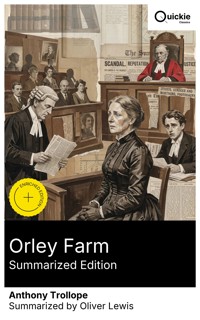
Orley Farm turns on a disputed inheritance: years after Sir Joseph Mason's death, suspicion reopens a case over a codicil that secured the estate for Lady Mason's son, Lucius. Trollope follows the scandal from country drawing rooms to the assizes, tracking the canny Mr. Furnival, the ruthless Chaffanbrass, idealistic Felix Graham, and scrupulous Judge Staveley. In patient omniscient prose he blends legal maneuver with domestic life and moral inquiry, adapting the 1860s taste for sensation fiction to his own realism. Issued in monthly parts with Millais's illustrations, it remains a subtle study of guilt, reputation, and truth. Anthony Trollope (1815–82), a Post Office civil servant turned prodigious novelist, wrote with clockwork discipline on trains and before breakfast. Administrative tours and electioneering sharpened his eye for institutions; acquaintances among barristers and editors tuned his ear to forensic rhetoric and scandal. Orley Farm channels these materials into an inquiry into conscience constrained by property law and patriarchal custom. Recommended to readers of Victorian fiction who value moral complexity over mere plot: a courtroom drama of rare inwardness, instructive for students of law, gender, and the making of public reputation. Quickie Classics summarizes timeless works with precision, preserving the author's voice and keeping the prose clear, fast, and readable—distilled, never diluted. Enriched Edition extras: Introduction · Synopsis · Historical Context · Author Biography · Brief Analysis · 4 Reflection Q&As · Editorial Footnotes.
Das E-Book können Sie in Legimi-Apps oder einer beliebigen App lesen, die das folgende Format unterstützen:
Veröffentlichungsjahr: 2026
Ähnliche






Orley Farm (Summarized Edition)
Table of Contents
Introduction
Orley Farm turns on the uneasy frontier where legal judgment, social standing, and private conscience intersect, asking how far a community will bend its notions of right when property, affection, and ambition press upon the scales of justice, and following the ripples of suspicion through drawing rooms and law offices as Trollope maps both the price of security and the cost of truth in a society determined to appear orderly even when its heart is troubled, illuminating the compromises people embrace to protect those they love, and the fragile bargains that hold communities together.
Anthony Trollope’s Orley Farm is a work of Victorian realism that blends domestic fiction with a carefully observed legal drama. Set primarily in rural England, with significant scenes in London’s professional and social circles, it examines how institutions and neighborhoods shape one another. First published in the early 1860s, during the high tide of the English novel, it draws on contemporary anxieties about property, legitimacy, and the reach of the courts. The book belongs to Trollope’s broader project of portraying English society with steadiness and detail, yet it distinguishes itself by giving the law’s machinery unusual prominence.
At the center lies a contested inheritance tied to a small estate called Orley Farm, where a widowed mother and her determined son find their future bound to the validity of a disputed document. Questions of forgery, motive, and memory gather force as lawyers, magistrates, and neighbors weigh what they think they know. Trollope’s narrator moves with patient omniscience, granting access to shifting motives without lecturing or sensationalism. The style is measured, ironical, and sympathetic, more concerned with pressure points of conscience than with melodramatic shocks, while still sustaining a quiet suspense that keeps the domestic and the judicial in constant conversation.
Readers meet an intricate network of friends, suitors, counselors, and observers whose judgments are tested as rumor hardens into accusation. Trollope alternates drawing-room confidences with chambers consultations, letting professional duty collide with private obligation. Court scenes sharpen the stakes but never eclipse the subtler negotiations carried on across card tables, country lanes, and letters. The pacing is deliberate rather than breathless, attentive to how small choices accumulate into public consequences. Throughout, a wry intelligence moderates sentiment, and an undercurrent of tenderness keeps even flawed characters legible, so that the drama arises not only from what may be proved, but from what must be borne.
Themes of law and morality interlace: the difference between what can be demonstrated and what ought to be believed; the sway of reputation over credence; the uneven access to credibility granted by class and gender. Trollope probes how institutions privilege documents and procedures while households traffic in affection and duty, and how each sphere both shelters and imperils the other. The novel asks what it means to forgive, to protect, to tell the truth when truth threatens livelihoods, and how memory resists tidy arrangement. It is also about authorship of narratives, since every witness, advocate, and neighbor is shaping a story.
These concerns remain strikingly contemporary. Readers today will recognize the novel’s interest in professional ethics, conflicts of interest, and the way public opinion can decide cases long before any verdict. Its portrait of the reputational economy—who is believed, who is dismissed, and who must perform virtue to be safe—echoes current debates about credibility and power. The book also illuminates pressures on women navigating patriarchal structures, and the hard edges of property regimes that tell people who they are allowed to be. Above all, it honors the difficulty of moral choice in situations where every option bears a real human cost.
Approached on its own terms, Orley Farm offers a deeply satisfying experience: a steady accumulation of insight, an ever-finer calibration of motive and consequence, and a legal plot that clarifies rather than flattens human complexity. Its realism invites patient reading, rewarding careful attention to tone, hesitation, and self-justification. Without relying on sensational secrets, it sustains genuine suspense by letting readers measure what is at stake for each person on the page. In an era eager for quick judgment, Trollope proposes a slower, more charitable scrutiny, making this novel not only a portrait of Victorian society, but a guide to ours.
Synopsis
Anthony Trollope’s Orley Farm, first published in 1861–62, is a legal and domestic novel centered on a contested inheritance that unsettles genteel communities in rural and metropolitan England. The story opens with the quiet respect accorded to Lady Mason, a widow living near the small estate of Orley Farm, and with the pride and promise of her son, Lucius Mason, who has grown into its proprietor. From the outset Trollope frames a question about law, character, and influence: how documents, reputations, and the machinery of advocacy can determine property and place, and how private loyalties are strained when public accusations begin to stir again.
Years before the main action, a dispute over the will of the deceased Mr. Mason had shaken the family, because a later codicil left Orley Farm to Lucius, displacing the expectations of an elder son, Joseph Mason of Groby Park. The earlier litigation ended with Lady Mason vindicated and the child’s title secured. Time passes; Lucius returns from education and travel to take up energetic management; Joseph remains resentful, and neighbors have not forgotten the old quarrel. Trollope sketches the boundaries of class and county opinion, suggesting how easily settled matters can be unsettled when memory, rivalry, and money recombine.
A new spark arrives through Mr. Dockwrath, a sharp provincial attorney whose livelihood and pride tie him to the case’s old paperwork. Studying earlier offices, he believes he perceives grounds to challenge the codicil’s validity and presses his discovery upon Joseph Mason, who seizes the chance to reopen the fight. Lady Mason turns again to Mr. Furnival, a prominent London barrister known for his skill and connections, to advise her. With this, the narrative moves between country and city, as solicitors marshal documents, track former clerks, and weigh procedural strategies, while every step threatens to revive gossip around a once-quiet household.
Seeking calm amid the renewed agitation, Lady Mason is received with kindness at The Cleeve, the seat of Sir Peregrine Orme, an elderly baronet respected for his courtesy and old-fashioned honor. His household, including Mrs. Orme, regards Lady Mason with sympathy; yet hospitality shades into deeper entanglement as the baronet’s chivalric sense tempts him to bind his name to her defense. Trollope explores the delicate line between protection and imprudence, and the costs of allowing sentiment to steer public action. The possibility of a formal alliance stirs debate among relatives and neighbors, becoming itself a test of judgment and duty.
Parallel to these developments, Trollope introduces the Staveleys of Noningsby, a judicial family whose home gathers lawyers and friends during legal vacations. Judge Staveley presides with temperate authority, while his daughter, Madeline, becomes the focus of a quieter strand of feeling. Into this circle comes Felix Graham, a young barrister and writer whose principled views on advocacy—skeptical of expediency and theatrical pleading—set him at odds with customary practice. His ideals and his affections, once seemingly straightforward, grow complicated as friendship deepens in a setting of ease and candor, challenging him to reconcile personal honor with professional ambition.
Back at Orley, Lucius Mason commits himself to improvements, investing in new methods and exerting strict discipline over tenants. His zeal, tinged with pride, creates friction in the parish and exposes him to whispers that he profits from a doubtful right. The revived lawsuit threatens not only title but solvency, since the costs and uncertainty of litigation bear heavily on a small estate. Joseph Mason, assured by Dockwrath’s arguments, presses forward, while the attorney pursues witnesses and papers with combative persistence. Trollope depicts the slow tightening of circumstance as money, temperament, and law combine to isolate those under accusation.
In London, the case reverberates in drawing rooms as much as in chambers. Mr. Furnival’s prominent involvement brings strain within his own household, as Mrs. Furnival bristles at the intimacy of consultations and the publicity surrounding them. Lady Mason, grateful yet anxious, must navigate the kindness of friends and the chill of scandal, while trying to shield her son from the worst of the storm. The novel’s domestic scenes show how legal conflict unsettles marriages, friendships, and reputations, and how tact or lack of it can inflame a crisis that might have been borne more quietly had pride and rumor not intermingled.
As the proceedings near their climax, eminent counsel are retained and strategies sharpen. The contest promises both technical argument and appeals to character, with earlier witnesses sought out and memories tested against dates, signatures, and habits of office work. Felix Graham faces a professional crossroad when asked to consider participation on grounds that would compromise principles he has loudly affirmed. In court, Trollope lays out the choreography of examination and the tension of waiting rooms, focusing attention on endurance under pressure rather than on spectacle. The central questions hover: what truly happened, and what can law be made to prove?
Without disclosing outcomes, the novel’s enduring power lies in its scrutiny of conscience under institutional strain. Trollope measures the distance between legal right and moral right, and the ways advocacy can obscure or illuminate that gap. He attends carefully to kindness, loyalty, and the temptations of vanity, suggesting that integrity often resides in everyday choices rather than dramatic gestures. The intertwined stories—of inheritance, hospitality, and young love—ask how far one should go to defend a cause, protect a name, or honor a promise. Orley Farm endures as a study of justice tempered by humanity, and humanity tempered by truth.
Historical Context
Orley Farm was serialized in 1861–1862 in the Cornhill Magazine, a leading shilling monthly founded by publisher George Smith and first edited by William Makepeace Thackeray. Anthony Trollope set the narrative in mid-Victorian England, moving between London’s legal quarter and the semi-rural Home Counties. The work appeared with illustrations by John Everett Millais, reflecting the period’s fusion of popular fiction and high-profile visual art. Its central concern with a disputed inheritance and an alleged forgery unfolds within institutions—courts, chambers, and country estates—that structured everyday life. Serial publication encouraged sustained attention to legal detail and social consequence, features that shape the novel’s tone.
Victorian readers brought to Orley Farm an acute awareness of law’s reach. The Wills Act 1837 had standardized testamentary formalities, making witnesses and codicils central to disputes. The Court of Probate Act 1857 (effective 1858) transferred probate from ecclesiastical courts to a secular system, while criminal charges related to forgery were tried on the assizes circuit. The 1850s also saw procedural reforms in common law and equity, amid public criticism of delays, notably in the Court of Chancery. In this climate, a contested document was both plausible and consequential, and Trollope’s plot engages prevailing anxieties about proof, professional conduct, and institutional credibility.
Mid-century legal practice was stratified and ritualized. Barristers trained through the Inns of Court—Lincoln’s Inn, Inner and Middle Temple, and Gray’s Inn—while solicitors organized through the Law Society (chartered 1831). The circuits brought counsel to provincial towns for assizes, and London chambers served as hubs for consultation, briefing, and social networking. Newspaper law reporting expanded professional reputations beyond courtrooms. Trollope’s lawyers operate within this recognizable architecture of rank, etiquette, and billable labor, reflecting a profession increasingly conscious of standards and status. The novel’s attention to chambers, consultations, and advocacy mirrors contemporary professional routines rather than melodramatic courthouse spectacle.
Orley Farm inhabits a society shaped by gradual political reform and the consolidation of a confident middle class. After the 1832 Reform Act broadened the electorate, wealth and influence migrated toward commerce, finance, and the professions, even as landed gentry retained cultural prestige. Country estates in the Home Counties symbolized continuity, yet mortgages, settlements, and wills increasingly mediated ownership. The expansion of railways linked rural districts to London’s markets and courts, accelerating legal and economic integration. Trollope stages conflicts where lineage, money, and professional expertise intersect, emphasizing how reputation and property management could make or unmake families in mid-Victorian England.
Victorian family law framed women’s stakes in property and reputation. Under coverture, a married woman’s legal identity was largely subsumed by her husband’s, and independent control over assets remained limited until reforms later in the century. The Matrimonial Causes Act 1857 created a civil divorce court, but standards for women seeking relief were stringent. Inheritance arrangements, guardianship, and social standing were therefore critical to widows and mothers. Trollope situates women within these constraints, where legal technicalities and public judgment could determine security or ruin. The novel’s emphasis on domestic respectability and maternal duty aligns with, yet also probes, prevailing gender norms.
Print culture powerfully shaped legal narratives in the 1850s and 1860s. The reduction of “taxes on knowledge”—the advertisement duty (1853), stamp duty (1855), and paper duty (1861)—lowered costs and broadened readership. Newspapers and weeklies reported trials and debated legal reform, and illustrated monthlies like the Cornhill cultivated respectable mass audiences. Readers were primed for fiction that blended procedural realism with moral inquiry. Trollope exploits this environment: serial pacing accentuates evidentiary twists, while Millais’s images guide interpretation. The work participates in a media ecosystem where courtroom developments, public opinion, and domestic reputation constantly interacted to confer or withdraw social legitimacy.
Material changes in movement and communication underwrote the world Trollope depicts. Railway expansion compressed distances between London and provincial towns, facilitating legal practice and social circulation. As a long-serving Post Office official (1834–1867), Trollope surveyed routes and promoted administrative efficiency; his role in introducing roadside pillar boxes to the British Isles in the 1850s is well documented. Such experience informed his granular realism about schedules, correspondence, and institutional routines. Letters, briefs, and timely travel are not incidental detail but the infrastructure of plot. The novel’s emphasis on paperwork, deadlines, and professional discretion reflects the bureaucratic discipline of mid-Victorian public life.
Published amid the early 1860s vogue for sensation and legal fiction—alongside Dickens’s Bleak House (1852–1853) and Wilkie Collins’s The Woman in White (1860)—Orley Farm adopts a legal mystery but insists on social and procedural verisimilitude. Millais’s illustrations anchor character and setting within contemporary visual culture, while the Cornhill’s platform targets an educated, respectable readership. Across its inheritance dispute and public scrutiny, the novel examines how legal forms, class expectations, and gendered respectability govern conduct. By foregrounding evidence, advocacy, and reputation rather than gothic excess, Trollope offers a measured critique of Victorian institutions: effective yet fallible, humane yet constrained by status and appearance.
Author Biography
Anthony Trollope (1815–1882) was an English novelist of the Victorian era whose vast body of fiction mapped the institutions and social textures of nineteenth‑century Britain. Best known for the Barsetshire novels and the Palliser or Parliamentary series, he combined close observation of provincial life with an insider’s knowledge of bureaucratic and political processes. Alongside his literary career, he worked for decades in the Post Office, a dual vocation that shaped his disciplined approach to writing and his interest in public service. Prolific yet attentive to nuance, Trollope became a central figure in the development of realistic, serial fiction for a broad reading public.
He was educated at Harrow School and other English public schools, experiences that he later described as difficult but formative for his sense of social hierarchy and institutional culture. Lacking a university degree, he entered the General Post Office as a junior clerk in the 1830s, beginning a parallel career that exposed him to varied regions and classes. His early reading in English fiction and history, together with the example of contemporaneous realist writing, encouraged an emphasis on everyday motives, gradual moral pressure, and credible dialogue. A professional outlook—treating authorship as steady labor—became an avowed principle and would inform both method and theme.
Assigned to Ireland in the early 1840s as a Post Office inspector, Trollope began writing while traveling on official business. His first completed novel, The Macdermots of Ballycloran (1847), drew on Irish settings, followed by The Kellys and the O’Kellys (1848). These early works met modest response, but his persistence, combined with a growing command of plot and character, laid the foundation for later success. He developed habits of early-morning composition before office hours, keeping to a steady daily quota. The discipline allowed him to balance public employment with creative work, and to plant the seeds of the clerical and provincial world that would soon define him.
His breakthrough came with The Warden (1855), the first of the Barsetshire novels, which introduced an imagined cathedral town and its clergy, officials, and gentry. Barchester Towers (1857) and Doctor Thorne (1858) consolidated his reputation, while Framley Parsonage (1861) reached a wide audience through serial publication in a leading magazine. The Small House at Allington (1864) and The Last Chronicle of Barset (1867) completed the sequence. These books blended institutional questions—especially concerning the Church of England—with intimate domestic narratives, producing a rich social canvas. Critics praised the naturalness of dialogue and the continuity of a shared world that allowed characters to recur and develop across volumes.
From the mid‑1860s he turned increasingly to politics, launching the Palliser or Parliamentary novels with Can You Forgive Her? (1864), followed by Phineas Finn (1869), The Eustace Diamonds (1873), Phineas Redux (1874), The Prime Minister (1876), and The Duke’s Children (1880). These works examine ambition, compromise, and public ethics within Parliament and fashionable society. Trollope briefly sought a seat in Parliament as a Liberal in the late 1860s, an experience that informed his depiction of elections. As a senior Post Office official he also supported practical reforms, contributing to the early adoption of pillar letter boxes. He retired from government service in 1867 to write full‑time.
Trollope’s range extended beyond his two cycles. Orley Farm explored legal and moral ambiguity; He Knew He Was Right probed jealousy and authority; The Way We Live Now offered a far‑reaching critique of speculation and credulity. He published travel books, including studies of the West Indies, North America, Australia, and South Africa, reflecting his professional journeys and curiosity about institutions abroad. He favored realism over sensational effects, often addressing money, marriage, vocation, and the weight of custom. His Autobiography, issued after his death, famously disclosed his workmanlike routine and views on payment and popularity—details that shaped debates about professionalism and artistry in Victorian fiction.
In later years he remained productive, experimenting occasionally with form, as in the speculative The Fixed Period. He continued to publish novels and stories up to his death in 1882. Posthumous publication of his Autobiography (1883) sparked controversy about the economics of authorship but also clarified his aims. His reputation fluctuated: some late‑nineteenth‑century critics questioned his sheer productivity, yet twentieth‑century scholarship and television adaptations of the Barsetshire and Palliser novels renewed admiration for his subtle social analysis and capacious fictional worlds. Today he is read for his insight into institutions, gender and class negotiation, and the fabric of communal life, making him a durable witness to Victorian modernity.
Orley Farm (Summarized Edition)
VOLUME I.
CHAPTER I. THE COMMENCEMENT OF THE GREAT ORLEY FARM CASE.
I deny that a rose would smell as sweet under any label; else I'd christen this tale 'The Great Orley Farm Case.' Who would buy a serial with that mouthful? So—Orley Farm. I warn, my purpose is not to preach about cream-cheese, boned pigs, or drilled wheat. Agriculturists will glean nothing here. The farm is named because it lies at the heart of lawsuits. Twenty years before our tale opens, Sir Joseph Mason, self-made merchant turned Yorkshire magnate, died. His firstborn Joseph expected both Groby Park and Orley Farm, but a sudden codicil[1] left the farm to two-year-old Lucius, son of his younger second wife.
Litigation flared. The widow had penned both will and codicil at Usbech’s dictation while the lawyer’s gouty hand quivered; Sir Joseph, she maintained, signed in full view of Usbech, young clerk Kenneby, and the housemaid. On the stand she spoke steady truths: “I urged him till he granted Orley to our child; in return he meant to aid Usbech’s daughter with two thousand pounds.” Kenneby swore he had witnessed perhaps a hundred and twenty signatures, this one included, yet under cross-fire doubted everything, till the judge dismissed him as useless. The maid recalled pens moving and names written; Usbech, she thought, held the quill.
Miriam Usbech, a gentle seventeen-year-old, testified next. Her father once hoped Sir Joseph would provide for her; she had lived at Orley Farm till his death and trusted both hosts. She added, “Lady Mason will never rest until the old gentleman settles the farm on her boy.” Court and county found her manner sweet, and with no shred against the widow, verdict favored the infant. The case slumbered nearly twenty years while Lady Mason ruled the house for Lucius. Miriam remained there until she spurned the wavering Kenneby and, despite warnings, bestowed her two thousand pounds—and her hand—on ambitious attorney Samuel Dockwrath.
Lady Mason, eager to help her maid, preferred John Kenneby, yet she accepted Miriam’s choice of the Hamworth attorney. "Well, Miriam, you must judge for yourself; you know my regard for you." "Oh yes, ma'am." "I shall always be glad to advance your welfare as Mrs. Dockwrath, though I had rather served you as Mrs. Kenneby." In the years that followed she stayed true, cheering Miriam through an annual baby and two pairs of twins, sixteen souls. She even let Dockwrath two fields beside Hamworth, the rent modest; he spent money there and, warned to quit when young Mason came of age, felt injured.
When notice came, Lady Mason reproved him: "Surely, Mr. Dockwrath, you are very ungrateful." He flung back disrespectful words, and the breach was made. "I must say, Miriam, that Mr. Dockwrath is unreasonable." "Oh, Lady Mason, pray let it bide a time till it all comes right." It never did; the quarrel over those two fields grew into the great Orley Farm Case. Orley Farm itself contained two holdings. The Old Farm, three hundred acres, lay with punctual Mr. Greenwood, who paid four hundred a year. Adjoining stood the irregular home Sir Joseph had enlarged—low tiled rooms, a three-story wing, then a slated dining-block.
A terrace lawn fell from the house to an apple-filled orchard; vines and passion-flowers climbed the sunny front, and a verandah linked the newer rooms. Two hundred acres, farm-yard masked by creepered walls and ornamental paling, stretched toward Hamworth, ending in the disputed slope cut by the church footpath. Beyond the gate at Coldharbour the land roughened into heath beneath Cleeve Hill, where Sir Peregrine Orme’s woods crown the view and seven counties seem to lie below in fields, oaks, and brown heather. Meanwhile Dockwrath stamped in town, muttering, "Ungrateful! I've paid her rent each half-year; I'll let her know whether I'm ungrateful.
Mr. Samuel Dockwrath pushes back from the breakfast fire, fury rising at the name of Lady Mason. Though for years he had pocketed her gifts and the lease of two good fields, his pride now burns hotter than gratitude. Sixteen children once forced him to swallow patronage, yet success and a new bank balance embolden him to hate the woman who, he thinks, once tried to divert his wife’s little fortune. He vows that losing the fields shall not go unpunished, disdains “trumpery presents from Orley Farm,” and decides his household must sever every tie with its rich, childless neighbour.
Miriam cradles a child amid the breakfast swarm. “I’m sure I’m very sorry,” she whispers. “Sorry? I’ll make her sorry, the proud minx; people in glass houses shouldn’t throw stones!” he snaps. “Samuel, she meant no harm; she always said— Don’t, Bessy, fingers out of the basin!” “Sam took my spoon, Mama.” “I’ll show her harm. Nothing was promised sixteen years ago, not in writing.” “I remember it, Samuel.” “Then forget it. Bob, hush, or you’ll smart. Where’ll you get milk when the fields are gone?” “I’m very sorry, Samuel.” “Somebody else will be sorrier. Hear me—set no foot at Orley Farm.” He storms out.
CHAPTER II. LADY MASON AND HER SON.
All eyes turn to Lady Mason, whose story, though not strictly heroic, commands equal weight. Her forebears on the Johnson side were solid hardware merchants; her parents climbed from retail to wholesale until bankruptcy flung Mr. Johnson into the Gazette. Amid the wreck, the chief assignee, old Sir Joseph Mason, gathered one portion of the assets—Mary Johnson herself—and made the girl his wife at Orley Farm. Of the ruined family only father, mother, and brother remained; the father soon died, while mother and son, aided by Sir Joseph, set up modest trade in a Lancashire manufactory.
The match, though abhorred by Sir Joseph’s four grown children, renewed his lonely house. Those ambitious offspring, now polishing the stains of commerce, rarely visited; Joseph of Groby Park came once, accepted a promise that his inheritance would stand, and departed. Meanwhile the quiet young wife asked nothing for herself, arranged the farm with cheerful skill, and lavished patient care upon her grave husband. Then Lucius Mason was born; the old man felt life begin anew, while his daughters’ letters hissed about disgrace and threatened loss of rent-rolls. They urged their brother to guard his rights.
Before they could act, Sir Joseph died suddenly. His will’s codicil named the infant heir of Orley Farm. Lady Mason had pressed for that gift only in witnesses’ hearing, often with attorney Usbech, now dead, and once with barrister Furnival, who testified firmly. A fierce suit followed; verdict went to Lucius and, incidentally, to Usbech’s daughter and her husband Dockwrath. Joseph Mason departed cursing law, vowing fraud, calling his step-mother the villain, yet shrinking from costlier appeals. Lady Mason, serene in trial and triumph, never boasted nor reviled her foes; neighbours paid respectful visits, she returned them quietly, avoiding bustle.
Among those who clasped Lady Mason’s hand in her darkest hour stood seventy-year-old Sir Peregrine Orme of The Cleeve, whose household now held only his widowed daughter-in-law and her boy, the heir. Admiring her and detesting her stepson Joseph Mason of Groby, whom he deemed no gentleman, Sir Peregrine encouraged friendship between the two widows until their intimacy seemed natural. He overlooked Lady Mason’s lack of old blood and praised her prudence, though neighbours whispered that she shunned Mrs. Arkwright’s tea because Sir Peregrine’s drawing-room was open to her. Tall, calm, forty-seven, she carried gray eyes, perfect teeth, a sharp chin, and habitual, dignified melancholy.
Rumour once vowed she meant to marry Sir Peregrine, yet her stately reserve forbade flirting and no local man dared try. Her son Lucius, now past twenty-two, had grown under elaborate care. When schooling was discussed, the baronet advised Harrow[2], but she gently won him to a quieter plan. “Looking at the peculiar position of his mother…it will be better he should not assume anything early; nothing can be better than Mr. Crabfield’s establishment,” Sir Peregrine declared, proud to think the choice his. “And perhaps it will be as well that he and Perry should not be together,” he added.
Crabfield returned Lucius at seventeen—a tall, handsome youth, versed in Greek, Latin, Euclid, French, and Italian, whiskers budding and confidence high—things Harrow might not have granted. During holidays both mothers, silently measuring, found Lucius superior in polish and learning, while Peregrine Orme, a year younger, clung to rat-catching over Shakespeare. Yet The Cleeve felt no deep concern; boys often scorn books. Pride bloomed instead at Orley Farm. Lady Mason spoke little of present triumphs, but to Sir Peregrine sought counsel and to Mrs. Orme confessed fears about the future. Sanction secured, she sent her son to Germany, shaping his destiny.
He came of age without salute of sword or property show, though the day put the inheritance wholly in his hands. He might have turned his mother from the farmhouse, yet stayed another year in Germany and reached Orley only for Peregrine Orme's twenty-first birthday. That rite, befitting a line that had knelt to kings, loved queens, and lost heads since James I, was hailed with loud pride. Lady Mason, whose son lacked such ancestry, kept silent, only whispering to Sir Peregrine that the young heir should shun his forefather's reckless gallantry. "No, by Jove, that would never do now," the baronet laughed.
After the festivities, the question of Lucius's career pressed. Lady Mason urged the law; her friend Mr. Furnival sent a long letter. From Germany the son replied, "I think lawyers are all liars." Rebuked for ignorance and uncharity, he remained unmoved. She then proffered civil engineering through Sir Peregrine's friend Mr. Brown. Lucius dismissed engineers as merely upper-class tradesmen and declared he would not be a tradesman. Again she reproved him and asked what he wished. "Philology," he answered, "perhaps literature: philology allied with the races of man; little has been done in that union." With those ambitions he returned home while Peregrine hunted rats.
Finding that he meant to live at Orley Farm, his mother proposed he cultivate his own acres. Lucius eagerly agreed; would have displaced Greenwood at once, but she checked that impulse. He remained adamant that Samuel Dockwrath quit his small holding. She pleaded the milk for sixteen children; he answered that an owner might do as he pleased and that Dockwrath had held only till the heir came of age. Thus he became farmer-scholar: chemistry to feed the world, philology to track mankind from Eden. Lady Mason listened to Mongolidae and Indo-Germanic Iapetidae, yet trembled at the mounting cost of chemical agriculture.
Three months later, eviction settled, he burst into the parlour. "Mother, I go to Liverpool tomorrow." "To Liverpool, Lucius?" "Walker's guano is adulterated; my analysis shows only thirty-two and a half hundredths when seventy-five should be. How work with trash? I will throw the seventy acres below Greenwood's Hill together, compensate him, kick Dockwrath out, and test real guano against patent blood." She urged delay; he answered, "Waiting has dwarfed half mankind. Not for me." She mentioned capital. "Capital is a bugbear," he declared; knowledge is the need. When she pressed for preparation he retorted, "That's waiting too," and marched off for Liverpool.
During his absence Lady Mason wished she had left him among the consonants of philology. The rent, including her own tenancy, would have kept him comfortably while he pursued quiet study. Instead she faced the dangers of a gentleman farmer who refused to wait for chemists. Any income from her smaller farm was gone, and Greenwood's punctual payments might soon be swallowed by experiments seeking untainted guano. Who could say where zeal would stop? He might yet charter a vessel for the Peruvian coast, all in pursuit of manure, and the comfortable revenues of Orley Farm would drift after it.
CHAPTER III. THE CLEEVE.
Sir Peregrine Orme drew only three or four thousand a year, modest for his rank, yet The Cleeve, over which he was lord of Hamworth manor, stood unrivalled. The house blended Elizabethan relics with Charles-II additions; no chamber was large, but black wainscot, carved chimneypieces and hidden panels lent venerable charm. Its fame, however, lay outside, where parkland dropped into ferny ravines and heathery commons fit for ancient oaks and shy deer. The slim River Cleeve foamed through a stone fissure, skirted by mossed paths and hanging bridges, and at dusk stags descended a steep track to drink beneath autumn light.
Past seventy, the baronet remained tall and handsome: white hair, keen grey eyes, aquiline nose, delicate hands and feet he quietly admired. Generous yet opinionated, he melted before agreement, grew curt under challenge, and measured rank by lineage rather than by moneyed acres. He trusted easily; once deceived, never again. Flattery guided him as surely as a leading-rein, a truth understood by groom, gardener and woodman, each steering him gently while loving him well. Another influence moved him without effort: Mrs. Orme, widow of his only son, slight and fair, whose slightest wish long ago became unquestioned law at The Cleeve.
Twenty years earlier the house had darkened: Peregrine Orme’s cherished son, heir and political hope, fell from his horse and was carried home lifeless. His bride, after one radiant year, chose perpetual mourning and never left her father-in-law’s side, ruling the quiet household with gentle sovereignty. Grief cooled festivity; yet debts were cleared, the acres secured for young Peregrine, her boy, whom his grandfather shields from the world’s roughness. The lad, barely past twenty, hunts rats instead of foxes, minds little for bankers’ ledgers, and remains more boy than man; time, not rival claimants or mere wealth, will fashion the future baronet.
Luckily Sir Peregrine’s grandson had been dismissed before sterner times arrived. Oxford had expelled him; the warden advised his name be struck off, so the heir of The Cleeve now idled at home. His offences were exuberantly juvenile: he herded a farmer’s sow into the parlour, smeared white paint on a tutor’s mortarboard, and loosed a sack of rats through hall at dinner. Pursued with relentless zest, such pranks earned banishment. Meanwhile his friend Lucius dreamt of chemistry and agriculture, but young Peregrine faced vacant days beside his blue-eyed mother and venerable grandfather at Cleeve estate.
Bills soon followed—ten of them—and the inquest took place in the library. Sir Peregrine asked, "How will you meet these debts? A gentleman does not order without intent to pay." The boy answered, "I intended they should all be paid." "How, sir; by whom?" "I supposed you would pay them." The man paced, returned, set a hand on his shoulder. "Then I will. For your sake I hope they're not heavy. Can you write the amount?" Peregrine, neither coward nor liar, wrote every item, gave the list, and heard no more; a year later Oxford tradesmen bowed like he owned twenty thousand a year.
Peregrine was small yet sturdy, light-haired, chin deeply dimpled, his mother’s brilliant blue eyes flashing above wrestler’s shoulders. Freshmen feared his boxing and stick-play. To Mrs. Orme he was perfection, the living likeness of her dead husband; she called the college master a tyrant for expelling him and Sir Peregrine spared her any talk of bills. The youth offered to qualify as master of hounds or at least hunt with the H.H. through the coming winter. She smiled, quoted, "Home-staying youths have homely wits," and proposed a spring abroad. "Exactly," he grinned, "therefore Leicestershire this winter." The request was refused and his future remained unsettled.
CHAPTER IV. THE PERILS OF YOUTH.
Leicestershire was impossible for young Peregrine Orme, but London was not. Drawn by an Oxford acquaintance, the rat-killer Carroty Bob of Cowcross Street, he hurried up, backed the champion terrier, lost money, and at midnight fought his way clear—leaving one sporting gent half-senseless. The brawl filled the papers and soon reached The Cleeve. Summoned to the study, he owned the debt—small, if undignified; “rats come cheaper than race-horses,” Sir Peregrine muttered. Then, looking as sternly as age allowed, the old man demanded, “Do you know, sir, that you are breaking your mother’s heart?” “I hope not, sir,” Peregrine answered.
“You will if this shameless career continues. When your father was your age—” the baronet’s voice broke, handkerchief raised. Peregrine shrugged: “I’ve heard you once went to cockfights.” “Seldom, and with gentlemen! Lord John Fitzjoly is the last man you should follow. Slaughtering vermin is no pursuit for a gentleman.” “But foxes are vermin.” “Silence!” At length the elder declared, “Give me your word of honour you will touch no rats for two years.” After a wistful pause the young man sighed, “Very well, sir—two years,” noting the date. Pleased, Sir Peregrine cried, “Fetch the nags; we’ll ride to Crutchley Wood.
Through the larches and beeches they talked of cutting a bridle-path; at the stable yard the baronet yielded, laughing, “Well, Perry, you and Samson shall have it.” That evening a messenger brought a note: “If you are free at noon, pray come to Orley Farm; I need your kind advice.—Mary Mason.” He answered at once, and next day his gray cob paced up the river path, over Crutchley Wood, and down to Lady Mason’s gate. The homely drawing-room glowed with careful taste; she disdained fashion, though her son had bought her a pony-chaise she never used. “Sir Peregrine—how kind!” she said.
Sir Peregrine pressed Lady Mason’s hand. “Not at all; what are neighbours for?” he said. She thanked him and confessed her reason for calling: “Lucius left for Liverpool two days ago.” “My grandson mentioned it,” he replied. She praised her son’s conduct, then hesitated. “I trust no attraction draws him?” “Nothing like that. The attraction is farming.” She explained Lucius had taken her land, added more, and burned to enlarge. “A gentleman farmer’s life is decent, yet I’d have chosen a profession,” Sir Peregrine said. She had urged the bar, but Lucius was resolute, and she feared costly experiments. “Experimental farming is expensive,” he warned.
She admitted Lucius had hurried north to buy guano. Sir Peregrine frowned. “Guano! Why not get Walker’s as Symonds does? If he disliked that he could order in London. Gone to Liverpool for guano! If he farms so, he needs heavy capital; his money will lie dead for years.” He pictured seasoned tenant farmers and scorned chemical fads. “He must stop soon or ruin himself—and you.” Her face grew grave. “He won’t heed me; would you speak to him?” He consented, though advising independent youth was awkward. “Let him dine at The Cleeve; we’ll thrash it out after dinner.” She was deeply grateful.




