


1,99 €
Mehr erfahren.
- Herausgeber: Quickie Classics
- Kategorie: Gesellschafts- und Liebesromane
- Sprache: Englisch
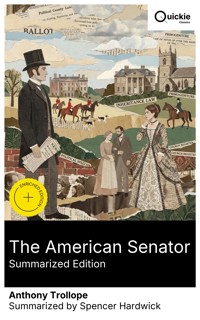
The American Senator surveys an English county through the cool gaze of Senator Elias Gotobed, whose visit exposes the absurdities and evasions of rural privilege. Around Dillsborough's hunt and the houses of Bragton and Rufford, Trollope interlaces the senator's lectures on law, church, and primogeniture with Arabella Trefoil's ruthless marriage campaign and the quieter courtship of Mary Masters and Reginald Morton. Late-Trollopean realism—ironic, patient, capacious—turns foxhunting and drawing-room ritual into an ethnography of Englishness. Trollope's Post Office career and wide American travels (recounted in North America) prepared him to compare institutions without caricature. A passionate rider to hounds and an acute observer of elections and patronage, he writes from lived experience of county sport, the marriage market, and local power, letting an outsider's empiricism probe customs he knew intimately. Readers of realist fiction and transatlantic history will relish its steady moral pressure and unblinking comedy. As a county novel of high finish and a comparative inquiry into foxhunting, entail, and clerical authority, The American Senator remains a lucid, humane guide to the textures of English society. Quickie Classics summarizes timeless works with precision, preserving the author's voice and keeping the prose clear, fast, and readable—distilled, never diluted. Enriched Edition extras: Introduction · Synopsis · Historical Context · Author Biography · Brief Analysis · 4 Reflection Q&As · Editorial Footnotes.
Das E-Book können Sie in Legimi-Apps oder einer beliebigen App lesen, die das folgende Format unterstützen:
Veröffentlichungsjahr: 2026
Ähnliche





The American Senator (Summarized Edition)
Table of Contents
Introduction
In The American Senator, Anthony Trollope stages the collision between a confident outsider’s practical scrutiny and the softly coercive authority of English custom, showing how institutions that seem natural at home—aristocratic privilege, the marriage market, the pleasures of sport, and the rites of local politics—turn brittle, comic, and quietly unjust when viewed with cool, transatlantic eyes, transforming friction into a searching comedy of manners in which genial civility, social ambition, and moral feeling continually negotiate the disputed ground between what has always been done and what, under the pressure of reason and sympathy, might at last be changed.
Trollope’s novel belongs to the Victorian social novel, set principally in the fictional English county of Dillsborough with forays into London drawing rooms, and first appeared in the late 1870s, when debates about reform and tradition animated British public life. Its title signals a transatlantic point of view unusual in his work, inviting readers to watch English habits under comparative inspection. The landscape of fields, kennels, and market towns anchors a broader panorama of class and patronage. Without requiring any prior knowledge of Trollope’s other series, the book offers an independent canvas on which manners, politics, and economic anxieties are vividly sketched.
At its center stands Senator Elias Gotobed of the United States, a visiting legislator who treats England as a case study, asking plain questions about inherited privilege, ecclesiastical authority, and the legality of sport. His arrival intersects with lives anchored in Dillsborough: Mary Masters, a young woman pressed between affection, family duty, and competing suitors, and Arabella Trefoil, a determined society beauty navigating the perilous arithmetic of status and security. Around them swirl the rituals and controversies of fox-hunting, local politics, and drawing-room calculations. Trollope uses these strands not for melodrama but to test how individuals bend—or resist—when tradition is politely, insistently interrogated.
Trollope writes in an omniscient voice that is urbane, steady, and gently ironic, pausing to address readers, trace motives, and weigh competing claims without rancor. The chapters are built from exact social observation—letters, calls, dinners, and hunt meetings—so that the pressure of convention is felt in the rhythm of everyday life. Dialogue carries much of the wit and argument, while set-pieces about the hunt and local politics display a craftsman’s command of detail. The tone is hospitable rather than caustic, making the satire persuasive through fairness, and the pacing rewards patience with accumulating clarity and quiet emotional force.
Among the novel’s central concerns are the ethics of privilege and property, the social calculus of marriage, the authority of law versus the force of custom, and the uneasy compact between sincerity and performance in public life. By juxtaposing transatlantic perspectives, Trollope asks what counts as national character and how far habit should govern justice. He pursues these questions not abstractly but through the compromises and hopes of people with much to lose or gain. The novel scrutinizes sport as a social institution, examines the texture of local governance, and details the subtle ways power travels through courtesy.
In an era when nations appraise one another’s institutions in real time, The American Senator remains bracing for its insistence that critique can be both courteous and unsparing. Readers today will recognize debates over entrenched privilege, the fairness of inherited advantage, and the ethics of leisure practices that claim tradition as their warrant. Trollope’s women and men negotiate agency within constricting systems, offering a lens on how ambition, care, and prudence are balanced in unequal markets. The novel also models careful listening across difference: it neither dismisses the outsider nor flatters the insider, but lets scrutiny and sympathy coexist.
For new readers, the book offers an accessible entry into Trollope’s art: a spacious plot, unforgettable social scenes, and moral problems approached without sermonizing. For returning admirers, it adds the bracing note of a transatlantic auditor, tightening the focus on how custom justifies itself. Without foreclosing outcomes, the narrative invites readers to weigh competing claims of happiness, duty, wealth, and public reputation, and to notice the small negotiations by which ordinary lives are steered. The result is both vivid entertainment and a quietly radical invitation to examine what we inherit, what we excuse, and what we may be ready to reform.
Synopsis
Anthony Trollope’s The American Senator unfolds in the small English town of Dillsborough and the nearby estate of Bragton, where an American visitor, Senator Elias Gotobed, comes to observe British life at close range. He is the guest of John Morton, a young diplomat and local landowner. Around this outsider’s perspective, Trollope weaves intertwined social plots: the ambitious Arabella Trefoil’s pursuit of a secure marriage, the quieter trials of Mary Masters and her suitors, and the rituals of the local hunt that bind the county together. Through these strands, the novel sets tradition and custom against scrutiny, calculation, and candor.
Senator Gotobed’s character—blunt, curious, and unwavering—quickly marks him as different from his hosts. He questions what he sees: primogeniture and landed privilege, the authority of the established Church, the peculiarities of the game laws, and the deferential habits that shape rural governance. His criticisms, delivered with unembarrassed directness, disturb the politeness of drawing rooms and challenge assumptions that others treat as beyond argument. Trollope places him amid magistrates, parsons, and tenants, using his candid inquiries to expose the bonds and blind spots of English society while maintaining the Senator’s good faith as an earnest, if sometimes abrasive, observer.
John Morton’s position as both diplomat and squire gives him a foot in two worlds, and his engagement to Arabella Trefoil brings metropolitan ambition into provincial life. Arabella, guided by the tireless efforts of her mother, Lady Augustus Trefoil, approaches marriage with a cool appraisal of income, rank, and future security. Morton’s sense of honor and propriety meets Arabella’s calculating needs uneasily. The Senator, long acquainted with Morton from transatlantic circles, watches this tension with interest, recognizing in the marriage market an institution as telling as Parliament or parish vestry. Trollope lets the private negotiations of courtship reveal public values.
The county’s social high point is the hunt, presided over by the popular Lord Rufford. The Rufford Hunt offers spectacle and status, and it becomes the stage on which Arabella works to consolidate connections. Her manner invites attention while preserving deniability; chaperonage rules, house-party politeness, and careful letters allow advances without open breach. Lord Rufford’s gallant hospitality and sporting fame complicate boundaries. As murmurs grow behind fans and in stable yards, Arabella’s position between pledged promises and fresh prospects turns precarious. Trollope shows how reputation can be staked on the smallest gesture when social currency depends on implication rather than plain speech.
Alongside this glittering maneuvering, Mary Masters lives quietly in Dillsborough. The daughter of the local attorney, she faces a candid proposal from Larry Twentyman, a prosperous young farmer and fearless rider, encouraged by Mary’s stepmother for reasons both practical and affectionate. Mary hesitates, divided between gratitude and a sense that her heart remains unengaged. Reginald Morton, a distant relation of the Bragton Mortons, moves in a different sphere—gentle, reserved, and attentive in a way that respects Mary’s dignity. Their guarded friendship and the town’s watchful judgment frame Mary’s choice as one between comfort, aspiration, and sincerity.
The Senator applies his measuring eye to country sport and law alike. He weighedly condemns foxhunting as cruelty disguised by ceremony, and he questions game-preserving practices that place wildlife above the needs or rights of poorer neighbors. In parlors and over dinner, he contrasts American notions of equality with English hierarchies, pressing local leaders to justify customs they regard as self-evidently proper. Trollope gives his English characters their full defense—tradition, stewardship, charity—yet the Senator’s pointed hypotheticals and logical clarity leave many uncomfortable. The conversations neither descend into caricature nor resolve easily, illustrating how entrenched institutions resist tidy verdicts.
Property and lineage at Bragton cast a long shadow over personal affairs. Old grievances and family pride shape the relations between John Morton and Reginald Morton, each bearing a different relation to the estate’s past and its future. Trollope treats succession not merely as a legal matter but as a web of expectations that governs friendships, courtships, and the pecking order of the town. The Senator, attentive to the power land confers, contrasts this with American habits of inheritance, finding in English continuity both strength and constriction. Through these reflections, the novel links private decisions to the broader architecture of class.
As the hunting season and social calendar advance, strains intensify. Arabella’s balancing of engagements, invitations, and letters invites scrutiny, and the latitude she once enjoyed narrows. John Morton, caught between feeling and obligation, must weigh what fidelity means when promises are strained by ambition and circumstance. Mary Masters faces the gentler but insistent pull of family wishes against the quieter truth of her own heart. Larry Twentyman’s pride and pain surface in the field and at home; Reginald’s reticence becomes its own obstacle. Meanwhile the Senator’s judgments reach their sharpest expression, testing friendships without extinguishing respect.
Without relying on melodrama, Trollope draws together questions of national character and private choice. The American Senator uses its visitor to hold a mirror to English custom, not to demolish it but to ask whether courtesy without candor can truly sustain justice or happiness. The marriage market, the prestige of sport, and the distribution of land all become measures of sincerity and fairness. The story’s resolutions remain for readers to discover; its lasting force lies in the humane scrutiny it applies to privilege, prudence, and love. In the end, the novel invites reflection on how societies change, and how individuals choose within them.
Historical Context
Anthony Trollope’s The American Senator was first serialized in Temple Bar from October 1876 to July 1877 and published in three volumes in 1877 by Chapman and Hall. Set in contemporary rural England, principally a fictional shire town and its surrounding estates, it examines country-house society, local politics, and the rituals of the hunt. Trollope, a prolific Victorian novelist, writes within the conventions of realistic social fiction, drawing on close observation of institutions and manners. The narrative centers on an American visitor’s scrutiny of English customs, allowing Trollope to frame a comparative portrait of British life during the later 1870s.
Britain in this period had recently undergone major electoral reform. The Second Reform Act (1867) expanded the urban male franchise, and the Ballot Act (1872) introduced secret voting, reshaping contests in counties and boroughs. Yet rural governance remained largely in the hands of landowning justices, who presided at Quarter Sessions and influenced Poor Law unions and policing. The Anglican Church retained establishment in England, entwining parish life with clergy authority, even as the Irish Church had been disestablished in 1869. These arrangements underpin the novel’s depiction of county politics, patronage, and social deference, against which the American’s republican sensibilities make pointed comparisons.
Fox-hunting stood at the center of genteel rural culture in the mid-Victorian decades, symbolizing status, masculinity, and county solidarity. After the Game Act of 1831, landowners’ control over game preservation and access was consolidated, with keepers and magistrates enforcing property and trespass rules. Hunts, subscriptions, and coverts intertwined with tenancy relations, as farmers tolerated crop damage in deference to landlords and sportsmen. Debates about cruelty, poaching, and the social costs of preservation persisted in newspapers and Parliament. Trollope, himself an enthusiastic rider to hounds, uses the hunt’s ceremonial and legal frameworks to illuminate hierarchies that an American egalitarian observer questions.
Economically, the novel’s countryside stands on the cusp of the late-nineteenth-century agricultural depression. The Long Depression began in 1873, and by the later 1870s cheap North American and Russian grain, improved shipping, and falling prices were undermining British arable farming. Estate incomes, traditionally reliant on rents and sporting prestige, felt pressure, exposing mortgages and expensive habits. Inheritance customs—primogeniture and strict settlements—often tied land to family lines, limiting flexibility. Legislative proposals for land-law reform circulated, though major English changes came later. Trollope’s scenes of county anxieties reflect a world beginning to strain under global markets, even as tradition insists on continuity.
Victorian marriage markets, especially among the gentry, were shaped by property, respectability, and social display. The Matrimonial Causes Act of 1857 created a civil divorce court and widened access to divorce, though standards remained unequal for men and women. The Married Women’s Property Act of 1870 gave wives limited control over earnings and certain funds, a step toward later reforms in 1882. Breach of promise suits and society journalism publicized engagements and reputations. Trollope draws on these legal and cultural conditions to depict courtship strategies, family negotiation, and calculation, while keeping within norms of propriety that his characters and readers recognized.
Transatlantic comparison informs the book’s perspective. In the United States, the Civil War had ended in 1865, and the 1870s were marked by Reconstruction’s struggles, expanded federal citizenship, and debates over states’ rights. The Alabama Claims were settled by international arbitration in 1872, easing Anglo-American tensions and enabling brisk travel and tourism. U.S. senators were then chosen by state legislatures, not by popular vote, highlighting contrasts with Britain’s hereditary peerage and elected Commons. Trollope had visited America and published North America (1862), sharpening his eye for institutional contrasts. The visiting senator’s critiques register emergent global conversations about democracy, privilege, and law.
Victorian print culture shaped the novel’s circulation and form. Temple Bar offered monthly serial exposure, while three-decker publication catered to circulating libraries such as Mudie’s, which influenced length, pacing, and respectability. Expanding literacy, aided by the Elementary Education Act of 1870 and cheaper periodicals, enlarged the middle-class readership for social realism. Trollope’s reputation from the Palliser and Barsetshire series gave authority to his depictions of Parliament, clergy, and county society. Telegraphs and railways connected London to provincial towns, facilitating the very visits and news exchanges the story records. The American Senator thus met an audience attuned to detailed institutional observation.
Within this framework, The American Senator scrutinizes English provincial life at a moment of reform and resistance. It tests the coherence of deference, landed privilege, and ecclesiastical establishment against ideals of accountability and egalitarian critique. Marriage negotiations, county elections, and hunting disputes function as case studies of how law, custom, and reputation govern behavior. The outsider’s questions, informed by American republicanism, do not simply flatter the new; they expose contradictions and complacencies shaped by history. Trollope’s measured realism offers readers tools to evaluate institutions rather than merely personalities, making the novel a contemporary commentary on the late-Victorian social order.
Author Biography
Anthony Trollope (1815–1882) was a leading English novelist of the Victorian era, renowned for panoramic, realist narratives that anatomize social institutions and private motives. Prolific across five decades, he created the Barsetshire and Palliser sequences, mapping provincial clergy and national politics with unusual continuity and depth. His dual career in the civil service informed his keen attention to bureaucracy, professionalism, and the pressures of reputation. Trollope’s work is notable for its steady moral intelligence, lively dialogue, and sympathy for ordinary compromises rather than melodramatic extremes. Alongside dozens of novels, he published short fiction, essays, and travel books that broadened the scope of mid-nineteenth-century narrative.
Raised and educated in England within the public-school tradition, Trollope received a classical curriculum typical of his generation but did not proceed to university. He entered the General Post Office in the mid-1830s, beginning a long civil-service career that coexisted with his literary ambitions. His reading ranged across eighteenth- and nineteenth-century novelists, and he later acknowledged the example of contemporaries who wrote for the magazines, helping to shape his sense of form and audience. The ethos of Victorian realism—attention to social process, character under constraint, and institutional settings—became his abiding framework. He cultivated professional habits early, drafting regularly before work and revising with pragmatic clarity.
Transferred to Ireland in the early 1840s as a postal surveyor, Trollope traveled widely, work that acquainted him with towns, railways, and administrative systems on the ground. His experiences there supplied settings, dialects, and political tensions for his first successful fiction. The Macdermots of Ballycloran (1847) and The Kellys and the O'Kellys (1848) explored Irish life with sympathetic attention to class and law. He later played a part in initiatives that led to the adoption of pillar letter boxes, reflecting practical engagement with communication’s infrastructure. Balancing long journeys with disciplined early-morning writing, he established a durable method that turned occupational observation into narrative material.
The Chronicles of Barsetshire consolidated his reputation. Beginning with The Warden (1855) and Barchester Towers (1857), and continuing through Doctor Thorne, Framley Parsonage, The Small House at Allington, and The Last Chronicle of Barset, the series follows clergy, gentry, and professionals in an imagined English county. Trollope linked recurring characters across novels while keeping plots grounded in plausible social conflicts—ecclesiastical preferment, property, courtship, and the obligations of duty. The sequence, partly issued in serial form, earned wide readership for its genial yet exact portraiture and for its nuanced treatment of moral choice without resort to caricature. It remains a central achievement of Victorian realism.
Turning to national politics, Trollope created the Palliser novels—Can You Forgive Her?, Phineas Finn, The Eustace Diamonds, Phineas Redux, The Prime Minister, and The Duke’s Children—probing Parliament, patronage, and the interplay of marriage and money. His insider’s grasp of procedure and ambition drew on years of administrative work and on direct political experience: he stood unsuccessfully for Parliament in 1868 as a Liberal, and wrote about electoral malpractice and reform. The cycle broadened his canvas, weaving personal dilemmas with legislative careers and party maneuvering. Readers valued its continuity and breadth, while critics noted his steady refusal of sensationalism in favor of cumulative moral pressure.
Beyond the two great series, Trollope produced striking single novels, including Orley Farm, He Knew He Was Right, and The Way We Live Now, the last a powerful critique of speculation and reputational panic in high society and finance. He also wrote substantial travel books on North America, Australia and New Zealand, and South Africa, reflecting a global curiosity. His famed routine—setting daily word targets and treating fiction as punctual labor—is candidly described in An Autobiography, published after his death and controversial in its plain talk about payment and production. While sometimes dismissed for fluency, later scholarship has emphasized his psychological tact and institutional insight.
Trollope retired from the Post Office in the late 1860s and continued to publish energetically through the 1870s, remaining a central presence in Britain’s literary marketplace. He died in 1882, leaving a vast body of work that has rarely been out of print. Posthumous debates over his methods gave way to renewed esteem in the twentieth century, and his novels have been frequently adapted for stage and screen. Today he stands as a principal architect of English social realism, prized for humane skepticism, structural clarity, and sustained attention to how public frameworks shape private lives. His portraits of bureaucracy and politics retain urgent relevance.




