


1,99 €
Mehr erfahren.
- Herausgeber: Quickie Classics
- Kategorie: Gesellschafts- und Liebesromane
- Sprache: Englisch
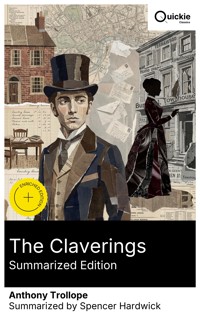
The Claverings examines the traffic between love, money, and reputation through Harry Clavering's wavering between his loyal fiancée, Florence Burton, and Julia Brabazon—now the widowed and rumor-haunted Lady Ongar, who once married for wealth. Shuttling from a decaying country house to London's counting rooms, Trollope offers a cool, exact social realism. An omniscient, wry narrator probes motive and duty, while the 1860s taste for "sensation" (compromising letters, predatory intriguers) is tempered by everyday plausibility and moral scrutiny. Anthony Trollope, veteran Post Office official and indefatigable traveler, wrote from intimate knowledge of bureaucracy, mobility, and the ethics of work. His skepticism toward idle privilege and respect for earned vocation shape Harry's dilemma and the sturdy probity of the Burton family. Composed with the disciplined routine later detailed in his Autobiography and serialized in the Cornhill, the novel borrows the era's thrills only to test them against character. Best for readers of Eliot or Thackeray, The Claverings offers lucid pleasures: incisive moral analysis, vivid women, and a quietly devastating portrait of gentlemanly weakness. Choose it for its wise debate over love, money, and work. Quickie Classics summarizes timeless works with precision, preserving the author's voice and keeping the prose clear, fast, and readable—distilled, never diluted. Enriched Edition extras: Introduction · Synopsis · Historical Context · Author Biography · Brief Analysis · 4 Reflection Q&As · Editorial Footnotes.
Das E-Book können Sie in Legimi-Apps oder einer beliebigen App lesen, die das folgende Format unterstützen:
Veröffentlichungsjahr: 2026
Ähnliche





The Claverings (Summarized Edition)
Table of Contents
Introduction
In The Claverings, Anthony Trollope probes how desire and ambition, pressed by the demands of money and rank, strain the promises people make to one another, testing whether constancy can survive opportunity, whether prudence can resist temptation, and whether a life built on calculation can ever be reconciled with the quieter claims of affection and duty, as public gossip and private doubt close in on characters who must choose between what seems advantageous and what feels right, discovering in that uneasy interval that indecision itself may be the most perilous commitment a person can make.
First published in the 1860s, The Claverings is a Victorian novel of manners and domestic realism set in England, moving between country estates and the professional and social world of the metropolis. As a standalone work from Anthony Trollope’s mature period, it examines the mechanisms of status, income, and marriage in a society attentive to lineage and respectability. The novel’s canvas includes drawing rooms, offices, and other public rooms, and its situations unfold within recognizable legal and financial constraints of the era. Readers encounter a carefully observed social fabric in which personal feeling must negotiate the pressures of class and livelihood.
The story centers on Harry Clavering, a young gentleman who has chosen to make his own way in a profession and to bind himself by an honorable engagement. Years earlier he loved Julia Brabazon, who married for wealth and title; now, as Lady Ongar, she returns to England a widow under the glare of rumor, and old affections stir against newly given promises. The narrative begins with this triangle, but attends as well to family expectations, the bargaining power of dowries and debts, and the everyday calculations that accompany work, friendship, and courtship. Trollope keeps the stakes intimate yet consequential.
Trollope narrates with a calm omniscience, alternating supple dialogue with measured authorial insight, so that motives emerge gradually and conflicts clarify without melodrama. The tone is patient, ironic, and humane; even flawed characters are rendered with fairness rather than caricature. Scenes move at a deliberate pace, attentive to practical details—letters, visits, sums, schedules—that shape feeling as much as grand declarations do. The result is a novel that rewards steady reading, inviting reflection on why characters vacillate, how they misunderstand themselves, and where self-justification shades into self-betrayal, all conveyed in prose that is clear, exact, and quietly, persistently engaging.
At its core, The Claverings studies money’s influence on intimacy, the social premium placed on advantageous marriage, and the question of how a modern professional identity can coexist with the older ideal of the independent gentleman. It considers the fragility of reputation, the unequal burdens borne by women whose choices are scrutinized more harshly, and the power of gossip to harden suspicion into verdict. Trollope is fascinated by moral vacillation—how a mind rehearses both principle and excuse—and by the small acts of courage that shore up integrity. The book illuminates how institutions reward prudence while testing, sometimes punishing, sincerity.
These concerns feel strikingly current. Readers will recognize the tension between vocation and financial security, the negotiation of relationships under the pressure of public opinion, and the way personal indecision can become a decision by default. The novel anticipates modern debates about careerism, transactional intimacy, and reputational risk, yet it resists cynicism by showing how responsibility can be chosen rather than inherited. Its careful attention to consent, compromise, and the costs of self-fashioning offers a humane counterpoint to more sensational narratives, reminding us that the hardest ethical work often takes place not in crises but in everyday arrangements.
As an entry point to Trollope, The Claverings is welcoming: it is self-contained, lucidly plotted, and focused on choices most readers can imagine facing, even if the social forms differ. The book offers the pleasures of a fully realized world without demanding prior knowledge of a series, and it pairs civilized wit with moral clarity. Approached as social study, character portrait, or quiet romance, it yields insight into how people rationalize, relent, and finally act. Its questions about how to keep faith—with others and with oneself—linger beyond the last page, making this novel both a period piece and a living argument.
Synopsis
The Claverings, a novel by Anthony Trollope first serialized in 1866–1867, follows a group of families connected to a country estate and to London’s professions, examining how money, rank, and personal loyalty pull at one another. At its center stands Harry Clavering, a younger son of a clerical branch related to the local baronetcy, and Julia Brabazon, a woman whose beauty and intelligence face the severe tests of position and security. Trollope opens with choices rather than catastrophes, posing whether prudent calculation can sit alongside affection, and whether social advancement purchased by marriage inevitably demands a private moral price.
Harry begins as a romantic but unestablished suitor to Julia. She assesses her prospects and, confronted with the limited future offered by an impecunious gentleman, marries the wealthy Lord Ongar. Harry, stung and ashamed of his idleness, renounces the easy parasitism of distant kinship and takes up practical work in an engineering office. The shift supplies Trollope with a contrast between aristocratic expenditure and middle-class industry. The decision also frames Harry’s emerging character: proud, energetic, and susceptible to vanity, he resolves to become independent, yet he carries forward a lingering grievance and desire that will test both his judgment and honor.
In London’s professional world, Harry encounters Florence Burton, whose plain sense, steadiness, and affectionate trust attract him. Their courtship proceeds with the quiet auspices of her family, and an engagement is formed that promises a life built on work, modest comfort, and mutual respect. Trollope calibrates the tone to show ordinary happiness as an ethical ideal, contrasting it with the glitter and peril of grand alliances. Harry prospers modestly and imagines a clear path ahead. Yet the narrative keeps alive the pressure of earlier disappointment, suggesting that stability, while valuable, must withstand the shock of revived passions and public rumor.
News soon arrives that Lord Ongar has died abroad after a brief, troubled marriage, and Julia returns to England as Lady Ongar. She carries wealth and notoriety in unequal measure, shadowed by tales of a dissipated husband and injurious companions who compromised her standing. The London drawing rooms that once courted her now weigh her every move. Seeking counsel and steady ground, she renews acquaintance with those who knew her before her brilliant marriage, among them Harry. Their renewed contact sets the book’s central dilemma in motion: the pull of former love against an existing engagement and the obligations embedded in it.
Lady Ongar struggles to reclaim control of her narrative and property while avoiding those who would profit from her vulnerability. A cosmopolitan intriguer and her brother, associated with the late Lord’s circle, press claims and threaten exposure, turning gossip into leverage. Harry, eager to help, visits, writes, and mediates, but his proximity invites ambiguity, and the residue of their earlier attachment complicates his pledged word to Florence. Trollope lets these scenes unfold through interviews and careful social choreography, dramatizing how small indiscretions feed public judgment, and how even generous impulses can erode trust when candor, distance, and timing are mismanaged.
Back at the country seat, the Clavering baronetcy offers its own moral picture. Sir Hugh Clavering’s severity and self-importance strain his household, while his younger brother Archie, idle and indebted, looks toward Lady Ongar’s fortune as a rescue. Their maneuvers—awkward courtships, petitions, and appeals to family pride—throw light on the dependence of certain gentlemen upon female money. Trollope counterbalances these scenes with glimpses of quieter domestic virtue among other relatives, suggesting that character, not pedigree, determines comfort. The estate, with its demands, expectations, and parish ties, becomes a stage where entitlement, need, and calculation find genteel but unmistakable expression.
As rumors proliferate, Lady Ongar must decide whom to trust, and the law’s prim technicalities—settlements, trustees, and contested claims—loom large. Advisors urge caution; enemies exploit every hesitation. Harry’s entanglement deepens as he acts as messenger and confidant, placing pressure on his engagement to Florence, who remains steadfast yet insists upon plain dealing. Trollope underscores the social weight of a promise, presenting engagement not as a private sentiment but as a public bond that creates claims on conduct. The narrative asks whether kindness can be separated from intimacy, and whether past affection can be acknowledged without unravelling present duty.
The later stages assemble decisive interviews: appeals to honor, reckonings over money, confrontations between restless ambition and patient integrity. Letters circulate, visits are calculated, and the quieter labors of work and routine continue in the background. Secondary strands—aspirations to political influence, efforts to improve the estate’s prospects, and the waning authority of bullying men—enrich the social canvas without displacing the central conflict. Trollope’s pacing is measured, each step turning on what someone dares to say aloud in a drawing room or commit to paper, and on who is present to hear it. Reputation, once stirred, proves difficult to still.
Without relying on melodrama or surprise, The Claverings distills a larger argument about the governance of the heart under conditions shaped by class and money. It weighs the claims of constancy against ambition, and judges promise-keeping as both a private virtue and a civic necessity. The book’s enduring force lies in its even-handed sympathy: it sees how people are tempted, how they rationalize, and how they recover or fail to recover themselves. Its caution is not punitive but clarifying, inviting readers to consider how choices become character, and how public respectability and inward peace are earned, guarded, and sometimes lost.
Historical Context
The Claverings appeared in the Cornhill Magazine from 1866 to 1867 and in book form in 1867, placing it squarely in mid-Victorian Britain. Trollope, a senior official in the British Post Office, wrote from long familiarity with provincial society and London. The narrative ranges between a country estate, parish life, and the metropolitan world of clubs, chambers, and commercial offices. England in the 1860s remained anchored by the Church of England, the peerage, and the landed gentry, yet was increasingly shaped by urban professions. This context supplies the novel’s concern with status, respectability, and the routes by which young men and women might advance.
Victorian rural society rested on hereditary property and ecclesiastical structures. Primogeniture and family settlements preserved estates, while entails and trustees restricted sale or subdivision. Titles from peerage to baronetcy conferred precedence and political influence at county level. The Church of England, supported by tithes and endowments, provided local authority through rectors, curates, and bishops. Patronage of benefices, or advowsons, remained legal, allowing families or institutions to present clergy to livings. Such arrangements linked land, income, and moral leadership. Trollope draws on this framework to examine duty, privilege, and the pressures placed on younger sons, parish households, and dependents within a stratified community.
By the 1860s, professional careers offered alternatives to inherited wealth. Civil engineering, organized through the Institution of Civil Engineers (chartered in 1828), grew with railway building, waterworks, docks, and bridges. The Great Exhibition of 1851 celebrated such technical achievement and the reach of British industry. Debates about merit intensified after the Northcote–Trevelyan Report of 1854, which urged competitive examinations in the civil service. University reforms and metropolitan training strengthened paths into science and commerce. Trollope situates aspirants within this expanding marketplace of skill, measuring new standards of expertise and diligence against traditional claims of birth, patronage, and leisurely cultivation.
London’s financial district—the City—dominated credit and investment through banks, discount houses, and joint-stock companies. Speculative cycles following railway expansion left scars, and the collapse of the prominent firm Overend, Gurney and Company in May 1866 triggered a severe panic, bank failures, and a spike in the Bank Rate. The ensuing contraction emphasized the precarity of fortunes tied to paper assets and confidence. Respectability and solvency were intimately linked, affecting business alliances and marriage prospects alike. Trollope’s attention to income sources, annuities, and settlements mirrors a milieu where liquidity, reputation, and prudent risk management could determine a family’s standing.
Victorian marriage law and custom framed personal choices. Under coverture, a married woman’s property typically came under her husband’s control, and her legal identity merged with his. The Matrimonial Causes Act of 1857 created a civil divorce court, but procedures remained costly and reputationally damaging, with stricter grounds for wives than husbands. Dowries, pin-money, and jointures could be negotiated, yet legal settlements often constrained independence. Chaperonage, letter-writing etiquette, and the importance of guardians shaped courtship. Trollope sets characters within these constraints to explore consent, calculation, and conscience, while acknowledging how widowhood, engagements, and rumor could alter prospects in respectable society.
National politics in the 1860s revolved around representation and deference. The Second Reform Act of 1867 broadened the franchise in English and Welsh boroughs to many male householders, signaling growing political weight for urban workers while leaving rural property qualifications largely intact. County influence of aristocratic families persisted through land, office, and social leadership. Parliamentary debates on corruption, public morality, and administration intersected with local contests over honor and patronage. Trollope, long attentive to electoral culture in his fiction, situates ambition and respectability against this backdrop of cautious expansion, where reform promised mobility but upheld established hierarchies and codes of conduct.
The novel entered a marketplace shaped by serial publication and circulating libraries. Cornhill Magazine, a leading monthly, courted respectable middle-class readers; libraries such as Mudie’s Select Library influenced taste and rewarded decorous narratives in three volumes. The 1860s also saw the sensation novel’s rise, exploring bigamy, crime, and hidden identities. Trollope practiced a realist mode attentive to work, money, and routine, favoring plausible motives over melodrama. His steady narrator, social topography, and legal-financial detail met Victorian expectations of instruction and entertainment. The Claverings reflects that climate by testing ambition, prudence, and honor within the limits enforced by polite readerships.
Advances in mobility and communication underwrote the novel’s plausibility. Railways linked counties to London in hours, enabling swift visits, business, and discreet escapes, while the expanding postal system and electric telegraph accelerated correspondence and news. Etiquette manuals, club rules, and newspaper gossip cultivated vigilant social surveillance. Within this web, reputations could be made or unmade quickly. Trollope’s story thus critiques mid-Victorian status anxiety, moneyed marriages, and the ethics of professional labor. It reflects an era negotiating the claims of inherited privilege and modern expertise, asking whether integrity and affection can survive the calculations demanded by property, publicity, and rank.
Author Biography
Anthony Trollope (1815–1882) was a leading Victorian novelist and long‑serving civil servant whose fiction mapped the institutions and manners of nineteenth‑century Britain. Celebrated for breadth and consistency rather than sensational experiment, he produced a vast body of novels, tales, essays, and travel books while employed in the Post Office. His two great cycles—the Barsetshire chronicles and the Palliser novels—constructed an enduring imaginative geography of clergy, gentry, and politicians. Trollope’s plain, conversational style, steady realism, and nuanced moral observation made him a cornerstone of the English novel, influential for later writers interested in social fabric, professional life, and the interdependence of private choice and public responsibility.
Trollope’s schooling included time at Harrow, after which financial constraints and circumstance pushed him directly into work rather than university study. He read widely and early, absorbing the eighteenth‑ and nineteenth‑century traditions of social fiction. His mother, the successful author Frances Trollope, provided both a model of professional authorship and a reminder that the novel could examine contemporary manners and institutions. As a critic of his own craft, he situated himself within the realist mainstream, favoring plausibility, continuity of character, and patient accumulation of detail over melodrama. He admired professional discipline in literature, an outlook that would shape both his methods and the measured, observant tone of his narratives.
In 1834 Trollope entered the General Post Office, a career that took him across Britain and Ireland and gave him intimate knowledge of bureaucracy, travel, and regional life. During the 1840s, while stationed in Ireland, he began publishing fiction, including The Macdermots of Ballycloran and The Kellys and the O’Kellys. He became widely associated with promoting roadside pillar boxes in the British Isles, emblematic of his practical cast of mind. Writing in the early mornings before work, he maintained strict word‑count targets and kept meticulous records. That disciplined routine underpinned the extraordinary productivity and continuity that critics often cite as central to his achievement.
Trollope’s first major success came with The Warden, which opened the Barsetshire series and introduced the cathedral town of Barchester, a setting he would revisit to portray clerical careers, provincial society, and evolving moral pressures. Barchester Towers consolidated his reputation with a broader canvas and comic vitality, while later installments—among them Doctor Thorne, Framley Parsonage, The Small House at Allington, and The Last Chronicle of Barset—expanded the county’s social range. Serialization helped build sustained readership, and the steady return to familiar places and families allowed him to refine themes of duty, pragmatism, conscience, and the sometimes comic frictions of institutional life.
From the mid‑1860s Trollope turned increasingly to political fiction in the Palliser novels, tracing parliamentary ambition, party maneuver, and the constraints of wealth and marriage. Can You Forgive Her?, Phineas Finn, The Eustace Diamonds, Phineas Redux, The Prime Minister, and The Duke’s Children form an interlinked panorama of public service and private calculation. Alongside these cycles, he produced notable stand‑alone works such as Orley Farm, He Knew He Was Right, and The Way We Live Now, the last often praised for its incisive portrait of speculation and modern finance. Contemporary readers admired his reliability and humanity; later critics emphasized his structural skill and moral clarity.
Trollope also wrote extensively in nonfiction and journalism, reinforcing his image as a professional man of letters. He contributed essays and served as editor of St Paul’s Magazine in the late 1860s. His travel books—North America, Australia and New Zealand, and South Africa—combined observation with comparative reflections on politics, culture, and infrastructure. Politically aligned with liberal principles, he stood unsuccessfully for Parliament in 1868, an experience that fed his understanding of electoral culture. His posthumously published An Autobiography offered unusually candid reflections on method, earnings, and the craft of fiction, prompting debate but also shaping modern discussions of literary professionalism.
Retiring from the Post Office in the late 1860s, Trollope devoted himself fully to writing and travel, continuing to publish at a remarkable pace into the 1870s and early 1880s. He died in 1882, leaving an oeuvre that has rarely been out of print. Subsequent generations rediscovered his range, with particular esteem for the Barsetshire and Palliser sequences and the continuing resonance of The Way We Live Now. Frequent adaptations for stage, radio, and television have refreshed his readership. Today he is valued for steady realism, durable characterization, and an unrivaled representation of Victorian institutions, qualities that continue to inform both scholarship and popular enjoyment.




