


Erhalten Sie Zugang zu diesem und mehr als 300000 Büchern ab EUR 5,99 monatlich.
- Herausgeber: The History Press
- Kategorie: Geisteswissenschaft
- Sprache: Englisch
For three decades after the Second World War, the 'Butcher of the Balkans' lived an idyllic life with his family in a Los Angeles suburb. Andrija Artuković was a senior member of the Ustasha, a Croatian fascist and nationalist movement, and was responsible for the wartime murders of hundreds of thousands of men, women and children. Wanted in Yugoslavia to stand trial for war crimes, he had illegally entered and claimed political asylum in the United States – and his powerful supporters sought to keep him there. Meanwhile, just 10 miles away, David Whitelaw lived with his mother, Judith, who fled Germany in 1938. Seventy-six of her relatives were killed in the Holocaust. When David learned Artuković was living comfortably nearby, he vowed to ensure his deportation to stand trial as a war criminal. But when a firebomb, thrown with the sole intention of causing fear, saw the young man sent to jail, a battle began for his own freedom, while the war criminal remained at large. A true David-versus-Goliath battle, The Fierce is the story of the teenager who helped take down the worst mass murderer and war criminal in America.
Sie lesen das E-Book in den Legimi-Apps auf:
Seitenzahl: 466
Veröffentlichungsjahr: 2023
Das E-Book (TTS) können Sie hören im Abo „Legimi Premium” in Legimi-Apps auf:
Ähnliche




















Praise for The Fierce
‘Judy Piercey expertly captures the remarkable and complicated relationship between David Whitelaw and his mother Judith. An inspiring story that reminds us what it means to be human and the responsibility we all have to make the world around us a better place.’
Barbara Smith, best-selling author
‘A groundbreaking portrayal of the trauma and burden imposed on the children of Holocaust survivors. Teenager David Whitelaw was a force of nature that inspired his government to seek justice for the unspeakable crimes unleashed against innocent people.’
Phil Blazer, founder of Jewish Life Television
‘Author Judy Piercey shines a brilliant light into this dark corner of post-war history, one that has been concealed for too long. You’ll find yourself cheering for the Jewish teenager who struggled to bring down one of the worst Nazi killers in history, sickened by the crimes this mass murderer committed, and aghast that he was protected by the United States government. Meticulously researched and skilfully written, this book provides a significant contribution to our body of historical knowledge about the Holocaust.’
Elinor Florence, author of Bird’s Eye View
In memory of Phil BlazerJournalist, activist and dear friend
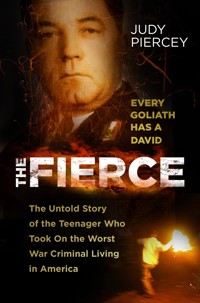
Front cover images: Jasenovac Memorial Site; UPI/Alamy Stock Photo.
First published 2023
The History Press
97 St George’s Place, Cheltenham,
Gloucestershire, GL50 3QB
www.thehistorypress.co.uk
© Myth Merchant Films, 2023
Fierce definition © Oxford University Press, 2023
The right of Judy Piercey to be identified as the Author of this work has been asserted in accordance with the Copyright, Designs and Patents Act 1988.
All rights reserved. No part of this book may be reprinted or reproduced or utilised in any form or by any electronic, mechanical or other means, now known or hereafter invented, including photocopying and recording, or in any information storage or retrieval system, without the permission in writing from the Publishers.
British Library Cataloguing in Publication Data.
A catalogue record for this book is available from the British Library.
ISBN 978 1 80399 294 5
Typesetting and origination by The History Press
Printed and bound in Great Britain by TJ Books Limited, Padstow, Cornwall.
eBook converted by Geethik Technologies
Contents
Foreword
1 ‘I Felt the Spirit of the Warsaw Ghetto Fighters’
2 A Destiny to Serve God
3 America, Land of the Free
4 ‘I Am Stateless’
5 ‘The Holocaust Was Mother’s Milk to Me’
6 ‘Like Trying to Put Together the Pieces of a Shattered Chandelier’
7 ‘Things Were Ugly and They Were About to Get a Lot Uglier’
8 ‘I Will Build a Better Tomorrow’
9 ‘The Uncrowned Leader of the Croatian Movement’
10 ‘We Can’t Let this Guy Get Biological Amnesty’
11 ‘It Felt Like Redemption’
12 ‘Man’s Law or God’s Law?’
13 ‘I’ve Never Been So Ashamed To Be Roman Catholic’
14 ‘It Has Made Those Who Know Us Love Us More’
15 ‘Artuković’s Final Battle’
16 The Power of Love
Epilogue
Acknowledgements
Bibliography
Andrija Artuković in his Ustasha uniform. (Jasenovac Memorial Site)
David Whitelaw as an 18-year-old member of the Jewish Defense League in 1974. (David Whitelaw/Myth Merchant Films)
Foreword
fierce, definition
1. Savage predatory and violent aggressiveness.
2. A powerful and passionate heartfelt intensity.
Oxford Languages
It was the second definition that struck me the first time I met David Whitelaw in 2018. I’d been warned that he was an intense and passionate character. Still, I wasn’t prepared for the slightly dishevelled man who walked into the room, barely taking the time to acknowledge me, before thrusting his hand into a plastic shopping bag and, with a flourish, pulling out a stapled sheaf of paper. He threw it on the desk. ‘You’ve heard of Schindler’s list?’ he asked fiercely. ‘This is Whitelaw’s list.’
Whitelaw’s list, typewritten on paper faded and yellowed by time, contains the names of his seventy-six relatives murdered in the Holocaust.
It was a gripping moment, one that set the scene for the story that he was about to share with a stranger for the first time. The story, with its many dramatic and fateful twists and turns, would always come back to this truth: the crushing misery inflicted upon three generations of one family by the Holocaust. One family, their lives a vignette, a microcosm of the worst genocide in our time.
The Whitelaw family suffered from two traumas: the Holocaust and parental abandonment. The story resonated with me, especially since my own family was shaped by parental abandonment that echoed David’s father’s. On a deeply personal level, I understood that particular inter-generational trauma. It had shaped me, too. It had also, perhaps unconsciously, drawn me onto my professional path. As a young journalist, I found my niche in telling stories that focused on Indigenous people in Canada. They told me stories about their own inter-generational trauma, the legacy of residential schools that stole their language, culture, dignity and all too often the lives of their loved ones. The crimes against them were sanctioned by government and executed in church-run schools.
The theme of crimes committed in the name of religion, one that has run through narratives since time immemorial, is a central theme of this story, too. David Whitelaw’s faith in the belief that he could create a better world led him to take on a war criminal, a true-life David-and-Goliath story that could have cost him his life. He acted in the belief that he was obeying God.
As I got to know David better, I was struck again by another parallel: the Goliath to his David was a man uncannily like himself. As a child, Andrija Artuković stood out for his intelligence. Like David Whitelaw, he excelled at school. Both young men aspired to become physicians. Both abandoned careers in medicine because they couldn’t stand the sight of blood. Both men were student activists engaged in fights fuelled by their faith. The identities of both David Whitelaw, a Jew, and Andrija Artuković, a Roman Catholic, were rooted in their religion. Both were fervent, even militant, in their religious beliefs. Both committed crimes in the name of God. Artuković became known as the ‘Butcher of the Balkans’ for his role in the murder of 770,000 people in Croatia’s death camps during the Second World War.
Both Whitelaw and Artuković were fierce men, serving organisations that invoked the first definition of fierce: savage predatory and violent aggressiveness.
Both the Jewish Defense League (JDL), which attracted 17-year-old David Whitelaw, and the Ustasha, which Andrija Artuković joined as a young man, were far-right movements that boasted about their violence. Both were terrorist organisations. Many Jews recoiled at the JDL’s tactics, just as many Croatians were repulsed by the Ustasha. My own perceptions about the organisations were informed by FBI files. As I pored through hundreds of pages of FBI reports, I learned that the FBI had been keeping tabs on Croatian American organisations even before the Second World War and were watching the JDL since its inception in 1968. As the Cold War set in, the FBI focused on JDL protests against the Soviet Union and on Andrija Artuković as a person with firsthand knowledge of communism. During my research, I also read firsthand accounts of witnesses and survivors who swore affidavits to support Artuković’s prosecution. Their accounts were poignant and chilling, especially since I had known little about the atrocities in Croatia. Some of those accounts were later disputed, as were the number of people murdered in the genocide. Depending on the source, some of which deny the genocide or claim that its number was vastly exaggerated, between 350,000 and 770,000 people were murdered. Since the true number can never be verified, I chose to stay with 770,000, the number cited by Yugoslavia in its prosecution against Artuković and reported in the media from the 1950s to 1980s. The numbers may be disputed but the horrors are not. I discovered how thoroughly the brutality of the Ustasha was documented when I started reading historical records and newspaper coverage spanning the Second World War and the 1980s, when Andrija Artuković was finally brought to justice.
Conducting research from my home in Canada proved challenging, despite the wealth of online resources. As a result, I split my time evenly between Edmonton and Los Angeles for a three-year period. In Los Angeles, I was able to visit the locations where this story took place and reflect upon the historical material cited here. I also examined archival court records and conducted 300 hours of interviews with David Whitelaw, his family, friends and supporters. I approached the Artuković family and requested interviews but received no reply.
I’ve always been a voracious reader, and as I read dozens of books about the Holocaust, I pondered the similarities with our world today. Antisemitism and white supremacism are on the rise globally. An appalling number of people believe the Holocaust didn’t happen or that the number of Jews murdered was considerably less than six million.
With The Fierce, I hope to shine a light on the danger of dogma and show how it fosters hatred. The tragic historical period of the Holocaust reminds us how hatred escalates and becomes normalised, a message that I believe is more important today than ever before.
1
‘I Felt the Spirit of the Warsaw Ghetto Fighters’
2 a.m., Sherman Oaks, Los Angeles, 29 January 1975
Focusing intently on his mission, David Whitelaw rolled down the car window and took a deep breath. Inhaling the air of the Smog Capital of the World was preferable to the stink of gasoline wafting from the back seat.
David listened for the familiar whir of the police helicopters in the sky. Nothing. But he could not afford to be lulled into a false sense of security because the Los Angeles Police Department’s helicopters could swoop in out of nowhere. He flipped on the AM radio to hear if any police blotter news had erupted. The last thing they needed was to happen upon some boneheaded crime that might draw attention to their own cargo in the back seat.
Traffic was mercifully light. He glanced over at the driver, Mike Schwartz, and thought the airhead ought to be paying more attention to the speed limit. If the cops happened to stop them for speeding along Sunset Boulevard, they’d be screwed.
Transporting the gasoline in the back seat had been a last-minute decision. But now David’s Boy Scout training sent a question flickering through his mind about the safety of carrying incendiary devices inside the car for the forty-five-minute drive to the San Fernando Valley.
Nothing in his entire nineteen years of existence had prepared him to even think of challenging authority. David practically grew up in Disneyland, which had opened down the road in neighbouring Anaheim on 17 July 1955, less than a week before his birth. Never one to seek the thrill of the adrenaline rush, David always preferred the tamest rides, making him an unlikely candidate for this mission. But as Bob Dylan sang, ‘The Times They Are A-Changin’’.
It was a fitting anthem for the chaos of his adolescent years: the Vietnam War, the Kent State Massacre, Watergate and the daily news footage of protests, bombings or hijackings. David couldn’t relate to the Black Panthers; or Patti Hearst, the rich kid who joined her kidnappers; or the IRA. His own mission was specific, with a single target. His goal was to expose the evil, once and for all, that had been allowed to live, even thrive, thanks to powerful protectors. After their mission tonight, the world would learn about the worst war criminal in America. Not only did he pray that no one would get hurt, but he was also keenly aware that causing any injury at all might blemish the moral rightness of their cause. When the mission was complete, David wanted to hold his head high and celebrate that he was able to accomplish what even the US government was unable to do: bring down the mass murderer living quietly on a California beach.
But as soon as David stepped out of the car, he sensed danger. Instinctively, he knew something was wrong. His shoulders tensed, eyes darting around. A shiver crawled up his spine, and he regretted not wearing a jacket. The temperature had dropped to 37°F since he’d slipped out of the house around dinner time, avoiding his mother’s inevitable questions about where he was going. To his relief, the wind that gusted earlier in the afternoon had settled down, and now the air was still. There was a full moon, and he could clearly see the 1974 Ford Mustang 11 parked in the carport, just as it had been the night before when he did a reconnaissance.
Next to the carport was a garage. Next to that was a sprawling two-storey house clad in typical California stucco but upgraded with brick trim on the lower half. The inside of the house was pitch black except for a night light in what he guessed was the kitchen of 16011 Meadowcrest Road.
David’s eyes quickly scanned the rest of the street. The windows were dark in every house.
Meadowcrest Road was a winding, dead-end street at the top of a hill in the leafy suburb of Sherman Oaks. The home of John Artukovich, the wealthy owner of a construction business, was one of the last houses on the upscale street, almost at the top of the hill.
David’s stomach rumbled, reminding him of the nerves that had prevented him from eating since lunch. His eyes took in the car parked down the street. It wasn’t as fancy as the cars that belonged in this neighbourhood. He wondered briefly if there were people inside it? Lovers making out?
He gauged the distance from the parked car to the Mustang. Less than 50 feet. Too close. It didn’t look as if anyone was in the car. But what if there was? Feeling the bile rise in his throat, he repressed the desire to jump back into the car and urge Schwartz to put the pedal to the metal and get the hell out of there.
The teenager swallowed hard, trying to shake the unsettling feeling that had sent his senses into overdrive. Unconsciously, he reached for his neck and fingered the pendant hanging on a cheap metal chain. It was an amulet, a prized possession that he had bought proudly with his own hard-earned money to wear on only the most special occasions. The Star of David medallion made from hammered black metal was admittedly a bit gaudy, big enough to cover half his hand. But that was the whole point. To be labelled. To stand out and be identified as a proud Jew.
Since David had started earning his own money, collecting Judaica had become a hobby, and perhaps an obsession. He cherished his small purchases from the Jewish gift shops on Fairfax Avenue, the beating heart of Jewish Los Angeles. Even his job in a factory, the night shift of boxing and labelling eight-track tapes, brought an intense feeling of connection with his people. The popular songs on the tapes, while not specifically Jewish, resonated with the moody teenager. Pink Floyd’s Dark Side of the Moon reinforced fighting for justice, and Black Sabbath’s Sabbath Bloody Sabbath conjured up images of evil and ghosts. Listening to the dark music on his car’s eight-track stereo, how could he not think of the six million Jews murdered? Of the evil that had robbed him of a family? Evil, as his mother reminded him every day of his life, had led to the unspeakable horrors of the Holocaust. The ghosts of the seventy-six members of his family murdered by Hitler haunted his mother’s every waking moment. For as long as he could remember, the evil had plagued him, too, disrupting his nightly sleep with terrifying nightmares.
Tonight, finally, was his chance to seek justice.
The opportunity had come out of the blue just two nights ago.
David wished that he’d had more time to plan, but after two years of wasted effort, he had to concede that time was not his friend. In the last forty-eight hours he’d created a plan, one that he shared with only one other person, Mike Schwartz. From the moment he started planning, David began thinking of himself and Schwartz as members of a cell, a Jewish Defense League fighting unit.
In the driver’s seat, Schwartz slipped his hands into a pair of rubber gloves and stuck to the plan of leaving the engine running and the doors open. As David watched his accomplice slide out and stride around the car, he experienced a surge of sensory overload. His ears, hidden by long curly brown hair, pricked up at the sound of Schwartz opening the door to the back seat of their borrowed 1965 Chevy Nova. The overwhelming smell of the gasoline filled his nose. Despite his parched mouth, he could even taste it. His skin tingled under the loose-fitting, black cotton sweatshirt and jeans chosen carefully earlier that evening. Dark clothing for camouflage, in fabrics less likely to cling and burn his flesh in case of a fire. But he was not prepared for the uneasy sensation of his sixth sense. The apprehension that something was lurking in the bushes.
He took a calming breath as he watched Schwartz strut around the car and lean into the back seat. He was about David’s height, but skinny, and when he lifted the gasoline can, it was heavy enough that he needed to use both hands.
Dressed as usual in cowboy boots, jeans and western-style shirt, Schwartz exuded an aura of confidence. He was 21, only two years older than David, but he was living on his own, having made his way from Houston to Los Angeles for reasons that he had never disclosed.
Schwartz had barely said a word all evening, not that he was what you’d call a world-class conversationalist anyway. David hardly knew the guy, having only met the Texan a few times after being introduced by the JDL’s California leader, Irv Rubin. Charismatic, with a wit that sharpened the bite of his militancy, Rubin had a wise-cracking grin that practically absorbed his wisp of a moustache. He no longer looked like the US soldier that he had once been, having grown his reddish-brown hair shaggily close to his collar. David, admittedly conceited about his own rich curls, empathised with Rubin’s vanity, especially since Rubin’s hair was already starting to thin at the age of 29. Rubin was tall, about 6ft 3in, and he enjoyed the attention of the ladies. David thought that maybe Rubin enjoyed female company a little too much since he was married to a nice woman from a well-off and respectable family. Nonetheless, David admired Rubin’s easy manner with women, whereas David himself seemed to be forever disappointing girls who wanted more from him than he had to give. At this point in his life, David was more focused on his mission with the JDL than going steady with a girl in junior college, no matter how cute she might be.
David, like Schwartz and the other young men hanging around the shabby offices of the JDL, was fond of putting his feet up on a desk and affecting a cocky air. Unlike David, Schwartz neither had a job nor went to school. He was a pimply faced drifter who seemed to spend most of his time schmoozing Rubin. David suspected that Schwartz looked up to Rubin as a father figure, seeking to fill an emotional void, a need that David understood. His own father was away at sea most of the time, and David had seen him infrequently since his parents’ divorce.
Hard-working and a straight-A student, David was far from impressed by Schwartz’s lack of ambition, but he was mollified by Schwartz’s enthusiasm for the JDL. Schwartz, now striding purposefully toward the Mustang parked in the carport, certainly seemed to know what he was doing.
Silently reassuring himself that he was just suffering a case of nerves, David picked up one of the quart-sized beer bottles sitting under the back seat. He checked to make sure the rags were stuffed firmly inside the bottles and still soaked in gasoline. Holding a Molotov cocktail in each hand, he summoned the spirit of the Warsaw Ghetto fighters. They were his heroes, those young people who risked their lives to resist the Nazis. For three days, they kept the Germans at bay, fighting with nothing more than their bare knuckles and Molotov cocktails.
David held the bottles close to his heart. The Molotov cocktail had been his heroes’ weapon of last resort. It was his weapon of choice, offered in their blessed memory.
He silently offered a prayer for them as his hands clenched the bottles. Just as they fought evil, so would he. The monster lurking inside the picture-perfect suburban Los Angeles home had gotten away with horrific murders for nearly thirty years, satisfied in the knowledge that no one would ever come for him.
It was time to shatter his peace. The JDL had him in its sights.
And David Whitelaw relished his role as a soldier.
6 a.m., Pico-Robertson District, Los Angeles, 29 January 1975
Judith Whitelaw awoke early and prepared her usual small continental breakfast. Vigilant about her size-five figure, the former homecoming queen stirred a packet of artificial sweetener and a little cream into the one cup of instant coffee she rationed herself each day. She carried her breakfast tray to her bedroom for her morning ritual of eating while listening to the news.
The roar of traffic coming off the freeway and onto La Cienega Boulevard was starting to pick up as Judith opened the curtains on the barred windows of her modest bungalow. It took her a moment to absorb the fact that something wasn’t quite right with the scene before her. She peered at the patch of lawn, the rosebushes that lined the fence, all of which usually brought a smile to her face. The wrought iron fence, custom-made with a Star of David design between each post and the gate, was her pride and joy. It was a luxury for which she had scrimped and saved, proudly showcasing her Jewish identity to her mostly Christian neighbours. The house at 1772 South Crescent Heights was the first house that Judith owned, the first that bore her name and her name only on its deed. And the Star of David design in the fence was both a symbol and a reminder of the childhood home she had lost. The one the Nazis stole from her.
The sun was just coming up; in the morning light, Judith could see what was missing from the picture. David’s van was not parked in its usual spot on the street. Was it possible that her son had not come home last night?
Frowning, Judith walked down the hall and into his bedroom. The room was just as he’d left it after dinner the night before: his bed neatly made, his guitar tucked into the corner, his radio and toy replica of a ship occupying a prominent bookshelf, and – in contrast to the orderly room – his desk overflowing with books and paper. The room was a reassuring reflection of David, her sensible, sensitive and studious middle son, the only one of her three sons that she could boast about as a ‘nice Jewish boy’.
Never before had David stayed out late without calling to let her know where he was. Even if he was working late, he always called. Of course, Judith had demanded that all of her sons let her know where they were going and when they’d be home. But only David was considerate enough to obey her.
David, who’d bought the beat-up old van with his own money so that he could commute to his part-time factory job, was hard-working. Solid. Reliable. Once in a while, he’d complain when Judith asked him for extra money, but what teenager wouldn’t complain? Her first-born son, Stephen, had never given her a penny and her youngest, Billy, was a drain on resources, albeit through no fault of his own. Billy, at the age of 14, was now in a psychiatric hospital, being treated for an undiagnosed condition that had led to a series of violent outbursts. If it weren’t for David’s support, both financial and emotional, Judith couldn’t imagine how she would even begin to cope.
Although he tried not to show it, Judith knew that David felt burdened by the weight of her emotional needs. She could read it in his gorgeous brown eyes, the way he would look away when she would tell him how much she relied on him. Or the way that he closed himself off in his room, listening to the radio or playing his guitar. Once in a while he would even joke that she treated him more like a husband than a son. Judith didn’t see the humour. The fact that her own husband, ex-husband for the past ten years, could not be relied upon was nothing to joke about.
‘Who am I supposed to rely on, if not you?’ Judith retorted to David’s jibe. ‘Certainly not your father. And certainly not your brother. And need I remind you that we don’t have any family.’ She sighed, and her voice softened. She smiled and cocked her head to one side, daring to see if she could get away with the special German pet name he no longer liked to hear. ‘Mein Puppele, there is no one else. You’re it.’
Her risk paid off. David rewarded her with a quick hug. Judith patted him on the back and tried not to cling too tightly.
Judith closed her eyes and took a deep breath as she remembered the moment. When had she become so clingy? It didn’t seem so long ago that she was the one wrapping men around her little finger, fighting off suitors, instead of begging for attention. At 54, Judith could still turn heads. But the men she was attracting were a far cry from the wealthy, educated men of the past. High-quality men like Rudy Sternberg, who fell in love with her when they were teenagers back in Germany. Rudy, elegant and handsome with his earnest brown eyes and sensuous mouth, was drawn to Judith as a mirror of himself. Her dark hair, soulful eyes and wide, Cupid-bow lips had always captivated men, and Rudy was no exception. Their romance seemed destined to bloom, but it had barely gotten past the flirtation stage before the Nazis came. Before Judith and Rudy could even begin to understand what lay ahead.
Like so much else in her life, Judith saw no point in contemplating ‘what if’ about her romance with Rudy. They had been forced to flee for their lives, Judith to Guatemala and Rudy to England.
Rudy had risen high in the world. He had used his chemical engineering degree to build one of Europe’s biggest petrochemical companies, the Sterling Group, which made Bakelite, the first plastic made from synthetic components. Judith couldn’t have been prouder when he was knighted by Queen Elizabeth in 1970.
And now another honour. Just one day ago, Judith had read in the newspaper that Rudy was named Baron Plurenden of Plurenden Manor in the County of Kent. She rushed to share the news with David that her old boyfriend had been awarded a life peerage.
A shadow had crossed her son’s face as he looked up from the book he was studying. But seeing her excitement, he managed a smile and started his customary teasing. ‘So, what are you telling me, Mom? If you’d married him, wouldn’t we be practically royalty? He’s a lord. What would that make me? Like I told you a million times, you should have married him, Mom.’
Judith smiled, letting David get away with this harmless, well-worn joke. Rudy had become a friend. Whatever might have been was forty years in the past. But still. Judith’s romance with Rudy was another example of what the Nazis had stolen from her. Her home. Her family. Everything about her life in Breslau, her city. Germany itself, her country that she loved. Judith would never forgive, never forget. Could never forgive. Could never forget.
Her destiny had changed forever on the night of 9 November 1938. Kristallnacht.
Her mother, Klara, had shaken Judith awake at 3 a.m., agitated and demanding that she rush into the kitchen. They stood at the window, watching in disbelief as the flames from burning Jewish businesses and synagogues seemed to scream as they shot into the heavens. As the fires grew, Klara took 18-year-old Judith by the hand to descend the stairs of their elegant five-storey building. They made their way to the square where, over the next two days, the glass of broken windows glittered like crystal in the flames. A couple of days earlier, Klara’s intuition had warned her that something evil was about to happen when she saw trucks loaded with cans of gasoline driving through the streets. For months, she’d been pleading with her parents to leave Germany. Even before that, as far back as 1935, she and her husband, Sigmund, had discussed getting away from the Nazis. But Sigmund had died two years ago and now, watching the Nazis toss the synagogue’s holy books into the fire, Klara made a decision. She turned to Judith and said: ‘We’re getting out of here.’
Judith stared at her mother, wide-eyed in disbelief. Leave their home? Their apartment building wasn’t just their home. It was their business. Some of Breslau’s finest people were their tenants. Judith knew other Jews who had packed up and left, but she never dreamed her mother would consider abandoning their home, their business, their beloved country, everything they knew.
Klara, her mind made up, was adamant. ‘Honey, in a couple of years, there’ll be nothing left.’
Once again, Klara implored her family to flee. This time, her parents and five other relatives agreed to go. Klara, Judith and her brother, Walter, packed as fast as they could. One suitcase each. Judith ignored her mother’s disapproving looks as she sorted through her most sentimental possessions. She could not bear to leave behind the things that meant most to her father: his Iron Cross, which the Kaiser himself had pinned on his chest, the battlefield photograph with his regiment. If she was forced to leave her father behind in his grave, Judith deserved something of his to cling to, and only after they were safely packed did she look for room for her book of sewing patterns, the drawings of dresses and suits illustrated in exquisite detail with her own artistic flair. Her mother, ever practical and without Judith’s sentimental streak, found hiding places for money. Klara took her own most precious possession, her wedding ring, and inserted it into her vagina, thanking Sigmund for continuing to protect his family even after his death. It was thanks to her husband that they had a place to go. After the First World War, when Sigmund had proudly served the Fatherland, he seized an opportunity to invest with relatives in a banana plantation in Guatemala. And now, Klara was determined to bribe whomever it took to get the family safely to the land and house that Sigmund had bought.
The wisdom of their decision to leave was validated when their new passports were issued. Stamped with the letter ‘J’ in red ink to identify them as Jews, the passports were part of a new provision introduced a month earlier by the Reich Ministry of the Interior to begin separating Jews from other Germans. With nothing but their suitcases and the Reichsmark equivalent of $4 each, the family took the train to Hamburg on 26 November 1938, to board the MS Cariba to Guatemala.
As a property owner with relatives in Guatemala City, Klara was fortunate. She had a destination as a safe haven. Many of the 36,000 Jews who fled Germany and Austria after Kristallnacht were turned away from the New World. And many of those who sought refuge in Europe were rounded up and sent to concentration camps after the Nazis occupied western Europe in 1940. Of the relatives that Judith, Klara and Walter left behind, seventy-six went on to perish in Hitler’s death camps.
Not a day went by that Judith did not think of her loved ones, of what their family had lost through their murders. Not a day passed without reminding her three sons of the injustice to their family and to their people. Of what had been stolen from them.
But even within the walls of her own home, Judith’s anger and grief did not fully resonate. Her eldest son tuned her out. Her youngest paid no attention. But her middle son, David, took the message to heart. He felt her loss. It was he who nodded solemnly when Judith teared up, asking the question she could never answer: how much loss could one heart bear?
And this morning, David’s bed was empty.
Her one good son hadn’t come home last night. The unsettling thought crossed her mind that he might have spent the night with a girl. Judith had discouraged girlfriends, finding fault even with the girls that David claimed were ‘just friends’. Her boy, so kind and sensitive, couldn’t see through what Judith saw as clearly as if the girls were wearing their hearts on their sleeves. She recognised the longing in their eyes, heard the eagerness as they laughed at his jokes.
Judith never missed an opportunity to remind David that the ‘just friends’ wanted more from him. And what they wanted could hold him back from achieving his dream. She reminded him that he was a natural healer, born to be a doctor. He had been working toward this goal since his bar mitzvah when he declared his intention ‘to build a better tomorrow’. Medical school was well within his intellectual reach, and he worked hard to keep his marks up. But medical school was expensive, far beyond the reach of Judith, a single mother who survived on the money she earned babysitting other people’s children.
David couldn’t afford to lose focus with the distraction of a girlfriend. Without straight As he’d never win the full scholarship needed to get through medical school. So far, David had listened to his mother, reassuring her that none of his friends would morph into girlfriends. Judith couldn’t help but wonder if David understood on some deep intuitive level that she had another reason to fight against the very notion of a girlfriend. Judith needed David. He wasn’t just her one good son; he was her sole emotional support. She clung to him as she clung to the memories of her lost family.
And last night he’d stayed out without calling to let her know where he was.
Judith feared she was losing David, too.
Present-day Croatia and Bosnia and Herzegovina. (Base map courtesy of d-maps.com/carte.php?num_car=14895)
2
A Destiny to Serve God
Half a world away, in the last days of the nineteenth century, another boy was born, a prodigy who would also aspire to become a doctor. Like David Whitelaw, he would be moulded by a belief in the injustice created by wartime hatred. And like David Whitelaw, his destiny would be shaped by faith and religious identity.
Even his name predicted his destiny: Andrija, named for Saint Andrew, a disciple and messenger of Jesus, a name which means ‘warrior’ in the Croatian language.
Andrija Artuković was born on 29 November 1899 in Klobuk, Herzegovina. He was the eldest of fourteen children born to Raza Rasic and Marija Artuković, deeply religious Croat farmers whose lives were anchored by the Roman Catholic Church. In many ways, life was idyllic for peasants who raised enough cattle, corn, pomegranates and figs to create delicious meals for their families. They grew cash crops, such as the region’s famous high-quality tobacco, to pay the bills and buy staples from local markets. For this, Roman Catholic families continuously expressed their gratitude through prayers, marking each juncture of the day with a blessing. They made the sign of the cross over their heads and hearts to greet the morning before they dressed, again over the bread they would break, and again with their bed-time prayers. Their gratitude was steeped in duty; their Catholic identity stamped in 1519 when Pope Leo X praised Croatia as a bulwark of Christianity for the bravery of Croatian soldiers fighting the Ottomans.
But as peaceful as life may have been on the farm, political strife from the outside world crept in. Croats in Bosnia and Herzegovina longed to be part of a Croatian homeland, a long-standing aspiration of Catholics living under Ottoman rule. Their Muslim rulers taxed Christians at a higher rate than Muslims and stifled many of their rights. Their dream of Croatian independence suffered another blow when the Austro-Hungarian Empire absorbed Croatia and placed it under Hungarian rule. In 1868, Austria-Hungary granted Croatia statehood but just how little power Croatia possessed became swiftly obvious. The Croatian Sabor, or parliament, tried to take back Bosnia and Herzegovina by arguing that it had been part of Croatia since medieval times. They failed to persuade Austria-Hungary. Croats were devastated; their grievance bolstered a growing nationalism.
Andrija’s own parents grew up in this turbulent time. When they were children, Bosnia and Herzegovina’s Muslim rulers tried to keep a lid on Croatian Catholics’ resentment by allowing some communities to build their own churches and schools. But they also imposed a farm tax, which burdened peasants. When Christian farmers revolted in 1875, they were brutally repressed. In the coming decades, new tensions developed, fuelled in part by the increasing number of Serbians who had moved into Croatia, as well as Bosnia and Herzegovina. As Serbian numbers grew, so did their political voice. Croats referred to them as ‘foreigners’, a hostile word that would take on an ominous meaning in the future.
In 1908, when Andrija Artuković was nine years old, Austria-Hungary marched in and annexed Bosnia and Herzegovina. Croatian nationalism, already entrenched when his own parents were growing up, reached a feverish pitch. Whenever Croats gathered in churches and markets, the talk always turned to politics. A new railway and roads had been built and industry was developing in Bosnia and Herzegovina. But Croats had little stomach for any future under rulers they perceived as oppressors. The discussions grew hot with anger and frustration. Some of Andrija’s relatives were talking about leaving. Everyone knew someone who had taken the train or caught a ride to travel down the new road, looking for a better future. Andrija’s own cousins were dreaming about America, a place of equality, where they would be free to build a new life, where their hard work would lead to prosperity.
Young Andrija soaked it all up. But little did he know that his own future would be shaped by another Croat who lived just a couple of hours down the road. This boy, now a teenager, had grown up drinking in all of the heated discussions.
He was thriving in the hotbed of political unrest that was Bosnia and Herzegovina. And this teenager was not talking about leaving. He was planning to stay and put his mark on Croatia.
* * *
Andrija Artuković had always stood out from the other children in his family and at church. Even before he started school, the priests noticed his keen intelligence and devotion to God. Providence seemed to intervene when Andrija started parochial school. The bright little boy so impressed the Roman Catholic priests who taught him that they selected him for a higher calling than farming. They encouraged his parents to commit to greater education for Andrija, even though school attendance was not mandatory and it would mean sending their son away from the village to attend school.
The church ensured that the Artuković family had the resources to send Andrija to a high school run by the Franciscan order.
He excelled as a student. In his last year of high school, the First World War broke out, but neither Andrija nor his spiritual mentors could have predicted that the war would bring about changes that further solidified the teenager’s fate.
By the time he was 16, the priests had raised money for scholarships and Andrija was sent even further away to the University of Zagreb. He entered medical school and began working part time setting up pins in a bowling alley to subsidise his education.
However, he was not destined to become a physician. As a family member would later tell a journalist, Andrija ‘didn’t like all that blood’ or the odour of cadavers in anatomy class. He and other medical students began smoking cigarettes to cope with the stench. By the time Andrija abandoned his ambition of a career in medicine, he’d developed a two-pack-a-day tobacco addiction.
Unsure of his path, Andrija considered the possibilities. He had an intellectual bent. He possessed a keen facility for languages and had learned to speak Greek, Bulgarian, Italian, French, German, Czech and Latin.
He settled on becoming a lawyer and the decision to attend law school proved life-changing. For Andrija, like students through the ages, the circle of acquaintances made on campus evolved into lifelong friends and a professional network that would alter his destiny.
One of those people was Ante Pavelić, who had graduated with a Doctor of Laws degree in 1915, the year that Andrija arrived as a freshman. Another was Mile Budak, a writer and poet whose work romanticised peasants like the Artuković family. Pavelić and Budak were emerging leaders who idolised peasants, placing them on a pedestal as pure and true Croatians. Andrija, with a foot in both worlds, must have seemed an attractive recruit.
The University of Zagreb, formed by the Jesuits in 1699, was a hotbed of political activism as the First World War came to an end. Croatia had suffered heavily in the war, losing 190,000 soldiers and civilians, and drought and famine had taken a toll, especially on children. The economy was struggling, and in 1918, the Spanish Flu pandemic further gutted the population.
In 1919, when the Treaty of Versailles was signed in Paris to officially end the war, Andrija had already been immersed in four years of student politics. The fallout from the war was a turning point for the promising 20-year-old student.
For eight centuries, ethnic hatred between Croats and Serbians had been held in check through the historical legacy of the Austro-Hungarian Empire to the north and the Ottoman Turks to the south. But now, thanks to the spoils of war, the lines of the old empires were dissolved. The Treaty of Versailles created a new country, the Kingdom of Serbs, Croats and Slovenes, in an attempt to unify southern Slavs under one federation. Croats were furious that they would be ruled by a Serbian king; they saw the new federation as a prize granted to Serbia for fighting with the Allies, and, by extension, as punishment to Croatians for fighting for the losing side.
As a devout Catholic, Andrija Artuković and other Croats both resented and feared the Serbs’ Eastern Orthodox religion. Both sides considered the other heathen. The resentment against ‘the other’ encompassed two of the usual suspects that nurture identity politics: religion and language. Both were Christians and spoke the same language. But the Serbs wrote in Cyrillic script and the Croats in Latin script.
Outnumbered by the Serbs and with a Central European identity fostered under the rule of the Austro-Hungarian Empire, Croatians saw Serb domination as the writing on the wall. Three years later, when the new constitution eliminated Croatia’s autonomy, they predicted that their culture and identity would go next. Stoking their fears were radical politicians. They revived an old dream, buried for eight centuries, that Croatia would once again be an independent country under a Roman Catholic pope. Nationalism soared as the Croatian Peasant Party gained popularity and political power.
Surprising opposition came from students at the University of Zagreb. Andrija Artuković and other young radicals were less than satisfied with the Croatian Peasant Party. The times were changing, and students felt that the establishment party was out of step, its nationalist message too meek to achieve Croatian dreams.
Ante Pavelić stepped in to offer a more appealing vision of a proud Catholic Croatia. He was a rising star in the ultra-nationalistic Croatian Party of Rights, or Hrvatska stranka prava. A charismatic leader, he was still connected to his friends on campus and young enough to share a beer at their drinking parties. By now, Pavelić was a practising lawyer in Zagreb and the president of the Croatian Law Society. Even if he hadn’t been so politically connected, Pavelić was a good contact for an ambitious student like Artuković.
Andrija Artuković was a natural protégé. The sense of ambition instilled in him by his childhood priests had blossomed at law school. After graduation, he served an apprenticeship with the law court in Zagreb. He joined Pavelić’s party and began using his legal skill to defend party members accused of political crimes.
Pavelić’s influence continued to spread. He became a member of Zagreb’s city council, taking on the role of Zagreb deputy for the Croatian Party of Rights. With a base that included the youth vote, the best and brightest from the University of Zagreb, Pavelić’s party eroded support for the more moderate Croatian Peasant Party.
The nationalist sentiment that had been brewing for almost ten years boiled over in 1928. The inciting moment was dramatic, happening on the floor of the National Assembly, no less: a Serb brazenly walked onto the floor and assassinated the leader of the Croatian Peasant Party.
For Croatians, the blow was twofold. Not only had they lost a beloved advocate, but the assassination led to a Serbian crackdown. A few short months later, the Serbs centralised the government. They called the new country Yugoslavia, and it was ruled by a Serbian king, Alexander.
For Artuković, personally, the moment proved pivotal. His hatred of the Serbian king was so fierce and well known that for the rest of his life, rumours of that hatred would follow him. The rumours eventually ended up in police files, casting a cloud of suspicion over Artuković.
To an objective observer looking at the life of the farm boy who had made good, the rumours might have seemed a stretch. But police reports suggested that Andrija Artuković was the ringleader of a plot to assassinate the Serbian king.
Proud as he may have been of his roots, Andrija Artuković had moved well beyond the farm. Upon graduation from the University of Zagreb law school, he could add Doctor in front of his name. With his newly minted Doctor of Laws degree, Artuković hung out his shingle and began practising law in Gospić, a picturesque town in the highlands on the River Lika.
His circle had expanded to include an intellectual and political powerhouse soon to make their mark on Croatia. At the centre of their orbit was Ante Pavelić, who had become even more radicalised. In 1929, Pavelić was calling for an uprising. He created a new movement called the Ustaše, translated as Ustasha, a name stemming from the word ustanak or ‘uprising’.
Andrija Artuković was one of the first to join up. For the young lawyer from a peasant family, joining the Ustasha must have felt like destiny since the movement held hard-working peasants in the highest esteem. But the more spiritual tug came from the Ustasha’s deep-seated commitment to the Catholic faith. Taken under the wing of priests since his childhood and wrapped in fabric woven with the threads of faith and cultural identity, Artuković was a true believer. His own identity as a devout Catholic was steeped in the principles of Pavelić’s new political movement: Croatians had a God-given duty to fight Orthodoxy and communism. Pavelić preached that the threat from godless communists would destroy Croatia’s religion, and that the Serbs would impose their religion.
According to historian Rob McCormick, the Ustasha believed they had been called to fight a ‘holy war’. In his book, Croatia Under Ante Pavelić: America, the Ustaše and Croatian Genocide in World War II, McCormick stresses the significance of religion:
Another key aspect of Ustaše ideology was an unmistakably close association with Catholicism. As a devout Catholic, Pavelić reckoned that the Croatian peoples had been chosen by God to defend Catholicism against assaults from both Orthodoxy and Communism. This religious zeal held by some Ustaše, which demanded no tolerance for Orthodoxy, helped give a mystical and almost Biblical quality to the Ustaše movement.
McCormick notes that Pavelić’s spiritual fervour managed to successfully demonise Serbs and whip up antagonism against communists as ‘mortal foes who had to be stopped’. It is no wonder then, that the ritual to become a member of the Ustasha was to take an oath of allegiance in a ceremony that included a crucifix, a revolver and a knife.
Andrija Artuković, championed from childhood by Catholic priests, took the oath. He swore allegiance to an independent Croatia with the Ustasha motto of Za dom spremni, which means ‘For the homeland, ready’. The motto, accompanied by a salute, was like the Sieg Heil gesture adopted by the Nazi Party in Germany.
From the outset, the Ustasha was violent and revolutionary. And despite the intellectual prowess and elegant poetry of its leaders, the Ustasha only managed to attract ne’er-do-wells. Most Croatians were repulsed by the violent rhetoric and those with nationalistic leanings tended to remain loyal to the Croatian Peasant Party.
Ante Pavelić looked elsewhere for support, and he found it in Benito Mussolini. When Pavelić approached the Italian prime minister through his emissaries, Il Duce liked what he heard. Mussolini had political goals of his own, namely to cause the collapse of Yugoslavia and take the Dalmatian coast. He thought it would serve him well to nurture Croatian independence and he was confident that Pavelić’s Ustasha would ultimately win. As a sign of his faith in the Ustasha, Mussolini supplied arms, money and training camps. With financial backing from Mussolini, Pavelić assigned Artuković to train his men for war. In short order, the Ustasha carried out 100 assassinations.
One of their first attacks was in 1932 on a police station in the Lika district of Gospić, where Artuković was practising law. The Velebit Uprising, as it was called, was not high in casualties, but it set off alarm bells in the Yugoslav capital. The government was concerned about Croatian unrest, and a warrant was issued for the arrest of Andrija Artuković.
Artuković escaped by fleeing to Venice, where Pavelić appointed him as an adjunct to the Ustasha commander for Italy. He stayed there for a couple of years before bouncing around Budapest, Vienna and London. He was living in London when the Yugoslav king was assassinated in an official motorcade procession while on a state visit to Marseilles. It was a sensational shooting: King Alexander’s death, on 9 October 1934, was captured on film and produced into newsreels which played in theatres around the world. French Foreign Minister Louis Barthou, sitting beside the king, tried to protect him when two gunmen jumped onto the car’s running board, but the bullets also hit him, and he died on the operating table a few hours later.
One of the gunmen was captured alive, the other shot dead by police. Pavelić, deemed to have given the order, was hunted by officials. An arrest warrant was also issued for Andrija Artuković, who was said to be the mastermind behind King Alexander’s assassination. Artuković was arrested in Paris, where he remained in jail for three months before he was extradited to Yugoslavia.
In Belgrade, he spent more than a year in prison, awaiting trial. A judge reluctantly acquitted him because he couldn’t find enough evidence for a conviction, but rumours persisted that Artuković was involved in planning King Alexander’s assassination. Decades later, those rumours ended up in an FBI file.
The name of Andrija Artuković first came to the attention of American intelligence-gathering agencies in the 1930s. Informants reported that Artuković was one of several Ustasha members sent to the United States to raise money and support from expatriate Croatians in 1930.
Artuković’s name also arose in 1939 following the arrest of Branimir Jelić, nicknamed ‘Branko’, at Ellis Island. Jelić, the medical doctor who had been Pavelić’s student deputy at the University of Zagreb, was on a mission to solicit money and memberships from Croatians who had immigrated to the United States, a diaspora of already more than 100,000.
With the growing certainty of war in Europe, US authorities were keeping an eye on revolutionary groups at home. Immigration officials found that Jelić’s passport was not in order; he was arrested and held at Ellis Island. At an immigration hearing on 20 February 1939, Jelić admitted that he’d entered the United States under a false name, Andrija Artuković. ‘He admitted using the name Andrija Artuković in order to allow an individual of that name to obtain credentials for admission to the United States,’ the informant said.
Years later, that piece of information would also end up in an FBI file.
As the National Socialist German Workers’ Party took hold in Germany, Andrija Artuković made Berlin his home. The atmosphere of one of Europe’s great cultural hubs was stimulating, and the ideals of the Nazis, who held peasants in the highest esteem, appealed to Artuković’s own identity. Ironically, the man named for Saint Andrew – legendary for promoting the ‘good news’ message of Jesus – copied the message of hatred promoted by the Nazis. In exile from his beloved Croatia, Artuković took on the role of propagandist, using his skills at Ustasha headquarters to spread propaganda. The messages aimed to curry favour with the Nazis, strengthening the relationships that would help Croatia achieve independence.
Artuković had dedicated his life to achieving that goal since he was a teenager. More than twenty years had passed since he first took on the all-consuming intellectual pursuit. There was no question of his passion for Croatia; there had been little room in his life for anything but Croatia and God. But as he approached middle age, Artuković found romantic love. Ana Marija Heidler was as fervent in her Catholic faith as Artuković himself. Austrian-born, she was twenty-one years his junior, half his age, and the sister of his cousin’s wife. They fell in love and married. In Ana, Artuković had found a steadfast partner, a woman who would stand with him in the turbulent years ahead.
Europe was at war. Artuković and his leader, Ante Pavelić, remained in exile. While Artuković was based in Berlin, Pavelić had been working from Italy to advance Croatia’s cause. He had forged a deep connection with his benefactor, Mussolini. Il Duce held Pavelić in high enough regard that he had funded and armed the Ustasha. In the years leading up to the war, Mussolini was happy to help Pavelić facilitate the relationships that would eventually bring Croatia into the Axis alliance of Germany, Italy and Japan. Il Duce presented Pavelić to Adolf Hitler. The Führer trusted Mussolini’s judgement on Pavelić and accepted him into the fold.
On 6 April 1941, Nazi tanks rode into Belgrade, followed by German bombs that destroyed much of the centre of the capital. Over the next few days, Yugoslavia suffered overwhelming losses of thousands of civilians and soldiers. On 13 April, the devastated military surrendered and on 17 April, the Nazis took over Yugoslavia.
The Nazi invasion of Croatia on 10 April went more smoothly. There was little resistance and many Croatians welcomed the Nazis as liberators. Hitler took to the airwaves to broadcast the news and to urge Croatians to hang Croatian flags and German flags from their homes. ‘It gives me special joy and satisfaction in this hour when the Croat people have received their long-sought independence,’ he declared.
Pavelić was installed as ‘Poglavnik’, just as Hitler was known as ‘Führer’ and Mussolini as ‘Duce’. One of Pavelić’s first telegrams was to Mussolini, sent on 8 April 1941, effusively thanking him for his support:




