


Erhalten Sie Zugang zu diesem und mehr als 300000 Büchern ab EUR 5,99 monatlich.
- Herausgeber: Atlantic Books
- Kategorie: Krimi
- Sprache: Englisch
A charming murder mystery from the internationally bestselling author for fans of Richard Osman and Anthony Horowitz, as well as classic tales by Arthur Conan Doyle and Agatha Christie _______________ 'The perfect murder mystery' JANICE HALLETT, author of The Appeal 'A true delight right up to its clever final reveal' PETER SWANSON, author of Kill Your Darlings 'One of the best crime novels I've read in years!' KELLY MULLEN, author of This is Not a Game _______________ To catch a killer, one must act the part. Arriving on the Greek island of Utakos, ageing actor Ormond Basil hopes only for a holiday and perhaps finally to shed the mantle of his most famous role: world-renowned sleuth, Sherlock Holmes. But when a body turns up in his hotel, the other guests, accustomed to seeing Ormond as the greatest detective of all time on the silver screen, pressure him to solve the mystery. Yet even with Ormond's encyclopaedic knowledge of plots and killers, this case turns out to be anything but elementary... ___________________ Praise for Arturo Pérez-Reverte 'Gives murder a touch of class' Observer 'Spain's most popular, inventive writer of historical fiction' The Sunday Times 'A sophisticated and exciting intellectual game' Daily Telegraph 'To read him is to rediscover the delights of Dumas and Conan Doyle' The Times 'It's rare a novelist who can create a literary page turner. Pérez-Reverte is one of those rarities' Denver Post
Sie lesen das E-Book in den Legimi-Apps auf:
Seitenzahl: 387
Veröffentlichungsjahr: 2026
Das E-Book (TTS) können Sie hören im Abo „Legimi Premium” in Legimi-Apps auf:
Ähnliche

















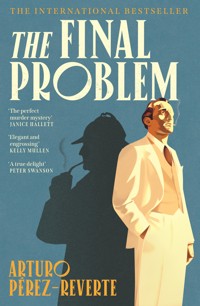
THE FINAL PROBLEM
ALSO BY ARTURO PÉREZ-REVERTE
What We Become
The Siege
The Painter of Battles
The Queen of the South
The Nautical Chart
The Fencing Master
The Seville Communion
The Flanders Panel
The Club Dumas
The Captain Alatriste Novels
Captain Alatriste
Purity of Blood
The Sun Over Breda
The King’s Gold
The Cavalier in the Yellow Doublet
Pirates of the Levant
THE FINAL PROBLEM
ARTURO PÉREZ-REVERTE
Translated from the Spanish by Frances Riddle
First published in the United States of America in 2026 by Mulholland Books, an imprint of Little, Brown and Company, a division of Hachette Book Group, Inc.
Published in trade paperback in Great Britain in 2026 by Atlantic Books, an imprint of Atlantic Books Ltd.
Copyright © Arturo Pérez-Reverte, 2026
Translation copyright © Frances Riddle, 2026
The moral right of Arturo Pérez-Reverte to be identified as the author of this work has been asserted by him in accordance with the Copyright, Designs and Patents Act of 1988.
The moral right of Frances Riddle to be identified as the translator of this work has been asserted by her in accordance with the Copyright, Designs and Patents Act of 1988.
All rights reserved. No part of this publication may be reproduced, stored in a retrieval system, or transmitted in any form or by any means, electronic, mechanical, photocopying, recording, or otherwise, without the prior permission of both the copyright owner and the above publisher of this book.
No part of this book may be used in any manner in the learning, training or development of generative artificial intelligence technologies (including but not limited to machine learning models and large language models (LLMs)), whether by data scraping, data mining or use in any way to create or form a part of data sets or in any other way.
This novel is entirely a work of fiction. The names, characters and incidents portrayed in it are the work of the author’s imagination. Any resemblance to actual persons, living or dead, events or localities, is entirely coincidental.
1 2 3 4 5 6 7 8 9
A CIP catalogue record for this book is available from the British Library.
Trade paperback ISBN: 9781805466178
E-book ISBN: 9781805466185
Printed in Great Britain
Atlantic Books
An imprint of Atlantic Books Ltd
Ormond House
26–27 Boswell Street
London
WC1N 3JZ
www.atlantic-books.co.uk
Product safety EU representative: Authorised Rep Compliance Ltd., Ground Floor, 71 Lower Baggot Street, Dublin, D02 P593, Ireland. www.arccompliance.com
To Carolina Reoyo, Holmesian to an (almost) infallible degree
To Pierre Lemaitre
And to Howard Morhaim
As you are aware, Watson, there is no one who knows the higher criminal world of London so well as I do.
— Arthur Conan Doyle, “The Final Problem”
CONTENTS
1. The Man Who Never Lived and Will Never Die
2. Footprints in the Sand
3. The Mystery of the Broken Cord
4. A Laconian Sense of Smell
5. A Locked-Room Mystery
6. Tricks of the Trade
7. A Three-Pipe Problem
8. The Probable and the Improbable
9. Postmortem
THE FINAL PROBLEM
1.
THE MAN WHO NEVER LIVED AND WILL NEVER DIE
A lie, Watson—a great, big, thumping, obtrusive, uncompromising lie—that’s what meets us on the threshold!
— The Valley of Fear
IT WAS JUNE OF 1960 AND I HAD TRAVELED TO GENOA TO purchase a hat. It was a custom I had picked up in my time shooting films in Italy: I would spend a few days at the Grand Hotel Savoia and buy a felt Borsalino or a Panama, depending on the time of year, from Luciana on the Via Luccoli. Shooting films was now a thing of the past, but I still held on to some of my old habits and enough money to maintain them. Genoa with a stopover in Ventimiglia was only four hours by train from my home in Antibes: enough time to read the latest novel my friend Graham Greene had sent with a warm dedication. The new hat was really just an excuse to spend a few days in the city, strolling along the old port and eating pasta at my favorite trattoria. On this trip I had chosen a classic Panama with a two-inch brim and a lovely tobaccocolored ribbon. I visited a couple of bookshops and then hung my new hat on a hook at Al Veliero, where, after chatting with the owner, an old friend, I enjoyed a delicious plate of spaghetti with clams and bottarga. I had just placed my hat on my head and stepped into the street when I practically crashed into Pietro Malerba.
“Cazzo, Hoppy. What a surprise.”
I hate being called Hoppy. Only people who know me from my early movies—the ones who are still alive, that is—use that ridiculous nickname. I have a theater agent who died in 1935 to thank for that stage name, Hopalong Basil. It was also thanks to him, however, that the name appeared on so many cinema marquees for twenty-five years—often in larger font than the others. But I never felt comfortable with it. I much prefer my real name, inscribed on the little brass plaque beside the door to my home with a view of the Mediterranean and polished daily by Mrs. Colbert, my housekeeper. Ormond Basil.
“What a surprise,” Malerba said again, seemingly delighted to see me. He gave me a hug and thumped me loudly on the back. So typically Italian. The display of affection felt a little forced and I assumed he was using my former glory to impress his companion, an attractive older woman.
“This is Hopalong Basil—you remember him,” he said to the woman. Then, looking up at me from beneath gray brows that gave him the appearance of the evil Mephistopheles: “And you know Najat Farjallah, of course.” He said it with evident pride.
I removed my hat and kissed her bejeweled hand, as was expected of me. While the public fervor that had elevated the celebrated soprano to demigoddess status was now somewhat diminished, she still possessed an effective beauty: large dark eyes under a silk turban, well-defined lips. She wore elegant clothing—I’d read somewhere that her Milanese friend Biki Bouyeure dressed her—but the amount of cleavage seemed a bit excessive for two fifteen in the afternoon.
“Oh, yes, of course. Mr. Sherlock Holmes himself,” said the Lebanese diva languidly, accustomed as she was to receiving admiration.
I smiled cordially, almost complicitly; what else could I do? It wasn’t the first time we had crossed paths—after meeting in Rome I’d seen her do Medea at La Scala. This time, as on other occasions, she looked me up and down with open interest. I’d just turned sixty-five, and while age shrinks one somewhat, I still maintained the better part of my five-foot-ten stature, a trim waist, and the thin, angular face that had been so popular on the big screen at one time. Also, a certain nimbleness. If Errol had lived—here I’m referring to Errol Flynn, of course—I would’ve still been able to get several jabs in, just like in the rehearsals for Captain Blood. The poor guy was always a terrible swordsman whereas I possessed an innate agility.
So Pietro Malerba and Najat Farjallah were there, and there I was with my new hat at the old Port of Genoa, all of us completely unaware that at that precise moment, a low-pressure system was moving in over the eastern Mediterranean and would stall between Cyprus and the Black Sea, causing winds of ten knots to blow off the Gulf of Taranto—something uncommon for that time of year. The unexpected storm would then lash the Ionian Sea and the western coast of Greece so violently that all navigation would be halted at Corfu, the large island that the Greeks call Kerkira, a name Malerba had just pronounced in reference to his yacht, the Bluetta.
“Come with us!” Malerba suggested. “A few days relaxing in the sun. We can talk about a project I think might interest you: a Warner-RAI coproduction for television.”
That didn’t sound too bad. Since playing the supporting role of a Russian aristocrat in War and Peace five years prior, I’d been mostly out of work, not counting a minor part as an elegant villain in the television adaptation of Ivanhoe with Roger Moore—average actor, nice guy. That, apart from Holmes, was my specialty. More work was always welcome. I was frugal and lived discreetly; my economic pressures were much eased now that my two ex-wives were both fortuitously deceased. The first saw her drinking habit catch up with her on the Pacific Palisades estate she’d acquired in the divorce—we’d started drinking together, but she’d always outpaced me in everything. The second took a 150-yard drop off a cliff on the Villefranche highway, going out with a final bang of ignited gasoline as her sports car crashed to the ground below. As for everything else, my lovely home in Antibes had been paid off ages ago but it could never hurt to stock up for the uncertain times to come, old age closing in, the Cold War, and other et ceteras that darkened the horizon at the time. Malerba was a bigwig producer for Cinecittà with major movie and television projects in America and Europe. So I accepted the invitation, much to his satisfaction and visible interest from the lovely soprano, who continued to make eyes at me. I spent the rest of the afternoon acquiring the items I would need, had my luggage moved from the hotel to the port, and slept that very night in a luxurious cabin aboard the Bluetta.
A week later, to my surprise, I found myself trapped on the small island of Utakos, across from Corfu. Or the three of us did. Pietro Malerba, Farjallah, and I had disembarked from the yacht to dine at the Hotel Auslander, which boasted a superb restaurant, when the weather took a turn. We watched from the terrace as the sea began to sputter with the first inklings of an unexpected thunderstorm and the wind caused the cypress trees to twist and wail like tortured souls. It was no time to return to the ship, since it looked as though it would be an uncomfortable night on the water, so Malerba reserved three rooms: one for me, plus two adjoining rooms for Farjallah and himself—he had separated from his wife, a well-known Italian actress, but divorce was illegal in Italy and he preferred to keep up appearances. The idea was to set sail the following morning once the storm had passed, but when we awoke, we were informed that the storm was still raging nearby and all navigation in the area had been suspended until the weather improved. The Bluetta, in fact, was no longer docked there, the captain having been forced to raise anchor and take refuge on the leeward side of Corfu.
“How dramatic, Ormond,” said Farjallah, holding Malerba’s hand but batting her eyes at me. “Like in one of your movies.”
Malerba didn’t mind her flirting; he knew me too well. Opera divas were not my type, and anyway, my glory days were long behind me. Also, I am an English gentleman of the old-school variety: I would never encroach on a friend’s territory, much less if possible future work might depend on him. David Niven, a dear comrade, often said after a few drinks: Never point your boner towards the pocket where you carry your wallet. Which, uttered by Dave in his posh accent, sounded surprisingly elegant.
But what really matters for this story is that I found myself, or rather we found ourselves—Malerba, Farjallah, and I—unable to continue our cruise and stranded on a tiny island. Although it didn’t provide much consolation, there were others in the same situation: unable to take the ferry back to Corfu or Patras and forced to prolong their stays. There were nine of us in total, of diverse nationalities. And all of us were guests, by force, of the only available accommodation. Like in some Agatha Christie novel.
Even under such circumstances, Utakos was lovely—a tiny paradise of olive trees, cedars, cypresses, and bougainvillea, with the jetty jutting into the water below the ruins of an ancient Venetian fortress, a densely forested hillside crowned with the remains of a Greek temple, and, in a dip in the hillside, protected from the winds, the Hotel Auslander: a nineteenth-century villa with splendid views of the Albanian coastline and the mountainous silhouette of Corfu backlit by an incredible sunrise each morning. Not even the storm could diminish the beauty of the landscape, since the cyclone on the open ocean had swept all clouds from the sky, leaving it clear, bright, and blue.
At 12:05 p.m. on the second day, after reading for a while on the terrace outside my room—Mani: Travels in the Southern Peloponnese by Patrick Leigh Fermor—I went down to the restaurant where Gérard, the maître d’, led me to the table that Malerba, Farjallah, and I had occupied the night before.
“Will your friends be joining you today, Mr. Basil?”
I told him they would not. The diva was a late riser and Malerba was looking over a contract for his business partner, Samuel Bronston, for a movie they wanted to shoot in Spain with Charlton Heston and Sophia Loren. At the table next to me sat an older couple whom I supposed to be Swiss, Austrian, or German based on the snippets of language I overheard. Farther away, another man sat eating alone, his head bent over his plate, a short, stocky individual who looked to be Spanish. As for Gérard, the maître d’, he was thin, distinguished, and French, dressed with somber aplomb in the typical black tuxedo and bow tie. He had lovely gray hair, an aristocratic, aquiline nose, and a gold tooth that glinted out from under a thin mustache whenever he smiled. He was also a fair pianist, as we’d learned the night before, after dinner, when he had entertained us on the old Steinway in the dining room.
“May I recommend the fish, Mr. Basil?” he suggested.
“What fish is it?”
“Dorada, and it arrived fresh just two days ago,” he said. Then, glancing around the dining room, he lowered his voice almost to a whisper. “I recommend it because, if the weather goes on like this, we may not receive any more fresh seafood.”
“Say no more,” I agreed. “That slippery bastard is mine.”
“A wise choice, sir, although I beg you’ll forgive any lapse in service. The chef and another waitress have been stranded in Corfu and it is Mrs. Auslander herself in the kitchen. The fish will have to be pan-grilled.”
“That’s quite all right. I’m sure it will be delicious.”
“And as for wine...a Goumenissa Boutari, for example?”
“I don’t drink, thank you,” I reminded him.
At that he expressed his regret with a small grimace that held a glimmer of gold. Forgoing wine with fish was equivalent to blasphemy, in his unspoken Mediterranean opinion. But I’d held the wolf by the ear: I’d gone almost five years on sheer willpower, abstaining from strong drink. Or weak drink. All drink.
“For dessert we have a tart made from blackberries picked fresh on the island. Delicious.”
“I’ll keep that in mind. Thank you.”
He moved on to the other tables. If there’s one thing I’m proud of it is my excellent rapport with subalterns. From boyhood I learned that these are the people who will solve one’s problems, and that their willingness to do so, or lack thereof, depends on the respect one is able to inspire in them. The two wars I’ve lived through in my long existence—the first more uncomfortable than the second, spent in the mud in Flanders—rounded out an idea that I later confirmed in the cinema: It is not the generals but the sergeants, the electricians, set designers, and makeup artists, to mention a few, who determine the outcomes of wars and films.
I followed Gérard with my gaze as I got to work on the starters: black olives, soft cheese, and octopus stewed in wine—Mrs. Auslander was a good cook. It was a pleasure to watch Gérard work, moving with elegant ease from table to table, attentive and professional, uncorking bottles, making sure that Spiros and Evangelia, the young waiter and waitress, attended to the guests’ every need.
Just then, the French doors that led to the dining room opened and a dashing man entered.
“Oh, hello, Mr. Foxá,” Gérard said, gold tooth gleaming.
The man was handsome and looked to be in his early forties. I’d seen him from a distance the night before, during dinner. Now he wore a dark blue blazer, checked shirt with no tie, and flannel trousers. I was discreetly observing him when the pleasant aroma of fish caused me to turn my head. Evangelia, the waitress, had crept up silently as a cat.
“Here we have your dorada, sir.”
“Oh, yes. Thank you.”
I tucked in, concentrated on handling my silverware—I detest fish knives—and was enjoying the meal and my glass of cold water. After a few minutes I looked up as a woman entered the dining room. She looked to be in her late thirties, soon to pass Cape Horn into her forties, typical tourist to the Greek isles. She wore a light patterned dress with thin straps that showed off her tanned shoulders and she carried a wide-brimmed straw hat with a red ribbon. Her hair was very blond, her legs were pretty, and her eyes were gray or blue; I wasn’t close enough to tell. She wasn’t a great beauty by any means, but not bad for an Englishwoman.
She looked around, seemingly anxious, as Gérard dutifully showed her to a table. She then asked the maître d’ a question that I didn’t catch, and Gérard shook his head. She looked around again, worriedly, and then turned her head to the door as if she expected someone to walk in at any moment. I supposed she was waiting for her traveling companion, a woman very similar to her in appearance. I’d noticed them the day before and I took it they shared a room.
I finished my meal and asked Evangelia if she could serve my coffee out on the terrace, set my napkin on the table, stood up, and crossed the dining room towards the French doors that led outside. As I passed the other tables, I was aware of everyone watching me. Accustomed to the public’s curiosity—although much diminished in recent years, as I’ve said—I responded with a slight nod of the head.
The view from the terrace was magnificent and more than justified a visit to the island. The ancient villa had been built against a formidable landscape: the ruins of the Greek temple atop the steep slope of the hillside dotted with cypresses and black cedars. Olive trees, mimosas, and bougainvillea filled the garden that descended to the beach. Beyond that, the sea, which the sun and wind had turned to a blue sheet of cobalt speckled with white waves as the far-off mountains of Albania and the rocky coastline of Corfu rose up imposingly in the distance.
Evangelia brought me the coffee, a strong Turkish brew. I pulled my tin of Panter cigarillos from my pocket and lit one with the gold Dupont that had been gifted to me by Marlene Dietrich twenty years prior, a time when she and I had exchanged more than just lines. The terrace was protected from the sun by an awning and there was not a whisper of wind. The coffee, thick as mud, burned my lips and tongue. I set it down to let it cool.
Other guests had had the same idea: The German couple—I later learned that their names were Hans and Renate Klemmer—made their way across the terrace to a table near the white stone staircase under the branches of a dense magnolia. Beside it was a marble Venus de Milo partly covered in ivy to add a touch of modesty. Behind that, hidden by mimosa shrubs, was the diesel generator that provided the hotel with power during the day and part of the night.
I felt another presence and I raised my gaze. The man who Gérard had called Foxá was standing nearby. He smiled politely. “You must be tired of people pestering you,” he said.
He spoke good English with a Spanish accent. I shook my head, smiling, and gestured to the seat beside me. He seemed to hesitate for a moment.
“I don’t want to intrude.”
“No, not at all. Please, have a seat.”
“Francisco Foxá,” he introduced himself. “Paco, actually. That’s what everyone calls me.”
His handshake was frank and vigorous. He was tanned, with dark wavy hair, and he looked like a man who knew the difference between a samba and a mambo. He settled into one of the wicker chairs and ordered a cognac from Evangelia.
“Would you like another coffee?”
“Not for now,” I replied. “Thank you.”
I took out my tin of cigars and offered him one. He lit his with a box of hotel matches that had been set out on the table and we smoked as he sipped from his glass. We talked for a good while. He laughed at what he called my “precise English pronunciation,” identical to the voice he’d heard so many times in the movies, saying things like “Come, Watson, come. The game is afoot,” or “Art in the blood is liable to take the strangest forms.”
I nodded happily. It was always nice to be reminded of those days.
“Sorry for staring,” he apologized, “but it’s incredible to be sitting here with you. Of course, the Sherlock Holmes films were my favorite. How many of them did you shoot?”
“Fifteen.”
“My God, I think I saw them all. It’s no surprise that we imagine your face when we think of the great detective.”
I laughed. “Well, as you can see”—I ran a hand over my cheek—“your detective has gotten old. I haven’t done any Holmes films since The Hound of the Baskervilles, and that was ten years ago. I hardly set foot on a film set or stage these days. Movies based on mystery novels no longer interest the public. Now they want car chases, shoot-outs, shouting, and making a spectacle. It’s no longer enough to elegantly light a cigarette; now you have to be a sharpshooter. And I’m terrible with pistols.”
Foxá nodded sympathetically. “I saw you on TV not too long ago.”
I gave him an appreciative smile. “A small part as a villain, that’s all. Nothing serious in terms of work.”
“It doesn’t matter if you keep playing the part or not: You’ll always be Sherlock Holmes.” He sipped his cognac, assuring me that a few more lines around the eyes and forehead or deeper folds around the mouth didn’t amount to much. I now had gray hair, but it was all there, enough to brush back and part stylishly. I was clean-shaven, and my well-worn tweed jacket—Anderson & Sheppard, naturally—and impeccable shirt and tie conferred on me, in his opinion, an elegant nonchalance. My bright dark eyes looked out at the world with a penetrating curiosity. Or so it seemed to him. “They’re Holmes’s eyes.” He looked around. “I almost expect Dr. Watson to appear at any moment. What was that actor’s name?” He thought for a second. “Oh, yes. Bruce Elphinstone.”
I nodded sadly. My dear Bruce, who’d played the role of Dr. Watson in all fifteen films, had died of cancer four years prior. I told Foxá, who hadn’t been aware, and he raised his glass, as if to toast Elphinstone.
“A magnificent actor,” he said.
“And a swell guy,” I added. “I doubt that, without him, those movies would’ve been so successful.”
The Spanish man stared at me. I began to feel uncomfortable.
“Please, I have to ask,” he said suddenly. “Will you do it for me?”
I was bewildered by the question. “What is it exactly that you want me to do?”
“You don’t know me. When this is over, you’ll leave and I’ll never see you again.”
“And what does that mean?”
“Look at me. What can you deduce?”
It took me a moment to understand his meaning. Then I laughed. “I’m just an actor, my friend.”
“Please, you have no idea what it would mean to me.”
I observed him for a moment, amused. Why not? I finally said to myself. He’s friendly and I have nothing better to do. “You play sports,” I said. “Tennis, perhaps.”
“Correct.”
“And you’re left-handed.”
He glanced at his hands. “Is it that obvious? They taught me to use my right hand as a child. I even wear my watch on the other wrist. How could you tell?”
“In the movies we’d call it breaking character.” I picked up the box of matches from the table and tossed it to him, and he caught it in the air. Then he looked at me, confused. “All of your instinctive gestures,” I explained, “you make them with your left hand.”
He let out a loud laugh. “Well, I’ll be damned.”
I decided to take it a little further. The Spanish man was entertaining and I was beginning to enjoy the game. “Also,” I added, “you shaved during the thirty-minute power outage this morning.”
This time his mouth fell open. He took a moment to react. “That’s amazing,” he finally said. “How did you...”
I rubbed one of my cheeks, more closely shaven than the other. “It happened to me too. I imagine that the window in your room lit up the right side of your face better than the left.”
“Yes!” he exclaimed, awed.
“I could see my left side better.”
“That’s amazing,” he said again.
“No. It’s elementary.”
“Dear Watson?”
“Yes.”
We both laughed heartily. I was having a good time. We lit two more of my cigars and he ordered another cognac. I tried to keep my eyes away from his glass and my thoughts away from the deliciously French aroma wafting towards me.
“You truly became Holmes,” he said.
“I lived inside his head for fifteen years. I read every novel and story dozens of times. It was a good way to get into character. Almost none of what I just said comes from my own deductions.”
“You say that as though it disappoints you. As if you weren’t satisfied.”
“Oh, not at all. I’m quite satisfied, but I’m afraid I won’t be remembered for any other role except that one.”
“I remember your other roles: You’ve played some magnificent villains. In The Adventurer of Sumatra, for example, or that swashbuckler in The Pardaillan Revenge. Not to mention the evil tax collector in The Queen of Castile.” He shot me an almost reverent look. “What was Greta Garbo like?”
“Pretty. Shy. More sensitive than a seismograph.”
“And is it true what they say—that, like any good Swede, she enjoyed strong liquor?”
“She could throw back vodka like it was water,” I responded automatically, distracted by the Englishwoman, who had appeared on the terrace, accompanied by Gérard. The two of them seemed to be questioning Evangelia. The woman looked nervous.
“You are so kind to remember my films,” I said.
“Well, other actors have played Sherlock Holmes, and will again, but none like you.”
“That’s not the most important thing to a classically trained actor like myself,” I replied. “Thirty-two roles in seventeen works by Shakespeare, two dozen movies playing other characters . . . all forgotten. Swallowed up by the famous detective.” I raised my arms in resignation and looked again at the Englishwoman. She’d sat down beside the French doors, as if she were waiting for something. Gérard seemed to be trying to soothe her. I watched as Evangelia crossed the terrace and went down the stairs to the garden that led to the beach.
“And what are you doing here?” I asked, turning my attention back to the Spanish man.
He had been stranded on Utakos by chance, after a romantic relationship came to an abrupt, unhappy ending. The woman, married, had ended things with him, furious over his refusal to support her legal separation from her husband. Two days prior, after a night of arguing, she’d packed her bags and had them taken down to the ferry. She managed to leave on what turned out to be the last boat to Corfu before the storm cut off all transportation to and from the island.
“You’re a bachelor, then,” I ventured.
“Fortunately.”
“And what line of work are you in?”
“I write novels.”
“Really! Would I have read any of them?”
“I doubt it. They’re mostly cheap detective stories and Westerns, published in Spain and Latin America. I have only one short story translated into any other languages. I write under two different pseudonyms: Frank Finnegan and Fox Creek.” He winked an eye. “What do you think?”
“Which one do you use for the Westerns?”
“Creek, of course. The other, Finnegan, specializes in platinum blondes and drunk detectives.”
“I’m impressed.”
He laughed. “I don’t know if you’re being serious. But don’t worry: I do all right for myself.”
“I meant it sincerely. I don’t know a lot about cowboys and Indians, but I was always fascinated by the construction of a detective novel. I reread many in my Holmes years, of course, by different authors.”
“Reread?”
The man seemed pleased, so I went on. “What I like about that type of novel is that, aside from the great classics, they’re the only kinds of books worth reading twice.”
“I know what you mean. Once to discover the mystery and again to figure out how it was plotted out, right?”
“Yes, exactly. And what fascinates me most is the art of deception.”
He nodded eagerly. “I love that you see it that way, because you’re absolutely right. In a good mystery novel, the solution is in plain sight from the beginning.”
“Conveniently concealed,” I added.
“Precisely. You must be a very sharp reader.”
I shrugged with modesty, or as much modesty as an actor is capable of, which is never very much. “I’m a reasonably good reader, for professional reasons,” I answered. “Playing those parts left me with certain habits.”
“It’s just marvelous,” he said, staring again with admiration. “No less than Hopalong Basil in the flesh.”
“But I imagine that detective novels require a great mastery of narrative technique.”
He shrugged. “It’s more like being able to give up on what some call serious literature.”
I raised my eyebrows. “An unjust opinion, as far as I’m concerned.”
“I appreciate you saying that, because The Murder of Roger Ackroyd is as much of a masterpiece as Crime and Punishment. But in a traditional mystery, too much emotion can do more harm than good: Passion, love, and hate are all extraneous. Because, in that kind of a story, the writer needs to forget the traditional concept of literature and focus on other aspects... Do you follow?”
“I think so.”
“Character traits are simply motors for the complex plot, since it’s more about stimulating the readers’ curiosity.”
“And are you good at that? At complex plots?”
“Oh, not really. The public is less demanding these days. It was different before, when the mystery novels had more reflection than action...I say ‘had’ because they’re out of fashion: too many writers trying to imitate Conan Doyle. Then the last wars stripped away any innocence we had left.”
“Was that the case with you?”
“Yes, of course. I started out on the more intellectual mystery stories, devouring them as a child, then moved on to modern detective fiction. What they call noir: more brawn than brains.”
“Have you made any significant contributions?”
He twisted his mouth into a pensive frown. “Few.”
“You must’ve written something good.”
He smiled slowly. “To be honest, of my thirty-something novels, not even half a dozen would pass a quality control test. I turn them out in under a month.”
“By Jupiter.”
“Yes... my record is twelve days.”
“And they sell well?”
“I can’t complain. I publish the detective novels in two series: FBI and Secret Service, both very popular. It’s rare to see a train station newspaper stand that doesn’t have a couple of my titles.”
“But you’re not proud of them, not satisfied?”
“I’m a mediocre hunter, I’m afraid.”
“It seems strange you would say that,” I said, surprised. “I always related the notion of the hunter more with an investigator than with an author. Sherlock Holmes even said so.”
“I like to think that the first detective stories were told by prehistoric hunters, sitting around the fire as they recounted the marks or footprints left by their prey as they tracked them.”
“Brilliant,” I admitted. “But tell me more about your novels.”
He thought for a moment. “The Suspicious Blonde and A 9mm Mystery aren’t all that bad,” he said. “Although my favorite is ‘The Vanishing Knife’; that was my last mystery story before I moved on to private eyes and corrupt cops. The murderer makes a knife out of ice using a canister of carbonic gas, eighty degrees below zero. They stab the victim to death but the weapon disappears as it melts, mixing with the blood, without leaving a trace.” He looked at me. “What do you think?”
“Sounds good,” I said approvingly. “Very original, I mean.”
“I appreciate that. It’s my only story that has been translated into English. It was published a few years ago in Mystery Magazine.”
“I’ll look for it.”
He shrugged modestly. “Before, I was a naive writer, if you know what I mean. Of the kind who rack their brains searching for an ingenious solution to the mystery.”
“I imagine that’s not easy.”
“Certainly not. You have to cover the reader’s ears when you show them something and then cover their eyes when you tell them something. Also, play with their capacity for misjudgment and forgetfulness. You have to plant an idea, hide it, and confuse the reader with things that lead them to a different idea...The truth is that I never enjoyed writing as much as when I wrote that kind of story.”
“You don’t enjoy it anymore?” I asked.
“It’s different. I earn a living writing the genre that’s in fashion, and I’ll keep doing so until so many people are writing noir that readers get bored.”
“What will you do then?”
“I’ll move on to spy novels, which are beginning to take off: Eric Ambler, Ian Fleming, all those guys.” He paused with a melancholic, pensive expression. Then he blinked as if returning from some faraway place. “And you?” he asked politely. “Have you been in England since you left Hollywood?”
I smiled. “Not if I can help it. I’ve lived in the South of France for some time now.”
“Ever since you left the cinema?”
“Ever since the cinema left me.”
“And how does a huge movie star like you adjust to that?”
“I couldn’t tell you.” I thought for a moment. “An irrational sense of bitterness can set in when one feels old, used up, or cast aside. All I can say is that up to now I’ve managed to keep it at bay.”
“You’re wise to do so.”
“It’s just that bitterness is exhausting.” I looked once again to the Englishwoman, who was still sitting beside the door. She seemed increasingly anxious. “Who is that woman?”
Foxá followed the direction of my gaze. “Her name is Vesper Dundas. She’s traveling with her friend Edith Mander. You might have seen them together yesterday.”
“Yes, I saw them. She looks quite nervous, doesn’t she?”
“Could be. She seems to be waiting for her friend.”
I stubbed out what was left of my cigar, signaling an end to our conversation. “Thank you, Mr. Foxá,” I said.
The Spanish man stood. “You can call me Paco.”
“Oh, I couldn’t possibly. It’s too...”
“Familiar?”
I laughed heartily. “I’m afraid so. Please forgive my British formality. I’m practically Victorian.” I glanced at the Englishwoman, her nervous posture. Gérard had returned inside. “As for me, I will not ask you to call me Hopalong,” I said, “because I detest it. My real name is Ormond...In any event, seeing as we’ll be here until the weather improves and I’m sure we’ll have more opportunities to chat, you can call me Basil, if you like.”
“Of course.” He made an affable bow of the head. “It has been an honor to speak with you.”
He walked back towards the hotel as I pulled out another cigar. But I didn’t have time to light it because at that moment Evangelia came rushing up the stairs screaming. Like in some bad movie.
That’s when everything began, or when everything that happened began to manifest itself. There was no authority on hand beyond Mrs. Auslander, proprietress of the hotel and island. She appeared as soon as she heard the shouting, and was the one to make the initial decisions.
“No one is to go down to the beach,” she ordered.
The woman commanded respect, with good reason: An Austrian Jew, she’d survived Auschwitz. Raquel Auslander was her maiden name. After the war she’d married an Albanian merchant who, through his premature death, had left her enough money to buy the villa. That was her story, or at least what was known of it. She was a tall, beautiful woman in her early fifties, with long dark hair always pulled into a low bun or braid. She was very tan, wore no jewelry other than two wedding bands on her right ring finger, and her dresses were loose, comfortable cotton tunics.
“Come with me, Dr. Karabin,” she said to the short, stocky man who had been eating alone. “Everyone else, please stay here.”
And off the two of them went, walking over the sand towards the beach cabana located a little over two hundred yards away, as we all stood gathered on the terrace. Miss or Mrs. Dundas sat on the stairs, overcome by nerves, and Evangelia shook with sobs, Gérard attempting to soothe them both. That’s when Pietro Malerba and Najat Farjallah appeared, confused over all the commotion.
After fifteen impatient minutes, the doctor returned. He was Turkish, it turned out, a portly man with a curly gray beard in sharp contrast to his mahogany hair, which, upon closer inspection, was obviously a toupee. He was the director, someone had commented, of a private clinic in Izmir. The knees of his white trousers were stained and he dabbed sweat from his brow with a handkerchief. “Terrible,” he murmured. “Terrible... The poor woman.”
“What woman?” Malerba asked.
“Edith Mander.” Karabin threw a commiserating glance towards the stairway. “Mrs. Dundas’s traveling companion.”
We were all shaken, shocked. The doctor pointed towards the cabana. “We need a few of you to come down. Do you understand? As witnesses.”
I was standing closest to him when he said this, so naturally he looked to me. Perhaps my familiar face inspired trust. “Of course,” I agreed immediately.
Then his eyes turned to Paco Foxá. “If you wouldn’t mind, sir . . . ”
“My pleasure,” said the Spanish man.
“I’ll come too,” Malerba said.
The three of us followed Karabin through the garden to the beach, sheltered from the wind by the forested hillside.
“Try not to step on the tracks in the sand,” the doctor asked, pointing to his left. “Those were the only footprints here when Mrs. Auslander and I walked this way.”
I looked at the footprints. They belonged to a single person, heading in the direction of the cabana. A one-way trip. A single, impeccably laid trail, with no return. A shiver ran down my spine, which—may God or the devil forgive me—I could only classify as exquisite.
The beach cabana was a little wooden shack where guests could change into their bathing costumes. It housed hammocks and beach umbrellas and was equipped with a shower and toilet, shelves of towels, a table piled with copies of glossy magazines—Life, Epoca, Zefyros—and a small, empty ice chest. There was no electricity, just a kerosene lamp. The only window in the cabana faced the hotel, and the door opened onto the beach. The hill did not offer as much shelter on the other side, where the wind blew in gusts along the ground, erasing all marks in the sand.
The wood floor of the cabana was partially covered in sand, and lying on the planks, face up, with a broken cord around her neck—the other end hung from one of the roof beams—was Edith Mander. Her eyes bulged wide in an expression of terror and her skin looked like wax. Beside her head was a small stool, overturned. She was dead.
“When did it happen?” I asked.
“Rigor mortis has already set in,” Karabin answered. “She’s been here all night.”
Mrs. Auslander sat on a hammock, staring at the corpse.
“Suicide?” I asked.
The doctor hesitated, exchanging a glance with the proprietress of the hotel; she remained expressionless, silent. “It’s very likely,” Karabin finally said. “The window was closed and the door as well, with a chair against it.”
“Against it?” I asked, surprised.
“Yes. The door has a lock, but the key is never here. Doubtlessly, the poor woman pushed the chair against it in order to...I don’t know. Ensure her privacy.”
“Privacy?”
“I don’t know if that’s the right word. I can’t think of a better way to say it.”
I threw Foxá a glance and his lips twisted into a faint smile. “A locked-room mystery,” I commented.
The Spanish man nodded, catching my meaning. The notion was familiar to me from my films and to him because of his novels: a dead body in a room that no one could’ve entered or exited. An obvious suicide, at first glance.
“Was it Evangelia who opened the door?” I inquired.
“No. She saw Mrs. Mander through the window and rushed back to tell us.”
“So, she didn’t enter the cabana?”
“No.”
“Who moved that?” Foxá pointed to the chair beside the door.
“It was pushed aside when Mrs. Auslander and I entered.”
I looked to the proprietress, who nodded in agreement.
“Did you cut the rope?”
“No,” she replied. “It was like that when we came in.”
“That means Evangelia didn’t find the poor woman hanging, but on the floor?”
“That’s right.”
“Maybe the rope broke from the force of her final convulsions,” Malerba said.
“Maybe so.”
Pietro Malerba leaned over the body with a lit Cuban cigar in his hand. He was short, strong, and prematurely gray, and his almond-shaped eyes brought to mind the marauding bands of Huns who had raided Italy centuries prior. In every other aspect he was Roman to the core: a weather-beaten pirate with solid social and economic ties to the city. The producer and I had known each other for fifteen years. He cared only about cinema, television, money, and sex, in that order.
“She’s suffered a blow to the head,” I commented. It was an obvious observation but everyone looked at me as if I had said something profound. I suppose I reminded them of the famous character I’d played, standing there framed by the rectangle of light from the window, leaning over a corpse with a pensive expression on my long, angular face.
Karabin nodded solemnly. “Yes, the bruise on the temple.” He pointed to the stool. “She must have hit her head when the rope broke and she fell. But she was most likely already dead. Death by asphyxiation, no doubt. As indicated by the rope marks on her neck and the position of the tongue. The bulging eyes. She shows all the signs.”
“And that small bruise on her left shin?”
“Let me see...I don’t know. Could be from the fall, or before.”
We all fell silent for a moment, unsure of what to say, listening to the sounds of the wind and the waves outside. Mrs. Auslander was still sitting as immobile as a judge, without taking her eyes off the corpse. I was surprised by her calm until I remembered Auschwitz.
“Her friend should not see her this way,” she said suddenly.
We all expressed our agreement. It was common sense.
“It would be better to have her taken up to the hotel,” Malerba suggested. “To lay her out somewhere more...more, eh... decently.”
“We shouldn’t move her. The authorities...” the doctor objected.
“It might take days for the authorities to come, with the storm. We can’t leave her lying here on the floor.”
“We should cover her with something.”
“I will radio over to Corfu,” said Mrs. Auslander, “to notify the police. They will know what to do.”
“They won’t come in this weather,” said Karabin.
“Yes, but I should inform them of the tragedy.”
I looked at the dead woman’s face: her expression, wild with agony, fixed in place. Her lips were twisted into a grimace, but behind them her teeth were stained a faint violet color. “What do you make of that?” I asked, pointing it out.
“I don’t know,” said the doctor. “Must’ve been something she ate.”
“The blackberry tart,” said Mrs. Auslander.
The dead woman’s blond mane was dirty and flattened down, and the bruise on her forehead extended almost over her left eye. She wore a beige linen dress that buttoned up the front and it was stained around her thighs, as if she had soiled herself in her final throes. Her feet were bare, her high heels beside the door. She’d surely carried them in her hands so as to move more easily over the sand.
“Why did she do it?” Foxá wondered aloud.
With his cigar between his teeth, Malerba let out a sarcastic chuckle. “They are very strange, those women.”
“Someone should speak to her friend, don’t you think? She must know something.”
Karabin looked away. “That’s a job for the police, I suppose.”
The Spanish man ignored the comment. He looked to the proprietress of the hotel. “We can’t sit by and do nothing,” he said.
I took in the scene, looking from the body up to the ceiling beams and around the room. For some perverse reason I felt comfortable, or maybe that’s not the right word. I felt as though I was back in a well-known, familiar situation. I almost found myself looking for my mark on the floor, imagined the technicians and the director in the shadows waiting for my lines. The plot thickens, et cetera.
“What do you know about her and her traveling companion?” I asked, returning to the real world. I spoke quietly but everyone went silent and turned to me, as if responding to a voice of authority.
“They arrived four days ago,” Mrs. Auslander answered, still seated. “Two tourists like any others. Vesper Dundas is a wealthy woman”—she looked at the dead body—“and Edith Mander was her friend. Her travel companion, a modern-day chaperone. The world is no place for a woman alone.”
“What else?”
“Not much else. They were not very talkative. I only know what was on their passports and registration cards,” she said, still contemplating the cadaver. “Edith Mander, forty-three years old, resident of Cromer, Norfolk.”
“And the other woman?”
“Thirty-nine years old. Resident of London. She has been traveling for a while. She was widowed fairly recently and her husband left her some money.”
“A lot?” Malerba wanted to know.
“Enough, I take it.”
“What else can you tell us?” I asked.
“Nothing. I already said they were not very sociable. ‘Good morning,’ ‘Good evening,’ things like that. Very English, the pair of them.”
I leaned over to study the sand on the dead woman’s feet and then touched the broken rope around her neck.
“You shouldn’t touch anything,” Karabin objected.
Ignoring the doctor, I studied the rope. Then I looked back up at the other end hanging from the ceiling. “Any emotional entanglements that you know of? Between the two women or a third party?” I asked Mrs. Auslander.
It was an uncomfortable question, but I believed I managed to pose it delicately. I was certain everyone else had the same thought even if no one dared to voice it aloud.
Malerba let out an unpleasant little chuckle. “I wouldn’t have been able to put it so elegantly,” he said.
“Not as far as I know,” replied Mrs. Auslander. “Their room has two beds.”
“Were both beds slept in?” I asked.




