


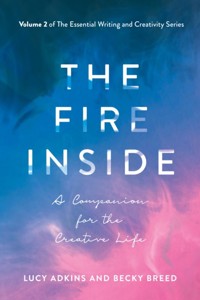
4,49 €
Niedrigster Preis in 30 Tagen: 4,49 €
Niedrigster Preis in 30 Tagen: 4,49 €
Mehr erfahren.
- Herausgeber: WriteLife Publishing
- Kategorie: Ratgeber
- Sprache: Englisch
The Fire Inside, through a well-researched collection of heart-warming essays, invites readers to uncover their unique talents, whether they be in writing, the visual arts, or the sort of “everyday” creativity which so enriches our lives.
Based on the authors’ combined fifty-five years of teaching and presenting workshops on writing and creativity, this book is packed with creative tips and exercises, anecdotes, insights, and inspiration. Written in a spirit of warmth and generosity, it includes the highs and lows of the creative life, and encourages readers to say yes to creativity, choose to live a bigger life, and discover how the “magic” happens.
Das E-Book können Sie in Legimi-Apps oder einer beliebigen App lesen, die das folgende Format unterstützen:
Veröffentlichungsjahr: 2021
Ähnliche



















The Fire Inside: A Companion for the Creative Life
© Lucy Adkins and Becky Breed. All rights reserved.
No part of this book may be reproduced or transmitted in any form or by any means, electronic or mechanical, including photocopying, recording, or by any information storage and retrieval system, without permission in writing from the publisher.
Published in the United States by WriteLife Publishing
(an imprint of Boutique of Quality Books Publishing Company, Inc.)
www.writelife.com
The poem “Mourning Dove Migration” was previously published in the 2000
Nebraska Poet’s Calendar by Black Star Press.
Printed in the United States of America
978-1-60808-248-3 (p)
978-1-60808-249-0 (e)
Library of Congress Control Number 2021931255
Book design by Robin Krauss, www.bookformatters.com
Cover design by Rebecca Lown, www.rebeccalowndesign.com
First editor: Caleb Guard
Second editor: Andrea Vande Vorde
Praise for Lucy Adkins, Becky Breed, and The Fire Inside
“Beginning with ‘Say Yes to Creativity’ and all the way through twelve chapters to ‘Just Do It,’ The Fire Inside is jam-packed with ideas, tips, suggestions, inspiration and general cheering-on. Lucy Adkins and Becky Breed’s newest book indeed lights a fire and tells us how to keep the flames burning. Whether using the book as a daily dose of inspiration or a straight-through read (and read again and again), writers and creators of all stripes will be grateful for this lively companion for their life, creative and otherwise.”
– Judy Reeves, author of A Writer’s Book of Days and Wild Women, Wild Voices
“The Fire Inside is packed with stories, lessons, and exercises that encourage readers to grow their creative souls. Written by two empathic educators, this book is practical and passionate, accepting and challenging. It is impossible to read The Fire Inside and not be inspired to follow our dreams. I recommend it to all artists and artists to be.”
– Mary Pipher, author of Writing to Change the World and Women Rowing North
“A warm and welcome conversation for those searching for their creative identity. Lucy Adkins and Becky Breed offer insights on how to pursue creative passion in the midst of the everyday in order to live a soul-filling, expansive life. Absolutely inspiring.”
– Tosca Lee, New York Times bestselling author
“The best books about writing are the ones that don’t read like books about writing, but instead feel like conversations with a wise friend who is sitting beside you as you write, encouraging and guiding you every step of the way. That is the kind of book Adkins and Breed have written, again. Like their first book, Writing in Community: Say Goodbye to Writer’s Block and Transform Your Life, this book, The Fire Inside, is sure to find a space on the shelf nearest your favorite writing spot and will become one of the most dog-eared books on that shelf. There is inspiration on every page.”
– Karen Gettert Shoemaker, author of The Meaning of Names
“If ever there was a book that could help the aspiring creative past the fear of finding and exercising the creative potential that stirs within all beings, it is this book: The Fire Inside: A Companion for the Creative Life. And a faithful companion it is. Lucy Adkins and Becky Breed have written a book that invites us to come forward with such intelligence and grace as to be irresistible. On every page they speak to the creative process and the creative spirit with a clarity that allows the reader to recognize the fire inside and believe in it as rightfully theirs. If you bring this wonderful book home, and hold it close, you will never walk alone in the vast field that is creative living.”
– Philip Kenney, author of The Writer’s Crucible
“A fine companion for anyone looking to begin or deepen a creative life. Filled with practical advice on getting started, nurturing inspiration, and connecting with other seekers in your community, The Fire Inside offers meditative and effective writing prompts that will help you observe the world and yourself in a more significant way.”
– Theodore Wheeler, author of In Our Other Lives
Table of Contents
Introduction
Authors’ Note
PART ONE: THE INVITATION
Chapter One: Say “Yes” to Creativity
The Fire Inside
The Highest Kite
Late Bloomers
Small Beginnings
Is Something Missing?
The Secret Garden
Those Places We Call Home
Everyday Creativity
What’s Your Life Assignment?
The Wild Silky Part
For Your Journey
Chapter Two: How Creativity Nurtures
Seek Wholeness
Happiness/Sadness
Accumulate Riches
Creativity, The Soft Edge of Grief
Writing the Secrets
Living with Metaphor
Mysterious Healing Powers
Close to the Soul
Find Your Way
Opening Your Heart
For Your Journey
Chapter Three: Choose to Live a Bigger Life
Big Dreams and Little Dreams
You Must Change Your Life
How Music Elevates Us
Luminescent Individuality
Wild Passions
Awaken to New Worlds
Young At Heart
The Poetry All Around
Dwell in Possibility
Work and Meaning
For Your Journey
PART TWO: INTO THE MYSTIC
Chapter Four: Look for the Mystery
When the Universe Calls
Blue Horses
A World with Infinite Connections
AWE-Some
Sweet Dirt
Waiting for Grace to Fall Down on Me
I Didn’t Know I Loved
Beneath the Prairie Sky
What We Are “About”
From the Body
For Your Journey
Chapter Five: Wooing the Muse
Making the Muse Welcome
Showers, Cows, What Else?
The Quiet Side of Inspiration
The Smell of Remembering
Sleep-Thinking
How the Song Sometimes Comes
A Memory to Swear By
Making Lists Isn’t Just for Santa
“Stand and Stare” Your Way to More Creativity
Living Among the Glories
For Your Journey
Chapter Six: How the Magic Happens
Big Magic
Taking the Brain Out to Play
Cross-Training
Hitting Rock Bottom
The Way of Epiphanies
A Country Without Borders
Nighttime Dreams: Creative Wonderland
The Hallway of Tapestries
Like a Child
To Reach Excellence: Quantity vs. Quality
For Your Journey
PART THREE: THE VILLAGE
Chapter Seven: The Village
The Loneliness of the Artist
Roses, The Impressionists, and Writing Groups
Standing on the Shoulders
Sometimes, It Takes Two
Lightning Bolts and Meatballs
Silent Companions
Dream-Chasing With Friends
A Story, A Story
Mentors Make the Difference
Creative Karma
For Your Journey
Chapter Eight: What It Takes
The Sandhills of the Mind
The Eye in the Heart
The Dailyness of Creativity
Doing Everything We Can
When We Believe
The Power of the Deadline
Staying in the Game
Animal Power
Two Types of Creativity
Winter Morning Walks
For Your Journey
Chapter Nine: Overcoming/Letting Go
Yes, You Are Creative
Writing About “Bad” Passions
Let Go of Your Little Will
The Gremlin House
Slay Your Dragons
Letting Off a Little Steam
Accepting Our Gifts
True Grit
Doing Scary Things
Dropping into Flow
For Your Journey
PART FOUR: IN THE SWEET SPOT
Chapter Ten: Build Your Life as an Artist
Seek Your Golden Mean
The Pomodoro Method
Curiosity and the Gaze
How Do We Write?
Getting a New Outlook
Artists’ Sanctuaries
A Creative Retreat
Reverence for the Particular
Because Words Matter
The Three Elements
For Your Journey
Chapter Eleven: Finding Your Rhythms
The Cycle of Life, of Creativity
Out of the Everyday
The Close Dance of Structure and Freedom
Revel in the Game of Life
Linked Through Rhythm
Time Travel
Back to School for Your Inner Artist
Mourning Dove Migration
When the World is Too Much
What We’ve Lost
For Your Journey
Chapter Twelve: Just Do It
Make It So
Red Purse
How Humor Fits In
Ground Blizzard
Take a Leap
The Story of Your Art
Pay It Forward
Going Long, Going Deep
The Power Within
Moments of Truth
For Your Journey
Sending Forth
References
Acknowledgements
About the Authors
Introduction
The underlying principle of The Fire Inside is that, whether we recognize it or not, we are all inherently creative, though creativity doesn’t happen in isolation. It happens when we open ourselves to possibility, to the idea that we create not only out of our innermost beings, our unique selves, but in partnership with mystery, the life-giving source that helps us achieve what is latent inside.
The ideas presented within these pages grew out of many years of devoting ourselves to the practice of creativity, working by ourselves and with others, paying attention to the process, and wanting to share what we have learned. We’ve learned how to find our rhythms, let go of what holds us back, woo the muse, and make the “magic” happen more often. We learned that when we do, the tremendous power of creativity fills our lives with purpose, cultivates opportunity, and connects us to the rest of the world in ways we would never imagine.
Our first book, Writing in Community: Say Goodbye to Writer’s Block and Transform Your Life, examined the potential of inspiration and connection within a writing community, how we can find our authentic voices working shoulder to shoulder with other writers. In this book, we take the process a step further, combining one hundred and twenty personal narratives and essays along with questions for reflection to explore how each individual can grow in their creative lives. It describes the cyclical nature of creativity—the times we need to persist as well as the times we need to let go, when we need to reenergize ourselves by exploring new places, new types of creativity, and seeking out and nurturing relationships with mentors. And it describes the times we would benefit from being in solitude, keeping company with ourselves in a quiet place.
We learned, and learned again, that great effort and patience are required, that we will experience delays and frustrations. But how much clay must we fire to create the pot we envision? How many pages of a short story must we shred before we craft the satisfying, mesmerizing end? Gratification has its own timetable. But when it arrives—when a ballet dancer performs a successful dance series, when the book of poetry is published, the delight is incomparable.
When you live your creativity, it’s an amazing journey. We want this book to be a companion on the way, to encourage and inspire you, and provide gentle proddings to help you continue the creative work you love. We craft our lives from the fire inside—listening to the spirit and following the promptings of the heart. Let them be amazing.
Authors’ Note
The examples and stories within these pages are the truth as we have experienced it through writing, study, participating in various writing and creative communities, and living in this world. Some of the names have been changed for purposes of confidentiality.
PART ONE: THE INVITATION
The place God calls you to is the place where your deep gladness and the world’s deep hunger meet.
—Frederick Buechner, Wishful Thinking
Chapter One: Say “Yes” to Creativity
The Fire Inside
Inner fire is the most important thing we possess.
—Edith Södergran, The Poet who Created Herself:
The Complete Letters of Edith Södergran to Hagar Olsson
Deep within us, we have a yearning, a passion, a desire to make and to do, to create something out of our hearts and imaginations that did not exist before. To bring forth something new upon the earth. It is innate in us, this intense wanting, and when we are engaged in the specific type of creativity we were meant to do—whether it be painting, writing, making music, or designing a new way to educate our children—we experience what Martha Graham calls “a vitality, a life force, an energy, a quickening.”1 It’s what puts the spark in our eyes, the skip in our steps. It is the fire inside.
Do you know that fire? Sometimes it manifests itself as restlessness, a vague dissatisfaction, a feeling that there is something important you must do, you have to do, to be true to yourself. It is the little ache you feel when you read a story that is heartbreakingly true and think I want to do that, or when you see a painting that stuns you with its power, and your fingers itch to pick up a paintbrush. Maybe it isn’t exactly clear what is burning inside, what you want and are put on earth to do. Or perhaps you know in your bones that you must write poetry, you must dance or die, you must create gardens of incredible beauty, but maybe you’re afraid that if you try you will fall flat on your face. You doubt yourself and your abilities.
This is the way we humans are, having an intense wanting on one hand, fear and doubt on the other. But let us accept as an essential truth that we are all creative, wildly creative, each and every one of us—that we have vast reserves of untapped talents and abilities—songs only we can write, sculptures waiting to be born from the unique spirit that is us; and when we accept that belief and act on it, oh, then! We wake each day with a new animation, a vibrancy and passion. We feel like children let out of a stuffy classroom into a blue-sky spring day, and we can’t wait to see what we can do with it.
The fire inside is the “something” that fascinates you, intrigues you, so that you go to sleep and wake up thinking about it. You want to study it from all its interesting angles and make it central to your life, keep working at it, falling short in your aspirations at times, but trying and trying again. And if you are not currently involved with something that brings with it such zeal, if you’ve kept your fire tamped down, unable to act on your passion for whatever reason, know that it is still there—the beginning of days filled with intense purpose and meaning, waiting for you.
The Highest Kite
Imagination is the highest kite that can fly.
—Lauren Bacall, By Myself and Then Some
The human brain is a remarkable thing. It keeps the body going, stores knowledge, analyzes, remembers, puts two and two together to make sense of the world, and somehow allows for the miracle of imagination. When we were children, we lived in worlds rich in imagination, allowing us to transform a blanket draped over a chair into a cave, the tree-filled ditch behind the house into a secret forest. We carried out endless adventures in the worlds we created, the synapses in our brains sparking with delight and excitement.
But when we become adults and take on duty and responsibility, we don’t invite imagination out to play as much as we used to. The good news—especially for those wanting to live more creative lives—is that we can become just as involved in flights of fancy as we used to be, rediscovering the world in all its beauty, its design as well as its asymmetrical magnificence. Ask yourself: if you were a little seed in the ground waiting for spring to warm you and pull the green livingness of you up to the sun, what would that be like? If you were a baby robin in a blue egg in a nest, how would it be pecking your way into the world? Crazy questions, maybe, but ones that can stimulate us to bursts of creativity, and as Lauren Bacall suggests, that is a joyous way of living in this world.
So, if you haven’t exercised the muscles of your imagination lately, why not start now? Not that you have to embark on a novel, necessarily, or begin work on the next Mona Lisa; you can begin simply and joyfully as children do. Look at pictures of art and imagine stepping inside the frames. Who would you talk to and what would you see? Or look outside your window and take note of the different elements there. Maybe you see a bird flying or tree branches swaying in the breeze, then imagine a conversation with that bird or that tree.
It may come haltingly at first, in fits and starts, but when you let whimsy back into your life, the brain begins to work in new ways, mapping out new neural pathways. And like muscles gradually becoming stronger as you exercise, so does the imagination become livelier and more free-wheeling. You will find your life opening up, becoming richer as your mind discovers ideas for your next artistic project in the pattern of the night sky or the sound of the wind before a storm. Imagination can be the be-all and end-all for you; it can be everything.
Late Bloomers
We always may be what we might have been.
—Adelaide Anne Procter, The Ghost in the Picture Room
I didn’t start to write seriously until I was in my mid-forties, and although I was overjoyed to (finally) discover what I truly loved, from time to time I find myself with a bad case of the “If Onlys.” If only I’d started writing earlier . . . if only I’d taken creative writing in college . . .
When my mind starts to go in that direction, I like to think about people like Grandma Moses, who didn’t take up painting until her late seventies, and then went on to astound the world. Or Laura Ingalls Wilder, who published the first of her many books at age sixty-four. There are other “late bloomers” like this, people like Julia Child, whose first cookbook came into print when she was forty-nine and David Sedaris, author of Me Talk Pretty One Day, who debuted on NPR at age forty-four. Their accomplishments did not come until later in life, but they did come—and for those of us who are men or women of a certain age and concerned about the time we have left to achieve our creative dreams, this is encouraging.
Why is it that some artists and writers—geniuses like Mozart and Picasso—find success early on in their lives, and others not until much later? University of Chicago economist David Galenson theorizes that the timing of an individual’s success lies in the artist’s approach to their art—whether they start out with a clear idea of the concept they are after, or whether it’s more about the journey.
For many of us, the reason our creative successes take place later in life may be much simpler. We started late, not seriously beginning to pursue our creative passions until our forties or fifties or sixties—or even later. This might happen for several reasons:
• We didn’t find our passions until later in life.
• We were discouraged in our early efforts—discouraged by parents, teachers, or friends. Discouraged even by ourselves, thinking that our dream was too frivolous, too hard, or that we lacked talent.
• We didn’t have sufficient financial resources to attain the education and training we needed, and it was necessary to spend the majority of our time making a living.
• We needed to devote our energies and time to raising a family.
Whatever the reason, late bloomers like Grandma Moses, David Sedaris, and others provide hope that whatever age we are, it’s not too late. Not too late to learn to paint, to play a musical instrument, or to try your hand at writing.
Small Beginnings
Big things have small beginnings.
—Peter O’Toole, Lawrence of Arabia
We are encouraged to think big, to dream big, and that is good advice. We as individuals are capable of great and many accomplishments, and our vision should be as large and limitless as our possibilities. But it is important, also, to think small. Not in regards to our potential, but in regards to the steps needed to reach that potential. “You need to be content with small steps,” Katie Kacvinsky wrote. “That’s all life is. Small steps that you take every day so when you look back down the road it all adds up and you know you have covered some distance.”2
When recovering from a virus or a bad case of the flu, something that truly gets you down, it may be that you’ve rallied to the extent that the debilitating headache and fever are gone, but still, you’re weak. It’s frustrating. Seeing all you want and need to do but not feeling well enough to dive back into your routine. So you do what you can. A writer friend shared with me her process of getting back to full-strength after an illness. She writes a paragraph—then goes back to the couch to rest. Twenty minutes later, she may get up and make some Jell-O, then rests again, repeating the process as long as she feels able. And while she’s not a ball of fire, (as she says) launching into her work with great gusto, she’s still getting something done, making headway.
Twenty some years ago, I took a novel writing workshop. Writing a novel had always been a mysterious and wonderful something calling out to me—come and write me. But an entire novel? Three hundred or so pages of a book? It was daunting, seemingly impossible. The instructor, however, said something I’ll never forget: that a novel is just one scene, and then another, and another until the book is completed, the story told.
Of course that’s true, but hearing it laid out simply as she did, making the project a series of small, manageable tasks made it something doable. Since that time, I’ve completed quite a few projects that way—everything from writing and editing a novel to accomplishing at least something in a day when I’m not feeling the best. “Success is the sum of small efforts, repeated day in and day out,” Robert Collier said. Mother Theresa suggests we “do small things with great love.” The little things do make a difference, as our mothers told us. We can create a life that way.
We may find ourselves speaking disparagingly of our talents. We say that the poems we write are really nothing special, the sketches in our notebooks just a little thing we do. Yet if we search our inner selves deeply enough, we realize that we are like children pulling at our teachers’ sleeves, wanting them to see us, to recognize the spark beneath the words we write, the emotional pull in the sketches. It’s there, if we dare admit it, the flicker of what may grow to be fabulous, latent but powerful. And little by little, as we take on the assignments presented to us, as we keep working, small accomplishments turn into bigger ones, and our dreams edge ever closer.
Is Something Missing?
People who follow their joy . . . discover a depth of creativity and talent that inspires us.
—Robert Holden, Follow Your Joy
Have you felt it? A feeling of emptiness at times, an ambiguous longing, a sense that time is passing and you’re missing out on something? It’s a common enough feeling. Too often, we put our creative selves on hold, allowing our traditional roles as men and women to dominate our lives. Every day we go about our tasks, doing the best we can to be diligent, hardworking employees, parents who do the right things, and people always on call for others. But how do we prevent our jobs from eating up our time? Where do we draw the line regarding obligations to family and friends?
We can’t do it all. Still we try, the tug of overwhelming expectations pulling in so many directions that we forget what stirs us, what brings authenticity and new energy to our lives. We can, however, reawaken our creativity, fall in love again with that part of ourselves which gives us meaning and joy. How do we do this?
First of all, we have to notice something is missing; and, for many of us, the process of awakening is similar to what happens when we choose to ignore a dripping faucet. Drip after drip, day after day, we pay no attention. Then one morning, water suddenly gushes out in a tremendous stream—we can’t stop its pouring forth—and we have to admit we’ve had a problem for a long time. In the same way, going about our daily lives, the unexpected occurs—an injury, the loss of a job, some other startling occurrence—and we’re caught off-guard, jolted awake, recognizing that we’re not living our lives as we’ve intended. That we ourselves seem to be less than before, diminished, doing this or that only out of a sense of duty or habit, our personal hopes and dreams nowhere in sight.
My friend Ellie had an experience like that, one that changed the course of her life. Besides being the primary caretaker for five children, Ellie loved to draw, to express herself through pen and ink, pencil and charcoal, and found it maddening that others defined her only as a wife and mother. Furthermore, she realized she’d allowed that to happen, ignoring the urgings of her soul, forgetting herself who she was.
Then, one night, rising from bed to check on a sick child, she was startled by moonlight streaming through the window, beautiful, glorious, reaching into every corner, it seemed, so that the room was suffused with gold. She was overcome with awe, taken aback. That gold came night after night, of course it did, but lately, she hadn’t noticed it. Her hands started to tingle, and she knew then she couldn’t return to bed. Instead, for the first time in months, she rushed to her workroom, gathered pencils and charcoal, took out her drawing paper, and began to sketch out what she’d experienced: those touches of gold, that awakening, the essence of miracles that are all around us.
We don’t have to wait for a roomful of golden light to get our attention, but we do have to recognize what’s missing in our lives. The next time a cardinal comes to your window, or you’re drinking your favorite green tea, ask yourself: Am I making room for joy in my life? For that which brings about contentment and bliss, and expresses the creative me? If not, turn your attention to finding the things for which you are grateful. With gratitude comes joy, which leads to bringing more creativity into our lives—and in turn, new moments of joy, the potential going on and on.
The Secret Garden
The earth has music for those who listen.
—Reginald Holmes, The Magic of Sound
There is a story of a spoiled and lonely young girl trying to make a new life after the death of her parents. Do you know it? It is The Secret Garden, a classic children’s book I didn’t discover until I was an adult, when it pulled at me, reached into me, maybe because its appeal is universal. For aren’t we all spoiled a little (at least as compared to most of the world)? And aren’t we all lonely and searching?
The little girl, Mary, is sent to her uncle’s home on the moors of England, where, bored and unhappy, she wanders outside in the cold of early spring, and behind an ivy-covered wall, discovers a hidden garden. She is intrigued—here is something new—but the gray and brown tendrils of climbing roses, the foliage of plants beneath her feet, appear dry and lifeless. The garden she has found is dead. Still, Mary is a curious sort, and when she picks up a stick and begins to scratch in the soil, she discovers the green poking up points of crocuses and jonquils struggling to the light.
This is thrilling, the unseen potential, the inherent possibility that exists within the earth, the inherent possibility that lives within us. For we all have little sprouts of watercolors or mosaics or songs waiting to arise out of our beings, and bring new beauty to the world.
Sometimes it seems that we have nothing new to offer—no ideas, no inspiration—but like Mary, if we poke around a little, if we put our pens to paper or pick up a paintbrush and start to fiddle about, some spark in us ignites, and we begin to work. Maybe we are inspired to create custom gold-edged wedding cakes decorated with flowers, or make art from the doorknobs and hinges found in old farmhouses. Whatever it may be, it is as if some essence in the words or the materials we are using becomes energized, as if what we are making wants to come into being. It takes hold of us, uses us, and is created.
In The Secret Garden, Mary returns every day to the hidden place behind the ivy-covered wall. She clears a space around each bit of green she finds and places seeds in the soil. And as she works, a little every day, the garden comes alive. It can be that way for us, too, when we find space in our lives for our creativity, and when we work steadily and faithfully. Then, brushstroke by brushstroke, the paintings will come, and line by line, the poems.
Those Places We Call Home
I am rooted, but I flow.
—Virginia Woolf, The Waves
Oh, those places we once called home: a farmhouse on the plains, a two-story brick house in Baltimore—a little old-fashioned, perhaps a little run-down—but places where we were comfortable in our skins, where we were understood and loved. They may be gone from us now, but still they beckon and shimmer before our eyes like mirages in the desert. How deeply they hold our imaginations, burning within in a slow smoldering pitch; and what staying power they have in our psyches, inextricably tied to our dreams. We long for them, for what we’ve lost; or perhaps this holds more truth: we yearn for the dream that could have been.
Sometimes we feel life has a certain inevitability, that we’re on a course we can’t get off, a trajectory which does not speak to who we are. But that can change. When we absorb ourselves in creating art, we find home—the deepest part of ourselves where we give life and form to our dreams, where we shape how we perceive the world we live in. Where’s home? Home is a place where we are most grounded and where all the threads of who we are exist together. Perhaps more than anything, home is where we find our truest selves.
Making art gives us the chance to plumb our own depths, connect with what steadies and reassures us. Reaching deep inside to touch the currents of our lives, we make lived experiences what we want. Our pieces radiate the essence of who we are from the deepest caverns of our beings and illuminate to us previously unimaginable, beautiful futures. Even with the disappointments that come inevitably with being alive, we still have tangible expressions of our creativity.
All art has the potential of changing us, as poetry helps us get at the heart of our experiences, calling forth a deeper self. Poetry begins with a wanting, an intense longing, something like a homesickness, an ache deep inside. Isn’t that one of the reasons we turn to our easels, go to our pottery wheels? That homesickness? Knowing that faithfulness to our art will take us where we need to be.
Everyday Creativity
You can’t use up creativity. The more you use, the more you have.
—Maya Angelou, Bell Telephone Magazine




