


35,99 €
Mehr erfahren.
- Herausgeber: John Wiley & Sons
- Kategorie: Geisteswissenschaft
- Sprache: Englisch
The final installment in the critically-acclaimed trilogy on globalization and art explores the growing dominance of Asian centers of art
This book takes readers on a fascinating journey around five Asian centers of contemporary art and its myriad institutions, agents, forms, materials, and languages, while posing vital questions about the political economy of culture and the power of visual art in a multi-polar world. He analyzes the financial powerhouse of Art Basel Hong Kong, new media art in South Korea, the place of the Kochi Biennale within contemporary art in India, transnational art and art education in China, and the geo-politics of art patronage in Palestine, and he develops a highly original synthesis of theoretical perspectives and empirical research.
Drawing on detailed case studies and personal insights gained from his extensive experience of the contemporary art scene in Asia, Professor Harris examines the evolving relationship between the western centers of art practice, collection, and validation and the emerging “peripheries” of Asian Tiger societies with burgeoning art centers. And he arrives at the somewhat controversial conclusion that dominance of the art world is rapidly slipping away from Europe and North America.
The Global Contemporary Art World is essential reading for undergraduates and postgraduate students in modern and contemporary art, art history, art theory and criticism, cultural studies, the sociology of culture, and globalization studies. It is also a vital resource for research students, academics, and professionals in the art world.
Sie lesen das E-Book in den Legimi-Apps auf:
Seitenzahl: 485
Veröffentlichungsjahr: 2017
Ähnliche
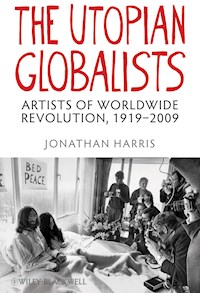



















Table of Contents
Cover
Title Page
About the Author
Introduction: “Global,” “Contemporary,” “Art,” “World”
Entering the Maze
Modernity, Contemporary Art and Globalization
Five Asian Centers within the Global Contemporary Art World
Global Crash, Crises and the Art World
Contemporary Art in the Friezer
1 Doing the Business
Hong Kong Gets the Art Basel Treatment
Offshore Art Business in the Global Neoliberal Capitalist Economy
Combined and Uneven Development in the Hong Kong Art World
Hong Kong’s Art World Inside and Outside China
2 New Media Art and Cultural Globalism in South Korea
The Chic of Global “New Media Art”
Contemporary Art as Global Cultural Diplomacy
“Glocal Video”: Conventions and Critiques
Culture, Contemporaneity and the Postcolonial Artwork
The “Real DMZ Project”: Conflict Art in the Korean Peninsula
Contemporary Art Across Global Asia
3 Globalizing Indian Contemporary Art
The Kochi Biennale Big Sell
Kochi as a Global Venue
Art at Kochi: Liberal Pluralism Versus Social Engagement with Globalization?
The Highs and Lows of Art, Media and Kochi Biennale Capital
Utopian Rhetoric in Contemporary Art at the Kochi Biennale
4 Social Reproduction of Contemporary Art in the People’s Republic of China
Art and Design Education as a Globalization Process
Changing Identifications in Art and Design Education in China
Contemporary Chinese Art Marketed for Global Consumption
Chinese Art and the World Art System
5 Contemporary Art and Post‐National Identities in the State of Palestine
“Palestine is Open for Business”!
Grounding the Culture Industry in Palestine
Palestinian Museums‐of‐art‐in‐waiting
The “NGO‐ization” of the Contemporary Art World in the State of Palestine
Concrete into Dust
Conclusion: Motifs of Global Fracture in the Art Of Bashir Makhoul and Wang Guofeng
Re‐Entering the Maze
In Girum Imus Nocte et Consumimur Igni
Utopian Photo‐Mythologies
Aesthetic and Social Implications of Digital Photography
The One and the Multitude in the World Order/Disorder
Selected Bibliography
Index
End User License Agreement
List of Illustrations
Chapter 01
Figure 3 BMW art car:
Jeff Koons BMW M3 GT2 2010
(BMW car, painted in style of Jeff Koons, 2010).
Figure 4 Sun Yuan and Peng Yu
Hong Kong Intervention
Figure 5 Ellen Pau
Recycling Cinema
(still from video, 1999).
Chapter 02
Figure 6 Tamura Yuichiro
Nightless (ver.5)
(still from video, 2010).
Figure 7 Jewyo Rhii
Night Studio
(mixed media installation, 2013).
Chapter 03
Figure 8 Vivan Sundaram
Black Gold
(mixed media, installation, 2012).
Figure 9 Nalini Malani
In Search of Vanished Blood
(mixed media installation, 2012).
Chapter 04
Figure 10 Wang Guofeng
North Korea 2012 no. 2
(DVD video still, 2012).
Figure 11 Zhang Xiaogang
Bloodlines: Three Comrades
(oil painting, 1994).
Chapter 06
Figure 12 Wang Guofeng
Number 3 (close‐up) North Korea 2012
(still from video, 2012).
Figure 13 Wang Guofeng
Number 1, Part 1 North Korea 2012
(still from video, 2012).
Figure 14 Wang Guofeng
Space No.1
(still from video, 2014).
Figure 15 Wang Guofeng
Students of Kim Chaek University of Technology
(still from video, 2014).
Guide
Cover
Table of Contents
Begin Reading
Pages
iii
iv
vii
1
2
3
4
5
6
7
8
9
10
11
12
13
14
15
16
17
18
19
20
21
22
23
24
25
26
27
28
29
30
31
32
33
35
36
37
38
39
40
41
42
43
44
45
46
47
48
49
50
51
52
53
54
55
56
57
58
59
63
64
65
66
67
68
69
70
71
72
73
74
75
76
77
78
79
80
81
82
83
84
85
86
87
88
89
90
91
92
93
95
96
97
98
99
100
101
102
103
104
105
106
107
108
109
110
111
112
113
114
115
116
117
118
119
120
121
122
123
124
125
127
128
129
130
131
132
133
134
135
136
137
138
139
140
141
142
143
144
145
146
147
148
149
150
151
152
153
154
155
156
157
158
159
160
161
162
163
164
165
166
167
168
169
170
171
172
173
174
175
176
177
178
179
180
181
182
183
184
185
186
187
188
189
190
191
192
193
194
195
196
197
198
199
201
217
218
219
220
221
222
223
224
225
226
227
228
229
230
231
232
The Global Contemporary Art World
Jonathan Harris
Birmingham City University
This edition first published 2017© 2017 John Wiley & Sons, Inc.
All rights reserved. No part of this publication may be reproduced, stored in a retrieval system, or transmitted, in any form or by any means, electronic, mechanical, photocopying, recording or otherwise, except as permitted by law. Advice on how to obtain permission to reuse material from this title is available at http://www.wiley.com/go/permissions.
The right of Jonathan Harris to be identified as the author of this work has been asserted in accordance with law.
Registered Office(s)John Wiley & Sons, Inc., 111 River Street, Hoboken, NJ 07030, USA
Editorial Office9600 Garsington Road, Oxford, OX4 2DQ, UK
For details of our global editorial offices, customer services, and more information about Wiley products visit us at www.wiley.com.
Wiley also publishes its books in a variety of electronic formats and by print‐on‐demand. Some content that appears in standard print versions of this book may not be available in other formats.
Limit of Liability/Disclaimer of WarrantyWhile the publisher and authors have used their best efforts in preparing this work, they make no representations or warranties with respect to the accuracy or completeness of the contents of this work and specifically disclaim all warranties, including without limitation any implied warranties of merchantability or fitness for a particular purpose. No warranty may be created or extended by sales representatives, written sales materials or promotional statements for this work. The fact that an organization, website, or product is referred to in this work as a citation and/or potential source of further information does not mean that the publisher and authors endorse the information or services the organization, website, or product may provide or recommendations it may make. This work is sold with the understanding that the publisher is not engaged in rendering professional services. The advice and strategies contained herein may not be suitable for your situation. You should consult with a specialist where appropriate. Further, readers should be aware that websites listed in this work may have changed or disappeared between when this work was written and when it is read. Neither the publisher nor authors shall be liable for any loss of profit or any other commercial damages, including but not limited to special, incidental, consequential, or other damages.
Library of Congress Cataloging‐in‐Publication Data
Name: Harris, Jonathan (Jonathan P.), author.Title: The global contemporary art world / Jonathan Harris, Birmingham City University.Description: First edition. | Hoboken: Wiley, 2017. | Includes bibliographical references and index. |Identifiers: LCCN 2017013717 (print) | LCCN 2017016069 (ebook) | ISBN 9781118339091 (pdf) | ISBN 9781118339084 (epub) | ISBN 9781118288917 (cloth) | ISBN 9781118338513 (pbk.)Subjects: LCSH: Art–Economic aspects–Asia–21st century. | Art and society–Asia–History–21st century.Classification: LCC N8600 (ebook) | LCC N8600 .H376 2017 (print) | DDC 701/.03–dc23LC record available at https://lccn.loc.gov/2017013717
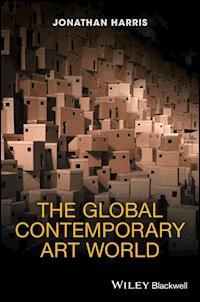
Cover Design: WileyCover Image: Bashir Makhoul: Enter Ghost, Exit Ghost (detail; cardboard boxes, as part of installation, Yang Gallery, Beijing, 2011–12)
About the Author
Jonathan Harris is Head of Birmingham School of Art at Birmingham City University, UK. He is the author and editor of twenty books on modern and contemporary art, including The New Art History: A Critical Introduction (2001), Globalization and Contemporary Art (Wiley‐Blackwell 2011) and The Utopian Globalists: Artists of Worldwide Revolution, 2013 (Wiley‐Blackwell). He has taught and lectured in universities, museums and galleries throughout the world for more than thirty years.
Introduction: “Global,” “Contemporary,” “Art,” “World”
Entering the Maze
The photograph on this book’s cover illustrates an artwork made by Bashir Makhoul, a Palestinian artist based in England, exhibited at the Yang Gallery in Beijing’s “798” art district in the People’s Republic of China in 2012. One of the two parts of this installation work called Enter Ghost, Exit Ghost was made from large‐scale lenticular photographic panels showing images of “old” and “new” Jerusalem joined together into a maze‐like structure of paths erected in the gallery’s converted factory space. Lenticular images, when seen from different angles, project alternative views apparently simultaneously present on a single surface. (This illusionistic device has been used in postcard design since the late nineteenth century.) “Lenticular” means both “shaped like a lentil” and “of the lens of the eye.” In this manner, a structure of 2.4‐meter‐high photographic “walls” depicting Jerusalem during and after British Mandate rule (subsequently occupied by Israel since 1967) confronted viewers as they made their way through the maze. The second part of the work consisted of a cardboard box “city,” built up almost to the ceiling of the gallery.
Figure 1 Bashir Makhoul Enter Ghost, Exit Ghost (2012, mixed media installation; detail).
Source: © Bashir Makhoul.
Enter Ghost, Exit Ghost, covering a floor space of more than 400 square meters, invited visitors to find and follow the right path through the maze to what looked like a makeshift model of a refugee camp. This was of the kind that millions have had to live in since the creation of the State of Israel in 1948, following what its protagonists called the “War of Independence” that forcibly displaced the Palestinian population and whose calamitous implications for local, regional and world history continue down to the present day.1
It would be hard to find a more appropriate example of an artwork that encapsulates my motivations and objectives in writing this book—the interconnected primary questions and concerns of which require that equal stress is placed on all the nouns and adjectives in its title: The Global Contemporary Art World. The last two decades have seen an extraordinary rise in the public visibility of contemporary art and of what have come to be recognized as its characteristic forms, museum buildings and producers. These first two categories remain relatively straightforward to exemplify. The installation form—instanced here by Enter Ghost, Exit Ghost—is typically made from combined or “mixed materials” and constructed on a site either inside an already existing building (though this is by no means always an art gallery) or outside, in a wide range of settings. The Yang Gallery, which opened in 2010, is an example of a recent contemporary art exhibition space hewn from a derelict industrial building. This renovation trend developed in the 1990s and so far has been most spectacularly embodied in Tate Modern, which opened in London in 2000.2
The category of producer, however, presents more complexity. The figure of the artist, understood either as the actual lone physical maker or at least director of a work’s fabrication, certainly remains at the apex of the art world. Both the ideal of the artist and actual artists are essential to contemporary narratives of art’s authenticity and quality, as well as to calculations of its financial value. Think here, for example, of the global status of Jeff Koons and Damien Hirst. But other kinds of producers in the art world have risen to almost equal public significance in the last two decades. For instance, in 2014 it was Sir Nicholas Serota, Director of the Tate galleries in London—not an artist—who was named the most influential player in the global contemporary art world by US‐based Art Review magazine in its annual “Power 100 List.”3 Serota’s greatest achievement was the opening of Tate Modern in a converted electricity power station on the south bank of the Thames in Southwark. The gallery’s cavernous “Turbine Hall” space then became the venue for the annual creation of spectacular large‐scale installation works co‐conceived and commissioned by Tate and supported financially by the multinational Unilever Corporation.4
In addition, then, to the indispensable agency of artists, the vitality and expansion of the contemporary art world has come to depend upon such productive and creative intervention by influential museum and gallery directors. These “facilitating agents” are also sometimes high‐profile collectors of contemporary art, although they do not themselves necessarily own the works they purchase or the institutional spaces in which they exhibit them. This is true of others, however, such as the former advertising tycoon Charles Saatchi, who was able to use his own considerable financial wealth to buy artworks to show in his own gallery in central London. Serota, in contrast, has bought artworks with Tate’s public money for its public art collections maintained by, and on behalf of, the British nation. However, a fundamental blurring of such distinctions between the spheres of state (meaning “publicly owned”) and private (meaning commercial but also sometimes “non‐profit”) has emphatically shaped the development of the global contemporary art world and visual arts funding—along with all other kinds of “public provision”—in Western societies, especially since the 1980s.This was the decade when capitalism in the democratic countries entered its globalizing “neoliberal” era under two of its chief political representatives, President Ronald Reagan in the USA and Prime Minister Margaret Thatcher in the United Kingdom.5
The following chapters illustrate how the global contemporary art world is not separate from this wider world. In fact, its character has been formed through the particular ways—economically, socially, politically—in which the world has become globalized. This “world order” as a whole is steered now through immensely powerful, though shifting, alliances of state and private corporate organizations, forces and resources. “Steered,” I stress, rather than “planned” and “governed.” Our globalized world certainly still includes panoplies of national and international state governance agencies (such as the United Nations and the European Union) based on moral objectives and legal principles derived, in large part, from formal commitments to the ideals of democracy and human rights. But, especially since the 1990s, the most globally powerful states, acting in concert with large commercial and technology corporations, have increasingly operated transnationally, and sometimes with imperious disregard for the known wishes or interests of their own peoples and in opposition to democratically elected governments around the world.6
This global socioeconomic and political system is one wherein autonomous might, as much if not more than public mandate, now compete in the building and ruination of whole regions, societies, states, markets, cultures and communities. This is true throughout the world, but perhaps most evidently, as the global media shows daily, in the Middle East and Asia. Partly in response to this inveterate developmental turmoil militantly theocratic “proto‐state” Islamic organizations proclaiming their “Jihadism” (Holy War) emerged in these and other regions to challenge the many embattled, corrupt or “failed states” and their Western backers in the new world order. The “War on Terror,” declared by President George W. Bush following the September 11, 2001, bombings, US‐led Western punitive military retaliation in Afghanistan in 2002, and the invasion and occupation of Iraq in 2003–2004 are the most salient recent events in this history. A full explanation, however, of these disasters constituting our own era—one as much, surely, of global disorder as order—requires analysis tracked back at least to the mid‐twentieth century Cold War between the US and Soviet superpowers, a confrontation played out over a half‐century in violent regional conflicts around the world.7
If our global world order/disorder does constitute a “system”—that is, a functioning totality that is organizing and productive, though manifestly also chaotic and destructive, as the 2008 Global Financial Crisis demonstrated—then the contemporary art world comprises a part of this wider world. This is my central contention and I set out to demonstrate here the contemporary art world’s own systemic yet volatile character, understood as a sector of the globalized world as a whole. But this global art world also has its own distinct and relatively autonomous connecting parts, functions, agents and products. Each chapter here will examine some of these elements and their interrelations. These include, as I’ve noted, its typical art forms and exhibiting institutions, along with a wider cast of significant “producers” besides its artists—agents who, individually and collectively, are active and necessary to the art world’s making and remaking.8 The purpose of my book is to elucidate through a series of complementary case studies what I shall argue are the key facets in the working of the global contemporary art world.
Focus in these case studies will be on five Asian centers, three of which are nation‐states. I shall explain why and how in the next few pages. But it is their imbrication and significance within a globalized system as part of the global contemporary art world that concerns me. The rise of Asia economically, within neoliberal global capitalism, has certainly been a condition of the emergence of these centers as places where contemporary art, and local contemporary art worlds, have flourished. But definitions of Asia are complex and contested, and the specificities of these five locations—whatever features they may have in common—must be recognized. The chapters concern territories in the region of “greater Asia”: Hong Kong, South Korea, India, the People’s Republic of China (PRC) and the State of Palestine.9 These places, vastly different from each other in many ways but with a shared postcolonial past, have all become incorporated quite rapidly and recently—in differing ways and to differing degrees—into the global contemporary art world dominated by Western (predominantly Western European and North American) institutions, networks and discourses historically created for art’s production, sale, collection, curation, exhibition and validation.
The intertwined concepts of “contemporary” and “contemporary art” are particularly significant within this account. They will feature in terms of understanding, firstly, how the global world order/disorder operates now in any and all spheres of human activity, and, secondly, in differentiating art made since the 1990s (usually called “contemporary art”) from the preceding era of modern art within which the key Western art museums and galleries, such as the Museum of Modern Art and the Solomon R. Guggenheim Museum, both in New York, were created.10 It will become clear that the terms “historical art,” “modern art” and “contemporary art” all pull into their orbits of habitual use critically important related senses of local, national, regional and global developments that have helped to shape the present world. It should also be or become obvious that these sets of terms name evaluative and ideologically freighted ideas that are both indispensable to the following analyses and yet in some ways also impede insightful movement beyond the conceptual frameworks of received disciplinary practice in art‐historical and theoretical discourse. In this sense the global art world profoundly challenges existing explanatory paradigms formed in the era of the rise of nation‐states in the late 19th and early 20th centuries.11
The Global Contemporary Art World is the final book in my trilogy exploring the character, history and meaning of art made in the 20th and 21st centuries’ “core” or “developed” Western countries, principally Western Europe and North America, and in the “peripheral” or “emergent” regions of greater Asia, as well as in South America and Africa (sometimes called the “global South”). It is my view that there is no decisive single point—historically, societally or aesthetically—at which “modern art” became or gave way to “contemporary art.” The distinction remains, however factual and firm it may seem, the product and purpose of contrasting perceptions, emphases and interests. Critics and theorists have variously asserted, for example, that contemporary art “began” after 1945, or after 1960, or after 1989, in arguments linking these chosen points of genesis to a wide range of sociocultural conditions, events and historical processes. All these accounts have both strengths and weaknesses.12 The second book in my series, The Utopian Globalists: Artists of Worldwide Revolution, 1919–2009 (2013), traced the development of installation art made in the recent past—since 2000, and therefore “contemporary” according to virtually all definitions—back to the 1917 Russian Revolution and the huge tower that the Bolshevik artist Vladimir Tatlin planned to erect to commemorate it, known as the Monument to the Third International. Though never built, Tatlin’s 1919 scale model in iron and glass became an inspiration for a considerable lineage of artists whose diverse artworks carried Tatlin’s utopian‐Left modernist radicalism down to the present day.
The Utopian Globalists concluded with a discussion of the large installations commissioned for Tate Modern’s Turbine Hall, works paid for in part with funding from the Unilever Corporation. The book closed with a skeptical questioning of the radicalism possible under such corporate‐patronal circumstances—for several of the artists who received these commissions had drawn, directly or indirectly, on Tatlin’s political and aesthetic avant‐garde legacy. The Utopian Globalists offers an historical (or “diachronic”) context for The Global Contemporary Art World. My chief motivation in writing the earlier book had been to provide such an interpretative grounding, robust though certainly to a degree speculative, for those trying to understand the sometimes mystifying forms of contemporary art—part “sculpture,” part “architecture,” as many installations are—made since the 1990s.13 My argument remains that in art and broad sociocultural terms the contemporary, and the contemporary in art, necessarily contains the historical, and that contemporary art itself emerged historically—from and out of the historical process—however profoundly its forms may appear alien to the historical and modern pasts of art, and even to disown or reject them.14
Books are always selective and can only offer partial perspectives. In studies dealing with all aspects of “the global” in contemporary art, acknowledgement of this necessity is particularly required. No single author could “master” this terrain of inquiry, and these two metaphors indicate the geopolitical as well as intellectual stakes in attempting to make sense of culture and social change in an increasingly integrated but increasingly unequal world. The first text in my trilogy recognized this reality by offering a substantial collection of mostly newly commissioned essays on contemporary art written by thirty different authors. Within the main and section introductions to Globalization and Contemporary Art (2011) I set out a theoretical framework based on seven thematic parts through which to make sense of the art world and its products seen as a systemic whole—and to understand it, systematically, through a series of interlinked concepts and analytic modes. Though various narratives and theoretical positions are traceable across the essays in the anthology, including the one I presented in the book’s introductory discussions, the totality was heterogeneous and even at times contradictory. Most of these essays dealt with art and the art world created since the 1990s. The critical framework they comprised, in contrast with The Utopian Globalists, was largely “synchronic”—that is, a kind of analytic slice through the recent contemporary art world looked at from different though interrelated perspectives.15 The chief focus was on artists, art forms and organizations outside of the Western countries, but understood in relation to the control or influence of Western global “gatekeeper” art institutions. By this term I mean the main art auction companies (i.e., Sotheby’s and Christie’s), leading art fair businesses (e.g., Art Basel and Frieze) and powerful museums and galleries (e.g., the Tate, the Museum of Modern Art in New York, the Guggenheim Museum, White Cube, Gagosian, etc.).
Globalization and Contemporary Art also offered some sets of essays on “regional” or “area” themes. These included contemporary artworks made by indigenous peoples in Australia, new formations of artists and publics in Latin America and the development of art movements and styles in Japan and China. The anthology demonstrated that, if there is a global contemporary art world and that if this constitutes a system, then it centrally pivots around the fundamentally asymmetrical (unequal) though dynamic relationship between the “core” Western nation‐states—still in the most potent ways the effective owners of modern and historical Art, a Western concept and practice that emerged during the Enlightenment—and all the other, “peripheral,” parts of the world. This contemporary art world, part of the world order/disorder, is the product of a historical process inseparably bound up with the Western imperial and colonial system that dominated most of the world until the end of the Second World War in 1945, when the concluding phases of formal decolonization began.16
Globalization and Contemporary Art’s synchronic, theoretical framework comprised complementary analyses based on a series of interconnected concepts. These were: institutions, formations, means and forces of production, identifications, forms, reproduction and organization. While it is not the purpose of The Global Contemporary Art World to regurgitate the detail of either of the two earlier studies, it does draw on materials and ideas from both. It is already clear, for example, that examinations of “forms” and “institutions” will feature strongly here, and therefore that these two sections of related essays in Globalization and Contemporary Art await the reader wishing to find out more. (Its “formations” section also includes related discussion of collective production in contemporary art, an idea closely related to the complexities of the term “producer” introduced earlier.)
The resources of intellectual and political radicalism that I drew on in these earlier texts—those based on the writings and activisms of, for instance, Raymond Williams, Edward Said, Tariq Ali, David Harvey and Mike Davis—continue to provide inspiration for this book. If the most compelling studies in global contemporary art and culture do have strong if complex genealogical connections to the Marxist, feminist and “Third World” art‐historical and art‐theoretical writings from the 1960s, 1970s and 1980s, then it is one based on recognition of the ever more pressing mutual necessity for critical understanding and progressive societal transformation on a global scale.17 The following sections in this Introduction set out further explanation of the aims, structure, content and context of this continuing project as I have pursued it through the case‐studies that constitute The Global Contemporary Art World.
Modernity, Contemporary Art and Globalization
All the following chapters explore different facets of the character of contemporary visual art. However, as the title of the book emphasizes, it situates these analyses within a broader account of the systemic cultural forms, materials, practices, networks and contexts (economic, social, political and ideological) within which this art has been made and as a component of which it is meaningful. While “contemporary art” understood as a descriptive category of modes and products now includes much that would not have been recognized as visual art at all before the 1960s—for example, those classes of objects and events deemed “performance” and “conceptual” works—its relations to architecture, graphic and environmental design; to folk, popular and mass culture; and to advertising and digital culture have become ever more integral to the circuits of its production, dissemination and consumption.
This is true in both simple and complex ways, as my case studies show. The empirically heterogeneous category of contemporary art now includes, for example, a DVD video—such as Sun Yuan and Peng Yu’s 2010 I Do Not Sleep Tonight, exhibited at the Hayward Gallery, London in “Art of Change: New Directions from China” (2012); an installation temporarily erected at the Reichstag Parliament building in Berlin—Christo’s and Jeanne‐Claude’s Wrapped Reichstag (1971–1995)—and a graffiti drawing by Banksy of a donkey and an Israeli soldier stenciled onto the “Separation Wall” erected near Ramallah in Palestinian territory across the border from the State of Israel. Contemporary art, it seems, can literally be, as one recent commentator suggests, anything, anywhere.18
Figure 2 Banksy Graffitti image of donkey and Israeli soldier on Separation Wall near Ramallah, Palestine (2012).
Source: © epa european pressphoto agency b.v./Alamy Stock Photo.
But in this book artworks have not been singled out as the primary, most significant objects of study against which everything else within the global contemporary art world is to be set as mere “background” or “context.” My contention is that the contemporary art world—understood as a subsection of the globalized world order/disorder—is a system of interrelated and interdependent objects, producers, groups, networks, organizations and socioeconomic relationships, materials and means of production and reproduction, legal, critical and advertising discourses (and much else besides). This system as a whole is my object of study however much I may focus in on specific bits of it in these chapters. Further, the broader globalized world will remain as much my object of explanatory concern as the contemporary art world nesting within it. This perspective and objective certainly raises important questions, problems and dilemmas. Surely, for instance, one might reasonably ask, doesn’t the extraordinary rise in the financial value of contemporary artworks since 2000 (especially those from Asia) indicate that these objects do actually have an overriding importance? Or, in another direction, one might plausibly argue that a focus on the contemporary art world in Asia necessarily implies that the globalized world around it must recede into at least an analytic “background,” in the way that a photograph presents layers of more or less visible and highlighted detail depending on where the camera has been pointed?
While the latter may turn out to be at least partially true in terms of the sense these chapters actually make, the reader should nevertheless recognize that the foreground/background distinction remains an analytic effect generated within the process of written composition. With an effort, the reader should be able to shift focus back and forth without necessarily affirming or conceding the primacy, of any particular layer of detail within the overall interpretative “image” that my text creates. (Readers, of course, may also choose to keep their own pre‐established priorities.) It is also worth stating that this book is in no way offered as a “survey,” though it presents what is at least the outline of a comprehensive systemic analysis. The comparatively tiny number of artworks discussed or referred to here are, inevitably, made to bear the burden of a range of explanatory tasks—including that of representing, or typifying, an idea of “global art” and the global contemporary art world system. But their significance as such is heuristic. I am “trying out” how they might be interpreted within the logic of the account as a whole. Other, very different accounts of the same artworks are possible, and defensible in other terms. This dilemma, partly one of the relations between quantitative and qualitative analyses in cultural studies, has plagued the discipline of art history since its origins, and recurs frequently in the chapters ahead.19
Another objection might be that the deeper intellectual problems actually lie with the innocuous‐looking prepositions, such as “in” and “from,” that often characterize discussion of global contemporary art (in phrases such as “contemporary art from Africa,” a usage discussed later in this Introduction). I discarded an earlier title for this book because it seemed to me implicitly to prejudge the analysis: that wording was “Contemporary Art in a Globalized World.” There are two sets of significant and still open questions raised by this formulation. Firstly, is, or in what ways is, contemporary art formed and meaningful before it is brought into contact with the public world of sales, exhibition and critical review? Secondly, is the globalized world itself to be conceived as formatively without contemporary art in some basic ways—to which it is then added, like sugar or salt?
Many different responses attend the negotiation of these important—though perhaps in some ways ineffable—questions in the chapters that follow here. My considered view, however, is that in the same way that we still do need to say, for example, that an artist is “from” Hong Kong or India, the prepositional formulation “in a” performs a necessary holding operation. That is, the lower‐case “in a” links but also separates all the heavy‐lifting capitalized nouns—“Contemporary Art”/“Globalized World.” It facilitates recognition of both the difference between and interrelation of its two balancing sides. The chapters here are based on empirical studies where analytic focuses highlight, respectively, the role of art fairs (Hong Kong), new technologies (South Korea), biennials (India), visual arts higher education (PRC) and neoliberal sociopolitical intervention (Palestine). Each chapter, however, is also concerned with many other elements to do with the specific way that contemporary art, and the contemporary art world, has developed in that place, within and as part of the globalized world order/disorder as a whole. This order/disorder is—as that schismatic slash is intended to indicate—systemic, dynamic and disruptively volatile: the order/disorder is global (globalized) and globalizing still to ends we do not and may not fully understand.20
It has become commonplace for commentators to claim, for example, that installation and video works in particular are inherently and typically the globalized media of contemporary art. This is because, as innovative modes, they have ostensibly become available for appropriation and transformation equally by anyone from anywhere, compared, say, to the culturally loaded use of traditional “Western” art media such as oil painting or sculpting in bronze.21 Part of this argument is based on the relative historical recentness—the “newness”—of both installation and video. (I’ll come to the issue of irritating scare quotes in a while.) These were modes effectively created in the 1960s and only subsequently, and quite slowly, critically validated by museums and related institutional–critical discourse in the 1970s and since. Though I have some sympathy with this view, which is usually articulated as part of an affirmation of these practices, the grounds often given for it raise a set of troubling questions.
These concern the broader and persisting problem of sociocultural modernity, which exists at once as an objective, factual matter and as a subjective idea and ideal. It is bound up with definitions of modern and what is modern in art and culture, to processes of “modernization,” and hence is a key to debate over the claimed transition from modern art to contemporary art, and from modern to contemporary societies. These now very longstanding arguments over the shift have been couched partly and necessarily in discussion of proposed world‐historical transition moments and processes. They centrally include, to reiterate: “after 1945,” meaning decolonization in greater Asia and Africa; “the 1960s,” meaning the rise of the New Left, Anti‐Stalinism, Third World movements, Environmentalism; and “after 1989”/”1991,” meaning the reunification of Germany, the end of the Soviet Union and supposed triumph of global capitalism. But the combined factual and value‐laden (ideological) uses of the terms “modern” and “modernity” pose particularly pressing and contentious issues for cultural analysis in our era of globalization. Given the power and predominance of the modernizing economies, societies and globally colonizing states of Europe and the United States—on both side of the Cold War—in the twentieth century, did all peoples, societies and cultures in the world really manage to become equally modern and then, since the 1990s, equally contemporary? This was a critical question in 1945, during the 1960s, in 1991, and still is in 2016. The answer remains “No.”
The recent era of globalization in economic and financial terms has been driven by industries, corporations, state institutions, international networks, agreements and protocols established by US and Western European states mostly since the Second World War. These primarily included the creation of the Bank of International Settlements (founded 1919), the World Bank (1944), the International Monetary Fund (1945), the European Economic Community and European Union (1958, 1993), the North American Free Trade Association (1994), and the World Trade Organization (1995). But the rise of south Asian and East Asian economies since the 1980s has brought into question assumptions of the continuing dominance of Western power within globalization, especially as the PRC’s economy grew to become the second biggest in the world by 2009 and its robustness seems to be a necessary condition for continuing global economic stability.22
In the contemporary art world, however, although the volume and value of sales of Asian art rocketed after 2000, the historically dominant institutions profiting from these markets remained Western, based in New York and London. Hong Kong has now become the third most important art‐trading city—although the US/UK auctioneers Sotheby’s and Christie’s compete to run most of the high‐value auction sales there, both having decided to use the territory to centralize their entire Asian operations. In 2012 MCH, the company that owns Art Basel, the most successful art fair business in the world, based in Switzerland (established in 1970), purchased a majority of shares in the ownership of the Hong Kong Art Fair and rebranded the annual event from 2013 as Art Basel Hong Kong. This was another sign, then, of the growing global significance of the contemporary art world in the PRC and Asia broadly.23
Sociocultural modernity and contemporaneity—the state of “being contemporary”—are centrally implicated in the development of the global contemporary art world. This process was driven in the 2000s by a lucrative and rapidly expanding world market dominated by Western auction houses and commercial galleries—whether the sales actually take place, as they have done and do, in New York, London, Hong Kong and other Asian centers. Given this predominance and the interrelated ability of powerful Western museums to validate contemporary art through purchase and exhibition of works by its global producers—many “from Asia,” if not resident there—it remains the case that the global contemporary art world is fundamentally asymmetrical in its power relations.
This situation might be posed polemically in terms of the grip that Western interests continue to have over the economic exploitation of contemporary art produced in Asia and all other parts of the decolonized or postcolonial world. It might be dramatized in a statement such as “global contemporary art is essentially a Western construct,” even if it is true that installation and video art modes have fundamentally superseded use of traditional Western media and materials. The latter remain bound up with philosophical definitions of Art elaborated in Europe in the Enlightenment and since: the epoch and episteme of Western modernity. From this perspective the global contemporary art world is a system that is being played and a game whose top players use some distinctly loaded dice.24
Amongst these players are its commentators. These include critics and theorists, who often work in universities and write for a wide range of magazines, journals and newspapers. Related to the complexities of “collective production” in the global contemporary art world is the development that some players may now occupy several roles both consecutively and simultaneously. An artist will curate their own and other artists’ shows; a critic will take up a curating role in a gallery or museum; directors and curators of contemporary art biennials (which have hugely expanded in number since the 1980s) write essays and books that may both justify and auto‐critique their day job of selecting works and artists for these exhibitions. Hans Ulrich Obrist, for instance, has been hovering around the top of the list of polymath game‐players for several years and was named sixth most influential art world figure in the 2014 Art Review Power List, though he was down five places from 2013. Some of these role combinations, of course, occurred in decades well before the 1990s. The French artist Gustave Courbet curated an exhibition of his own paintings in Paris in 1855!25 (I will use “after 1989” as shorthand for my own practical sense of when contemporary art “began,” or at least moved up a few gears.) All serious players, however, performing as many roles as they do or can, decide to declare or conceal their interests that are economic as much as anything else. They certainly “do it for the money,” that is, but not only for that reason.
I work as an art historian in an art school that is part of a British university. As well as writing books and essays—on modernist art for twenty years and more recently on art made after 2000—I publish reviews and essays on artists and exhibitions I‘ve seen or sometimes with which I have had some personal or professional involvement. In 2011 I helped to establish a university research center concerned with global contemporary art and culture. I was lucky enough to begin to travel to some of the “signature” events in the contemporary art world calendar—especially those in Asian countries and in one case where my university at the time had set up a campus, with a partner institution in the PRC. The chapters in this book in one sense constitute an embellished, reflective record of my visits to cities hosting contemporary art events of varying kinds. These included fairs, biennials, conferences, museum development meetings, inaugural exhibitions and “private views,” parties and other “VIP” events. Though getting to these events often involved fairly uncomfortable long‐haul flights because, in the main I wasn’t able to travel as a VIP, I know that I’ve been very lucky to experience something of the texture and social life of the global contemporary art world. I can confirm that some of it is glamorous (though some aspects are squalid) and that this occasional immersion alters the way one sees and understands it.
I had thought to add a subtitle to the book: A Rough Guide. This term would have indicated several significant factors marking its conception, production and organization. The book has a picaresque dimension. As I’ve just noted, its choice of case studies is partly based on some of my trips involving fairly short if intense visits to the contemporary art world happening around me, performing itself, as it were. This world is urban, metropolitan and cosmopolitan, though these terms can mean quite different things in the diverse centers and regions I focus on.26 Though I believe the selection and sequence of case studies is coherent intellectually, it certainly also reflects the contingencies of my life as an institutionalized academic over the last seven years. The book’s first chapter investigates Hong Kong, where I attended the first “Art Basel Hong Kong” art fair in May 2013 and gave a lecture at one of the fair’s “collateral events.” The second chapter turns to Seoul, South Korea, where I took part in a conference on new media in contemporary art in November 2013 and attended various exhibitions. The third focuses on Kochi in southern India, when I visited the opening of the first biennial of contemporary art held there in December 2012. The fourth chapter concerns contemporary art and visual arts higher education in the PRC. It relates to numerous visits I’ve made to Beijing, Shanghai, and Dalian, where I worked for several years with one of the local universities on an art and design project. The final chapter concerns Palestine (and inevitably its relations with Israel), where I have taken part in conferences and seminars, in Jerusalem, Ramallah and Tel Aviv, Israel, over a longer period of years.
A Rough Guide would, however, also have signaled something about the style of argument and conclusions of my book.It contains occasional reference to these visits and my experience of and reactions to these places. All travel guide series to a degree reflect the globalization process as it developed in the last third of the twentieth century. This was when cheaper international, relatively “non‐packaged,” excursions became available to millions—though again differentially and unequally, as foreign holidays and travel came to form one of the linchpins of the “postindustrial” or “postmodern” Western states’ economies. But these guides themselves helped to produce a kind of globalization and a kind of globalism (by which I mean a theory or ideal of global development) in their style and practicality.27 These guides often identified and recommended cheap, or cheaper, places to stay, less known locations and aimed to give tourists the confidence and knowledge to perceive the world to be a set of expanding, reachable, livable and affordable destinations. I acknowledge, then, that I am a part of the global contemporary art world, whatever my criticisms of it may be. This has been true both when I’ve travelled to the art world’s locations and events in Asia and elsewhere, but also when I’ve sat at home writing about it. Subjective experience, while travelling always limited and often rooted in ignorance and bafflement, is not to be posed against a theoretical knowledge of the contemporary art world. The two forms of response and understanding interpenetrate, inform and complement each other.
Travelling also remains a matter of actual, physical borders. Though “border” can be a capacious metaphor—one that I exploit a good deal in these chapters—I am concerned to point out here the material borders dividing states, territories and peoples. Globalization processes have not, in the main, eroded the attempted maintenance (or principle) of national borders and have, if anything, helped lead to their reinforcement. Consider, for example, European Union attempts in 2014, later abandoned and then reinstated in 2016, to prevent refugees sailing from North Africa and the Middle East to Italy and Greece; or the decision taken by the British government, following the dramatic referendum result in June 2016, to take the United Kingdom out of the European Union. Globalization and “internationalization” have thus occurred concurrently, if also asymmetrically, for decades.28
The former process has become dominant in economic and industrial terms, but the latter is entrenched in legal and sociopolitical spheres, especially in response to the threat of terrorism. Nevertheless, conglomerates of states such as the European Union and the conventions that now underpin the global capitalist economy have steadily worked to remove or erode individual states’ abilities to control capital transfer and domestic industrial assets, contract tendering, immigration and imports.29 Globalization in this way has certainly “opened up” Asian economies, cultures and their artists to influence from other nations and regions. Many of these have travelled to the “core” North American and Western European countries as part of their higher education, in order to produce and exhibit work and to experience the freedoms and opportunities that helped produce Western modern and contemporary art. But these postcolonial societies, holding components of the “peripheral” global contemporary art world, remain in significant part the historical and cultural products of the actual borders and regimes imposed by the Western imperial, colonial and Cold War powers of the last century.
Five Asian Centers within the Global Contemporary Art World
Every chapter here is, amongst other things, a sketch of such an historic border zone. Hong Kong, defined by the Chinese Communist Party government as a “special administrative region” (SAR), had been, since the mid‐nineteenth century, a British economic and military colony. It is now “relatively autonomous” from, though a part of, the PRC, a nation‐state that became finally independent of multiple colonizers—Asian and European—in 1949 with the victory of Mao Zedong’s communists. Looming within all the case studies is the active contemporary legacy of the dichotomous territorial system erected by the two chief protagonist states of the Cold War after the Second World War. This “iron curtain” divided Europe, but also most regions in Asia, the Middle East and Africa in the names of either Soviet communism or US‐Western European capitalist democracy.
But the Cold War actually created another kind of totality. This was effectively a global system based on the volatile but symbiotic interdependence of two spheres of influence driven by ideological and territorial dispute that, over a 45‐year period, sought to contest the interests of all those other peoples and territories that tried to avoid cooption into either bloc. The Asia‐based Non‐Aligned Movement, begun in Bandung, Indonesia in the mid‐1950s was one such attempt, though it was of course not free of power struggles amongst its participating states.30 My own view is that Western capitalist democracy is as tainted now as Soviet communism became in popular consciousness. Global neoliberalism’s “victory” in 1991, with the end of the USSR, rapidly became a hollow one in the face of serial systemic economic crises and mounting “legitimation entropy” as ostensibly democratic political systems perceived to offer little real differences between parties became widely discredited across the whole world.
Hong Kong’s SAR—a key node in financial capitalism’s global network—is about 2,000 kilometers southwest of South Korea (the Republic of Korea). My second chapter touches, inevitably, on facets of South Korea’s connection to and dislocation from North Korea (the Democratic People’s Republic of Korea), after the peninsula was divided in an armistice agreement in 1953. The still‐temporary ceasefire in this civil war begun in 1950 brought the suspension, but not the termination, of the early Cold War’s hot “Korean War.” This was fought directly by opposing US‐led Western and Chinese military forces in a conflict estimated to have resulted in 2.8 million military and civilian deaths. Is contemporary art made in South Korea or that made by artists displaced from the two territories throughout the world inevitably to be marked by this trauma of division and unresolved conflict? Visiting North Korea wasn’t possible for me. But “cultural diplomacy” of a kind has been practiced by the two states over the last few decades, its feasibility, character and significance dependent on the wildly oscillating intensities of the dispute. Beyond South Korea, the role of foreign diplomacy, trade missions and NGO (Non‐Governmental Organization) aid activity across the global contemporary world, and in its Asian art worlds, will become evident in the chapters that follow.
Might North Korea’s monumental public art and its vast set‐piece media spectacles of mass adoration for the Leader constitute an authentic variant of contemporary art? The question might seem impertinent or outrageous but it raises some important issues. For instance: what (if any) might be the unacknowledged but necessary sociopolitical and even moral–ideological conditions for the emergence of a regional center in the global contemporary art world? It may well be that North Korea clearly fails to meet these conditions—if they exist at all. After all, the Democratic People’s Republic has been subject and has subjected itself to a highly restricted version of globalization, denuded of contact with most other nation‐states, peoples and cultures, though it maintains a complex relationship with its chief remaining “communist” ally to the north, the PRC, as well as with Russia and a few other countries. A broader question raised by this chapter concerns a highly significant issue for the book as a whole. Is all of Asia’s contemporary art equally globalized, equally contemporary, equally marked by the asymmetrical “core–periphery” relations of dominant Western sociocultural power and emerging Asia’s late entry into modernity and contemporaneity?31
The first Kochi–Muziris Biennale, held in 2012–2013 in Kerala state in southern India, comprises my third chapter’s case study. I attended its official opening, some symposia events and visited its venues, located in the industrial, social and cultural buildings and spaces of a city—formerly known as Cochin—that had been colonized several times over, most recently by the Dutch and then the British. I offer a critical reading of the Biennale organizers claims for their exhibition, its varying contexts, meanings and significance for contemporary Indian art. Two Indian (Kerala state‐born) artists, not curators, were responsible for developing and articulating the Biennale’s “vision.” The show was not intended simply to replicate the sundry recurrent exhibitions put on by jet‐setting elite curators following the well‐established “multicultural diversity” template deployed in many other cities of the world.32 The Kochi Biennale is another example of artist‐become‐curator “collective production” in the global contemporary art world, although there was also the familiar concerted mix of public and private corporate involvement (“investment”) in the event.
I also provide a broader analytic framework for making sense of this biennial, considering works made by artists from across another nearby border, in Pakistan. This is a state and territory sharing with India what were crudely drawn and violently contested borders created in 1947 by the British colonizers, at great human cost, as they prepared to evacuate the subcontinent. Pakistan, with its originally west and east regions divided by Indian territory, proved unsustainable and a third state, Bangladesh, was created, following more extreme violence, war and suffering, in 1971. Some of these artists (born in places that at the time were part of British India) were invited to participate in the Kochi Biennale. I consider the organizers’ ambitious claims for the significance of the event and the wider development of contemporary art in India through a discussion of the country’s economic, societal and cultural neoliberal modernization over the past two decades. If “rough guide” also suggests a tentative understanding and even perhaps some unreliable information, then this may prove to be an apt description, too, of at least some of the discourse produced by some central players—curators, directors, critics, artists—in the global contemporary art world. Genuine critical analysis and advertising have become more interrelated, blurred, even perhaps interchangeable modes; the ingenuous claims are serious but sometimes sit alongside excitable rhetoric. This inflated currency of terms and spin in the global contemporary art world, in which market relations are both highly determinant and have become fetishized, constitutes a form of multiple, cross‐investment or speculative “hedging of bets”—another way of playing the system.
This accusation, of course, might be turned against my own account. Perhaps the hugely capacious term “Asia” is also just too rough an idea? But it should be clear by now that all the words I have been placing in scare‐quotes should be interrogated carefully, their senses revised and perhaps even eventually abandoned. “Core,” “periphery,” “dominant,” “emergent”—these have been common ideas and presuppositions in contemporary art debate based on “postcolonial” theoretical perspectives developed since the 1970s.33 Is the world actually like this now? In what ways does Tate Modern remain one of the dominant contemporary art institutions? Are artists in Kochi or Seoul aware that they are miserably still only peripheral? These terms, I will argue, however, remain useful; they have some truth content, but also entail inadequacies in many ways.
Part of the inadequacy lies in what may be called their “performative” role. Their continued use may work, that is, to entrench a situation that is actually changing, or could be changed precisely if a different language, a different mode of understanding, were used. But their adequacy remains in them naming a reality that needs to be acknowledged before and as a condition that—along with other conditions—such change can occur at all. So these terms are, in the end, maddeningly both inadequate and yet necessary. Within discourse on Asia, for example, the term “West Asia” has been coined, with good intentions, to replace the manifestly imperialist usages “Near/Middle/Far East.” For this sequence manifestly spelt out the distance from and relations between the metropolitan centers of late‐nineteenth century Empire—that of the British above all—and the colonized territories located on the edge of the eastern Mediterranean Sea and those progressively further to the east.34 “West Asia” tries to shift the meaning from, in one sense, a concluded past (that of European colonialism) but can act as a euphemistic mystification because the power relations of European imperialism and Cold War spheres of influence manifestly still operate powerfully and destructively in this “post‐Cold War” part of the world.
Along with the exploration of the use of all these terms, however, I offer a new set that I have borrowed and fashioned in order to articulate the systemic character of the global contemporary art world. This world, for example, requires what might be called a “resource infrastructure” in order to take root and develop. Central to creating this at once economic, material, institutional and knowledge‐based organizational framework is the production and reproduction of a diversely skilled and professionalized art workforce. At the apex of this labor hierarchy—above curators, directors and critics, though wholly dependent upon them—stand the artists. As I noted earlier, these agents remain potent symbols and embodiments of ideals of creativity and individuality, however much collective agency and production has grown over the last two decades. This system’s maintenance and self‐regulation is one of the chief subjects of my fourth chapter concerned with the PRC’s now highly significant place in the global contemporary art world.
The globalized visual arts higher education system, dominated by Western, English‐speaking universities able to attract thousands of Asian international students to their postgraduate courses, is instrumental in helping to fashion the proto‐identity and “branding” of aspirant artists. A very limited number of these are then able to sell works, whether through dealers, auction houses or at art fairs like Art Basel Hong Kong. A tiny proportion of this elite of economically successful artists may be invited to exhibit at events like the Kochi Biennale and perhaps eventually may have their works bought by institutions such as Tate or the Guggenheim Museum. I suggest that the exhibition catalogues for Beijing’s Tsinghua University graduates in art and design evidence the development of a widening and “westernizing” process of social and cultural individuation taking place in China, within which contemporary art is an important if relatively minor aspect. I also consider the experience of Chinese students enrolled at Dalian Polytechnic University on a joint program run with a British university. They go through a process of “knowledge internationalization” shaped by their English‐language inculcation in Western art and design practices, informed by aspects of its distinctive history and philosophy.
My final chapter is concerned with contemporary art in Palestine, its relations with Israel and the world beyond. To characterize Palestinian lands and people as such is already to court vociferous disagreement over the nameable identity of this place and the character of its legal, political, socioeconomic and cultural existence. But the territory’s “dependent state” status was affirmed by the General Assembly of the United Nations in late 2012. Setting these matters aside here, however, the States of both Palestine and Israel must be considered part of West Asia. Yet the use of that term, rather than “Middle East,” as I have just noted, threatens to obscure the active political realities of a region where Western (first European) imperial power operated directly for two hundred years (c. 1750–1950) to be followed by economic neocolonialism based on US‐led oil extraction businesses, client‐state realpolitik




