


19,99 €
Mehr erfahren.
- Herausgeber: John Wiley & Sons
- Kategorie: Fachliteratur
- Sprache: Englisch
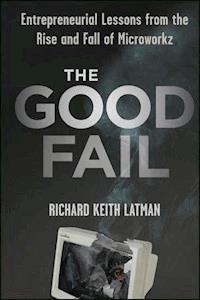
An inside look at how companies and executives rise and fall, with important lessons for all aspiring entrepreneurs The Good Fail is part business story, part guilty pleasure, exploring Richard Keith Latman's very public missteps and the painful lessons he learned as a result, presented to fellow entrepreneurs, in his own words, for the first time. Written in a lively, conversational style, the book answers questions many computer industry veterans have been asking for more than a decade about what went wrong at Microworkz, the failed former free PC enterprise. Chronicling Latman's long roller-coaster journey back and offering pointed advice about effective business development, negotiating, human resource management, and leadership, which Latman has successfully applied at his latest ventures, iMagicLab and Latman Interactive, the book is an important set of insights for entrepreneurs everywhere. * Offers 19 practical lessons learned, which can help put other entrepreneurs on the path to success faster * Includes invaluable insight into how to overcome even the worst public business failures * Provides a behind-the-scenes look from the ultimate insider at an important time in computer industry history * Presents a case study of how personal and business lives can negatively impact each other Microworkz's failure can be your success. The Good Fail provides both important insights into how to start a business that will reap rewards, and warnings about how to avoid going astray.
Sie lesen das E-Book in den Legimi-Apps auf:
Seitenzahl: 232
Veröffentlichungsjahr: 2012
Ähnliche



















Contents
Preface
Introduction
Chapter 1: Against All Odds
Overnight Upheaval
Growing Independence
Feeling Left Out
Crying for Attention
Talking My Way into College
Chapter 2: Out of My League
Overachiever Goes to Jail
A New Career Begins
The Car Business, Round 1
A Business Idea Is Born
Am I Funny?
Pay for Performance
West Coast Bound
My Stint in Publishing
A New Partner
Chapter 3: From Brides to BeOS
A Rocky Start
Bridal Politics
Shifting Focus
Unexpected Demand
From Gowns to Graphical User Interfaces
Chapter 4: Catching the Wave
The Seedier Side of the Business
Microworkz’s Rapid Rise
Twenty-First Century Revenue Sources
Free PCs
The Pull of Being Connected
Tapping into a New Market of Computer Owners
The Start of the Roller Coaster
Pioneer of the Alternative Revenue Stream
Chapter 5: Too Much Too Soon
New Voices in Management
A Personal Life Going Haywire
Chapter 6: The Fall
A Speed Bump
Sourcing from China
A Failed Mutiny
A Mole Discovered
A Different Market
Piling On
Out of the Frying Pan and into the Fire
The Back Story
The Slowdown
A Possible Way Out
Chapter 7: iToaster
Taking Back Control
The Rollout
Electronics Boutique
Grasping at Straws
Chapter 8: Moving On
Starting Over
And Over . . .
And Over . . .
Crying Uncle
Marketing Success
Round Three
Opportunity Walks Through the Front Door
A New Start
Chapter 9: Redemption
My Marketing Methodology
A Turning Point
Shifting Gears
The Certification Conundrum
Haunted by the Past
Personal Struggles
Déjà Coup
Fighting Fire with Fire
Putting Down New Roots
The Future
Epilogue
Appendix
About the Author
Copyright © 2012 by Richard Keith Latman. All rights reserved.
Published by John Wiley & Sons, Inc., Hoboken, New Jersey.
Published simultaneously in Canada.
No part of this publication may be reproduced, stored in a retrieval system, or transmitted in any form or by any means, electronic, mechanical, photocopying, recording, scanning, or otherwise, except as permitted under Section 107 or 108 of the 1976 United States Copyright Act, without either the prior written permission of the Publisher, or authorization through payment of the appropriate per-copy fee to the Copyright Clearance Center, Inc., 222 Rosewood Drive, Danvers, MA 01923, (978) 750-8400, fax (978) 646-8600, or on the Web at www.copyright.com. Requests to the Publisher for permission should be addressed to the Permissions Department, John Wiley & Sons, Inc., 111 River Street, Hoboken, NJ 07030, (201) 748-6011, fax (201) 748-6008, or online at http://www.wiley.com/go/permissions.
Limit of Liability/Disclaimer of Warranty: While the publisher and author have used their best efforts in preparing this book, they make no representations or warranties with respect to the accuracy or completeness of the contents of this book and specifically disclaim any implied warranties of merchantability or fitness for a particular purpose. No warranty may be created or extended by sales representatives or written sales materials. The advice and strategies contained herein may not be suitable for your situation. You should consult with a professional where appropriate. Neither the publisher nor author shall be liable for any loss of profit or any other commercial damages, including but not limited to special, incidental, consequential, or other damages.
For general information on our other products and services or for technical support, please contact our Customer Care Department within the United States at (800) 762-2974, outside the United States at (317) 572-3993 or fax (317) 572-4002.
Wiley also publishes its books in a variety of electronic formats. Some content that appears in print may not be available in electronic books. For more information about Wiley products, visit our web site at www.wiley.com.
Library of Congress Cataloging-in-Publication Data:
Latman, Richard Keith.
The good fail : entrepreneurial lessons from the rise and fall of Microworkz / Richard Keith Latman.
pages cm
ISBN 978-1-118-25071-6 (cloth); ISBN 978-1-118-28327-1 (ebk); ISBN 978-1-118-28444-5 (ebk); ISBN 978-1-118-28640-1 (ebk)
1. Entrepreneurship. 2. Business failures. I. Title.
HB615.L275 2012
658.4’21—dc23
2012003003
I am very blessed, after all I have put my friends and family through, to still have many people who believe in me and have been supportive through the years. This book is dedicated to my mother Lynne who, in good times and bad, when I was right and wrong, has always been there. I love you, Mom.
Preface
During the first 45 years of my life, I started 11 different businesses, contributed to hundreds of others, and stumbled vastly more than I succeeded. Whether it was creating custom bumper stickers for college students, shooting virtual tours of luxury hotels in Hawaii, or reinventing the distribution model for millions of computers, one thing has stayed completely consistent: I was never afraid of failure.
The definition of a Good Fail, as defined by yours truly, is a failure that has a learning value greater than the offset collateral damage. It is a failure that an entrepreneur is unlikely to repeat and one that will positively shape that person’s managerial and business acumen. In short, it’s a lesson from the hard knocks of the high stakes risks inherent in the pursuit of fame and fortune.
Of course, there are many different kinds of failures and, to be sure, they are not all created equal. I specialize, I hope, in intelligent failures—those that happen quickly and inexpensively and that contribute new critical ideas about your customers and/or business plan. These should be more than just grudgingly acceptable; they should be welcomed and embraced. Figuring out how to master this process of failing fast and failing cheaply and stumbling toward success is something companies have to get good at, and it is critically what has helped me avoid an even worse pummeling at the altar of business.
“Getting good” at failure, however, doesn’t mean creating anarchy or chaos out of the company. It means leaders, not just at weekly staff lunches, but also in the trenches, every day, who create an environment safe for taking risks and who share stories of their own mistakes. It means bringing in outsiders unattached to a project’s past. It means carving out time to honestly reflect on failure, not just success.
Perhaps most important, it means designing ways to measure performance that balance accountability with the freedom to make mistakes. People may fear failure, but they fear the consequences of it even more. It’s an unusual executive who can balance the performance culture with the learning culture and avoid deep conflict.
Companies need to remember this is a long-term game and one that is bound to have ups and downs. Downs are failures and ups are successes from the failures: It’s that simple. You really don’t need to hire a consultant to evaluate this because you’ve been doing this longer than you can imagine. Your first step upright as a very small child was preceded by hundreds of failures. I hope that you’re a little better at that ratio by now, but clearly the long-term goals don’t stop just because you trip over your own feet.
Few put it as well as Theodore Roosevelt when he said, “Far better is it to dare mighty things, to win glorious triumphs, even though checkered by failure . . . than to rank with those poor spirits who neither enjoy nor suffer much, because they live in a gray twilight that knows not victory nor defeat.” Perhaps this statement is slightly militaristic, but it aptly gets the point across about what all strong leaders embody. There are those who study, those who lecture, and those who execute what they are put on this earth to do. In my new version of rock-paper-scissors, execution always wins over study and lecture.
I have always viewed my business and personal losses as steps toward my eventual success and, although my road has been a painful one, it was a journey that has made me who I am today. Make no mistake about it; I am deeply embarrassed at some of the decisions I made and saddened by the people who I hurt along the way. With this book I hope that in some measure I can explain my thoughts, teach what is obvious, and mentor to the best of my ability anyone willing to invest the time to read. In truth, I believe failure is a requirement for success. Fortunately, you don’t need to fail as spectacularly as I did.
I have tried to remember all the events factually and, of course, present them in such a way that your experience with the story imparts the same wisdom I absorbed by living it. It’s amazing to me, looking back, that so many things happened so fast in the runup to the dot-com bust, but that was the way we lived. It’s funny, as I watch Silicon Valley today: Many of the same players are blowing a new web bubble as I write this, and almost as sure as can be, many good fails are about to happen.
Introduction
“Your life is about to change,” the menacing male voice on the other end of the phone warned me. “I’ve just received notice that the attorney general’s office has commenced a formal action against you. Bye-bye.” Then there was a click as the line went dead. I froze.
We had heard rumors for weeks that a consumer protection lawsuit would soon be filed, but with all the activity swirling at Microworkz at the time, my team and I just tried to focus on fixing our issues. The company’s growing profits were just over the horizon and everyone felt we were on the verge of greatness. If we could just catch up on all the orders we had received for our low-cost computers, all would be well.
Lesen Sie weiter in der vollständigen Ausgabe!
Lesen Sie weiter in der vollständigen Ausgabe!
Lesen Sie weiter in der vollständigen Ausgabe!
Lesen Sie weiter in der vollständigen Ausgabe!
Lesen Sie weiter in der vollständigen Ausgabe!
Lesen Sie weiter in der vollständigen Ausgabe!
Lesen Sie weiter in der vollständigen Ausgabe!
Lesen Sie weiter in der vollständigen Ausgabe!
Lesen Sie weiter in der vollständigen Ausgabe!
Lesen Sie weiter in der vollständigen Ausgabe!
Lesen Sie weiter in der vollständigen Ausgabe!
Lesen Sie weiter in der vollständigen Ausgabe!




