


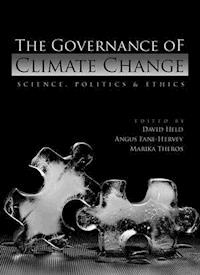
The Governance of Climate Change E-Book
18,99 €
Mehr erfahren.
- Herausgeber: John Wiley & Sons
- Kategorie: Geisteswissenschaft
- Sprache: Englisch
Climate change poses one of the greatest challenges for human society in the twenty-first century, yet there is a major disconnect between our actions to deal with it and the gravity of the threat it implies. In a world where the fate of countries is increasingly intertwined, how should we think about, and accordingly, how should we manage, the types of risk posed by anthropogenic climate change?
The problem is multi-faceted, and involves not only technical and policy specific approaches, but also questions of social justice and sustainability. In this volume the editors have assembled a unique
range of contributors who together examine the intersection between the science, politics, economics and ethics of climate change. The book includes perspectives from some of the world's foremost commentators in their fields, ranging from leading scientists to political theorists, to high profile policymakers and practitioners. They offer a critical new approach to thinking about climate change, and help express a common desire for a more equitable society and a more sustainable way of life.
Sie lesen das E-Book in den Legimi-Apps auf:
Seitenzahl: 471
Veröffentlichungsjahr: 2013
Ähnliche




















The Governance of Climate Change
Science, Economics, Politics and Ethics
The Governance of Climate Change
Science, Economics, Politics and Ethics
Edited by David Held, Angus Fane-Hervey and Marika Theros
polity
Individual chapters © their authors 2011; this collection © Polity Press, 2011
First published in 2011 by Polity Press
Polity Press65 Bridge StreetCambridge CB2 1UR, UK
Polity Press350 Main StreetMalden, MA 02148, USA
All rights reserved. Except for the quotation of short passages for the purpose of criticism and review, no part of this publication may be reproduced, stored in a retrieval system, or transmitted, in any form or by any means, electronic, mechanical, photocopying, recording or otherwise, without the prior permission of the publisher.
ISBN-13: 978-0-7456-3783-9
A catalogue record for this book is available from the British Library.
Typeset in 10.5 on 13 pt Swiftby Servis Filmsetting Ltd, Stockport, CheshirePrinted and bound in Great Britain by MPG Books Group Limited, Bodmin, Cornwall
The publisher has used its best endeavours to ensure that the URLs for external websites referred to in this book are correct and active at the time of going to press. However, the publisher has no responsibility for the websites and can make no guarantee that a site will remain live or that the content is or will remain appropriate.
Every effort has been made to trace all copyright holders, but if any have been inadvertently overlooked the publisher will be pleased to include any necessary credits in any subsequent reprint or edition.
For further information on Polity, visit our website: www.politybooks.com
Contents
Notes on Contributors
Editors’ Introduction
Part 1 The Challenge of Climate Change
1 The Challenge of Climate Change
David King
2 The Climate for Science
Martin Manning
3 Global Shocks, Global Solutions: Meeting 21st-Century Challenges
Ian Goldin
4 The Economics of Climate Change
Alex Bowen and James Rydge
5 Democracy, Climate Change and Global Governance: Democratic Agency and the Policy Menu Ahead
David Held and Angus Hervey
6 ‘Until the Last Ton of Fossil Fuel Has Burnt to Ashes’: Climate Change, Global Inequalities and the Dilemma of Green Politics
Ulrich Beck and Joost van Loon
Part 2 Social Justice and Sustainability
7 Social Justice and Sustainability: Elastic Terms of Debate
Onora O’Neill
8 Changing Values for a Just and Sustainable World
Peter Singer
9 The Ends of Justice: Climate Vulnerability beyond the Pale
Michael Mason
Part 3 Where to from Here?
10 Green Peace: Energy, Europe and the Global Order
David Miliband
11 The Politics of Climate Change
Ed Miliband
12 International Climate Policy after Copenhagen: Toward a ‘Building Blocks’ Approach
Robert Falkner, Hannes Stephan and John Vogler
Index
Notes on Contributors
Ulrich Beck is the British Journal of Sociology Visiting Centennial Professor at the London School of Economics and Political Science (LSE) and Professor of Sociology at the Institute of Sociology, University of Munich. His recent publications include World at Risk (2008), Cosmopolitan vision (2007) and Power in the Global Age (2005).
Alex Bowen is a principal research fellow at the Grantham Research Institute on Climate Change and the Environment at the LSE. He has previously served as a Senior Economic Advisor to the UK Stern Review on the Economics of Climate Change, a Senior Policy Advisor at the Bank of England, and Head of Policy Analysis and Statistics at the UK’s National Economic Development Office.
Robert Falkner is a senior lecturer in international relations at the London School of Economics and a senior research fellow at LSE Global Governance. He is also an associate of the Grantham Research Institute on Climate Change and the Environment at the LSE and of the Energy, Environment and Development Programme at Chatham House. He is the author of Business Power and Conflict in International Environmental Politics (2008).
Ian Goldin is the Director of the James Martin 21st Century School at the University of Oxford. He previously held positions as Vice President of the World Bank (2003–6), Director of Development Policy at the World Bank (2001–3), Chief Executive of the Development Bank of Southern Africa (1996–2001) and advisor to President Nelson Mandela. He has published over fifty articles and twelve books, including Globalisation for Development: Trade, Finance, Aid, Migration and Ideas (reprinted 2007) and The Economics of Sustainable Development (1995).
David Held is the Graham Wallas Chair in Political Science and co-Director of the Centre for the Study of Global Governance at the LSE. His recent publications include Cosmopolitanism: Ideals and Realities (2010), Globalisation/Anti-Globalisation (2007), Models of Democracy (2006) and Global Covenant (2004).
Angus Hervey is a Ph.D. candidate and the Ralph Miliband Scholar at the LSE, where he is conducting doctoral research on the political economy of tropical deforestation in Africa. He is co-author of The Scramble for Africa in the 21st Century: A View from the South (2006).
David King is the Director of the Smith School of Enterprise and Environment at the University of Oxford. He has served as the UK Government’s Chief Scientific Advisor and Head of the Government Office of Science from October 2000 to December 2007 and as President of the British Science Association from 2008 to 2009. He has published more than 500 papers on chemical physics and science and policy, and has co-authored (with G. Walker) The Hot Topic: How to Tackle Global Warming and Still Keep the Lights On (2008).
Martin Manning is the Director of the New Zealand Climate Change Research Institute at the School of Government at the Victoria University of Wellington. He has led research programmes at the National Institute of Water and Atmospheric Research covering atmospheric chemistry and the carbon cycle for ten years, and represented New Zealand on the Intergovernmental Panel on Climate Change (IPCC). He is the author of over forty peer-reviewed scientific research papers plus numerous book contributions and reports.
Michael Mason is a senior lecturer in the Department of Geography and Environment and an associate of the Grantham Research Institute on Climate Change and the Environment at the LSE. He has authored Environmental Democracy (1999) and The New Accountability: Environmental Responsibility across Borders (2005).
David Miliband is a British Labour Party politician who has been the Member of Parliament (MP) for South Shields since 2001. He was the Secretary of State for Foreign and Commonwealth Affairs from 2007 to 2010.
Ed Miliband is a British Labour Party politician who is currently the leader of the Labour Party and the Leader of the Opposition of the UK. He has been the Member of Parliament (MP) for Doncaster North since 2005. He served in the Cabinet from 2007 to 2010, first as the Minister for the Cabinet Office and Chancellor of the Duchy of Lancaster, and then as Secretary of State for Energy and Climate Change.
Baroness Onora O’Neill is a professor of philosophy at the University of Cambridge. She is a former President of the British Academy and chairs the Nuffield Foundation. In 2003, she was the founding President of the British Philosophical Association (BPA). She was created a Life Peer in 1999 and has served on the House of Lords Select Committees on Stem Cell Research and the BBC Charter Review, and is currently serving on the Select Committee on Genomic Medicine. Some of her recent books include Rethinking Informed Consent in Bioethics, with Neil Manson (2007), Autonomy and Trust in Bioethics (2002) and Bounds of Justice (2000).
James Rydge is a post-doctoral researcher at the Grantham Research Institute on Climate Change and the Environment at the LSE. Prior to that he worked at the Bank of New York in London, and was a research fellow and lecturer in finance at the University of Sydney.
Peter Singer is Ira W. DeCamp Professor of Bioethics in the University Center for Human Values at Princeton University, and Laureate Professor at the University of Melbourne, in the Centre for Applied Philosophy and Public Ethics. He is the founding President of the International Association of Bioethics, and co-founder and President of The Great Ape Project. His books include Animal Liberation (1975), Practical Ethics (1979), Rethinking Life and Death (1994) and, most recently, The Life You Can Save (2009).
Hannes Stephan is a post-doctoral fellow at Keele University and is affiliated with the ESRC Centre for Climate Change Economics and Policy (CCCEP). He has published on global environmental governance, with special attention to international organizations and the EU’s leadership role.
Joost van Loon is Professor of Media Analysis at Nottingham Trent University and Editor-in-Chief of Space and Culture, a journal that brings together critical interdisciplinary research in cultural geography, cultural studies, architectural theory, ethnography, communications, urban studies, environmental studies and discourse analysis. He is author of Media Technology: Critical Perspectives (2007) and Risk and Technological Culture: Towards a Sociology of Virulence (2003).
John Vogler is Professor of International Relations at Keele University. He is a member of the CCCEP and serves as Convenor of the British International Studies Association Environment Working Group. He has written numerous articles on international environmental politics, co-edited The Environment and International Relations (1996) and The International Politics of Biotechnology (2000), and authored The Global Commons (2000).
Editors’ Introduction
In the last decade the problem of climate change has moved from the realm of scientific research and environmental advocacy into mainstream political and economic policy discussions at all levels of governance. Yet, as politicians and citizens become increasingly aware of the threat that climate change poses to human societies, the debate has become more fractious and the level of rhetoric has increased. It also appears more and more apparent that progress in combating climate change has stalled. This presents something of a paradox – the more we become aware of the level of the threat posed by anthropogenic climate change, the less we seem capable of acting to prevent it.
There are a number of reasons for this. While the nature of the threat is quite well understood, thanks to scientific research and sustained advocacy on behalf of environmental groups and increasingly from private business, the way in which the issue has been framed has alienated significant sections of society, and has failed to convince many of the necessity of taking concerted action. Structural problems are apparent too. Democratic countries find it difficult to translate policy commitments into policy outcomes, and the entrenched interests of a relatively small proportion of state and non-state actors have paralysed or blunted many of the efforts to limit greenhouse gas (GHG) emissions and to develop pathways to sustainable energy usage. The atmosphere is a shared resource, and countries have failed to set aside national interests in favour of the common global good. International efforts have not been helped by existing international institutions either, which appear increasingly outdated and unfit for purpose. There has been a failure of collective action that has profound implications.
The lack of concerted action is understandable, but not inevitable. For what is at stake is a fundamental reorganization of the way in which modern industrial economies are constituted – the kind of change that involves the same level of disruption as previous watershed developments such as the industrial revolution, the development of the internal combustion engine and the information technology revolution. Yet, given our relatively recent awareness of just how serious a threat it poses, we are only just starting to appreciate what is at stake. Climate change involves not only physical changes in the weather, sea levels, food production, water, but also major political and social upheavals, such as struggles over scarce resources, market fluctuations and migration.
This book is an attempt to further stimulate the debate about these issues by bringing together scholars and practitioners from a number of different fields to discuss the nature of climate change and its wide-ranging implications. It begins by reflecting on the science. David King sets out a selection of the scientific evidence on climate change, and frames it within the larger context of population growth, demographic shifts and health pandemics. Martin Manning, a lead author of the most recent IPCC report, follows in chapter 2 by looking at the gaps between science and society. He explains how scientific research, despite showing the clear and possibly even understated threat posed by climate change to human society, has failed to overcome opposition from vested interests opposed to reductions in GHG emissions and from a relatively small minority who hold strong personal viewpoints. The economic and technological context is provided in chapter 3 by Ian Goldin, head of the James Martin 21st Century School at Oxford. In a wide-ranging piece on 21st-century challenges, he explores how globalization and greater interdependence amongst societies have brought with them new types of existential risks, such as climate change, which threaten our way of life.
Alex Bowen and James Rydge then look more closely at some of the key elements of the economics of climate change in chapter 4. They describe the scale of the potential impacts of climate change and how the associated risks shape economic analysis. They explore central economic issues such as greenhouse gas externalities, market failures that allow GHG emissions to grow, and key policy instruments that aim to encourage emission reductions. In chapter 5, two of the book’s co-editors, David Held and Angus Hervey, analyse the political barriers to combating climate change. They contend that structural obstacles to effective policy have to be understood at both the domestic and global levels. Exploring the strengths and weaknesses of different types of political associations in relation to climate change, they argue that an effective approach must include greater space for deliberative principles and a policy mix that can operate effectively both within and across borders. A sociological perspective is provided in chapter 6 by Ulrich Beck, from Munich University, and Joost van Loon, from Nottingham Trent, who argue for a new type of thinking about climate change based on a shared recognition of a ‘world risk society’, and a politics anchored in cosmopolitan principles.
The volume also includes contributions from two well-known philosophers, Baroness Onora O’Neill and Peter Singer. In chapters 7 and 8, they engage with some of the deeper social and ethical questions posed by climate change. The former points out how the pursuit of both social justice and sustainability requires trade-offs and serious decisions that have an impact on the wellbeing of both people and the environment, while the latter presents an ethical case for urgent action. They are followed by Michael Mason in chapter 9 who explores what climate change means in the context of modern liberal theories of justice, and asks how this might apply to a specific case, namely, the implications of climate change for Palestine.
The final section looks toward the future with contributions from both the sons of Ralph Miliband, after whom the lecture series which gave rise to this book was named. David Miliband presents his vision for a global deal on climate change, placing particular emphasis on the role of the EU, while Ed Miliband outlines his views on a new politics for climate change, based on long-term sustainability and ethical concerns rather than the politics of ‘now’, which lies at the heart of so many of the challenges outlined in this book. The book concludes with a piece by Robert Falkner, John Vogler and Hannes Stephan, who explore in greater detail why climate policy has failed at the global level, and advocate what they call a ‘building blocks’ approach for the future.
Running throughout the volume are four key underlying questions, around which there is some controversy.
How settled are the debates about climate change?
In the lead-up to the negotiations at Copenhagen in 2009 it looked like both the scientific and economic arguments had been settled. The IPCC, having recently received its Nobel prize, was unchallenged as the definitive authority on the subject, and had delivered its verdict on the existence and seriousness of anthropogenic climate change, while Nicholas Stern’s 2007 report had shown that the costs of taking immediate action were relatively minor compared to the costs of waiting and doing nothing. It looked like the debate was finally ready to move on from arguing about whether climate change was real or not to arguing about what to do about it. Yet somehow, since the breakdown of the Copenhagen negotiations, both the scientific and economic arguments for doing something about climate change have taken a number of steps backwards. Media outlets across the world have revelled in the various ‘Climategate’ stories, and a series of polls reveal a public that seems unwilling to incur costs and take the word of politicians and scientists at face value.
This is all the more surprising since, as both King and Manning point out, the nature of the climate change problem is by now very well understood. There is a critical mass of scientific research and opinion incorporating analysis from geologists, climatologists and paleontologists, among others, that points overwhelmingly to the conclusion that the average global temperature is climbing, and that it is due to the emission of greenhouse gases. Worryingly, as noted by King, Manning and Goldin, there is also a massive amount of inertia in the present climate, thanks to the earth’s oceans which take more time to register and absorb temperature rises. This means that by far the majority of the effects of increased emissions are still to come. This is an important point, and one to which little attention has been paid by sceptics.
Why then, given the overwhelming nature of the evidence, is scepticism making a comeback? There are a number of reasons. One is that the nature of science in this area lends itself to criticism. The general public is not used to uncertainty amongst scientists, yet climate science, by its nature, is unpredictable. The complexity of the different factors involved at a global scale means that scientists are unwilling to make specific predictions, and instead revert to ranges and estimates. The complexity of the problem also means that data can be contradictory, with changing states and tipping points, and with the potential for non-linear feedback processes that can’t be accounted for by linear models. King mentions the example of methane hydrates emissions from regions around the Arctic, which, because they cannot be estimated, are not factored into models. However, as Manning points out, while it is important to consider uncertainties in science, an objective approach must consider the full range of potential causes and not simply focus on the one we might prefer.
It also seems that the issue has until now been framed largely in the wrong way, a criticism made by Beck and van Loon, who show that environmentalists have either advocated a romantic return to pre-industrial activities or offered a too negative view of the problems at hand. The same point is raised by King, who suggests there is a need to reframe the debate in terms of risk avoidance rather than in terms of certainty. As he says, a passenger would not board an aeroplane once informed that it had only an 80 per cent chance of landing. In the case of climate change, the potential for catastrophe is far higher than that. The next step then, is to take on board the nature of the challenge politically. This requires a fundamental transformation of economic systems, the biggest since the rise of the industrial age.
Yet, as Bowen and Rydge suggest, such a transformation will not emerge from competitive markets left to their own devices. This is due to the continued plentiful supply of fossil fuels, multiple market failures and some policy failures. Their discussion of the various risks implied by climate change, the scale of the problem, and the actions required places a strong emphasis on the notion of risk and uncertainty. A failure to see the problem in these terms is likely to result in poor policy choices that do not adequately reflect the seriousness of the threat. The authors conclude that:
While traditional economic techniques such as project cost–benefit analysis and other marginal analysis techniques are useful as a guide, the primary analysis must consider how to bring about large changes in our economic structures, in particular a transition away from high-carbon to low-carbon growth, while always maintaining the flexibility to accommodate changes in our understanding of the science, economics and ethics of climate change.
Why is climate change such a difficult problem to solve?
Climate change is an incredibly complex problem, and a very difficult policy issue to address. In addition to the debate about its physical effects and the economic costs and benefits of addressing it, climate change also involves questions of power, social justice and distribution. Ian Goldin explains how globalization has led to an explosion of growth and wellbeing, but also creates new types of risk and vulnerabilities. Because we are more integrated than before, and interdependent, the threat from existential risks such as health pandemics, nuclear terrorism and climate change has become more serious. The rise of such challenges reveals that no one country or community alone can provide the solution. This is because climate change is a problem at the global scale, transcending physical and political boundaries. As Beck and van Loon point out, the types of risks mentioned by Goldin are not only transcending, but also ‘de-bounding’, because they eventually transform boundaries themselves. They do so spatially (across nation-states), temporally (different timescales) and socially (accountability, responsibility, liability).
At the national level, it can be argued, as Held and Hervey do, that modern liberal democracies suffer from a number of structural characteristics that prevent them from tackling climate change. These include short-term decision-making based on electoral cycles, self-referring decision-making that downplays externalities and cross-border spillover effects, and greater interest group concentration and pluralism that tends to cater to narrow interests and can lead to a gridlock in public decision-making. Another problem is that the issue of climate change spans both the domestic and the international domains. Institutional fragmentation and competition between states can lead to it being addressed in an ad hoc and dissonant manner. And, even when the global dimension of a problem is acknowledged, there is often no clear division of labour among the myriad of international institutions that seek to address it: their functions frequently overlap, their mandates conflict and their objectives often become blurred
The ethical implications of climate change are profound as well. This is an area that has not received enough attention. Goldin shows how climate change is taking place in an era of rising inequality, with vast disparities in the living conditions of people around the world. This is coupled with the prospect of population growth and major demographic shifts in the future. Climate change is, accordingly, occurring in the context of ever-growing demands for resources, in a world in which they are increasingly scarce. The distributional questions are therefore crucial – who gets what, how, and when? O’Neill attempts to better understand this question by unpacking the terms ‘social justice’ and ‘sustainability’. She suggests that both are highly indeterminate, because they can be realized in many ways. While it may possible in theory to aim for equal opportunities and equal outcomes, not all specific configurations of these are possible. Similarly, you can at least in theory have sustainable growth and sustainable agriculture – but at certain points choices will be needed. Moreover, if we aim for both social justice and sustainability, we shall need to aim not merely for a configuration of each that is internally coherent, but for a configuration of the two that is coherent: we might find that we have to trade off some forms of equality for some forms of sustainability. Unless we recognize this, we are only playing with the rhetoric of social justice and sustainability, rather than thinking seriously about either.
Singer makes a distinctive and bold ethical argument, suggesting that, since we are aware of the threat implied by climate change, we are also obliged to counteract it. Knowledge of the consequences of climate change together with an understanding of the atmosphere as a shared resource means that the actions of those with high carbon footprints in industrialized countries are curbing the rights of people in developing nations. GHG emissions involve rights violations, and citizens of relatively rich, industrialized countries therefore have an obligation to lead a carbon neutral lifestyle. Mason also suggests that our current ways of thinking about and dealing with social justice and sustainability are inadequate. Climate vulnerability generates issues about the bounds of justice, including duties to those deemed most vulnerable to present and future climate hazards. However, in his overview of the dominant liberal theories of justice (the social contract and capabilities approaches), he argues that they do not fit the bill. Climate vulnerability falls outside moral parameters of Rawlsian justice because of uncertainty about the cumulative impact of climate change, since previous generations were unable to recognize the climate harm being caused by carbon-intensive development. The capabilities approach also fails to grasp the profile of climate change, especially the non-substitutable nature of the environment’s sink capacity. There is no priority accorded to the conditions necessary for human survival as opposed to human development, and no distinction made between the present vulnerable and the future vulnerable. Liberal theorists, despite wishing to bring the least advantaged into the fold of moral concern, are found wanting when confronted with the problem structure of climate change.
What works and what doesn’t in the mitigation and adaptation of climate?
At the level of global governance there has so far been a failure to generate a sound and effective international framework for managing global climate change, whilst at the level of the state solutions have been weak and have struggled to transcend the normal push and pull of partisan politics. A number of this volume’s contributors, including King, Goldin and both the Milibands, suggest that tackling climate change can only be achieved via a comprehensive global agreement. This strategy, predicated on the idea of negotiating a comprehensive, universal and legally binding agreement, prescribes top-down policies based on agreed principles. However, as Falkner, Vogler and Stephan show, attempts to reach a global deal have failed because of deep fissures on climate politics. Major powers are interested in narrow national interests and in avoiding costly commitments to emission reductions. Major emitting countries also lack domestic support to create a basis for international commitments, particularly in the US. This has been compounded by a changing global economic system. A shift in the power centres of the world economy, driven largely by the rise of the East, has weakened the bargaining power of the traditionally dominant Western countries, who had become used to dictating their priorities in international deals. The Copenhagen Conference demonstrated that this is no longer the case. As Falkner, Vogler and Stephan point out, the US/China bilateral relationship is increasingly coming to define world politics – and with the lion’s share of GHG emissions, they now hold primary responsibility for taking action on climate change.
In terms of specific policy options, efforts thus far have not been convincing. According to its supporters (including Singer and King from this volume), cap-and-trade makes the most sense of the options available, because it allows for greater certainty about eventual emissions levels and provides better incentives for producers. At this point, it also appears to be the approach most likely to be adopted at the global level, with a European Union Emission Trading System (EU ETS) already in place, and a successful precedent in the form of markets for sulphur in the United States. However, cap-and-trade has not led to substantial emission reductions, nor is it likely to in the future. It is too easily manipulated, and susceptible to special interests. An alternative, or supplementary, approach is to put a price on GHG emissions via carbon taxation. However, taxes do not allow certainty over how big future GHG reductions will be, since estimates are imprecise and there is a long lag time between policy output and actual outcomes. They are also hard to coordinate internationally, and developing countries are unlikely to agree to such arrangements, which impose economic burdens on crucial industries without offering the offsetting gain of being able to sell emissions permits. Moreover, in the current economic and political climate, and especially in the wake of the financial crisis and future austerity cuts, carbon taxation seems politically unattractive and unrealistic.
What is the right policy mix for the future, and can a viable coalition be found?
Climate change, if taken seriously, implies a political paradigm shift. It requires an alliance of multiple state and non-state actors, motivated by a sense of what Beck and van Loon call a ‘world risk society’. This is not a matter of abolishing or undermining nation-states but of bolstering their capacity to act effectively. What is needed is a ‘cosmopolitan realpolitik’ which could empower societies and states. The task is to analyse and explore how global risks can be deployed as mobilizing forces to help us encounter climate change realities and find solutions. What can unite human beings faced with such challenges? According to Beck and van Loon, the answer is to develop an understanding of the world as a community of global risks that threaten our existence. A new approach must overcome false alternatives of retreat or accommodation, and instead must develop via a cosmopolitan philosophy which opens up a moral and political space that can give rise to a civic culture of responsibility that transcends borders and conflicts.
In terms of actual steps, the first requirement is to agree on targets. Despite the pessimism surrounding the failure of negotiations over climate change in Copenhagen, this is one thing which was largely agreed upon. Most countries have converged on a target of keeping the global temperature rise to less than 2 degrees Celsius, although a number of African countries during the negotiations insisted on even lower targets. In addition, most of the major emitters, including the EU and the US, have set national targets of varying degrees. The next step is to ensure that such commitments are likely to be carried out. Putting a price on GHG emissions (whether through tradable permits or taxes) will not be enough on its own to deliver the needed reductions. What is ultimately required is a fundamental overhaul of energy systems through transformative technologies that require a combination of factors to succeed – not only market incentives, but also applied scientific research, early high-cost investments, regulatory changes, infrastructural development, information instruments and public acceptance.
At the international level, it will require coordination and participation, and the reform of global institutions. The current system is not adequate for the task, a point raised by a number of authors in this volume. Of course, this is easier said than done. It is unclear whether it can be achieved in time, or whether it is possible at all. Falkner, Vogler and Stephan argue for an alternative ‘building blocks’ approach, which recognizes that a functioning framework for climate governance is unlikely to be constructed all at once, in a top-down fashion. They suggest there is no need for a comprehensive legally binding treaty. Rather, we should engage in an ongoing process that seeks to build an overall international framework for action from the bottom up. Climate issues can be disaggregated into different areas, and countries can focus on the here and now, and on what can be realistically done at national level. Economic change can be initiated via the creation of incentives, the promotion of efficiency and technological breakthroughs. This approach doesn’t ignore international politics but recognizes the need for it to reflect domestic politics and priorities. Ultimately, the aim is to create a coherent governance architecture out of separate and partial agreements. Such an approach is not without precedent – trade policy provides an example of how it can work.
Taken together, the chapters in this book provide a comprehensive overview of climate change and the immense challenges it poses for the way human society is organized. The issues raised span all areas of human understanding and endeavour. There are very few moments in history in which humankind has been faced with such pressing questions which go to the heart of how we relate both to each other and to our environment. Climate change contextualizes the place of human beings and clarifies that they are but one element in a highly complex and vulnerable world. This is one reason why it invokes such controversy and intense questioning. While it is unlikely that the controversy can be entirely put to rest, the overwhelming scientific consensus is that if we do not act now, and act together across borders, we will store up more problems than we solve. This book explains why acting now in relation to climate change is scientifically rational, economically sensible and ethically desirable. Yet it also highlights how extraordinarily difficult it is to produce a clear and coherent political and economic response in a world of divided communities and competing states.
Part 1
THE CHALLENGE OF CLIMATE CHANGE
1
The Challenge of Climate Change
David King
I want to start this chapter with a very simple idea: we have an enormous knowledge base. It has been developing rapidly over the previous 200 years. Then the computer revolution came along and we suddenly created the ability to retain our high level of sophistication and analysis for very complex phenomena involving enormous amounts of data. I would like to use that as a starting point. My thesis is going to be that, having this knowledge capability very largely cocooned into our universities, we have a rather poor system of moving that understanding into policy decision-making.
Lesen Sie weiter in der vollständigen Ausgabe!
Lesen Sie weiter in der vollständigen Ausgabe!
Lesen Sie weiter in der vollständigen Ausgabe!
Lesen Sie weiter in der vollständigen Ausgabe!
Lesen Sie weiter in der vollständigen Ausgabe!
Lesen Sie weiter in der vollständigen Ausgabe!
Lesen Sie weiter in der vollständigen Ausgabe!
Lesen Sie weiter in der vollständigen Ausgabe!
Lesen Sie weiter in der vollständigen Ausgabe!
Lesen Sie weiter in der vollständigen Ausgabe!
Lesen Sie weiter in der vollständigen Ausgabe!
Lesen Sie weiter in der vollständigen Ausgabe!
Lesen Sie weiter in der vollständigen Ausgabe!
Lesen Sie weiter in der vollständigen Ausgabe!




