


Erhalten Sie Zugang zu diesem und mehr als 300000 Büchern ab EUR 5,99 monatlich.
- Herausgeber: IVP
- Kategorie: Religion und Spiritualität
- Sprache: Englisch
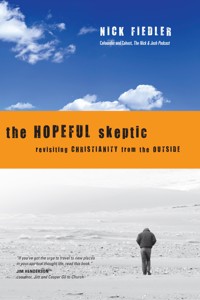
Nick Fiedler (of Nick and Josh Podcast fame) decided to travel the world for a year or so, and in the process of figuring out what to set aside, what to carry along and what to throw out, heard a little voice telling him to set aside the faith of his childhood.So Nick changed his Facebook religion status from Christian to "Hopeful Skeptic" and set out to see where God would take him.If you find yourself asking nagging questions of the faith you were born into, put on your boots and take a little trip with Nick.
Sie lesen das E-Book in den Legimi-Apps auf:
Seitenzahl: 261
Veröffentlichungsjahr: 2010
Das E-Book (TTS) können Sie hören im Abo „Legimi Premium” in Legimi-Apps auf:
Ähnliche



















The Hopeful Skeptic
Revisiting Christianity from the Outside
Nick Fiedler
www.IVPress.com/books
InterVarsity Press P.O. Box 1400 Downers Grove, IL 60515-1426 World Wide Web: www.ivpress.com E-mail: [email protected]
© 2010 by Nick Fiedler
All rights reserved. No part of this book may be reproduced in any form without written permission from InterVarsity Press.
InterVarsity Press® is the book-publishing division of InterVarsity Christian Fellowship/USA®, a movement of students and faculty active on campus at hundreds of universities, colleges and schools of nursing in the United States of America, and a member movement of the International Fellowship of Evangelical Students. For information about local and regional activities, write Public Relations Dept. InterVarsity Christian Fellowship/USA, 6400 Schroeder Rd., P.O. Box 7895, Madison, WI 53707-7895, or visit the IVCF website at www.intervarsity.org.
All Scripture quotations, unless otherwise indicated, are taken from the Holy Bible, New International Version®.NIV®. Copyright ©1973, 1978, 1984 by International Bible Society. Used by permission of Zondervan Publishing House. All rights reserved.
Design: Cindy Kiple Image: © Jeff Smith/iStockphoto Interior images by Justin Banger
ISBN 978-0-8308-7836-9 (digital) ISBN 978-0-8308-3727-4 (print)
For Leslie, my wife and best friend.
In many ways, you are the coauthor of this book—
with an accompaniment of brilliant ideas,
inspirations and heaps of challenging questions.
Contents
A Note to the Reader
1: Changing My Religion
2: Why I Like Agnosticism
3: Traveling
4: Flip-Flopper
5: Technianity
6: Scripture
7: Traditional Views of Jesus
8: Civil (Dis)Obedience and Revolutionary Change
9: Communities That Give Hope
10: Prayer
11: Conclusions and Concert T-Shirts
Inspiration and Insights
About the Artist
Notes
Likewise
About the Author
More Titles from InterVarsity Press
A Note to the Reader
I think it’s fair to say that most of the time we don’t know the authors of the books we pick up. Buying a book can be a stab in the dark, only completely illuminated when we have made it a good way through the book. Starting out a reader might see a title like The Hopeful Skeptic and think, Here is a book written by someone who has learned to live without knowing what to believe. Then the reader would see the logo on the book’s spine—IVP Books—and think, Wait, this is a Christian book. And then, based on the reader’s thoughts on Christianity or IVP Books, she might either put the book down and quickly walk away, or decide to give it a closer look. And on closer inspection she might find that I don’t fit the profile she expected me to fit.
As a way of introduction, I would like to offer a few notes about myself. First, as long as I can remember I have been intricately connected with churches and Christianity. I was raised in a Christian family, received a Christian education and worked in student ministry for eight years. So when I speak on Christianity, it is not as though I am talking about it from an isolated platform on the outside and picking on it. I am talking about it like I would talk about a close friend or a family member. I hope that if, at any point during your read, you think I am intonating something out of a divisive or hurtful spirit, you would give me the benefit of the doubt until you have finished the book and have seen the whole scheme of what I have termed “hopeful skepticism.”
During the initial stages of learning about a ministry that my wife, Leslie, and I were considering joining, one of the leaders told me that a cardinal rule they held for all of their coworkers was to give each other the benefit of the doubt on every occasion. He was saying that if there was any situation where a coworker could mean one of two things in their words or actions, the rule was to assume that they meant the better of the two until you had a chance to discuss the matter with the individual. As a rule of thumb, this is a gracious way to go. It seems to be the high road, and though we may be incorrect at times, I believe that we will hold each other in higher regard if we can do this. I hope that for the duration of the book, if you can see two meanings or spirits about some words or thoughts, you will give me the same benefit of the doubt.
Finally, I want to make a note about my use of the word skepticism. I hope that the overall notion of skepticism within a faith tradition doesn’t completely turn you off, especially because I do not hope to join the ranks of the popular modern skeptics. Rather, I want us to view the term and the ideas that come with it as a wrestling with God (like Jacob in the Old Testament story in Genesis 32:23-34). It is easy to see people wrestling with God, or with ideas about God, and think that they have got it all wrong, but instead of labeling these people as doubting Thomases, I hope that we can see skepticism as an act of wrestling with God—and, in that sense, being in close proximity to the divine.
Apart from this note on skepticism and my promise that I am not interested in being a church basher, I want to thank you for taking the time to pick up this book. It might not be the safest option on the shelf, but it is a journey that starts with packing bags, moving through my changing thoughts about Christianity and ending with a new appreciation of and way of approaching religion. I hope this book will become a conversation, because I would love to hear your thoughts on these subjects. These conversations have already started on The Nick and Josh Podcast (thenickandjoshpodcast.com) and my blog, The Hopeful Skeptic (thehopefulskeptic.com/blog). I invite you to join them.
1 Changing My Religion
I knelt on a cool wood floor and shifted my weight slowly from knee to knee to relieve the pressure that had built up under my body’s weight. I have a smaller frame, even for someone who is six-feet tall, and my friends, family and various street people often call me skinny. But for that hour, on my knees, I felt like a lumbering giant. I felt overweight and tired. While I squirmed I started to feel guilty for thinking more about my sore joints than sitting in awe at the feet of the Tibetan Buddhist monk—a monk who had traveled thousands of miles to meet with a small group of followers that night in Atlanta, Georgia, and deliver a lecture.
Just before the lecture, the monk was sitting inside a private room, the one in which I knelt on an increasingly hard wood floor. My world religion professor at Georgia State University had pulled some strings with the local Tibetan Buddhist temple to allow me and three other students to have a private sitting with this world-renowned monk. He looked like a typical monk, wearing the bright orange and red cloth, the prayer beads, the overly thick Dalai-Lama-like glasses and having the shaved head, which looked like an aged peach with soft transparent hair barely hovering over the labyrinth of wrinkles. To the right of the monk was a man in a suit and tie, which somehow added to the monk’s noble appearance. The suited man had been assigned to help the monk during his travel in the States, and he operated as a translator-assistant for our private assembly.
We were each allowed five questions, one at a time, straight down the line in a somewhat hurried manner. We sat and asked our very-American questions, wasting our time in the presence of someone who had spent over sixty years studying metaphysics, truth and ancient texts, and living ascetically according to his beliefs about ultimate truth. But we stumbled over the most pedestrian questions.
“Are those beads on your wrist, like, a rosary?”
“Why do you wear orange?”
“Are you just a vegetarian or a full vegan?”
“Why do monks sometimes set themselves on fire?”
“Do you always have to travel with a translator?”
We were completely unenlightened. I had spent my four questions (the ones about the fire and the rosaries were mine), and I was the last one to get to ask a question before the monk went to his lecture. I put down my paper and looked him directly in the eyes, trying to come up with something profound—something that would make the monk raise his head and tell me that I had attained enlightenment. All I could conjure up from deep inside me was, “I will never see you again, and you have devoted your whole life to understanding truth, what one piece can you give me today for my journey that will take me another step closer to truth?” (I used the word journey because it’s a buzzword in spiritual circles and it can translate into interfaith discussions.)
It took a moment for my words to get translated through the suit-and-tie-man and into the ears of the older monk. He looked me in the eyes and smiled, but only to the extent an octogenarian monk would smile. Then he spoke directly at me in a language I couldn’t understand but in a way that I felt the quiet rebuke. The translator too spoke very curtly, but I understood it wasn’t intended to insult. The translator said, “You Americans are always looking for shortcuts. Asking this question is good, but there is no short path on a spiritual journey. I can give you no answer today; you have to walk before you can find truth. Go, walk and learn, and find someone to sit under for the rest of your life. Then return to this question.”
That was it. The translator became a worried assistant who tapped his watch, bowed to us and ushered us out of the room to an assembly hall. In the hall we sat and listened to a ninety-minute lecture about metaphysics. It was somewhat gibberish, mostly about how we can know what is real, what it means to know and whether we can alter reality simply by changing our perceptions. I say it was gibberish because I didn’t follow everything at the time—and the translator wasn’t helping.
Two hours after arriving I picked up my shoes at the cubby near the front door where I had left them. I had a piece of paper with notes on it, but the only question I had was, Where am I supposed to go and learn?
That was five years ago.
In the Beginning
In 2008 a few major things happened in my life. My wife, Leslie, and I celebrated our second wedding anniversary, we both turned twenty-six and thereby entered our “late twenties,” an African American was elected president, I changed my religion status on my Facebook profile from “Christian” to “Hopeful Skeptic,” and my wife and I sold most of our possessions, quit our corporate jobs, packed two large backpacks and moved to the other side of the world on a journey that would last nearly fourteen months and span ten countries.
I guess that is a lot for one year, especially considering both my wife and I have college degrees and we had jobs that could have turned into “careers.” We had never made such a big change in our lives before. The truth is, though, that that quick summary doesn’t even begin to get into all of ways our lives changed, but it’s a start.
It is also a good introduction to this book, which is born not only out of a podcast that I cohost with my great sidekicks Josh Brown and Josh Case, and our correspondent Ariah Fine, but it is also born out of a need to travel and change, it is born out of a faith that values skepticism, and it is born out of a global perspective.
Maybe I should start with the podcast. I am the cocreator and cohost of The Nick and Josh Podcast. (If you are already lost, a podcast is an Internet radio show, largely promoted by Apple’s iTunes music store, but it is downloadable so that you can put it on a portable media device and listen to at your convenience.) Since 2006, Josh Brown and I have been podcasting on “faith, reason and absurdity.” We have typically interviewed spiritual leaders, authors, speakers and theologians, asking questions that we genuinely wonder about. Sometimes the questions are deep and meaningful, like “Can you explain your understanding of atonement theology,” but sometimes they are simple like, “What does the theology of Jack Bauer from the TV show 24 look like?”
The beauty of the podcast is that it allows us and our listeners to learn from some of the best and brightest people in emerging forms of faith and leadership. Doing this podcast has allowed me to learn about faith communities and meet people all over the world. As I was interviewing these people who lived further and further away from me, the podcast inspired the idea of travel. I realized that these people had different ideas about church and community, and I assumed this was because they were in places with different customs and even values. But I wanted to engage them where they were at—try their food, see their buildings, meet them face-to-face and see what about their surroundings make them come up with different theological ideas.
The podcast, though, wasn’t the main catalyst that led us to travel; it just made it easier in some respects, giving us contacts all over the world. But the reason we ended up moving was because Leslie wanted to live overseas. She has always wanted to move overseas; she even told me before we were engaged. At first I fought with the idea: I didn’t think I wanted to live in a foreign country. I was all about traveling, but living abroad, away from basic cable and the local Waffle House, seemed hard. But it turned out to be something that fit perfectly into our plans. Well, sort of.
Even now, Leslie and I consider ourselves newlyweds, mostly because we are lightweights with only a couple of years under our belts. We haven’t gotten used to all the changes in our lives: living with another person, getting real jobs, figuring out what we want to do with our lives. That is a lot of stuff. And on top of that, we were trying to figure out our thoughts about religion and God. But because we both love to travel and were still early on in the life-changing world of marriage, we decided it was a good time to try living overseas—especially since we didn’t have a house, a child or a dog, and Leslie’s mom was willing to take our plant for us.
So we saved up for almost two years, living in a one-bedroom apartment with a torn couch and working jobs we weren’t exactly enthusiastic about. (You know the mortgage collapse? That was me.) Don’t get me wrong, our apartment was actually quite nice, but we would have loved an extra room and not having to work desk-jobs. Although the sacrifice would pay off, before we left for the other side of the world, we had ample time to examine our lives—mostly through the lens of our possessions. Even for a one-bedroom apartment and only twenty-six years of existence, we seemed to hoard an unimaginable heap of things. Our plans to travel for fourteen months made us realize that we had too much stuff.
Have you ever done the mental exercise where you make a list of the items you would take if your house started burning down? That particular exercise was a writing assignment in elementary school, and it instilled a fear in me of losing my house in a fire from early on. In fact, growing up I always kept a laundry basket by my bed, so in case of fire I could carry a lot more out of the house. I would have had some dirty clothes and whatever I could fit in the basket. During my childhood, my list consisted mostly of the dirty clothes, my inventions and some pictures. Imagine doing a similar exercise with what you would keep in storage for two years and what you would keep in a backpack to haul around the globe for over a year. This became a soul-searching time, but it trained us in the theology of stuff.
Do we need everything we have? No.
Should we keep everything we have? No.
We decided we should give away what others could use and save what was valuable to us, but then we had to think about what really was valuable to us. And we had to be prepared to wear the same six T-shirts and two sets of pants for a long time. We created boxes for giving away, throwing away, storing and traveling.
Then something happened to us. As we were putting our stuff into boxes and donating books that we never intended on rereading, we realized that a lot of the things we kept were only for filling space on shelves. For example, my bookcase was only a trophy case for books I had conquered; it offered me bragging rights to visitors. In fact, I wouldn’t even put books that I hadn’t read on the bookcase; I wanted them separate so that I could say that I had read everything on the bookcase. Things had gotten bad. As Brad Pitt from Fight Club had taught us a few years before: the stuff we owned, owned us.
But while we were packing, I thought about religion, about Christianity. And as I was thinking about my deep Christian roots and my impending travel, I thought about Facebook. So while I was updating my profile on Facebook and letting everyone online know that I was packing, I changed my religion. Right then—not under the pressure of the Inquisition, not while being dunked under water and accused of witchcraft and not even the week that I was fired from a church—I changed my religion while I was packing to leave the country on an exciting adventure.
Things were changing rapidly: boxes were getting packed, visas were being accepted, Homeland Security was tracking the travel books we were getting from the library, and my views on religion were changing as I decided what to bring with me, what to put in storage and what to get rid of. And while I was making those decisions, my own religious beliefs started to get labeled and put in boxes of their own.
Arranged Marriages
Religion is a big topic, especially where I have lived for over half my life: Birmingham, Alabama. Some say this is the glittering buckle of the proverbial Bible belt. I disagree. I think that there are other places that would better be the buckle of that belt, but perhaps Birmingham is the name “Bubba” that is branded into the leather of the Bible belt. When it comes to the subject of religion, I think that my friends and I are in arranged marriages—or at least we were until some of our recent divorces. This isn’t the type of arranged marriage that my wife’s Indian friend almost got into at the coaxing of her parents. It wasn’t a marriage to another Indian who our friend had never met and, about whom, the only information she had was the promised dowry, a wallet-size 1980s glamour shot and an important last name. No, my friends were in arranged marriages of religion.
Every single one of my friends that is or was religious became religious because of their parents. Now I am certainly not saying that this is always the case with people, nor am I suggesting that this is even the case for most. Obviously some children of atheists become religious and vice versa, but for my friends and me, this has been the rule (with little exception) living in the Bible belt. Our parents had a specific faith, and we, in turn, grew up being told about the virtues of that faith—and that faith only. I noticed that, by and large, my friends who were Christians grew up in Christian households, and this pattern was also true for my Hindu and Jewish friends.
However, most of the friends that I grew up with, even through college, were Christians. We were introduced to Jesus at a very early age and told about his life, all of his miracles and about how he died so we could have eternal life after death. We were also told about an alternative life without Jesus, which ended in an eternity of hell. With this little bit of background information, we were all led down to the altar where we said marriage vows to Jesus and put him in our hearts.
This isn’t uncommon. I suppose this arranged-marriage thing happens in every faith: Hindus beget Hindus, Jews beget Jews, Muslims beget Muslims, and Scientologists, well, I don’t know how they do it, but their children if they have the right thetan readings, will most likely be Scientologists. It happens to most of us in the same way that in an American school you are brought up with an American history book; it is just part of the circle you are in, and there is nothing inherently wrong with that. We teach what we value and what we know. And even though, sometimes, we completely turn away from what we are brought up in, a large number of us will follow what we were brought up to follow.
I don’t intend to criticize the “relationships” that people have with Jesus, conversions to Christianity or faith traditions in families. I only use this relationship metaphor because a lot of Christians apply it to themselves, and they frequently use the metaphor when talking about religion. And I use this metaphor because, for my whole life, I have had a love relationship with Jesus. I sang him love songs, I trusted he would save me from hell, and I believed he was the only definition for the word truth. So I bring this up not to belittle the relationship metaphor but because, at the time when Leslie and I were packing and while I was asking all sorts of loaded questions about my religion, I realized that my relationship was an arranged marriage. I had been set to accept Jesus into my heart from birth, and in my churches and my Christian high school, I was given marital counseling from pastors and teachers on how to be a better spouse in my relationship with Jesus. I had been groomed for the position that I was occupying completely.
But after coming home from dinner with my wife’s Indian friend, I turned my attention back to packing up my things. And I decided I didn’t want to be in an arranged marriage. I wanted to date around and sow those wild oats. In other words, I wanted to ask a lot of really tough questions, I wanted to explore my faith from an outsider’s perspective, I wanted to be able to doubt parts of my tradition that I couldn’t blindly accept. I wanted to be around people that didn’t blindly accept some version of scriptural inspiration because it was what they had been taught since birth. And I thought about Leslie’s Indian friend, whose parents were giving her pictures of grown men in India, doctors and lawyers, but who had started dating someone of her own choosing.
Are arranged marriages really what happened to generations of the faithful? Did they ever stop to ask good questions to really get to know the faith they were being married into, or did they just accept the faith of their fathers because it was their father’s faith? Don’t misunderstand me, I’m not saying anything here about Indian culture and the role of arranged marriages (other than that I probably couldn’t cut it as a traditional Indian), but I am asking if the same practice should be imposed on our spiritual journeys. Westerners have the hardest time accepting a foreign idea like an arraigned marriage, but when it comes to our faith, that seems exactly like what some of us have.
I really do want to stress how much I am not attacking Christianity or any religion, nor am I attacking my personal religious upbringing or any family for passing on their faith traditions to their children. But while I was packing those boxes for storage, I wondered to myself, Why not pack some of those beliefs I have been married to for these years and suspend them until I get back? Why not try on something else for a while and see where I end up?
So while I was logged into my profile on Facebook and was complaining about moving furniture or painting the apartment, I thought about what religion might best fit me, and I came up with the words “Hopeful Skeptic.” And now, even after traveling thousands of miles, reading dozens of books and sipping tea with some of the most inspiring people in the world, those words have stuck. I can happily say that I have become a hopeful skeptic, and I invite you to hear some of the stories and thoughts that have changed my life.
Some of you will probably think that the religious label I have decided on seems to be a new dressing for the faith that I was born into, but I hope to show some categorical differences. Or some of you may say that I have drifted too far and I am now out of the fold. I understand that frustration, but I hope and believe that what I have become is more in line with the early followers of Jesus than the way I use to live.
The Church Has Become a Flashpacker
My insight about the church, attained through my finite power of observation combined with my pretentiousness since becoming a world traveler, is that the church has become a flashpacker.
I don’t blame you if you don’t know what a flashpacker is; I didn’t either until Leslie and I started traveling. I didn’t even use the adjective flash as many people from the United Kingdom do, but you learn all sorts of things when you’re traveling, like how to use waterless toilets, what various countries’ definitions of the word clean mean, how to pack a years worth of stuff into one bag, how to accidentally rebel against the social norms of the country you are in, how to drive on the opposite side of the road and, last but not least, new vocabulary words. Flashpacker was a new one for me. It describes a backpacker who has chosen to have a more comfortable, cushy and “flashy” type of travel experience.
I should talk a little bit about the typical backpacker experience in case you have never been to a hostel to sleep in a room with eleven other people. As a rule, backpackers are crazy people; most of the people that we have encountered just up and left their countries without any idea of what they were doing. Some of the people we met left their countries permanently and could care less that their visas have expired (if Australian Immigration is reading this, the man you are looking for is camping in the Yarra Valley and is working on an apple orchard). These people come from numerous countries, they live out of one or two pieces of luggage, they camp in tents, hostels, minivans or just on the sidewalk to save money—money that they don’t actually have. The average backpacker probably only has a couple hundred dollars in their bank accounts, and when that gets down to about twenty dollars, they find whatever work they can and do that until said bank accounts have enough to go see another city or another country. Backpackers scavenge for cheap food, alcohol and accommodation, accommodation that they usually share with a large number of other backpackers crammed together in a room with multiple bunks and virtually no privacy. Oh, and there is a lot of drug use, sex and awful European techno music. This is the traveling life.
Flashpackers, on the other hand, are typically a little older than the late teen and twentysomething backpackers. They are in their thirties or forties and actually have a job back home in their own countries. They save up their sick days and leave for more pampered traveling. Pampered doesn’t necessarily mean that they are rich; it just means hotels over hostels, it means flying to places versus taking the incredibly long train or bus ride with livestock, it means seeing a country without having to work too hard to see it or be a part of it, or it means not having to work while you are in a country to fund the rest of your trip. It is nicer for the trip. No group showering or having to barter with the locals, and it is still traveling abroad by all means, but it is travel without all the hassle. You gain comfort but lose the spontaneity of getting lost in a place you don’t know with scary locals. The latter is an experience everyone should have—often.
I think the church at large has become a flashpacker on the quest to follow Jesus. In the same way that both the backpacker and the flashpacker get stamps in their passports for visiting another country, the early church and the contemporary church are both genuinely following Jesus, but something is different. There was something to that first group. That group was scared for their lives, thought Jesus was coming back at any minute, met in houses, shared their possessions, had wild ideas about theology and had huge questions about orthodoxy.
There was something organic, dangerous and raw about them. Jesus was killed for trying to subvert the Roman Empire. One could even say he was accused of being a terrorist and that his earliest followers had that revolutionary taste fresh in their mouth when they met. But, slowly, that changed. Or maybe not so slowly. In the fourth century, Christianity became the state religion thanks to a vote of confidence from the emperor Constantine. When that happened, house churches declined and the temples of other religions became the new Christian churches. The state funded Christianity and it became a little, well, flash. Sure, it still gave money to the poor and took very seriously the teachings of Jesus, but it became domesticated. I would argue that it forgot the wild apocalyptic look that it had seen in the eyes of John the Baptist, and it forgot the hope of the coming kingdom of God that it had heard in the voice of Jesus.
Christianity didn’t lose these things as if they never existed, but comparing the two versions of Christianity becomes like comparing the difference between backpacking and flashpacking. The backpackers and the flashpackers are in the same country, they are on the same soil, but some have started taking flights between cities, renting when they need transportation around town or booking prepackaged tours altogether. The tours are still exceptional, they are still lifelike, and you get some of same exact pictures as the backpackers, but as a flashpacker, you miss some of the subtleties of a country. You miss riding on public transport and sitting with the people; you only eat at the really nice restaurants and miss the hole in the wall that has authentic food. You don’t get to hear all of the stories of the street people or the locals. You have a similar experience, and your stories will be great, but you miss out a little bit on something.




